Snake plants are popular indoor plants because they tolerate conditions that can challenge many other houseplants. They handle lower light, dry indoor air, and occasional missed watering better than many tropical plants.
That does not mean they are impossible to kill.
The most common problems happen when indoor care is based on assumptions rather than the plant’s actual needs. A snake plant sitting in a dark corner may survive but grow very slowly. A plant watered every week may develop root rot even when the soil looks dry on top.
This guide explains how to create those conditions and how to recognize problems before they become serious.
Quick Answer
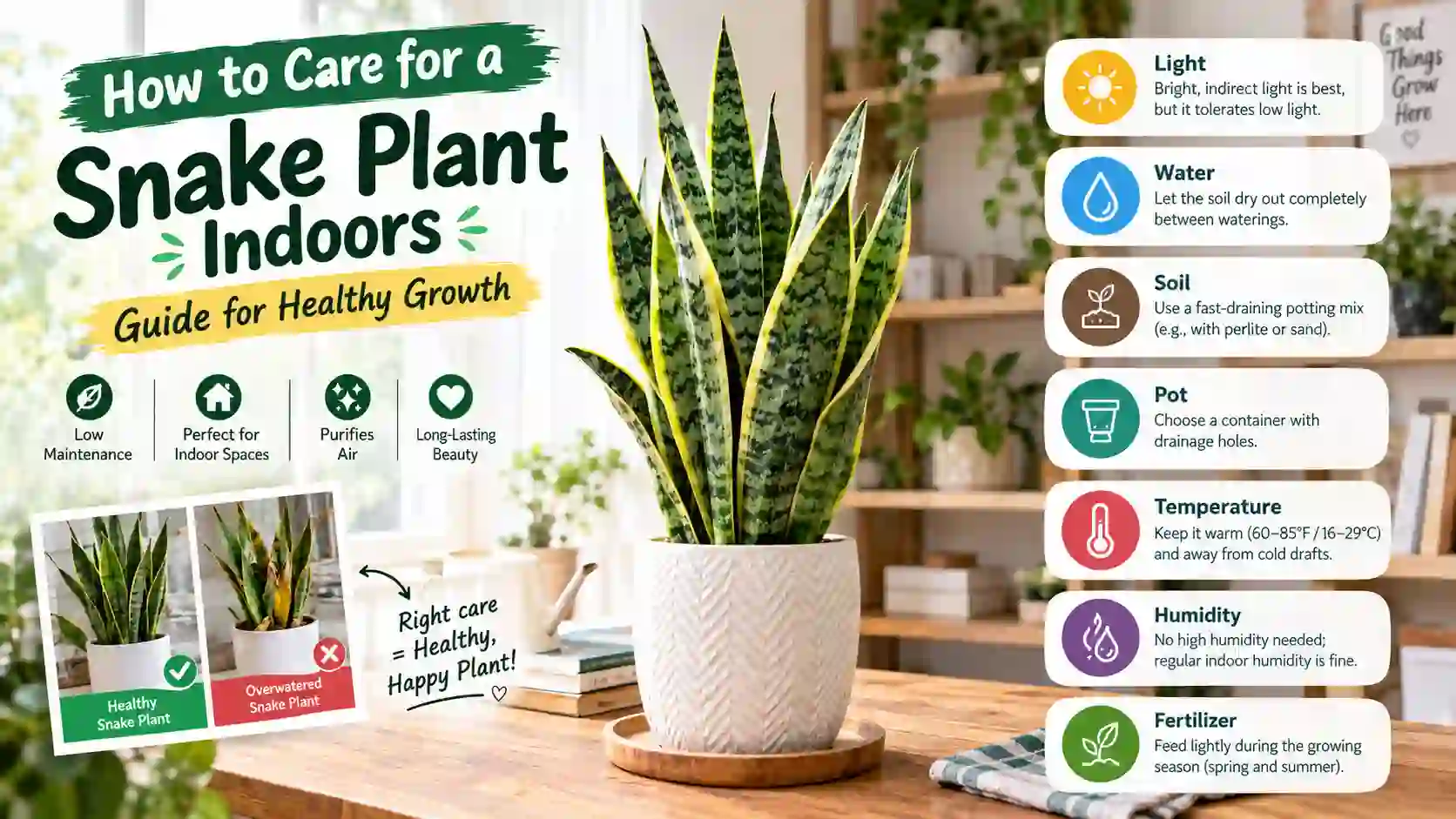
To care for a snake plant indoors, place it in bright indirect light, although it can tolerate lower light. Water only when the soil has dried well, then drain excess water completely. Use a fast-draining potting mix and a container with drainage holes. Keep the plant warm, avoid cold drafts, and fertilize lightly during active growth. The biggest indoor mistake is usually overwatering, not underwatering.
Understanding Snake Plant Growth Indoors
Snake plants belong to the genus Dracaena and were formerly classified under Sansevieria. The plants commonly sold as snake plants include several cultivars with upright, sword-shaped leaves.
Their leaves are designed to conserve water. This helps explain why snake plants generally prefer drying between waterings instead of constantly moist soil.
Indoor growth is also influenced by the amount of light available.
A plant near a bright window may produce new leaves more regularly than the same variety placed several feet inside a dim room. However, sudden exposure to intense direct sunlight can cause leaf damage, especially after the plant has adapted to lower indoor light.
Practical observation: If your snake plant has remained unchanged for months but still looks healthy, it may simply be receiving enough light to survive but not enough to grow vigorously.
Image Suggestion: A realistic infographic showing a healthy snake plant indoors with labeled light, water, soil, temperature, drainage, and humidity requirements.
How Much Light Does a Snake Plant Need Indoors?

Snake plants are adaptable, but bright indirect light is usually the best starting point for healthy indoor growth.
Place your plant near a bright window where it receives plenty of natural light without being exposed to harsh midday sunlight for long periods.
Good indoor locations include:
- Near an east-facing window
- A few feet from a bright south-facing window
- Near a bright west-facing window with some protection from intense afternoon sun
- A bright room with filtered natural light
- Under suitable grow lights when natural light is limited
Snake plants can tolerate lower light, but tolerance is not the same as preference.
In very low light, growth may become extremely slow. Variegated varieties can also produce less pronounced coloring when light levels are inadequate.
Signs your snake plant needs more light
Watch for:
- Very slow or stalled growth
- New leaves that appear smaller or weaker
- Leaves leaning toward a window
- Loss of strong variegation in some cultivars
- Long periods without producing new growth
What if the leaves receive direct sunlight?
Some direct sunlight is not automatically harmful.
Morning sun is often gentler than strong afternoon sunlight. If a plant has been growing in low light, introduce stronger sunlight gradually rather than moving it directly into intense exposure.
Expert tip: Rotate the pot every few weeks if the plant consistently leans toward the light. This helps maintain more balanced growth.
How Often Should You Water a Snake Plant Indoors?
Water your snake plant when the soil has dried substantially rather than following a fixed weekly schedule.
There is no universal watering calendar because indoor conditions vary. A plant in a warm, bright room may dry much faster than one in a cool, dim room.
Before watering, check the soil.
Push your finger several inches into the potting mix or use a moisture meter to assess the deeper soil. Do not rely only on the surface because the top layer can become dry while the lower root zone remains wet.
When watering is needed
Follow these steps:
- Check the soil moisture.
- Make sure the upper portion of the root zone has dried.
- Water thoroughly until some water exits the drainage holes.
- Allow the container to drain completely.
- Empty standing water from the saucer or decorative outer pot.
The goal is not to give the plant a tiny amount of water every few days.
The goal is to thoroughly wet the root zone and then allow excess water to escape.
Why overwatering causes problems
Snake plants store water in their leaves and underground structures. Constantly wet soil reduces air around the roots and can create conditions that encourage root deterioration.
This is why a snake plant can suffer from too much water even when its leaves appear thirsty.
Image Suggestion: Step-by-step watering infographic showing “Check Soil → Water Thoroughly → Drain Completely → Let Soil Dry.”
How to Tell When a Snake Plant Needs Water
Learning the plant’s signals is more reliable than memorizing “water every Sunday.”
Signs the soil is too dry
You may notice:
- The pot feels unusually light.
- The soil is dry well below the surface.
- Leaves feel less firm than usual.
- Some leaves may begin to curl or wrinkle.
- Growth slows.
One missed watering is usually not a disaster for a mature snake plant.
Signs you are watering too often
More concerning signs include:
- Yellowing leaves
- Soft or mushy leaf bases
- Leaves collapsing from the bottom
- Persistently wet soil
- A sour or unpleasant soil smell
- Brown or black roots when inspected
- Sudden leaf loss
A single yellow leaf does not automatically prove overwatering. Older leaves can naturally decline, so look at the overall pattern.
What Soil Is Best for an Indoor Snake Plant?
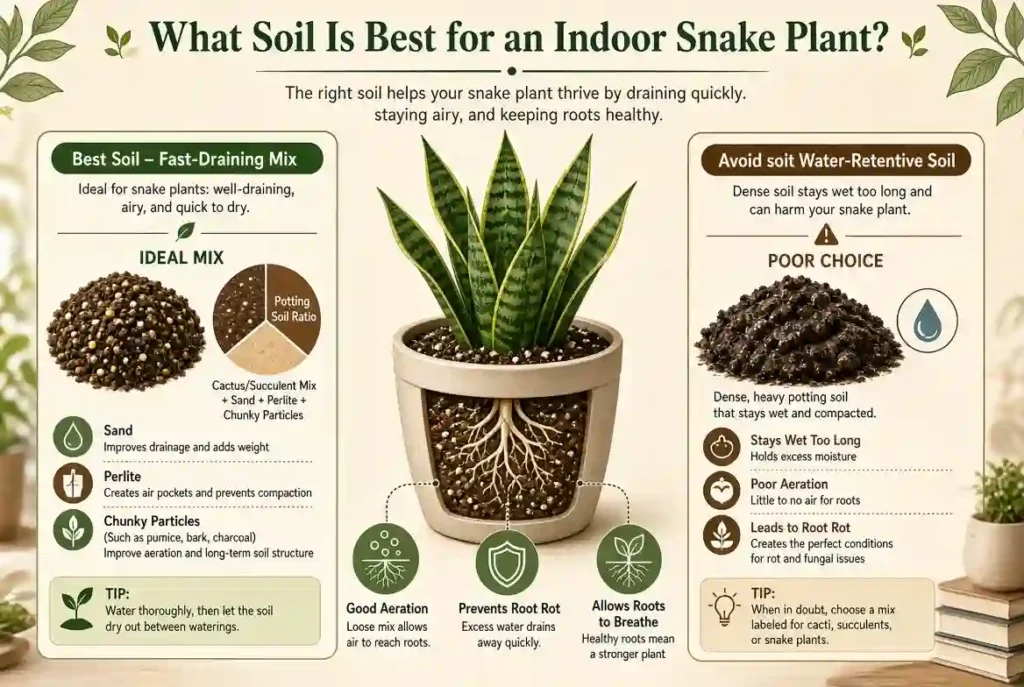
Snake plants need a potting mix that drains quickly and does not remain saturated for long periods.
A standard houseplant mix can often work when amended with materials that improve drainage and aeration.
A practical mix can contain:
- Quality indoor potting mix
- Perlite or pumice
- Coarse material such as orchid bark
The exact recipe does not need to be complicated.
The important characteristic is fast drainage.
Why soil structure matters
Roots need both moisture and oxygen.
Dense soil can hold excessive water around the roots. A loose, well-aerated mix allows water to move through the container while leaving air spaces around the root system.
Avoid heavy garden soil indoors
Outdoor garden soil can become compacted inside containers. It may also drain poorly and create an environment that is difficult to manage in an indoor pot.
Expert tip: If your snake plant repeatedly stays wet for more than a week in a normal indoor environment, investigate the soil and container before simply changing your watering schedule.
Choose a Pot With Drainage Holes
A drainage hole is one of the simplest ways to reduce watering problems.
When excess water can escape from the bottom of the container, you have much more control over soil moisture.
A good container should:
- Have at least one functional drainage hole
- Match the size of the root system
- Not be dramatically larger than the current root ball
- Allow excess water to drain freely
Decorative pots without drainage holes can still be used as outer covers. Keep the plant in a draining nursery pot inside the decorative container.
After watering, remove standing water from the outer pot.
Why oversized pots can be problematic
A very large container holds more soil than the plant currently needs. That extra soil can stay wet for a long time after watering.
For a snake plant, “bigger pot” does not automatically mean “better growth.”
What Temperature Is Best for a Snake Plant Indoors?
Snake plants generally perform best in warm indoor conditions.
Keep them away from:
- Cold drafts
- Frequently opened exterior doors
- Freezing temperatures
- Strong heating vents
- Very hot air blowing directly from radiators or heaters
- Sudden temperature changes
Normal comfortable indoor temperatures are usually suitable.
Cold stress becomes particularly important near windows during winter. A plant that looks healthy in summer may begin declining if its container sits against a very cold window or draft.
Practical tip: If the leaves suddenly develop damage during winter, check the plant’s location before assuming the watering routine is responsible.
Does a Snake Plant Need High Humidity?
No. Snake plants generally do not require high humidity to perform well indoors.
This makes them especially convenient for homes with relatively dry indoor air.
You usually do not need:
- Daily misting
- Humidity trays
- A dedicated humidifier
- Constantly damp air
Good airflow is more useful than excessive humidity.
If your home is extremely dry, maintaining reasonable indoor humidity can benefit many houseplants, but increasing humidity is not usually the first solution for a struggling snake plant.
Common mistake: Misting the leaves repeatedly while leaving the roots in waterlogged soil. This addresses the wrong problem.
Should You Fertilize a Snake Plant?
Snake plants generally need relatively little fertilizer.
During active growth, you can use a balanced houseplant fertilizer at a diluted rate according to the product label.
Avoid heavy feeding.
Excess fertilizer can build up in the potting mix and damage roots. Fertilizing more frequently also does not necessarily make a snake plant grow faster.
A simple feeding approach
During the growing season:
- Water the plant when needed.
- Use a diluted, balanced fertilizer occasionally.
- Follow the fertilizer manufacturer’s instructions.
- Avoid fertilizing severely stressed or recently repotted plants.
- Reduce or stop feeding when growth naturally slows.
If your plant is growing well, you do not need to fertilize aggressively.
Expert insight: Light is often more important than fertilizer. A plant cannot compensate for inadequate light simply because it receives more nutrients.
How to Repot a Snake Plant Indoors
Snake plants do not need frequent repotting.
Repot when the plant has genuinely outgrown its container or when the existing soil has become unsuitable.
Signs it may be time to repot
Look for:
- Roots filling the container
- Roots emerging from drainage holes
- A pot that repeatedly becomes unstable
- Severely compacted or degraded potting mix
- Water running through unusually quickly because the root mass has become extremely dense
- The plant becoming crowded or top-heavy
Choose a new pot only slightly larger than the current one.
Repotting steps
- Prepare a clean container with drainage holes.
- Use fresh, well-draining potting mix.
- Carefully remove the plant.
- Inspect the roots.
- Remove clearly damaged or rotten material with clean tools.
- Position the plant at approximately the same depth.
- Fill around the roots with fresh mix.
- Allow excess water to drain after watering.
Do not bury the leaf bases much deeper than they were previously.
Image Suggestion: Before-and-after repotting diagram showing a root-bound snake plant, healthy roots, drainage hole, and correctly sized new pot.
How to Clean Snake Plant Leaves
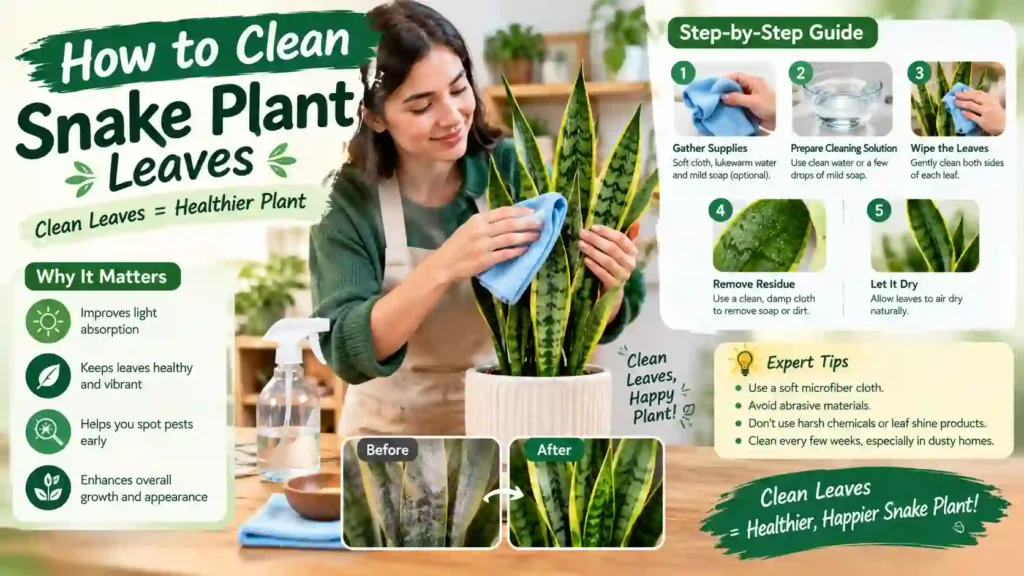
Large snake plant leaves can collect dust indoors.
Dust can make leaves look dull and can interfere with the plant’s ability to use available light efficiently.
Clean the leaves gently with a soft, damp cloth.
Support the leaf with one hand while wiping with the other.
Avoid abrasive materials and unnecessary leaf-shine products.
Why cleaning matters
Clean leaves:
- Look healthier
- Allow better light exposure
- Make pests easier to spot
- Help you monitor changes in leaf color and texture
This is also a good opportunity to inspect the plant for scale, mealybugs, or other pests.
How to Prune a Snake Plant
Snake plants require little pruning.
Remove leaves that are:
- Completely dead
- Severely damaged
- Rotten
- Diseased-looking
Use a clean, sharp blade or pruning shears.
Cut damaged leaves near their base without unnecessarily injuring healthy surrounding growth.
Do not repeatedly trim healthy leaf tips simply to shape the plant. Snake plant leaves do not grow back from the cut tip in the same way a branching plant might produce new growth.
Brown tips do not always mean disease
Brown leaf tips can result from several factors, including physical damage, inconsistent moisture, environmental stress, or accumulated salts.
Look at the entire plant before diagnosing the cause.
How to Propagate a Snake Plant Indoors
Snake plants can be propagated through leaf cuttings or division, depending on the type and cultivar.
Division is often straightforward when the plant has multiple connected growth points or offsets.
Propagation by division
- Remove the plant from its container.
- Gently separate the root system.
- Identify natural sections with roots and healthy growth.
- Separate them carefully.
- Pot each section in an appropriate container.
- Use well-draining soil.
- Water appropriately and provide suitable light.
Leaf propagation
Healthy leaves can also be cut into sections and rooted under suitable conditions.
However, there is an important detail for variegated cultivars: leaf cuttings may not always reproduce the original variegation.
If preserving the exact appearance of a particular cultivar matters, division or offsets may be preferable when available.
Common Snake Plant Problems and What They Mean
| Problem | Likely Causes | What to Check |
|---|---|---|
| Yellow leaves | Excess moisture, aging leaves, stress | Soil moisture and roots |
| Soft leaves | Overwatering or root problems | Root condition and drainage |
| Wrinkled leaves | Prolonged dryness or root dysfunction | Soil and roots |
| Brown tips | Dryness, salt buildup, physical damage | Watering and environment |
| Leaves falling outward | Weak growth, overcrowding, physical imbalance | Light and plant structure |
| Slow growth | Low light, cool conditions, season | Light and temperature |
| Mushy base | Severe moisture stress or rot | Roots and leaf bases |
| Pests | Environmental stress or introduction from another plant | Inspect leaf surfaces and joints |
Do not diagnose a problem from one symptom alone.
For example, wrinkled leaves do not always mean the plant simply needs more water. Root damage can prevent a plant from absorbing water even when the soil is wet.
That distinction is especially important.
Why Is My Snake Plant Turning Yellow?
Yellow leaves are one of the most common concerns among indoor snake plant owners.
The first thing to investigate is watering.
If several leaves are turning yellow while the soil stays wet for long periods, excessive moisture becomes a strong possibility.
Check:
- How frequently you water
- How long the soil remains wet
- Whether the container has drainage holes
- Whether water collects in the outer pot
- Whether the roots show signs of deterioration
An occasional older leaf turning yellow can be normal.
The pattern matters more than a single leaf.
Image Suggestion: Split infographic showing a healthy green snake plant beside an overwatered plant with yellow leaves, wet soil, and damaged roots.
Why Are My Snake Plant Leaves Turning Brown?
Brown areas can have several causes.
Possible explanations include:
- Prolonged dryness
- Physical damage
- Strong environmental stress
- Excess fertilizer salts
- Root problems
- Low temperatures
- Leaf aging
Start with the basics.
Check the soil, roots, light exposure, temperature, and recent changes in care.
If the brown area is dry and localized, physical damage may be more likely. If the entire plant is deteriorating and the soil remains wet, root problems deserve closer attention.
Why Is My Snake Plant Drooping?
A healthy snake plant generally has firm, upright leaves.
Drooping can indicate stress, but the cause is not always underwatering.
Check the soil first.
If the soil is very dry:
The plant may need a thorough watering.
If the soil is wet:
Do not automatically add more water.
Instead, inspect drainage and root health.
A plant with damaged roots can droop because the roots are no longer functioning properly, even though the pot contains plenty of moisture.
This is one of the most important troubleshooting principles for indoor plant care:
Always consider the roots, not just the leaves.
Why Is My Snake Plant Not Growing?
Snake plants are naturally slow growers compared with many tropical houseplants.
However, extremely slow growth can indicate inadequate conditions.
Check these factors:
Light:
Is the plant receiving enough bright light?
Temperature:
Is it sitting in a cold location?
Roots:
Is the plant severely root-bound or experiencing root problems?
Water:
Are you keeping the soil wet for too long?
Season:
Has growth naturally slowed during a darker or cooler period?
Nutrition:
Has the plant been in the same depleted potting mix for a long time?
Do not respond to slow growth by immediately increasing fertilizer.
Light is often the first variable worth improving.
How to Care for a Snake Plant in Low Light
Snake plants are among the better choices for rooms with limited natural light, but low-light tolerance has limits.
If your home has a darker room, place the plant in the brightest practical location rather than the darkest corner simply because the plant can survive there.
A grow light can help when natural sunlight is inadequate.
Low-light care tips
- Water less frequently because soil may dry more slowly.
- Monitor the soil before every watering.
- Avoid keeping the plant in a permanently dark corner.
- Watch for stretched or weak growth.
- Consider supplemental lighting if growth is poor.
Remember:
Low light usually means lower water demand.
This is why using the same watering schedule in a bright room and a dark room can create problem.
Seasonal Snake Plant Care
Snake plant care should change slightly with the seasons because indoor light, temperature, and evaporation change.
Spring
Growth may increase as daylight becomes stronger.
- Check soil more frequently.
- Gradually resume regular feeding if appropriate.
- Rotate the plant for balanced growth.
- Inspect for pests after winter.
Summer
Bright conditions can increase water use.
- Monitor soil moisture.
- Protect plants from extreme heat through glass.
- Avoid placing leaves against hot windows.
- Continue feeding moderately during active growth.
Fall
Growth may begin slowing.
- Reduce watering frequency when the soil stays wet longer.
- Monitor changing light levels.
- Move plants away from cold drafts.
Winter
Indoor heating and shorter days create a different environment.
- Water less often when evaporation slows.
- Keep the plant away from cold drafts.
- Avoid cold windows.
- Do not fertilize heavily during slow growth.
- Use supplemental lighting if necessary.
Expert tip: Do not schedule winter watering based on your summer routine. Check the soil every time.
A Simple Indoor Snake Plant Care Routine
If you prefer a straightforward routine, use this checklist.
Every few days
Observe the plant.
Look for:
- New growth
- Yellow leaves
- Brown damage
- Pests
- Unusual softness
- Leaning or collapsing leaves
Before every watering
Check:
- Soil moisture
- Pot weight
- Drainage
- Recent environmental changes
Every few weeks
Rotate the plant if necessary and inspect the leaves carefully.
During active growth
Monitor whether the plant needs occasional fertilizer.
Every few months
Check:
- Root crowding
- Soil condition
- Drainage holes
- Pest activity
- Light exposure
This routine is more reliable than following a rigid calendar.
The Biggest Mistakes When Caring for Snake Plants Indoors
1. Watering on a Schedule
“Every seven days” sounds simple, but indoor conditions change.
Better approach: Check soil moisture first.
2. Using a Pot Without Drainage
Excess water has nowhere to go.
Better approach: Use a container with functional drainage holes.
3. Keeping the Plant in Complete Darkness
Snake plants tolerate low light but still need light.
Better approach: Give them the brightest suitable location available.
4. Using Heavy Soil
Dense soil can retain excessive moisture.
Better approach: Use a well-draining, aerated mix.
5. Choosing an Oversized Pot
More soil can mean slower drying.
Better approach: Increase pot size gradually.
6. Fertilizing Too Much
More fertilizer does not automatically mean more growth.
Better approach: Feed lightly and only when the plant is actively growing.
7. Diagnosing Leaves Without Checking Roots
A drooping or wrinkled leaf does not always mean dehydration.
Better approach: Consider both moisture and root health.
Indoor Snake Plant Care: A Practical Cheat Sheet
| Care Factor | Best Practice |
|---|---|
| Light | Bright indirect light is ideal; tolerates lower light |
| Water | Water thoroughly after the soil dries substantially |
| Soil | Fast-draining and well-aerated |
| Pot | Drainage holes are essential |
| Temperature | Warm, stable indoor conditions |
| Humidity | Average indoor humidity is generally sufficient |
| Fertilizer | Light feeding during active growth |
| Repotting | Only when necessary |
| Pruning | Remove dead or severely damaged leaves |
| Cleaning | Wipe dusty leaves gently |
| Growth | Naturally slow, especially in lower light |
When Should You Move Your Snake Plant?
Move the plant when its current location creates a problem.
Good reasons include:
- Insufficient light
- Strong cold drafts
- Excessive heat
- Harsh direct sun causing damage
- Poor access to drainage
- Frequent physical contact with the leaves
Do not move a healthy plant constantly just to find the “perfect” spot.
Plants can adapt to stable conditions.
If you move a snake plant from a dim room to a much brighter location, transition it gradually when the new light is significantly stronger.
How to Tell If Your Snake Plant Is Healthy
A healthy indoor snake plant usually has:
- Firm leaves
- Strong coloration
- Stable upright growth
- No persistent soft or mushy areas
- Healthy roots
- Gradual new growth when conditions are favorable
Remember that “healthy” does not always mean “fast-growing.”
A snake plant can be perfectly healthy while producing new growth slowly.
The goal is stable, firm, healthy growth rather than forcing rapid growth with excessive water or fertilizer.
Image Suggestion: Premium comparison infographic labeled “Healthy Snake Plant vs Stressed Snake Plant,” showing firm leaves, healthy roots, proper soil, and common warning signs.
Advanced Tip: Think About the Root Zone
Experienced plant growers often stop asking only, “What do the leaves look like?”
They also ask:
What is happening beneath the soil?
Roots need oxygen, moisture, and appropriate temperatures.
A plant can have wet soil and still show signs that look like dehydration because damaged roots cannot function properly.
This is why repeatedly watering a wilted snake plant can make the situation worse.
If the plant is declining despite adequate moisture, inspect the root environment rather than automatically adding more water.
This simple change in thinking can prevent many indoor snake plant problems.
Frequently Asked Questions
How often should I water a snake plant indoors?
Water when the soil has dried substantially rather than following a fixed schedule. Bright, warm rooms may require more frequent watering than cool, low-light rooms.
Can snake plants live in low light?
Yes. Snake plants tolerate lower light better than many houseplants. However, growth may become very slow, and extremely dark conditions are not ideal.
Do snake plants need direct sunlight?
They can tolerate some direct sunlight, especially gentler morning sun. Strong afternoon sunlight through glass can be intense, so introduce it gradually.
Why are my snake plant leaves turning yellow?
Overwatering is a common cause, especially when several leaves become yellow while the soil remains wet. Check drainage, watering frequency, and root health before changing other care factors.
Should I mist my snake plant?
Usually, no. Snake plants generally do not need regular misting. Proper watering, drainage, and light are much more important.
What type of soil is best for snake plants?
Use a fast-draining, well-aerated potting mix. A quality indoor mix amended with perlite, pumice, or another drainage-enhancing material can work well.
Can a snake plant survive without sunlight?
It cannot thrive indefinitely without light. It may tolerate very low-light conditions, but some light is necessary for photosynthesis and healthy growth.
Why is my snake plant drooping?
Possible causes include watering problems, root damage, low temperatures, or physical stress. Check the soil and roots before assuming the plant needs more water.
How do I make my snake plant grow faster?
Provide better light, appropriate watering, good drainage, suitable temperatures, and modest nutrition during active growth. Avoid excessive watering or fertilizer in an attempt to accelerate growth.
Do snake plants need fertilizer?
They can benefit from occasional, diluted houseplant fertilizer during active growth. Heavy feeding is unnecessary and can damage roots.
When should I repot my snake plant?
Repot when roots have significantly filled the container, drainage has become problematic, or the soil has degraded. Avoid moving a healthy plant into a much larger pot without a reason.
Can snake plants grow indoors all year?
Yes. Snake plants are well suited to indoor cultivation throughout the year when they receive suitable light, appropriate watering, and stable temperatures.
Related Topics You May Also Want to Read
If you are building a complete indoor plant-care routine, these related topics can help:
- How to water houseplants correctly
- Best soil for indoor plants
- How to identify and treat root rot
- Snake plant propagation guide
- Best low-light indoor plants
- How to repot houseplants
- How to recognize overwatering vs underwatering
- How to use grow lights for houseplants
Conclusion
Give it good light, allow the soil to dry between thorough waterings, use a fast-draining potting mix, and make sure excess water can escape. Keep temperatures reasonably stable and fertilize modestly during active growth.
When something goes wrong, look at the whole growing environment rather than reacting to one symptom. Yellow leaves, drooping, wrinkles, or slow growth can have different causes.
If you get light, watering, and drainage right, a snake plant can remain attractive and healthy indoors for many years.