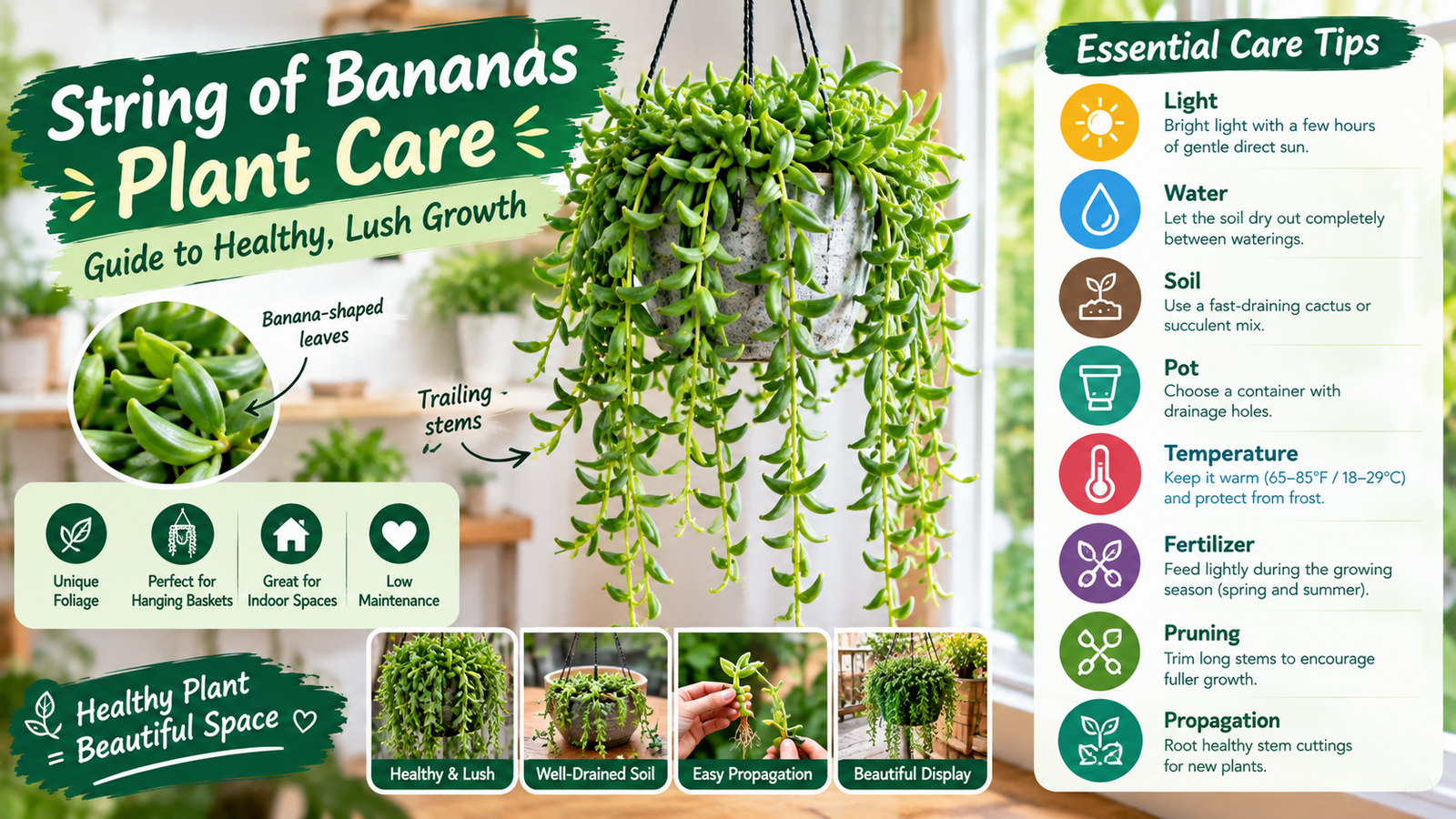
The string of bananas plant is one of those succulents that looks complicated but is surprisingly manageable once you understand how it stores water.
Its slender stems trail over shelves and hanging baskets, while its fleshy, curved leaves resemble tiny green bananas. The plant is closely related to string of pearls and belongs to the daisy family, Asteraceae. Its current accepted botanical name is Curio radicans, although many nurseries and older care guides still use Senecio radicans.
The biggest challenge with string of bananas plant care is usually too much care rather than too little.
Because the leaves store moisture, frequent watering can keep the roots and stems wet for too long. Meanwhile, inadequate light can make the trailing stems sparse and stretched.
Get the balance right, and this succulent can become a dense, attractive cascade of banana-shaped foliage.
Quick Answer
String of bananas (Curio radicans, formerly Senecio radicans) is a trailing succulent that grows best in bright light, fast-draining soil, and relatively dry conditions. Water thoroughly only after the potting mix has dried well, and always use a container with drainage. Avoid frequent watering, heavy soil, and dark locations. Prune long stems to encourage fuller growth and propagate healthy cuttings directly from the stems.
Understanding the String of Bananas Plant
String of bananas is a trailing succulent native to southern Africa. Its botanical name is Curio radicans.
The plant produces slender, flexible stems covered with fleshy, curved leaves. Mature stems can trail substantially beyond the edge of their container, making the plant especially attractive in hanging baskets and elevated planters. North Carolina State Extension describes the leaves as thick, glossy, and banana-shaped, with translucent areas that help light reach deeper into the leaf.
Key characteristics
| Feature | Description |
|---|---|
| Botanical name | Curio radicans |
| Older name | Senecio radicans |
| Common name | String of bananas |
| Plant type | Trailing succulent |
| Family | Asteraceae |
| Native range | Southern Africa |
| Growth habit | Cascading or trailing |
| Leaf shape | Curved, banana-like |
| Light | Bright light with some gentle direct sun |
| Water | Allow soil to dry well between waterings |
| Soil | Fast-draining succulent mix |
| Humidity | Average indoor humidity is usually sufficient |
| Propagation | Stem cuttings and division |
| Best display | Hanging baskets, shelves, tall planters |
Image Suggestion: Botanical-style 16:9 infographic showing Curio radicans with labels for banana-shaped leaves, trailing stems, succulent foliage, and translucent leaf windows.
How Much Light Does String of Bananas Need?
String of bananas needs bright light to maintain compact, attractive growth.
A few hours of gentle direct sunlight can be beneficial, particularly through an east-facing window. Bright filtered light also works well.
North Carolina State Extension recommends bright, indirect sunlight and notes that the plant should not be treated as a frost-tolerant or full-sun outdoor plant. The RHS recommends a bright position with several hours of direct sun for Curio species, illustrating that light requirements can vary somewhat with acclimation and growing conditions.
Good indoor locations
Try:
- An east-facing window
- A bright south-facing window with suitable filtering
- A bright west-facing window
- A sunny indoor shelf
- A bright conservatory
- A grow-light area when natural light is inadequate
What happens in low light?
Low light can cause:
- Longer gaps between leaves
- Thin, stretched stems
- Smaller new leaves
- Slower growth
- Sparse-looking vines
- Growth leaning toward the light
This stretched growth is called etiolation.
It cannot be completely corrected on the existing section of stem. Improving light helps new growth become more compact.
Expert tip: Do not judge the light level by how bright a room looks to your eyes. Human vision adapts extremely well to indoor lighting, while plants require much more usable light.
Can String of Bananas Take Direct Sun?
Yes, but introduce stronger sunlight gradually.
A plant that has been growing behind a curtain may react poorly if suddenly placed in intense midday sunlight.
Start with gentle morning sunlight and gradually increase exposure.
Watch the foliage.
Too much intense sunlight may cause:
- Pale or bleached patches
- Brown scorch marks
- Reddish or stressed-looking foliage
- Dry, damaged leaf tissue
North Carolina State Extension specifically notes that browning or reddish leaves can result from sunburn.
A practical approach
If your plant is currently in low light:
Week 1: Give it bright filtered light.
Week 2: Introduce a little morning sun.
Following weeks: Increase exposure gradually if the plant responds well.
This is especially useful when moving plants outdoors for summer.
Image Suggestion: 16:9 sunlight infographic comparing low light, bright indirect light, gentle direct sun, and excessive unfiltered sun.
How Often Should You Water String of Bananas?

Water string of bananas only after the potting mix has dried well.
Do not water according to a fixed calendar.
A small pot near a sunny window may dry much faster than a large container in a cooler room.
The RHS recommends allowing the compost to dry between waterings and watering sparingly during winter.
The soak-and-dry method
When the soil is dry:
- Water the soil thoroughly.
- Allow water to flow from the drainage holes.
- Let the container drain completely.
- Empty water sitting in the saucer.
- Wait until the mix dries again before watering.
This is much better than giving the plant a small splash every few days.
Why frequent watering is dangerous
String of bananas stores moisture in its leaves.
Its roots do not need continuously wet soil.
If the mix stays wet, oxygen around the roots decreases and root or stem rot can develop.
Practical observation: If the leaves still look plump but the soil is wet, resist the temptation to water again.
How Do You Know When String of Bananas Needs Water?
The soil is your first indicator.
Check the potting mix several inches below the surface.
You can also learn to read the leaves.
Signs of prolonged dryness
- Leaves become less plump.
- Leaves may flatten slightly.
- Stems can appear thinner.
- Growth may slow.
- The pot feels unusually light.
Signs of excessive moisture
- Leaves become soft or translucent.
- Leaves may turn yellow or brown.
- Stems become mushy.
- The base of the plant may collapse.
- Soil remains wet for an unusually long period.
- An unpleasant smell may develop.
A crucial distinction is this:
Shriveled leaves plus dry soil can indicate thirst.
Soft leaves plus wet soil can indicate excess moisture or root problems.
Do not treat both symptoms by adding water.
What Soil Is Best for String of Bananas?
Use a fast-draining cactus or succulent potting mix.
The goal is to create a root environment where water passes through quickly while enough moisture remains for the plant to absorb what it needs.
North Carolina State Extension recommends a coarse, well-drained cactus or sandy potting medium.
A practical homemade mix
You can combine:
- Quality potting mix
- Perlite or pumice
- Coarse horticultural material
A simple starting point is roughly equal parts potting mix and perlite or pumice, then adjust according to how quickly the mixture dries in your environment.
The exact ratio is less important than the final drainage.
Avoid heavy soil
Do not use dense garden soil by itself in an indoor container.
It can hold too much water and compact around the roots.
Expert tip: If your string of bananas remains wet for many days despite a warm, bright location, the problem may be the potting mix rather than your watering habits.
Does the Pot Need Drainage Holes?
Yes.
A drainage hole gives excess water somewhere to escape.
This is particularly important for a succulent that dislikes persistently wet roots.
Best container features
Choose a pot that:
- Has a drainage hole
- Is not excessively large
- Provides enough room for the roots
- Is stable enough for trailing growth
- Allows excess water to drain freely
A decorative pot without a drainage hole can still be used as an outer cover.
Keep the plant in a draining nursery pot inside it.
After watering, empty collected water.
Should String of Bananas Be Grown in a Hanging Basket?
A hanging basket is one of the best ways to display this plant.
The trailing stems naturally spill over the container and become part of the plant’s visual appeal.
However, hanging baskets can introduce one problem: they are easy to place too far from the window.
A plant hanging from the ceiling may look beautiful but receive far less light than a plant sitting beside the window.
For a hanging basket:
- Keep it close enough to a bright light source.
- Make sure the basket drains freely.
- Check the soil before watering.
- Rotate the basket occasionally if light is strongly directional.
- Avoid placing trailing stems where they are constantly brushed or damaged.
Image Suggestion: Realistic 16:9 indoor gardening image showing a lush string of bananas cascading from a hanging basket beside a bright window.
What Temperature Does String of Bananas Prefer?
String of bananas prefers warm indoor conditions during active growth.
Protect it from:
- Frost
- Freezing temperatures
- Cold drafts
- Sudden temperature drops
- Very cold windows
- Direct blasts from heating or cooling vents
RHS guidance for related Curio plants recommends warm summer conditions and cooler but still frost-free winter conditions.
For ordinary indoor growing, maintaining a stable, comfortable room is usually more important than chasing an exact temperature.
Winter matters
As light levels fall, growth slows.
The plant will generally use less water.
This is why continuing a heavy summer watering routine through winter can cause problems.
Does String of Bananas Need High Humidity?
No.
String of bananas is a succulent and generally does well in normal indoor humidity.
You do not need to mist it regularly.
Avoid unnecessary humidity practices
You usually do not need:
- Daily misting
- Humidity trays
- Constantly wet leaves
- A humidifier dedicated only to this plant
Good drainage and appropriate watering matter much more.
If your home has average indoor humidity, focus your attention on light and soil instead.
How to Fertilize String of Bananas
String of bananas is not a heavy feeder.
It can benefit from light fertilization during active growth, especially when it has been growing in the same container for a long period.
Use a diluted fertilizer intended for succulents or a balanced houseplant fertilizer according to the product label.
A sensible feeding routine
During active growth:
- Water appropriately.
- Apply diluted fertilizer according to the label.
- Avoid heavy feeding.
- Reduce or stop feeding during slow winter growth.
- Do not fertilize a severely stressed or recently repotted plant immediately.
Too much fertilizer can lead to salt buildup and unnecessary vegetative growth.
Expert tip: If the plant is stretched and sparse, improve the light before increasing fertilizer. Nutrition cannot replace inadequate light.
How to Prune String of Bananas
Pruning helps control length and encourage a fuller appearance.
String of bananas can become extremely long under good conditions.
That is part of its natural growth habit, but excessive length can leave the pot looking sparse near the crown.
Prune when:
- Stems become excessively long.
- Growth becomes sparse.
- Sections are damaged.
- You want a bushier appearance.
- The plant has outgrown its display area.
Use clean scissors or pruning shears.
Make cuts at healthy sections of stem.
Do not throw away healthy cuttings. They can often be used for propagation.
North Carolina State Extension recommends pruning in spring or summer to manage growth and encourage branching.
How to Make String of Bananas Fuller
A fuller plant usually comes from combining good light with strategic pruning and propagation.
Step 1: Improve the light
Bright conditions encourage denser new growth.
Step 2: Trim excessively long stems
Cut healthy trailing sections back to create manageable lengths.
Step 3: Propagate the cuttings
Root healthy pieces and return them to the same container.
Step 4: Allow new growth to develop
Healthy stems can branch from suitable nodes.
Step 5: Rotate the plant
Balanced light exposure can prevent one side from becoming much denser than the other.
Practical technique: Instead of planting every cutting in a separate pot, rooted pieces can be grouped into the original container to create a fuller display.
How to Propagate String of Bananas
Stem cuttings are one of the easiest ways to propagate this succulent.
North Carolina State Extension identifies stem cuttings as the quickest and most common propagation method.
Propagation by stem cutting
- Select a healthy stem.
- Cut a section several inches long.
- Allow the cut end to dry briefly.
- Place the stem on or into a well-draining propagation medium.
- Position nodes against the medium.
- Keep the medium only lightly moist rather than constantly wet.
- Provide bright, indirect light.
- Wait for roots to develop.
- Gradually transition the cutting into normal succulent care.
Why nodes matter
Roots commonly develop from stem nodes.
This is why a long section with several nodes gives you multiple potential rooting points.
Propagating fallen pieces
Do not automatically throw away healthy pieces that fall from the plant.
A healthy stem section can often be rooted.
However, remove any section that is soft, black, or rotten rather than propagating it.
Image Suggestion: Step-by-step 16:9 propagation infographic showing “Cut → Dry → Place on Soil → Root → Grow → Plant Back.”
Can You Propagate String of Bananas From a Single Leaf?
Stem propagation is the practical method.
A detached banana-shaped leaf is not the same as a stem cutting with a node.
If you want reliable propagation, use a healthy stem section containing nodes rather than depending on individual leaves.
This is one reason pruning is useful: it produces propagation material while also improving the shape of the parent plant.
How to Repot String of Bananas
String of bananas does not need frequent repotting.
Repot when:
- Roots have filled the container.
- Water runs through unusually quickly.
- The soil has broken down.
- Drainage has become poor.
- The plant has become unstable.
- Growth has stalled for reasons unrelated to light or watering.
Choose a pot only moderately larger than the existing container.
An oversized pot can hold excess moisture around a relatively small root system.
Repotting steps
- Allow the existing soil to dry.
- Remove the plant carefully.
- Inspect the roots.
- Remove clearly rotten material.
- Prepare fresh succulent mix.
- Place the plant at the appropriate depth.
- Fill around the roots.
- Allow the plant to settle before resuming normal watering.
Be gentle with the trailing stems.
They can detach when handled roughly.
Why Is My String of Bananas Shriveling?
Shriveling is one of the most useful signals this plant provides.
First check the soil.
If the soil is completely dry:
The plant may simply need water.
Water thoroughly and allow the excess to drain.
If the soil is wet:
Do not immediately add more water.
Investigate the roots and stems.
Root damage can prevent the plant from absorbing water even when the potting mix is wet.
Other possible causes
- Excessive heat
- Root damage
- Very low light combined with poor watering
- Severe underwatering
- Recent repotting stress
Look at the entire plant rather than one leaf.
Why Are My String of Bananas Leaves Turning Brown?
Brown foliage can have several causes.
Possible causes include:
- Sunburn
- Severe dryness
- Physical damage
- Root problems
- Excessive fertilizer salts
- Environmental stress
Why Is My String of Bananas Losing Leaves?

Leaf drop can occur when the plant experiences environmental stress.
Check the following:
Light
Is the plant suddenly receiving much less light?
Water
Has the watering pattern changed?
Soil
Does the mix stay wet for too long?
Temperature
Was the plant exposed to cold?
Physical handling
Are the trailing stems being bumped or moved frequently?
The delicate trailing growth can shed leaves when repeatedly disturbed.
If healthy-looking pieces fall, consider using them for propagation rather than discarding them.
Why Is My String of Bananas Turning Yellow?
Yellowing often indicates a problem with the root environment, although it is not diagnostic by itself.
Start by checking moisture.
If the soil is consistently wet, reduce watering and investigate drainage.
If the plant is extremely dry, underwatering may be contributing.
Also inspect for:
- Root damage
- Pests
- Poor light
- Sudden temperature changes
- Fertilizer buildup
Avoid treating yellow leaves with fertilizer before identifying the underlying problem.
Why Is My String of Bananas Not Growing?
Slow growth usually has a reason.
Check these five areas:
1. Light
Low light is a common reason for weak growth.
2. Temperature
Cold conditions slow growth.
3. Watering
Extreme drought or chronically wet soil can both interfere with growth.
4. Roots
Root damage prevents normal water and nutrient uptake.
5. Season
Growth naturally slows when light and temperatures decline.
If your plant is healthy but not growing rapidly, patience may be all that is needed.
Why Is My String of Bananas Getting Leggy?
Leggy growth almost always deserves a light check.
When light is inadequate, the plant may produce longer sections of stem with wider spaces between leaves.
This is an attempt to reach a better light source.
To correct it:
- Move the plant closer to a bright window.
- Introduce direct sunlight gradually.
- Rotate the pot periodically.
- Prune excessively stretched sections.
- Root healthy cuttings to rebuild density.
Do not simply fertilize a leggy plant.
More fertilizer cannot fix an insufficient-light problem.
Why Is the Center of My String of Bananas Bare?
A bare center can develop when older stems lose leaves or when growth has become excessively stretched.
This is especially common when light is strongest at the ends of the trailing stems.
Improve the appearance by:
- Increasing light.
- Pruning long bare sections.
- Rooting healthy cuttings.
- Replanting rooted cuttings near the crown.
- Avoiding excessive disturbance.
This creates a more balanced, cascading plant.
Common Pests on String of Bananas
String of bananas is relatively easy to maintain, but indoor pests can still appear.
North Carolina State Extension lists aphids, mealybugs, scale, and spider mites among pests to monitor.
Inspect regularly
Pay particular attention to:
- Stem joints
- New growth
- Leaf undersides
- Crowded areas
- The crown of the plant
Mealybugs
Look for small white, cotton-like clusters.
Scale
Look for small, fixed bumps attached to stems or leaves.
Spider mites
Fine webbing and speckled foliage can indicate an infestation.
Aphids
These often cluster around tender new growth.
Treat pests promptly with an appropriate method for the specific pest and follow product instructions carefully.
String of Bananas Root Rot: What to Do
Root rot is one of the most serious problems for this plant because the damage often begins below the soil.
Warning signs
- Soft stems near the soil
- Mushy leaves
- Yellowing
- Sudden leaf loss
- Persistent wet soil
- Unpleasant smell
- Black or brown damaged roots
If you suspect root rot:
- Remove the plant from the pot.
- Inspect the roots and lower stems.
- Remove clearly rotten tissue with clean tools.
- Discard saturated, degraded soil.
- Allow healthy cut surfaces to dry appropriately.
- Repot into fresh, fast-draining mix.
- Use a clean container with drainage.
- Correct the watering routine.
Do not place a recovering plant back into the same wet soil.
Image Suggestion: 16:9 troubleshooting infographic showing healthy roots versus rotten roots, with causes such as overwatering, poor drainage, and heavy soil.
Does String of Bananas Flower?
Yes.
Mature plants can produce small, pale flowers that are often described as having a cinnamon-like fragrance.
Flowering is not guaranteed indoors.
Good light and suitable seasonal conditions improve the plant’s chances.
Do not judge the health of your string of bananas solely by whether it flowers.
The trailing foliage is its main ornamental feature.
How to Encourage Flowering
If you want to encourage blooms:
- Provide strong light.
- Keep the plant healthy throughout active growth.
- Avoid chronic overwatering.
- Give it an appropriate seasonal rest.
- Avoid excessive fertilizer.
- Maintain stable temperatures.
A mature plant in excellent conditions may flower, but indoor flowering should be treated as a bonus rather than the primary goal.
String of Bananas Care in Winter
Winter care should usually be drier than summer care.
As daylight decreases, the plant’s growth and water consumption can slow.
In winter:
- Reduce watering.
- Let the soil dry thoroughly.
- Keep the plant away from freezing temperatures.
- Provide as much bright light as practical.
- Avoid cold drafts.
- Stop or reduce fertilizer when growth slows.
The RHS recommends sparse winter watering for related string-type Curio succulents.
Important: A winter plant sitting in cool, wet soil is much more vulnerable to rot than one allowed to dry appropriately.
String of Bananas Care Outdoors
In suitable warm climates, string of bananas can be grown outdoors.
However, it is not frost tolerant.
North Carolina State Extension places Curio radicans in USDA hardiness zones 10a–11b and notes that it is not frost tolerant.
Outdoor growing tips
Choose:
- Bright filtered light or appropriately acclimated sun
- Excellent drainage
- Protection from prolonged heavy rain
- Warm temperatures
- Good airflow
When moving an indoor plant outdoors, acclimate it gradually.
A sudden transition from filtered indoor light to intense outdoor sunlight can cause leaf scorch.
String of Bananas vs. String of Pearls
These plants are closely related and have similar care requirements.
| Feature | String of Bananas | String of Pearls |
|---|---|---|
| Botanical name | Curio radicans | Curio rowleyanus |
| Leaf shape | Banana-shaped | Round pearls |
| Growth habit | Trailing | Trailing |
| Light | Bright light | Bright light |
| Water | Allow soil to dry | Allow soil to dry |
| Soil | Fast-draining succulent mix | Fast-draining succulent mix |
| Humidity | Low to average | Low to average |
| Display | Hanging baskets | Hanging baskets |
| Main risk | Overwatering | Overwatering |
Do not assume the banana-shaped leaves mean the plant needs more water.
They are succulent leaves and store moisture.
The Biggest String of Bananas Care Mistakes
1. Watering Too Frequently
This is perhaps the easiest mistake to make.
Better approach: Check the soil before every watering.
2. Keeping It in a Dark Corner
It may survive but become sparse and stretched.
Better approach: Give it a bright location.
3. Using Heavy Potting Soil
Dense soil dries too slowly.
Better approach: Use a gritty, fast-draining succulent mix.
4. Choosing a Pot Without Drainage
Excess water becomes trapped.
Better approach: Always provide drainage.
5. Giving Sudden Intense Sun
A plant adapted to indoor filtered light can scorch.
Better approach: Acclimate gradually.
6. Using a Huge Pot
Extra soil can stay wet longer than necessary.
Better approach: Increase container size modestly.
7. Ignoring the Roots
Leaves can show symptoms caused by root problems.
Better approach: Inspect the root zone when symptoms do not match the watering conditions.
8. Throwing Away Healthy Cuttings
Long stems can become valuable propagation material.
Better approach: Root healthy sections and replant them.
A Simple String of Bananas Care Routine
Every few days
Look at the plant.
Check for:
- Pests
- New growth
- Damaged leaves
- Unusual discoloration
- Stretched stems
Before watering
Check:
- Soil moisture
- Pot weight
- Drainage
- Recent weather or temperature changes
Every few weeks
Inspect the entire plant closely.
Rotate it if necessary.
Check the crown and stem bases for pests or rot.
During active growth
- Provide strong light.
- Water when dry.
- Feed lightly when appropriate.
- Prune excessively long growth.
- Propagate healthy cuttings.
During winter
- Reduce watering.
- Maintain bright light.
- Avoid cold temperatures.
- Stop unnecessary feeding.
String of Bananas Care Cheat Sheet
| Care Need | Best Practice |
|---|---|
| Light | Bright light with some gentle direct sun |
| Water | Thoroughly water after soil dries well |
| Soil | Fast-draining cactus or succulent mix |
| Pot | Drainage hole required |
| Humidity | Average indoor humidity is fine |
| Temperature | Warm and frost-free |
| Fertilizer | Light feeding during active growth |
| Pruning | Trim long or sparse stems |
| Propagation | Stem cuttings |
| Repotting | Only when necessary |
| Pests | Watch for aphids, mealybugs, scale, and mites |
| Main risk | Overwatering |
| Best display | Hanging basket or elevated shelf |
Expert Tips for Healthier String of Bananas
Let the plant tell you when to water
A calendar cannot account for changing light, temperature, pot size, and humidity.
Bright light makes a major difference
If you want dense, attractive trailing growth, light should be one of your first priorities.
Keep the crown dry enough
The point where the stems enter the soil is especially important. Chronic moisture around this area can lead to rot.
Use cuttings to create fullness
A single mature plant can become much bushier when healthy cuttings are rooted and returned to the container.
Do not panic over an occasional fallen leaf
Trailing succulents can lose individual leaves from handling or normal stress.
Look for a pattern before changing your entire care routine.
Check the pot, not just the leaves
A decorative container may hide standing water.
Always make sure the inner pot drains properly.
Acclimate before stronger sunlight
Sun-loving does not mean “move directly from a dim room into intense midday sun.”
Gradual exposure is safer.
Frequently Asked Questions
Is String of Bananas easy to care for?
Yes. It is generally considered a relatively easy trailing succulent when given strong light, good drainage, and a proper dry-down period between waterings.
How often should I water String of Bananas?
Water when the potting mix has dried well. The exact interval varies with light, temperature, pot size, and soil. Avoid watering according to a fixed weekly schedule.
Does String of Bananas need direct sunlight?
It benefits from bright light and can tolerate some gentle direct sunlight after acclimation. Avoid suddenly exposing a low-light plant to intense midday sun.
Can String of Bananas grow in low light?
It may survive in lower light, but growth is usually less compact. Stems can become stretched and leaves may become more widely spaced.
Why are my String of Bananas leaves shriveling?
Check the soil first. If it is completely dry, the plant may need water. If the soil is wet, investigate root health instead of watering again.
Why is my String of Bananas turning brown?
Possible causes include sunburn, severe dryness, physical damage, or root problems. Examine the location, soil, and affected tissue before deciding on a treatment.
What soil is best for String of Bananas?
Use a fast-draining cactus or succulent mix. Adding perlite or pumice can improve aeration and drainage.
Can I grow String of Bananas in a hanging basket?
Yes. Hanging baskets are particularly suitable because the plant naturally produces trailing stems.
How do I make String of Bananas fuller?
Provide strong light, prune excessively long stems, and root healthy cuttings back into the container. This can gradually create a denser display.
Can I propagate String of Bananas from cuttings?
Yes. Stem cuttings are the most practical propagation method. Place healthy stem sections containing nodes onto or into a suitable well-draining propagation medium.
Does String of Bananas need humidity?
No. It generally tolerates normal indoor humidity and does not require regular misting.
Should I fertilize String of Bananas?
Light feeding during active growth can be beneficial. Use a diluted fertilizer and avoid excessive applications.
Why is my String of Bananas getting leggy?
Insufficient light is a common cause. Move it to a brighter location and prune severely stretched sections.
Can String of Bananas survive winter outdoors?
Only in sufficiently warm, frost-free climates. It is not frost tolerant and is generally treated as a houseplant outside its warm native-climate range.
Is String of Bananas safe around pets?
This is a plant where caution is appropriate. RHS lists Curio species including string-of-beads relatives as potentially harmful if ingested, with sap that may irritate skin. Keep the plant away from pets and children who may chew plant material.
Related Plant-Care Topics
If you enjoy trailing succulents, these related guides can complement your care routine:
- How to care for string of pearls
- How to care for string of dolphins
- How to propagate succulents from cuttings
- Best soil for indoor succulents
- How to identify succulent root rot
- How to grow succulents indoors
- How to use grow lights for succulents
- How to water indoor succulents correctly
Conclusion
The secret to successful string of bananas plant care is surprisingly simple: bright light, fast drainage, and restraint with water.
Give Curio radicans a bright location, allow its potting mix to dry well between thorough watering’s, and use a gritty succulent mix in a container with drainage. Keep it warm, protect it from frost, and prune long stems when you want a fuller display.
If the plant starts looking sparse, check the light before reaching for fertilizer. If the leaves become soft while the soil is wet, investigate the roots instead of adding more water.
Once you understand that those banana-shaped leaves are built to store moisture, the plant’s care requirements make much more sense. With the right balance of light and dryness, this trailing succulent can become a lush, cascading feature for a shelf, sunny window, or hanging basket.