
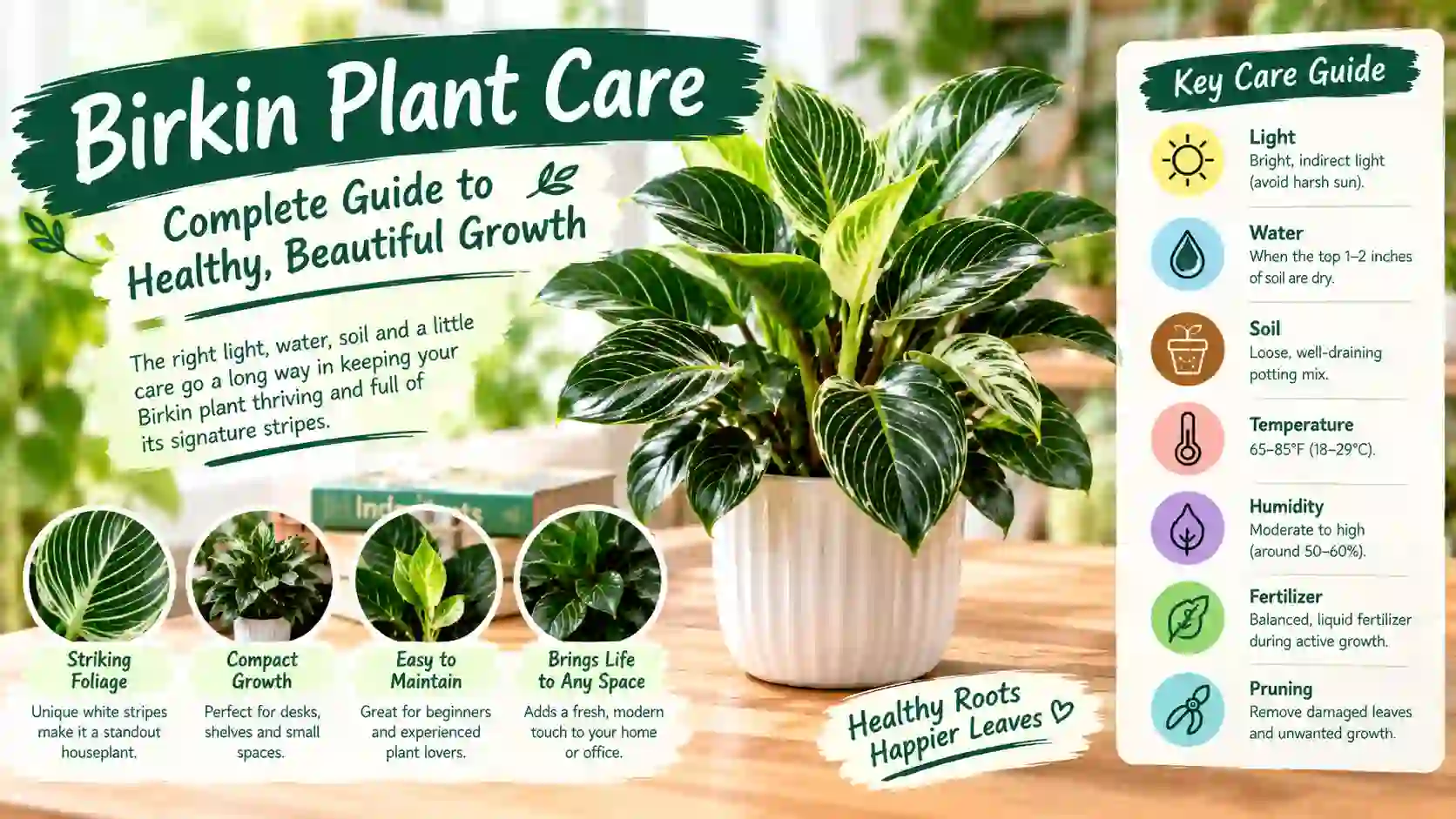
The Philodendron Birkin stands out for its glossy green leaves decorated with creamy white or pale yellow pinstripes. Its compact growth and striking foliage make it a popular choice for desks, shelves, and bright indoor spaces.
However, keeping those attractive stripes can be challenging. New leaves may emerge mostly green, older leaves may turn yellow, and brown edges can appear when watering or humidity is unsuitable. These changes do not always mean the plant is dying, but they can signal that its growing conditions need attention.
Successful birkin plant care depends on understanding how this unusual philodendron grows. It needs enough light to support healthy foliage, soil that allows roots to breathe, and watering based on actual moisture rather than a fixed schedule.
This guide explains how to maintain your Birkin, troubleshoot common problems, encourage attractive new growth, and recognize when a change in leaf color is normal.
Quick Answer:
For healthy Birkin plant care, grow your Philodendron Birkin in bright, indirect light and a loose, well-draining potting mix. Water when the top 1–2 inches of soil feel dry, and use a pot with drainage holes. Maintain warm indoor temperatures, moderate humidity, and gentle airflow. Feed lightly during active growth, and remove damaged leaves with clean scissors. Avoid soggy soil and harsh direct sunlight, which can damage roots and foliage.
1. Understand Your Philodendron Birkin

The Birkin is a cultivated variety of philodendron grown for its distinctive striped foliage. Its botanical name is Philodendron ‘Birkin’. It is commonly believed to have originated as a spontaneous mutation of Philodendron ‘Rojo Congo’, although its exact origin is not completely settled.
North Carolina Extension Gardener Plant Toolbox
+1
Unlike climbing philodendrons, Birkin has a self-heading growth habit. Its leaves emerge from a compact central base, so it generally does not need a moss pole or trellis.
What makes Birkin unusual?
- Creamy pinstripes: Narrow stripes run along the leaf veins, creating the plant’s signature appearance.
- Compact shape: Its upright growth suits tabletops, shelves, and bright offices.
- Changing new leaves: Young leaves may look lighter or slightly different before they mature.
- Unstable variegation: Some plants produce increasingly green leaves or occasional unusually pale leaves because the cultivar’s variegation is not fully stable.
Pinstripe Philodendron (2026)+1
This last point matters. If one new leaf looks greener than the previous one, do not immediately assume you have made a care mistake. Watch the next few leaves and assess the plant’s overall health.
2. Birkin Plant Care at a Glance
| Care factor | Recommended conditions |
|---|---|
| Light | Bright, indirect light |
| Watering | When the top 1–2 inches of soil feel dry |
| Soil | Airy, well-draining potting mix |
| Temperature | About 65–85°F (18–29°C) |
| Humidity | Moderate to high humidity; around 50–60% is a useful target |
| Fertilizer | Balanced houseplant fertilizer during active growth |
| Pruning | Remove damaged leaves and unwanted reverted growth |
| Pot | Container with drainage holes |
| Growth habit | Compact, upright, self-heading |
| Pet safety | Toxic if chewed; keep away from pets |
These conditions reflect horticultural guidance from North Carolina State Extension and practical indoor growing recommendations.
North Carolina Extension Gardener Plant Toolbox
+1
3. Provide Bright, Indirect Light
Light affects the Birkin’s growth rate, leaf size, and ability to maintain attractive foliage. A bright location without harsh direct sunlight is usually the best starting point.

Where should you place a Birkin plant?
Good locations include:
- Near an east-facing window with gentle morning light.
- A few feet from a bright south- or west-facing window.
- In a bright room where sunlight does not fall harshly on the leaves.
- Under a suitable grow light if natural light is limited.
Avoid placing the plant in a dark corner for long periods. Insufficient light can weaken growth and contribute to less attractive variegation. Too much direct sun can scorch the leaves.
North Carolina Extension Gardener Plant Toolbox
+1
How do you know if the light is right?
Sign’s of suitable light:
- New leaves develop steadily.
- The plant remains upright and compact.
- Creamy stripes remain visible on successive leaves.
- Foliage looks firm rather than bleached or scorched.
Signs of insufficient light:
- Growth slows considerably during the growing season.
- New leaves become smaller or less distinctly striped.
- The plant leans toward the window.
Signs of excessive direct sunlight:
- Pale, dry patches appear on exposed leaves.
- Leaf edges become scorched.
- Damage is concentrated on the side facing the window.
Can a Birkin grow under artificial light?
Yes. A suitable LED grow light can help in rooms with limited daylight. Follow the manufacturer’s recommended distance and daily lighting duration, and observe how the leaves respond.
Practical tip: Move your plant gradually when increasing light. Sudden exposure to intense sunshine can damage foliage that developed in a shaded indoor location.
Image suggestion: A 16:9 infographic comparing a healthy Birkin in bright indirect light, a low-light plant with weak growth, and leaves scorched by direct sunlight.
4. Water Your Birkin Plant the Right Way
Watering mistakes are among the most important problems to prevent. Birkin roots need moisture, but they also need oxygen. Soil that remains saturated can deprive roots of air and encourage root rot.
When should you water?
Use the soil as your guide rather than watering on the same weekday every week.
- Push your finger about 1–2 inches into the potting mix.
- If the upper layer is dry, check whether the soil beneath it is still noticeably wet.
- If the upper layer has dried and the root zone is not saturated, water thoroughly.
- Allow excess water to drain through the bottom holes.
- Empty any saucer or decorative outer pot that holds runoff.
The exact timing depends on temperature, light, pot size, soil, and season. A plant in bright light may dry much faster than one in a cool room.
How much water does it need?
Water slowly and evenly across the soil surface until excess water drains from the bottom. This helps moisten the root ball rather than just the top layer.
Avoid frequent, tiny amounts of water. They may wet only part of the root zone and leave salts concentrated in the soil.
Why are the leaves yellow after watering?
Yellowing leaves combined with consistently wet soil may indicate overwatering or poor drainage. Check the potting mix and roots before adding more water. NC State Extension identifies overwatering and root rot as problems associated with Birkin care.
North Carolina Extension Gardener Plant Toolbox
If the soil is dry and the leaves are drooping, underwatering may be the cause. Water thoroughly, let the pot drain, and check whether the foliage recovers.
The key rule: Do not water just because the leaves look unhappy. Check the soil first.
Image suggestion: A watering infographic showing a finger testing soil moisture, thorough watering, drainage from the pot, and a healthy root system.
5. Choose an Airy, Well-Draining Soil Mix
A suitable potting mix holds enough moisture for the roots while allowing air to circulate through the root zone.
Birkin prefers moist but well-drained growing conditions. Dense soil that remains wet for too long increases the risk of root damage.
North Carolina Extension Gardener Plant Toolbox
+1
A practical Birkin potting mix
For a simple homemade blend, combine:
- 2 parts indoor potting mix for moisture retention and nutrients.
- 1 part perlite or pumice to improve aeration and drainage.
- 1 part fine orchid bark to create additional structure and air spaces.
These proportions are a practical starting point, not a strict requirement. If your existing mix drains freely and dries at a reasonable pace, you may not need to change it.
What type of pot is best?
Choose a container with drainage holes. Plastic pots retain moisture longer, while unglazed terracotta generally dries faster.
Do not automatically choose a much larger pot when repotting. Excess soil around a small root system can stay wet longer than the roots can use it.
How can you tell if the soil is too dense?
Watch for these warning signs:
- Water pools on the surface instead of soaking in.
- The soil stays wet for an unusually long time.
- The mix becomes hard or compacted.
- The plant develops yellow leaves despite adequate light.
- Roots appear dark and mushy when inspected.
If these signs appear, check the drainage and root health before adding fertilizer.
Image suggestion: A labeled soil infographic showing potting mix, perlite, orchid bark, drainage holes, and healthy roots.
6. Maintain Warm Temperatures and Suitable Humidity
Birkin is a tropical foliage plant and grows best in warm, stable indoor conditions. North Carolina State Extension gives a preferred temperature range of approximately 65–85°F (18–29°C) and notes its preference for warm, humid conditions.
North Carolina Extension Gardener Plant Toolbox
What temperature is best?
Aim for a comfortable, consistent indoor temperature. Protect the plant from:
- Cold drafts near windows and exterior doors.
- Air-conditioning vents blowing directly onto the leaves.
- Hot air from heaters.
- Sudden temperature changes.
- Frost or freezing outdoor conditions.
If your plant is near a window, pay attention to nighttime temperatures in cooler months.
Does Birkin need high humidity?
Moderate humidity often works well. If your home is very dry and the leaves develop crispy edges, try a humidifier near the plant.
Other helpful habits include grouping plants together while maintaining airflow and avoiding locations where hot, dry air constantly blows across the foliage.
Misting is not a dependable way to raise room humidity for long periods.
Expert tip: Brown edges can also result from inconsistent watering, root damage, or fertilizer salt buildup. Check these factors before assuming humidity is the problem.
Image suggestion: A realistic indoor scene showing a Birkin near a humidifier, with temperature and humidity icons.
7. Fertilize for Steady, Healthy Growth
Fertilizer supports new leaves, roots, and stems, but more is not always better. Excess fertilizer can contribute to salt buildup and root damage.
What fertilizer should you use?
Choose a balanced liquid houseplant fertilizer and follow its label. During active spring and summer growth, apply it at the recommended rate. If growth slows in winter, reduce or pause feeding.
How to fertilize safely
- Check that the plant is healthy and the soil drains properly.
- Follow the product label instead of increasing the dose to encourage faster growth.
- Avoid feeding a severely dry or stressed plant.
- Do not use fertilizer as a solution for yellow leaves when the roots may be damaged.
- If salt buildup appears, consider flushing the potting mix with clean water, provided drainage is good.
Fertilizer does not directly guarantee stronger white pinstripes. Birkin’s variegation is genetically unstable, so leaf patterns can change even when the plant receives good care.
North Carolina Extension Gardener Plant Toolbox
+1
Image suggestion: A simple fertilizer infographic showing a balanced liquid feed, healthy new leaves, and a spring-to-winter feeding schedule.
8. Keep the Leaves Clean and Prune When Needed
Birkin does not need frequent heavy pruning. Because it grows in a compact, upright clump, routine care usually means removing damaged leaves and addressing stems that begin producing consistently non-variegated growth.
How to prune a Birkin plant

- Inspect the plant for dead, yellow, or badly damaged leaves.
- Use clean, sharp scissors or pruning snips.
- Cut damaged leaf stems close to their base without cutting into the main stem.
- Remove fallen plant material from the soil surface.
- Monitor new growth before making additional cuts.
Avoid removing too many healthy leaves at once. Green portions of the foliage contribute energy to the plant, and unnecessary pruning can slow recovery.
Should you prune all-green leaves?
Not every green-looking leaf is a problem. A young leaf may still be unfolding, and individual leaves naturally vary in their striping.
If several consecutive leaves emerge completely green or reddish-green, the growing point may have reverted toward its non-variegated form. You can prune that growth back to a node associated with variegated growth, but there is no guarantee that the next leaves will regain their stripes.
Pinstripe Philodendron (2026)
+1
Practical tip: Wait until a new leaf has unfolded and matured before deciding that its variegation has disappeared. This helps you avoid cutting healthy growth unnecessarily.
Image suggestion: A before-and-after infographic showing a healthy Birkin, a damaged leaf being removed, and an example of consistently green reverted growth.
9. Understand Why Birkin Leaves Lose Their White Stripes
This is one of the most distinctive challenges in Birkin plant care. The plant’s variegation is not completely stable, meaning its leaves do not always retain the same pattern.
Why does a Birkin turn green?
The creamy stripes result from a naturally occurring change in the plant’s growing tissues. Because the cultivar’s variegation is unstable, some new growth can emerge with little or no striping.
openriver.winona.edu
+1
Low light may contribute to poor foliage quality and weaker variegation, but genetics also play a role. Even a well-maintained Birkin can produce all-green leaves.
How to respond when the stripes fade
- Check the light: Move the plant to a brighter location with indirect sunlight if it has been kept in a dim room.
- Review recent stress: Consider whether the plant has experienced root damage, drought, or a difficult repotting.
- Watch several new leaves: One unusual leaf is not enough to establish a persistent reversion.
- Prune selectively: If a stem repeatedly produces completely green leaves, you may trim it back to a node with variegated growth.
- Keep expectations realistic: Good care can support healthy growth, but it cannot guarantee stable pinstripes.
What if a leaf is almost completely white?
An unusually pale leaf may have very little chlorophyll available for photosynthesis. One pale leaf does not necessarily threaten the plant, but repeated growth with very little green tissue can make it harder for the plant to support itself.
Keep the plant in bright, indirect light and observe how subsequent leaves develop. Avoid increasing fertilizer or exposing it to harsh sunlight in an attempt to force more color.
Image suggestion: A comparison infographic showing a normally striped Birkin, a mostly green reverted leaf, and a nearly white leaf, with a note explaining natural variation.
10. Repot Your Birkin When It Needs More Space
Birkin does not need to be repotted on a strict annual schedule. Repot when the roots have outgrown the container or the potting mix has deteriorated.
Signs that repotting may be necessary
- Roots emerge from the drainage holes.
- The root ball occupies most of the pot.
- Water passes through unusually quickly because the pot is crowded with roots.
- The potting mix has compacted or drains poorly.
- The plant dries out much faster than before, despite similar conditions.
A single root emerging from a drainage hole does not always mean the plant urgently needs a larger pot. Check the overall root ball and the condition of the soil.
How to repot a Birkin plant
- Choose a pot with drainage holes that is only one size larger.
- Gently remove the plant and inspect its roots.
- Trim away roots that are clearly mushy or decayed with clean tools.
- Add fresh, airy potting mix.
- Position the plant at its previous soil depth.
- Water as appropriate and allow excess water to drain.
- Return the plant to bright, indirect light and monitor its moisture needs.
Do not bury the base of the plant deeply to make it stand taller. Keeping the plant at a similar depth helps avoid unnecessary moisture around its stem base.
Image suggestion: A step-by-step repotting infographic with root inspection, a drainage-hole pot, fresh potting mix, and the finished Birkin.
11. Can You Propagate a Birkin Plant?
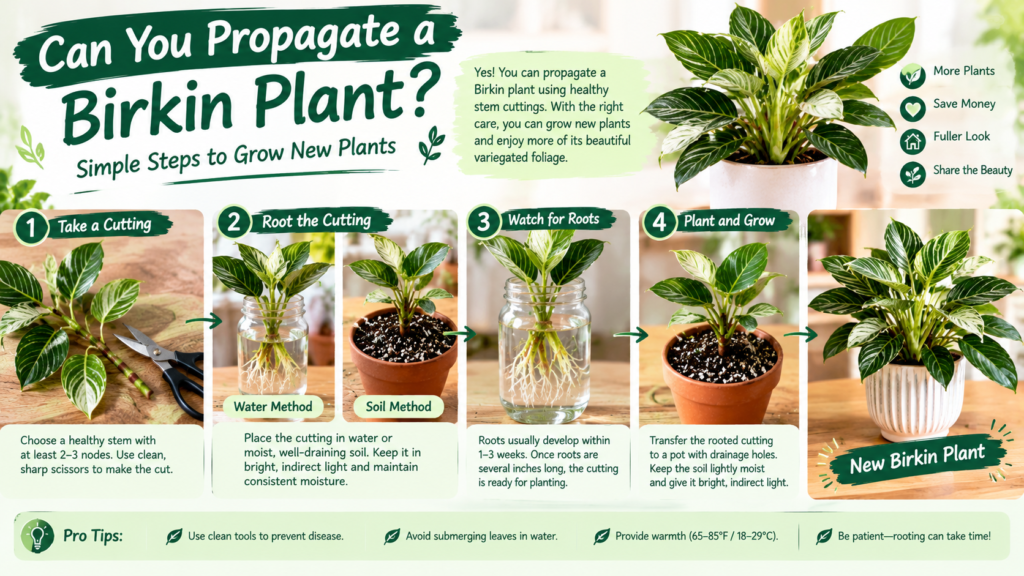
Propagation is possible, but Birkin requires a little more care than plants that root readily from ordinary leaf cuttings.
A detached leaf alone generally will not produce a complete new plant. Successful stem propagation requires a viable node with a growth point. Because Birkin is a self-heading plant with a compact central stem, not every cutting is suitable.
Propagation by stem cutting
- Inspect the plant for a healthy stem section with a viable node and growth point.
- Use a clean, sharp cutting tool.
- Take a suitable cutting without removing too much of the parent plant.
- Root the cutting in an appropriate propagation medium, keeping the node in contact with the medium.
- Maintain warmth, bright indirect light, and careful moisture.
- Wait for roots and new growth before moving the plant into its longer-term pot.
Do not remove the growing point of a valuable plant unless you understand how it will respond. Depending on the cutting and the parent plant’s structure, propagation may be better left to experienced growers.
Will a cutting keep the Birkin’s stripes?
Not necessarily. Because Birkin’s variegation is unstable, a propagated plant may produce a different pattern or revert toward green growth.
Pinstripe Philodendron (2026)
+1
If you want to preserve the characteristic foliage, select healthy material from a plant that consistently produces striped leaves, while understanding that the result is not guaranteed.
Image suggestion: A botanical propagation diagram showing the difference between a leaf-only cutting and a stem section containing a viable node and growth point.
12. Diagnose Common Birkin Plant Problems
When your Birkin looks unhealthy, look at the combination of symptoms rather than diagnosing the problem from one leaf.
Yellow leaves
Possible causes: Overwatering, poorly draining soil, insufficient light, or normal aging of older foliage.
What to do:
- Check the soil before watering.
- Inspect drainage holes and the condition of the potting mix.
- Look for soft stems or dark, mushy roots.
- Improve light if the plant has been kept in a dim location.
- Remove leaves that are completely yellow and will not recover.
A single older leaf turning yellow can be normal. Several leaves yellowing rapidly, especially in wet soil, deserves closer inspection.
Brown leaf tips or edges
Possible causes: Inconsistent moisture, dry indoor air, fertilizer salts, or root problems.
What to do: Check the soil, review your fertilizer routine, and assess humidity. If the brown areas are concentrated on the sun-facing side, consider whether direct sunlight is too intense.
Brown tissue will not turn green again. Focus on correcting the cause and protecting the healthy leaves.
Drooping leaves
Drooping can occur when the soil is too dry, but root damage from excessive moisture can also prevent the plant from taking up water.
What to do: Check the soil first. If it is dry, water thoroughly and drain. If it is wet, avoid adding more water and investigate the root zone.
Small new leaves
Small leaves may indicate insufficient light, root crowding, or generally slow growth. Check the growing conditions before applying more fertilizer.
If the plant has been in the same dim location for months, improving light gradually may help more than repotting immediately.
Leaves developing spots
Leaf spots may result from physical damage, pests, or disease. Keep the foliage reasonably dry, avoid overcrowding, and remove severely affected leaves with clean tools.
If spots continue spreading, isolate the plant and examine it closely for pests or signs of infection.
Quick troubleshooting table
| Symptom | Possible cause | First action |
|---|---|---|
| Yellow leaves with wet soil | Overwatering or poor drainage | Check roots and soil |
| Brown, crispy edges | Moisture stress, dry air, or salt buildup | Review watering and feeding |
| Drooping with dry soil | Underwatering | Water thoroughly and drain |
| Drooping with wet soil | Root stress or rot | Inspect the root zone |
| Small new leaves | Low light or root crowding | Check light and roots |
| New leaves mostly green | Natural reversion or unsuitable light | Assess successive leaves and lighting |
| Pale, scorched patches | Excessive direct sun | Filter or reduce direct sunlight |
| Persistent spots or speckling | Possible pests or leaf disease | Inspect both sides of leaves |
Image suggestion: A 16:9 diagnostic infographic comparing healthy Birkin foliage with yellow leaves, brown tips, drooping leaves, green reversion, and sun damage.
13. Watch for Pests Before They Spread
Birkin can be affected by common indoor plant pests, including spider mites, mealybugs, aphids, and scale insects. North Carolina State Extension recommends monitoring the plant for these pests.
North Carolina Extension Gardener Plant Toolbox
Where should you inspect?
Check:
- The undersides of leaves.
- The places where leaves meet the stem.
- New leaves as they unfurl.
- The central growing area.
- Any spots with webbing, sticky residue, or unusual speckling.
How to manage an infestation
- Isolate the affected plant from nearby houseplants.
- Identify the pest before choosing a treatment.
- Remove small numbers of insects manually or rinse the foliage gently if appropriate.
- Use a houseplant-labeled treatment when necessary, following the product instructions.
- Recheck the plant and repeat treatment only as directed.
Test a treatment on a small area first, especially if the foliage is already stressed. Do not spray a plant in strong direct sunlight unless the product label specifically allows it.
Regular inspection is usually easier than trying to eliminate a widespread infestation later.
Image suggestion: A pest-identification infographic showing spider mites, mealybugs, aphids, and scale insects on close-up philodendron leaves.
14. Is a Birkin Plant Toxic to Pets?
Yes. Philodendron Birkin should be kept away from pets that may chew it. Philodendrons contain insoluble calcium oxalate crystals, which can irritate the mouth and digestive tract when plant material is chewed.
Practical precautions include:
- Place the plant beyond the reach of cats and dogs.
- Remove fallen leaves promptly.
- Wash your hands after handling damaged foliage.
- Seek veterinary advice if a pet chews the plant and develops symptoms.
If you have curious pets, choose a location they cannot access or consider a plant known to be safer for them. Do not rely on a pet simply avoiding the plant.
15. Common Birkin Plant Care Mistakes
These mistakes can undermine an otherwise healthy care routine.
Watering too frequently. Check soil moisture instead of following a rigid schedule.
Using heavy soil. A dense mix can stay wet and deprive roots of oxygen.
Putting the plant in direct afternoon sun. Strong sunlight can scorch its leaves.
Overfertilizing. Extra nutrients will not correct poor lighting or damaged roots.
Repotting into an oversized pot. Excess soil may retain moisture for too long.
Cutting every unusual leaf. Birkin’s variegation varies naturally, and young leaves may look different before maturing.
Assuming all-green leaves always mean poor care. Reversion can occur because the cultivar’s variegation is unstable, even under suitable conditions.
Ignoring pests until the plant declines. A quick weekly inspection can catch many infestations early.
16. Frequently Asked Questions About Birkin Plant Care
How often should I water my Birkin plant?
Water when the top 1–2 inches of potting mix feel dry. The exact frequency depends on light, temperature, pot size, and soil. Always allow excess water to drain.
Is a Birkin plant easy to care for?
Yes, it is manageable for beginners who can provide bright, indirect light and avoid overwatering. Its main challenge is maintaining attractive foliage because its white pinstripe variegation can change naturally.
How much sunlight does a Philodendron Birkin need?
It prefers bright, indirect light. A bright window with filtered sunlight is often suitable. Protect the leaves from strong direct sunlight, which can cause scorching.
Why is my Birkin plant turning green?
Birkin has genetically unstable variegation, so some leaves can emerge with fewer stripes or turn completely green. Insufficient light may also contribute to poor foliage quality. Improve the lighting, observe new growth, and prune consistently reverted growth only when appropriate.
Pinstripe Philodendron (2026)
+1
Should I mist my Birkin plant?
Misting is not essential. If your home is very dry, a humidifier provides more consistent humidity. Avoid leaving the leaves constantly wet.
Does a Birkin plant need a moss pole?
No. Birkin has a compact, self-heading growth habit rather than the climbing habit of many other philodendrons. It generally does not require a moss pole or trellis.
Why are my Birkin plant leaves curling?
Curling may result from moisture stress, heat, pests, or root problems. Check soil moisture, inspect the leaf undersides, and make sure the plant is not exposed to hot air or intense sunlight.
Can a Birkin plant grow in low light?
It may survive in lower light, but growth can slow and foliage quality may decline. Bright, indirect light is a better choice for maintaining healthy leaves and attractive striping.
When should I repot my Birkin plant?
Repot when the roots crowd the container, the potting mix deteriorates, or the plant dries out unusually quickly. Choose a pot only one size larger with adequate drainage.
Is a Birkin plant safe for cats and dogs?
No. Philodendron Birkin contains compounds that can irritate pets when chewed. Keep it out of their reach and contact a veterinarian if your pet eats it and develops symptoms.
17. Related Plant Care Guides
If you are building an indoor plant collection, these related topics can help you care for other popular houseplants:
- Philodendron Plant Care: Learn about light, watering, soil, and the differences between climbing and self-heading varieties.
- Monstera Plant Care: Understand how to support large leaves and healthy root growth.
- Pilea Plant Care: Learn about compact growth, watering, and propagation.
- Snake Plant Care: Discover how to prevent overwatering and root rot.
- Spider Plant Care: Explore lighting, watering, and growing healthy plantlets.
- How to Fix Yellow Leaves on Indoor Plants: Compare symptoms and find practical solutions.
For RootWisse, these topics fit naturally within an indoor plant care content cluster. Link to the relevant guides when they are published, especially from sections about watering, leaf problems, and propagation.
Conclusion
Successful Birkin plant care starts with bright, indirect light, well-draining soil, and watering based on soil moisture. Keep the plant warm, feed it moderately during active growth, and inspect its foliage regularly for pests or signs of stress.
Remember that the Birkin’s distinctive white stripes are not completely stable. A change in variegation does not always mean you have done something wrong. By separating normal variation from genuine care problems, you can make better decisions and avoid unnecessary pruning, watering, or fertilizing.
Focus on healthy roots and steady new growth first. When those conditions are right, your Philodendron Birkin has a much better chance of maintaining its attractive, compact appearance.


