The Heart of Jesus plant is loved for its dramatic, heart-shaped foliage. Its colorful leaves can brighten shaded gardens, patios, and indoor spaces without relying on flowers.
However, its beautiful foliage can be surprisingly sensitive to the wrong conditions. Leaves may turn yellow, curl, fade, or droop when the plant receives too much sun, dries out, or sits in soggy soil.
Successful heart of Jesus plant care starts with understanding that this is a tropical foliage plant that appreciates warmth, moisture, and suitable light. It also helps to know that many caladiums grow from tubers and naturally slow down or go dormant during cooler or less favorable seasons.
This guide explains how to grow a healthy Heart of Jesus plant indoors or outdoors, maintain its vivid leaf colors, troubleshoot common problems, and manage its seasonal growth.

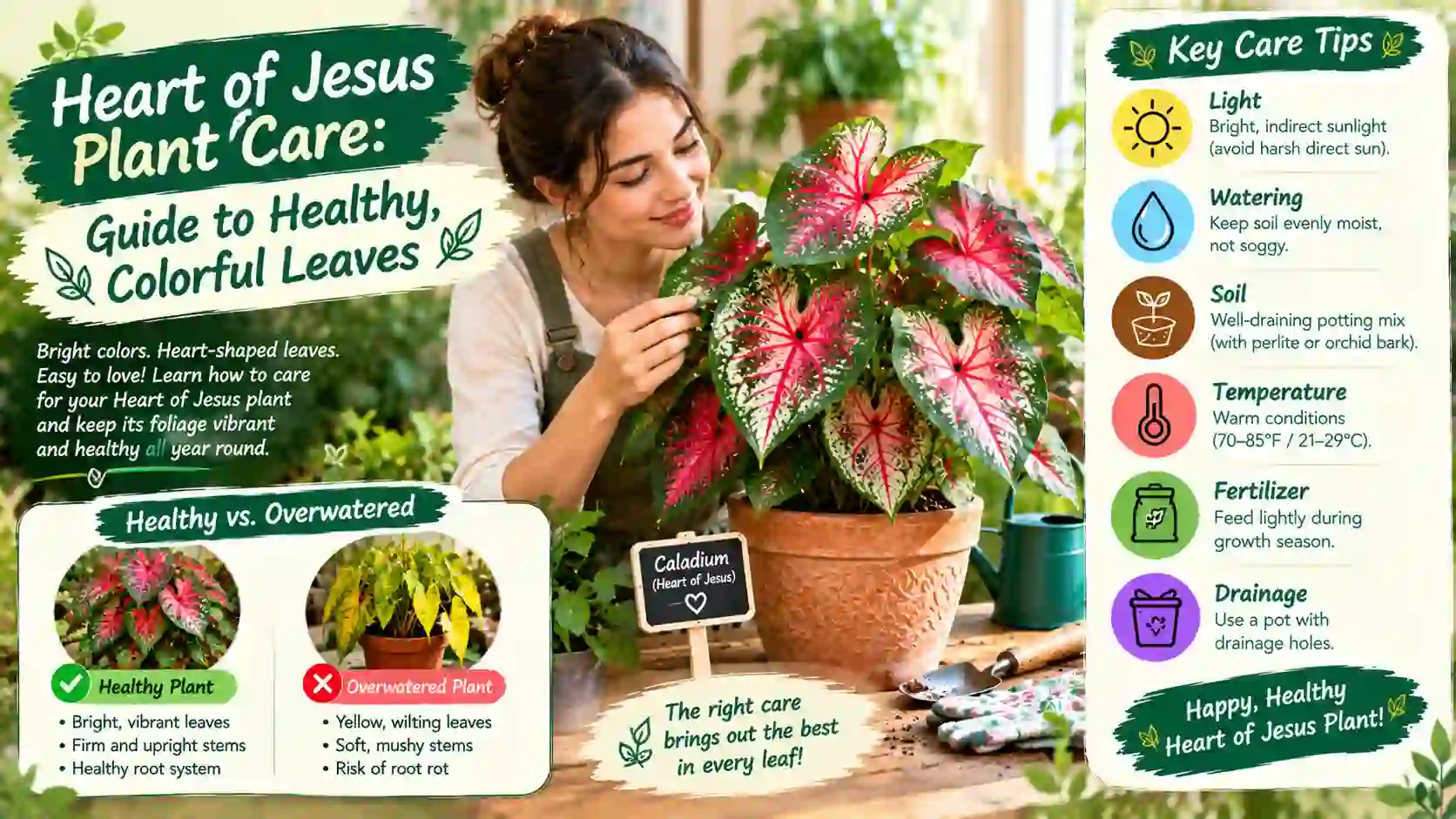
Image suggestion: A healthy Heart of Jesus caladium displaying colorful, heart-shaped leaves in a bright, sheltered growing space.
Quick Answer:
Heart of Jesus plant care focuses on warm temperatures, bright indirect light, evenly moist but well-draining soil, and moderate to high humidity. The plant, commonly known as the Caladium (Caladium bicolor and related hybrids), grows colorful, heart-shaped leaves in shades of green, pink, red, and white. Protect it from harsh sunlight, cold temperatures, and waterlogged soil. Many caladiums also enter a natural dormant period when their leaves die back.
1. What Is the Heart of Jesus Plant?
The Heart of Jesus plant is a common name for caladiums, especially varieties with striking heart-shaped leaves. These tropical plants are grown mainly for their foliage rather than their flowers.
The botanical name most often associated with them is Caladium bicolor, although many cultivated varieties and hybrids are sold under the broader name Caladium.
Caladiums are native to tropical regions of South America and are adapted to warm, humid conditions. Many garden varieties grow from underground tubers, which store energy and allow the plant to return when conditions become favorable again.
Popular Heart of Jesus varieties

White-leaved caladiums
These varieties have white or creamy leaves with green veins and margins. They brighten shaded corners and often show their best colors in filtered light.

Pink and red caladiums
Their vivid centers create a strong color contrast. Bright indirect light helps maintain attractive foliage without exposing delicate leaves to scorching sun.

Multicolored caladiums
These combine green margins, pale veins, and pink or red patterns. Their exact color depends on the cultivar, light, temperature, and leaf maturity.
Important identification note: Common plant names vary by seller and region. If your plant has thin, colorful, heart-shaped leaves growing from tubers, it is likely a caladium. Confirm the botanical name if your plant looks different, because care requirements can vary between plants sold under similar common names.
2. How Much Light Does a Heart of Jesus Plant Need?
Light has a major influence on leaf color, size, and overall growth. Most caladiums perform best in bright, filtered light or partial shade.
A plant in deep shade may develop fewer leaves and weaker stems. On the other hand, intense direct sunlight can scorch its thin leaves, leaving brown patches or faded areas.
Best lighting conditions
- Indoors: Place it near an east-facing window or near a bright window filtered by a sheer curtain.
- Outdoors: Choose a sheltered spot with bright shade or gentle morning sun, depending on the variety.
- Avoid: Strong midday and afternoon sun, especially during hot weather.
Some caladium cultivars tolerate more sun than others, particularly when acclimated gradually. Always watch how the leaves respond rather than assuming every variety needs identical conditions.
Signs of incorrect lighting
| Symptom | Possible cause | What to do |
|---|---|---|
| Brown, crispy patches | Sun scorch or dry conditions | Move to filtered light and check moisture |
| Faded or washed-out colors | Excessive direct light or cultivar characteristics | Provide gentler light and observe new leaves |
| Long, weak leaf stalks | Insufficient light | Move to a brighter location |
| Slow leaf production | Low light, cool temperatures, or dormancy | Check season, temperature, and growing conditions |
Practical tip: If you move a Heart of Jesus plant from a dim room to a sunny patio, introduce it to the brighter environment gradually. Sudden exposure can damage leaves that developed under lower light.
Image suggestion: A three-panel infographic comparing bright indirect light, deep shade, and harsh direct sunlight for caladiums.
3. How Often Should You Water a Heart of Jesus Plant?
Caladiums prefer consistently moist soil during active growth, but their roots and tubers can rot if the potting mix remains saturated. The goal is to maintain steady moisture without leaving the plant sitting in water.
North Carolina Extension Gardener Plant Toolbox
+1
Unlike a snake plant or succulent, a Heart of Jesus plant generally needs more frequent moisture while producing leaves.
A practical watering guide
| Growing conditions | Watering approach |
|---|---|
| Warm, bright room | Check soil frequently and water when the surface begins to dry |
| Hot outdoor weather | Check daily, especially in small pots |
| Cool weather or slow growth | Reduce watering as the soil dries more slowly |
| Dormant plant with dying leaves | Gradually reduce watering and allow the tuber to rest |
These are guidelines, not a fixed calendar. Pot size, airflow, humidity, soil composition, and temperature all affect how quickly moisture disappears.
How to water correctly

Step 1: Check the soil
Touch the top layer of soil. If it is starting to dry but the deeper mix is still slightly moist, it may be time to water. Do not wait for the entire root zone to become bone-dry during active growth.

Step 2: Water the soil evenly
Pour water around the root zone rather than repeatedly soaking one small area. Water until excess drains from the bottom of the pot.

Step 3: Let excess water escape
Empty the saucer after watering. Keep the soil moist, not swampy, and never leave the pot standing in a pool of water.
Why are the leaves drooping?
Drooping leaves do not always mean the plant needs water.
- Dry soil and limp leaves: The plant may need watering.
- Wet soil and limp leaves: Roots may be struggling from poor drainage or rot.
- Drooping during intense heat: The leaves may be losing water faster than the roots can replace it.
- Drooping as the season ends: The plant may be entering natural dormancy.
Check the soil before reaching for the watering can. Adding water to an already waterlogged plant can make the problem worse.
Image suggestion: A watering infographic comparing a properly moist caladium, a dry plant, and a plant suffering from waterlogged soil.
4. Choose the Right Soil and Pot
Heart of Jesus plants need soil that retains enough moisture for their tropical growth while allowing excess water to drain. Heavy, compacted soil can suffocate roots and encourage tuber rot.
Wisconsin Horticulture
+1
A suitable potting mix
For a container-grown caladium, start with:
- 2 parts quality indoor potting mix
- 1 part perlite or pumice
- 1 part fine orchid bark or another suitable airy organic amendment
This is a practical starting recipe, not a strict formula. Adjust it if the mix dries too quickly or remains soggy for days.
The finished mix should feel loose and crumbly, hold some moisture, and allow excess water to escape.
Which pot is best?
Choose a container with drainage holes. Plastic pots retain moisture longer, while terracotta generally dries faster through its porous walls.
Use a pot that comfortably fits the tuber and roots without excessive unused soil. A container that is much too large may stay wet for too long around a small root system.
For outdoor beds: Improve compacted soil with organic matter before planting. If your garden soil stays waterlogged after rain, use a raised bed or container instead.
Image suggestion: A labeled diagram showing a caladium tuber in airy potting mix, with drainage holes at the base of the container.
5. Maintain Warm Temperatures and Suitable Humidity
Caladiums are tropical plants. Warmth encourages tubers to sprout and supports the production of colorful leaves.
| Growing factor | Practical recommendation |
|---|---|
| Temperature | Aim for warm conditions, roughly 21–29°C (70–85°F) during active growth |
| Cold protection | Keep plants away from chilly drafts and temperatures near or below 10–13°C (50–55°F) |
| Humidity | Moderate to high humidity is helpful |
| Air circulation | Provide gentle airflow without exposing leaves to drying winds |
The precise temperature tolerance varies with cultivar and growing conditions. Caladiums are sensitive to cold, and cool, wet soil can encourage rot.
North Carolina Extension Gardener Plant Toolbox
+2
Do Heart of Jesus plants need high humidity?
They often grow well in humid conditions, but constant misting is not necessary. In dry indoor rooms, a humidifier or grouping compatible plants together may help. Ensure there is still enough airflow around the leaves.
Avoid placing the plant directly beside air-conditioning outlets, heaters, or cold windows. These locations can cause rapid moisture loss or temperature stress.
Warm-climate tip: In hot regions such as Lahore, protect outdoor caladiums from harsh afternoon sun and drying winds. Warmth is helpful, but extreme heat combined with direct sunlight can damage delicate foliage.
6. How to Fertilize a Heart of Jesus Plant
Fertilizer supports leaf production, but excessive feeding can damage roots and reduce the vivid colors that make caladiums attractive.
During active growth, use a balanced, water-soluble houseplant fertilizer at the label’s recommended dilution, or apply a suitable slow-release fertilizer according to its instructions. Many growers feed lightly about once a month during active growth, adjusting for the potting mix and the plant’s response.
Wisconsin Horticulture
+1
Feeding tips for colorful leaves
- Feed only when the plant is actively growing.
- Avoid applying concentrated fertilizer to dry soil.
- Do not let fertilizer solution collect on the leaves.
- Reduce or stop feeding as growth slows and dormancy approaches.
- Avoid excessive nitrogen, which may encourage greener foliage and reduce the contrast of some cultivars.
A plant that is not growing because it is cold, dormant, or suffering from root problems will not benefit from extra fertilizer. Fix the underlying issue first.
Image suggestion: A simple fertilizer guide showing a healthy caladium during active growth and a reminder to stop feeding during dormancy.
7. Why Is My Heart of Jesus Plant Losing Its Leaves?
One of the most important things to understand about caladiums is that leaf loss can be a normal part of their life cycle.
Many caladiums grow vigorously for a season, then gradually lose their leaves as conditions change. Their above-ground growth may disappear while the underground tuber remains alive. They can produce new leaves when warmth and growing conditions return.
Wisconsin Horticulture
+2
How to recognize dormancy
Signs of natural dormancy include:
- Older leaves gradually turning yellow or brown.
- Leaf stalks collapsing over time.
- New leaves appearing less frequently.
- The plant declining as temperatures cool or the growing season ends.
If the decline is gradual and the tuber remains firm, dormancy may be the explanation.
How to manage dormancy
- Reduce watering as the leaves naturally yellow and die back.
- Remove fully dead foliage with clean scissors.
- Stop fertilizing while the plant is dormant.
- Keep the tuber warm and protect it from cold.
- Resume watering gradually when new growth appears.
Do not continue watering a pot heavily just because the leaves have disappeared. A dormant tuber uses far less water than a plant with a full canopy.
If the plant collapses suddenly while the soil is wet, inspect for rot instead of assuming it is dormant.
Image suggestion: A seasonal illustration showing a leafy caladium, a naturally dormant tuber, and fresh spring growth.
8. How to Grow Heart of Jesus Plants from Tubers
Caladiums are commonly propagated from tubers. This method is more reliable for producing new plants than attempting to grow them from leaf cuttings.
Step-by-step propagation

Step 1: Choose a healthy tuber
Select a firm tuber without mushy areas, foul odors, or extensive decay. Visible buds can help you identify where new growth will emerge.

Step 2: Plant it in warm soil
Place the tuber with its growing points facing upward. Cover it with an appropriate layer of potting mix and keep the container warm.

Step 3: Manage moisture carefully
Keep the mix lightly moist while the tuber establishes growth. Avoid saturation, especially before roots and shoots develop.

Step 4: Provide filtered light
Once leaves emerge, provide bright indirect light or sheltered partial shade. Increase watering as the plant develops more foliage.
For established tubers, division can also be used when a tuber has multiple viable growing points. Each division needs a healthy bud and enough sound tuber tissue to support new growth. Use a clean, sharp knife and allow cut surfaces to dry before planting.
Important: Do not divide small or weak tubers unnecessarily. A healthy, undivided tuber may produce a fuller display than several small divisions.
Image suggestion: A four-step infographic showing a caladium tuber, planting orientation, emerging shoots, and a mature plant.
9. Common Heart of Jesus Plant Problems
The most useful way to diagnose a caladium problem is to examine the leaves alongside the soil moisture, light exposure, and season. A yellow leaf alone does not identify the cause.

Yellow leaves
Likely causes: Waterlogged soil, root or tuber rot, excessive sun, or natural dormancy.
What to do: Check whether the soil is saturated. Inspect the tuber if the plant is declining rapidly, but reduce watering gradually if the foliage is dying back naturally at the end of its growth cycle.

Brown, crispy leaf edges
Likely causes: Dry soil, intense sunlight, low humidity, or fertilizer buildup.
What to do: Check the soil and move the plant away from harsh afternoon sun. Keep moisture consistent during active growth without allowing water to accumulate around the roots.

Drooping leaves
Likely causes: Dry soil, extreme heat, root damage, or dormancy.
What to do: Check soil moisture first. If it is dry, water thoroughly. If it is wet and the plant remains limp, investigate drainage and root health instead of adding more water.

Faded leaf colors
Likely causes: Excessive direct sunlight, cultivar characteristics, or excessive fertilizer.
What to do: Provide filtered light and review your feeding routine. Some varieties naturally produce more green or pale foliage than others.

Pests or damaged leaves
Likely causes: Spider mites, aphids, slugs, or snails.
What to do: Inspect the undersides of leaves and new growth. Remove visible pests, isolate an infested indoor plant, and use a product labeled for the specific pest if needed. Follow all label directions.
How to prevent tuber rot
Tuber rot can destroy the plant before leaves emerge, so prevention matters.
- Use a clean pot and fresh, well-draining growing medium.
- Plant only firm, healthy tubers.
- Avoid excessive watering before shoots develop.
- Keep the plant warm during establishment.
- Never leave the container standing in water.
If a tuber is mushy or smells rotten, remove it from the soil and inspect it. Discard severely decayed material rather than planting it again.
Image suggestion: A troubleshooting infographic comparing healthy caladium leaves, sun-scorched edges, yellowing foliage, and a rotten tuber.
10. Seasonal Care: What to Do Throughout the Year
Caladium care changes as the plant moves between active growth and dormancy. A plant that needs regular moisture in summer may need almost none when its foliage has completely died back.
| Season | What to do |
|---|---|
| Spring | Start dormant tubers in warm conditions and increase watering as shoots develop. |
| Summer | Maintain evenly moist soil, provide filtered light, and feed lightly during active growth. |
| Autumn | Watch for natural yellowing and gradually reduce watering as growth slows. |
| Winter | Keep dormant tubers warm and protected. Resume watering when new growth appears. |
In frost-free tropical climates, caladiums may remain in the ground or pots for longer periods, depending on conditions. In colder climates, tubers usually need protection from frost and cold, wet soil.
Wisconsin Horticulture
+2
How to store dormant tubers
If you need to lift tubers from an outdoor bed:
- Lift them carefully after the foliage begins to decline naturally.
- Remove loose soil without damaging the tubers.
- Allow them to dry in a warm, shaded, well-ventilated place.
- Store them in a suitable dry packing material in a warm, frost-free location.
- Check occasionally for rot or excessive shriveling.
Storage recommendations vary with climate and cultivar, so follow locally appropriate extension advice when possible. Do not assume a caladium tuber needs the same cold storage as a tulip or other temperate bulb.
11. Is the Heart of Jesus Plant Toxic?
Yes. Caladiums are toxic if chewed or swallowed. They contain insoluble calcium oxalate crystals that can cause intense irritation of the mouth and throat, drooling, pain, vomiting, and difficulty swallowing. Sap may also irritate sensitive skin.
ASPCA
+2
For safe handling:
- Keep the plant away from children and pets.
- Wear gloves if you have sensitive skin or need to cut or divide tubers.
- Wash your hands after handling damaged leaves or tubers.
- Do not eat any part of the plant.
- If a person or pet chews the plant, contact an appropriate medical professional, veterinarian, or poison-control service for advice.
Caladiums are beautiful ornamental plants, but they should be placed where curious children and animals cannot reach them.
Frequently Asked Questions
How often should I water a Heart of Jesus plant?
Water when the upper layer of soil begins to dry during active growth, while keeping the root zone lightly moist. The exact interval depends on temperature, pot size, humidity, and light. Reduce watering as the plant enters dormancy.
Can I grow a Heart of Jesus plant indoors?
Yes. Give it bright indirect light, warm temperatures, moderate to high humidity, and a pot with drainage holes. An indoor plant may still enter dormancy even if it never experiences frost.
Why is my Heart of Jesus plant turning yellow?
Yellowing may result from waterlogged soil, root damage, excessive sunlight, or natural dormancy. Check the soil and the season before deciding what to change.
Does a Heart of Jesus plant need direct sunlight?
Usually not. Most caladiums prefer filtered light or partial shade. Gentle morning sunlight may be suitable for some varieties, but strong midday and afternoon sun can scorch leaves and fade their colors.
Can I grow a Heart of Jesus plant in water?
Caladiums are not normally grown permanently in water. Their roots and tubers need oxygen, and constant immersion can cause rot. Use a moisture-retentive but well-draining potting mix.
Why are the leaves curling?
Curling may indicate dry soil, heat stress, excessive sunlight, pest damage, or other environmental stress. Check the soil moisture and leaf undersides, then adjust the growing conditions according to what you find.
Does the Heart of Jesus plant flower?
Caladiums can produce a small flower structure called a spathe and spadix, but they are primarily grown for their colorful foliage. Their flowers are usually much less prominent than their leaves.
Can I keep a Heart of Jesus plant alive after all its leaves die?
Often, yes. If the plant has entered natural dormancy and its tuber remains firm, reduce watering and keep it warm. Resume watering gradually when new shoots emerge. A soft, rotten tuber is unlikely to recover.
What is the best fertilizer for a Heart of Jesus plant?
A balanced fertilizer or one with a modest nitrogen level is generally suitable during active growth. Apply it according to the product label. Too much nitrogen can reduce the strong color contrast of some varieties.
Is Heart of Jesus the same as Caladium?
The name Heart of Jesus is commonly used for caladiums, especially colorful varieties with heart-shaped leaves. Common names are not always consistent, so check the botanical label if you need to confirm a particular plant.
Conclusion
The key to successful heart of Jesus plant care is balancing moisture, light, and warmth. Give your caladium bright filtered light, keep its soil evenly moist during active growth, provide good drainage, and feed it lightly.
Most importantly, learn to recognize dormancy. When leaves gradually die back at the end of the growing season, the plant may simply be resting rather than dying. Protecting its healthy tuber and restarting growth at the right time can help you enjoy its colorful foliage again.
With the right conditions and a little seasonal attention, your Heart of Jesus plant can bring vivid tropical color to your home, patio, or shaded garden.