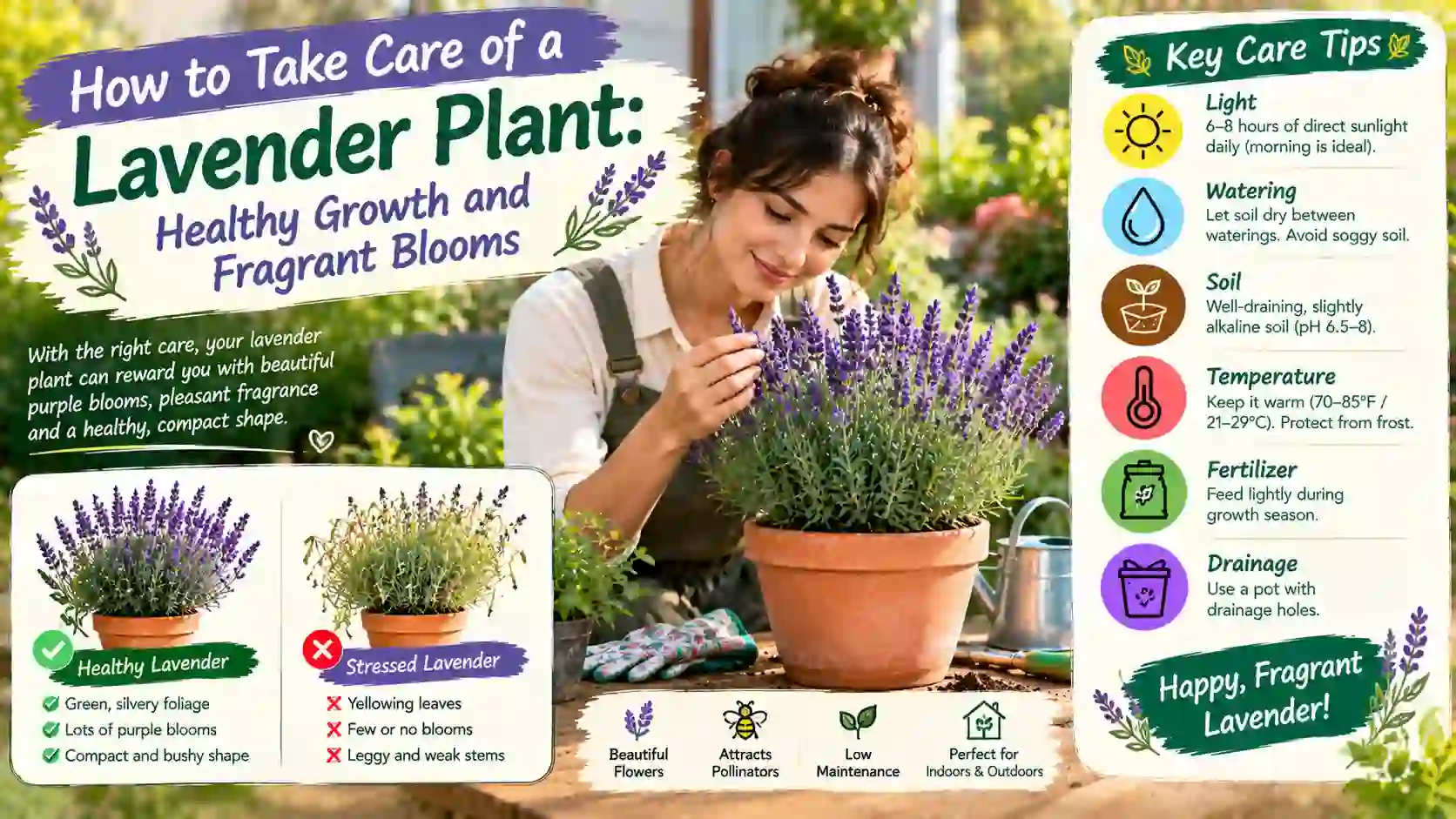
Lavender is loved for its fragrant flowers, silvery-green foliage, and ability to attract bees and butterflies. It can thrive in garden beds, containers, and sunny patios when its growing conditions match its needs.
However, lavender often struggles when gardeners treat it like a typical flowering plant. Too much water, heavy soil, limited sunlight, and excessive fertilizer can cause weak growth, fewer blooms, and root rot.
Learning how to take care of a lavender plant starts with understanding one important principle: lavender prefers plenty of sun, excellent drainage, and relatively dry conditions once established.
This guide explains how to grow lavender successfully, whether you are planting it outdoors, keeping it in a pot, or trying to revive a struggling plant. It also covers seasonal care, pruning, propagation, common problems, and practical tips for warmer or humid climates.
Quick Answer:
To take care of a lavender plant, give it at least 6–8 hours of direct sunlight, fast-draining soil, and deep but infrequent watering. Allow the soil to dry between waterings, and avoid heavy fertilizers and waterlogged roots. Prune lightly after flowering to maintain a compact shape. Choose a lavender variety suited to your climate, because humidity, winter temperatures, and poor drainage can affect its health.
1. Understand Your Lavender Plant Before You Start

Not all lavender plants have identical growing requirements. Identifying your variety helps you provide the right amount of warmth, winter protection, and humidity control.
| Lavender type | Main characteristics | Growing considerations |
|---|---|---|
| English lavender (Lavandula angustifolia) | Fragrant flowers and relatively cold-hardy growth | Prefers full sun, excellent drainage, and cooler conditions than many tender types |
| French lavender (Lavandula dentata) | Distinctive toothed leaves and long flowering potential in suitable climates | Often prefers milder winters and protection from frost |
| Spanish lavender (Lavandula stoechas) | Showy flower heads with colorful petal-like bracts | Needs strong sunlight and drainage; cold tolerance varies by cultivar |
| Lavandin (Lavandula × intermedia) | Often larger plants with long flower stems | Needs space, sun, and soil that does not stay wet |
Practical tip: When buying lavender, check the botanical name and the seller’s climate recommendations. A plant sold simply as “lavender” may not be the best match for your local winters or summers.
2. Give Lavender Plenty of Sunlight

Sunlight is one of the most important factors in healthy lavender growth. Plants grown in insufficient light often become leggy, produce fewer flowers, and develop weaker stems.
How much sunlight does lavender need?
Aim for 6–8 hours of direct sunlight daily, with more light often beneficial in climates where temperatures remain suitable.
Choose a location that receives morning and afternoon sun. Good airflow around the plant also helps foliage dry after rain or watering.
What if your lavender grows indoors?
Place the pot beside your sunniest window, preferably one that receives several hours of direct light. A bright room without direct sunlight may not provide enough energy for vigorous growth and flowering.
If natural light is insufficient, a suitable grow light can help. Keep the plant away from cold drafts and avoid trapping it in a humid, poorly ventilated corner.
Signs your lavender needs more light
- Stems stretch toward a window.
- The plant becomes open and floppy.
- Flower production decreases.
- New growth looks weaker than older growth.
Move the plant gradually into brighter conditions to reduce stress, especially if it has been growing indoors.
Image suggestion: A comparison infographic showing compact lavender in full sun beside a stretched, sparse plant grown in shade.
3. Use Fast-Draining Soil
Lavender’s roots need both moisture and oxygen. Soil that stays wet for long periods deprives roots of oxygen and increases the risk of root rot.
What soil is best for lavender?
Use a loose, gritty growing medium that drains quickly. Lavender generally performs well in moderately fertile soil rather than rich, moisture-retentive compost.
For container lavender, you can start with:
- 2 parts quality potting mix
- 1 part coarse horticultural grit or pumice
- Optional additional mineral material if the mix still holds too much water
Adjust the mix based on the materials available and how quickly it dries. Avoid fine sand that can compact the growing medium.
For garden beds, improve drainage before planting. In heavy clay soil, a raised bed or a different planting location may be more effective than simply adding a small amount of grit to the planting hole.
Does lavender need acidic or alkaline soil?
Lavender generally prefers neutral to slightly alkaline soil, although suitable conditions vary by species and local soil composition. A soil pH around 6.5–8 can work for many garden lavenders if drainage is good.
Do not add lime automatically. Test the soil first if you suspect it is too acidic.
Choosing the right pot
A container should have drainage holes at the bottom. Terracotta pots can be useful because their porous sides help the growing medium dry.
Choose a pot that comfortably accommodates the root ball without leaving a huge volume of wet soil around it. Decorative pots without drainage should not be used as the plant’s only container.
Image suggestion: A labeled soil infographic featuring potting mix, pumice, a terracotta pot, and arrows showing water draining away from lavender roots.
4. Water Lavender Correctly

Watering mistakes are a common reason lavender declines. Although newly planted lavender needs consistent moisture while establishing roots, mature plants tolerate dry conditions better than constantly wet soil.
Illinois
+1
How often should you water lavender?
There is no single schedule that works for every plant. Your watering frequency depends on temperature, rainfall, soil type, pot size, and the plant’s stage of growth.
| Growing situation | Watering approach |
|---|---|
| Newly planted lavender | Water when the upper soil begins to dry; check regularly while roots establish |
| Established garden lavender | Water deeply during prolonged dry weather, then allow the soil to dry |
| Lavender in a pot | Check the soil more frequently because containers dry faster |
| Lavender during cool or rainy weather | Water less often; rainfall may provide enough moisture |
| Lavender during extreme heat | Check soil moisture more often, especially in small containers |
The correct way to water lavender
- Check the soil with your finger. Do not rely on a calendar alone.
- If the root zone has dried sufficiently, water slowly around the soil rather than over the foliage.
- In containers, continue until excess water drains from the bottom.
- Empty any saucer beneath the pot so the roots do not sit in standing water.
- Wait until the soil has dried appropriately before watering again.
A plant can wilt from either underwatering or damaged roots. If the soil is already wet, adding more water may make the problem worse.
Expert tip: In hot weather, check the soil early in the morning. A dry surface does not always mean the entire root zone is dry, particularly in a large pot.
5. Maintain the Right Temperature and Airflow
Lavender is adapted to sunny conditions, but its tolerance for heat, humidity, and cold depends on the variety.
Many English lavender cultivars prefer relatively mild summers and can struggle in persistently hot, humid conditions. Spanish and French lavenders may suit different climates, but their individual cultivars still have temperature limits.
UC IPM
+2
How to protect lavender in hot climates
If your summers are extremely hot, focus on root health rather than keeping the soil constantly wet.
- Give the plant morning sunlight and assess whether intense afternoon heat is causing stress.
- Use a pot with drainage holes and avoid dark containers that become excessively hot.
- Keep plants spaced apart so air can circulate around their leaves.
- Avoid overhead watering late in the day.
- Use a loose growing medium that drains quickly after irrigation.
For gardeners in Lahore and other hot regions of Pakistan, container growing can make it easier to control soil drainage and move plants when conditions become extreme. However, lavender still needs ample sunlight, and a sheltered position should not become a dark indoor location.
What about humidity?
Lavender does not need frequent misting. In humid weather, wet foliage and stagnant air can encourage disease.
Instead of misting, improve airflow, avoid overcrowding, and water the soil directly. If your climate stays hot and humid for long periods, choose a cultivar known to tolerate those conditions.
6. Should You Fertilize Lavender?
Usually, very little fertilizer is needed. Lavender often grows well in relatively low-fertility soil, and heavy feeding can produce leafy growth at the expense of compact growth and flowers.
Ask Extension
+1
How to fertilize lavender safely
- Start with suitable soil rather than relying on fertilizer to correct poor growing conditions.
- If the plant is growing weakly and the soil is genuinely nutrient-poor, use a light application of a balanced fertilizer during active growth.
- Follow the product label and avoid repeated high-nitrogen applications.
- Do not fertilize a plant that is struggling with waterlogged roots, severe heat stress, or poor drainage before addressing the underlying problem.
A healthy lavender plant with gray-green leaves and steady growth usually does not need extra feeding simply because other garden plants are being fertilized.
Common mistake: Applying fertilizer whenever lavender stops flowering. Lack of blooms is often caused by insufficient sunlight, unsuitable pruning, excessive nitrogen, or the wrong variety for the climate.
7. Prune Lavender to Keep It Compact

Regular pruning helps lavender maintain a rounded shape, encourages branching, and reduces the chance of the plant becoming open and woody. However, lavender is a woody subshrub, so severe cutting into old, leafless wood can prevent recovery.
University of Maryland Extension
+1
When should you prune lavender?
The best timing depends on the variety and your climate.
- After flowering: Trim off spent flower stems and lightly shape the plant while leaving healthy leafy growth.
- In spring: Once new growth is visible, remove dead or winter-damaged stems and shape the plant carefully.
- During the growing season: Remove dead flower spikes as needed, but avoid repeated severe trimming.
How to prune lavender step by step
- Use clean, sharp pruning shears.
- Remove spent flower stems and dead tips.
- Trim a modest amount of leafy growth to maintain the plant’s rounded form.
- Keep cuts within green, leafy sections whenever possible.
- Leave the woody base intact and avoid cutting deeply into bare stems.
For an established, healthy plant, a moderate annual trim is generally more useful than an occasional drastic cut. Some varieties tolerate harder pruning than others, so identify your lavender before making major cuts.
Image suggestion: A three-panel infographic showing when to prune lavender, where to cut above leafy growth, and the difference between a compact plant and an overgrown woody plant.
8. Plant Lavender in a Pot or in the Ground?
Both methods can work. The better choice depends on your soil, local climate, and how much control you need over drainage.
| Feature | Lavender in a pot | Lavender in a garden bed |
|---|---|---|
| Drainage control | Easier to manage with the right mix and pot | Depends on the existing soil |
| Watering | Usually requires more frequent checking | Often needs less frequent irrigation once established |
| Moving the plant | Possible if the container is manageable | Usually impractical |
| Root space | Limited by container size | More room for roots |
| Best use | Patios, balconies, heavy soils, and movable displays | Sunny borders, raised beds, and suitable garden soil |
Planting lavender in a container
Choose a pot with drainage holes and fill it with a loose, fast-draining mix. Place the plant at approximately the same depth it grew in its nursery pot. Avoid burying the crown deeply.
Water after planting to settle the soil around the roots, then let the mix begin to dry before watering again.
Planting lavender in the garden
Choose a sunny site away from lawn sprinklers and places where rainwater collects. If the ground drains slowly, create a raised bed or plant in a suitable container instead.
Space plants according to their mature width. Crowded lavender dries more slowly after rain and may develop foliage problems.
9. How to Encourage More Lavender Flowers
If your plant looks healthy but produces few flowers, check its growing conditions before adding fertilizer.
Common reasons lavender does not bloom
- Insufficient sunlight: Move it to a sunnier location if possible.
- Excess nitrogen: Reduce fertilizer use.
- Incorrect pruning: Avoid removing too much of the plant’s leafy growth.
- Immature plants: Newly established plants may need time to develop.
- Climate mismatch: Some varieties flower poorly when exposed to prolonged heat or humidity.
- Waterlogged roots: Improve drainage before expecting healthy flowering.
Tips for fuller blooms
- Provide several hours of direct sunlight every day.
- Keep the soil well-drained.
- Avoid excessive fertilizer.
- Remove spent flower stems when appropriate.
- Choose a variety suited to your local climate.
Remember that lavender’s flowering season varies by variety and region. A plant that blooms in spring in one climate may flower later elsewhere.
10. Common Lavender Problems and How to Fix Them

When lavender looks unhealthy, inspect the soil, roots, sunlight, and recent weather before changing its care routine. Yellowing, wilting, and browning can have several causes, so one symptom alone rarely gives a definite diagnosis.
Ask Extension
+1
| Problem | Possible cause | What to do |
|---|---|---|
| Yellow leaves | Excess moisture, root damage, heat stress, or nutrient issues | Check soil moisture and drainage before applying fertilizer |
| Brown, dry tips | Heat stress, drought, root problems, or excess fertilizer | Check the root zone and review recent watering and feeding |
| Wilting despite wet soil | Waterlogged roots or root rot | Stop unnecessary watering and inspect drainage and roots |
| Long, floppy stems | Insufficient sunlight or excessive nitrogen | Improve sunlight and reduce unnecessary feeding |
| Few or no flowers | Too much shade, unsuitable pruning, or climate mismatch | Increase suitable sunlight and review pruning practices |
| Gray or blackened foliage | Possible disease or prolonged wet conditions | Remove affected debris, improve airflow, and avoid wetting foliage |
| Plant turning woody | Age and insufficient regular shaping | Prune conservatively while green growth remains; replace if severely declining |
Why is my lavender dying from the bottom up?
Lower leaves and inner stems may decline when roots remain too wet, particularly in heavy soil or during humid weather. Remove dead plant debris and examine the base for soft, dark tissue.
If the roots are brown, mushy, and deteriorating, root rot may be involved. Improving drainage is essential, although a severely damaged plant may not recover. Taking cuttings from healthy growth can preserve the plant if the variety is worth keeping.
UC IPM
+1
What pests affect lavender?
Lavender is relatively trouble-free, but it can attract aphids, whiteflies, spider mites, and spittlebugs.
University of Delaware
+1
Inspect the undersides of leaves and the growing tips. For a small infestation, remove affected material or rinse pests away when appropriate. If you use a pesticide or insecticidal soap, select a product labeled for the intended plant and pest, and follow its instructions carefully.
11. Seasonal Lavender Care Calendar
Lavender care changes throughout the year. The most important adjustment is to respond to active growth, flowering, rainfall, and temperature rather than following a rigid schedule.
| Season | Main tasks |
|---|---|
| Spring | Check winter damage, remove dead growth, shape the plant, and resume watering as growth increases |
| Summer | Monitor moisture during dry spells, deadhead flowers when appropriate, and maintain airflow |
| Autumn | Finish any suitable post-flowering pruning and reduce watering as growth slows |
| Winter | Avoid waterlogged soil, protect cold-sensitive varieties, and delay major pruning until new growth reveals which stems survived |
In climates with mild winters, lavender may continue growing or flowering outside the usual seasonal pattern. In cold regions, protection depends on the cultivar and the severity of winter conditions.
Important: Do not prune heavily simply because the calendar says it is spring or autumn. Check the plant’s condition and local growing season first.
12. How to Propagate Lavender

Stem cuttings are a practical way to grow new lavender plants that retain the characteristics of the parent cultivar. Seed-grown plants may vary in growth habit and flower quality.
Yard and Garden
+1
Propagating lavender from cuttings
- Select a healthy, non-flowering shoot with flexible green growth.
- Cut a section approximately 7–10 cm (3–4 inches) long.
- Remove the leaves from the lower portion of the stem.
- Insert the bare end into a small pot filled with a clean, free-draining propagation mix.
- Keep the medium lightly moist, not saturated.
- Place the pot in bright, indirect light while roots develop.
- Once the cutting has rooted and produces steady new growth, gradually introduce it to stronger sunlight.
Rooting time varies with temperature, the variety, and the cutting’s condition. Do not pull the stem repeatedly to check for roots; look for stable new growth and gentle resistance instead.
13. Harvesting and Using Lavender Flowers
Lavender flowers can be harvested for dried arrangements, sachets, and other appropriate uses.
For drying, cut flower stems when the buds are fragrant and before all the florets have fully opened. Gather small bunches and hang them upside down in a dry, shaded place with good airflow. Once completely dry, store them in a clean, dry container.
University of Maryland Extension
+1
If you want the plant to keep looking tidy, avoid removing too much foliage when harvesting. Leave enough healthy growth for the plant to continue developing.
Lavender is also attractive to pollinators, so consider leaving some flowers for bees and butterflies instead of harvesting every stem.
14. Common Mistakes to Avoid
Even experienced gardeners can lose lavender when they overlook its preference for sunny, well-drained conditions.
- Watering on a fixed daily schedule: Check soil moisture instead of assuming the plant needs water every day.
- Using a pot without drainage holes: Standing water can damage roots.
- Growing it in heavy, wet soil: Improve the site or use a suitable raised bed or container.
- Keeping it in deep shade: Lavender needs strong light for compact growth and flowering.
- Adding too much fertilizer: Excess feeding can encourage leafy growth without improving flowering.
- Cutting into old, bare wood: Lavender may not produce replacement growth from severely pruned woody stems.
- Ignoring humidity and airflow: Crowded plants and persistently wet foliage can increase disease risk.
- Assuming every variety suits every climate: Select lavender based on local temperatures, humidity, and winter conditions.
Frequently Asked Questions
1. How do you take care of a lavender plant for beginners?
Start with a suitable variety, at least six hours of direct sunlight, fast-draining soil, and a pot with drainage holes if growing in a container. Water when the root zone has dried appropriately, and prune lightly after flowering.
2. How often should I water a lavender plant?
Watering frequency depends on weather, soil, and container size. Water newly planted lavender more regularly while it establishes roots. Established plants generally need less frequent watering, but they may still require irrigation during prolonged dry periods.
3. Can lavender grow indoors?
Yes, but it can be challenging because indoor locations often lack enough direct sunlight and airflow. Choose the brightest available window, use a free-draining mix, and avoid leaving the pot in standing water.
4. Does lavender need full sun every day?
Lavender generally needs at least six hours of direct sunlight daily. More sunlight can support stronger growth and flowering when temperatures and other conditions are suitable.
5. Why is my lavender not flowering?
Common causes include insufficient light, excessive nitrogen, unsuitable pruning, an immature plant, and climate conditions that do not suit the variety. Correct the growing conditions before trying extra fertilizer.
6. Should I cut back lavender after flowering?
Usually, yes. Remove spent flower stems and lightly shape the leafy growth. Avoid cutting deeply into old, bare wood because lavender may not regrow reliably from those sections.
7. Can lavender survive hot weather?
Many lavender varieties tolerate warmth, but prolonged extreme heat can stress plants, especially in small containers. Monitor soil moisture, maintain drainage, and choose a variety suited to your climate.
8. Why are my lavender leaves turning brown?
Brown leaves can result from drought, extreme heat, root damage, excess fertilizer, or disease. Check the soil and roots first instead of automatically increasing watering.
9. Does lavender need fertilizer?
Established lavender usually needs little or no fertilizer when grown in suitable soil. If growth is weak, investigate sunlight, drainage, and root health before applying a light, appropriate feed.
10. Can I grow lavender in Pakistan?
It is possible, especially when you select a suitable variety and manage drainage carefully. In very hot areas, monitor containers closely, provide ample light, and protect plants from prolonged extreme heat. High humidity and poorly drained soil can make cultivation more difficult.
11. How long does a lavender plant live?
Lifespan varies by variety, climate, and care. Some plants remain productive for several years, while others become woody or decline sooner, especially under unsuitable growing conditions.
12. Can lavender grow in ordinary garden soil?
It can grow in suitable garden soil if the site is sunny and drains well. Heavy clay or persistently wet soil is risky, so consider a raised bed or container if water collects around the roots.
Conclusion
Learning how to take care of a lavender plant is mostly about getting a few growing conditions right. Provide plenty of sunlight, use fast-draining soil, water according to soil moisture, and prune carefully without cutting into old woody stems.
The biggest improvement for many struggling lavender plants is not more water or fertilizer. It is better drainage, more suitable sunlight, and a variety that matches the local climate.
Start by checking your plant’s current location and soil. Make gradual adjustments, watch how it responds, and maintain a light pruning routine. With the right conditions, lavender can reward you with attractive foliage, fragrant flowers, and a garden that welcomes pollinators.