
Quick Answer
Successful schefflera plant care starts with bright, indirect light, well-draining soil, and careful watering. Let the upper 2 inches of soil dry before watering thoroughly, then empty any collected water. Keep the plant between 65°F and 80°F, feed it lightly during spring and summer, and prune long stems above a leaf node to encourage fuller growth.
Schefflera is valued for its glossy umbrella-shaped leaflets. The most common indoor type is Schefflera arboricola, now classified as Heptapleurum arboricola. It tolerates occasional neglect but may drop leaves when overwatered, chilled, moved abruptly, or kept in poor light. Good schefflera plant care therefore depends more on stable conditions than constant attention.
Schefflera Plant Care at a Glance
| Care factor | Best conditions |
| Light | Bright, indirect or filtered light |
| Water | When the upper 2 inches of soil are dry |
| Soil | Loose, well-draining houseplant mix |
| Temperature | 65°F to 80°F |
| Humidity | About 40 to 60 percent |
| Fertilizer | Half-strength balanced feed monthly in active growth |
| Pruning | Spring or early summer |
| Repotting | Every 2 to 3 years or when root-bound |
| Propagation | Stem cuttings containing a node |
Provide Bright, Filtered Light
Schefflera grows most evenly in bright, indirect light. An east-facing window provides gentle morning sun. Near a south- or west-facing window, move it several feet back or use a sheer curtain.
Strong afternoon rays can bleach the leaves or produce pale, dry patches. Variegated varieties need brighter light to retain their markings but also scorch more easily. In low light, stems stretch, gaps between leaves increase, and new growth becomes smaller. Rotate the pot regularly. If growth remains leggy, improve the light because fertilizer cannot correct insufficient illumination.
Water Only After Checking the Soil
Overwatering is the most frequent mistake in schefflera plant care. The roots need oxygen as well as moisture, so permanently wet soil can cause root damage even when the foliage initially looks healthy.
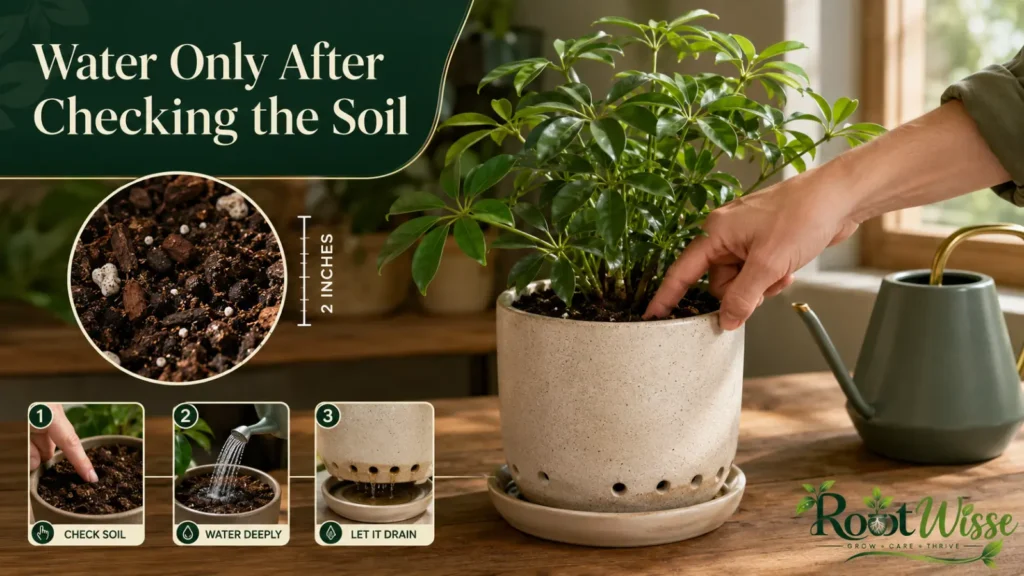
Push a finger about 2 inches into the potting mix. Water only when the soil at that depth feels dry. Apply water slowly across the surface until it flows from the drainage holes, then empty the saucer or cover pot. If the soil still feels cool and damp, wait and test it again after a few days.
There is no fixed answer to how often to water Schefflera. A plant in a warm, bright room might need water every 7 to 10 days in summer but only every two weeks or longer in winter. Pot size, soil, temperature, roots, and light all change the drying rate.
Avoid frequent small drinks, which create uneven moisture. A complete soak followed by partial drying supports healthier roots. If water runs down the pot’s sides without soaking in, apply it slowly in stages.
Use Airy Soil and a Pot with Drainage
A suitable mix should retain moisture without becoming dense. Combine two parts indoor potting soil with one part perlite or pumice and one part fine orchid bark.
Always use drainage holes. A pot without holes is safe only as an outer cover for a removable nursery pot. Check that water is not trapped inside it.
When repotting, choose a container only 1 to 2 inches wider than the existing root ball. An oversized pot contains more wet soil than the roots can use, which increases the risk of rot.
Maintain Stable Temperature and Humidity
Schefflera performs well between 65°F and 80°F. Protect it from cold windows, exterior doors, air-conditioning vents, radiators, and sudden changes. Chilling can make healthy green leaves fall without warning.
Average household humidity is usually adequate, ideally 40 to 60 percent. Very dry air may cause brown edges and encourage spider mites. A humidifier is more useful than misting, which changes humidity only briefly.
Feed Without Damaging the Roots
Apply a balanced liquid houseplant fertilizer at half strength once a month during spring and summer. Reduce or stop feeding when growth slows in fall and winter.
Excess fertilizer can damage roots, create brown tips, and leave a pale crust on the soil. Flush visible buildup with water. Do not feed a newly repotted, severely dry, pest-infested, or root-damaged plant until normal growth resumes.
Prune Schefflera for Bushier Growth
Schefflera responds well to pruning. Use clean shears and cut stretched stems just above healthy leaf nodes. New shoots commonly emerge below the cuts.
Shorten the tallest stems first and remove no more than one-third of the foliage at once. Spring and early summer are best. Pruning cannot permanently fix legginess if light remains inadequate, so provide brighter filtered light afterward. Do not compensate with extra water or fertilizer.
Repot Only When Necessary
Young plants may need repotting every one or two years, while mature plants can often wait two or three. Repot when roots circle tightly, emerge through drainage holes, or make the soil dry unusually fast.
Move up one pot size and keep the original planting depth. Return the plant to its usual location and wait several weeks before feeding. Continuing leaf loss may indicate damaged roots or excessive moisture.
Schefflera Plant Care Troubleshooting
The appearance of the leaves and soil usually provides better evidence than the symptom alone.
| Symptom | Likely cause | Best response |
| Soft yellow leaves with wet soil | Overwatering | Let the mix dry and inspect drainage |
| Dry, curled leaves with dry soil | Underwatering | Water thoroughly and check more regularly |
| Green leaves falling suddenly | Cold, relocation, or temperature shock | Stabilize the environment |
| Pale, widely spaced growth | Insufficient light | Provide brighter filtered light |
| Brown leaf tips | Dry air, salts, or root stress | Check humidity, feeding, and moisture |
| Sticky foliage | Scale or another sap-feeding pest | Isolate and inspect the plant |
Why Are Schefflera Leaves Falling Off?
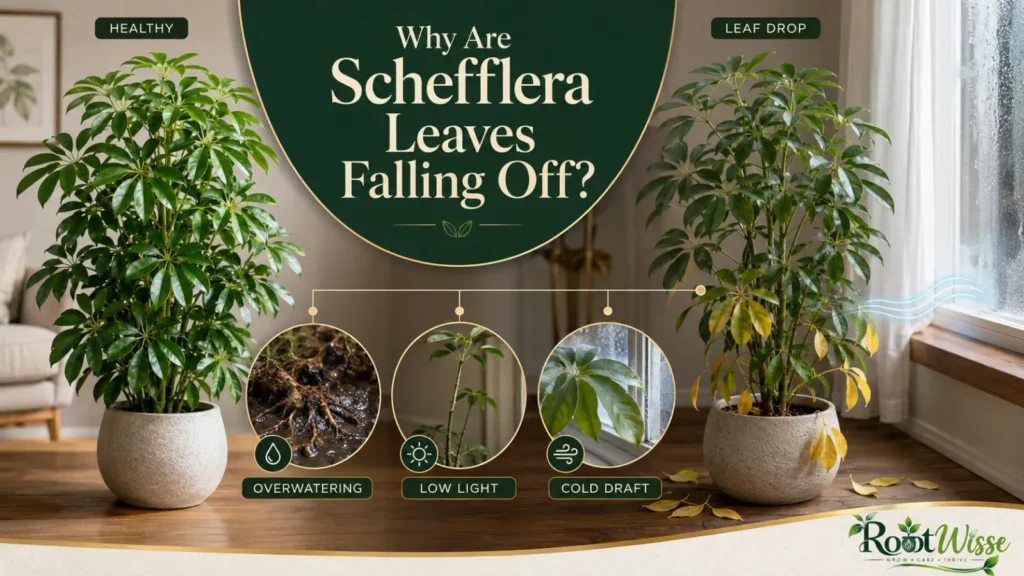
Leaf drop is a stress response rather than a single disease. Soft yellow leaves combined with wet soil usually suggest excessive moisture. Crisp leaves and very dry soil point toward underwatering. Green leaves dropping soon after the plant was moved often indicate relocation shock, cold, or a rapid change in light.
A new plant may lose a few leaves while adapting. Keep its conditions consistent. If loss continues, inspect the roots and look for pests.
What Causes Schefflera Yellow Leaves?
One older lower leaf turning yellow can be natural. Several yellow leaves appearing together require investigation. Check whether the soil stays wet for many days or smells sour. Healthy roots are firm and pale tan or cream, while rotten roots are dark, soft, and unpleasant-smelling.
Remove decayed roots with sterilized shears and repot in airy soil. Yellowing can also result from low light, cold, fertilizer buildup, or pests, so do not automatically add fertilizer.
Control Common Schefflera Pests
Inspect leaf undersides and stem joints for scale, spider mites, mealybugs, and aphids. Scale looks like fixed brown bumps, spider mites cause pale speckling and fine webbing, and mealybugs resemble small pieces of white cotton.
Isolate an affected plant and remove visible pests with a damp cloth. Apply insecticidal soap or horticultural oil labeled for indoor plants. Repeat as directed because eggs or hidden insects may survive the first treatment. Cleaning dusty foliage also makes infestations easier to see.
How to Propagate Schefflera
Stem cuttings are the most reliable propagation method. A cutting must include at least one node, which is the point where a leaf or side shoot connects to the stem. A detached leaflet may form roots but generally cannot produce a complete new plant without a viable node.
- Take a healthy 4 to 6-inch stem cutting below a node.
- Remove the leaves from its lower half.
- Dip the base in rooting hormone if desired.
- Insert it into a moist mixture of potting soil and perlite.
- Keep it warm in bright, indirect light.
- Maintain light moisture without saturating the mix.
A loose clear covering can retain humidity, but open it regularly for ventilation. Rooting may take several weeks. New growth or gentle resistance when tugged indicates developing roots.
Is Schefflera Toxic to Pets?
Schefflera is toxic to cats and dogs. Chewing it can cause mouth irritation, drooling, vomiting, or difficulty swallowing. Keep it beyond the reach of pets and children, and contact a veterinarian if ingestion causes symptoms.
Frequently Asked Questions
Is Schefflera easy to care for?
Yes. It is forgiving when it receives bright indirect light and its soil is allowed to partially dry. Persistent overwatering and sudden environmental changes cause most serious problems.
Can Schefflera grow in low light?
It can survive moderate light, but growth becomes slower and less compact. Variegated plants may lose their markings. Move it gradually rather than suddenly exposing it to strong sun.
Why is my Schefflera tall and thin?
Widely spaced leaves and thin, leaning stems usually indicate insufficient light. Provide brighter filtered light, rotate the pot, and prune stretched stems above healthy nodes.
Conclusion
Reliable schefflera plant care depends on bright filtered light, airy soil, and watering based on actual soil moisture. When leaves change color or fall, inspect the soil, roots, temperature, light, and pests before reacting. Once those conditions are stable, sensible pruning, light seasonal feeding, and occasional repotting will keep an umbrella plant attractive for years.