
Quick Answer
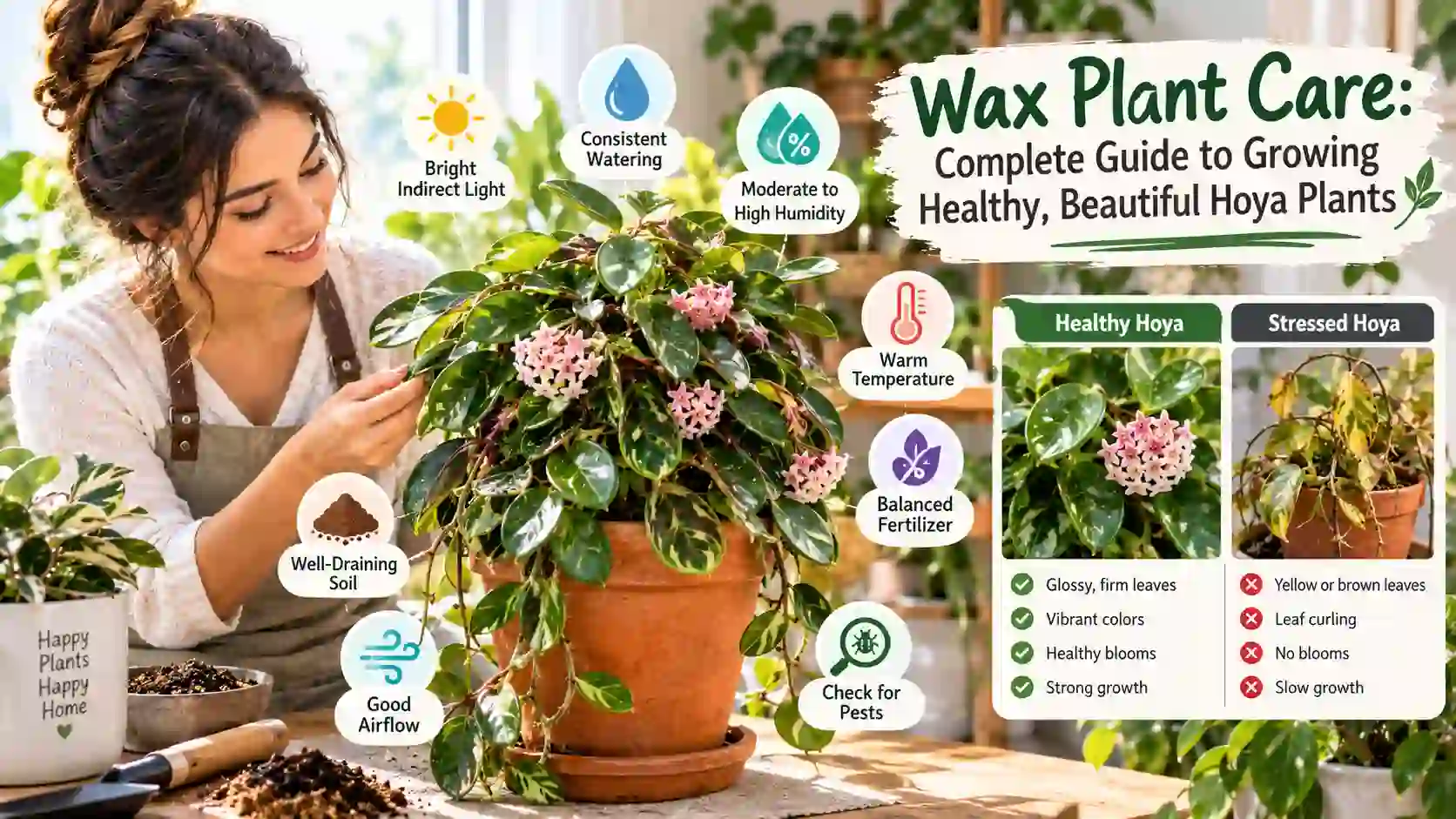
Wax plant care is mainly about bright filtered light, excellent drainage, careful watering, warmth, and patience. Wax plants, commonly called Hoyas, have thick leaves and stems that store some moisture, so they usually tolerate drying better than constantly wet soil. Water thoroughly when the potting mix has partly dried, provide a chunky, airy soil mix, and avoid moving the plant once flower buds develop. With enough light and mature growth, many Hoyas can produce fragrant clusters of waxy flowers.
Introduction
Wax plants are popular houseplants because they combine attractive foliage with unusual, long-lasting flowers. Their thick leaves can look almost artificial, while their trailing or climbing stems make them excellent choices for shelves, hanging baskets, trellises, and plant stands.
But wax plants have one habit that surprises beginners: they often grow slowly when conditions are not quite right.
A Hoya may survive in poor light for months without immediately collapsing. It can look healthy while producing little new growth or no flowers. Likewise, watering it too often can damage the roots before obvious symptoms appear.
Successful wax plant care is therefore less about constant attention and more about creating stable conditions.
The biggest priorities are:
- Give the plant plenty of bright, filtered light.
- Use a loose, fast-draining potting mix.
- Water deeply rather than giving frequent small sips.
- Let excess water drain completely.
- Keep the plant warm and away from cold drafts.
- Provide moderate to high humidity when practical.
- Avoid unnecessarily large pots.
- Do not cut off old flower spurs after blooming.
- Give mature plants enough light if flowering is your goal.
The most important lesson is simple: Hoyas prefer consistency over constant intervention.
What Is a Wax Plant?
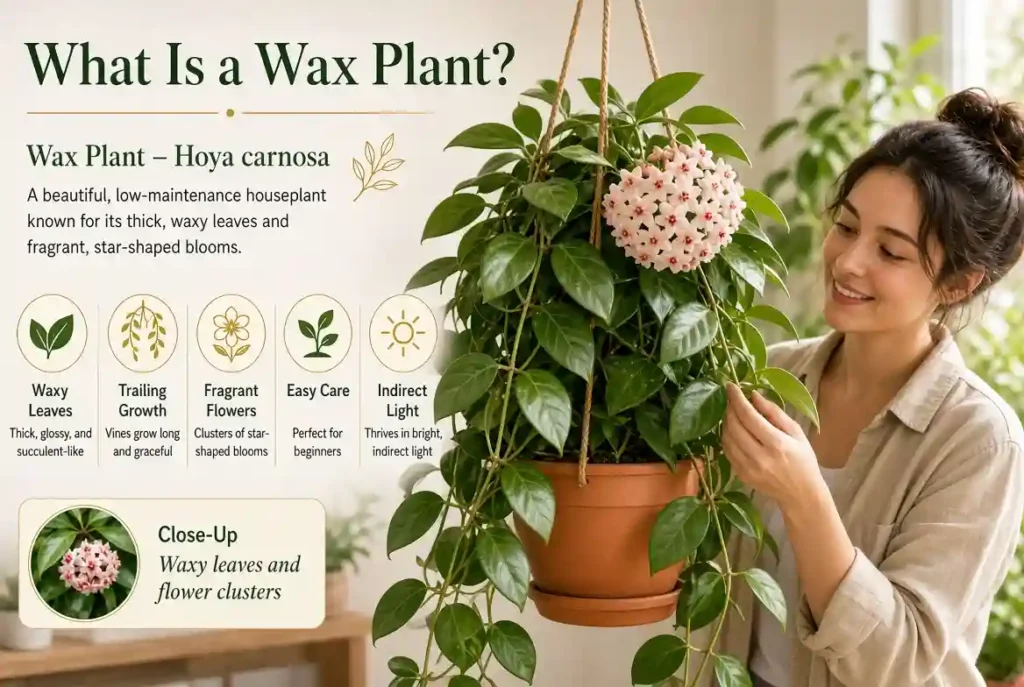
The name “wax plant” commonly refers to plants in the Hoya genus. Hoya carnosa is one of the best-known species, but many other Hoya species and cultivars are grown as houseplants.
Hoyas are generally evergreen vines or trailers with:
- Thick, fleshy leaves
- Flexible or woody stems as they mature
- A climbing or trailing growth habit
- Waxy-looking flowers
- Fragrant blooms in many varieties
- Specialized flowering structures called spurs or peduncles
Different Hoyas can look dramatically different.
Some have large oval leaves, while others have narrow, fuzzy, heart-shaped, curled, splashed, or highly variegated foliage.
Why Wax Plants Store Water
Many Hoyas have semi-succulent characteristics. Their thick leaves and stems can retain moisture.
This does not mean they should be treated exactly like cacti.
A Hoya still needs adequate water during active growth. The difference is that it generally does not appreciate staying continuously wet.
This explains why a watering schedule based only on the calendar often causes problems.
Check the plant and soil instead of automatically watering every few days.
How Much Light Does a Wax Plant Need?
Light is one of the most important factors in wax plant care.
For strong growth and flowering, provide bright filtered or indirect light for much of the day.
An east-facing window is often an excellent starting point. A bright south- or west-facing location can also work if intense sunlight is filtered or the plant is positioned far enough from the glass.
What Good Light Looks Like
A Hoya receiving suitable light usually develops:
- Firm leaves
- Healthy new growth
- Good leaf color
- Shorter gaps between leaves
- Better potential for flowering
Variegated Hoyas generally need particularly good light to maintain attractive coloration.
Can Wax Plants Take Direct Sun?
Some Hoyas can adapt to gentle direct sunlight, especially during the morning.
However, intense afternoon sunlight through glass can scorch foliage.
Watch for:
- Pale or bleached patches
- Brown scorched areas
- Crispy leaf edges
- Sudden discoloration after moving the plant
If these symptoms appear, move the plant slightly farther from the window or add a sheer curtain.
What Happens in Low Light?
A Hoya can survive surprisingly long in low light, but survival is different from thriving.
Low light may cause:
- Slow growth
- Long spaces between leaves
- Small new leaves
- Poor flowering
- Weak, stretched stems
- Loss of strong variegation in some cultivars
If your Hoya grows leaves but never flowers, evaluate light before immediately adding more fertilizer.
Image Suggestion: Create a realistic three-panel infographic showing a Hoya in bright filtered light, harsh direct sun, and low light, with visual symptoms under each condition.
The Best Soil for Wax Plants
Wax plants need a potting mix that holds some moisture but drains quickly.
Heavy garden soil or dense traditional potting soil can remain wet around the roots for too long.
A practical Hoya mix can contain:
- High-quality indoor potting mix
- Orchid bark
- Perlite or pumice
- A small amount of coco coir or another moisture-retaining material
The goal is not a specific recipe. The goal is air around the roots plus controlled moisture retention.
Why Airy Soil Matters
Hoya roots need oxygen.
When soil stays saturated for extended periods, air spaces become filled with water. Roots can become stressed and eventually damaged.
A chunky mix also makes it easier to determine when the plant actually needs water.
A Simple Test
After watering, excess water should flow freely from the drainage holes.
If water sits on the surface or takes a long time to pass through the pot, the mix may be too dense.
How to Water a Wax Plant Correctly
Watering is probably the most common area where beginners make mistakes.
The goal is not to keep the soil permanently moist.
Instead, water thoroughly when the upper portion of the mix has dried and the plant actually needs moisture.
Step-by-Step Watering Method
- Check the potting mix with your finger or a moisture meter.
- Feel the weight of the pot if you know how heavy it is after watering.
- If the upper layer has dried and the plant is ready for water, water slowly.
- Continue until water begins draining from the bottom.
- Allow excess water to leave the pot completely.
- Empty any water sitting in the saucer or decorative container.
Do not give a Hoya a tiny amount of water every day simply because the leaves look thirsty.
How Often Should You Water a Wax Plant?
There is no universal weekly schedule.
Watering frequency depends on:
- Pot size
- Pot material
- Soil composition
- Light intensity
- Temperature
- Humidity
- Plant size
- Root density
- Season
A Hoya in a small terracotta pot near a bright window may dry much faster than a large Hoya in a plastic pot in a dim room.
Signs Your Hoya May Need Water
Look for several signals together:
- Soil has noticeably dried
- Pot feels lighter
- Leaves lose some firmness
- Growth slows during an otherwise active season
Do not wait for severe wilting every time. Severe dehydration can stress the plant.
Signs of Overwatering
Overwatering may cause:
- Yellowing leaves
- Soft or collapsing roots
- Persistent wet soil
- Leaf drop
- Black or brown damaged roots
- Unpleasant-smelling potting mix
- Soft stems in advanced cases
One of the most useful Hoya-care habits is learning the difference between thirst and poor root health.
Choosing the Right Pot
The pot should match the plant’s root system rather than simply its vine length.
A huge pot may look attractive, but it contains more soil than the roots can use. That soil can remain wet for too long after watering.
Choose a container with:
- Drainage holes
- A size only modestly larger than the root ball
- Stable construction for climbing Hoyas
- Good airflow around the root zone
Terracotta can help some growers manage excess moisture because it dries faster than many plastic containers.
However, terracotta is not automatically better. Your watering habits and growing environment matter more.
Should You Repot a Wax Plant?
Hoyas generally do not need frequent repotting.
A plant can remain in the same container for years if:
- Roots are healthy
- The pot drains well
- Growth remains steady
- The potting mix has not broken down
- The plant is not severely root-bound
Repot When You Have a Reason
Consider repotting when:
- Roots are circling heavily around the container
- The soil has become compacted
- Drainage has deteriorated
- The pot is damaged
- The plant has outgrown its container
- Root problems require inspection
Avoid moving a healthy Hoya into a dramatically larger pot just because it has been a year.
After Repotting
Give the plant time to settle.
Temporary slowing of growth after root disturbance is not necessarily a sign that something went wrong.
Humidity for Wax Plants
Many Hoyas appreciate moderate to high humidity, but humidity should not become an excuse for poor airflow or wet soil.
Good humidity management includes:
- Grouping compatible plants
- Using a humidifier in very dry rooms
- Keeping plants away from heating vents
- Maintaining airflow around foliage
- Avoiding constantly wet leaves
A humidifier is generally more predictable than repeatedly misting the foliage.
Does Misting Help?
Misting may temporarily increase moisture around the leaves, but it does not replace proper root watering or stable room humidity.
If the room is genuinely dry, focus on the environment rather than repeatedly spraying the leaves.
Temperature and Location
Wax plants prefer warm, stable conditions.
Avoid placing them:
- Directly beside air conditioners
- Against cold windows during winter
- Next to heating vents
- In areas with sudden temperature swings
- Outdoors where unexpected cold can damage them
A stable environment is especially valuable when a Hoya is producing flower buds.
How to Fertilize a Wax Plant
Fertilizer can support healthy growth, but more fertilizer does not automatically mean more flowers.
During active growth, use a balanced houseplant fertilizer according to the product label.
A Sensible Fertilizing Routine
- Water the plant appropriately before or during fertilization.
- Use the recommended dilution.
- Fertilize during active growth.
- Reduce feeding when growth naturally slows.
- Avoid repeatedly applying strong fertilizer.
If the plant is already struggling because of root damage, poor light, or improper watering, fertilizer will not fix the underlying problem.
Solve environmental problems first.
How to Encourage a Wax Plant to Flower
This is one of the most common Hoya questions.
A healthy Hoya can sometimes grow vigorously without flowering. That does not necessarily mean it needs more fertilizer.
Flowering is influenced by factors such as:
- Plant maturity
- Light intensity
- Species or cultivar
- Growing conditions
- Root environment
- Seasonal growth patterns
The Most Important Flowering Tips
1. Give It Enough Light
Insufficient light is one of the first things to investigate when flowering is poor.
2. Avoid Constantly Changing Locations
Hoyas can react poorly to sudden environmental changes, especially when buds have already formed.
3. Avoid Excessive Watering
Constantly wet roots can weaken the plant and interfere with healthy growth.
4. Do Not Remove Flower Spurs
After flowers fade, the small flowering structure may look useless.
Do not automatically cut it off.
Hoyas can produce future flowers from existing spurs.
5. Be Patient
Some Hoyas flower while relatively young. Others require more maturity.
A healthy plant that is still developing may simply need time.
Image Suggestion: Show a mature Hoya covered with flower clusters beside a close-up diagram identifying the persistent flower spur and explaining why it should not be removed.
Why Is My Wax Plant Not Flowering?
If your Hoya has healthy leaves but refuses to bloom, work through this checklist.
| Possible Cause | What to Check | Practical Response |
|---|---|---|
| Insufficient light | Long gaps between leaves, little flowering | Move toward brighter filtered light |
| Young plant | Healthy but immature growth | Give it time |
| Recent repotting | Growth slowed after root disturbance | Allow recovery |
| Too much water | Soil stays wet for long periods | Improve drainage and watering |
| Too little light in winter | Weak seasonal growth | Provide a brighter location |
| Constant movement | Buds forming and dropping | Keep conditions stable |
| Damaged flower spurs | Old peduncles repeatedly removed | Leave healthy spurs intact |
Do not change five things at once.
Make one meaningful adjustment, then observe the plant over time.
How to Train a Wax Plant
Hoyas are naturally useful as hanging or climbing plants.
You can:
- Let vines trail from a shelf
- Grow them in hanging baskets
- Train stems around a hoop
- Use a small trellis
- Guide vines around a support
Training can improve presentation while giving long stems a useful structure.
Be Gentle With Long Vines
Do not force mature stems sharply around a support.
Older Hoya vines can become less flexible and may snap when bent aggressively.
Guide them gradually instead.
Pruning Wax Plants
Pruning is usually performed to manage size, remove damaged growth, or encourage a more attractive shape.
Remove:
- Dead stems
- Diseased portions
- Severely damaged leaves
- Unwanted or excessively long growth
Avoid aggressive pruning simply because the plant looks sparse.
Long bare sections may still produce new growth under suitable conditions.
Important Flowering Warning
Avoid cutting off healthy flower spurs after blooming.
Those structures can be valuable for future flowering.
How to Propagate a Wax Plant
Stem cuttings are one of the most practical propagation methods for many Hoyas.
Basic Stem-Cutting Method
- Select a healthy stem.
- Take a cutting with suitable nodes.
- Remove unnecessary lower leaves.
- Place the cutting in an airy propagation medium.
- Keep the medium lightly moist rather than saturated.
- Provide warm conditions and bright filtered light.
- Wait for roots and new growth to develop.
Avoid keeping an unrooted cutting constantly soaked.
Why Nodes Matter
New roots and shoots develop from nodes, so a leaf without the appropriate stem structure may not produce a complete new plant.
Propagation also works through layering, where a stem is encouraged to root while still attached to the parent plant.
Common Wax Plant Problems and How to Fix Them
Yellow Leaves
Yellow leaves can have several causes.
Possible explanations include:
- Excess moisture
- Root damage
- Natural aging of older leaves
- Poor light
- Nutritional imbalance
Do not assume every yellow leaf means the plant needs fertilizer.
Check the roots and soil moisture first.
Brown, Crispy Leaves
Brown edges may occur because of:
- Severe dryness
- Low humidity
- Excessive direct sun
- Root damage
- Salt buildup
Look at the whole growing environment before treating the symptom.
Wrinkled Leaves
Wrinkled leaves often suggest a water-balance problem, but the cause is not always simply “underwatering.”
Check:
- Is the soil genuinely dry?
- Is the pot draining correctly?
- Are the roots healthy?
- Has the plant recently been repotted?
- Is the room unusually hot or dry?
A plant can have wet soil and still have dehydrated foliage if damaged roots cannot absorb water properly.
Leaves Falling Off
Sudden leaf drop can follow:
- Overwatering
- Cold exposure
- Root damage
- Major environmental changes
- Pest infestations
- Severe underwatering
Start by examining the soil and roots rather than immediately adding more water.
Soft or Black Roots
This is a serious warning sign.
Remove the plant from its container and inspect the root system.
Healthy roots should generally be firm rather than mushy.
If roots are damaged, remove severely affected portions with a clean tool and repot into fresh, airy medium.
Wax Plant Pests
Hoyas can experience common indoor plant pests, including:
- Mealybugs
- Scale insects
- Aphids
- Spider mites
- Whiteflies in suitable conditions
How to Inspect a Hoya
Look closely at:
- Leaf joints
- Undersides of leaves
- New growth
- Stems
- Areas where leaves meet the vine
Mealybugs can resemble tiny white cottony deposits.
Scale insects may look like small bumps attached to stems or leaves.
Early detection makes pest management much easier.
Practical Pest Strategy
Isolate an affected plant from nearby houseplants.
Then:
- Physically remove visible pests where practical.
- Clean affected surfaces.
- Use an appropriate houseplant pest treatment according to its label.
- Repeat monitoring regularly.
- Treat the cause of plant stress as well.
A single treatment is not always enough because pest life cycles can extend beyond one application.
Common Wax Plant Care Mistakes
Mistake 1: Watering on a Fixed Calendar
“Water every Sunday” sounds simple but ignores changes in light, temperature, pot size, and season.
Better approach: Check the soil and plant before watering.
Mistake 2: Using a Huge Pot
More soil means more moisture capacity.
Better approach: Match the container to the root system.
Mistake 3: Keeping the Plant in a Dark Corner
Hoyas may survive low light but often grow and flower poorly there.
Better approach: Give them a brighter location with suitable protection from harsh sun.
Mistake 4: Removing Flower Spurs
This can remove structures capable of producing future blooms.
Better approach: Leave healthy flowering spurs in place.
Mistake 5: Repotting Too Often
Constant root disturbance can create unnecessary stress.
Better approach: Repot because the plant needs it, not because the calendar says so.
Mistake 6: Using Fertilizer to Fix Poor Light
Fertilizer cannot compensate for insufficient light.
Better approach: Correct light first.
Mistake 7: Treating Every Hoya Like a Succulent
Although many Hoyas have thick, moisture-storing foliage, they are not all identical.
Better approach: Learn the needs of your particular species or cultivar.
Wax Plant Care by Season
Spring
Spring is often a good time for:
- Increased watering as growth resumes
- Regular but moderate feeding
- Propagation
- Training new vines
- Checking for pests
Watch the soil closely because watering needs can change quickly as light increases.
Summer
During bright, warm weather:
- Monitor soil more frequently
- Protect foliage from extreme direct sunlight
- Maintain airflow
- Watch for pests
- Support vigorous new vines
Outdoor summer placement can work in suitable climates, but acclimate plants gradually.
Fall
As light levels decline:
- Reduce watering as necessary
- Watch for slower drying
- Avoid automatic summer watering schedules
- Inspect for pests before bringing outdoor plants inside
Winter
Winter care depends heavily on indoor conditions.
In lower light, the plant generally uses water more slowly.
Avoid the common mistake of maintaining summer watering frequency when the soil is now drying much more slowly.
Indoor vs. Outdoor Wax Plant Care
| Factor | Indoors | Outdoors |
|---|---|---|
| Light | Bright filtered light | Bright light with protection from harsh exposure |
| Watering | Based on drying rate | Often more frequent in heat |
| Temperature | Stable environment | Protect from cold |
| Pests | Easier to monitor | Greater exposure |
| Humidity | May require management | Often naturally higher |
| Wind | Minimal concern | Protect long vines from strong wind |
| Acclimation | Usually unnecessary | Important when moving outside |
For outdoor growing, climate matters greatly.
Hoyas are tropical or subtropical plants, so cold exposure can cause serious damage.
A Simple Weekly Wax Plant Care Routine
You do not need to fuss over your Hoya every day.
Once a week, perform a quick inspection.
Check the Soil
Ask whether it has dried enough to require watering.
Inspect the Leaves
Look for:
- Pests
- Discoloration
- Scorching
- New growth
- Unusual spots
Check the Stems
Make sure new vines are supported and not being crushed or bent.
Look at the Light
Confirm that nearby furniture, curtains, or seasonal changes have not dramatically reduced available light.
Check Flower Buds
If buds are forming, avoid unnecessary relocation.
This five-minute inspection can prevent many problems before they become serious.
Advanced Tips for Healthier Hoyas
Learn Your Plant’s Drying Pattern
Instead of memorizing a watering schedule, learn how long your particular pot takes to dry.
That gives you a much more useful understanding of your plant’s needs.
Use the Pot as a Diagnostic Tool
A lightweight pot often indicates that significant moisture has been lost.
This becomes especially useful after several months of caring for the same plant.
Observe New Growth
New leaves and stems tell you more about current conditions than old leaves do.
Healthy new growth suggests the plant is responding well to its environment.
Keep Environmental Changes Gradual
Hoyas generally respond better to gradual changes than sudden moves between dramatically different conditions.
If moving a plant outdoors, acclimate it instead of placing it immediately into strong sunlight.
Do Not Chase Perfection
A few old yellow leaves or occasional cosmetic damage does not automatically mean the entire care routine is wrong.
Look for trends:
Is new growth healthy? Is the soil drying appropriately? Are roots healthy? Is the plant steadily developing?
Those questions are more useful than judging one leaf.
Is a Wax Plant Safe Around Pets?
Hoya carnosa is listed by the ASPCA as non-toxic to dogs, cats, and horses. Hoya carnosa ‘Krinkle Kurl’ and Hoya kerrii are also listed as non-toxic to dogs and cats.
However, “non-toxic” does not mean a pet should eat large amounts of any houseplant. Individual species and cultivars can differ, so identify your particular Hoya before making a blanket assumption about every plant sold as a wax plant.
Frequently Asked Questions
How often should I water a wax plant?
Water when the potting mix has partially dried rather than following a fixed calendar. Water thoroughly and let excess moisture drain completely.
Does a wax plant need direct sunlight?
Not necessarily. Bright filtered light is an excellent starting point. Gentle morning sun may be beneficial, while intense afternoon sun can scorch some foliage.
Why is my wax plant growing but not flowering?
Insufficient light, young age, recent repotting, environmental changes, and cultivar differences can all affect flowering. Start by evaluating light and stability.
Should I mist my wax plant?
Misting is not essential. Stable humidity, appropriate watering, good airflow, and healthy roots are more important.
What is the best soil for a Hoya?
Use a loose, fast-draining mix containing components such as potting mix, bark, and perlite or pumice. Avoid dense soil that stays wet for long periods.
Can wax plants grow indoors?
Yes. Hoyas are widely grown as indoor plants when provided with adequate light, suitable drainage, warmth, and careful watering.
Can I put my wax plant outside?
In warm, suitable climates, many Hoyas can spend part of the year outdoors. Acclimate them gradually and protect them from harsh sun, strong wind, and cold temperatures.
Should I cut off dead Hoya flowers?
Remove faded flowers if desired, but avoid cutting off healthy flower spurs because they can produce future blooms.
Why are my Hoya leaves wrinkled?
Wrinkled foliage can result from insufficient water, excessive heat, damaged roots, or problems with water absorption. Check both the soil moisture and root health before deciding what to change.
Why are my Hoya leaves turning yellow?
Overwatering is a common possibility, but yellowing can also result from natural aging, poor light, root problems, or other environmental stress. Examine the entire plant rather than treating the leaf color alone.
How long does it take a wax plant to flower?
There is no universal timeline. Species, cultivar, maturity, light, growing conditions, and plant history all influence flowering. Some plants flower relatively young, while others need considerably more time.
Related Plant-Care Topics
Readers growing Hoyas may also benefit from guides covering:
- How to propagate houseplants from stem cuttings
- How to fix root rot in indoor plants
- Best soil mixes for tropical houseplants
- How to increase humidity for houseplants
- How to identify common houseplant pests
- How to encourage indoor plants to flower
- Hoya propagation and pruning
- Hoya yellow leaves and watering problems
These topics naturally complement a wax plant care guide without forcing unrelated information into the article.
Final Takeaway
Successful wax plant care is not about watering frequently or constantly adjusting the plant.
It is about creating the right balance.
Give your Hoya bright filtered light, an airy and well-draining potting mix, thorough but appropriately timed watering, warmth, reasonable humidity, and a stable location. Avoid oversized pots, constantly wet soil, unnecessary repotting, and aggressive pruning.
If flowering is your goal, focus especially on light, maturity, stable conditions, and preserving healthy flower spurs.
The best way to become good at Hoya care is to stop relying on rigid schedules and start observing how your specific plant, pot, soil, and room interact. Once you understand that pattern, wax plants become much easier to grow—and much more rewarding when those distinctive flowers finally appear.
The care guidance above is consistent with horticultural references from the Royal Horticultural Society and Missouri Botanical Garden, which emphasize bright filtered light, free-draining growing media, moderate watering, and careful winter watering for Hoyas. (RHS) The ASPCA specifically lists Hoya carnosa as non-toxic to dogs, cats, and horses. (ASPCA)
For publication, I’d pair this article with 2–4 custom infographics, especially the watering, lighting, flowering, and troubleshooting sections.