Quick Answer
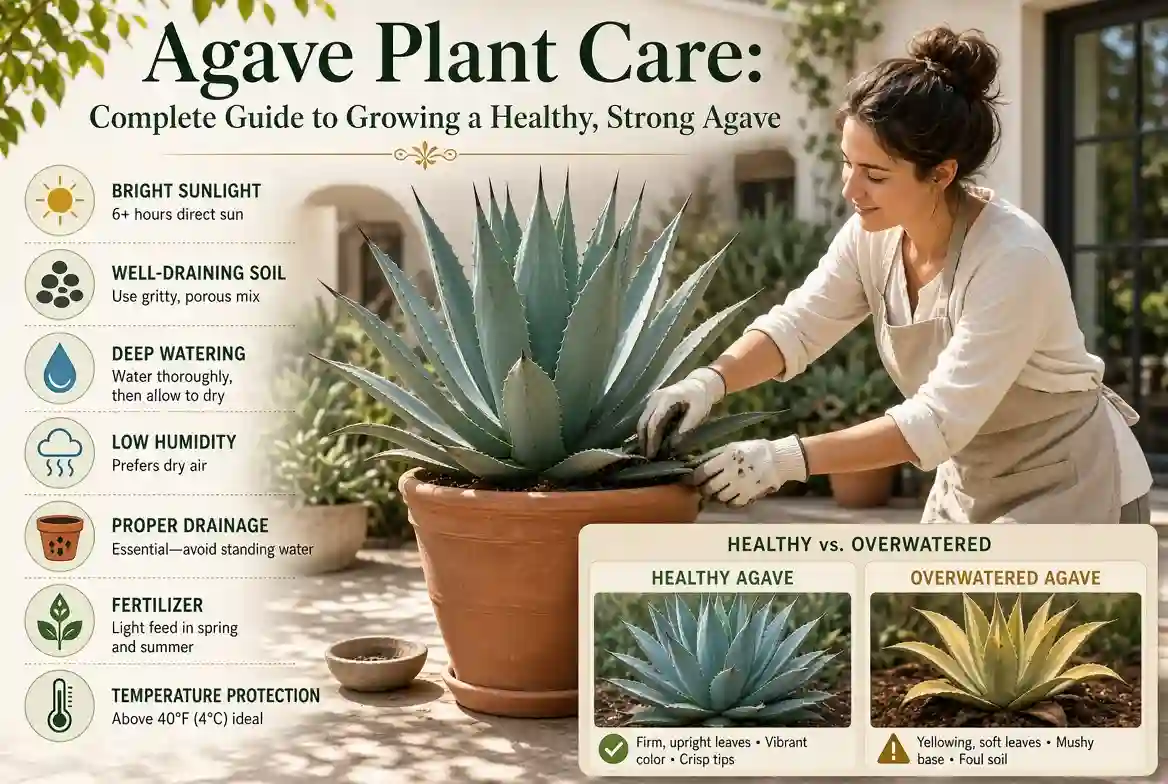
Agave plant care is mainly about giving the plant plenty of sunlight, sharply draining soil, and infrequent but thorough watering. Let the soil dry well between waterings, avoid standing water, and protect agaves from prolonged cold or excessive moisture. Most agaves need little fertilizer and rarely require pruning. The biggest problems usually come from overwatering, poor drainage, insufficient light, or pests such as agave snout weevil.
Introduction
Agaves are tough, architectural plants that can thrive with surprisingly little attention. Their thick leaves are designed to store water, making them naturally adapted to dry conditions.
The challenge is that their toughness can lead beginners to treat them like ordinary houseplants. Frequent watering, moisture-retaining soil, or a dim indoor location can quickly create problems.
Good agave plant care is therefore less about doing more and more about getting the basic conditions right. Light, drainage, watering technique, temperature, pot selection, and seasonal changes all affect how an agave grows.
This guide explains how to care for agave plants indoors and outdoors, how to recognize problems early, and how to adjust care as your plant matures.
Understanding the Agave Plant
Agave is a genus of succulent plants in the family Asparagaceae. There are many species and cultivars, ranging from compact container plants to very large landscape specimens.
Most agaves form a rosette of thick, fleshy leaves. Depending on the species, leaves may be green, blue-gray, striped, spotted, or edged with teeth.
Agaves are adapted to environments where water may be scarce. Their leaves store moisture, while their root systems are particularly vulnerable to prolonged wet conditions.
Important differences between agave varieties
Not every agave has identical care requirements.
| Feature | Smaller Agaves | Large Landscape Agaves |
|---|---|---|
| Container suitability | Excellent | Often limited |
| Light needs | Bright to full sun | Usually full sun |
| Water needs | Low | Low |
| Growth rate | Slow to moderate | Slow to moderate |
| Mature size | Small to medium | Medium to very large |
| Indoor use | Possible near strong light | Usually impractical |
| Cold tolerance | Species-dependent | Species-dependent |
Tip: Always check the mature size and cold tolerance of your specific agave before planting it permanently.
Image Suggestion: A labeled botanical infographic showing an agave rosette, fleshy leaves, roots, leaf spines, and offsets.
How Much Sunlight Does an Agave Need?
Light is one of the most important factors in successful agave care.
Most agaves prefer bright light and several hours of direct sunlight. Outdoor plants generally perform best in a sunny location, although some species tolerate partial shade.
Indoor agaves need the brightest location available.
Signs your agave needs more light
A plant receiving insufficient light may show:
- Pale or dull foliage
- Weak or stretched growth
- Wider spacing between leaves
- Slow growth
- A leaning rosette
- Loss of strong leaf coloration
Healthy agaves generally maintain a compact, symmetrical shape.
Be careful when moving an agave into direct sun
An indoor agave should not suddenly be placed outside in intense midday sunlight.
Its leaves may develop sunburn because they have not had time to adapt.
Instead:
- Start with bright indirect light.
- Introduce gentle morning sunlight.
- Increase direct exposure gradually.
- Monitor leaves for bleaching or brown patches.
- Increase exposure over several days or weeks.
Expert tip: Older leaves can sometimes develop cosmetic damage after a sudden lighting change. New growth is a better indicator of whether the plant is adapting successfully.
Image Suggestion: Realistic 16:9 infographic comparing a healthy sun-grown agave with a stretched, low-light agave.
The Best Soil for Agave Plants
Agaves need soil that drains quickly.
Ordinary garden soil or moisture-retaining indoor potting soil can stay wet around the roots for too long. This increases the risk of root problems.
A good agave soil should:
- Drain rapidly
- Contain plenty of mineral material
- Avoid compacting easily
- Allow air around the roots
- Dry reasonably quickly after watering
A practical container mix can include:
- Quality potting soil
- Coarse sand or grit
- Pumice or perlite
- Fine gravel or another suitable mineral component
The exact ratio does not need to be complicated. The important goal is fast drainage without creating a completely water-repellent medium.
Why drainage matters more than fertilizer
A nutrient-rich soil does not compensate for poor drainage.
An agave with slightly imperfect nutrition can often continue growing. An agave sitting in constantly wet soil can develop serious root problems.
Image Suggestion: Cross-section infographic showing an agave pot with drainage holes, gritty soil, healthy roots, and water flowing away from the root zone.
How to Water an Agave Plant
Watering is where many agave owners make their biggest mistake.
Agaves store water in their leaves, so they do not need frequent watering.
Instead of watering according to a fixed calendar, check the soil and consider the plant’s environment.
A better watering method
When the soil has dried substantially:
- Water thoroughly.
- Allow excess water to drain from the pot.
- Empty any water collected in a saucer.
- Wait until the soil dries again before watering.
Do not give a small splash of water every few days.
That approach can keep portions of the root zone continually damp without fully hydrating the entire root system.
How often should you water?
There is no universal schedule.
Your watering frequency depends on:
- Temperature
- Sunlight
- Pot size
- Soil composition
- Humidity
- Season
- Plant size
- Indoor or outdoor conditions
A plant in a hot, sunny outdoor container may dry much faster than one indoors during winter.
Seasonal watering
| Season | General Approach |
|---|---|
| Spring | Increase watering as active growth begins |
| Summer | Water when the soil has dried sufficiently |
| Autumn | Gradually reduce watering as growth slows |
| Winter | Water much less, especially in cool conditions |
The most important rule is simple:
Do not water simply because the calendar says it is watering day.
How to Fertilize Agave
Agaves generally do not require heavy feeding.
Too much fertilizer can encourage soft, rapid growth that may be less desirable for a plant naturally adapted to nutrient-poor environments.
During active growth, you can use a diluted balanced or succulent-appropriate fertilizer according to the product label.
Avoid excessive fertilization.
When to fertilize
Spring and summer are generally the most useful periods for feeding actively growing plants.
Avoid routine fertilizing when:
- The plant is dormant
- The soil is extremely dry
- The plant is suffering from root problems
- The plant has recently been severely stressed
Expert tip: Fertilizer should support healthy growing conditions, not compensate for poor light, inadequate drainage, or incorrect watering.
Choosing the Right Pot for an Agave
The container can make agave care much easier—or much harder.
Choose a pot with at least one functional drainage hole.
Terracotta can be useful because it allows moisture to evaporate through the pot walls. Plastic containers can also work well if the soil and drainage are appropriate.
Avoid unnecessarily large pots
A huge container holds more soil than the plant needs. More soil can also mean longer drying times.
Choose a container that gives the root system adequate room without creating a large reservoir of unused wet soil.
Stability matters
Some mature agaves become top-heavy.
A heavy container can help prevent the plant from tipping.
Safety note: Many agaves have sharp leaf tips and teeth. Position them away from walkways, children, and pets where appropriate.
Image Suggestion: Comparison infographic showing an agave in a well-sized pot versus an oversized container holding wet soil.
Agave Plant Care Indoors
Agaves can grow indoors when their lighting requirements are met.
A bright south-facing or similarly strong-light location can work well, depending on the climate and window exposure.
Indoor environments create several challenges:
- Lower light than outdoors
- Slower evaporation
- Poor airflow
- Longer soil-drying periods
- Temperature fluctuations near windows
Indoor care routine
Check the plant regularly rather than automatically watering it.
Look at:
- Soil moisture
- Leaf firmness
- Leaf color
- Plant symmetry
- Signs of pests
- Drainage after watering
If the soil remains wet for a long time, investigate the cause instead of repeatedly adding water.
Possible causes include:
- Oversized pot
- Dense soil
- Insufficient light
- Cool temperatures
- Poor drainage
Agave Plant Care Outdoors
Outdoor agaves can be excellent landscape plants in suitable climates.
Choose a location with:
- Strong sunlight
- Excellent drainage
- Adequate airflow
- Enough space for mature growth
- Protection from prolonged cold when necessary
Before planting directly into the ground, research the mature size and climate tolerance of the specific species.
A young nursery plant can look small while eventually becoming a substantial landscape specimen.
Avoid planting agaves in naturally wet areas
Low spots that collect rainwater are usually poor locations.
If the soil drains slowly, consider:
- A raised planting area
- A mound
- A container
- Amending the planting environment appropriately
The goal is to keep the crown and roots from remaining saturated.
Temperature and Cold Protection
Cold tolerance varies significantly among agave species.
Some tolerate occasional freezing better than others. Tropical or warm-climate species may be damaged by temperatures that a hardy landscape agave handles easily.
Before exposing an agave to freezing weather, identify its species or cultivar and check its documented hardiness.
Protecting container agaves
Container plants can be more vulnerable because their roots have less insulation than plants growing in the ground.
During unusual cold:
- Move vulnerable containers to a protected location.
- Keep them away from prolonged cold, wet conditions.
- Avoid combining cold temperatures with excessive watering.
- Return plants gradually to stronger light after protection.
Important: Cold tolerance should never be guessed from appearance. Two agaves that look similar can have very different temperature limits.
Humidity and Airflow
Agaves generally do not require high humidity.
They are better suited to conditions where the foliage dries relatively quickly.
Indoor plants benefit from reasonable airflow, especially when humidity is high.
You usually do not need to mist an agave.
In fact, repeatedly wetting the foliage without improving airflow provides little benefit and can create unnecessarily damp conditions.
Pruning and Cleaning an Agave
Agaves generally require very little pruning.
Remove leaves only when they are:
- Completely dead
- Severely damaged
- Diseased
- Creating a genuine safety problem
Use clean, sharp tools when removing damaged tissue.
Avoid repeatedly cutting healthy leaves simply to change the plant’s shape.
Brown leaf tips
A brown tip does not automatically mean the plant needs more water.
Possible causes include:
- Physical damage
- Natural aging
- Sun stress
- Cold damage
- Root problems
- Watering problems
Look at the entire plant before deciding what caused the symptom.
Agave Offsets: How to Handle Pups
Many agaves produce offsets, commonly called pups.
These young plants develop around the parent plant and can eventually be separated and grown independently.
When to separate an offset
A pup is easier to handle once it has developed enough size and, ideally, some roots of its own.
A general process is:
- Prepare a clean container with well-draining soil.
- Carefully expose the connection between pup and parent.
- Separate the pup with a clean tool if necessary.
- Allow damaged surfaces to dry appropriately.
- Plant it in a suitable container.
- Avoid excessive watering while it establishes.
- Gradually provide appropriate light.
Do not rush to separate every small offset.
Keeping young pups attached can sometimes allow them to develop further before handling.
Image Suggestion: Step-by-step infographic showing an agave producing pups, separating a rooted offset, potting it, and establishing new growth.
Common Agave Problems and How to Fix Them
Agave Leaves Turning Yellow
Yellowing leaves can have several causes.
The most common concern is excessive moisture, especially when yellowing occurs with soft tissue or a consistently wet growing medium.
Check:
- Soil moisture
- Drainage
- Root condition
- Pot size
- Recent rainfall
- Watering frequency
Do not automatically increase watering because a leaf has turned yellow.
Agave Leaves Turning Brown
Brown tissue can result from:
- Sunburn
- Cold injury
- Physical damage
- Root stress
- Natural aging
- Prolonged drought
Look at where the damage occurs.
Sudden brown patches after moving a plant into intense sunlight suggest a different problem from gradual browning accompanied by wet soil.
Agave Leaves Becoming Soft
Soft leaves are a warning sign.
If the soil is wet, investigate possible overwatering or root/crown problems immediately.
Remove the plant from its container if necessary and inspect the roots.
Healthy roots are generally firm rather than mushy or foul-smelling.
Agave Is Leaning
Leaning can occur because of:
- Insufficient light
- Uneven light exposure
- Root instability
- A top-heavy plant
- Loose soil
If the plant is stretching toward a window, insufficient light is a likely factor.
Rotate indoor plants periodically if appropriate, but rotation cannot replace adequate light.
Agave Has Wrinkled Leaves
Wrinkling can indicate water stress, but it does not always mean the plant needs immediate watering.
Check the soil first.
If the soil is completely dry and the plant is otherwise healthy, thorough watering may be appropriate.
If the soil is already wet, wrinkling may indicate damaged roots that cannot absorb water effectively.
This distinction is important.
Wet soil + wrinkled leaves does not necessarily mean the plant needs more water.
Agave Pests to Watch For
Agaves can encounter several pests, although healthy plants are often relatively trouble-free.
Potential problems include:
- Scale insects
- Mealybugs
- Spider mites
- Agave snout weevil in regions where it occurs
Inspect plants regularly, particularly around leaf bases and concealed areas.
Why early detection matters
Pests can be harder to manage once they become established deep inside a tightly packed rosette.
Look for:
- Unusual discoloration
- Damaged tissue
- Sticky residue
- Visible insects
- Declining leaves
- Unexplained collapse
For serious infestations, identify the pest before choosing a treatment.
The Most Common Agave Care Mistakes
1. Watering on a fixed schedule
Plants do not consume water at the same rate throughout the year.
Better approach: Check soil moisture and environmental conditions.
2. Using heavy potting soil
Dense soil can remain wet too long.
Better approach: Use a fast-draining growing medium.
3. Giving an indoor agave too little light
Agaves need much stronger light than many typical houseplants.
Better approach: Place them in the brightest suitable location.
4. Moving a plant suddenly into intense sunlight
This can cause sunburn.
Better approach: Acclimate gradually.
5. Choosing a huge decorative pot
Extra soil can remain wet around the roots.
Better approach: Select an appropriately sized container with drainage.
6. Fertilizing too frequently
More fertilizer does not necessarily mean better growth.
Better approach: Feed lightly during active growth when needed.
7. Ignoring the mature size
A small nursery agave may eventually become much larger.
Better approach: Research the mature dimensions before planting.
8. Handling leaves carelessly
Many agaves have sharp spines and leaf margins.
Better approach: Wear appropriate gloves and handle the plant carefully.
A Simple Agave Care Routine

You do not need to constantly monitor an agave.
A simple routine works well.
Weekly
Check:
- Leaf appearance
- Soil condition
- Signs of pests
- Overall plant stability
Before watering
Ask:
- Has the soil dried sufficiently?
- Is the plant actively growing?
- Is the weather hot or cool?
- Does the pot drain quickly?
Monthly
Inspect:
- Leaf bases
- Drainage holes
- Root-zone conditions
- New offsets
- Signs of pests
Seasonally
Adjust:
- Watering frequency
- Fertilizer
- Cold protection
- Sun exposure
- Container placement
This approach is more reliable than following a rigid watering calendar.
Agave Plant Care by Growing Environment
| Condition | Main Priority | Common Risk |
|---|---|---|
| Bright outdoor garden | Drainage | Excess rain |
| Hot sunny patio | Watering balance | Rapid drying |
| Indoor sunny window | Strong light | Insufficient light |
| Cool indoor room | Dry soil | Overwatering |
| Humid climate | Airflow and drainage | Persistent moisture |
| Container garden | Drainage holes | Root saturation |
| Rainy season | Protection from excess water | Root/crown problems |
How to Tell if Your Agave Is Healthy
A healthy agave usually shows:
- Firm leaves
- Strong natural coloration
- Compact rosette growth
- No widespread mushiness
- No persistent foul odor
- Stable growth appropriate for its species
- Healthy new leaves emerging from the center
Do not judge health based only on growth speed.
Some agaves naturally grow slowly.
A plant that looks stable and structurally healthy may be doing exactly what it should.
Advanced Agave Care Tips
Match watering to evaporation
Two identical agaves can need different watering schedules if one receives intense sun and airflow while the other sits indoors.
Think about how quickly the growing medium dries, not simply how many days have passed.
Watch the crown
The center of the rosette is especially important.
Water should not be allowed to remain trapped around the crown for extended periods, particularly under cool or humid conditions.
Understand natural leaf aging
Older outer leaves can decline while the center continues producing healthy growth.
Removing an aging leaf is not the same as treating a plant disease.
Plan for mature size
This is particularly important with landscape agaves.
Planting too close to paths, windows, walls, or seating areas can become a safety issue as the plant expands.
Can You Grow Agave in a Pot?
Yes. Many agaves perform very well in containers.
Container growing can actually make care easier in climates where outdoor conditions are unsuitable.
Benefits include:
- Easier relocation
- Better control of soil
- Protection from excessive rain
- Easier winter protection
- Control over mature placement
The main disadvantages are that containers can dry quickly in hot weather and may require occasional repotting as the plant develops.
Can Agave Grow Indoors?
Yes, provided it receives enough light.
The biggest indoor challenge is usually light rather than watering.
An agave that receives weak indoor light may become less compact and attractive.
If natural light is inadequate, an appropriately positioned grow light can help.
Keep the plant far enough from heat sources and cold drafts to avoid unnecessary stress.
When Should You Repot an Agave?
Agaves do not need frequent repotting.
Consider repotting when:
- Roots are severely crowded
- The container is unstable
- The soil has deteriorated
- Drainage has become poor
- The plant has outgrown its container
Repot during active growth when practical.
After repotting, avoid immediately giving excessive water simply because the plant has been moved into fresh soil.
Frequently Asked Questions
How often should I water an agave?
Water when the growing medium has dried sufficiently rather than following a fixed schedule. Hot, bright conditions may require more frequent watering than cool indoor conditions.
Does agave need full sun?
Many agaves prefer full sun, but light requirements vary by species. Indoor plants need the brightest suitable location and should be acclimated gradually to stronger sunlight.
Why are my agave leaves turning yellow?
Overwatering and poor drainage are important possibilities, especially when the soil stays wet. Check the roots and growing medium before increasing watering.
Can agave survive indoors?
Yes. Smaller species and cultivars can grow indoors when provided with strong light, excellent drainage, and careful watering.
What soil is best for agave?
Use a fast-draining succulent-style growing medium containing enough mineral material to prevent prolonged saturation.
Should I mist my agave?
Usually, no. Agaves do not generally need misting, and keeping foliage or the crown unnecessarily wet is not helpful.
Why is my agave wrinkled?
Wrinkling can result from dehydration, but it can also occur when damaged roots cannot absorb water. Check the soil before watering.
How do I make my agave grow faster?
Provide appropriate light, drainage, temperature, and water during active growth. Avoid forcing growth with excessive fertilizer or watering.
Can agave grow in shade?
Some species tolerate partial shade, but many agaves maintain stronger, more compact growth with substantial sunlight.
Does agave need fertilizer?
Agaves generally have modest fertilizer needs. A diluted fertilizer during active growth can support healthy development, but excessive feeding is unnecessary.
How do I care for an agave in winter?
Reduce watering as growth slows and protect species that are not cold-hardy. Keep container plants away from prolonged cold and wet conditions.
How do I propagate agave?
Many agaves can be propagated from offsets or pups. Allowing a sufficiently developed offset to establish roots before separation usually makes the process easier.
Related Plant-Care Topics Worth Exploring
If you’re building a broader succulent-care routine, useful related topics include:
- Aloe vera plant care
- Jade plant care
- Aloe plant watering
- Succulent soil and drainage
- How to prevent root rot
- Indoor succulent care
- How to acclimate plants to full sun
- Container gardening for drought-tolerant plants
Conclusion
Successful agave plant care comes down to understanding what the plant is naturally adapted to do. Agaves store water, tolerate dry conditions, and generally prefer strong light with rapidly draining soil.
The biggest mistake is treating an agave like a thirsty tropical houseplant. Instead, focus on bright light, excellent drainage, deep but infrequent watering, restrained fertilizing, and appropriate temperature protection.
When something goes wrong, examine the growing conditions before treating the symptom. Yellow leaves, wrinkles, brown patches, and slow growth can have different causes.