Quick Answer
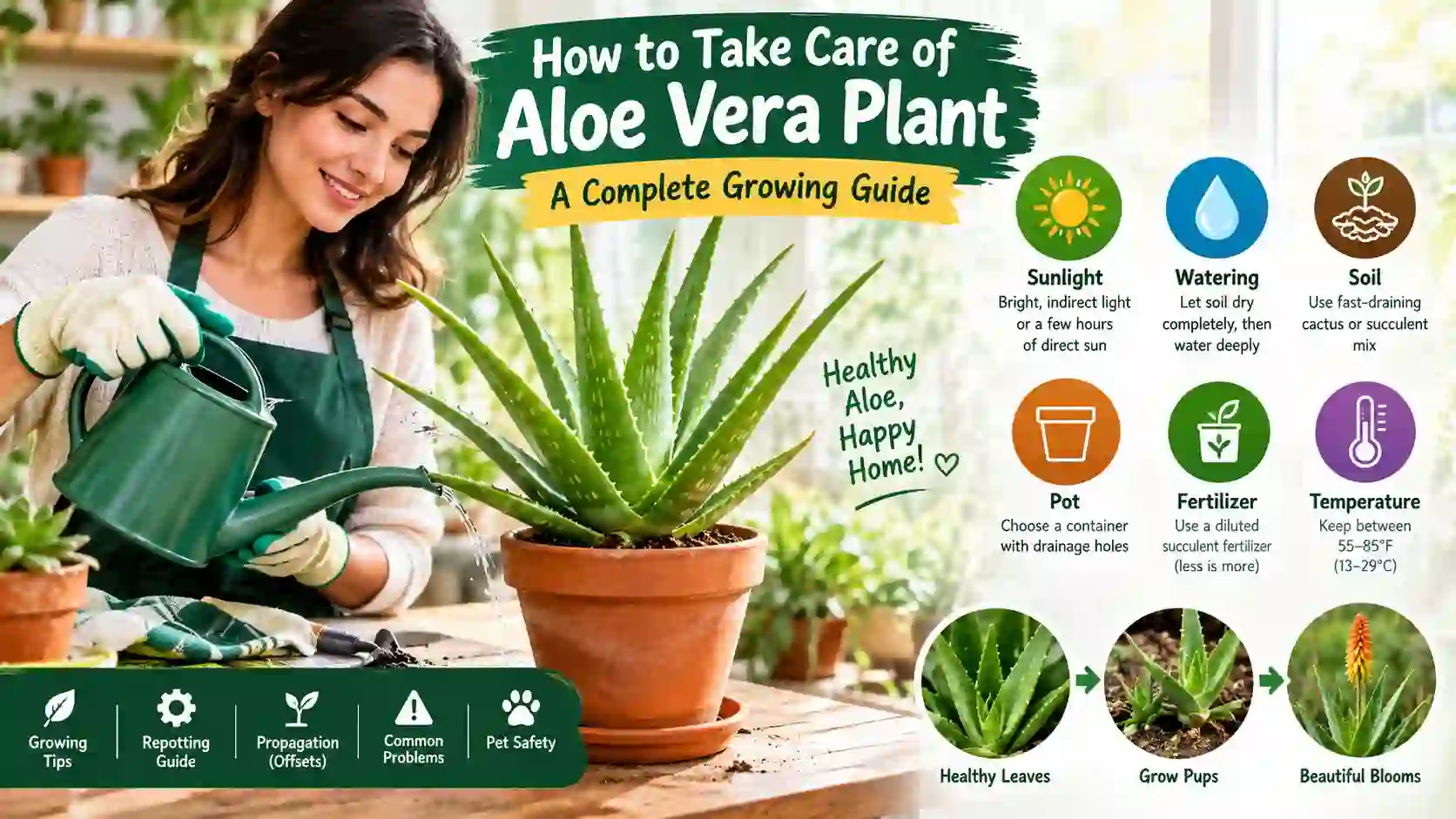
To take care of an aloe vera plant, place it where it receives bright, indirect light or several hours of gentle sunlight. Use a pot with drainage holes and a fast-draining cactus or succulent mix. Water deeply only when the soil has dried out completely, then let excess water drain away. Avoid leaving the plant in standing water, and protect it from frost. Aloe vera usually needs less water and attention than many houseplants.
Introduction
Knowing how to take care of aloe vera plant starts with understanding what this succulent needs—and what can harm it. Aloe vera stores water in its thick leaves, so it does not need frequent watering. However, it still needs enough light, suitable soil, and a container that drains properly.
Many aloe plants struggle because they sit in wet soil or receive too little sunlight. Others develop brown patches after being moved suddenly into strong direct sun. These problems are usually preventable with a few simple adjustments.
This guide explains how to grow aloe vera indoors or outdoors, recognize signs of stress, and maintain a healthy plant throughout the year. You will also learn how to repot aloe, separate its pups, and avoid common care mistakes.
🌿 Understanding Aloe Vera
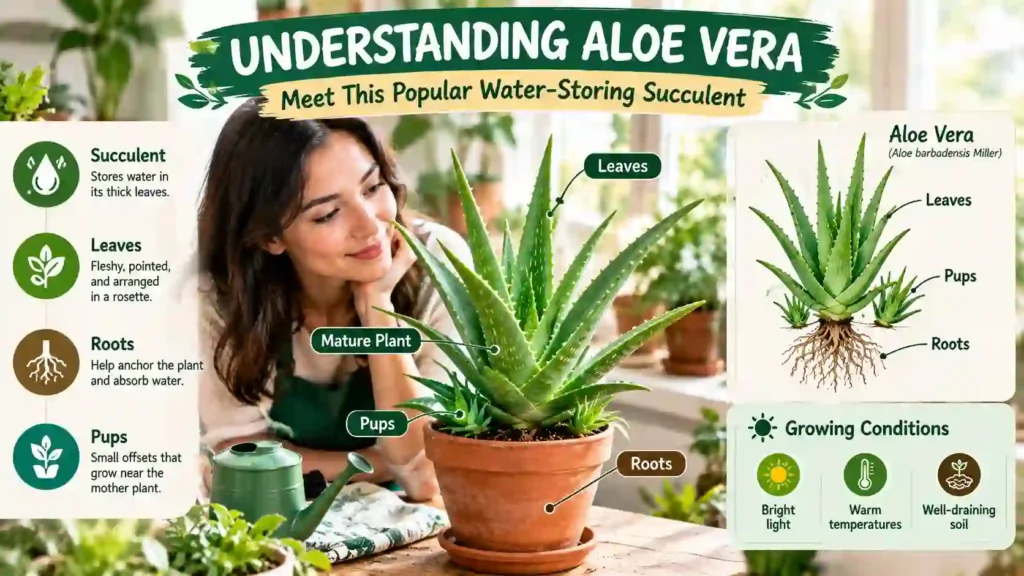
Aloe vera (Aloe vera, also known as Aloe barbadensis Miller) is a succulent with thick, fleshy leaves arranged in a rosette. It stores water in its leaves, allowing it to tolerate dry conditions better than many ordinary houseplants.
The plant is native to the Arabian Peninsula and is widely cultivated in warm regions. It can grow in containers indoors and outdoors where temperatures remain suitable. Mature plants may produce tall flower stalks, although indoor plants do not always bloom. <Cite refs={}/>
Why aloe vera is popular
- Low-maintenance growth: It can tolerate periods of dry soil once established.
- Distinctive appearance: Its upright, fleshy leaves make it an attractive houseplant.
- Easy propagation: Mature plants often produce small offsets, commonly called pups.
- Versatile placement: It can grow indoors near a bright window or outdoors in a suitable climate.
Image suggestion: A labeled botanical illustration showing aloe vera’s rosette, fleshy leaves, roots, and offsets.
☀️ How Much Sunlight Does Aloe Vera Need?
Aloe vera needs plenty of light to grow compact, sturdy leaves. Indoors, place it near a bright window where it receives strong natural light. A south- or west-facing window may work well, depending on the climate and intensity of the sun. <Cite refs={}/>
Best lighting conditions
- Indoors: Choose a bright windowsill or another location with several hours of good light.
- Outdoors: Give the plant sun appropriate to your climate. In very hot areas, protect it from harsh afternoon exposure.
- When moving outside: Introduce stronger sunlight gradually instead of moving it directly from a dim room into intense sun.
Aloe can develop pale, brown, or scorched patches when exposed to intense sunlight too suddenly. On the other hand, inadequate light can cause weak, stretched growth or leaves that spread outward.
Signs your aloe needs a lighting adjustment
| What you notice | Possible cause | What to do |
|---|---|---|
| Long, stretched growth | Insufficient light | Move it gradually to a brighter location |
| Leaves leaning strongly toward a window | Uneven light | Rotate the pot periodically |
| Dry, bleached, or scorched patches | Sunlight became too intense | Reduce direct exposure and acclimate more slowly |
| Slow growth in a dim room | Not enough usable light | Move it closer to a bright window |
Practical tip: Rotate the pot occasionally so one side does not receive all the light. Avoid frequent changes between very different lighting conditions.
Image suggestion: A simple comparison showing a compact aloe in bright light beside a stretched aloe in a dim location.
💧 How Often Should You Water Aloe Vera?
Water aloe vera only after its soil has dried out thoroughly. Then water the soil deeply and let the excess drain through the pot. Do not leave the container standing in water.
Overwatering is a major cause of aloe problems because persistently wet soil can damage the roots. The plant stores moisture in its leaves, so it can usually tolerate dry periods better than waterlogged roots. <Cite refs={}/>
A practical watering routine
- Check the soil with your finger or a wooden stick.
- If the soil is still damp below the surface, wait.
- When the soil has dried thoroughly, water slowly until excess water drains out.
- Empty the saucer or outer pot so the roots are not left sitting in water.
- Check the soil again before watering next time.
How often should you water?
There is no single schedule that works for every aloe plant. The timing depends on temperature, light, pot size, soil, and season.
| Conditions | Watering approach |
|---|---|
| Warm, bright growing conditions | Check the soil regularly and water when it has dried thoroughly |
| Cool weather or winter dormancy | Water less often because the plant usually grows more slowly |
| Small pot in a warm, bright location | Check more frequently because it may dry faster |
| Large pot or dense soil | Be especially careful; the soil may stay wet for too long |
A schedule such as every two or three weeks can be a rough starting point in some homes, but always check the soil instead of watering by the calendar. <Cite refs={}/>
Signs of watering problems
- Soft, mushy, or translucent leaves: The plant may be receiving too much water or suffering from root damage.
- Wrinkled or thinner leaves: The plant may need water, although damaged roots can also prevent it from absorbing moisture.
- Yellowing leaves with wet soil: Check for excessive watering and poor drainage.
- Dry, shriveled leaves with very dry soil: Water thoroughly and review how quickly the pot dries.
Image suggestion: A side-by-side infographic of healthy aloe, underwatered aloe, and overwatered aloe, with clear labels.
🪴 Choose the Right Soil and Pot
Aloe vera needs a growing medium that drains quickly. Ordinary potting soil can hold too much moisture when used by itself, especially in a deep container or a cool room.
Use a commercial cactus and succulent mix, or improve a suitable potting medium with coarse mineral material such as perlite or pumice. The goal is a mix that allows water to pass through while giving the roots enough support. <Cite refs={}/>
What kind of pot is best?
Choose a container with drainage holes. Unglazed terracotta can be helpful because it allows moisture to evaporate through the pot’s sides.
Select a pot only slightly larger than the root ball. An oversized container holds more unused soil, which may stay wet longer than the roots can tolerate. <Cite refs={}/>
Soil and container checklist
- Use a fast-draining succulent mix.
- Choose a pot with at least one open drainage hole.
- Avoid letting the pot sit in collected water.
- Select a container that comfortably fits the roots without excessive extra space.
- Do not bury the base of the leaves deeply in the soil.
Image suggestion: A labeled diagram of an aloe vera pot showing drainage holes, gritty soil, the root ball, and the correct planting depth.
🌡️ Temperature and Humidity
Aloe vera prefers warm conditions and does not tolerate frost well. Keep indoor plants away from cold drafts and protect outdoor plants when temperatures are expected to drop too low. South Dakota State University Extension lists approximately 55–85°F (13–29°C) as a suitable temperature range for aloe houseplants. <Cite refs={}/>
Aloe does not need unusually high humidity. Typical indoor humidity is generally suitable, and misting the leaves is unnecessary.
Seasonal placement tips
- In warm weather, you can move an indoor aloe outdoors gradually.
- Before cold weather arrives, bring container-grown plants inside if frost is possible.
- Avoid placing the plant against a cold, drafty window during winter.
- In very hot climates, provide protection from the harshest afternoon sun if the leaves show scorching.
Image suggestion: A seasonal care graphic showing aloe vera in a bright indoor spot, outdoors in mild weather, and protected from cold conditions.
🌱 How to Fertilize Aloe Vera

Aloe vera is not a heavy feeder. Too much fertilizer can cause unnecessary stress and may encourage weak growth. Many plants grow well with little or no feeding when they receive suitable light, water, and soil.
If you choose to fertilize, use a fertilizer formulated for cacti and succulents or a balanced houseplant fertilizer diluted according to its label. Apply sparingly during active growth rather than repeatedly feeding a plant that is dormant or struggling. <Cite refs={}/>
Fertilizing tips
- Feed during the active growing season if the plant needs it.
- Use a diluted dose and follow the product instructions.
- Avoid fertilizing dry, severely stressed, or recently damaged roots.
- Do not use fertilizer as a substitute for better light or drainage.
✂️ Pruning and Routine Maintenance
Aloe vera does not need frequent pruning. Remove leaves that are completely dead or badly damaged, but leave healthy green leaves in place. They store water and help the plant continue growing.
Use clean, sharp scissors or a knife when removing damaged leaves. Cut close to the base without injuring nearby leaves or the plant’s growing center.
Simple maintenance routine
- Remove dead leaves and dried flower stalks.
- Wipe dust from the leaves with a soft, damp cloth.
- Check the leaf bases and soil surface for pests.
- Rotate the pot periodically for more even light.
- Inspect drainage and soil condition when watering.
Avoid cutting healthy leaves just to make the plant smaller. If the aloe has outgrown its container, repotting or separating offsets is usually more appropriate.
🔄 When and How to Repot Aloe Vera
Repot aloe when it becomes crowded, the roots fill the container, the pot becomes unstable, or the growing medium no longer drains properly. Repotting every couple of years may be useful for some plants, but the plant’s condition matters more than a strict timetable. <Cite refs={}/>
Repotting steps
- Choose a pot with drainage holes that is only slightly larger than the root ball.
- Remove the plant carefully, supporting the base rather than pulling hard on the leaves.
- Inspect the roots and remove any clearly dead or rotten sections with a clean tool.
- Place the plant in fresh, fast-draining succulent mix.
- Keep the leaf bases above the soil surface.
- Allow any damaged roots time to settle before returning to normal watering.
If the plant has been divided or has significant root damage, avoid immediately soaking the soil. Give wounds time to dry and follow a cautious watering approach while the plant re-establishes.
Image suggestion: A step-by-step repotting illustration showing removal, root inspection, placement in fresh mix, and the finished plant.
🌿 How to Propagate Aloe Vera from Pups
Aloe vera commonly produces small offsets, or pups, near the base of a mature plant. These can be separated and grown into new plants once they are large enough to handle. Division is a standard propagation method for aloe. <Cite refs={}/>
Propagation steps
- Remove the mother plant from its pot or gently expose the pup’s base.
- Look for an offset with its own roots, if possible.
- Separate it carefully using a clean knife if it remains attached.
- Let any cut surface dry before planting.
- Place the pup in a small pot with drainage holes and succulent mix.
- Keep it in bright light and water cautiously while it establishes.
Very small pups without roots may take longer to establish. Avoid placing them in a large pot or keeping their soil constantly wet.
Image suggestion: A close-up sequence showing aloe pups attached to the mother plant, a separated pup, and a newly potted offset.
🩺 Aloe Vera Problems: Symptoms and Solutions
Aloe problems often begin with an environmental issue rather than a need for extra products. Check light, soil moisture, drainage, and temperature before changing several things at once.
| Problem | Possible reason | What to do |
|---|---|---|
| Leaves become soft or mushy | Excess moisture or root rot | Stop watering, check the roots, and improve drainage |
| Leaves wrinkle or thin | Dry soil or damaged roots | Check soil moisture and root health before watering |
| Leaves turn yellow | Overwatering, poor drainage, or stress | Inspect the soil and adjust watering conditions |
| Brown, dry patches appear | Sun scorch, cold damage, or physical injury | Review recent exposure and protect the plant from stress |
| Leaves stretch or flop outward | Insufficient light | Move the plant gradually to a brighter position |
| Plant becomes crowded | Offsets have filled the pot | Repot or separate suitable pups |
| White cottony clusters appear | Possible mealybugs | Isolate the plant, inspect leaf bases, and remove pests carefully |
Aloe may also be affected by pests such as mealybugs and aphids. Root and leaf diseases can occur, particularly when growing conditions remain too wet. <Cite refs={}/>
How to check for root rot
If the plant remains soft despite dry soil, or the base smells unpleasant, inspect the roots.
- Healthy roots are generally firm.
- Rotten roots may be dark, soft, or slimy.
- Remove badly damaged roots with a clean tool.
- Replace soggy or unsuitable soil with a fast-draining mix.
- Use a pot that drains freely.
Do not assume every brown leaf means root rot. Sun exposure, cold, physical damage, and normal aging can also change leaf color.
🐾 Is Aloe Vera Safe for Pets?
Aloe vera can be harmful if cats or dogs eat it. The ASPCA lists aloe as toxic to cats and dogs, so keep the plant and fallen leaves out of their reach. If you think a pet has eaten aloe, contact a veterinarian or an animal poison-control service for advice. <Cite refs={}/>
🌞 Growing Aloe Vera Indoors vs. Outdoors
Aloe vera can grow in either setting when its basic needs are met. The main difference is how quickly the soil dries and how much sunlight and temperature exposure the plant receives.
| Factor | Indoors | Outdoors |
|---|---|---|
| Light | Bright window or strong indirect light | Sun exposure suited to the local climate |
| Watering | Often dries more slowly in cool or dim rooms | May dry faster in warm, sunny, windy conditions |
| Temperature | Protect from cold windows and drafts | Protect from frost and extreme heat |
| Drainage | Use a pot with drainage holes and suitable mix | Ensure containers or garden soil drain freely |
| Main concern | Insufficient light or excess watering | Sudden sun exposure, rain-soaked soil, heat, or cold |
In warm regions, aloe can be grown outdoors where conditions are frost-free. In colder areas, container growing makes it easier to move the plant indoors when necessary. <Cite refs={}/>
🇵🇰 Aloe Vera Care in Hot Climates
In hot climates, including areas where summer afternoons become intensely hot, aloe vera may need protection from the strongest direct sun. A plant that has been growing indoors should not be moved straight into full outdoor sunlight.
For hot-weather care:
- Introduce outdoor sunlight gradually.
- Consider morning sun and protection from harsh afternoon exposure.
- Check soil moisture more often during hot, dry spells—but water only when the soil has dried sufficiently.
- Make sure heavy rain cannot leave the pot sitting in water.
- Move container-grown plants to a protected place when temperatures become unsuitable.
The plant still needs plenty of light. The goal is to balance strong light with protection from sudden or excessive exposure. <Cite refs={}/>
❌ Common Aloe Vera Care Mistakes to Avoid
1. Watering on a fixed schedule
A plant may need water sooner in a warm, bright room than in a cool, dim one. Check the soil before watering.
2. Using a pot without drainage
Water trapped around the roots increases the risk of rot. Choose a pot with open drainage holes.
3. Keeping aloe in a dark corner
Low light can cause stretched, weak growth. Move it toward a brighter location gradually.
4. Exposing it suddenly to strong sunlight
Aloe grown indoors may scorch when moved directly into intense sun. Acclimate it over time.
5. Choosing a pot that is much too large
Excess soil can remain wet around the roots. Select a container only modestly larger than the root ball.
6. Feeding too often
Aloe does not need heavy fertilizing. Excess feeding will not fix poor light, unsuitable soil, or watering problems.
7. Ignoring changes in leaf texture
Softness, shriveling, or unusual discoloration can signal stress. Check the plant’s roots and growing conditions instead of guessing.
❓ Frequently Asked Questions
How do you take care of an aloe vera plant indoors?
Place it near a bright window, use fast-draining succulent soil, and choose a pot with drainage holes. Water thoroughly only after the soil has dried out, and keep it away from frost and cold drafts.
How often should I water my aloe vera plant?
Water when the soil has dried thoroughly. The interval varies with light, temperature, pot size, and season, so check the soil rather than following a fixed calendar.
Does aloe vera need direct sunlight?
Aloe needs plenty of light and can tolerate direct sun when acclimated. Strong sunlight may scorch a plant that has been kept indoors or in shade, so increase exposure gradually.
Why are my aloe vera leaves turning brown?
Brown leaves or patches can result from intense sunlight, cold exposure, physical damage, or watering problems. Check where the damage appears and review recent changes in the plant’s environment.
Why is my aloe vera plant turning soft?
Soft or mushy leaves can indicate excess water or damaged roots. Check whether the soil is wet, inspect the roots if necessary, and improve drainage.
Can aloe vera grow in a bathroom?
It can grow in a bathroom if the room receives enough bright light and the soil dries between waterings. A dark bathroom is usually unsuitable without supplemental plant lighting.
Should I mist my aloe vera plant?
No special misting routine is needed. Aloe is adapted to relatively dry conditions, and keeping the leaves or soil persistently damp is not helpful.
How do I make my aloe vera grow faster?
Provide strong suitable light, fast-draining soil, correct watering, and enough room for the roots. Aloe is not a plant that benefits from constant watering or heavy feeding.
Can aloe vera survive winter?
It can survive indoors through winter when protected from frost and given suitable light. Reduce watering when growth slows and avoid leaving the soil constantly damp.
Is aloe vera safe for cats and dogs?
No. Aloe vera is listed as toxic to cats and dogs if eaten. Keep it out of reach and seek veterinary advice if a pet ingests it. <Cite refs={}/>
Conclusion
Learning how to take care of aloe vera plant is mostly about getting a few essentials right. Give it plenty of suitable light, plant it in a fast-draining mix, and use a container with drainage holes. Water thoroughly when the soil has dried out, then allow excess water to escape. Reduce watering during cooler periods, protect the plant from frost, and introduce stronger sunlight gradually.
Watch the leaves for changes in texture and color, but check the roots and growing conditions before deciding what is wrong. With thoughtful watering and good drainage, aloe vera can remain a healthy, attractive plant for years. If it produces pups, you can also use them to grow new plants and expand your collection.