Quick Answer
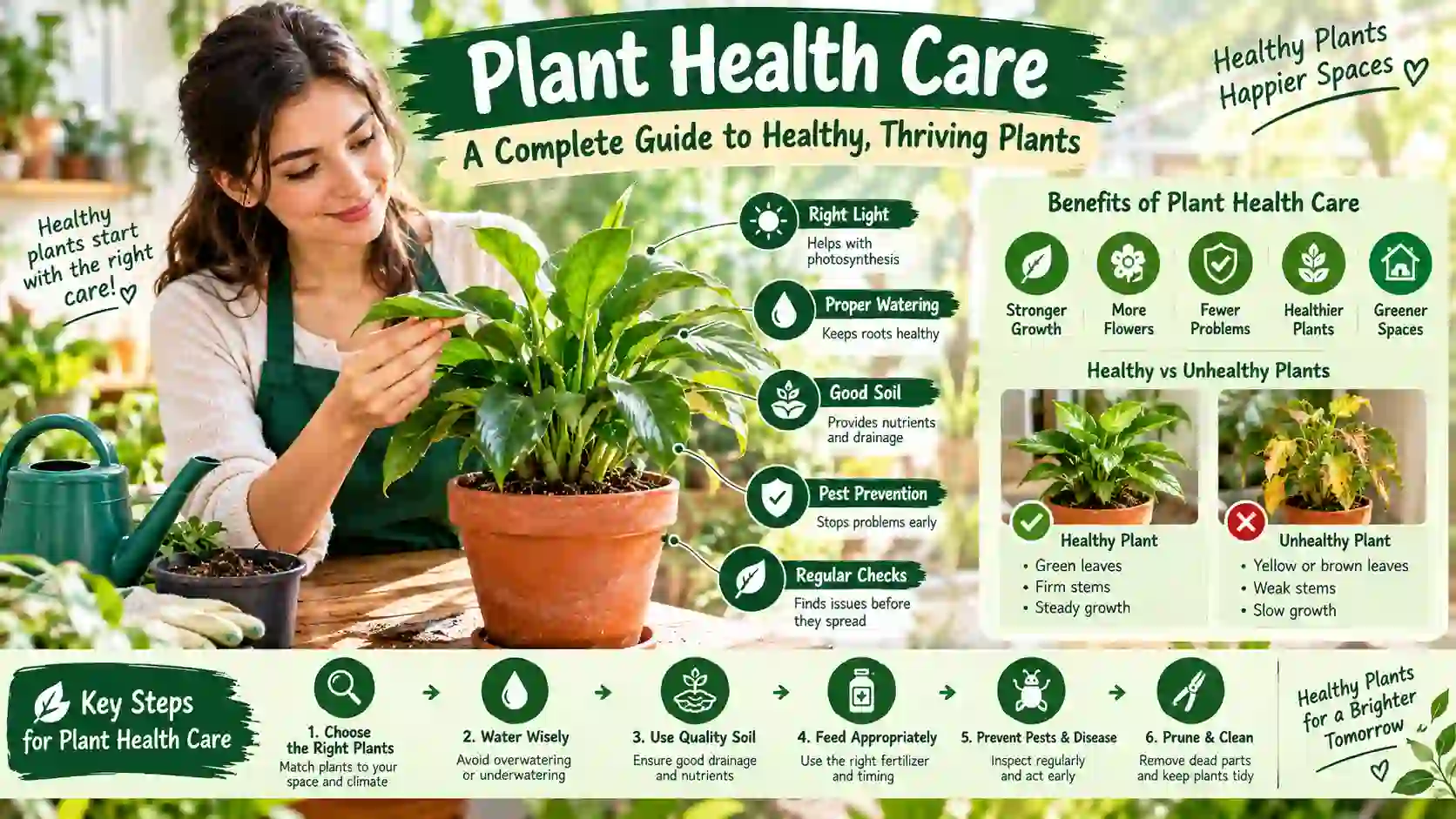
Plant health care means giving plants the right growing conditions and checking them regularly for signs of stress, pests, or disease. Healthy plants need suitable light, properly timed watering, well-draining soil, appropriate nutrients, and enough space to grow. Inspect leaves, stems, and soil often, and address problems early. Match care to each plant’s species, season, and environment rather than following one routine for every plant.
This article treats plant health care as a practical system for preventing problems, monitoring plants, and responding when something goes wrong—not simply watering and fertilizing on a schedule.
Edit
Introduction
Healthy plants do more than look attractive. They create welcoming spaces, support garden ecosystems, and reward you with steady growth, flowers, or harvests. But keeping plants healthy can feel confusing when leaves turn yellow, growth slows, or pests suddenly appear.
Plant health care gives you a practical way to prevent these problems and respond before they become severe. It combines suitable plant selection, proper growing conditions, regular observation, and informed treatment.
The most important lesson is simple: a struggling plant does not always need more water, fertilizer, or pesticide. Its symptoms may come from poor drainage, unsuitable light, temperature stress, root damage, pests, or disease. Several causes can also occur together.
This guide explains how to build a plant care routine, recognize early warning signs, troubleshoot common problems, and make responsible treatment decisions.
🌿 What Is Plant Health Care?
Plant health care is a preventive approach to maintaining plants and managing problems throughout their growth. It focuses on keeping plants in suitable conditions while identifying and addressing potential threats early.
It can apply to:
- Indoor houseplants
- Outdoor ornamental plants
- Trees and shrubs
- Vegetable and fruit gardens
- Lawns and landscape plants
- Plants grown in containers or greenhouses
Plant health care overlaps with integrated pest management (IPM). IPM combines observation, prevention, cultural practices, physical controls, biological methods, and carefully selected pesticides when necessary. The aim is to manage problems effectively while reducing unnecessary harm to people, beneficial organisms, and the environment. <Cite refs={}/>
Plant care versus plant health care
| Routine plant care | Plant health care |
|---|---|
| Focuses on everyday tasks such as watering and pruning | Combines routine care with prevention, monitoring, and diagnosis |
| May follow a regular schedule | Adjusts actions to the plant’s needs and changing conditions |
| Often responds to visible problems | Tries to identify risks before serious damage occurs |
| May treat symptoms directly | Looks for the underlying cause before choosing a treatment |
Both approaches matter. Good everyday care is the foundation of a plant health care plan.
🪴 Start With the Right Plant in the Right Place
One of the most effective ways to prevent plant problems is to choose plants suited to their growing environment. A plant that needs full sun may struggle in a dark room. A moisture-loving plant may decline in dry soil, while a drought-tolerant succulent may rot in constantly wet conditions.
Extension guidance emphasizes matching plants to site conditions, including sunlight, soil, drainage, and climate. <Cite refs={}/>
Check these conditions before planting
Light: Determine whether the plant needs full sun, partial sun, bright indirect light, or shade.
Soil: Consider soil texture, drainage, pH requirements, and the plant’s nutrient needs.
Water: Find out whether the plant prefers consistently moist soil or needs the soil to dry between waterings.
Temperature: Check whether the plant tolerates local summer heat, winter cold, and sudden temperature changes.
Space: Allow enough room for mature roots, stems, and foliage. Crowded plants may have poor airflow and become harder to inspect.
Practical example: If a plant repeatedly wilts in a hot, exposed spot despite appropriate watering, the location may be unsuitable. Moving it to a better-matched site may help more than adding fertilizer.
Image suggestion: A garden infographic showing the “right plant, right place” concept, with sun, shade, soil, water, and temperature icons.
☀️ Give Plants the Light They Actually Need
Light powers photosynthesis, the process plants use to make sugars for growth. Too little light can lead to weak, stretched growth, while excessive sunlight can scorch leaves on plants that are not adapted to it.
How to assess light
- Observe how many hours of direct sunlight reach the area.
- Notice whether nearby buildings or trees create shade.
- Check whether the light changes significantly between seasons.
- Watch the plant’s growth after moving it.
- Acclimate plants gradually when increasing their exposure to direct sun.
Indoor plants may receive much less usable light than a bright room appears to provide. If a plant becomes leggy or leans strongly toward a window, insufficient light may be one cause. However, consider the plant species before making changes.
Image suggestion: A comparison of plants growing in suitable light, excessive direct sun, and insufficient light.
💧 Water Wisely Instead of Following a Fixed Schedule
Watering mistakes can damage roots and foliage. Too much water may reduce oxygen around roots and encourage root decay. Too little water can cause wilting, leaf drop, and reduced growth.
There is no universal watering schedule for all plants. Water needs depend on species, pot size, soil, light, temperature, humidity, and season. <Cite refs={}/>
A reliable watering method
- Check the soil before watering.
- Learn whether the plant prefers evenly moist soil or a drying period.
- Water the root zone thoroughly when the plant needs it.
- Allow excess water to drain from containers.
- Empty saucers when water collects in them.
- Recheck moisture rather than automatically watering again the next day.
For outdoor plants, account for rainfall and the soil’s drainage. A garden bed that receives heavy rain may need less supplemental water than a raised bed or container.
Avoid these watering mistakes
- Watering every plant on the same day regardless of its needs.
- Assuming a wilted plant is always thirsty.
- Leaving pots in standing water.
- Using containers without drainage for plants that are sensitive to wet roots.
- Giving frequent small splashes when the plant needs a thorough watering.
Important: Wilting can result from dry soil, damaged roots, excessive heat, or waterlogged soil. Check the root zone and growing conditions before deciding how to respond. <Cite refs={}/>
Image suggestion: A watering infographic showing soil moisture checks, thorough watering, and proper drainage.
🌱 Maintain Healthy Soil and Roots
Roots absorb water and nutrients while anchoring the plant. If roots are unhealthy, the plant may struggle even when its leaves receive adequate light.
What healthy growing media should provide
- Suitable drainage and aeration
- Enough moisture retention for the plant
- Physical support for the roots
- Appropriate nutrient availability
- A pH range suited to the species
Different plants need different growing media. A cactus or succulent generally needs a faster-draining mix than a plant that naturally grows in consistently moist soil.
Improve soil without overcorrecting
Before adding amendments, consider what the soil actually lacks. Compost can improve many garden soils, but it is not a universal solution for every container plant. Likewise, adding sand to clay soil without understanding the proportions and soil structure may not improve drainage.
For container plants, use a potting mix suited to the species rather than assuming garden soil will work well in every pot.
Check the roots when symptoms persist
If a plant continues to decline despite reasonable care, inspect the roots when practical.
- Firm roots are generally healthier than soft, decaying roots.
- Dark, mushy roots may indicate rot or other damage.
- Roots tightly circling a container may indicate that the plant is root-bound.
- A sour or unpleasant smell from wet growing media can be a warning sign.
Root appearance varies by plant species, so use the plant’s normal characteristics as a reference.
Image suggestion: A labeled illustration comparing healthy roots, crowded roots, and roots showing possible rot.
🧪 Fertilize According to Plant Needs
Fertilizer supplies nutrients plants use for growth. However, applying more fertilizer does not automatically make a plant healthier.
Excess fertilizer can damage roots or create salt buildup in the growing medium. Nutrient problems can also resemble symptoms caused by poor light, damaged roots, or improper watering. <Cite refs={}/>
A sensible fertilizing routine
- Identify the plant and learn its nutrient requirements.
- Consider whether it is actively growing or dormant.
- Choose a fertilizer suitable for the plant.
- Follow the label’s application rate and timing.
- Avoid feeding a severely stressed plant until you understand the cause.
- Monitor new growth and adjust care if necessary.
Some plants need regular feeding during active growth. Others thrive with limited fertilizer. Newly purchased plants may already contain nutrients in their growing mix, so check before adding more.
Expert tip: If older leaves are yellowing, do not immediately assume the plant needs nitrogen. Poor drainage, insufficient light, pests, and root problems can produce similar symptoms. Diagnose the likely cause before applying fertilizer.
Image suggestion: An infographic showing measured fertilizer application, a product label, and signs of possible overfertilization.
🔍 Inspect Plants Regularly for Early Warning Signs
Regular observation is one of the simplest ways to improve plant health. Pests and diseases are often easier to manage when detected early. Extension recommendations encourage frequent inspection of foliage, stems, and other plant parts. <Cite refs={}/>
What to inspect
- Leaves: Look for spots, yellowing, holes, curling, webbing, or unusual discoloration.
- Leaf undersides: Check for insects, eggs, mites, and fine webbing.
- Stems: Look for lesions, soft areas, cracks, or unusual growth.
- Growing tips: Notice distorted leaves, damaged buds, or stalled growth.
- Soil surface: Check for persistent wetness, mold-like growth, or fungus gnats.
- Roots: Inspect when the plant’s condition suggests a root problem.
How often should you inspect?
Use a routine that fits your garden:
- Check houseplants briefly during regular watering and maintenance.
- Inspect outdoor plants more closely during active growth or when pests are common.
- Increase monitoring after bringing new plants home or moving plants indoors.
- Recheck plants after treatment to see whether the problem is improving.
A quick inspection is useful, but do not rely on one glance at the upper leaves. Many pests hide beneath foliage or near stem joints.
Image suggestion: A close-up visual guide showing where to inspect a plant for pests and damage.
🐛 Prevent and Manage Pests With Integrated Pest Management
Integrated pest management, or IPM, uses several compatible methods to prevent and manage pests. It begins with correct identification and monitoring rather than automatically spraying every damaged plant. <Cite refs={}/>
Step 1: Identify the problem
Look for the pest itself, feeding damage, eggs, webbing, or other clues. Similar symptoms can have different causes, so avoid treating an unidentified problem with a random product.
Step 2: Reduce conditions that favor the pest
Depending on the situation, useful measures may include:
- Improving plant care and reducing stress.
- Removing dead or heavily infested plant material.
- Improving spacing and airflow where appropriate.
- Avoiding excessive watering or fertilizer.
- Removing weeds or debris that harbor certain pests.
Step 3: Use physical or biological controls when appropriate
Some pests can be removed by hand, washed from foliage, or managed with barriers. Beneficial insects and other biological controls may help in suitable outdoor or greenhouse settings.
Step 4: Consider pesticides only when justified
If other measures are insufficient and treatment is necessary, identify the pest and choose a product labeled for the intended plant and problem. Follow all label directions, including application rates, protective equipment, and restrictions.
Indoor pesticide use requires particular care because people and pets share the same space. The National Pesticide Information Center recommends minimizing pesticide exposure and considering IPM approaches for houseplants. <Cite refs={}/>
Image suggestion: A flowchart showing pest identification, monitoring, cultural controls, physical controls, and careful pesticide use when needed.
🍂 Keep Plants Clean and Prune Carefully
Sanitation helps make plant problems easier to detect and may reduce some sources of pests and disease. Remove dead leaves, fallen debris, and clearly diseased material when appropriate. Clean tools between plants when working with suspected infections.
Pruning best practices
- Use clean, sharp tools.
- Remove dead or damaged growth without unnecessarily cutting healthy tissue.
- Learn the plant’s flowering and growth habits before pruning.
- Avoid severe pruning unless the species and situation call for it.
- Dispose of diseased material appropriately rather than leaving it beside healthy plants.
Pruning is not a cure for every problem. If a plant is declining because of poor roots, unsuitable light, or a nutrient issue, removing healthy foliage may add stress instead of solving the cause.
Image suggestion: A gardener using clean pruning shears to remove damaged leaves, with a small tool-cleaning reminder.
🌦️ Adjust Plant Health Care With the Seasons
Plant needs change as temperatures, daylight, rainfall, and growth rates change. A routine that works in spring may not be suitable during winter dormancy or extreme summer heat.
Spring
- Check plants for winter damage.
- Resume feeding only when appropriate for the species and active growth.
- Inspect container roots and repot plants when needed.
- Gradually acclimate indoor plants to outdoor conditions.
Summer
- Monitor soil moisture during hot or dry weather.
- Watch for heat stress, sun scorch, and increased pest activity.
- Water at suitable times and avoid unnecessary wetting of foliage when disease risk is high.
- Protect shade-loving plants from excessive direct sun.
Autumn
- Remove fallen debris where it may harbor pests or disease.
- Prepare tender plants for cooler temperatures.
- Reduce feeding when growth slows, according to the plant’s needs.
- Review watering as evaporation and growth rates change.
Winter
- Protect frost-sensitive plants.
- Reduce watering for plants that grow more slowly, while avoiding prolonged severe drought.
- Provide adequate light indoors.
- Check plants for pests before moving them inside.
Image suggestion: A four-season plant care calendar with seasonal inspection, watering, pruning, and protection reminders.
🚨 Troubleshooting Common Plant Health Problems
Plant symptoms are clues, not always a diagnosis. Several different problems can produce similar changes, so examine the plant’s environment and recent care before choosing a treatment. UC IPM notes that houseplant decline can be linked to watering, fertilizer, roots, sanitation, pests, and environmental conditions. <Cite refs={}/>
| Symptom | Possible causes | First steps |
|---|---|---|
| Yellow leaves | Excess water, insufficient light, nutrient issues, pests, or natural aging | Check soil moisture, light, leaf age, and pests |
| Brown leaf tips | Dry conditions, fertilizer salts, low humidity, or other environmental stress | Review watering, feeding, humidity, and water quality |
| Wilting | Dry soil, heat stress, damaged roots, or waterlogged soil | Check moisture and inspect roots if symptoms persist |
| Leggy growth | Often insufficient light | Assess light levels and adjust gradually |
| Leaf spots | Sun scorch, chilling, physical or chemical injury, or disease | Review recent exposure and inspect the pattern of damage |
| Stunted growth | Root restriction, unsuitable light, temperature stress, pests, or nutrient problems | Check roots, growing conditions, and pest signs |
| Sticky leaves | Possible sap-feeding insects such as aphids, scale, or mealybugs | Inspect leaves and stems closely |
| Fine webbing | Possible spider mites | Inspect leaf undersides and look for mites or stippling |
These are possible explanations, not guaranteed diagnoses. If the plant is valuable or the problem is spreading quickly, seek help from a local extension service, qualified horticulturist, or plant clinic.
A useful diagnostic habit: change one major factor at a time
When several care conditions are changed at once, it becomes difficult to tell which adjustment helped. If the plant is not in immediate danger, make a targeted change and observe the new growth.
For example, if a plant is stretching toward a window, improving light may be a reasonable first adjustment. Do not automatically repot, fertilize, prune, and change the watering routine simultaneously unless there is a clear reason.
Image suggestion: A plant troubleshooting chart linking common symptoms to checks for water, light, roots, temperature, and pests.
🗓️ Create a Simple Plant Health Care Routine
A repeatable routine makes it easier to notice changes without turning plant care into a long daily chore.
Weekly check
- Inspect leaves, stems, and leaf undersides.
- Check soil moisture for plants that may need watering.
- Look for pests, webbing, spots, or unusual growth.
- Remove fallen leaves and debris.
- Check outdoor plants for weather-related stress.
Monthly check
- Review whether each plant is receiving suitable light.
- Check containers for drainage problems or instability.
- Assess whether feeding is appropriate for the season and plant.
- Clean dusty foliage when suitable for the species.
- Record recurring problems and any treatments used.
Seasonal check
- Review plants’ temperature and light needs.
- Repot or divide plants when necessary.
- Prepare sensitive plants for heat, cold, or changing daylight.
- Reassess watering as growth and weather change.
Keep a short plant care record
A simple notebook or spreadsheet can include:
| Record | What to note |
|---|---|
| Plant identity | Common and scientific name, if known |
| Location | Window, room, garden bed, or patio |
| Watering | Date, soil condition, and any response |
| Feeding | Product, dilution, and application date |
| Symptoms | Leaf changes, pests, wilting, or growth changes |
| Actions | Pruning, repotting, relocation, or treatment |
| Follow-up | Whether new growth improved or symptoms continued |
This record can help reveal patterns. For example, repeated leaf damage after moving a plant outdoors may point toward a change in sun or temperature exposure.
Image suggestion: A clean printable plant health checklist or sample plant care journal.
🏡 Indoor and Outdoor Plant Health Care: Key Differences
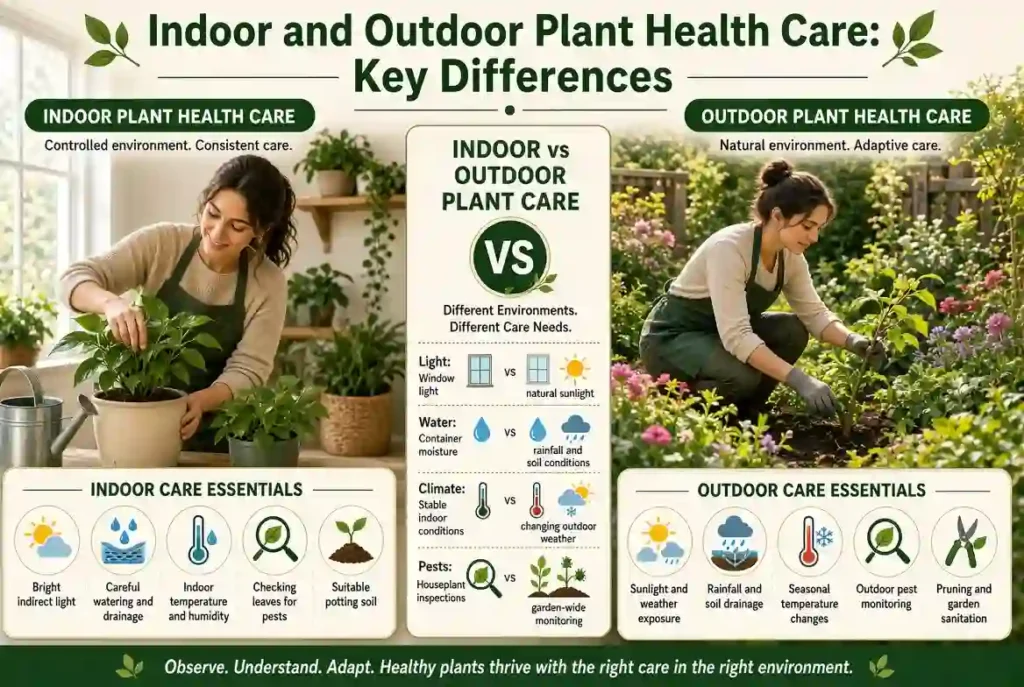
Indoor and outdoor plants share basic needs, but their environments create different challenges.
| Factor | Indoor plants | Outdoor plants |
|---|---|---|
| Light | Window direction, distance, and indoor shading matter | Sun exposure changes with weather, trees, and buildings |
| Water | Pots may dry slowly in cool or dim rooms | Rain, wind, and heat can change soil moisture quickly |
| Pests | New plants can introduce pests; inspect leaf undersides | A wider range of insects and other organisms may be present |
| Temperature | Watch drafts, heaters, air conditioners, and cold windows | Watch frost, heatwaves, wind, and sudden weather changes |
| Soil | Container mix and drainage are especially important | Garden soil structure, drainage, and site conditions matter |
| Monitoring | Inspect individual plants and isolate affected ones | Monitor groups of plants and look for patterns across the garden |
For indoor plants, isolating a newly purchased or infested plant can reduce the chance of pests spreading. For outdoor plants, choosing suitable species and observing the garden ecosystem can support longer-term prevention. <Cite refs={}/>
⚠️ When to Seek Expert Help
Some plant problems are difficult to diagnose from a photograph or a brief description. Consider professional help when:
- A disease-like problem spreads rapidly through several plants.
- A tree or large shrub develops major dieback or structural damage.
- The plant continues declining despite correcting obvious environmental problems.
- You suspect a serious pest or regulated plant disease.
- You need to select a pesticide but cannot confidently identify the target.
- The plant is valuable, rare, or difficult to replace.
A local extension service, plant diagnostic laboratory, qualified arborist, or experienced horticulturist may be able to examine symptoms and recommend suitable next steps. <Cite refs={}/>
❓ Frequently Asked Questions About Plant Health Care
What does plant health care mean?
Plant health care is a preventive approach to keeping plants healthy through suitable growing conditions, regular monitoring, early diagnosis, and appropriate management of pests, diseases, and environmental stress.
What are the five basic needs of most plants?
Most plants need suitable light, water, air around their roots, nutrients, and an appropriate growing environment. The exact requirements differ by species, so care should be adjusted to the individual plant.
How can I tell if my plant is unhealthy?
Look for changes such as unusual yellowing, wilting, spots, distorted growth, pests, webbing, or stalled development. Compare the symptoms with the plant’s normal growth pattern and check its soil, light, temperature, and roots.
Why are my plant’s leaves turning yellow?
Yellow leaves can result from overwatering, underwatering, insufficient light, nutrient issues, pests, or natural aging. Check the soil and inspect the plant before deciding on a treatment.
How often should I check my plants for pests?
Briefly inspect plants during routine care and check them more closely when you bring home new plants, notice damage, or enter a season with increased pest activity. Examine leaf undersides and stem joints as well as the visible upper surfaces.
Should I use pesticides whenever I see insects?
Not necessarily. Identify the insect and determine whether it is causing meaningful damage. Physical removal, improved plant care, or other IPM methods may be sufficient. If a pesticide is needed, choose one labeled for the problem and follow its directions. <Cite refs={}/>
Can fertilizer cure a sick plant?
Fertilizer helps when a plant genuinely needs nutrients, but it will not fix every problem. Poor drainage, damaged roots, unsuitable light, pests, and disease require different responses. Excess fertilizer can also cause injury.
What is the best way to prevent plant diseases?
Start with healthy plants, choose suitable growing locations, maintain appropriate watering and drainage, keep tools and growing areas clean, and inspect plants regularly. Avoid unnecessary treatments and investigate symptoms early. <Cite refs={}/>
What should I do first when a plant starts wilting?
Check the soil moisture and recent weather or indoor conditions. If the soil is dry, the plant may need water. If it is wet, investigate drainage and root health rather than adding more water automatically.
Is plant health care only for professional gardeners?
No. Beginners can use the same principles on a few houseplants, balcony containers, or a small garden. Start with plant identification, suitable placement, careful watering, and regular observation.
Conclusion
Effective plant health care begins with prevention and careful observation. Choose plants suited to their environment, provide the right light and water, maintain healthy soil and roots, and fertilize only when needed. Inspect plants regularly so you can notice changes before they become severe.
When a plant struggles, treat its symptoms as clues. Check its growing conditions, look for pests, and consider root health before applying a treatment. Integrated pest management offers a thoughtful way to prevent and manage problems while limiting unnecessary pesticide use.
You do not need a complicated routine to get started. Identify your plants, learn their basic needs, and keep a simple care record. Small, informed adjustments can help you maintain healthier plants over time.