
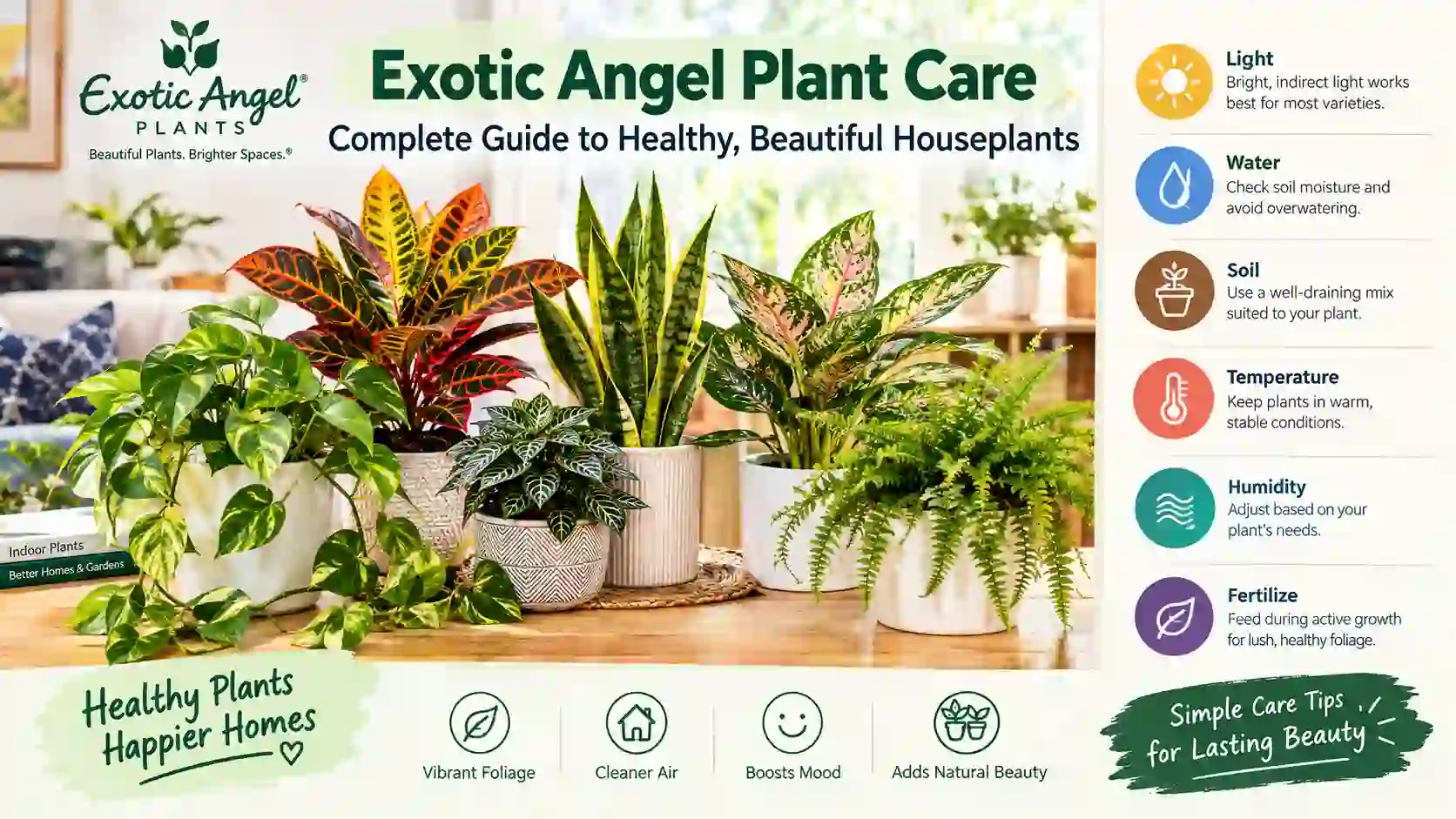
Exotic Angel plant care depends on the specific plant variety because Exotic Angel is a brand name used for many different tropical houseplants. Most varieties grow well in bright, indirect light, warm temperatures, and a suitable potting mix with good drainage. Water when the soil begins to dry according to the plant’s needs, and avoid leaving roots in standing water. Always identify your exact plant before following a detailed care routine.
Exotic Angel plants bring tropical foliage, interesting leaf patterns, and colorful textures into homes. You may find them sold under names such as pothos, philodendron, aglaonema, dieffenbachia, and other familiar houseplant groups.
But there is one important detail: Exotic Angel is not a single plant species. It is a plant brand that includes many varieties with different needs. A watering routine that suits one plant may leave another too wet or too dry.
This guide explains the general care principles that help many Exotic Angel houseplants thrive. It also shows you how to identify your plant, adjust care to its growth habit, recognize common problems, and avoid mistakes that can damage tropical foliage.
What Are Exotic Angel Plants?


5
Exotic Angel® Plants is a collection of houseplants associated with Costa Farms. It includes many different species and varieties rather than one botanical species. The collection features plants with varied foliage, sizes, and growing habits.
Costa Farms
+1
That distinction matters because the label alone cannot tell you exactly how to water, light, or prune your plant.
For example:
- A snake plant stores water in thick leaves and generally needs the potting mix to dry substantially between waterings.
- A fern may need more consistent moisture and higher humidity.
- A pothos can trail or climb and usually benefits from allowing the upper soil to dry somewhat between waterings.
- A croton needs bright light to maintain strong foliage color and may react poorly to abrupt environmental changes.
These are examples of why you should identify the plant before following species-specific instructions. Costa Farms recommends choosing plants according to their light, water, temperature, and care requirements.
Costa Farms
+1
How to identify your Exotic Angel plant
Check the original plant tag, pot label, or product listing for the botanical or common name. If the tag is missing, compare the leaves, stems, growth habit, and any flowers with a reliable plant-identification reference.
Costa Farms also says customers can contact its support team with a plant photo when a generic label does not identify the variety.
Costa Farms
Image suggestion: A labeled collage of common foliage types, such as pothos, fern, croton, snake plant, and aglaonema, emphasizing that their care requirements differ.
Exotic Angel Plant Care: General Growing Conditions
The following guidance is a starting point for many tropical foliage plants in the collection. It is not a replacement for the care instructions for your exact species.
|
Care factor
|
General starting point
|
What to watch
|
| — | — | — |
|
Light
|
Bright, indirect light suits many tropical foliage plants
|
Some tolerate lower light; others need brighter conditions to maintain color or compact growth
|
|
Water
|
Check soil moisture before watering
|
Succulents and drought-tolerant plants need a different approach from moisture-loving plants
|
|
Soil
|
Use a mix suited to the plant, with appropriate drainage
|
Ferns, succulents, and epiphytes may need different mixes
|
|
Temperature
|
Many indoor tropicals prefer warm, stable conditions
|
Avoid cold drafts, sudden temperature changes, and hot vents
|
|
Humidity
|
Depends on the plant species
|
Ferns and some tropical plants may need more humidity than tougher foliage plants
|
|
Fertilizer
|
Feed according to species, season, and product directions
|
Avoid feeding dry, damaged, or dormant plants heavily
|
|
Pot
|
Choose a container with suitable drainage and size
|
The wrong pot or dense soil can keep roots wet for too long
|
Costa Farms describes its Exotic Angel collection as including a wide variety of plants, from low-water options to tropical and trailing varieties. Its general indoor-plant guidance emphasizes matching care to the plant rather than treating every variety alike.
Costa Farms
+1
1. Provide the Right Amount of Light
Light is one of the first things to assess when an Exotic Angel plant begins to decline. Too little light can lead to weak, stretched growth, while excessive direct sun can scorch foliage on plants that prefer filtered light.
How to choose a location
- Bright, indirect light: A good starting point for many tropical foliage plants. Place the plant near a bright window without prolonged exposure to intense direct sun.
- Medium light: May suit some adaptable foliage plants, but growth can slow and colorful leaves may lose intensity.
- Low light: Suitable only for varieties known to tolerate it. Low-light tolerance does not mean the plant can thrive in darkness.
- Direct sunlight: Appropriate for some species, but potentially damaging to shade-loving tropical foliage plants.
Costa Farms explains that Exotic Angel plants have different light requirements and that its plant labels use light categories to help customers choose a suitable location.
Costa Farms
Signs the light may be unsuitable
|
What you notice
|
What it may indicate
|
| — | — |
|
Long, weak stems or widely spaced leaves
|
The plant may need more light
|
|
Faded, bleached, or scorched patches
|
The plant may be receiving excessive direct sun
|
|
Slow growth with no other obvious symptoms
|
Light may be insufficient, though other causes are possible
|
|
Variegated leaves becoming less colorful
|
The variety may need brighter conditions to maintain its pattern
|
These symptoms are not conclusive on their own. Check watering, roots, pests, and recent changes as well.

Image suggestion: Show a tropical houseplant near a bright window, with simple indicators for filtered light, low light, and intense direct sun.
2. Water According to the Plant’s Needs
There is no single watering schedule for every Exotic Angel plant. A succulent and a fern can require very different moisture levels, even when they are sold under the same collection name.
A reliable watering routine
- Identify the plant species and review its care guidance.
- Check the soil with your finger or a moisture meter appropriate for the potting mix.
- Water when the plant’s upper soil layer has reached the dryness level suitable for that species.
- Water evenly around the root zone, rather than repeatedly pouring into one small spot.
- Allow excess water to drain through the pot.
- Empty the saucer or decorative outer pot so the roots do not sit in standing water.
The amount of time between waterings changes with light, temperature, pot size, soil, and season. Check the soil instead of assuming that watering every few days is always correct.
Why overwatering happens
Overwatering is not simply giving a plant a large drink. It often means watering too frequently or keeping the soil wet for too long. Roots need oxygen as well as moisture, and persistently saturated soil can damage them.
At the other extreme, allowing a moisture-loving plant to become severely dry can cause wilting, leaf loss, or crispy edges.
Practical tip: If a plant looks wilted, check the soil before watering. Wet soil and dry soil can both be associated with drooping, but they require different responses.
3. Use Soil and a Pot That Suit the Species
A suitable potting mix should provide the balance of moisture retention and air space that the plant’s roots need.
Choosing potting mix
- For many tropical foliage plants, start with a quality indoor potting mix that drains freely.
- For plants that need extra aeration, consider a mix amended with perlite or another suitable drainage component.
- For succulents and other plants adapted to drier conditions, use a faster-draining mix designed for that group.
- For moisture-loving plants, choose a mix that retains some moisture without becoming waterlogged.
Avoid adding a thick layer of gravel to the bottom of a pot as a substitute for drainage. Use a container with drainage holes and a suitable mix throughout the root zone.
Choosing the right pot size
A pot that is much larger than the root ball can hold excess moisture for too long. A pot that is too small may dry very quickly or leave the roots cramped.
When repotting, choose a container that gives the roots room to grow without leaving a large volume of unused, wet soil.
Image suggestion: A simple cross-section comparing a well-draining pot with drainage holes and a plant in compact, waterlogged soil.
4. Maintain Suitable Temperature and Humidity
Many plants in the Exotic Angel collection are tropical, but their tolerance of dry air and temperature changes varies.
Temperature tips
- Keep indoor plants away from cold drafts and sudden temperature swings.
- Avoid placing foliage directly against hot radiators or heating vents.
- Do not assume a plant is cold-tolerant because it looks sturdy.
- If moving a plant outdoors in suitable weather, acclimate it gradually and protect it from harsh sun and temperature extremes.
Costa Farms describes warm temperatures as a general requirement for its indoor houseplants, while also noting that individual varieties have different care needs.
Costa Farms
Humidity tips
Some tropical plants, especially certain ferns and delicate foliage varieties, may struggle in very dry indoor air. Other plants tolerate ordinary household humidity.
If the plant develops dry edges:
- Check whether the soil is becoming too dry.
- Check for hot airflow or intense sun.
- Inspect for pests.
- Consider humidity if the plant’s species is known to prefer moist air.
A humidifier can help maintain more stable humidity for plants that need it. Routine misting is not a dependable substitute for controlling room humidity.
5. Fertilize Carefully During Active Growth
Fertilizer can support new leaves and healthy growth, but it cannot compensate for poor light, damaged roots, or unsuitable watering.
How to feed your plant
- Identify the species before choosing a fertilizer.
- Use a fertilizer labeled for that type of houseplant.
- Follow the label’s dilution and frequency instructions.
- Feed mainly when the plant is actively growing.
- Reduce or pause feeding when growth slows, unless the species’ care guidance says otherwise.
- Avoid fertilizing a plant with severely dry soil or suspected root rot until its condition improves.
Excess fertilizer can contribute to salt buildup and root injury. More fertilizer does not necessarily mean faster or healthier growth.
Image suggestion: A gardener applying diluted houseplant fertilizer to a healthy tropical plant, with a reminder to follow label directions.
6. Prune, Clean, and Support Your Plant
Routine maintenance helps keep foliage attractive and makes it easier to spot developing problems.
Basic maintenance
- Remove dead or badly damaged leaves with clean scissors.
- Wipe dusty leaves gently with a damp, soft cloth when appropriate for the plant.
- Trim leggy growth if pruning suits the species.
- Provide a support or trellis for climbing plants that naturally need one.
- Keep trailing plants positioned so stems are not crushed or sharply bent.
Do not remove large amounts of healthy foliage simply to make a plant look smaller. Leaves help the plant produce energy, and heavy pruning can add stress.
Should you rotate the pot?
Rotating a plant occasionally can help varieties that lean toward a window receive light more evenly. However, avoid repeatedly moving sensitive plants between very different environments. Stability is especially useful for plants that react poorly to changes in light or temperature.
7. Repot When Necessary
Repotting is useful when roots become crowded, the potting mix deteriorates, or drainage becomes difficult to manage. It is not automatically required every year.
Signs your plant may need repotting
- Roots are growing out of the drainage holes.
- The root ball is tightly packed.
- Water runs through the pot unusually quickly because little soil remains.
- The potting mix has broken down or stays wet for too long.
- The plant has become unstable in its container.
Repotting steps
- Choose a pot with drainage holes that is only moderately larger than the current root ball.
- Prepare fresh potting mix suited to the plant species.
- Remove the plant carefully and inspect the roots.
- Trim only roots that are clearly dead or rotten, using clean tools.
- Set the plant at its previous soil level and fill around the root ball.
- Water according to the plant’s needs and let excess water drain.
- Keep it in suitable light while it adjusts.
If the plant is already stressed, avoid combining repotting with unnecessary pruning, heavy fertilizing, and a major location change.
8. Troubleshoot Common Exotic Angel Plant Problems
A symptom can have several possible causes. Use the plant’s species, soil moisture, recent care changes, and growing environment to narrow down the problem.
|
Problem
|
Possible causes
|
What to check or do
|
| — | — | — |
|
Yellow leaves
|
Overwatering, poor drainage, low light, nutrient issues, or natural aging
|
Check moisture, drainage, light, and whether only older leaves are affected
|
|
Brown, crispy edges
|
Dry soil, low humidity, hot airflow, sun damage, or mineral buildup
|
Review watering, placement, humidity needs, and water quality
|
|
Drooping leaves
|
Underwatering, waterlogged roots, temperature stress, or recent repotting
|
Check soil moisture first and inspect roots if the mix stays wet
|
|
Leggy growth
|
Insufficient light or the plant’s natural growth habit
|
Improve light gradually and provide support if needed
|
|
Pale or faded foliage
|
Excessive sun, inadequate light for some varieties, or other stress
|
Compare the symptoms with the species’ light requirements
|
|
Soft stems or foul-smelling soil
|
Possible root or stem rot
|
Inspect roots and remove decaying material if present
|
|
Sticky leaves or fine webbing
|
Possible insect pests
|
Inspect leaf undersides and stems; isolate the plant if pests are found
|
Costa Farms advises checking leaves, stems, roots, and signs of pests when selecting and caring for houseplants.
Costa Farms
How to respond to suspected root rot
If the soil remains wet and the plant continues to decline, inspect the root system rather than repeatedly adding water or fertilizer.
- Remove the plant from its pot carefully.
- Check for roots that are soft, dark, or decaying.
- Trim clearly rotten roots with clean tools.
- Remove degraded, saturated potting mix.
- Repot into a clean container with drainage and fresh, suitable mix.
- Adjust the watering routine to the plant’s needs and the new mix.
Extensive damage may limit recovery. The plant’s exact species and the condition of its stem and roots affect the outcome.
How to check for pests
Inspect both sides of the leaves, leaf joints, stems, and the soil surface. Look for small insects, sticky residue, cottony clusters, fine webbing, or unusual spotting.
If you find pests:
- Isolate the affected plant from nearby plants.
- Identify the pest before selecting a treatment.
- Remove badly affected leaves when appropriate.
- Use a treatment labeled for the pest and indoor plants, following all instructions.
- Recheck the plant regularly and repeat treatment only as directed.
Image suggestion: A troubleshooting infographic showing yellow leaves, brown edges, drooping foliage, and a pest inspection close-up.
9. Adapt Your Care to the Plant You Own
Once you identify your Exotic Angel plant, use its growth habit to refine the general routine.

Pothos and other trailing plants
Check the soil before watering and provide suitable light for the variety. Give climbing types a support if you want them to grow upward, or allow trailing stems to cascade from a shelf or hanging pot.

Snake plants
These plants generally tolerate drier conditions than many tropical foliage plants. Use a well-draining mix and avoid frequent watering while the soil is still wet.

Nerve plants and moisture-sensitive foliage
Monitor soil moisture closely and avoid allowing the root ball to become severely dry. Their care can differ from tougher, drought-tolerant houseplants.

Crotons and colorful foliage plants
Check the variety’s light needs carefully. Sudden changes in location, temperature, or watering can contribute to leaf drop or foliage stress.

Ferns
Many ferns prefer more consistent moisture and humidity than succulents or snake plants. Avoid applying a dry-soil watering routine intended for drought-tolerant species.
These are broad examples, not complete care prescriptions. Confirm the exact species or cultivar before making major changes.
10. A Simple Weekly Care Check
A short observation routine is more useful than watering every plant on the same day.
Weekly plant-care checklist
0 of 6
Check the soil moisture and water only if the plant needs it.
Look at new and older leaves for yellowing, browning, or unusual spots.
Inspect leaf undersides, stems, and leaf joints for pests.
Check whether the plant is leaning, stretching, or receiving uneven light.
Remove dead foliage and clear fallen leaves from the soil surface.
Make sure the pot drains freely and is not sitting in collected water.
Reset checklist
This checklist is a reminder to observe your plant, not a requirement to water or prune it every week. Some weeks, the right action may simply be to leave it undisturbed.
Frequently Asked Questions About Exotic Angel Plant Care
Are Exotic Angel plants easy to care for?
Many varieties are suitable for home growing, but difficulty depends on the species. Some tolerate lower light or occasional dry soil, while others need more consistent moisture, humidity, or brighter conditions.
Costa Farms
+1
How often should I water an Exotic Angel plant?
There is no universal schedule. Check the soil and follow the needs of your exact plant. Water when it reaches the appropriate dryness level, then allow excess water to drain.
Do Exotic Angel plants need sunlight?
Most need some suitable light to grow, but their requirements differ. Many tropical foliage varieties prefer bright, indirect light. Some tolerate lower light, while others need brighter conditions. Protect plants from direct sun if their leaves are prone to scorching.
Why are the leaves on my Exotic Angel plant turning yellow?
Yellowing may result from overwatering, poor drainage, unsuitable light, nutrient problems, pests, or normal aging. Check the soil and roots, then consider recent changes in the plant’s environment.
Can Exotic Angel plants grow indoors?
Yes. Exotic Angel is a collection of houseplants intended for indoor growing. Choose a variety that suits your available light, space, and care routine.
Costa Farms
+1
Should I mist my Exotic Angel plant?
Not automatically. Misting does not provide lasting humidity, and some plants do not need it. If your species prefers higher humidity, consider a more stable way to maintain suitable room conditions.
When should I repot my Exotic Angel plant?
Repot when roots become crowded, the potting mix breaks down, or drainage becomes problematic. Choose a pot with drainage holes and a size appropriate for the root ball.
Why is my Exotic Angel plant drooping?
Drooping can be caused by dry soil, waterlogged roots, temperature stress, or adjustment after a move or repotting. Check the soil before watering because adding more water to already saturated soil can worsen root problems.
Are all Exotic Angel plants tropical?
The collection includes a wide range of houseplants, including many tropical varieties as well as plants with different growing habits and care needs. Identify your specific plant instead of assuming every variety requires the same conditions.
Costa Farms
+1
How can I identify an Exotic Angel plant if its tag is missing?
Compare its leaves, stems, and growth habit with reliable plant references. You can also send a photo to Costa Farms support for help identifying a plant with a generic or missing label.
Costa Farms
Related Plant-Care Topics for Internal Linking
Consider linking to these genuinely related guides where they fit naturally:
- Pilea Plant Care: Learn how to care for the Chinese money plant.
- Philodendron Plant Care: Explore lighting, watering, pruning, and propagation for philodendrons.
- Palm Plant Care: Discover how to maintain healthy indoor palms.
- Jade Plant Care: Learn watering and soil practices for a popular succulent.
- Aloe Plant Care: Understand the light and drainage needs of aloe plants.
- How to Choose Well-Draining Potting Soil: Learn how soil structure affects root health.
Image Opportunities
Use custom images to make the article easier to follow:
- Featured image: A collection of Exotic Angel houseplants in a bright indoor setting, with the title “Exotic Angel Plant Care.”
- Plant identification: A labeled collage of different foliage shapes and growth habits.
- Light requirements: A window-placement illustration showing indirect light and intense direct sunlight.
- Watering and drainage: A diagram showing soil moisture checks and a pot draining excess water.
- Soil and repotting: A comparison of suitable airy potting mix and compact, waterlogged soil.
- Troubleshooting: A visual guide to yellow leaves, crispy edges, drooping, and pest symptoms.
Conclusion
Successful Exotic Angel plant care begins with identifying the plant you actually own. Exotic Angel is a diverse houseplant collection, so its varieties do not all share identical watering, lighting, humidity, or soil requirements.
Start by checking the plant tag or identifying its species. Then choose a suitable location, monitor soil moisture, provide appropriate drainage, and adjust care as the plant grows. When problems appear, inspect the growing conditions before making several changes at once.
With species-specific care and regular observation, you can build a routine that supports healthy foliage and steady growth.