Quick Answer
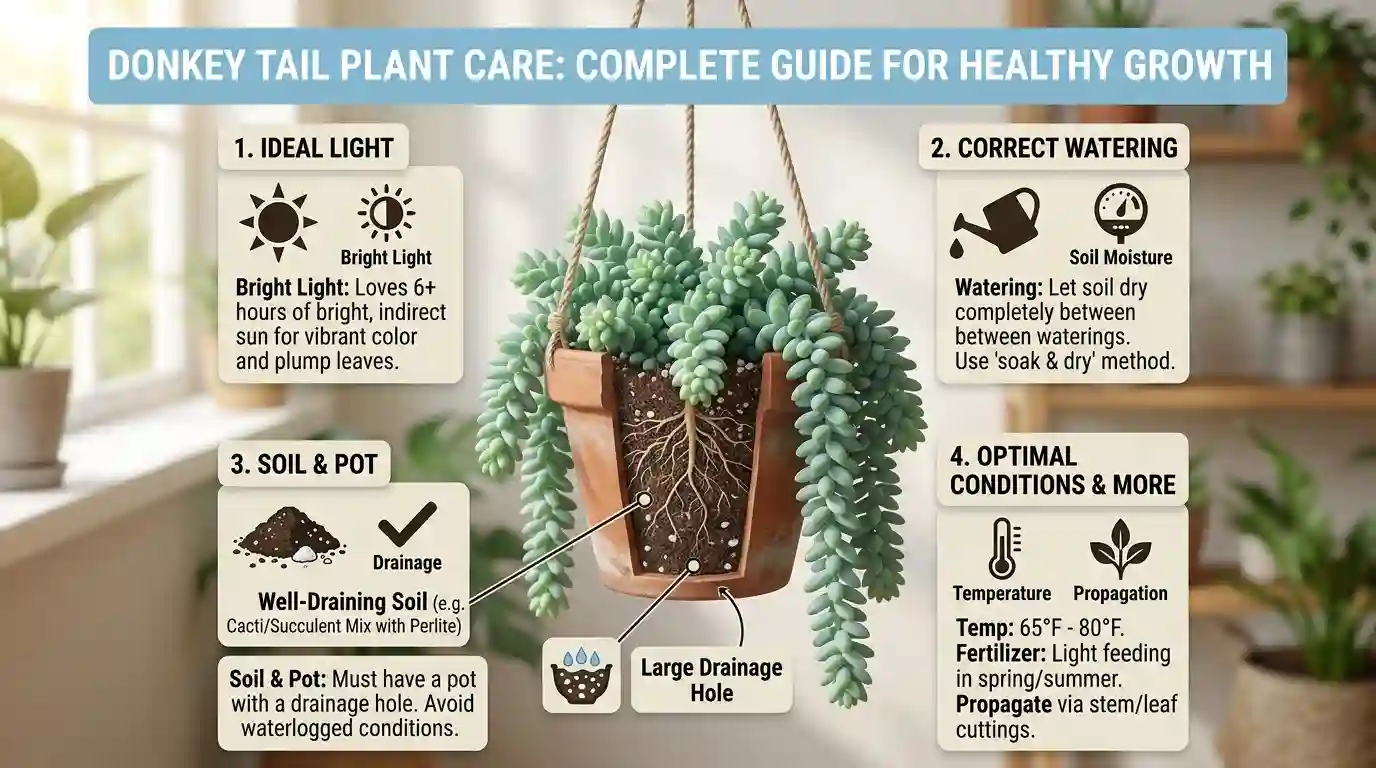
Donkey tail plant care is simple once you understand its succulent nature. Give Sedum morganianum bright light, sharply draining soil, and a pot with drainage holes. Water thoroughly only after the soil has dried, then let excess water drain completely. Handle the stems gently because the plump leaves detach easily. Feed lightly during active growth and protect the plant from prolonged cold and wet conditions.
Introduction
Donkey tail is one of those plants that looks difficult but is surprisingly manageable when its natural growing habits are respected.
Also called burro’s tail, horse’s tail, lamb’s tail, or Sedum morganianum, it produces long trailing stems covered with tightly packed, blue-green succulent leaves. The species is native to Mexico and grows in seasonally dry environments.
Its biggest challenge is not keeping it alive. It is keeping those beautiful trailing stems full, compact, and intact.
The leaves are loosely attached and can fall when the plant is bumped, moved, repotted, or handled roughly. Fortunately, fallen leaves and stem pieces can also produce new plants, making accidental leaf loss less disastrous than it first appears.
This guide explains how to provide the right light, water, soil, pot, temperature, fertilizer, and maintenance while also covering the problems that commonly confuse new growers.
What Is a Donkey Tail Plant?
The donkey tail plant is the common name most often used for Sedum morganianum, a trailing succulent in the Crassulaceae family. Kew currently recognizes Sedum morganianum as an accepted species.
Its defining features include:
- Long, cascading stems
- Fleshy blue-green leaves
- Closely packed leaves that resemble beads or scales
- A trailing or hanging growth habit
- Small pink to reddish flowers under suitable conditions
- Strong drought tolerance
Mature stems can become quite long, making the plant especially attractive in hanging baskets and containers placed where the tails can cascade freely. North Carolina Extension describes stems reaching about 24 inches, while other horticultural sources report longer trailing growth under suitable conditions.
Donkey Tail vs. Burro’s Tail
The names can be confusing because donkey’s tail and burro’s tail are commonly used for Sedum morganianum. Other similar-looking plants may also be sold under informal names such as “burro’s tail.”
When buying one, check the botanical name on the plant label whenever possible.
Image Suggestion: Close-up botanical image showing Sedum morganianum, its blue-green leaves, trailing stems, and hanging growth habit.
How Much Light Does a Donkey Tail Plant Need?
Donkey tail plants prefer bright light, with some direct sun tolerated when the plant is acclimated appropriately. North Carolina Extension recommends high-light indoor conditions, while the RHS lists full sun for outdoor cultivation.
A bright south- or west-facing window can work well indoors. An east-facing window can also be suitable if it provides strong morning light.
Why light matters
Light affects more than color.
Adequate light helps the plant produce:
- Compact growth
- Closely spaced leaves
- Stronger stems
- Fuller-looking tails
When light is insufficient, stems can become elongated and the spaces between leaves may increase.
How to introduce stronger sunlight
Do not move a plant that has been growing in low indoor light directly into intense outdoor sun.
Instead:
- Move it into brighter indirect light first.
- Introduce short periods of gentler direct sunlight.
- Gradually increase exposure.
- Watch for bleaching, scorching, or sudden discoloration.
This gradual transition is especially important when moving a houseplant outdoors for summer.
Image Suggestion: 16:9 infographic comparing compact donkey tail growth in bright light with stretched growth caused by inadequate light.
How to Water a Donkey Tail Plant
Watering is where many donkey tail plants go wrong.
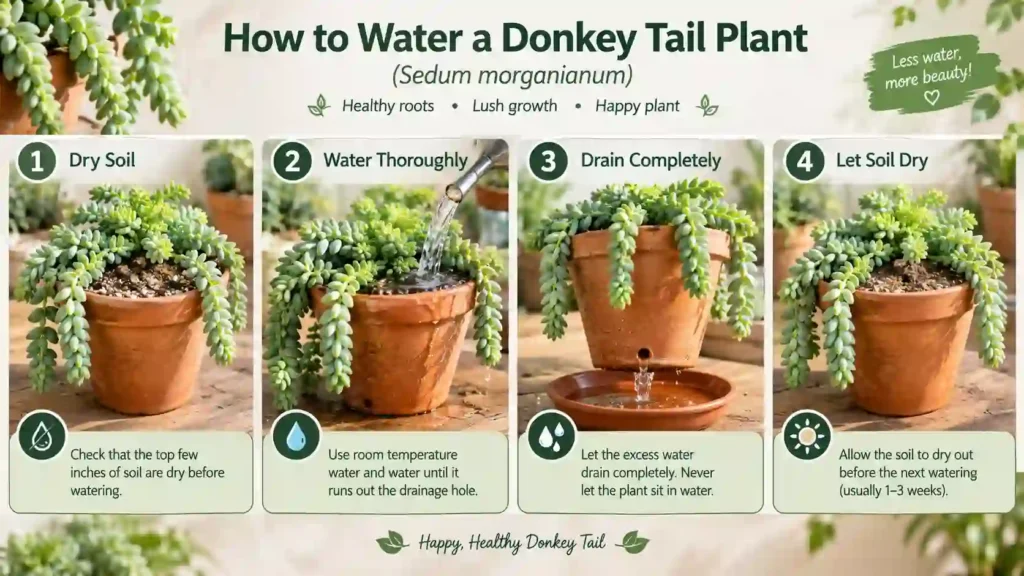
This succulent stores water in its fleshy leaves, so it does not need constantly moist soil. North Carolina Extension recommends allowing the soil to dry between waterings, while Iowa State Extension recommends a wet-dry cycle for indoor succulents: thoroughly wet the root ball, let the excess drain, and allow the soil to dry before watering again.
The best watering method
When the soil has dried sufficiently:
- Water the soil thoroughly.
- Continue until water drains from the bottom.
- Let the container drain completely.
- Empty standing water from a saucer or decorative cachepot.
- Wait until the soil dries before watering again.
Avoid giving tiny amounts of water every few days.
That pattern can keep portions of the root zone damp without providing the deep wet-dry cycle succulents prefer.
How often should you water?
There is no reliable universal schedule.
A plant may need water sooner when it has:
- Strong light
- Warm temperatures
- Fast-draining soil
- A small container
It may need water much less frequently when it has:
- Low light
- Cool temperatures
- A large container
- Dense soil
- Reduced winter growth
Some extension guidance gives roughly 9–14 days under particular growing conditions, but that should be treated as an example rather than a fixed rule. Your plant’s soil and environment are better indicators.
A useful beginner test
Before watering, check the soil several centimeters down and lift the container if possible.
If the pot still feels heavy and the soil is moist, wait.
If the mix is dry and the pot feels significantly lighter, it is much more likely to be ready for a thorough watering.
Image Suggestion: Step-by-step infographic showing dry soil → thorough watering → drainage → dry period.
What Soil Is Best for Donkey Tail?
The best soil for donkey tail is fast-draining and well-aerated.
A commercial cactus or succulent mix is a convenient starting point. If the mix stays wet for a long time, improve its drainage with an appropriate mineral component such as perlite or pumice.
The goal is not simply to make the soil dry instantly. The goal is to create a root environment where water drains efficiently and air can return to the root zone.
Why dense soil causes problems
Ordinary moisture-retentive potting soil can remain wet around succulent roots for too long.
Constantly wet conditions increase the risk of root and crown problems. Both North Carolina Extension and the RHS warn about problems associated with wet or poorly drained conditions.
Avoid the gravel-layer myth
Putting a layer of gravel at the bottom of a container does not turn a poorly draining soil mix into a well-draining one.
The better solution is to use:
- Appropriate succulent soil
- A container with a drainage hole
- A correctly sized pot
- A suitable watering routine
Iowa State Extension specifically recommends containers with drainage holes and notes that a gravel layer does not solve the problem of keeping succulent soil too wet.
Image Suggestion: Soil cross-section showing healthy airy succulent soil versus compact, waterlogged soil around donkey tail roots.
Choosing the Right Pot
A donkey tail plant needs a container that can drain excess water efficiently.
Look for these features
- Drainage hole
- Stable base
- Appropriate size
- Enough room for roots
- Strong support for trailing stems
Terracotta can be useful because its porous sides allow soil to dry faster. Iowa State Extension notes that clay or terracotta containers can encourage quicker drying and that succulents often perform well in smaller or shallow containers.
Plastic pots can also work. They simply retain moisture longer, so watering habits become even more important.
Should you use a hanging basket?
Yes.
A hanging basket can be excellent for donkey tail because its trailing stems naturally spill over the edges.
However, make sure the basket is secure. A mature plant becomes heavier as its stems lengthen.
Image Suggestion: Donkey tail plant cascading from a terracotta hanging planter with visible drainage and adequate space around the trailing stems.
Temperature and Humidity
Donkey tail generally performs well under normal indoor conditions when protected from prolonged cold and excessive moisture.
North Carolina Extension reports outdoor tolerance down to about 40°F under its regional guidance, while the RHS classifies it as a tender plant rather than a frost-hardy succulent.
For indoor growing, focus on avoiding:
- Frost
- Freezing temperatures
- Cold drafts
- Sudden temperature changes
- Constantly damp conditions
High humidity is usually unnecessary.
In fact, normal household humidity is generally sufficient for a succulent of this type. Iowa State Extension notes that succulents commonly perform well in the relatively low humidity found in homes.
How to Fertilize Donkey Tail
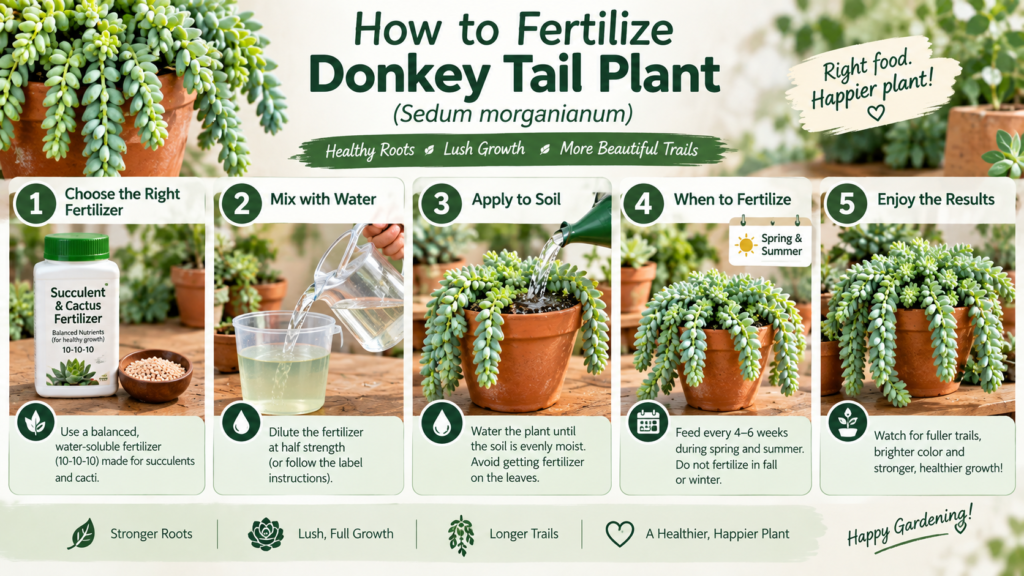
Donkey tail is not a heavy feeder.
North Carolina Extension recommends light fertilization once or twice during the growing season.
A practical approach is to use a diluted fertilizer intended for succulents or other suitable houseplants during active growth.
Avoid overfertilizing
Too much fertilizer can create unnecessary salt buildup and encourage growth that is not necessarily stronger or healthier.
Do not use fertilizer as a substitute for:
- Better light
- Proper drainage
- Correct watering
- Fresh growing medium
If the plant is stressed, severely dehydrated, recently repotted, or showing root problems, correct the underlying issue before feeding it.
How to Repot a Donkey Tail Plant Without Losing Every Leaf
Repotting donkey tail requires more care than repotting many ordinary houseplants.
The leaves detach easily when the stems are brushed or bent. North Carolina Extension specifically notes that the leaves are delicate and readily break off when manipulated.
Before repotting
Prepare everything first:
- New pot
- Fresh succulent mix
- Clean work surface
- Small support material if needed
- Clean scissors or pruning shears
Repotting steps
- Let the soil become appropriately dry before handling the plant.
- Prepare the new container and soil.
- Support the trailing stems rather than lifting them individually.
- Gently remove the root ball.
- Inspect the roots.
- Place the plant at approximately the same depth.
- Fill around the roots without compacting the mix heavily.
- Return the plant to suitable light.
- Resume normal watering based on soil moisture and plant condition.
A useful handling trick
Do not carry a long donkey tail plant by its stems.
Support the pot with one hand and gently cradle the stems with the other.
If a few leaves fall during repotting, do not panic. Fallen leaves can often be used for propagation.
Image Suggestion: Step-by-step repotting infographic showing gentle stem support, root inspection, fresh succulent mix, and correct planting depth.
Why Are My Donkey Tail Leaves Falling Off?
This is probably the most recognizable donkey tail problem.
Some leaf loss is normal because the leaves are naturally fragile. Even healthy plants can lose individual leaves when moved.
However, heavy or sudden leaf drop deserves investigation.
Common causes
Physical disturbance
Moving, brushing, pruning, repotting, or rearranging the plant can knock leaves loose.
Insufficient light
Weak growth can produce less compact stems.
Watering problems
Both prolonged drought and excessive moisture can cause stress.
Root problems
A plant sitting in wet soil may develop root damage, which eventually affects the stems and leaves.
What to do
First, look at the pattern.
If the plant is healthy and only a few leaves fell after moving it, leave it alone.
If leaves are falling in large numbers and the stems are soft, discolored, or the soil stays wet, investigate the roots and watering conditions.
Image Suggestion: Comparison infographic showing normal occasional leaf drop versus excessive leaf drop caused by environmental stress.
How to Propagate Donkey Tail
One of the best things about donkey tail is that fallen leaves are not necessarily wasted.
North Carolina Extension reports that both cuttings and dropped leaves can root easily, and Iowa State Extension lists both stem and leaf propagation for burro’s tail.
Propagating from a stem cutting
- Select a healthy stem section.
- Make a clean cut.
- Allow the cut surface to dry appropriately.
- Place the cutting into well-draining growing medium.
- Provide bright light.
- Avoid keeping the medium constantly wet.
- Give the cutting time to establish roots.
Long or heavy cuttings may need support until roots develop.
Propagating from leaves
Individual leaves can also produce new plants.
Place healthy fallen leaves on suitable, well-draining growing medium and provide bright conditions.
Not every leaf will produce a mature plant, so using several healthy leaves improves your chances.
The important part is not to treat propagation material like an ordinary thirsty cutting. Excess moisture can cause the tissue to decay before roots develop.
Image Suggestion: 16:9 propagation infographic showing healthy fallen leaves and stem cuttings developing roots and new growth.
How to Keep Donkey Tail Stems Full and Beautiful
A full donkey tail does not come from aggressive pruning.
It comes mainly from good light and consistent growing conditions.
Focus on these habits
- Provide strong light.
- Avoid frequent relocation.
- Do not overwater.
- Avoid unnecessary pruning.
- Give trailing stems room to hang.
- Handle the plant as little as possible.
A mature plant often looks best when placed somewhere it can remain undisturbed.
This is one of those cases where “leave it alone” is genuinely useful gardening advice.
Does Donkey Tail Need Pruning?
Usually, very little.
The RHS lists no routine pruning requirement for Sedum morganianum.
Pruning may make sense when:
- A stem is damaged.
- A section has died.
- You want to propagate healthy cuttings.
- A stem has become unusually bare or unattractive.
Use clean scissors or pruning shears.
Do not repeatedly trim healthy trailing stems just to keep the plant short. The long cascading habit is one of its main ornamental features.
Donkey Tail Plant Care Through the Seasons
Your care routine should respond to changes in light and growth rather than a fixed calendar.
| Season | What to Watch |
|---|---|
| Spring | Increasing light and active growth |
| Summer | Faster drying and stronger sunlight |
| Fall | Gradually changing light and watering needs |
| Winter | Slower growth and reduced water use |
Spring
As light increases, the plant may begin producing more active growth.
Check the soil more frequently, but do not water until it actually needs water.
Summer
Strong sunlight and warmer temperatures can increase evaporation.
If the plant is outdoors, protect it from prolonged rain and acclimate it to stronger sunlight.
Fall
As daylight decreases, soil may take longer to dry.
Adjust watering accordingly.
Winter
Reduce watering as growth slows and light decreases. North Carolina Extension specifically recommends reducing watering during winter.
Common Donkey Tail Plant Care Mistakes
1. Watering too often
The most common mistake is treating a succulent like a tropical foliage plant.
Better approach: Let the soil dry appropriately between thorough waterings.
2. Using a pot without drainage
Even excellent soil cannot compensate for a container that traps water.
Better approach: Always use a drainage hole.
3. Moving the plant constantly
Every move can cause leaf loss.
Better approach: Find a bright location and leave the plant there.
4. Handling the tails
The stems look tempting to touch, but the leaves are fragile.
Better approach: Handle the pot, not the foliage.
5. Keeping it in low light
Low light can lead to stretched, sparse growth.
Better approach: Provide a bright location and acclimate gradually to direct sun.
6. Planting in heavy soil
Dense soil stays wet longer.
Better approach: Use a well-draining succulent mix.
7. Following a rigid watering schedule
“Water every Sunday” may work temporarily, but environmental conditions change.
Better approach: Check soil moisture and pot weight.
8. Overfertilizing
More fertilizer does not automatically mean more beautiful tails.
Better approach: Feed lightly during active growth.
Donkey Tail Troubleshooting Guide
| Problem | Likely Causes | What to Check |
|---|---|---|
| Leaves dropping after moving | Physical disturbance | Handle stems less |
| Leaves turning yellow | Excess moisture or root stress | Soil and drainage |
| Soft leaves | Overwatering or root problems | Root condition and soil |
| Wrinkled leaves | Dehydration or root dysfunction | Soil moisture and roots |
| Long bare spaces | Insufficient light or leaf loss | Light exposure |
| Stems becoming sparse | Low light, stress, or natural aging | Growing conditions |
| Brown or damaged tissue | Sun stress, cold, or moisture problems | Recent environmental changes |
| Soil stays wet | Poor drainage or oversized pot | Mix and container |
| Slow growth | Low light, cool conditions, or seasonal slowdown | Light and temperature |
The important point is to diagnose the combination of symptoms, not one symptom in isolation.
For example, wrinkled leaves do not automatically mean “add water.” If the soil is already wet, the real problem could be damaged roots that cannot absorb water properly.
What Does an Overwatered Donkey Tail Look Like?
An overwatered plant may show several symptoms together:
- Soft leaves
- Yellowing
- Sudden leaf loss
- Persistently wet soil
- Dark or damaged roots
- Soft stem tissue
The first step is to stop treating the symptom with more water.
Remove the plant from its container if root damage is suspected. Inspect the roots and growing medium.
If the soil is dense and remains wet, replacing it with a better-draining mix may be necessary.
The long-term solution is to correct the growing conditions that caused excessive moisture.
What Does an Underwatered Donkey Tail Look Like?
A dehydrated donkey tail may develop:
- Wrinkled leaves
- Less plump foliage
- Dry, shriveled leaves
- A noticeably lightweight pot
- Very dry growing medium
If the plant is otherwise healthy and the soil is completely dry, give it a thorough watering and allow excess water to drain.
Do not respond to every wrinkled leaf by watering immediately. Always check the soil first.
Can Donkey Tail Grow Indoors?
Yes.
Donkey tail can make an excellent indoor trailing plant if it receives enough light.
A bright windowsill, high shelf, or hanging location can work particularly well.
The main indoor challenge
Indoor rooms often provide less light than people realize.
A plant may look “brightly placed” to the human eye while receiving much less usable light than it would near a strong window.
If the stems become increasingly stretched and sparse, reconsider the lighting before adding fertilizer.
Can Donkey Tail Grow Outdoors?
Yes, in suitable climates.
The RHS recommends full sun and well-drained conditions, while North Carolina Extension recommends sun to part sun for outdoor cultivation.
Outdoor growing can produce excellent results, but introduce indoor plants gradually to stronger sunlight.
Also protect the plant from:
- Frost
- Prolonged rain
- Poorly drained soil
- Severe temperature swings
- Physical contact from pets, children, or foot traffic
In colder climates, growing donkey tail in a container makes seasonal protection much easier.
How to Encourage Flowers
Flowers are not the main reason most people grow donkey tail, but mature plants can produce small pink to reddish flowers. North Carolina Extension notes terminal pink or red flower clusters in summer, while the RHS describes pale pink to reddish-purple flowers in spring and summer.
The best approach is not to force flowering with excessive fertilizer.
Instead, provide:
- Strong light
- Appropriate seasonal conditions
- Good drainage
- Correct watering
- Healthy roots
A plant that is stressed, severely shaded, or constantly wet is unlikely to reward you with its best growth.
A Simple Donkey Tail Care Routine
If you are new to this plant, use this checklist.
Every few days
Look at the plant rather than automatically watering it.
Check:
- Leaf firmness
- Color
- Stem condition
- Light exposure
- Signs of pests
Before watering
Check the soil.
If it is still damp, wait.
When watering
Water thoroughly and allow the pot to drain completely.
Monthly
Inspect:
- Drainage
- Root crowding
- Stem health
- Light levels
- Pests
During active growth
Feed lightly if the plant is healthy and actively growing.
During winter
Reduce watering as light and growth decrease.
This routine keeps the focus on plant signals rather than arbitrary dates.
Expert Tips for Better Donkey Tail Growth
Tip 1: Choose the final location carefully
Once a donkey tail develops long tails, moving it becomes much harder.
Tip 2: Use a heavy enough container
A lightweight hanging or tabletop container can become unstable as the plant grows.
Tip 3: Do not judge watering by the leaves alone
Check the soil too. Leaf texture can change for several reasons.
Tip 4: Keep fallen leaves
Healthy fallen leaves can become propagation material.
Tip 5: Avoid overcrowding
Good airflow around the foliage and rapid soil drying are helpful for succulent health.
Tip 6: Rotate only when necessary
If light comes strongly from one direction, occasional rotation can help, but frequent movement is not worth the leaf loss.
Tip 7: Photograph the plant
Taking a monthly photo from the same angle can reveal slow changes in fullness, stretching, or leaf loss that are difficult to notice day to day.
Frequently Asked Questions
Is donkey tail plant easy to care for?
Yes, once its main requirements are understood. It needs bright light, well-draining soil, careful watering, and minimal physical disturbance.
How often should I water donkey tail?
Water when the soil has dried appropriately, then soak the root zone thoroughly and allow it to drain. The interval changes with light, temperature, soil, pot size, and season.
Why does my donkey tail lose leaves when I touch it?
Its fleshy leaves attach relatively delicately to the stems. Physical contact can cause healthy leaves to detach. North Carolina Extension specifically notes this sensitivity.
Does donkey tail need direct sunlight?
It benefits from strong light and can tolerate direct sun when acclimated. Avoid suddenly exposing a low-light plant to intense sunlight.
Can donkey tail grow in low light?
It may survive, but low light can produce stretched, sparse growth. A brighter location usually produces a fuller appearance.
What type of soil does donkey tail need?
Use a fast-draining succulent or cactus mix. Improve drainage when necessary with materials such as perlite or pumice.
Should donkey tail be in a terracotta pot?
Terracotta is a useful option because it can help soil dry faster, but plastic and other containers can also work when they have effective drainage.
Can I grow donkey tail from fallen leaves?
Yes. Fallen leaves can root and produce new growth under suitable conditions. Stem cuttings are another propagation option.
Why is my donkey tail turning yellow?
Yellowing can be associated with excessive moisture and root stress. Check how long the soil remains wet before increasing or changing watering.
Why are my donkey tail leaves wrinkled?
Wrinkling can indicate dehydration, but it can also occur when damaged roots cannot supply the plant properly. Check both the soil and root condition.
Does donkey tail need fertilizer?
Only light feeding is generally necessary. North Carolina Extension recommends light fertilization once or twice during the growing season.
Should I mist my donkey tail?
Usually, no. Donkey tail is a succulent and does not need regular misting. Focus on appropriate root-zone watering and good airflow.
Can I keep donkey tail outside?
Yes, in suitable climates. Protect it from freezing temperatures, prolonged wet conditions, and sudden exposure to intense sunlight.
Final Takeaway
Successful donkey tail plant care comes down to four priorities: bright light, fast drainage, careful watering, and gentle handling.
Do not be alarmed by an occasional fallen leaf. This plant naturally has delicate foliage, and fallen leaves can often become propagation material. The bigger warning signs are persistent wet soil, soft tissue, widespread leaf loss, and weak or stretched growth.
Give your Sedum morganianum a bright, stable location, use a draining succulent mix, water deeply only when the soil has dried, and resist the temptation to constantly move or touch those trailing stems.
With those conditions in place, donkey tail can develop the long, dense, cascading growth that makes it such a distinctive succulent.