Quick Answer
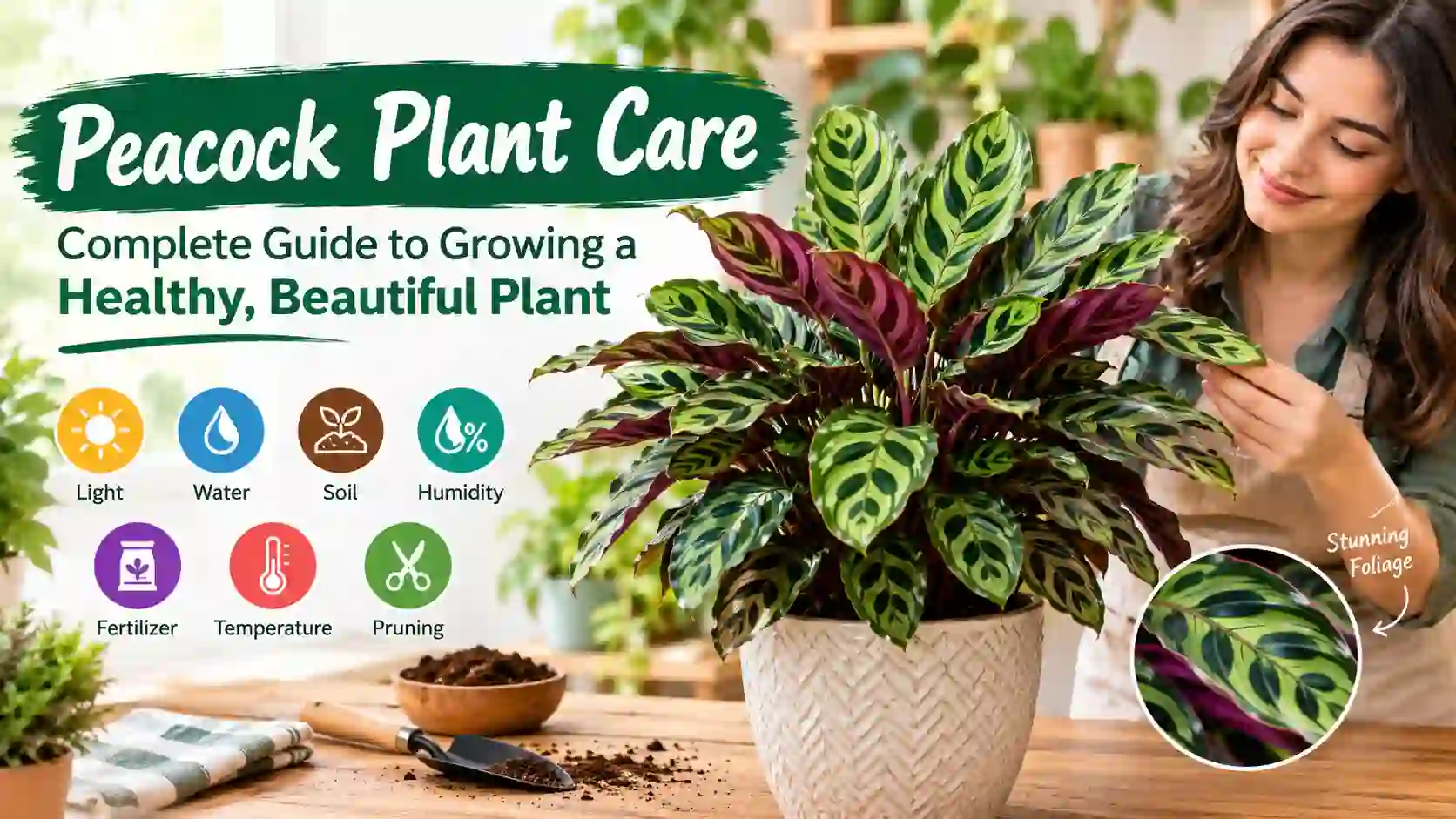
Peacock plant care is mainly about balancing moisture, humidity, warmth, and gentle light. The peacock plant, Goeppertia makoyana (formerly Calathea makoyana), grows best in bright indirect or filtered light, consistently moist but well-drained soil, high humidity, and stable warm temperatures. Use rainwater, distilled water, or suitable filtered water when possible, because fluoride in tap water can contribute to brown leaf tips. (Plant Toolbox)
Introduction
Few houseplants make a room look as lush as a peacock plant.
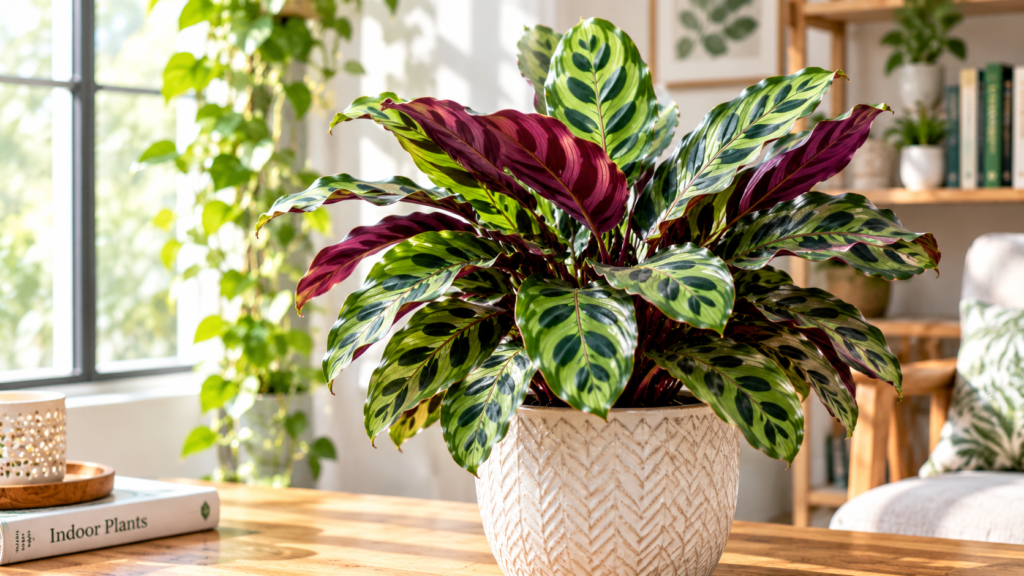
Its thin, patterned leaves feature feather-like markings that resemble a peacock’s tail. The purple undersides add another layer of color, while the leaves naturally fold upward at night and reopen with changing light conditions. (Plant Toolbox)
However, this tropical beauty can be less forgiving than many common houseplants.
A peacock plant may look healthy when you first bring it home, then develop brown edges, curling leaves, fading patterns, or yellow foliage after a few weeks. These problems often come from a mismatch between the plant’s tropical needs and indoor conditions.
The good news is that you do not need a greenhouse to grow one successfully.
The key is understanding why each care requirement matters. Instead of watering on a fixed calendar, for example, learn to read the soil. Instead of placing the plant in the brightest window, understand the difference between bright indirect light and harsh direct sun.
This guide explains how to create those conditions and how to troubleshoot problems when your plant starts looking unhappy.
Botanical note: The plant commonly sold as Calathea makoyana is now classified as Goeppertia makoyana. Both names may appear on nursery labels and care guides. (Plant Toolbox)
Peacock Plant Care at a Glance
| Care Factor | What Your Peacock Plant Needs |
|---|---|
| Botanical name | Goeppertia makoyana |
| Common names | Peacock plant, peacock calathea, cathedral windows |
| Light | Bright indirect or filtered light |
| Direct sun | Avoid strong direct sunlight |
| Water | Keep soil consistently moist, never soggy |
| Water quality | Rainwater, distilled, or suitable filtered water |
| Humidity | High humidity |
| Temperature | Warm, stable conditions |
| Soil | Moisture-retentive but well-draining |
| Fertilizer | Balanced fertilizer during active growth |
| Propagation | Division |
| Main problems | Brown tips, curling leaves, root problems, pests |
| Difficulty | Moderate |
NC State Extension describes the species as a tropical rainforest plant that prefers warm, shaded, humid conditions and moist, well-drained soil. (Plant Toolbox)
What Is a Peacock Plant?
The peacock plant is an evergreen tropical perennial in the Marantaceae family.
Its accepted botanical name is Goeppertia makoyana, although Calathea makoyana remains extremely common in the houseplant trade. It originates from the tropical regions of southeastern Brazil. (Plant Toolbox)
The plant is prized primarily for its foliage rather than flowers.
Its leaves typically feature:
- Light green backgrounds
- Darker feather-like markings
- Purple or burgundy undersides
- Long leaf stalks
- An upright, clumping growth habit
One fascinating feature is its daily leaf movement. The foliage can fold upward in the evening and reopen as daylight returns. This movement is part of the plant’s natural response to changing light conditions. (Plant Toolbox)
Peacock Plant vs. Other Calatheas
The word Calathea can cause confusion because many plants sold under that name have since been reclassified into other genera.
For example, the RHS currently places the peacock plant under Goeppertia makoyana, while other familiar plants formerly called Calathea now have different accepted botanical names. (RHS)
So if your plant label says Calathea makoyana, you are still looking at the same commonly recognized peacock plant.
1. Give Your Peacock Plant the Right Light
Light is one of the first things to correct when a peacock plant starts declining.
The ideal location provides bright, indirect light or filtered light.
That means the plant should receive plenty of ambient daylight without having strong midday sunlight hitting its leaves for extended periods.
The RHS specifically recommends indirect or filtered light and warns that bright light can scorch G. makoyana foliage. (RHS)
Good locations
Try:
- Near an east-facing window
- Near a north-facing window with good ambient light
- Behind a sheer curtain
- Several feet away from a bright south- or west-facing window
- In a bright room where direct rays do not hit the foliage
What happens with too much light?
Excessive direct sunlight can cause:
- Faded leaf patterns
- Bleached-looking patches
- Brown or scorched areas
- Curling
- General leaf stress
A common mistake is assuming that a tropical plant needs intense sunshine.
Peacock plants grow naturally beneath forest vegetation, where light is filtered rather than continuously intense.
What happens with too little light?
Insufficient light can produce:
- Slower growth
- Less vibrant foliage
- Weak or stretched growth
- Poor overall plant density
NC State Extension also notes that inadequate light can cause the foliage color to fade. (Plant Toolbox)
Practical tip: If your plant is several feet from a window and growing slowly, move it gradually toward brighter filtered light rather than immediately placing it in direct sun.
Image Suggestion: A three-panel infographic comparing bright indirect light, harsh direct sunlight, and insufficient light.
2. How to Water a Peacock Plant
Watering is where many peacock plant owners struggle.
The goal is simple:
Keep the root zone evenly moist without keeping it waterlogged.
NC State Extension recommends moist, well-drained soil and specifically warns against wet or soggy conditions. (Plant Toolbox)
How to water correctly
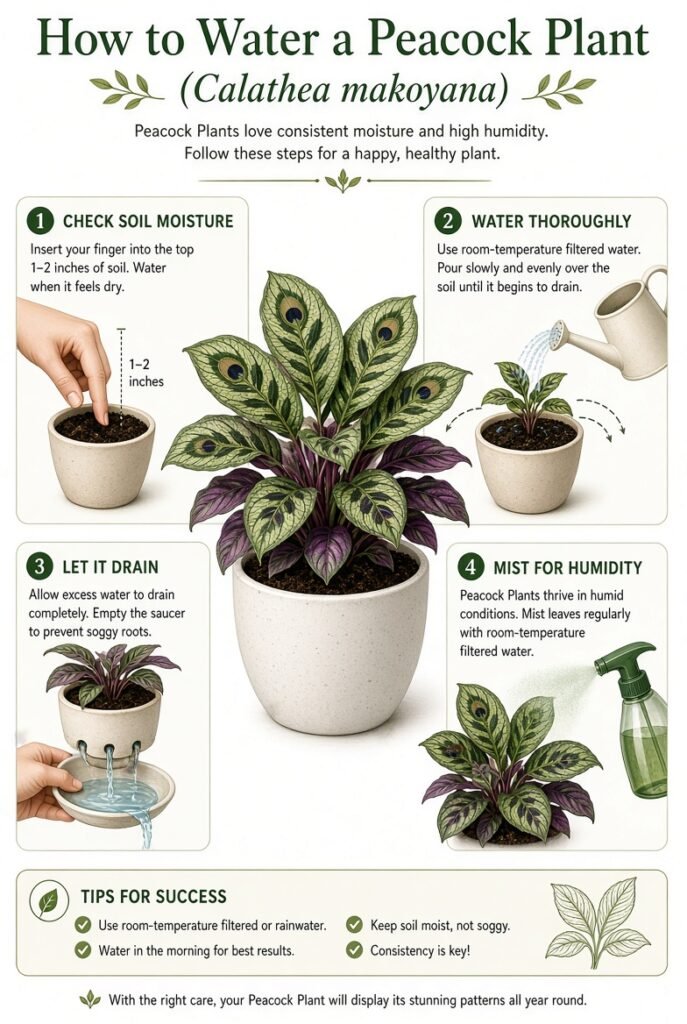
- Check the upper layer of soil with your finger.
- If the surface has started drying, inspect deeper into the pot.
- Water thoroughly when the plant needs it.
- Allow excess water to drain from the pot.
- Empty standing water from a decorative cover pot or saucer.
- Check the soil again before watering next time.
Do not rely on a rigid schedule such as “water every Sunday.”
Indoor conditions change throughout the year.
A plant in a warm, bright room may dry faster than one in a cooler, dimmer room.
Avoid two extremes
Too dry:
Leaves may curl, droop, or develop crispy edges.
Too wet:
Roots may become oxygen-starved, increasing the risk of root problems and yellowing foliage.
The RHS similarly recommends keeping calatheas evenly moist during active growth while taking care not to overwater during winter. (RHS)
Why water quality matters
Water quality deserves special attention with peacock plants.
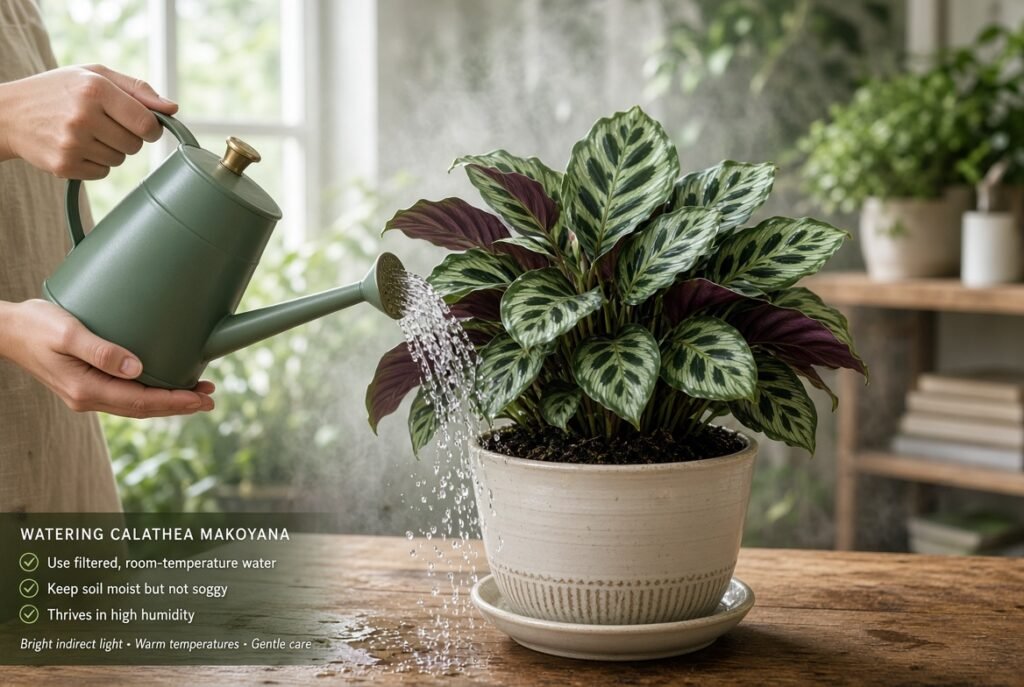
NC State Extension recommends distilled or rainwater because fluoride in tap water can contribute to brown leaves. (Plant Toolbox)
If your local tap water is hard or heavily treated, consider:
- Rainwater
- Distilled water
- A suitable filtered water source
You do not need to panic if you have used tap water occasionally. The important point is to consider water quality when unexplained brown tips keep appearing despite otherwise good care.
Image Suggestion: A realistic step-by-step infographic showing soil checking → thorough watering → drainage → checking moisture before the next watering.
3. Maintain High Humidity
Humidity is often the missing piece in peacock plant care.
The species comes from humid tropical environments, and its thin foliage can react quickly when indoor air becomes dry. NC State Extension identifies high humidity as an important requirement and notes that low humidity can cause leaf rolling or browning. (Plant Toolbox)
Signs your air may be too dry
Look for:
- Brown leaf tips
- Crispy margins
- Curling leaves
- Small or poorly developed new leaves
- Increased sensitivity to temperature changes
Ways to increase humidity
Use a humidifier
A humidifier is usually the most controllable option, especially during dry seasons or when indoor heating runs frequently.
Group plants together
Placing several plants near one another can create a more humid local environment.
Try a bathroom
A bright bathroom can be an excellent location if it receives sufficient indirect light.
The RHS specifically notes that bathrooms and kitchens can provide naturally higher humidity for calatheas. (RHS)
Use a pebble tray
A tray containing pebbles and water can modestly increase humidity around the plant when the pot is positioned above the water rather than sitting directly in it. The RHS recommends this as one way to create a more humid microclimate. (RHS)
Don’t confuse humidity with wet soil
This is an important distinction.
A humid room does not mean the potting mix should remain saturated.
Humidity affects the air around the leaves. Watering affects the roots.
Both matter, but they are not interchangeable.
4. Choose a Soil Mix That Holds Moisture but Drains Well
Peacock plants dislike the false choice between “dry soil” and “soggy soil.”
They need something in between.
The ideal mix holds enough moisture around the roots while still allowing air to move through the root zone.
NC State Extension recommends a moist, well-drained potting mix with high organic matter and perlite to improve drainage. (Plant Toolbox)
A practical homemade mix
You can start with:
- 2 parts quality indoor potting mix or coco-based mix
- 1 part perlite
- 1 part fine orchid bark
This provides a useful combination of moisture retention and aeration.
The exact recipe does not need to be perfect.
What matters is the final behavior of the mix.
After watering, it should become evenly moist without staying saturated for days.
Avoid heavy garden soil
Garden soil can become compacted inside containers.
Compaction reduces air around the roots and makes moisture management more difficult.
A quality indoor potting mix is generally much easier to manage.
Image Suggestion: A labeled soil-layer infographic showing organic potting mix, perlite, and fine bark with arrows explaining moisture retention and aeration.
5. Use the Right Pot and Drainage
A beautiful pot cannot compensate for poor drainage.
Always use a container with a drainage hole.
The RHS recommends containers that allow excess water to escape and warns that roots sitting in water can rot. (RHS)
Choose a pot that is not dramatically oversized
An enormous pot may look generous, but it can hold wet soil around the root ball for too long.
A moderately sized container is easier to manage.
When should you repot?
Look for signs such as:
- Roots emerging from drainage holes
- The plant drying unusually quickly
- Roots becoming tightly crowded
- Noticeably slowed growth
- The root ball becoming densely packed
The RHS recommends repotting calatheas every few years when the clump has filled its pot, preferably during active growth. (RHS)
Move the plant into a container only slightly larger than the current root system.
6. Keep Temperatures Warm and Stable
Peacock plants are tropical plants, so consistency matters.
The RHS recommends keeping calatheas around 16–21°C (61–70°F) and protecting them from drafts and direct heat sources. (RHS)
NC State Extension similarly describes the species as warm-loving and intolerant of low or inconsistent temperatures. (Plant Toolbox)
Keep your plant away from:
- Cold drafts
- Frequently opened exterior doors
- Air-conditioning vents
- Space heaters
- Radiators
- Very cold windows during winter
Why stability matters
A room can have an acceptable average temperature while still exposing the plant to repeated temperature shocks.
For example, placing a peacock plant beside an air-conditioner may expose its leaves to cold, dry airflow even when the rest of the room feels comfortable.
A sheltered position is often better than chasing a precise temperature number.
7. Fertilize Peacock Plants Carefully
Peacock plants are primarily grown for their foliage, so balanced nutrition supports healthy leaf production.
The RHS recommends feeding calatheas with a general-purpose liquid fertilizer or balanced houseplant fertilizer about once a month during the growing season, with feeding stopped during autumn and winter. (RHS)
A practical feeding routine
During active growth:
- Use a balanced liquid houseplant fertilizer.
- Dilute it according to the product instructions.
- Avoid repeatedly applying concentrated fertilizer.
- Water appropriately so fertilizer does not accumulate excessively in the soil.
Do not assume that more fertilizer produces better foliage.
Too much fertilizer can damage roots and contribute to leaf-tip problems.
When should you stop feeding?
Reduce or stop feeding when growth naturally slows.
There is little benefit in pushing fertilizer into a plant that is receiving weak winter light and producing little new growth.
8. How to Prune a Peacock Plant
Peacock plants do not require aggressive pruning.
Instead, pruning is mostly about removing damaged or declining foliage.
Remove leaves that are:
- Completely brown
- Dead
- Severely damaged
- Yellow and deteriorating
Use clean, sharp scissors.
Cut the damaged leaf stalk close to the base rather than repeatedly trimming only the brown tip.
Should you cut brown tips?
You can trim brown sections for appearance.
However, trimming the tip does not solve the underlying problem.
If new leaves continue developing brown edges, investigate:
- Humidity
- Water quality
- Watering consistency
- Root health
- Direct sunlight
- Temperature stress
This diagnostic approach is much more useful than repeatedly cutting damaged leaves.
9. Why Are Peacock Plant Leaves Turning Brown?
Brown leaves are among the most common complaints about this plant.
But “brown leaves” is not a diagnosis by itself.
The location and appearance of the damage provide clues.
| Symptom | Possible Cause | What to Check |
|---|---|---|
| Brown crispy tips | Low humidity or water-quality issues | Humidity and water source |
| Brown bleached patches | Too much direct sun | Move into filtered light |
| Curling leaves | Dry soil, low humidity, or stress | Check soil and humidity |
| Yellowing leaves | Excess moisture or root stress | Check drainage and soil |
| Fading patterns | Insufficient or excessive light | Evaluate placement |
| Fine webbing | Spider mites | Inspect leaf undersides |
| Sudden decline | Root problems or environmental shock | Inspect roots and recent changes |
NC State Extension specifically identifies low humidity, fluoride in tap water, direct sunlight, low light, and overwatering as potential sources of peacock plant problems. (Plant Toolbox)
The important lesson
Do not change five things simultaneously.
If you move the plant, change its water, repot it, increase humidity, and fertilize it on the same day, you will have difficulty identifying what actually helped.
Change the most likely factor first and observe the plant’s response.
10. Why Are Peacock Plant Leaves Curling?
Curling leaves often indicate environmental stress.
First check the soil.
If it is unusually dry, the plant may be experiencing water stress.
Next check humidity.
A peacock plant in a dry room can curl even when the soil is adequately moist.
Also inspect the location.
Strong sunlight, cold drafts, heating vents, or air-conditioning can all create stressful microclimates.
NC State Extension lists low humidity and dry soil among conditions the plant does not tolerate well. (Plant Toolbox)
A useful troubleshooting order
Check these in order:
- Is the soil too dry?
- Is the air unusually dry?
- Is direct sun hitting the leaves?
- Is the plant near a vent or heater?
- Are pests present?
- Has the plant recently been repotted or moved?
This prevents you from treating symptoms randomly.
11. Why Are Peacock Plant Leaves Yellow?
A yellow leaf can have several causes.
One of the first things to investigate is excess moisture.
If the soil remains wet for long periods, roots may struggle with inadequate oxygen and eventually develop problems.
Check:
- Drainage holes
- Pot size
- Soil texture
- Watering frequency
- Root condition
If several leaves are yellow while the soil stays constantly wet, watering and drainage deserve immediate attention.
The RHS warns that overwatering calatheas can lead to poor leaf development and root rot. (RHS)
However, one old yellow leaf does not necessarily mean the entire plant is dying.
Older leaves naturally decline over time.
Look at the pattern across the plant, rather than reacting to a single leaf.
12. Peacock Plant Pests to Watch For
Peacock plants can experience common indoor plant pests.
NC State Extension lists:
- Aphids
- Scale
- Mealybugs
- Spider mites
among pests that may affect the species. (Plant Toolbox)
Spider mites
Look closely at the undersides of leaves.
Possible signs include:
- Fine webbing
- Tiny pale speckles
- Faded foliage
- Curling leaves
Dry indoor air can make pest problems particularly noticeable.
Mealybugs
These may look like small white cottony clusters around stems and leaf joints.
Scale
Scale insects appear as small, fixed bumps on stems or foliage.
What to do
Isolate an infested plant from nearby houseplants.
Then inspect neighboring plants as well.
Early detection is much easier to manage than a large established infestation.
13. How to Propagate a Peacock Plant
Peacock plants are generally propagated by division, rather than from leaf cuttings.
The RHS lists division as the recommended propagation method and suggests doing it in late spring. (RHS)
Basic division process
- Remove the mature plant carefully from its container.
- Inspect the root system.
- Identify naturally separate clumps.
- Gently divide the plant while preserving healthy roots.
- Place each division into an appropriately sized pot.
- Use fresh, moisture-retentive but well-drained mix.
- Keep the divisions warm and humid while they establish.
- Provide bright indirect light.
Avoid dividing a small, weak plant simply because you want more plants.
Propagation works best when the parent plant is already healthy and well established.
Image Suggestion: A realistic four-step propagation infographic showing a mature peacock plant being removed, divided at the root clump, replanted, and recovering in bright indirect light.
14. Seasonal Peacock Plant Care
Your watering and feeding routine should change with the environment.
Spring
As growth increases:
- Check soil more frequently.
- Resume regular feeding.
- Increase watering only as the plant actually dries faster.
- Consider repotting if the root system has filled its container.
Summer
This is often the strongest growth period.
Pay attention to:
- Faster soil drying
- Higher water demand
- Intense sunlight
- Air-conditioning
- Humidity
A plant near a sunny window may need more frequent monitoring than one in a shaded room.
Autumn
As light levels decline:
- Reduce fertilizer.
- Monitor soil before watering.
- Watch for cooler drafts.
- Check humidity as indoor heating begins.
Winter
Winter care is often about preventing stress.
Keep the plant:
- Warm
- Away from drafts
- Away from heaters
- In suitable indirect light
- Moist but never waterlogged
The RHS specifically recommends taking care not to overwater calatheas in winter and stopping regular feeding during the cooler season. (RHS)
Common Peacock Plant Care Mistakes
1. Watering on a fixed schedule
Calendar-based watering ignores changes in temperature, light, humidity, and soil.
Better approach: Check the soil first.
2. Putting it in harsh sunlight
Tropical does not automatically mean full sun.
Better approach: Give it bright, filtered or indirect light.
3. Keeping the soil constantly soaked
Moist soil is not the same as saturated soil.
Better approach: Use a well-drained mix and avoid standing water.
4. Ignoring water quality
Persistent brown tips may have more than one cause.
Better approach: If other conditions are good, consider rainwater, distilled water, or suitable filtered water.
5. Treating humidity with watering
Adding more water to the soil does not fix dry air.
Better approach: Improve room humidity separately.
6. Fertilizing a stressed plant
Fertilizer does not repair environmental stress.
Better approach: Correct light, moisture, humidity, or root problems first.
7. Repotting too aggressively
A much larger pot can stay wet for too long.
Better approach: Increase pot size modestly when repotting.
A Simple Weekly Peacock Plant Care Routine
You do not need to spend hours caring for this plant.
Once a week, perform a quick inspection.
Check the soil
Feel the upper soil and determine whether watering is needed.
Inspect the leaves
Look for:
- Brown tips
- Curling
- Yellowing
- New growth
- Pest activity
Check the environment
Ask:
- Is direct sun hitting the plant?
- Is a heater or AC vent nearby?
- Does the air feel unusually dry?
- Has the plant been exposed to a cold draft?
Rotate the pot
A small rotation can help prevent strongly one-sided growth.
Clean dusty foliage
Use a gentle, soft method to remove dust without damaging the thin leaves.
This five-minute inspection can catch problems before they become major.
A Practical Troubleshooting Chart
| What You See | First Thing to Investigate | Likely Adjustment |
|---|---|---|
| Crispy brown tips | Humidity and water quality | Increase humidity; consider softer water |
| Brown patches | Direct sunlight | Move away from harsh rays |
| Curling leaves | Moisture and humidity | Check soil and room humidity |
| Yellow leaves | Wet soil | Improve drainage and watering |
| Faded patterns | Light level | Adjust toward brighter indirect light |
| Fine webbing | Spider mites | Isolate and inspect carefully |
| Slow growth | Light, temperature, roots | Improve conditions before adding fertilizer |
| Leaf damage after moving | Environmental shock | Stabilize temperature and light |
The most important diagnostic principle is to look at several symptoms together.
For example, brown tips plus dry soil and low humidity point toward a different problem than brown tips with constantly wet soil and poor drainage.
Can a Peacock Plant Grow in Low Light?
It can tolerate lower light than some tropical foliage plants, but that does not mean low light is ideal.
The RHS notes that G. makoyana can tolerate low light, while also warning that inadequate light can weaken growth and reduce foliage quality. (RHS)
If your plant is surviving but barely growing, try improving the light before increasing fertilizer.
A brighter indirect location often provides a better solution than feeding a plant that lacks enough energy for strong growth.
Can You Grow a Peacock Plant Outdoors?
Yes, but only when the climate and conditions are suitable.
This is a tropical plant that needs protection from:
- Frost
- Strong direct sunlight
- Cold temperatures
- Dry conditions
- Sudden environmental changes
For most temperate climates, it is better treated as an indoor or protected container plant.
NC State Extension describes it as a tropical rainforest species requiring warm, shaded, humid conditions. (Plant Toolbox)
In warm, frost-free environments, it can be grown outdoors in a sheltered, shaded location.
Expert Tips for Better Peacock Plant Care
Tip 1: Watch the new leaves
New foliage often tells you more about current conditions than old damaged leaves.
If new leaves emerge healthy, your current care is probably improving.
Tip 2: Do not chase perfect leaves
Older leaves may retain damage from previous conditions.
A few brown edges do not automatically mean your current routine is failing.
Tip 3: Change one major variable at a time
This is especially useful when troubleshooting.
Give each adjustment enough time to show a response.
Tip 4: Prioritize environmental consistency
Stable conditions are often more valuable than constantly optimizing individual numbers.
Tip 5: Look underneath the leaves
Pests frequently hide where casual inspections miss them.
Tip 6: Use the plant’s growth as your feedback
Healthy new leaves, firm stems, good coloration, and stable soil moisture are better indicators than following a rigid watering calendar.
Frequently Asked Questions
How often should I water a peacock plant?
Water when the upper layer of the potting mix has begun to dry, then water thoroughly and allow excess water to drain. The exact interval varies with light, temperature, humidity, pot size, and season. Avoid relying on a fixed weekly schedule.
Does a peacock plant need direct sunlight?
No. Bright indirect or filtered light is generally better. Strong direct sunlight can scorch or fade the foliage. (RHS)
Why are my peacock plant leaves turning brown?
Common causes include low humidity, unsuitable water quality, direct sunlight, dry soil, or environmental stress. NC State Extension specifically notes low humidity, fluoride in tap water, and direct sunlight as potential causes. (Plant Toolbox)
Should I mist my peacock plant?
Misting can temporarily increase moisture around foliage, but it is not a substitute for maintaining suitable room humidity. A humidifier or naturally humid location provides more consistent environmental conditions.
What water is best for a peacock plant?
Rainwater or distilled water is a good choice. Suitable filtered water can also work. This plant can be sensitive to fluoride in tap water, which may contribute to brown foliage. (Plant Toolbox)
Why is my peacock plant curling?
Check soil moisture, humidity, direct sunlight, temperature changes, and drafts. Curling can occur when the plant experiences dry conditions or other environmental stress.
Why are my peacock plant leaves yellow?
Check whether the soil remains wet for too long. Poor drainage and overwatering can contribute to root problems and yellowing. Also consider whether the yellow leaf is simply an older leaf naturally declining.
What fertilizer is best for a peacock plant?
A balanced liquid houseplant fertilizer is appropriate during active growth. The RHS recommends monthly feeding with a general-purpose or balanced liquid fertilizer during the growing season. (RHS)
How do I propagate a peacock plant?
Propagation is generally done by division. Separate established clumps while retaining healthy roots, then pot the divisions into suitable moist, well-drained mix. The RHS recommends division in late spring. (RHS)
Is a peacock plant difficult to grow?
It is more demanding than many beginner houseplants because it responds strongly to dry air, inconsistent moisture, poor water quality, temperature fluctuations, and unsuitable light. Once those conditions are controlled, care becomes much more predictable.
Why does my peacock plant move its leaves?
The leaves naturally respond to changes in light and temperature. The foliage can fold upward in the evening and reopen as daylight returns. (Plant Toolbox)
Final Thoughts
Successful peacock plant care is less about following a perfect schedule and more about creating a stable environment.
Give Goeppertia makoyana bright filtered light rather than harsh sun. Keep its soil evenly moist without leaving the roots saturated. Provide high humidity, stable warmth, good drainage, and suitable water quality. Feed during active growth, and adjust care as seasonal conditions change.
Most importantly, learn to read the plant.
Brown tips, curled leaves, yellow foliage, and fading patterns are clues rather than diagnoses. Check the soil, roots, light, humidity, water quality, temperature, and pests before deciding what to change.
When those fundamentals are right, the peacock plant can reward you with dense, beautifully patterned foliage and its distinctive daily leaf movement.