Quick Answer
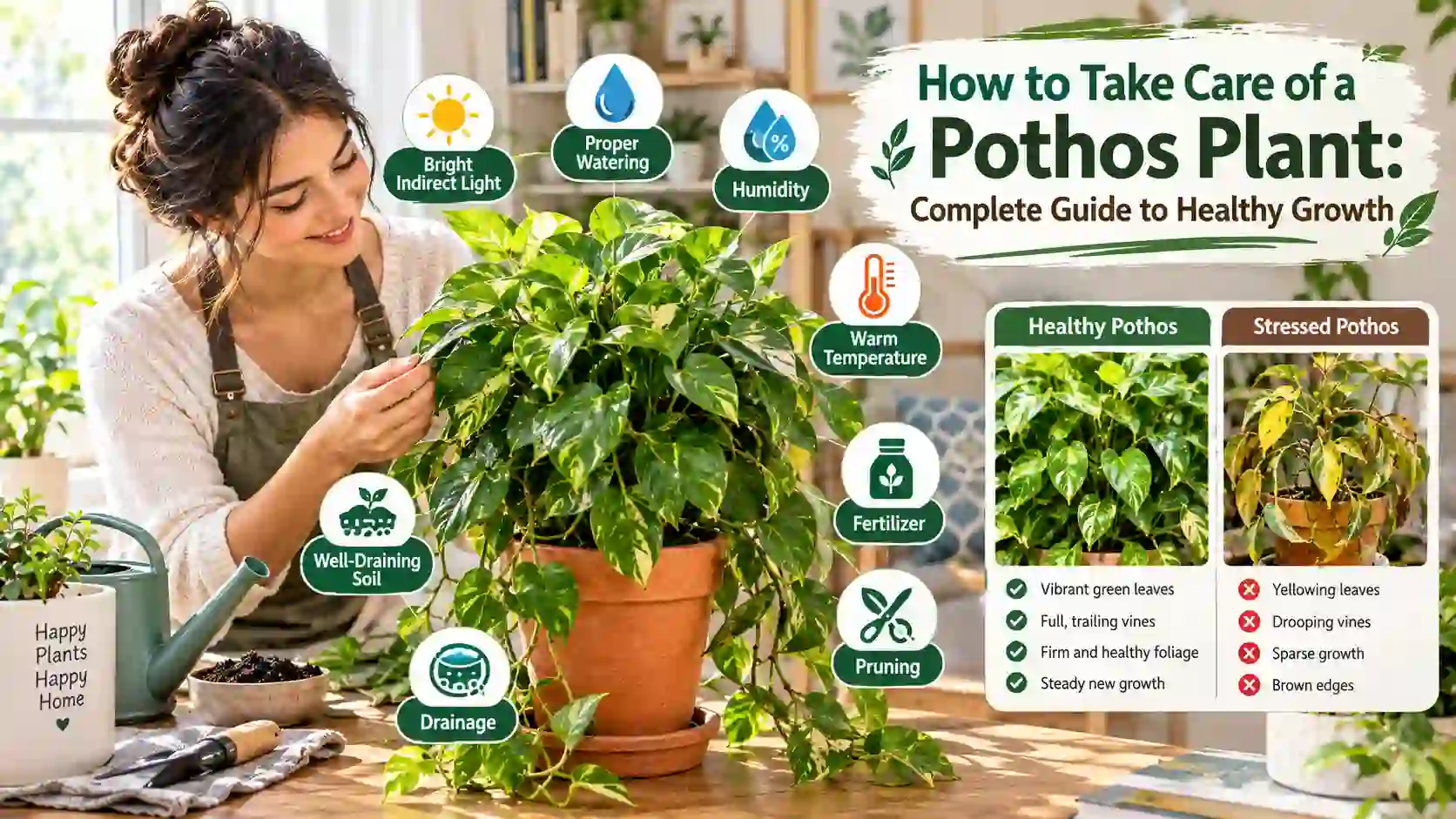
To take care of a pothos plant, place it in bright, indirect light, use a well-draining potting mix, and water when the upper portion of the soil has dried. Keep it warm, provide moderate humidity, and use a pot with drainage holes. Prune long or damaged vines to maintain a fuller shape. Pothos tolerates lower light and occasional missed watering, but consistent care produces stronger growth and healthier leaves.
Introduction
Pothos is one of the most forgiving houseplants, but “easy to grow” does not mean it can thrive under every condition.
A pothos sitting in a dark corner may survive but produce small leaves and long, sparse vines. A plant watered too frequently may develop yellow leaves and damaged roots. A variegated pothos placed in very low light can gradually lose some of its attractive pattern.
Learning how to take care of a pothos plant is therefore less about following a strict calendar and more about understanding what the plant is telling you.
Pothos, botanically known as Epipremnum aureum, is a tropical aroid grown for its attractive foliage and trailing or climbing habit. Popular types include Golden Pothos, Marble Queen, Neon Pothos, Jade Pothos, and several other cultivars.
The good news is that pothos is remarkably adaptable.
Once you get four things right—light, watering, drainage, and temperature—the rest of its care becomes much easier.
What Does a Pothos Plant Need to Grow Well?
A healthy pothos does not require complicated equipment or a demanding maintenance routine.
Its basic requirements are:
| Care Factor | What Pothos Prefers | Why It Matters |
|---|---|---|
| Light | Bright, indirect light | Supports vigorous, compact growth |
| Water | Water after partial drying | Prevents prolonged saturation |
| Soil | Loose, well-draining mix | Keeps roots supplied with oxygen |
| Temperature | Warm, stable conditions | Supports tropical growth |
| Humidity | Moderate humidity or higher | Helps foliage remain healthy |
| Fertilizer | Moderate feeding during growth | Supports new leaves and vines |
| Pot | Drainage holes | Prevents trapped excess water |
| Pruning | Occasional trimming | Encourages a manageable, fuller plant |
The plant’s environment determines how quickly the soil dries.
That means there is no universal rule such as “water pothos every seven days.”
How Much Light Does a Pothos Need?
Light has a major influence on pothos growth.
The ideal location is usually bright, indirect light.
Place your pothos near a bright window where it receives plenty of ambient daylight without being exposed to intense sunlight for long periods.
What Bright Indirect Light Looks Like
A suitable location might be:
- Near an east-facing window
- A short distance from a bright south-facing window
- Near a west-facing window with filtered afternoon sunlight
- In a bright room with light-colored walls that reflect daylight
A sheer curtain can help soften intense sunlight.
Can Pothos Grow in Low Light?
Yes, but there is an important distinction between surviving and growing well.
Pothos can tolerate lower-light conditions better than many houseplants. However, prolonged low light may cause:
- Slower growth
- Smaller leaves
- Longer spaces between leaves
- Sparse vines
- Less pronounced variegation
- Reduced vigor
If your pothos is growing extremely slowly, evaluate light before immediately adding fertilizer.
What About Direct Sunlight?
Strong, direct afternoon sun can scorch pothos foliage.
Symptoms may include:
- Pale patches
- Brown or crispy areas
- Bleached-looking leaves
- Sudden leaf damage after moving the plant
Gentle morning sunlight can be tolerated by many pothos plants, especially when introduced gradually.
Variegated Pothos Needs Better Light
Variegated cultivars contain areas with less chlorophyll.
For example, Marble Queen pothos generally benefits from brighter conditions than a completely green pothos.
If light is too weak, new growth may become greener.
This is not necessarily a disease. The plant is producing more chlorophyll-rich tissue to make better use of available light.
Image Suggestion: Create a realistic three-panel pothos lighting infographic showing bright indirect light, low light with sparse growth, and harsh direct sunlight with leaf scorch.
How Often Should You Water a Pothos Plant?
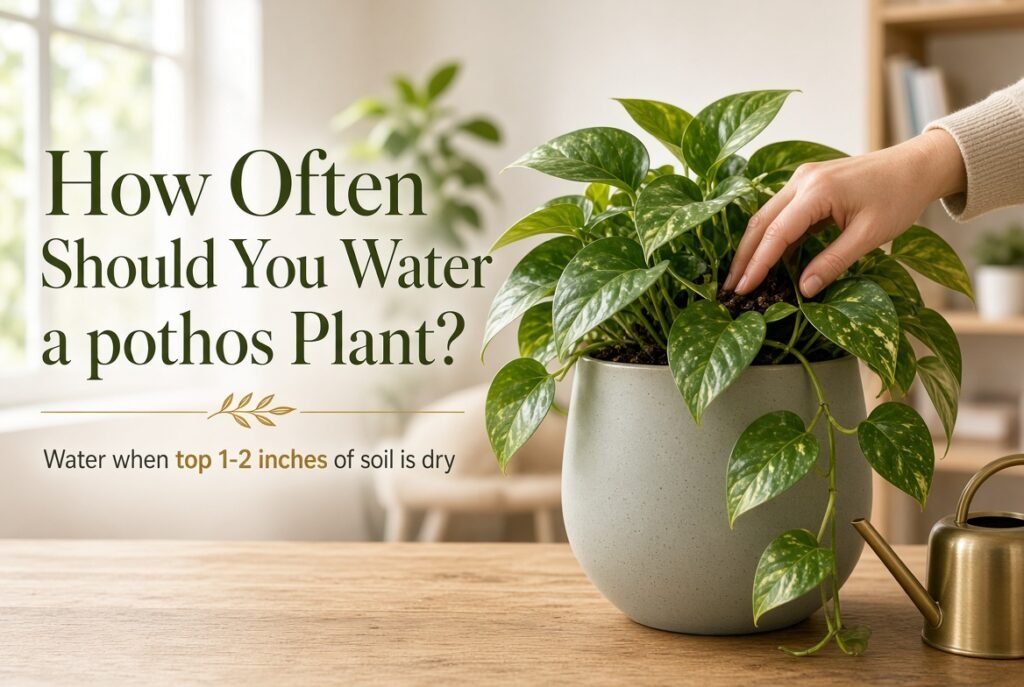
Watering is where many pothos problems begin.
Pothos prefers consistent moisture during active growth, but its roots should not remain in saturated soil continuously.
The safest approach is to check the soil before watering.
A Simple Watering Method
- Check the upper portion of the potting mix.
- Feel whether it has dried noticeably.
- Check the weight of the container if you know how it feels after watering.
- If the plant needs water, soak the soil thoroughly.
- Let excess water drain through the bottom.
- Empty standing water from the saucer or decorative container.
Do not provide a tiny amount of water every day.
A thorough watering followed by appropriate drying is generally more useful than constant surface moisture.
How Dry Should Pothos Soil Be?
Allow the upper portion of the potting mix to dry before watering again.
You do not need to let the entire root ball become bone-dry.
The exact drying point depends on:
- Pot size
- Soil composition
- Temperature
- Humidity
- Light
- Season
- Root density
A pothos in a small pot beside a bright window may need water much sooner than a large plant in a dim room.
A Useful Beginner Test
Insert your finger a short distance into the soil.
If the upper layer still feels clearly moist, wait and check again later.
If it has dried and the pot feels considerably lighter, the plant may be ready for a thorough watering.
How to Tell If a Pothos Is Underwatered
Underwatering can cause:
- Drooping leaves
- Limp foliage
- Dry potting mix
- Curling leaves
- Brown or crispy edges
- Slower growth
A mildly thirsty pothos often recovers after proper watering.
Severe or repeated dehydration, however, can damage roots and foliage.
If the plant remains wilted even after the soil has been watered properly, do not automatically keep adding water.
The roots may be damaged or the soil may have become difficult to rehydrate.
How to Tell If a Pothos Is Overwatered
Overwatering is usually more accurately described as too much moisture around the roots for too long.
Possible symptoms include:
- Yellow leaves
- Soft or limp foliage
- Persistent wet soil
- Leaf drop
- Root discoloration or mushiness
- Unpleasant-smelling soil
- Slow growth despite wet soil
One of the most common beginner mistakes is assuming yellow leaves always mean the plant needs more water.
Sometimes the opposite is true.
What to Do If You Suspect Overwatering
First, stop watering temporarily.
Then examine:
- How wet the soil is
- Whether the pot has drainage holes
- How quickly the container normally dries
- Whether roots appear healthy
- Whether the plant is sitting in collected water
If the root system is severely damaged, the plant may need to be removed from its container and repotted into fresh, airy soil.
Image Suggestion: Show a side-by-side comparison of an underwatered pothos and an overwatered pothos, including dry soil, drooping leaves, saturated soil, yellow leaves, and healthy roots.
What Is the Best Soil for Pothos?
Pothos performs well in a loose, well-draining potting mix.
The soil should retain enough moisture for the plant while allowing excess water and air to move through the root zone.
A practical mix can include:
- Quality indoor potting mix
- Perlite or pumice
- Orchid bark or another coarse component
The exact proportions are less important than the final texture.
Test Your Potting Mix
After watering, water should move through the container rather than sitting on top for an extended period.
If the soil stays saturated for many days, investigate both the soil and the pot.
Remember that even excellent soil cannot compensate for a container with poor drainage.
Choosing the Right Pothos Pot
A good pot has drainage holes.
This is more important than choosing an expensive decorative container.
The pot should also be appropriately sized for the root system.
Why Oversized Pots Can Cause Problems
A large container holds a larger volume of soil.
If the pothos has a relatively small root system, that extra soil can remain wet for longer.
This increases the chance of prolonged root-zone saturation.
When repotting, moving up one reasonable pot size is often safer than placing a small root ball into a huge container.
Plastic vs. Terracotta
Both can work.
Plastic pots:
- Retain moisture longer
- Are lightweight
- Work well in drier environments
Terracotta pots:
- Dry more quickly
- Allow moisture to evaporate through the pot walls
- Can be useful for growers who tend to overwater
Choose based on your environment and watering habits rather than assuming one material is always superior.
What Temperature Does Pothos Need?

Pothos is a tropical plant and generally prefers warm indoor conditions.
Protect it from:
- Cold drafts
- Freezing temperatures
- Air-conditioning blasts
- Sudden temperature changes
- Direct heat from radiators or heaters
A stable room is usually better than constantly moving the plant between dramatically different environments.
Cold stress can cause sudden leaf damage even when watering has been perfect.
Does Pothos Need High Humidity?
Pothos can adapt to ordinary indoor humidity, which is one reason it is popular as a houseplant.
However, moderate humidity can help foliage remain attractive, especially in very dry homes.
Useful approaches include:
- Grouping plants together
- Running a humidifier when indoor air is very dry
- Keeping plants away from heating vents
- Maintaining reasonable airflow
Should You Mist Pothos?
Misting is not essential.
It may temporarily increase moisture around the foliage, but it does not replace proper watering or stable humidity.
If your home is consistently dry, a humidifier is generally a more reliable way to increase ambient humidity.
How to Fertilize a Pothos
Pothos is not a heavy feeder that requires constant fertilizer.
During active growth, a balanced houseplant fertilizer used according to its label can support healthy foliage and new vines.
Basic Fertilizing Guidelines
- Feed during active growth.
- Follow the fertilizer’s recommended dilution.
- Avoid repeatedly applying excessive fertilizer.
- Reduce or stop feeding when growth naturally slows.
- Water appropriately rather than fertilizing a severely stressed plant.
Can Fertilizer Fix Slow Growth?
Only if nutrition is actually limiting growth.
If your pothos has poor light, damaged roots, compacted soil, or inconsistent watering, fertilizer is unlikely to solve the underlying problem.
Light first. Roots second. Fertilizer third.
That simple order can prevent a lot of unnecessary experimentation.
How to Make a Pothos Grow Faster
There is no safe shortcut that forces unlimited growth.
Instead, improve the conditions that support normal growth.
1. Improve Light
Move the plant toward a brighter location with filtered light.
2. Correct Watering
Do not keep the soil constantly wet or repeatedly allow severe dehydration.
3. Improve Drainage
Make sure the container drains freely and the soil does not stay saturated.
4. Feed During Active Growth
Use a suitable fertilizer at an appropriate strength.
5. Keep the Plant Warm
Avoid cold drafts and extreme temperature changes.
6. Prune Strategically
Cutting excessively long vines can encourage branching from appropriate nodes.
7. Give It Time
Healthy roots must support new growth.
A recently repotted pothos may spend time establishing its root system before producing a lot of new foliage.
How to Make a Pothos Fuller
A pothos naturally tends to produce long vines.
If you want a fuller-looking plant, pruning is one of the most useful techniques.
Pruning for Bushier Growth
- Identify a long or sparse vine.
- Locate a healthy node.
- Use clean pruning scissors.
- Cut just above an appropriate node.
- Continue shaping the plant gradually.
- Root healthy cuttings to create additional plants.
Pruning does not magically create new stems everywhere.
New growth develops from appropriate nodes, so understanding where those nodes are helps you prune with a purpose.
The Secret to a Fuller Pot
A single long cutting can eventually create a trailing plant.
But a pot containing multiple rooted cuttings can create a much fuller appearance.
This makes propagation a useful companion to pruning.
How to Propagate Pothos
Pothos is one of the easiest houseplants to propagate from stem cuttings.
Water Propagation
- Choose a healthy vine.
- Cut a section containing one or more nodes.
- Remove leaves that would sit underwater.
- Place the node in clean water.
- Keep the cutting in bright, indirect light.
- Change the water periodically.
- Wait for roots to develop.
- Transfer to an appropriate potting mix when established.
The Node Is the Important Part
A pothos leaf alone cannot produce a complete new plant.
The cutting needs a suitable stem section containing a node.
A node is the point where leaves and new growth originate.
Soil Propagation
You can also place a node directly into a moist, airy propagation medium.
The medium should remain appropriately moist without becoming permanently saturated.
Soil propagation can reduce the shock of transitioning a cutting from water to soil later.
Image Suggestion: Create a step-by-step pothos propagation infographic showing stem cutting → node → water rooting → established roots → potting.
How to Prune a Pothos Plant
Pruning serves several purposes:
- Removes damaged growth
- Controls vine length
- Encourages branching
- Improves appearance
- Provides propagation material
Use clean, sharp scissors.
Avoid removing large amounts of healthy growth at once unless there is a specific reason.
Where Should You Cut?
For shaping, make your cut near a healthy node.
If you want to propagate the removed section, ensure the cutting contains viable nodes.
Do not throw every pruning offcut into the trash. Healthy pieces can become new plants.
Why Are My Pothos Leaves Turning Yellow?
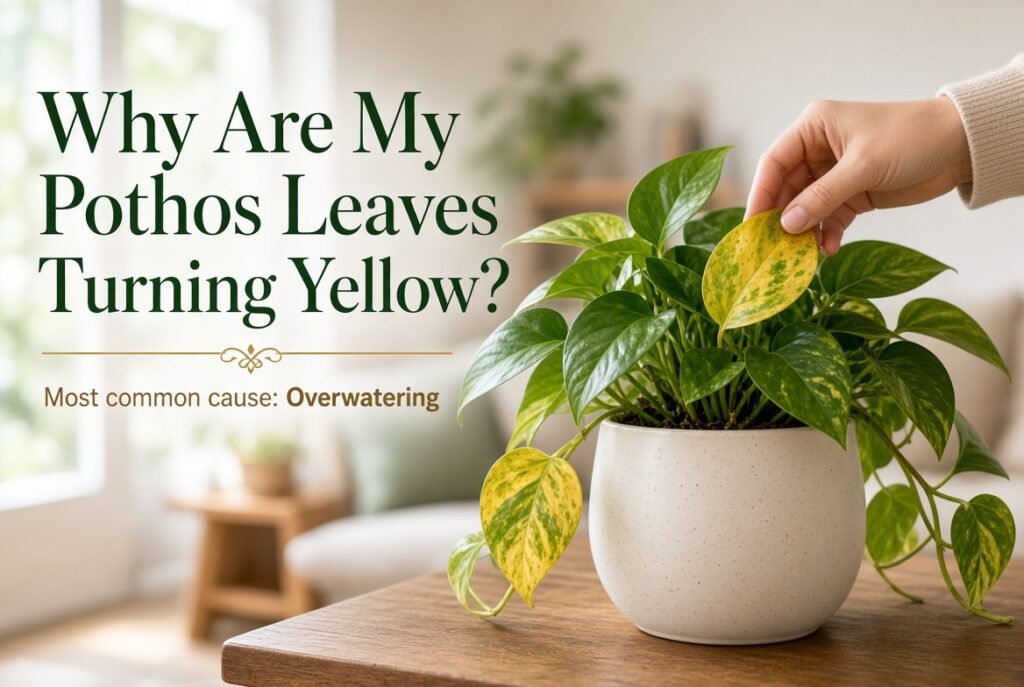
Yellow leaves are a symptom, not a diagnosis.
Possible causes include:
- Excessive soil moisture
- Root stress
- Natural aging
- Insufficient light
- Environmental changes
- Nutritional problems
Start With the Soil
If multiple leaves are turning yellow and the soil remains wet for a long time, investigate watering and drainage first.
If only one old leaf occasionally turns yellow while the plant continues producing healthy new growth, natural leaf aging may be involved.
Look at the pattern, not just one leaf.
Why Are My Pothos Leaves Turning Brown?
Brown areas can develop for several reasons.
Brown, Crispy Edges
Possible causes include:
- Severe dryness
- Very dry air
- Excessive direct sunlight
- Root problems
- Salt buildup
Brown, Soft or Dark Spots
These deserve closer inspection because they can occur with tissue damage or disease-related problems.
Avoid diagnosing the plant from color alone.
Check the leaf texture, soil moisture, roots, light, and recent environmental changes together.
Why Is My Pothos Drooping?
Drooping can happen when the plant is:
- Underwatered
- Overwatered
- Experiencing root damage
- Exposed to cold
- Exposed to sudden environmental changes
The Important Question
Is the soil dry or wet?
If the soil is extremely dry, watering may resolve the problem.
If the soil is already saturated, adding more water can make the underlying issue worse.
This simple observation prevents one of the most common pothos-care mistakes.
Why Are Pothos Leaves Curling?
Curling can be associated with water stress, excessive heat, low humidity, or root problems.
Check:
- Soil moisture
- Recent watering
- Light intensity
- Room temperature
- Humidity
- Root condition
Do not automatically move the plant into a darker location just because the leaves curl.
You need to identify the environmental stress first.
Why Is My Pothos Losing Leaves?
Occasional loss of an older leaf can be normal.
More extensive leaf drop can indicate:
- Watering problems
- Root damage
- Cold stress
- Poor light
- Sudden environmental changes
- Pest activity
If leaf loss happens rapidly, inspect the roots and soil rather than simply increasing watering.
Pothos Pests and How to Handle Them
Pothos can be affected by common houseplant pests such as:
- Mealybugs
- Scale
- Spider mites
- Aphids
- Thrips
Inspect the plant regularly, particularly:
- Under leaves
- Around leaf joints
- Along stems
- Around new growth
What to Do If You Find Pests
- Isolate the affected plant.
- Remove visible pests when practical.
- Clean the foliage and stems carefully.
- Use an appropriate houseplant pest treatment according to its label.
- Repeat inspections because one treatment may not eliminate every life stage.
- Check neighboring plants.
Early detection is far easier than dealing with a heavily infested plant.
Image Suggestion: Create a close-up educational infographic identifying common pothos pests on leaves and stems, with healthy foliage shown beside affected foliage.
Pothos Care in Different Seasons
Spring
As light and growth increase:
- Check soil more frequently.
- Resume regular feeding if appropriate.
- Prune overgrown vines.
- Propagate healthy cuttings.
- Watch for new pest activity.
Do not suddenly double watering just because spring has arrived.
Let the plant’s actual drying rate guide you.
Summer
Summer often means faster drying.
Pay attention to:
- Strong window sunlight
- Higher temperatures
- Faster water loss
- Pest activity
- Outdoor placement
If moving pothos outside, acclimate it gradually.
Fall
As daylight decreases:
- Soil may dry more slowly.
- Watering frequency may need to decrease.
- Growth may naturally slow.
- Inspect plants before bringing them indoors.
Winter
Winter is particularly important for avoiding overwatering.
A pothos sitting in low light may use considerably less water than it did during summer.
Keep it away from cold drafts and heating vents.
Do not follow the same watering schedule year-round.
Should You Put Pothos Outside?
Pothos can grow outdoors in suitable warm climates.
Outdoor conditions can provide:
- More natural light
- Greater humidity
- Stronger airflow
- Faster growth
But outdoor exposure also introduces risks.
Protect the plant from:
- Harsh direct sunlight
- Cold temperatures
- Strong winds
- Heavy rain
- Sudden environmental changes
- Increased pest exposure
Acclimate indoor plants gradually rather than moving them immediately from a dim room into intense outdoor sunlight.
How to Grow Larger Pothos Leaves
Many people notice that pothos leaves remain relatively small indoors.
This is not necessarily a sign of poor care.
Leaf size can be influenced by:
- Species or cultivar
- Plant maturity
- Light
- Climbing habit
- Growing environment
Climbing Can Change Growth
Pothos is naturally a climbing plant.
A mature plant growing upward against a support may produce larger foliage than a plant continuously trailing from a hanging basket.
If large leaves are your goal, provide:
- Strong filtered light
- A stable growing environment
- Appropriate nutrition
- A climbing support
- Time for the plant to mature
Do not expect every pothos cultivar to develop enormous leaves indoors.
How to Care for Different Pothos Varieties
Different pothos cultivars share broadly similar care requirements, but their appearance and growth behavior can differ.
| Pothos Type | Typical Feature | Care Consideration |
|---|---|---|
| Golden Pothos | Green leaves with yellow variegation | Good light helps maintain variegation |
| Marble Queen | White and green marbling | Benefits from brighter indirect light |
| Neon Pothos | Bright chartreuse foliage | Good light helps maintain vivid color |
| Jade Pothos | Solid green leaves | Often tolerates lower light better |
| Satin Pothos | Silver-patterned leaves | Not technically a true pothos; care can differ |
That final distinction matters.
Satin pothos (Scindapsus pictus) is not botanically a true pothos. It is commonly sold under a pothos-style name because of its trailing growth habit.
Common Pothos Care Mistakes
1. Watering Every Week Automatically
A calendar cannot account for changes in temperature, light, humidity, and pot size.
Better: Check the soil.
2. Keeping the Plant in Complete Darkness
Pothos tolerates low light, but that does not mean low light is ideal.
Better: Give it bright filtered light whenever possible.
3. Using a Pot Without Drainage
Decorative containers can trap excess water.
Better: Use a nursery pot with drainage holes inside the decorative pot.
4. Repotting Into a Huge Container
A huge pot can keep the root zone wet too long.
Better: Increase pot size gradually.
5. Fertilizing a Stressed Plant
Fertilizer is not medicine for root rot or poor lighting.
Better: Fix the environment first.
6. Cutting Every Long Vine
Aggressive pruning can remove healthy growth unnecessarily.
Better: Prune strategically and propagate the cuttings.
7. Ignoring the Roots
Leaves show symptoms, but roots often explain the cause.
Better: Inspect roots when watering problems persist.
A Simple Pothos Care Routine
You do not need to spend hours caring for a pothos.
Once a Week
Check:
- Soil moisture
- Leaf condition
- New growth
- Pest activity
- Light exposure
Every Few Weeks
Look closely at:
- Leaf undersides
- Stems
- Drainage
- Root-zone moisture
- Vine growth
Every Few Months
Consider whether the plant needs:
- Pruning
- Propagation
- Trellis support
- Fertilizer adjustment
- Repotting
This routine is more reliable than constantly touching, misting, moving, and watering the plant.
Expert Tips for Healthier Pothos
Learn How Fast Your Pot Dries
Instead of memorizing a watering schedule, observe your particular plant.
Record roughly how long it takes the potting mix to dry after a thorough watering.
This creates a useful baseline.
Use New Growth as Your Report Card
Old leaves reflect past conditions.
New leaves tell you more about what the plant is experiencing now.
If new leaves are healthy and expanding, your current conditions are probably supporting growth.
Rotate the Plant Occasionally
If one side receives much more light, growth can become uneven.
A gentle rotation from time to time can help maintain balanced exposure.
Avoid constantly moving the plant between dramatically different locations.
Don’t Chase Every Imperfection
A pothos does not need to look perfect to be healthy.
One yellowing old leaf does not necessarily require a complete change in your care routine.
Look for patterns.
Keep a Stressed Plant Stable
When a plant is already struggling, avoid making several dramatic changes simultaneously.
Changing the pot, soil, location, watering schedule, fertilizer, and humidity all at once makes it difficult to determine what actually helped.
Make one or two sensible changes and observe the response.
Is Pothos Toxic to Pets?
Pothos is considered toxic to cats and dogs when chewed or ingested because it contains insoluble calcium oxalates.
Possible signs after ingestion can include oral irritation, drooling, difficulty swallowing, vomiting, or other discomfort.
Keep pothos away from pets and children who may chew plant material.
If a pet has eaten part of a pothos plant, contact a veterinarian or an appropriate animal poison-control service for specific advice.
Frequently Asked Questions
How often should I water pothos?
Water when the upper portion of the potting mix has dried rather than watering according to a fixed weekly schedule. Water thoroughly and allow excess water to drain.
Does pothos need direct sunlight?
No. Bright, indirect light is usually ideal. Some gentle morning sunlight may be tolerated, but intense direct sunlight can scorch leaves.
Can pothos grow in low light?
Yes, pothos can tolerate low light, but growth is usually slower. Variegated varieties may also produce greener foliage when light is insufficient.
Why is my pothos turning yellow?
Yellow leaves can result from excess moisture, root problems, natural aging, insufficient light, or other stress. Check the soil and overall growing conditions before changing your routine.
Why is my pothos drooping even though the soil is wet?
Wet soil combined with drooping can indicate root stress or poor drainage. Adding more water may worsen the problem, so inspect the root environment.
How do I make pothos fuller?
Prune selected vines above suitable nodes and propagate the healthy cuttings. Multiple rooted cuttings planted together can create a fuller container.
How do I make pothos grow faster?
Provide bright indirect light, appropriate watering, good drainage, warm conditions, and moderate feeding during active growth. Avoid trying to force growth with excessive fertilizer.
Can pothos grow in water permanently?
Pothos can grow in water for extended periods, but plants grown long-term in water require appropriate nutrients and care. A healthy, well-drained growing medium is generally the simpler approach for long-term houseplant culture.
Can pothos live in a bathroom?
Yes, if the bathroom receives sufficient natural or artificial light. Higher humidity can be beneficial, but humidity cannot compensate for inadequate light.
Should I mist my pothos?
Misting is not necessary for healthy growth. Consistent watering, appropriate humidity, and good airflow are more important.
When should I repot pothos?
Repot when the plant has outgrown its container, the soil has deteriorated, drainage has become poor, or the roots need attention. Do not repot solely because a certain amount of time has passed.
Why are my pothos leaves small?
Small leaves can result from low light, young growth, insufficient support, cultivar characteristics, or other growing conditions. Mature climbing growth can sometimes produce larger foliage than continuously trailing indoor vines.
Can pothos grow outside?
Yes, in suitable warm climates. Acclimate plants gradually and protect them from harsh sunlight, cold temperatures, strong winds, and excessive rain.
Is pothos safe for cats and dogs?
No. Pothos contains insoluble calcium oxalates and can cause oral irritation and gastrointestinal symptoms if chewed or swallowed. Keep it inaccessible to pets.
Related Pothos and Houseplant Topics
If you are building a broader houseplant-care routine, useful related topics include:
- How to propagate pothos from cuttings
- How to fix pothos root rot
- Why pothos leaves turn yellow
- How to prune pothos for fuller growth
- Best soil for pothos plants
- How to grow pothos in water
- How to care for a Golden Pothos
- How to care for a Marble Queen Pothos
- How to increase humidity for indoor plants
- How to identify common houseplant pests
These topics naturally extend the basic care guide into propagation, troubleshooting, and cultivar-specific care.
Conclusion
Learning how to take care of a pothos plant does not require a complicated routine.
Focus on the fundamentals: bright indirect light, well-draining soil, appropriate watering, drainage, warmth, and occasional feeding during active growth.
The most useful habit is to stop treating watering as a calendar task. Check the soil, consider how quickly the pot is drying, and look at the plant’s overall condition.
When problems appear, diagnose the environment before treating the symptom. Yellow leaves can come from several causes. Drooping does not always mean thirst. Slow growth does not automatically mean the plant needs fertilizer.
Give your pothos suitable light, healthy roots, and stable conditions, then give it time.
With that approach, even a beginner can maintain a vigorous plant with long, attractive vines—and with proper pruning and support, a mature pothos can become one of the most rewarding foliage plants in an indoor collection.