Quick Answer
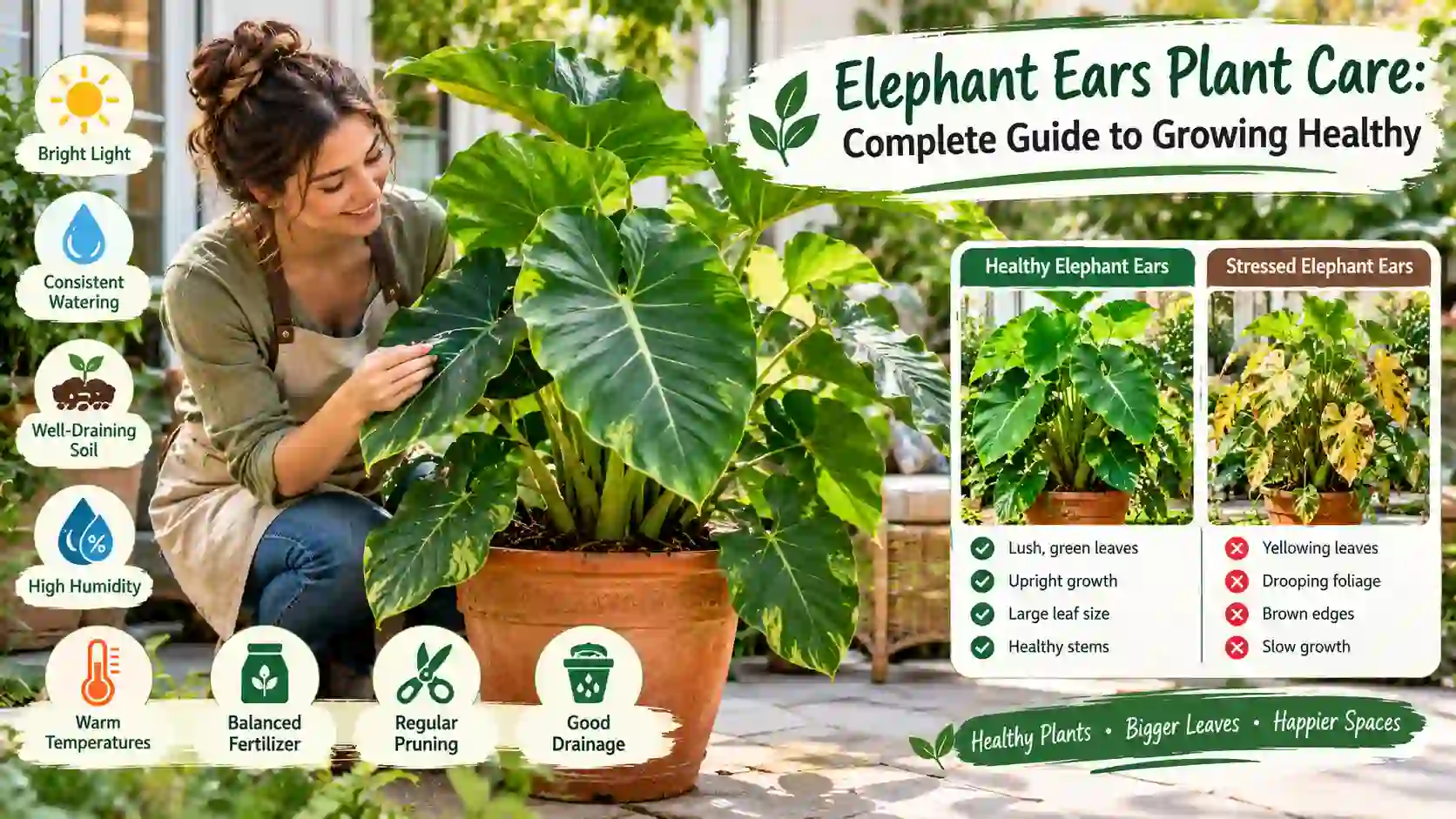
Elephant ears need bright light, consistently moist but well-drained soil, warmth, humidity, and regular feeding during active growth. Most types grow best when protected from cold temperatures and strong drying winds. Water when the soil begins to dry rather than allowing it to become bone-dry. Provide plenty of space because healthy elephant ears can develop enormous leaves. In cold climates, many types need to be overwintered indoors or as dormant bulbs, tubers, or corms.
Introduction
Elephant ears are grown for one spectacular feature: their foliage.
A healthy plant can produce enormous, architectural leaves that instantly transform a patio, garden bed, container, or indoor space. Depending on the type, the leaves may be deep green, nearly black, lime green, burgundy, or patterned with dramatic veins.
But those giant leaves also tell you when something is wrong.
A drooping elephant ear may need water, but it could also be suffering from root problems. Yellow leaves can indicate natural aging, excessive moisture, insufficient light, or environmental stress. A plant that produces small leaves may not be receiving enough warmth, water, nutrients, or growing space.
That is why successful elephant ears plant care is less about memorizing a watering schedule and more about understanding the plant’s growing environment.
The term “elephant ears” is used for several tropical and subtropical plants, especially members of the genera Colocasia, Alocasia, and Xanthosoma. Their care overlaps, but they are not identical.
Before changing your routine, it helps to know which type you are growing.
What Are Elephant Ears?
“Elephant ear” is a common name rather than one specific plant species.
The name is commonly used for plants in these groups:
| Group | Typical Characteristics | General Growing Preference |
|---|---|---|
| Colocasia | Large, often downward-facing leaves; many tolerate very moist conditions | Moist soil and warm conditions |
| Alocasia | Upright leaves with prominent veins; many have dramatic shapes | Moist but well-drained soil and filtered light |
| Xanthosoma | Large tropical foliage with distinctive leaf shapes | Warmth, moisture, and rich soil |
You may also encounter cultivars sold under names such as:
- Elephant Ear
- Taro
- Upright Elephant Ear
- African Mask
- Black Elephant Ear
- Giant Elephant Ear
- Alocasia varieties
- Colocasia varieties
This distinction matters because one elephant ear may tolerate wetter soil than another, while an Alocasia may be more sensitive to cold or excessive moisture.
Always check the botanical name on the plant label when possible.
Where Should You Grow Elephant Ears?
Elephant ears need a location that provides warmth, moisture, and suitable light.
Outdoor plants often perform best in a protected area where they have room to expand.
Good locations include:
- Warm garden beds
- Sheltered patios
- Large containers
- Humid greenhouse environments
- Bright indoor spaces for suitable varieties
Avoid locations exposed to:
- Cold drafts
- Freezing temperatures
- Strong drying winds
- Extremely harsh afternoon sun if the cultivar is not acclimated
- Poorly draining soil unless the species specifically tolerates wet conditions
Their large leaves lose moisture quickly, especially in hot, windy weather.
A protected location can therefore make a surprisingly large difference.
How Much Light Do Elephant Ears Need?
Light requirements vary somewhat by species and cultivar, but most elephant ears appreciate bright light with protection from excessively harsh conditions.
Some Colocasia types can tolerate substantial sunlight when adequately watered and gradually acclimated.
Many Alocasia varieties prefer bright filtered or indirect light.
Bright Light Encourages Strong Growth
Adequate light helps elephant ears produce:
- Larger leaves
- Stronger stems
- Better coloration
- More vigorous growth
- Compact, attractive plants
However, more sunlight is not automatically better.
A plant suddenly moved from an indoor room into intense midday sun may develop scorched foliage.
Signs of Too Much Sun
Watch for:
- Bleached patches
- Brown leaf margins
- Crispy areas
- Faded coloration
- Rapid moisture loss
Signs of Insufficient Light
Low light can cause:
- Small leaves
- Slow growth
- Long, weak stems
- Poor coloration
- Increased leaning toward windows
For indoor elephant ears, a bright window with filtered light is often a good starting point.
Image Suggestion: Create a realistic infographic comparing elephant ears in bright filtered light, excessive direct sunlight, and insufficient light, showing the resulting foliage differences.
How Often Should You Water Elephant Ears?
Unlike drought-tolerant plants, elephant ears generally appreciate consistent moisture during active growth.
But there is an important distinction:
Moist soil does not mean permanently waterlogged soil.
Roots still need oxygen.
The Best Watering Approach
Instead of watering according to a fixed calendar:
- Check the soil.
- Consider the plant’s recent weather and growing conditions.
- Water when the soil begins to dry according to the needs of your particular species.
- Water thoroughly around the root zone.
- Allow excess water to drain from containers.
- Avoid leaving container plants sitting in stagnant water unless the particular growing setup is intentionally designed for aquatic or bog conditions.
Outdoor plants in hot weather may require much more frequent watering than indoor plants.
Why Elephant Ears Sometimes Wilt Quickly
Those huge leaves can lose water rapidly.
A plant may wilt during a hot afternoon even when it is otherwise healthy.
If the foliage recovers after adequate watering and the soil was genuinely dry, temporary heat-related wilting may not indicate a serious problem.
However, persistent wilting deserves investigation.
Do Elephant Ears Like Wet Soil?
Some elephant ears, particularly many Colocasia, tolerate very moist growing conditions.
That does not mean every elephant ear should be planted in stagnant water.
Alocasia varieties, in particular, can be damaged by poorly aerated, constantly saturated soil.
The safest general rule is:
Provide consistent moisture while maintaining adequate root-zone drainage and oxygen.
If you are growing a particular cultivar in a pond edge, bog garden, or unusually wet location, follow care information for that specific plant.
What Is the Best Soil for Elephant Ears?
Elephant ears are vigorous foliage plants and generally appreciate fertile soil containing organic matter.
A suitable garden soil should:
- Hold moisture reasonably well
- Drain excess water
- Contain organic matter
- Remain loose enough for root development
For containers, use a high-quality potting mix rather than heavy garden soil.
A practical container mix can include:
- Quality potting mix
- Compost or another suitable organic component
- Perlite, pumice, or another drainage component
The goal is moisture retention without suffocation of the roots.
Why Soil Quality Matters
Elephant ears can become large plants.
Large foliage requires an active root system capable of supplying water and nutrients.
Poor soil can restrict that root development and make the plant much more difficult to manage.
Choosing the Right Pot for Elephant Ears
Elephant ears can quickly outgrow small containers.
Choose a pot that is:
- Large enough for the expected plant
- Stable enough to support heavy foliage
- Equipped with drainage holes
- Deep enough for healthy root development
Large leaves catch wind and can make a lightweight container unstable.
A heavy pot or a sheltered location can prevent the plant from repeatedly tipping over.
Don’t Start With an Extremely Huge Container
An oversized pot contains more unused soil.
That soil can stay wet longer than the root system can use it.
Move the plant into a larger container when its growth and root system justify the additional space.
How to Fertilize Elephant Ears
Elephant ears are known for vigorous foliage, and adequate nutrition supports that growth.
During active growth, feed according to the instructions on a suitable balanced fertilizer.
Plants growing in fertile garden soil may need less supplemental fertilizer than plants growing in containers.
Fertilizing Tips
- Feed during active growth.
- Follow the fertilizer label.
- Avoid excessive fertilizer.
- Water appropriately.
- Reduce feeding when growth slows significantly.
- Do not use fertilizer as a solution for poor light or root problems.
Want Bigger Elephant Ear Leaves?
Large leaves require more than fertilizer.
For impressive foliage, focus on:
Warmth + adequate light + consistent moisture + fertile soil + sufficient root space.
Adding more fertilizer to a plant growing in poor conditions usually will not produce the dramatic improvement people expect.
How to Grow Bigger Elephant Ear Leaves
Giant leaves are often the main reason people grow elephant ears.
If your plant’s leaves are smaller than expected, examine the growing conditions.
1. Give It Enough Light
Too little light can limit vigorous growth.
2. Keep the Plant Warm
Elephant ears are warm-season plants.
Cold conditions can dramatically slow growth.
3. Maintain Consistent Moisture
Large leaves require substantial water.
Repeated severe drying can restrict growth.
4. Provide Nutrients
Active foliage growth requires adequate nutrition.
5. Give Roots Enough Space
A severely cramped root system can limit the plant.
6. Choose the Right Cultivar
Some elephant ears naturally produce much larger foliage than others.
This is an often-overlooked point.
You cannot make a compact cultivar behave exactly like a naturally giant type simply by adding more fertilizer.
How to Care for Elephant Ears in Containers
Container-grown elephant ears require closer monitoring than plants growing in the ground.
Containers can:
- Dry rapidly
- Heat up in direct sun
- Become root-bound
- Lose nutrients through repeated watering
- Tip over under heavy foliage
Container Care Routine
Check the plant regularly for:
- Soil moisture
- Root crowding
- Drainage
- Nutritional symptoms
- Pest activity
- Wind damage
During hot weather, a large container may still require frequent watering because the plant’s leaves can lose moisture quickly.
Indoor Elephant Ear Plant Care
Some elephant ears can be grown indoors successfully, although they can be more demanding than common low-maintenance houseplants.
The biggest indoor challenges are usually:
- Insufficient light
- Dry air
- Inconsistent watering
- Cold drafts
- Spider mites and other pests
- Limited space for mature foliage
Indoor Light
Place the plant near a bright window with appropriate filtered light.
If natural light is inadequate, supplemental grow lighting can help.
Indoor Humidity
Many tropical elephant ears appreciate higher humidity.
A humidifier can be useful in a dry room.
Grouping plants can also modestly increase humidity around their foliage.
Keep Air Moving
High humidity without airflow can create an environment that favors certain plant problems.
Use gentle airflow rather than strong wind directly against the leaves.
How Much Humidity Do Elephant Ears Need?

Elephant ears generally appreciate humidity because many originate from warm, moist environments.
Low humidity can contribute to:
- Brown leaf edges
- Crispy foliage
- Increased water loss
- Stress during hot weather
Ways to Increase Humidity
Consider:
- A room humidifier
- Grouping plants
- A naturally humid room with adequate light
- Keeping plants away from heating vents
A pebble tray can provide limited localized humidity, but it should not leave the pot sitting directly in water.
Avoid Excessive Leaf Wetness
Humidity and wet foliage are not the same thing.
Good airflow remains important.
Temperature Requirements for Elephant Ears
Warmth is essential for active growth.
Elephant ears generally dislike cold conditions, and many varieties can be seriously damaged by frost or freezing temperatures.
Protect plants from:
- Frost
- Freezing temperatures
- Cold wind
- Chilly drafts
- Sudden temperature drops
Growth naturally slows when conditions become cool.
This is why elephant ears often look spectacular during warm weather and decline rapidly when temperatures fall.
What Happens to Elephant Ears in Winter?
Winter care depends heavily on the species, climate, and whether the plant is growing outdoors or indoors.
In warm climates, some elephant ears can continue growing outdoors.
In colder climates, many types need protection.
Depending on the variety, the plant may be:
- Brought indoors
- Grown as a houseplant
- Allowed to enter dormancy
- Dug up and stored as a tuber or corm-like structure
Do Not Treat Every Elephant Ear the Same
This is particularly important.
Some elephant ears can overwinter more easily than others.
Check the botanical identity and specific cultivar before deciding whether to leave it outdoors.
How to Overwinter Elephant Ears
For plants that cannot safely remain outdoors through cold weather, there are two common approaches.
Option 1: Bring the Plant Indoors
This works when the plant is manageable enough to grow as a houseplant.
Before bringing it inside:
- Inspect the foliage and soil for pests.
- Treat pests if necessary.
- Gradually move the plant into its indoor environment.
- Place it in bright light.
- Adjust watering to the lower indoor growth rate.
- Maintain suitable warmth.
Option 2: Store the Dormant Structure
For suitable dormant varieties:
- Allow foliage to decline naturally after cold weather begins.
- Lift the plant carefully when appropriate.
- Remove excess soil.
- Allow the storage structure to dry appropriately.
- Store it in a suitable cool, dry, frost-free location.
- Inspect periodically.
- Replant when warm conditions return.
The exact procedure depends on the species.
Do not assume every elephant ear should be stored in exactly the same way.
Image Suggestion: Create a four-step winter infographic showing outdoor elephant ear → foliage decline → lifting/storing the dormant structure → spring replanting.
Why Are My Elephant Ear Leaves Turning Yellow?
Yellow leaves are a symptom rather than a diagnosis.
Possible causes include:
- Excessive moisture
- Poor drainage
- Natural aging
- Nutritional problems
- Insufficient light
- Cold stress
- Transplant shock
Look at the Pattern
If one older leaf turns yellow while the plant continues producing healthy new foliage, natural aging may be involved.
If several leaves become yellow at once and the soil remains saturated, investigate the root environment.
Do not immediately add fertilizer simply because a leaf has turned yellow.
Why Are Elephant Ear Leaves Turning Brown?
Brown foliage can have several causes.
Brown, Crispy Edges
Possible causes include:
- Dry soil
- Very dry air
- Excessive sunlight
- Wind
- Salt buildup
- Root problems
Brown, Soft Areas
Soft or rapidly expanding damaged tissue deserves closer attention.
Inspect:
- Soil moisture
- Airflow
- Recent weather
- Leaf wetness
- Pest activity
- Root health
The location and texture of the damage often provide more information than its color alone.
Why Are My Elephant Ear Leaves Drooping?
Large elephant ear leaves naturally move and droop more than small-leaved plants.
But persistent drooping can indicate stress.
Check the soil first.
If the Soil Is Dry
The plant may simply need water.
If the Soil Is Wet
Do not automatically add more water.
Investigate:
- Drainage
- Root health
- Recent temperature changes
- Pot size
- Soil compaction
A plant with damaged roots can sometimes wilt even while its soil is wet because the roots are no longer functioning properly.
This is one of the most important troubleshooting lessons for large-leaved tropical plants.
Why Are My Elephant Ear Leaves Curling?
Curling leaves may be caused by:
- Water stress
- Low humidity
- Excessive heat
- Cold exposure
- Root problems
- Pest damage
- Sudden environmental changes
Check the entire growing environment before changing one factor.
If several symptoms appeared immediately after moving the plant, environmental shock may be involved.
Why Is My Elephant Ear Not Growing?
Slow growth can occur when:
- Temperatures are too cool
- Light is insufficient
- The plant is recovering from transplanting
- Soil remains excessively wet
- The root system is damaged
- The plant has entered dormancy
- Nutrition is inadequate
- The cultivar naturally grows more slowly
Warmth is particularly important.
An elephant ear sitting in a cool room may remain alive but grow very slowly.
Elephant Ear Pests
Common pests can include:
- Spider mites
- Aphids
- Mealybugs
- Scale insects
- Thrips
Spider mites can become especially troublesome in hot, dry indoor environments.
Inspect Regularly
Look at:
- Leaf undersides
- New growth
- Petioles
- Leaf joints
- Stems
Early detection makes pest management much easier.
If You Find Pests
- Isolate the plant when practical.
- Remove visible pests.
- Clean affected foliage.
- Use an appropriate treatment according to its label.
- Repeat inspections.
- Check nearby plants.
Do not assume one treatment has solved the problem permanently.
How to Prune Elephant Ears
Elephant ears generally do not require heavy pruning.
Remove:
- Dead leaves
- Severely damaged leaves
- Diseased-looking foliage
- Completely yellow or brown leaves when they are naturally declining
Use clean tools.
Don’t Remove Healthy Leaves Too Quickly
A leaf that looks slightly damaged may still contribute to the plant.
If it is mostly green and functioning, removing it prematurely can reduce the plant’s ability to photosynthesize.
Wait until a leaf is clearly declining unless there is a specific reason to remove it.
How to Propagate Elephant Ears
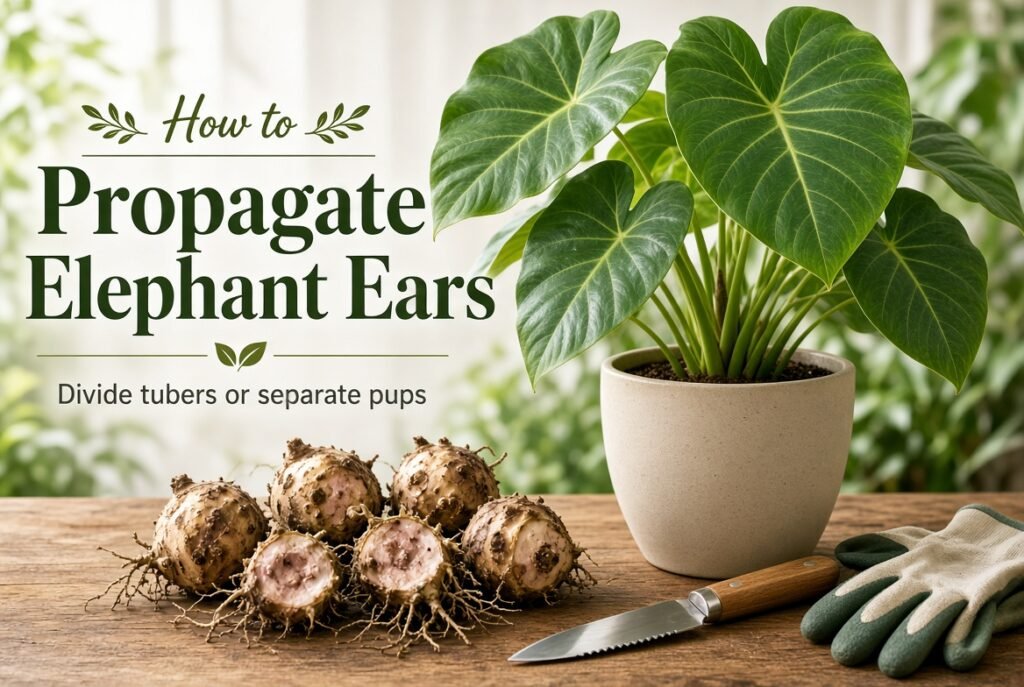
Propagation depends on the plant type.
Many elephant ears are propagated through division of offsets, corms, tubers, or rhizomatous structures, depending on the genus and species.
General Division Approach
When the plant has developed suitable offsets or divisions:
- Remove the plant carefully.
- Identify natural divisions or offsets.
- Separate them using a clean tool when necessary.
- Ensure each division has viable growth tissue and roots when appropriate.
- Plant at a suitable depth.
- Keep warm and appropriately moist.
- Provide suitable light.
Do not cut random pieces of leaf and expect them to produce a new elephant ear.
Successful propagation depends on the plant’s growth structure.
Elephant Ears in the Ground vs. Containers
| Feature | In Ground | In Container |
|---|---|---|
| Root space | Usually greater | Limited |
| Watering | Often more stable | Can dry quickly |
| Nutrients | Soil reserves may be larger | Nutrients can deplete faster |
| Winter management | Depends on climate | Easier to move |
| Wind stability | Usually better | Large leaves can tip pots |
| Maximum size | Often greater | Limited by container |
| Monitoring | Less frequent | Usually more frequent |
If your goal is maximum foliage, planting in a suitable garden location can provide more room for root development.
Containers are useful when you need portability or want better control over winter protection.
Common Elephant Ear Plant Care Mistakes
Mistake 1: Treating Every Elephant Ear as the Same Plant
Colocasia and Alocasia can have different preferences.
Better approach: Identify the genus and cultivar.
Mistake 2: Assuming More Water Is Always Better
Some elephant ears love moisture, but constantly stagnant soil can damage roots.
Better approach: Maintain moisture while considering drainage and species.
Mistake 3: Ignoring Temperature
A tropical plant cannot maintain vigorous growth when exposed to cold conditions.
Better approach: Protect elephant ears from cold and frost.
Mistake 4: Using a Tiny Pot
Large foliage needs adequate root space and a stable container.
Better approach: Choose a container appropriate for the mature plant.
Mistake 5: Fertilizing a Stressed Plant
Fertilizer will not fix root damage, cold stress, or poor light.
Better approach: Diagnose the environment first.
Mistake 6: Removing Leaves Too Early
Slightly damaged leaves may still contribute energy to the plant.
Better approach: Remove foliage when it is clearly declining or creating a specific problem.
Mistake 7: Moving Indoor Plants Directly Into Harsh Sun
Indoor foliage can be highly sensitive to sudden sunlight changes.
Better approach: Acclimate plants gradually.
Elephant Ear Care Through the Seasons
Spring
Spring is an excellent time to restart active growth.
Focus on:
- Increasing light gradually
- Increasing watering as growth resumes
- Feeding during active growth
- Repotting if necessary
- Dividing mature plants
- Checking for pests
Do not assume the plant needs maximum water immediately.
Let growth and temperature guide your routine.
Summer
Summer is usually the strongest growth period.
Monitor:
- Soil moisture
- Sun exposure
- Fertility
- Wind damage
- Pests
- Container stability
Large leaves can lose water quickly during hot weather.
Fall
As temperatures decrease:
- Watch for slower growth.
- Reduce feeding as growth declines.
- Monitor soil drying.
- Prepare cold-sensitive varieties for winter.
- Inspect plants before moving them indoors.
Winter
Winter care depends on the species and climate.
Cold-sensitive plants may need:
- Indoor protection
- Reduced watering
- Bright light
- Warm conditions
- Dormant storage
Avoid keeping a dormant plant excessively wet.
A Simple Elephant Ear Care Routine
You do not need to constantly fuss over an elephant ear.
Every Few Days During Hot Weather
Check:
- Soil moisture
- Leaf firmness
- Sun exposure
- Wind damage
Weekly
Inspect:
- New growth
- Leaf undersides
- Stems
- Pests
- Container drainage
Monthly During Active Growth
Evaluate:
- Fertilizer needs
- Root space
- Overall plant size
- Support and location
Before Winter
Determine:
- Your exact elephant ear type
- Whether it can remain outdoors
- Whether it should be brought inside
- Whether the dormant structure should be stored
This simple routine prevents many problems before they become severe.
Expert Tips for Growing Exceptional Elephant Ears
Give Giant Plants Giant-Sized Growing Conditions
If you want enormous foliage, think beyond fertilizer.
A large plant needs:
- Strong but appropriate light
- Plenty of water
- Warm temperatures
- Nutrient-rich growing conditions
- Adequate root space
Trying to grow a giant elephant ear in a tiny pot with weak light usually leads to disappointment.
Protect Large Leaves From Wind
Wind can shred elephant ear leaves surprisingly quickly.
A sheltered position can preserve foliage quality.
Acclimate Before Increasing Sun
A plant grown indoors or in shade should not immediately receive intense outdoor sunlight.
Gradual exposure gives foliage time to adapt.
Watch New Leaves
New leaves are useful indicators of current conditions.
If new leaves are progressively larger and healthier, your care is moving in the right direction.
If new leaves become smaller, distorted, or increasingly damaged, investigate environmental conditions.
Are Elephant Ears Toxic?
Many plants commonly sold as elephant ears contain insoluble calcium oxalate crystals.
Chewing or ingesting plant material can cause painful irritation of the mouth and throat and may lead to drooling, difficulty swallowing, vomiting, or other symptoms.
Keep elephant ears away from pets and young children who may chew the foliage.
There is another important distinction: some elephant-ear relatives are cultivated as food crops, but edible varieties require appropriate preparation because raw plant tissues can contain irritating compounds.
Do not assume that a plant sold as an ornamental elephant ear is safe to eat.
If a person or pet has ingested part of the plant and develops symptoms, seek appropriate medical or veterinary advice.
Frequently Asked Questions
How often should I water elephant ears?
Watering frequency depends on the species, weather, soil, pot size, and growing location. During active growth, keep the soil consistently moist without allowing unsuitable varieties to remain stagnant and waterlogged.
Do elephant ears need full sun?
Not all elephant ears have identical light requirements. Some Colocasia can tolerate considerable sun when adequately watered, while many Alocasia perform well in bright filtered light. Acclimate plants gradually to stronger sunlight.
Can elephant ears grow indoors?
Yes. Suitable varieties can grow indoors with bright light, warmth, adequate humidity, and careful watering. Their mature size can become the biggest indoor challenge.
Why are my elephant ear leaves turning yellow?
Yellow leaves may result from excess moisture, poor drainage, natural aging, cold stress, insufficient light, or nutritional issues. Look at the soil and overall plant condition before changing your care routine.
Why is my elephant ear drooping?
Dry soil is one possible cause, especially in hot weather. However, wet soil with persistent drooping can indicate root problems. Check moisture and drainage before adding more water.
Do elephant ears like wet soil?
Many Colocasia tolerate very moist conditions, but not every elephant ear should be kept in stagnant water. Species-specific care matters, especially with Alocasia.
How do I make elephant ear leaves bigger?
Provide appropriate light, warmth, consistent moisture, fertile soil, and enough root space. The plant’s species and cultivar also strongly influence its maximum leaf size.
Can elephant ears survive winter?
This depends on the species and climate. In cold areas, many elephant ears need indoor protection or dormant storage. Some varieties can remain outdoors in sufficiently warm climates.
Should I cut off damaged elephant ear leaves?
Remove completely dead or severely damaged leaves with clean tools. Avoid removing partially green leaves unnecessarily because they can still contribute energy to the plant.
Can elephant ears grow in pots?
Yes. Choose a stable container with drainage holes and enough room for the expected root system. Container plants often need more frequent monitoring of water and nutrients.
How do you propagate elephant ears?
Many are propagated by dividing offsets, corms, tubers, or rhizomatous structures, depending on the genus. The exact method should match the plant’s botanical type.
Why are my elephant ear leaves curling?
Curling can result from water stress, low humidity, excessive heat, cold exposure, pests, or root problems. Check the entire environment instead of treating the curl itself.
How much humidity do elephant ears need?
Most tropical elephant ears appreciate moderate to high humidity, especially indoors. Humidity should be combined with good airflow rather than creating a constantly wet environment around the foliage.
Do elephant ears come back every year?
Some types can return from underground structures in warm climates. In colder climates, the foliage may die back and the underground structure may need protection or storage. Winter survival depends on the specific type and local conditions.
Related Plant-Care Topics
If you are growing elephant ears alongside other tropical plants, these related guides can provide useful next steps:
- How to care for Alocasia plants
- How to care for Colocasia plants
- How to fix yellow leaves on tropical plants
- How to prevent root rot in container plants
- How to increase humidity for indoor plants
- How to overwinter tropical plants
- How to propagate plants by division
- How to grow large tropical foliage plants indoors
- How to identify common houseplant pests
These topics complement elephant ear care without repeating the same information.
Conclusion
Give them appropriate bright light, fertile and well-drained soil, consistent moisture, warmth, adequate humidity, and enough room for their roots and leaves. Protect them from cold temperatures and strong drying winds, and adjust watering as the seasons change.
The most important troubleshooting rule is to look at the entire growing environment.
A drooping leaf does not automatically mean the plant needs water. A yellow leaf does not automatically mean it needs fertilizer. A slow-growing elephant ear may simply be too cold, too dark, or growing in a container that restricts its roots.
Most importantly, identify whether you are growing Colocasia, Alocasia, Xanthosoma, or another plant sold under the elephant-ear name. Once you understand the plant’s specific needs, growing those enormous, dramatic leaves becomes much more predictable.
Give the plant the warmth, moisture, light, nutrition, and space it needs—and let the foliage show you when the conditions are working.