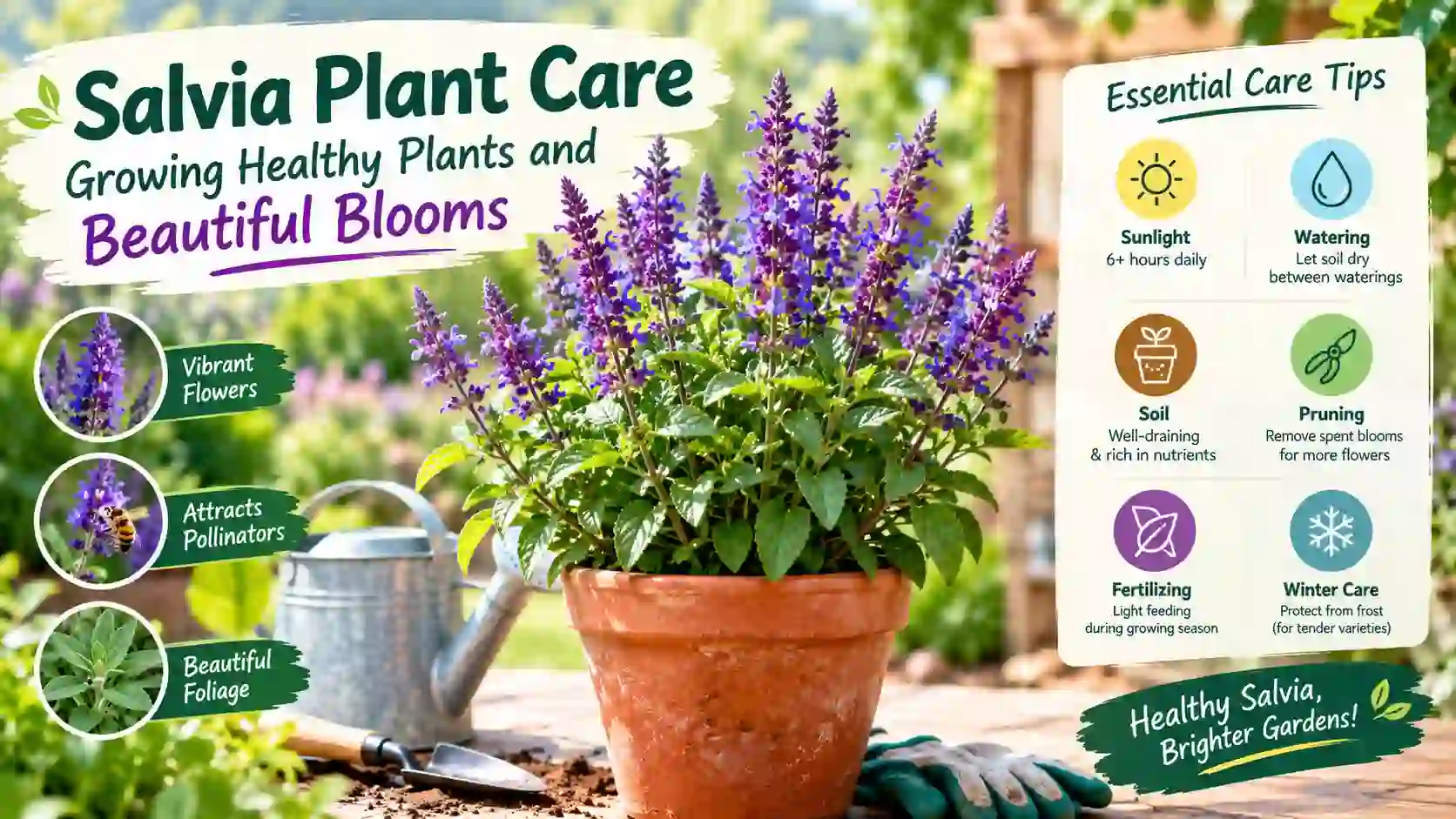
Salvia is a favorite among gardeners for its colorful flower spikes, aromatic foliage, and ability to attract pollinators. Depending on the variety, salvia can grow as a compact bedding plant, a flowering perennial, a woody shrub, or an annual that provides color throughout the growing season.
However, successful salvia plant care involves more than watering and occasional pruning. Some salvias thrive in dry, sunny borders, while others prefer more consistent moisture. Certain varieties survive winter outdoors, whereas tender types need protection from frost.
Choosing the right variety and matching its needs to your garden can make the difference between a plant that flowers for months and one that produces plenty of leaves but very few blooms.
This guide explains how to grow salvia successfully, from selecting the right location and preparing the soil to watering, fertilizing, pruning, propagation, and troubleshooting common problems.
Quick Answer:
Salvia plants grow best in a sunny location with well-draining soil and enough space for good airflow. Most ornamental salvias need around 6–8 hours of sunlight daily, moderate watering while establishing, and less frequent watering once mature. Trim spent flower spikes to encourage additional blooms, and prune according to your variety’s growth habit. Because salvia species differ in cold tolerance, moisture needs, and pruning requirements, identify your variety before following a specific care routine.
1. Understand Which Salvia You Are Growing

Add to Favorites

Add to Favorites

4
Add to Favorites
Before changing your watering, pruning, or winter care routine, identify your salvia. The genus Salvia belongs to the mint family, Lamiaceae, and contains more than a thousand species and numerous cultivars. They differ considerably in size, flowering habits, and growing requirements.
North Carolina Extension Gardener Plant Toolbox
+1
Here are four common types you may encounter.
| Salvia type | Main features | Important care consideration |
|---|---|---|
| Salvia nemorosa | Upright purple, blue, or pink flower spikes | Excellent drainage, sunlight, and removal of faded blooms |
| Salvia splendens | Bright red, pink, or white bedding flowers | Regular moisture and protection from frost |
| Salvia officinalis | Aromatic gray-green leaves used as culinary sage | Sunny conditions and relatively dry, well-drained soil |
| Salvia guaranitica | Tall plants with striking blue flowers on dark stems | Adequate room, moisture during establishment, and climate-appropriate winter care |
Varieties and cultivars within each species can have different growth habits and hardiness. Confirm the plant label when possible.
Are salvia and sage the same plant?
Yes, in botanical terms, culinary sage and ornamental salvias belong to the same genus. However, gardeners commonly use “sage” for plants grown primarily for their aromatic leaves and “salvia” for ornamental flowering varieties.
Do not assume every salvia is edible because common sage is used in cooking. Only consume a species that has been positively identified as suitable for culinary use.
Practical tip: If your plant has a nursery label, keep it. Knowing the species or cultivar makes it much easier to determine pruning time, mature size, and winter protection needs.
Image suggestion: A labeled comparison infographic featuring four salvia varieties, their flower colors, growth habits, and primary uses.
2. Choose the Right Sunlight and Planting Location
Most ornamental salvias flower best in full sun, although some varieties tolerate partial shade. A sunny position also helps foliage dry quickly after rain, reducing conditions that encourage certain leaf diseases.
UC IPM
+1
How much sunlight does salvia need?
Aim for approximately six or more hours of direct sunlight daily for most sun-loving varieties. Some perform best with longer exposure, while certain tender or light-colored varieties benefit from protection during intense afternoon heat.
| Garden location | Expected result |
|---|---|
| Full morning and afternoon sun | Often excellent flowering and compact growth |
| Morning sun with light afternoon shade | Useful in hot climates or for heat-sensitive varieties |
| Bright partial shade | May work for shade-tolerant varieties, but flowering can decrease |
| Deep shade | Often results in weak stems and fewer flowers |
Where should you plant salvia?
Choose a location that offers:
- Plenty of sunlight suited to your variety.
- Soil that drains well after rain or watering.
- Enough room for the mature plant to spread.
- Good air circulation around the foliage.
- Protection from damaging winds for tall varieties.
For gardeners in hot regions, including areas with intense summer sun, morning sunlight with some afternoon protection may help prevent leaf scorch. However, do not place a sun-loving salvia in deep shade simply to protect it from heat.
Expert tip: If your salvia produces lush green foliage but few flowers, assess sunlight before adding fertilizer. Low light is a common reason for poor flowering, and extra nitrogen can encourage even more leafy growth.
Image suggestion: A sunny garden comparison showing a flowering salvia in full sun and a leggy salvia growing in excessive shade.
3. Prepare the Best Soil for Salvia
Salvia needs soil that allows excess water to drain while retaining enough moisture to support roots. Many species tolerate relatively dry conditions once established, but persistent waterlogging can damage roots and encourage disease.
UMN Extension
+1
What soil is best for salvia plants?
A loose, well-draining loam is suitable for many garden salvias. Soil requirements vary, so match the mix to the species rather than assuming every variety needs the same conditions.
For typical ornamental salvias:
- Use garden soil that drains freely.
- Improve heavy clay soil with suitable organic matter and better drainage.
- Consider raised beds if the ground remains saturated.
- Avoid planting directly into compacted soil where water collects.
- Test soil pH if growth remains poor despite suitable light and watering.
Do not add sand blindly to heavy clay. Small amounts of fine sand can create a dense mixture rather than improve drainage. For serious drainage problems, a raised bed or a better planting location is often more effective.
How to improve heavy soil
- Check the area after rain to see how long water remains.
- Loosen compacted soil over the planting area.
- Incorporate appropriate organic matter when preparing the bed.
- Create a raised planting area if drainage remains poor.
- Avoid burying the plant’s crown beneath excess soil or mulch.
For Mediterranean culinary sage, leaner, well-drained soil is often preferable to rich, continuously moist soil. Some ornamental hybrids appreciate more consistent moisture, so species identification matters.
Image suggestion: A soil-preparation infographic comparing well-drained loam, compacted clay, and a raised garden bed.
4. How to Water Salvia Correctly

Add to Favorites

Add to Favorites

8
Add to Favorites
Watering needs change as the plant develops. Newly planted salvias need help establishing roots, while mature plants often tolerate short dry periods.
How often should you water salvia?
There is no universal watering schedule for every salvia. Soil type, rainfall, temperature, container size, and the species all affect how quickly the root zone dries.
| Plant condition | Watering approach |
|---|---|
| Newly planted salvia | Check soil frequently and water when needed to prevent the root ball from drying out |
| Established salvia in garden soil | Water deeply during prolonged dry periods, allowing the soil to drain between applications |
| Salvia in a container | Check more often because pots dry faster, especially in hot weather |
| Salvia in heavy or persistently wet soil | Improve drainage and avoid adding water while the root zone remains saturated |
Step-by-step watering method
- Check the soil near the root zone rather than judging by the surface alone.
- If the soil is dry enough to need water, apply it slowly around the base.
- Water deeply enough to moisten the active root zone.
- Allow excess water to drain rather than leaving the roots in standing water.
- Recheck the soil before watering again.
Avoid repeatedly sprinkling only the soil surface. Deep, appropriate watering encourages roots to explore the surrounding soil.
Signs of overwatering and underwatering
Possible overwatering symptoms:
- Yellowing leaves combined with persistently wet soil.
- Soft or darkened stems near the base.
- Wilting despite moist soil.
- Declining growth or root damage.
Possible underwatering symptoms:
- Drooping leaves and stems during dry weather.
- Dry, crispy foliage.
- Soil pulling away from the edges of a container.
- Improvement after appropriate watering, provided the roots are healthy.
Wilt alone does not prove that a plant needs water. Roots damaged by waterlogged soil can also cause wilting. Check soil moisture and root condition before deciding what to do.
Expert tip: Water the soil rather than routinely soaking the foliage. This helps maintain healthier growing conditions, particularly where humidity is high or airflow is limited.
Image suggestion: An infographic comparing a healthy salvia, an underwatered salvia, and an overwatered plant with simple diagnostic labels.
5. Fertilizing Salvia for More Flowers
Salvia generally does not need heavy feeding. Many perennial varieties grow well in reasonably fertile soil without frequent fertilizer, while annual bedding salvias and container-grown plants may benefit from more regular nutrition.
UMN Extension
+1
Which fertilizer should you use?
A balanced, slow-release fertilizer can be useful for annual ornamental salvias when the soil lacks sufficient nutrients. Apply it according to the label and the plant’s growth needs.
For established perennial salvias:
- Start with healthy soil and appropriate drainage.
- Use compost when it suits the species and planting conditions.
- Avoid repeated high-nitrogen applications.
- Fertilize only when growth or soil conditions justify it.
- Stop adding fertilizer if the plant shows signs of salt buildup or root stress.
Too much nitrogen can encourage leafy growth at the expense of flowers. Excess fertilizer can also increase disease problems in some growing conditions.
Why is my salvia growing leaves but not flowering?
Check these possible causes before feeding the plant:
- Insufficient sunlight: Move or thin surrounding plants if appropriate.
- Excess nitrogen: Review fertilizer applications and avoid additional feeding.
- Recent pruning: Cutting stems before flowering can delay blooms.
- Seasonal timing: Some salvias flower later than others.
- Plant maturity: Young plants may need time to establish.
- Water stress: Both prolonged drought and waterlogged roots can limit flowering.
Image suggestion: A side-by-side infographic showing a flowering salvia with balanced growth and a leafy, sparsely flowering salvia receiving excessive fertilizer.
6. How to Prune Salvia for Bushier Growth

Add to Favorites

Add to Favorites

8
Add to Favorites
Pruning helps many salvias maintain a tidy shape and produce additional flowers. However, the correct method depends on whether your plant is a soft-stemmed perennial, a woody shrub, or an annual bedding variety.
Deadheading: Encourage another flush of blooms
Deadheading means removing flower spikes after they fade.
For many repeat-flowering salvias:
- Wait until the flowers have faded.
- Follow the flower stalk down to a healthy pair of leaves or a suitable side shoot.
- Cut with clean pruning shears.
- Continue monitoring the plant for new flower spikes.
Removing spent flowers can redirect growth toward additional flowering instead of seed production. Some salvias naturally produce new blooms without deadheading, so consider it a maintenance option rather than a universal requirement.
Yard and Garden
+1
When should you cut salvia back?
| Salvia growth habit | Pruning approach |
|---|---|
| Annual bedding salvia | Pinch young tips for bushier growth; remove faded flowers as needed |
| Herbaceous perennial salvia | Remove spent flower stems; cut back old growth according to the variety |
| Woody shrubby salvia | Shape lightly and remove dead or crossing branches without cutting indiscriminately into old wood |
| Tender perennial salvia | Remove damaged growth and protect from cold; time major pruning to suit the climate |
For woody salvias, avoid cutting far into old, leafless wood unless the species is known to regenerate from it. Some woody varieties respond poorly to severe pruning.
Should you prune salvia in fall or spring?
For many hardy herbaceous salvias, leaving old stems through winter and removing them when new growth begins in spring is a safe approach. The old stems can offer some protection and provide winter structure.
Woody salvias may need a different routine. Some benefit from light shaping after flowering, while others are best pruned more substantially once the risk of severe cold has passed.
Practical observation: If a mature salvia has a woody base and green shoots near the tips, do not assume you can cut it down to ground level. Identify the variety before making a major cut.
Image suggestion: A four-step pruning infographic showing faded flower spikes, the correct cutting point, fresh side shoots, and renewed flowering.
7. Growing Salvia in Pots and Containers

Add to Favorites

Add to Favorites

8
Add to Favorites
Container growing is useful when you have limited garden space, want flowers near a doorway, or need to move a tender variety into shelter during cold weather.
Not every salvia stays compact, so check the mature height and spread before selecting a container.
Choose the right container
A suitable container should have:
- Unobstructed drainage holes.
- Enough space for the plant’s root system.
- A potting mix that drains well but retains appropriate moisture.
- A stable base for tall varieties.
- Enough volume to reduce rapid drying during hot weather.
Use a quality potting mix suited to flowering plants, adjusted with drainage material when necessary. Avoid filling a container with dense garden soil.
How to care for potted salvia
- Place the pot where the variety receives suitable sunlight.
- Check moisture more frequently during hot, dry weather.
- Water thoroughly when needed, then allow excess water to drain.
- Feed according to the potting mix and fertilizer label.
- Remove faded flowers and inspect leaves for pests.
- Repot when roots become crowded or the mix deteriorates.
Containers can heat up rapidly in direct sun. If roots are exposed to extreme heat, move the pot to a more suitable position or use a container material that moderates temperature changes.
Expert tip: A salvia that wilts every afternoon in a small pot may need a larger container or more frequent moisture checks. Do not assume it needs extra fertilizer.
Image suggestion: A patio-container infographic showing ideal pot size, drainage holes, sunlight, watering, and deadheading.
8. Salvia Plant Care Through the Seasons
Seasonal care depends on your climate and the plant’s cold tolerance. A hardy perennial can survive winter outdoors in suitable regions, while a frost-sensitive variety may need to be grown as an annual or protected.
Spring
- Remove dead growth when appropriate for the species.
- Divide mature clumps of suitable herbaceous perennials.
- Plant new salvias after the relevant frost risk has passed.
- Check drainage before the main growing season.
- Begin light feeding only when needed.
Summer
- Monitor soil moisture during prolonged heat.
- Deadhead repeat-flowering varieties.
- Watch for aphids, thrips, and signs of leaf disease.
- Provide support for tall plants if necessary.
- Avoid severe pruning during extreme heat unless required to remove damaged growth.
Autumn
- Reduce watering when growth slows and the soil dries more slowly.
- Collect seeds from suitable varieties if you want to propagate them.
- Identify tender salvias that need protection.
- Leave hardy perennial stems in place when appropriate for winter protection.
Winter
- Protect tender plants from cold and frost.
- Avoid keeping dormant or slow-growing plants in saturated soil.
- Prune according to the variety rather than applying a universal winter cutback.
- Keep containers from sitting in water during prolonged wet weather.
The Royal Horticultural Society recommends planting tender salvias after frost risk has passed and protecting less hardy types during winter.
RHS
+1
Can salvia grow in hot climates?
Yes, many salvias grow well in warm climates. However, heat tolerance varies among species and cultivars.
In very hot regions, consider:
- Morning sunlight with some afternoon protection for heat-sensitive varieties.
- Deep watering when the root zone needs it.
- Mulching around the root zone without covering the crown.
- Containers that do not overheat excessively.
- Excellent drainage during heavy rain or monsoon weather.
In warm climates, do not assume that every salvia needs to be watered daily. Soil texture, rainfall, container size, and plant maturity remain important.
Image suggestion: A seasonal care infographic with spring pruning, summer flowers, autumn seed collection, and winter protection.
9. Common Salvia Problems and How to Fix Them
Most salvia problems become easier to manage when you identify the underlying cause. Start with the plant’s growing conditions before applying fertilizer or pesticides.

Add to Favorites
Yellow leaves
Likely causes: Waterlogged soil, root damage, nutrient problems, or normal aging of lower leaves.
What to do: Check soil moisture and drainage. Remove severely damaged foliage and inspect roots if the plant continues to decline.

Add to Favorites
Leggy growth and few flowers
Likely causes: Insufficient light, excessive nitrogen, overcrowding, or pruning at the wrong time.
What to do: Improve sunlight, reduce unnecessary fertilizer, and trim according to the variety’s growth habit.

Add to Favorites
Wilting leaves
Likely causes: Dry soil, damaged roots, excessive heat, or waterlogged conditions.
What to do: Check the root zone first. Water if it is dry, or correct drainage if it is persistently wet.

Add to Favorites
White powdery patches
Likely causes: Powdery mildew or, in some cases, mineral residue.
What to do: Examine the leaf surface closely, improve airflow, avoid excessive crowding, and use an appropriate labeled treatment if a fungal disease is confirmed.

Add to Favorites
Aphids or distorted new growth
Likely causes: Sap-feeding pests, including aphids or thrips.
What to do: Inspect young shoots and flower stems. Remove small infestations manually or use a suitable treatment according to its label.

Add to Favorites
Woody, sparse, or declining stems
Likely causes: Natural aging, winter injury, poor drainage, or unsuitable pruning.
What to do: Check for living growth, remove dead branches carefully, and determine whether the plant needs rejuvenation pruning or replacement.
Why is my salvia dying after winter?
Possible causes include frost damage, waterlogged roots, unsuitable hardiness, and pruning at the wrong time.
Do not discard a perennial immediately because its stems look brown. Scratch a small section of stem gently to check for living green tissue beneath the surface. Also inspect the crown for firm, healthy growth.
If new shoots emerge from the base, the plant may recover. If the crown is soft, rotten, or entirely dead, replacement may be necessary.
Important: Salvia species vary widely in cold tolerance. Winter survival depends on the variety, local climate, drainage, and protection, not just the plant’s common name.
North Carolina Extension Gardener Plant Toolbox
+1
Image suggestion: A troubleshooting infographic showing yellow leaves, powdery mildew, aphids, wilting, and winter damage, each paired with a practical fix.
10. How to Propagate Salvia Plants
Propagating salvia allows you to grow more plants for borders, containers, and pollinator gardens. Depending on the species, you can use stem cuttings, seeds, or division.
North Carolina Extension Gardener Plant Toolbox
+1
Method 1: Propagate salvia from stem cuttings
Stem cuttings are useful for reproducing a particular cultivar when the plant is suitable for this method.

Add to Favorites
Step 1: Select a healthy stem
Choose a non-flowering shoot with healthy leaves. Take a cutting approximately 8–12 cm long, adjusting for the variety.

Add to Favorites
Step 2: Prepare the cutting
Remove the leaves from the lower portion and keep several healthy leaves near the tip. Avoid crushing the stem.

Add to Favorites
Step 3: Plant in a suitable mix
Insert the lower stem into a moist, well-draining propagation medium. Keep it warm and in bright indirect light.

Add to Favorites
Step 4: Encourage root development
Maintain light moisture without saturating the medium. Once roots develop and new growth appears, gradually acclimate the cutting to stronger light.
Rooting time varies by species, temperature, and growing conditions. Do not tug on cuttings repeatedly to check for roots.
Method 2: Grow salvia from seeds
Seeds work well for many species and seed-grown varieties.
- Follow the seed packet for sowing depth and germination requirements.
- Use a clean seed-starting medium.
- Maintain suitable warmth and moisture.
- Provide adequate light after germination.
- Transplant seedlings when they have developed enough roots to handle safely.
Some cultivars do not grow true to type from seed. If you want flowers identical to a named hybrid, vegetative propagation is usually the better option.
Method 3: Divide established salvia plants
Suitable clump-forming perennial salvias can often be divided in early spring as new growth begins. Lift the plant carefully, separate healthy rooted sections, and replant them promptly.
Division is not appropriate for every woody salvia. Check the growth habit before attempting it.
Image suggestion: A propagation infographic showing stem cuttings, seedlings, and division of a mature salvia clump.
11. Best Salvia Varieties for Different Gardens
The best salvia depends on your climate, available space, preferred flower color, and whether you want a short-lived bedding plant or a returning perennial.

Add to Favorites
For perennial flower borders: Salvia nemorosa
This group is valued for upright flower spikes and compact growth. It suits sunny borders where soil drains well. Many varieties are cold-hardy, although hardiness depends on the cultivar.

Add to Favorites
For bright seasonal color: Salvia splendens
Scarlet sage is popular for vibrant bedding displays and containers. It generally needs regular moisture and protection from frost.

Add to Favorites
For an edible herb garden: Salvia officinalis
Common sage has aromatic foliage used in cooking. Give it full sun and well-drained soil, and avoid excessive watering.

Add to Favorites
For dramatic blue flowers: Salvia guaranitica
This group produces striking blue flowers and can grow quite tall. Allow room for mature growth and check the cultivar’s winter requirements.

Add to Favorites
For fragrant foliage: Salvia elegans
Pineapple sage is known for its fruity-smelling foliage and red flowers. It appreciates suitable moisture during active growth and may need winter protection in cold regions.
These varieties illustrate the diversity of the genus rather than a universal ranking. Local climate and growing conditions should guide your final selection.
North Carolina Extension Gardener Plant Toolbox
+2
Image suggestion: A salvia variety comparison infographic with plant names, flower colors, mature size, and garden uses.
12. How to Make Salvia Flower Longer
Many ornamental salvias produce successive waves of flowers during favorable growing conditions. You can often extend the display by maintaining suitable light, moisture, and pruning practices.
Use these practical techniques:
- Provide enough sunlight. Most flowering varieties need a sunny location to produce abundant blooms.
- Remove faded flower spikes. Deadheading can encourage new flowering on repeat-blooming varieties.
- Avoid excess nitrogen. Too much fertilizer can promote foliage rather than flowers.
- Water appropriately. Newly planted salvias need regular attention, while established types may tolerate some drying between waterings.
- Maintain airflow. Give plants sufficient spacing and remove badly diseased material.
- Respect natural flowering cycles. Not every variety blooms continuously, and some flower mainly in a particular season.
Should you cut salvia back after flowering?
Often, yes, if the variety responds well to deadheading or light pruning. Remove faded spikes to encourage fresh growth, but avoid severe pruning without checking the plant’s growth habit.
If you want seeds for propagation or food for wildlife, leave some flowers in place rather than removing every spike.
13. Frequently Asked Questions About Salvia Plant Care
Does salvia need full sun?
Most ornamental salvias flower best with approximately six or more hours of direct sunlight daily. Some tolerate partial shade, particularly in hot climates, but deep shade often reduces flowering.
How often should you water salvia?
Watering frequency depends on the species, weather, soil, and whether the plant grows in a pot or the ground. Water newly planted salvias as needed to establish their roots, then adjust based on soil moisture and rainfall.
Does salvia come back every year?
Many salvias are perennials, but others are annuals or tender perennials. Whether a plant returns depends on its species, cultivar, and local climate.
Why is my salvia not flowering?
Insufficient sunlight, excessive nitrogen, recent pruning, seasonal timing, and water stress can all reduce flowering. Check these factors before applying additional fertilizer.
Should I deadhead salvia?
Deadheading is useful for many repeat-flowering varieties because it can encourage additional blooms and improve appearance. It is optional for varieties that flower well without it.
Can salvia grow in pots?
Yes. Many compact and medium-sized salvias grow well in containers. Choose a suitable pot with drainage holes, use an appropriate potting mix, and monitor moisture more frequently than you would for plants in the ground.
Is salvia drought-tolerant?
Many salvias tolerate dry conditions after their roots are established. However, drought tolerance varies by species. Newly planted salvias and container-grown plants usually require closer moisture monitoring.
When is the best time to plant salvia?
Spring is suitable for many salvias, particularly after frost risk has passed for tender varieties. Hardy perennial salvias can have different planting windows depending on local conditions.
Can I grow salvia in a hot climate?
Yes, many species grow successfully in warm climates. Choose a variety suited to your conditions, provide appropriate sunlight, and ensure excellent drainage. Heat-sensitive varieties may benefit from afternoon shade.
Why are my salvia leaves turning yellow?
Yellowing can indicate overwatering, poor drainage, root damage, nutrient issues, or natural leaf aging. Check soil moisture and inspect the plant before deciding on a treatment.
Is salvia good for bees and butterflies?
Many flowering salvias attract bees, butterflies, and other pollinators. Planting several varieties with overlapping flowering periods can provide a longer-lasting source of nectar.
UC IPM
+1
Can I grow salvia indoors?
Some salvia species can be grown indoors with strong light, adequate airflow, and suitable containers. However, most ornamental flowering salvias perform better outdoors, where they receive more sunlight and room to grow.
Conclusion: Build a Healthy Salvia Plant Care Routine
Successful salvia plant care starts with choosing the right variety and matching it to your garden’s sunlight, soil, and climate. Most salvias perform best in sunny locations with good drainage, while their watering, feeding, pruning, and winter requirements vary by species.
For reliable results, focus on five priorities:
- Choose a variety suited to your local climate.
- Provide the right amount of sunlight.
- Maintain well-draining soil and avoid waterlogging.
- Remove faded flowers when it benefits your variety.
- Prune and protect the plant according to its growth habit.
If your salvia is struggling, inspect the soil, sunlight, and roots before making several changes at once. These simple checks can help you identify the real problem and avoid unnecessary treatments.
With the right variety and a care routine suited to its needs, salvia can provide beautiful flowers, aromatic foliage, and valuable pollinator habitat for many growing seasons.