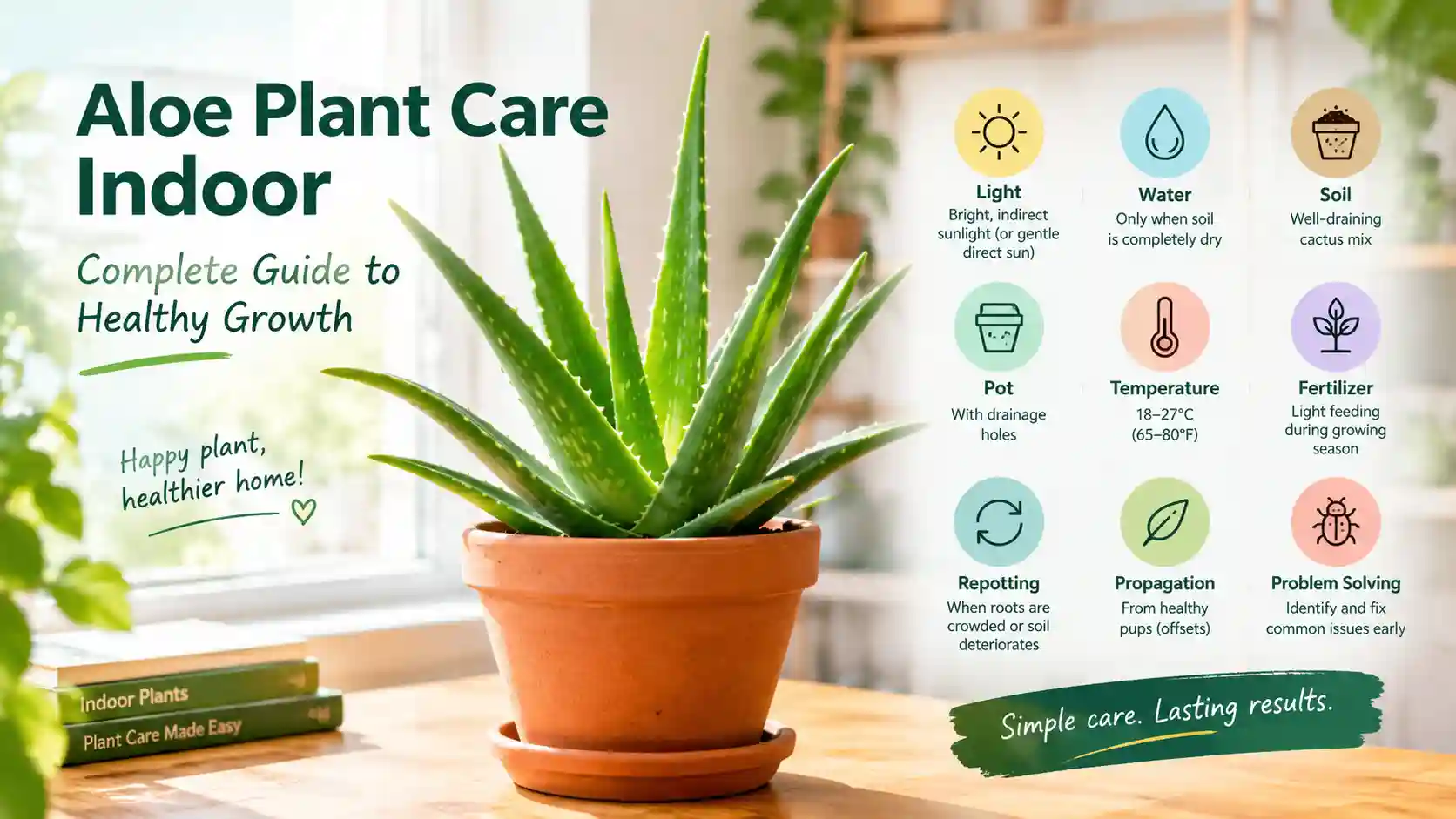
Learning proper aloe plant care indoor techniques helps you grow a healthy, attractive succulent without complicated routines. Aloe vera is a popular houseplant because it stores water in its thick leaves and tolerates occasional dry conditions.
However, aloe plants can still struggle indoors. Weak light may cause stretched, leaning leaves, while frequent watering can lead to yellowing, soft leaves, and root rot. A decorative pot without drainage can also create problems, even when you follow a regular watering schedule.
The good news is that aloe vera does not require constant attention. It needs the right balance of light, water, soil, temperature, and space.
This guide explains how to grow aloe indoors, recognize early signs of stress, fix common problems, and encourage healthy new growth. Whether you are caring for your first small aloe or trying to revive a struggling plant, you will learn how to adjust your routine to your home’s conditions.
Quick Answer:
Indoor aloe plants grow best in bright, indirect sunlight with several hours of gentle light daily. Plant aloe vera in a well-draining cactus or succulent potting mix and use a pot with drainage holes. Water thoroughly only when the soil has dried out completely, then let excess water drain away. Keep your plant in a warm room, avoid cold drafts, and never leave its roots sitting in water. Proper light and careful watering are the keys to healthy aloe growth indoors.
1. Understanding Indoor Aloe Plant Growth

Add to Favorites

Add to Favorites

7
Add to Favorites
Aloe vera (Aloe vera, also known as Aloe barbadensis Miller) is a succulent that stores water in its fleshy leaves. Its natural adaptations help it survive dry periods, making it well suited to indoor growing when its basic needs are met.
Unlike tropical foliage plants, aloe does not need constantly moist soil or high humidity. Its roots need oxygen, and its leaves need enough light to remain compact and sturdy.
What healthy indoor aloe looks like
Look for these signs:
- Firm, fleshy leaves: Healthy leaves feel plump and hold their shape.
- Compact growth: New leaves emerge from the center without excessive stretching.
- Even green coloring: Leaf color varies naturally by variety and light exposure.
- Stable roots and base: The plant sits firmly in the soil without a soft, dark stem base.
- Gradual new growth: The central rosette produces fresh leaves during active growth.
Aloe may develop a reddish or brownish tint when exposed to strong light, cold, or other stress. Some varieties also have natural spots or markings. Judge the plant by its overall condition rather than color alone.
Practical tip: Check the newest leaves first. If they are firm and developing normally, the plant may be healthy even if older outer leaves are beginning to dry.
Image suggestion: A labeled botanical illustration identifying the aloe rosette, fleshy leaves, roots, and offsets.
2. Choosing the Best Indoor Location
Light is one of the biggest factors in successful aloe plant care indoors. Even a healthy plant can gradually weaken if it spends its life in a dim corner.
How much sunlight does indoor aloe need?
Aim for several hours of bright light each day. A bright windowsill with gentle direct sunlight is often ideal, although the best exposure depends on your climate and window direction.
| Indoor location | Suitability | What to consider |
|---|---|---|
| Bright east-facing window | Excellent | Gentle morning sun is usually easier to tolerate. |
| South-facing window in the Northern Hemisphere | Often excellent | Strong midday sun may require gradual acclimation or light filtering. |
| West-facing window | Good with monitoring | Afternoon sun can be intense, especially in hot climates. |
| North-facing window | Often insufficient | Supplemental grow lighting may be necessary. |
| Dark room or distant shelf | Poor | Aloe may become stretched and pale. |
Window direction is not the only consideration. Buildings, curtains, trees, glass coatings, and the distance between your plant and the window all affect the amount of light reaching its leaves.
Can aloe vera grow in indirect sunlight?
Yes. Aloe can grow in bright indirect light, particularly when the light remains strong for much of the day. However, very low light often leads to slower growth and weaker, elongated leaves.
If your aloe sits several feet from a window, monitor its growth. A plant that gradually leans toward the glass or produces unusually narrow leaves may need a brighter location.
How to introduce aloe to direct sunlight
Aloe bought from a nursery or grown in a shaded room may develop sunburn if moved directly into intense sunlight.
Follow these steps:
- Place it in bright indirect light initially.
- Introduce gentle morning sunlight for a short period.
- Increase direct exposure gradually over one to two weeks.
- Watch for bleached, pale, or dry brown patches.
- Reduce exposure if damage appears.
Expert tip: In very hot climates, including places with intense summer sunlight, a bright window with filtered midday sun may be safer than an exposed, sun-heated windowsill.
Image suggestion: A 16:9 infographic showing ideal window placement, gentle morning sunlight, and a stretched aloe plant in low light.
3. How to Water an Indoor Aloe Plant Correctly

Add to Favorites

Add to Favorites

6
Add to Favorites
Watering is where many indoor aloe plants run into trouble. Because aloe stores moisture in its leaves, it generally tolerates dry soil better than constantly wet soil.
The goal is not to water on a fixed weekday. It is to water when the root zone has dried sufficiently.
When should you water indoor aloe?
Water when the potting mix has dried completely throughout the root zone. Depending on pot size, light, temperature, and season, this may take a week or several weeks.
Use these checks before watering:
- Insert a wooden skewer into the soil and check whether it comes out dry.
- Feel the potting mix several centimeters below the surface.
- Lift the pot to compare its weight with how it feels after watering.
- Check whether the leaves are becoming noticeably thinner or less firm.
Do not rely on the soil surface alone. The top may feel dry while the lower part of the pot remains damp.
Step-by-step watering method

Add to Favorites
Step 1: Check the soil
Make sure the entire root zone has dried. If it still feels damp, wait and check again later.

Add to Favorites
Step 2: Water thoroughly
Slowly water the soil around the plant until excess water flows from the drainage holes. Avoid leaving water trapped in the leaf rosette.

Add to Favorites
Step 3: Empty the saucer
Let the pot drain completely. Remove standing water from the saucer or decorative outer container.

Add to Favorites
Step 4: Let the soil dry again
Wait until the root zone dries before repeating the process. Do not water simply because several days have passed.
How often should you water aloe indoors?
Use this table as a starting point, not a strict schedule.
| Conditions | Typical watering pattern |
|---|---|
| Bright light and warm weather | Soil may dry within one to two weeks. |
| Cooler weather or slower growth | Drying may take several weeks. |
| Low light or a large pot | Soil may remain wet for longer; assess drainage and conditions. |
| Small terracotta pot | Soil often dries faster than in a large plastic pot. |
| Plastic pot with dense soil | Drying may be slower, requiring extra caution. |
These ranges are approximate. Always check the soil before watering.
Signs of overwatering
Overwatered aloe may show:
- Yellow, translucent, or unusually soft leaves.
- Mushy tissue near the base.
- A persistently wet potting mix.
- Brown or black roots with a soft texture.
- An unpleasant smell from the soil.
If the plant is collapsing or its base is soft, inspect the roots promptly. Remove rotted material with a clean tool and repot healthy remaining tissue in fresh, dry, well-draining mix. Severely damaged roots may not recover.
Signs of underwatering
Aloe that has been dry for too long may develop thin, curled, or wrinkled leaves. The leaves may lose their usual plump appearance.
If the soil is completely dry and the roots remain healthy, water thoroughly and allow the pot to drain. Do not try to correct a long dry spell by leaving the plant submerged in water.
Important distinction: Wrinkled leaves can indicate underwatering, but damaged roots from overwatering can also prevent the plant from absorbing moisture. Check the soil and roots before deciding to add more water.
Image suggestion: A side-by-side infographic showing healthy firm leaves, underwatered wrinkled leaves, and overwatered translucent leaves.
4. The Best Soil and Pot for Indoor Aloe
Aloe roots need both moisture and air. Dense garden soil or ordinary potting mix that stays wet for long periods can deprive roots of oxygen and increase the risk of rot.
What soil is best for aloe vera indoors?
Choose a commercial cactus and succulent mix that drains freely. If it holds too much moisture, improve it with suitable mineral material.
A practical starting mix is:
- Two parts cactus or succulent potting mix.
- One part pumice or perlite.
Adjust the proportions to suit your existing mix. The finished medium should drain readily without becoming a compact, muddy mass.
Avoid heavy garden soil, poorly drained compost, and mixes that remain saturated long after watering.
Which pot should you choose?

Add to Favorites

Add to Favorites

6
Add to Favorites
A terracotta pot is a good option because its porous walls help moisture evaporate. Plastic and glazed ceramic pots can also work when the soil mix and watering routine are appropriate.
Choose a pot with:
- At least one unobstructed drainage hole.
- Enough room for the existing roots.
- A stable base that supports the plant’s weight.
- A size only slightly larger than the root system.
An oversized pot holds more soil than the roots can use, which may cause the mix to remain wet for too long.
If you want a decorative container without drainage, keep the aloe in a separate nursery pot with drainage holes. Remove it for watering, let it drain fully, and return it only when no water is collecting inside the decorative pot.
Common mistake: Adding gravel to the bottom of a pot does not replace drainage holes or correct poorly draining soil.
Image suggestion: Cross-section infographic comparing an aloe plant in a suitable draining pot with one in waterlogged soil.
5. Ideal Temperature and Humidity for Indoor Aloe
Aloe vera generally prefers normal warm indoor temperatures and does not need a humidifier to thrive.
| Factor | Recommended approach |
|---|---|
| Temperature | Aim for roughly 18–27°C (65–80°F) for comfortable growth. |
| Cold protection | Keep the plant away from frost and cold drafts. |
| Humidity | Average household humidity is generally adequate. |
| Air circulation | Provide gentle room airflow without harsh cold drafts. |
| Heat exposure | Avoid prolonged contact with hot glass, heaters, or heating vents. |
Aloe can tolerate some variation in household temperatures, but cold, wet conditions are particularly risky. Growth also slows in cooler, darker periods.
In warm homes, a bright window may provide excellent growing conditions. In winter, move aloe away from icy window glass if temperatures drop significantly overnight.
There is usually no need to mist aloe leaves. Misting adds little lasting humidity and may leave water trapped between leaves or around the central growing point.
Image suggestion: A clean indoor aloe care infographic with temperature, humidity, sunlight, and airflow icons.
6. How to Fertilize Indoor Aloe Vera
Aloe is a relatively light feeder. Too much fertilizer can cause weak growth, salt buildup, or root damage, so regular heavy feeding is unnecessary.
When should you fertilize aloe?
Feed only when the plant is actively growing and receiving adequate light. Spring and summer are often suitable periods in homes with seasonal light changes. In consistently warm, bright conditions, growth may continue outside these months.
Use a balanced or succulent-specific fertilizer at a diluted strength, following the product label. Applying it to already dry, stressed, or rotting roots can make the problem worse.
Fertilizing tips
- Water the plant appropriately before applying fertilizer if the product instructions call for moist soil.
- Use a diluted application rather than repeated heavy doses.
- Avoid fertilizing during periods of very slow growth.
- Do not use fertilizer as a substitute for better light or drainage.
- If a white crust develops on the soil, review your fertilizer use and water quality.
Aloe that is growing slowly may simply need more light, warmer conditions, or time. Fertilizer will not correct these underlying problems.
Image suggestion: A gardening infographic showing diluted fertilizer, a healthy aloe plant, and a simple seasonal feeding calendar.
7. Repotting Aloe Vera Without Damaging It

Add to Favorites

Add to Favorites

7
Add to Favorites
Aloe does not need frequent repotting. Moving it to a new pot is useful when roots become crowded, the pot loses stability, or the soil has deteriorated.
When should you repot indoor aloe?
Consider repotting if:
- Roots emerge from the drainage holes and the plant is crowded.
- The pot tips over because the rosette has become heavy.
- Water runs through poorly or the mix stays wet for too long.
- The roots show signs of rot and the soil needs replacement.
- The plant has produced several offsets that need additional space.
Roots emerging from a drainage hole alone do not always mean immediate repotting is necessary. Assess the overall root system and how quickly the soil dries.
Step-by-step repotting guide
- Choose a pot with drainage holes, slightly larger than the root ball if more room is needed.
- Gently remove the plant and loosen compacted soil.
- Inspect the roots and remove soft, black, or rotten sections with a clean tool.
- Place the plant in fresh cactus and succulent mix.
- Keep the base of the leaves above the soil line.
- If roots were damaged, allow cuts to dry and follow a cautious watering approach rather than immediately saturating the new mix.
- Return the plant to bright light, avoiding abrupt exposure to intense sun.
Healthy roots are generally firm, while rotten roots tend to be soft and dark. Avoid pulling or twisting the leaves to remove the plant.
Expert tip: Repotting into a much larger container is rarely a shortcut to faster growth. Aloe usually does better when the pot size matches its root system.
Image suggestion: A four-panel repotting infographic showing removal, root inspection, fresh soil, and final placement.
8. How to Propagate Indoor Aloe Plants

Add to Favorites

Add to Favorites

7
Add to Favorites
The easiest way to propagate aloe vera is to separate its offsets, often called pups. These are small plants that grow around the base of a mature aloe.
How to separate aloe pups
- Wait until an offset is large enough to handle and, ideally, has developed its own roots.
- Remove the mother plant from its pot if necessary to access the roots.
- Gently separate the pup using your fingers or a clean knife.
- Keep as many of the pup’s own roots intact as possible.
- Allow any damaged areas to dry before planting.
- Plant it in a small pot with drainage holes and succulent soil.
- Give it bright indirect light while it establishes, then gradually adjust its exposure.
Avoid separating very tiny offsets that have no independent roots unless you are prepared to manage a slower, less reliable establishment process.
Can you grow aloe from a leaf cutting?
Aloe vera is not reliably propagated from an ordinary detached leaf. Leaf cuttings commonly rot before producing a new plant.
If you want a dependable result, use rooted offsets rather than relying on a detached leaf.
Image suggestion: A labeled illustration showing a mature aloe, rooted pups, separation points, and newly potted offsets.
9. Common Indoor Aloe Problems and How to Fix Them
Aloe problems are easier to solve when you identify the underlying cause rather than treating every symptom with more water, fertilizer, or sunlight.

Add to Favorites
Problem: Yellow leaves
Likely causes: Excess moisture, root damage, insufficient light, or normal aging of the oldest leaves.
Solution: Check soil moisture and roots. Correct drainage and watering first. If only one old outer leaf is yellowing while the center remains healthy, monitor rather than making drastic changes.

Add to Favorites
Problem: Long, thin, leaning leaves
Likely causes: Insufficient light, especially when new growth becomes elongated.
Solution: Move the plant to a brighter location gradually. Rotate the pot periodically for more even growth. Existing stretched leaves usually will not return to their original compact shape.

Add to Favorites
Problem: Brown leaf tips
Likely causes: Inconsistent watering, root stress, fertilizer salt buildup, strong sun, or physical damage.
Solution: Inspect the soil and roots, review recent changes, and check light exposure. Trim only the dead portion with clean scissors if desired.

Add to Favorites
Problem: Soft or translucent leaves
Likely causes: Overwatering, cold injury, or damaged roots.
Solution: Check the root system immediately if the base is soft or the soil is wet. Remove rotten tissue and correct the growing conditions. Do not automatically water wrinkled leaves if the roots may be damaged.

Add to Favorites
Problem: Pale or scorched patches
Likely causes: Sudden exposure to intense sunlight or excessive heat near glass.
Solution: Reduce the intensity temporarily and reintroduce direct sun gradually. Damaged patches may remain, so judge recovery by the health of new growth.

Add to Favorites
Problem: White cottony patches or pests
Likely causes: Mealybugs or other sap-feeding pests. White mineral residue may also resemble an infestation.
Solution: Inspect leaf joints and the plant’s base. Isolate affected plants, remove visible pests carefully, and use a houseplant treatment labeled for the pest if needed.
Why is my aloe dying even though I water it regularly?
A regular watering schedule does not guarantee that the plant receives the right amount of moisture. If the pot stays wet, the roots may rot. Once the roots are damaged, they can no longer absorb water effectively, and the leaves may become thin or wrinkled.
Check these four things before watering again:
- Is the soil still moist below the surface?
- Does the pot have functioning drainage holes?
- Is the plant sitting in standing water?
- Are the roots firm, or are they dark and mushy?
If the soil is dry but the plant continues to decline, inspect the roots rather than repeatedly adding water.
Image suggestion: An aloe troubleshooting chart matching yellow, wrinkled, stretched, and brown leaves with likely causes and corrective actions.
10. Indoor Aloe Care Through the Seasons
Your watering and light routine should respond to actual growing conditions. Indoor plants do not always follow the same seasonal pattern as outdoor plants, particularly in warm climates.
| Season | Care priorities |
|---|---|
| Spring | Increase light gradually, check for new growth, and repot if necessary. |
| Summer | Monitor soil drying carefully, protect against intense heat, and fertilize lightly if actively growing. |
| Autumn | Watch for slower drying and reduce watering as needed. |
| Winter | Maximize available light, protect from cold drafts, and avoid watering damp soil. |
Adjust your routine to your home
In a hot, sunny room: Soil may dry quickly, but extreme heat near glass can stress leaves. Check moisture rather than assuming daily watering is necessary.
In a cool, dim room: Water may remain in the pot for longer. Allow the soil to dry completely and improve available light where possible.
In an air-conditioned room: Aloe usually tolerates ordinary indoor air, but cold airflow and abrupt temperature changes can cause stress.
During cloudy weather: Reduced sunlight can slow water use. A pot that normally dries in ten days might take much longer during a prolonged period of low light.
The key principle is simple: adjust watering to the speed at which the soil dries, not to the calendar.
Image suggestion: A 16:9 seasonal aloe care infographic with spring growth, summer sunlight, autumn adjustments, and winter protection.
11. Indoor Aloe Care: Common Mistakes to Avoid
Even an easy-care succulent can struggle when several small mistakes occur together.
- Watering every week automatically: Check the soil first. Fixed schedules can cause overwatering during cool or cloudy periods.
- Keeping aloe in a dark room: Low light weakens growth and increases the risk of overwatering because the plant uses moisture more slowly.
- Using a pot without drainage: Standing water around the roots can cause serious damage.
- Choosing dense soil: A mix that stays saturated deprives roots of air.
- Moving the plant into harsh sun suddenly: Acclimate it gradually to prevent sunburn.
- Using a very large pot: Excess soil can retain moisture longer than the roots can use it.
- Fertilizing a struggling plant: Correct light, water, soil, and root problems before adding nutrients.
- Mistaking every brown leaf for a watering problem: Brown tips can have several causes, including sun exposure and salt buildup.
- Ignoring the base of the plant: Soft tissue near the crown or stem can signal serious rot.
- Assuming aloe is safe to eat because it is a household plant: Aloe products and raw plant material are not interchangeable. Do not consume the plant casually.
Is aloe vera safe around pets?
Aloe vera is considered toxic to cats and dogs if ingested. Keep the plant and its fallen leaves out of reach. If a pet eats part of the plant, contact a veterinarian or animal poison service for guidance.
Aloe is also not a substitute for medical treatment. Although its gel is used in some topical products, the plant’s yellow latex and other components can cause adverse effects. Avoid using raw aloe on serious burns or wounds without appropriate medical advice.
12. A Simple Weekly and Monthly Aloe Care Routine
You do not need to inspect your aloe every day. A short routine helps you catch problems early without disturbing the plant unnecessarily.
Aloe care checklist
0 of 6 complete
Weekly
Inspect leaves for softness, discoloration, pests, or damage.
Weekly
Check soil moisture if watering may be needed.
Monthly
Inspect the pot’s drainage holes and empty any standing water.
Monthly
Check for new growth, offsets, and changes in leaf shape.
Seasonally
Review light exposure, temperature, and how quickly the soil dries.
As needed
Repot crowded plants, remove dead leaves, and address pests or root problems.
Reset checklist
The most important habit is to check the growing conditions before changing anything. Healthy aloe often needs less intervention than beginners expect.
13. Frequently Asked Questions About Indoor Aloe Plant Care
How often should I water an aloe plant indoors?
Water when the potting mix has dried completely throughout the root zone. This may take one to several weeks, depending on light, temperature, pot size, and soil composition. Always check the soil instead of following a rigid schedule.
Can aloe vera survive indoors without direct sunlight?
Yes. Aloe can grow in bright indirect light, although it may grow more slowly than it would with suitable direct sunlight. Very dim rooms often produce stretched, weak growth. A suitable grow light can help when natural light is limited.
Should I mist my indoor aloe plant?
No. Aloe stores water in its leaves and generally does not need misting or high humidity. Focus on bright light, good drainage, and allowing the soil to dry between waterings.
Why are the leaves on my aloe plant turning yellow?
Yellow leaves can result from overwatering, root damage, insufficient light, or normal aging of older leaves. Check soil moisture and root health before changing your watering routine.
Why is my indoor aloe plant leaning?
Leaning often indicates that the plant is reaching toward a light source. Move it gradually to a brighter location and rotate the pot periodically. If the base is soft or unstable, inspect the roots as well.
What is the best window for an indoor aloe plant?
An east-facing window often provides gentle morning sunlight. A south- or west-facing window can also work, depending on your hemisphere, climate, and sunlight intensity. Acclimate aloe gradually to stronger direct light.
Do aloe plants like small or large pots?
Aloe generally does best in a pot that comfortably accommodates its roots without leaving a large volume of excess soil. A drainage hole is essential, regardless of pot size or material.
How do I know if my aloe plant has root rot?
Common signs include persistently wet soil, soft or dark roots, a mushy base, and leaves that turn yellow or translucent. Remove the plant from its pot to inspect the roots if these symptoms occur together.
How fast does aloe vera grow indoors?
Growth depends on light, temperature, root health, and the plant’s age. Aloe typically grows more actively in warm, bright conditions and more slowly during darker or cooler periods. It is naturally a relatively slow-growing succulent.
Can I put my aloe plant outside during summer?
Yes, if temperatures and conditions are suitable. Introduce outdoor sunlight gradually, protect the plant from prolonged cold or excessive rain, and ensure the pot drains freely. Bring it indoors before temperatures become too cold.
Is aloe vera good for the bedroom?
Aloe can be a suitable bedroom houseplant if the room receives enough light. A bedroom that remains dark throughout the day is unlikely to provide ideal growing conditions without supplemental lighting.
When should I repot my indoor aloe plant?
Repot when the plant is substantially crowded, unstable, or growing in deteriorated soil. Choose a container with drainage holes and avoid moving it into an unnecessarily large pot.
Conclusion:
Successful aloe plant care indoor comes down to a few consistent habits: provide bright light, use a fast-draining succulent mix, choose a pot with drainage holes, and water only after the soil dries completely.
Watch the leaves and soil together rather than relying on a fixed watering schedule. Firm leaves, steady new growth, and healthy roots are better indicators of success than frequent watering or heavy fertilizing.
If your aloe is struggling, start by checking its light exposure, soil moisture, and drainage before making several changes at once. Small, thoughtful adjustments can help the plant recover and support stronger growth over time.
Your next step: Place your aloe in the brightest suitable spot in your home, check how quickly its soil dries, and adjust your watering routine to match its actual needs.