Dahlias can turn an ordinary garden border into a spectacular display of color.
Their flowers range from small, simple blooms to dinner-plate-sized varieties with intricate petals. They also make excellent cut flowers and can keep producing blooms for months when conditions are right.
The biggest differences between a struggling dahlia and a vigorous one usually come from a few practical decisions. These include choosing the right planting location, managing moisture, providing enough sunlight, supporting tall stems, and protecting tubers from damaging cold.
Dahlias are tender perennials that grow from underground tubers. In suitable climates, they can remain in the ground for years. In colder or very wet climates, the tubers are often lifted and stored for the next growing season.
This guide explains how to grow healthy dahlias from planting through flowering and winter dormancy.
Quick Answer:
Dahlias grow best in full sun, fertile well-drained soil, consistent moisture, and good airflow. Plant healthy tubers after the risk of frost has passed, keep the soil evenly moist without making it soggy, and support taller varieties before they become top-heavy. Deadhead spent flowers to encourage continued blooming. In cold climates, dig and store the tubers before freezing temperatures arrive.
Understanding Dahlia Growth
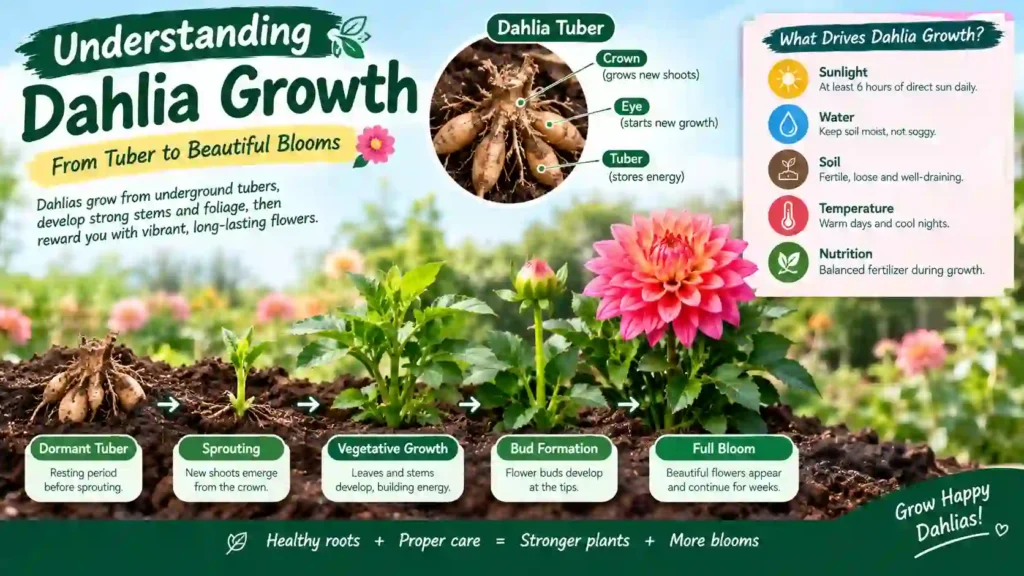
Dahlias are flowering plants native to Mexico and Central America. Modern garden dahlias belong primarily to the genus Dahlia and are available in an enormous range of cultivars.
Unlike plants that grow from ordinary roots, dahlias develop swollen underground storage structures called tubers.
These tubers store energy that supports new growth.
A healthy tuber has a crown with one or more viable eyes. An eye is the growing point from which a new shoot develops.
This detail matters when buying or dividing tubers.
A large tuber is not automatically better than a smaller one. A smaller, healthy tuber with a viable eye can produce an impressive plant, while a large tuber without a viable eye may fail to grow.
Practical tip: When buying dormant tubers, look for firm, healthy material with an identifiable eye and no obvious rot or severe damage.
How Much Sun Do Dahlias Need?
Dahlias perform best in a sunny location.
Aim for a position that receives plenty of direct sunlight during the day. Strong light supports vigorous stems, foliage, and flower production.
A sheltered sunny border is particularly useful because tall dahlia varieties can become unstable in exposed locations.
Choose a location with:
- Full sun
- Good air movement
- Protection from strong winds
- Fertile soil
- Reliable drainage
- Enough room for the mature plant
Dahlias can grow in partial shade, but reduced light can limit flowering and make plants more prone to weak, stretched growth.
Why sunlight matters for flowering
If a dahlia produces lots of leaves but very few flowers, inadequate sunlight is one of the first things worth checking.
Do not immediately add more fertilizer.
Look at the plant’s location.
A dahlia surrounded by taller plants may receive considerably less light than you realize.
Expert tip: Observe the planting area throughout the day before choosing a permanent location. A spot that looks sunny at 10 a.m. may become shaded by a building or tree later.
Image Suggestion: A 16:9 infographic showing a healthy dahlia in full sun, with icons for sunlight, airflow, drainage, and spacing.
What Soil Is Best for Dahlias?
Dahlias prefer fertile soil that holds moisture while still draining efficiently.
The ideal soil should not remain saturated after heavy rain or irrigation.
At the same time, extremely dry soil can stress plants during hot weather.
This balance is important because dahlia roots need access to both water and oxygen.
Good soil characteristics
Look for soil that is:
- Fertile
- Loose
- Well drained
- Rich in organic matter
- Able to retain reasonable moisture
- Not permanently waterlogged
If your soil is heavy clay, improve its structure before planting.
Adding appropriate organic matter can improve soil structure, while raised beds can help where drainage is consistently poor.
If your soil is very sandy, organic matter can help improve its ability to retain moisture.
Avoid waterlogged soil
Constantly wet conditions can encourage tuber rot and other root problems.
Dahlias appreciate moisture, but they do not appreciate sitting in saturated soil.
Practical observation: If water remains around the planting area long after rainfall, fix the drainage problem before planting valuable dahlia tubers.
When Should You Plant Dahlia Tubers?
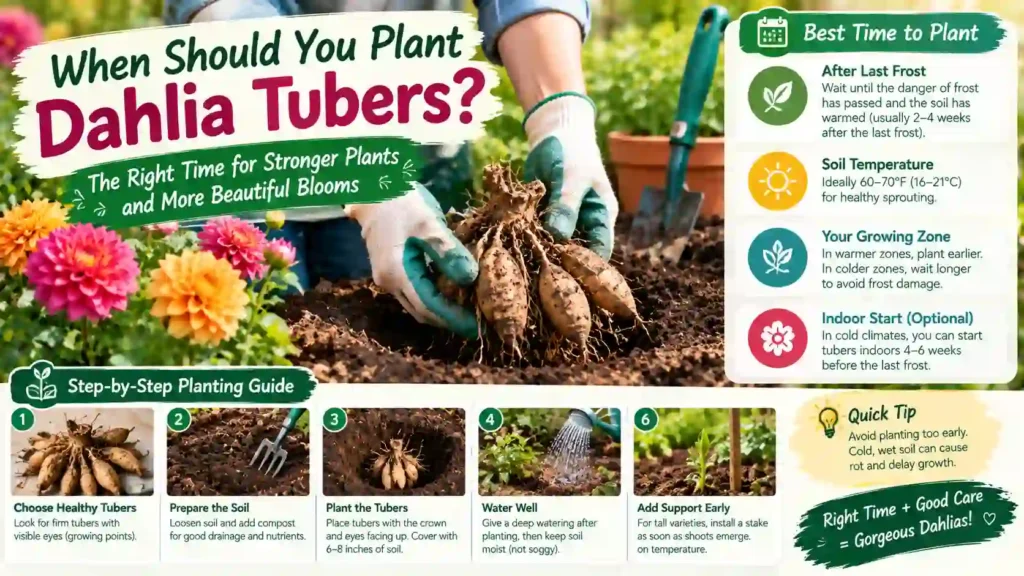
Planting time depends on your local climate and frost risk.
Dahlia tubers are sensitive to freezing conditions, so outdoor planting should generally wait until the danger of damaging frost has passed and the soil has warmed.
In cooler climates, gardeners often start tubers indoors or in a greenhouse before planting them outside.
For outdoor planting:
- Wait until the danger of severe frost has passed.
- Choose a sunny planting location.
- Prepare fertile, well-drained soil.
- Position the tuber with its eye or crown oriented correctly.
- Cover it with an appropriate layer of soil.
- Water according to the condition of the soil and planting stage.
- Protect emerging shoots from pests.
Starting tubers indoors can give you a head start on the growing season.
However, do not rush dormant tubers into cold, wet soil simply to plant them early.
Cold, saturated conditions are more dangerous than waiting a little longer.
How to Plant Dahlia Tubers Correctly
Planting the tuber correctly gives the new shoot a strong starting point.
Step 1: Choose a healthy tuber
Look for:
- Firm texture
- Healthy appearance
- No obvious rot
- No severe shriveling
- At least one viable eye
Step 2: Prepare the soil
Loosen the planting area and incorporate suitable organic matter if needed.
Avoid creating a water-retaining hole in heavy soil.
Step 3: Position the tuber
Place the tuber so the crown and growing eye are correctly oriented.
The exact planting depth varies with cultivar and local growing conditions, so avoid burying the crown excessively.
Step 4: Add the support
For tall varieties, install a stake during planting.
Doing this early is much easier than pushing a stake through a mature root and tuber system later.
Step 5: Water appropriately
Give the planting area enough moisture to establish the tuber, but avoid keeping dormant tubers constantly wet before shoots develop.
Step 6: Watch for emerging growth
Young shoots can be attractive to slugs and snails.
Inspect the plant frequently during its earliest growth stage.
How Often Should You Water Dahlias?
Dahlias need consistent moisture during active growth, especially during hot or dry weather.
However, the correct watering frequency depends on your soil, climate, rainfall, plant size, and container size.
There is no useful universal rule such as “water every three days.”
Instead, check the soil.
During active growth:
- Water when the soil begins to dry.
- Water deeply enough to reach the root zone.
- Avoid constantly saturated soil.
- Increase monitoring during hot weather.
- Container-grown dahlias usually need more frequent attention.
Water near the base of the plant rather than repeatedly wetting the flowers and foliage.
Why consistent moisture matters
Drought stress can reduce growth and flowering.
On the other hand, excessive moisture can encourage tuber and root problems.
The goal is even moisture without waterlogging.
Expert tip: Mulch can help reduce evaporation during hot weather. Keep mulch slightly away from the main stem rather than piling it directly against the plant.
How to Fertilize Dahlias for More Flowers
Dahlias are vigorous growers and can benefit from adequate nutrition.
However, fertilizer should support healthy flowering rather than simply produce more foliage.
One common mistake is applying too much nitrogen.
High nitrogen availability can encourage lush leafy growth at the expense of desirable flowering and may produce weaker stems.
A practical feeding strategy
Start with fertile soil and organic matter.
If additional fertilizer is needed, choose a balanced or relatively lower-nitrogen formulation appropriate for flowering plants and follow its label instructions.
Container dahlias generally lose nutrients more quickly because repeated watering can wash nutrients from the potting mix.
If your dahlia has:
Lots of leaves but few flowers:
Check sunlight and fertilizer use.
Weak, floppy growth:
Check light, watering, and excessive nitrogen.
Small flowers:
Check cultivar expectations, sunlight, moisture, nutrition, and plant stress.
Expert insight: More fertilizer is not a substitute for good growing conditions. A dahlia planted in shade will not become a heavy bloomer simply because it receives extra nutrients.
Should You Stake Dahlia Plants?
Many dahlias benefit from staking, particularly tall varieties with large flowers.
Heavy blooms can make stems bend or collapse, especially after rain or strong wind.
The best time to install support is before the plant becomes large.
How to stake dahlias
- Place a sturdy stake near the planting location.
- Position it without damaging the tuber.
- Tie stems loosely as they grow.
- Add additional ties as the plant becomes taller.
- Support heavy branches before flowers become fully developed.
Use soft garden twine or another material that will not cut into growing stems.
Do all dahlias need staking?
No.
Compact or dwarf varieties may remain naturally sturdy.
Tall decorative, dinner-plate, and many other large varieties are much more likely to benefit from support.
Image Suggestion: A step-by-step 16:9 infographic showing “Stake Early → Guide Stems → Tie Loosely → Support Heavy Blooms.”
How to Prune Dahlias
Dahlia pruning is mainly about controlling shape and encouraging productive growth.
When young plants have developed several sets of leaves, gardeners may pinch growing tips to encourage branching.
This can create a bushier plant with more flowering stems.
However, timing matters.
Do not repeatedly remove developing growth from a plant that is already struggling because of poor light, cold, drought, or root problems.
Pruning goals include:
- Encouraging branching
- Creating stronger flowering stems
- Removing damaged growth
- Improving plant structure
- Managing overcrowding
Tall plants may need more active training than compact varieties.
How to Deadhead Dahlias
Deadheading is one of the easiest ways to keep dahlias looking attractive and encourage continued flowering.
Do not simply remove the colorful petals.
Look below the flower and identify the developing seed head.
Spent dahlia flowers can begin looking somewhat like pointed green buds as they age. Removing the entire spent flower head prevents the plant from putting unnecessary energy into seed production and encourages further flowering.
Deadheading steps
- Find a spent flower.
- Follow its stem downward.
- Cut back to an appropriate side shoot or leaf junction.
- Remove the entire spent flower head.
- Repeat regularly during the flowering season.
Check plants every few days when they are flowering heavily.
Practical tip: Regular harvesting of flowers for bouquets can also function as a form of pruning and encourage continued production.
How to Grow Dahlias in Containers
Dahlias can grow successfully in containers, particularly compact and dwarf cultivars.
Container growing is useful when:
- You have limited garden space.
- Your soil drains poorly.
- You want flowers on a patio.
- You want to move plants more easily.
- You want greater control over soil quality.
Choose the right container
Use a large, stable container with drainage holes.
Tall dahlias need more root space and may become top-heavy, so a heavy container can be useful.
Smaller cultivars are usually easier to manage in pots.
Container care differs from garden care
Pots dry faster than garden soil.
They may also lose nutrients more quickly.
Therefore, check container moisture more frequently and adjust feeding according to the plant’s growth and fertilizer instructions.
Image Suggestion: Realistic container-gardening infographic comparing dwarf dahlia and tall dahlia requirements, including pot size, drainage, sunlight, watering, and staking.
How to Encourage More Dahlia Blooms
If your dahlia is healthy but flowering poorly, work through the basics before trying complicated solutions.
1. Increase sunlight
Dahlias need a bright, sunny location.
2. Check moisture
Do not allow the root zone to remain extremely dry during active growth.
3. Avoid excessive nitrogen
Too much nitrogen can encourage foliage rather than flowers.
4. Deadhead regularly
Remove spent blooms before they become mature seed heads.
5. Reduce overcrowding
Nearby plants can compete for light, water, and nutrients.
6. Support the plant
Broken or damaged stems reduce productive growth.
7. Check the cultivar
Some dahlias naturally flower later than others.
Real-world example: If a dahlia has enormous healthy leaves but almost no flowers, moving it into stronger light may produce a bigger improvement than adding another round of fertilizer.
Why Is My Dahlia Not Flowering?
Poor flowering has several possible causes.
| Symptom | Possible Cause | What to Do |
|---|---|---|
| Lots of leaves, few flowers | Excess nitrogen or low light | Improve light and review feeding |
| Weak stems | Low light, excessive nitrogen, poor support | Improve conditions and stake |
| Buds fail to develop | Stress, pests, weather | Check plant and growing conditions |
| Very late flowering | Cultivar or planting timing | Allow more time |
| Small flowers | Stress or cultivar traits | Review light, moisture, and nutrition |
| Plant looks wilted | Dry soil or heat stress | Check soil and water deeply if needed |
| Yellow foliage | Stress, nutrition, water problems | Inspect soil and roots |
Do not assume fertilizer is the answer.
Poor flowering is often an environmental problem.
Common Dahlia Pests
Dahlias can attract several pests, particularly when young growth is tender.
Common problems include:
- Aphids
- Slugs
- Snails
- Earwigs
- Caterpillars
- Spider mites
- Certain beetles
Check the plant regularly
Inspect:
- New shoots
- Leaf undersides
- Flower buds
- Stems
- Areas close to the soil
Early detection is much easier than dealing with a severe infestation.
Aphids
Aphids often gather around soft new growth.
A strong spray of water can sometimes dislodge small populations. For persistent problems, use an appropriate pest-control product according to its label.
Slugs and snails
These can cause severe damage to young shoots.
Inspect plants in the evening or early morning when activity is easier to detect.
Dahlia Diseases and Fungal Problems
Good growing conditions are an important part of disease prevention.
Avoid unnecessary overhead watering and maintain adequate spacing between plants.
Good airflow helps foliage dry more quickly.
Powdery mildew
Powdery mildew appears as a white or gray powdery coating on leaves.
It can become more noticeable under stressful conditions.
Improve airflow and avoid creating a crowded planting area.
Viral diseases
Mottled, distorted, or stunted growth can sometimes indicate a viral problem.
Viral diseases cannot simply be corrected with extra fertilizer or water.
If a plant shows strong signs of a serious viral infection, isolate or remove it according to local horticultural guidance rather than propagating from questionable material.
Important: Do not take cuttings from plants showing suspicious disease symptoms.
Image Suggestion: A diagnostic infographic showing healthy dahlia leaves versus powdery mildew, pest damage, and suspected viral symptoms.
Why Are My Dahlia Leaves Turning Yellow?
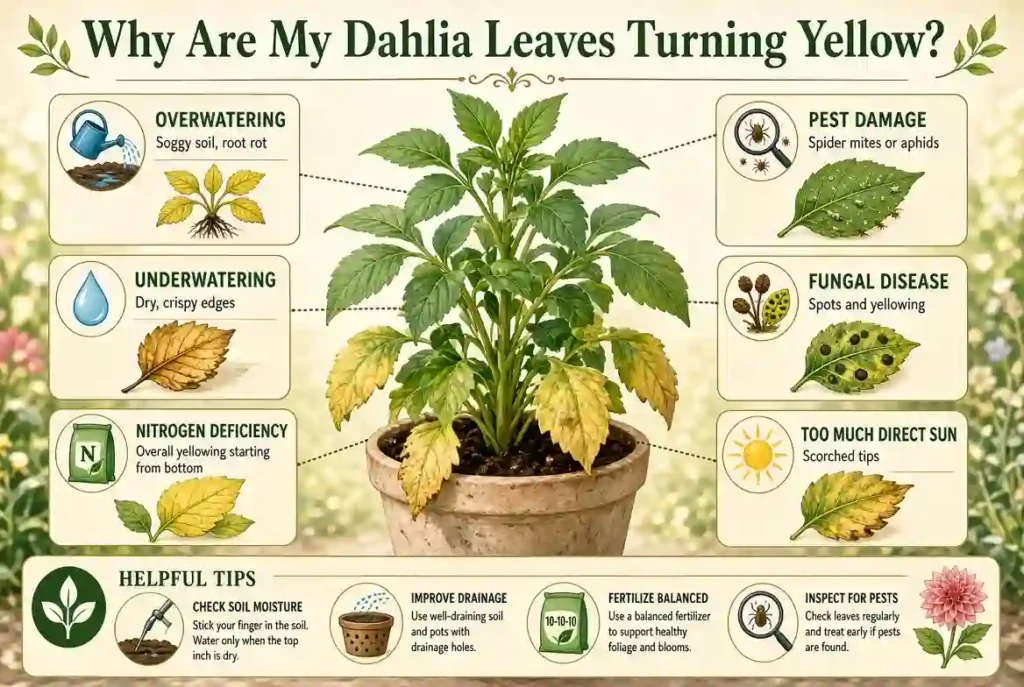
Yellow leaves can result from several different causes.
Do not diagnose the problem from color alone.
Check:
- Soil moisture
- Drainage
- Light exposure
- Fertilizer use
- Pest activity
- Disease symptoms
- Natural aging
If lower leaves are yellowing while the plant continues growing vigorously, natural aging may be involved.
If the entire plant is declining and the soil remains saturated, drainage or root problems deserve immediate attention.
Why Are My Dahlia Leaves Curling?
Curling leaves can indicate environmental stress or pest activity.
Inspect the leaves closely for insects.
Then check:
- Soil moisture
- Recent heat
- Wind exposure
- Fertilizer application
- Leaf discoloration
- Signs of disease
Do not immediately increase watering.
A plant can curl leaves because of excessive heat even when the soil is adequately moist.
How to Overwinter Dahlia Tubers
This is one of the most important parts of long-term dahlia care.
Dahlias are tender plants and their tubers can be damaged or killed by freezing conditions.
Gardeners in mild climates may be able to leave tubers in the ground with adequate protection and excellent drainage. In colder climates, lifting and storing them is usually safer.
When to dig dahlias
A common signal is the first significant frost that damages the foliage.
Once the top growth has died back, the plant can be cut down and the tubers lifted if your climate requires winter storage.
How to lift tubers
- Cut back the stems.
- Dig around the plant carefully.
- Lift the tuber clump without cutting into it.
- Remove excess soil.
- Inspect for damaged or rotten sections.
- Allow the tubers to dry appropriately.
- Store them in a cool, dark, frost-free environment.
Avoid rough handling.
Cuts and broken necks can create entry points for rot.
How to Store Dahlia Tubers Over Winter
Good storage is about controlling both temperature and moisture.
Tubers should not freeze.
They also should not remain excessively wet.
Store them in:
- A cool location
- A dark location
- A frost-free environment
- A place with reasonable ventilation
- A suitable dry or lightly insulating medium
Depending on your method, gardeners use materials such as dry potting material, vermiculite, coir, or other suitable storage media.
Check the tubers periodically.
Remove any material showing clear signs of rot before it spreads.
What if the tubers shrivel?
Slight wrinkling does not always mean the tuber is dead.
Severe dehydration, however, can reduce viability.
The ideal storage environment keeps tubers dormant without exposing them to freezing temperatures or persistent excess moisture.
Image Suggestion: Detailed 16:9 winter-storage infographic showing “Dig → Clean → Dry → Inspect → Store → Check.”
When to Divide Dahlia Tubers
Division allows you to create new plants from an established tuber clump.
The critical point is that each division needs a viable growing eye.
A piece of tuber without an eye may not produce a new plant.
Basic division process
- Start with a healthy tuber clump.
- Identify the crown.
- Locate viable eyes.
- Use a clean, sharp tool.
- Divide carefully so each section has an eye and suitable tuber tissue.
- Plant the divisions appropriately.
Some gardeners prefer dividing in spring because emerging eyes are easier to identify.
Expert tip: Do not divide simply because the clump is large. Divide when you can clearly identify viable eyes and can make clean, controlled cuts.
Growing Dahlias From Cuttings
Cuttings can produce plants genetically identical to the parent plant.
This is particularly useful when you want to multiply a favorite cultivar.
Healthy shoots are taken from actively growing tubers and rooted under controlled conditions.
Cuttings require more attention than simply planting a tuber, so they are generally better suited to gardeners who want to propagate specific varieties.
Growing Dahlias From Seed
Growing dahlias from seed is an interesting alternative to tuber propagation.
However, seed-grown plants are not necessarily identical to the parent plant.
This means seed is excellent for experimentation and breeding but less reliable when you want an exact copy of a named cultivar.
If your goal is to preserve a specific flower form or color, division or cuttings are generally more predictable.
Dahlia Plant Care Through the Seasons
Spring
Spring is the season for starting growth.
- Inspect stored tubers.
- Divide healthy clumps if needed.
- Start tubers indoors in colder climates.
- Provide strong light for indoor growth.
- Harden plants before moving them outside.
- Protect young shoots from pests.
Summer
This is the main growth and flowering period.
- Maintain consistent moisture.
- Monitor pests.
- Stake tall varieties.
- Deadhead regularly.
- Feed appropriately.
- Harvest flowers frequently if desired.
Fall
Flowering can continue late into the season.
- Continue deadheading.
- Monitor weather forecasts.
- Prepare for frost.
- Decide whether tubers can safely remain outdoors.
- Lift and store tubers where winter freezing is a concern.
Winter
The plant is dormant.
- Keep stored tubers frost-free.
- Check periodically for rot.
- Avoid excessive moisture.
- Label cultivars carefully.
- Plan spring propagation.
The Most Common Dahlia Care Mistakes
Planting Too Early
Cold soil and wet conditions can cause problems before the plant even emerges.
Better approach: Wait for suitable soil temperatures and frost conditions.
Overwatering Dormant Tubers
Tubers can rot before they produce shoots.
Better approach: Keep early-stage tubers only appropriately moist and avoid saturated soil.
Waiting Too Long to Stake
A mature dahlia can become difficult to support without damaging the root zone.
Better approach: Install the stake when planting.
Ignoring Sunlight
A dahlia in inadequate light may produce foliage without impressive flowering.
Better approach: Choose a sunny location from the beginning.
Overfeeding With Nitrogen
More leaves do not necessarily mean more flowers.
Better approach: Use appropriate fertilizer and avoid excessive nitrogen.
Forgetting to Deadhead
Spent blooms can reduce the plant’s incentive to continue producing fresh flowers.
Better approach: Remove spent flower heads regularly.
Leaving Tubers in Wet Winter Soil
Cold and wet conditions can destroy stored energy reserves.
Better approach: Lift and store tubers when your climate makes outdoor survival unreliable.
Dividing Tubers Without an Eye
A tuber section without a viable eye may not produce a new plant.
Better approach: Identify the growing points before cutting.
A Simple Dahlia Care Checklist
Use this checklist throughout the growing season:
Before planting
- Choose a sunny location.
- Prepare fertile, well-drained soil.
- Select healthy tubers.
- Identify viable eyes.
- Prepare stakes for tall varieties.
After planting
- Avoid keeping the soil waterlogged.
- Watch for emerging shoots.
- Protect young plants from slugs and snails.
- Begin monitoring growth.
During active growth
- Water consistently.
- Maintain good airflow.
- Feed appropriately.
- Stake tall plants.
- Inspect leaves regularly.
- Remove spent blooms.
During flowering
- Deadhead frequently.
- Harvest flowers when desired.
- Monitor pests.
- Maintain soil moisture.
- Support heavy stems.
Before winter
- Check your local frost risk.
- Cut back damaged foliage.
- Lift tubers if necessary.
- Dry and inspect them.
- Store them in suitable conditions.
- Check periodically for rot.
Dahlia Care Cheat Sheet
| Care Factor | Best Practice |
|---|---|
| Light | Full sun |
| Soil | Fertile, loose, well drained |
| Water | Keep evenly moist during active growth |
| Drainage | Essential; avoid waterlogged soil |
| Feeding | Moderate feeding; avoid excessive nitrogen |
| Staking | Recommended for most tall varieties |
| Deadheading | Remove spent flowers regularly |
| Spacing | Give plants enough room for mature growth |
| Containers | Choose large pots with drainage |
| Pests | Watch young shoots and new growth |
| Winter | Protect tubers from freezing |
| Propagation | Tubers, division, cuttings, or seed |
Expert Tips for Better Dahlia Results
Start with the soil, not the fertilizer
Healthy soil creates a better root environment than repeated applications of fertilizer.
Stake before you need to
Support is much easier to install before roots spread through the surrounding soil.
Water the roots, not the flowers
Keeping flowers repeatedly wet can create unnecessary problems, especially after heavy irrigation or rain.
Check plants after storms
Large flowers can become extremely heavy when wet.
Inspect stems and ties after strong wind or rain.
Do not judge a tuber by size alone
A smaller tuber with a healthy eye can outperform a larger tuber without a viable growing point.
Photograph your favorite plants
If you grow several cultivars, photograph each plant while it is flowering and label it.
This makes dividing and replanting much easier the following season.
Keep diseased material out of propagation
Do not save tubers or cuttings from plants that show strong signs of viral or other serious disease.
Frequently Asked Questions
Do dahlias need full sun?
Yes. Dahlias generally perform best in a sunny location. Insufficient sunlight can contribute to weak growth and poor flowering.
How often should I water dahlias?
Water according to soil moisture, weather, and plant size. Keep the soil consistently moist during active growth but avoid waterlogging.
Can dahlias grow in pots?
Yes. Compact and dwarf varieties are particularly suitable for containers. Use a large container with good drainage and monitor moisture more frequently than you would in garden soil.
Should I deadhead dahlias?
Yes. Removing spent flowers can encourage continued blooming and keeps the plant looking tidy.
Why does my dahlia have lots of leaves but no flowers?
Insufficient sunlight and excessive nitrogen are two possibilities. Also check the plant’s maturity, moisture, crowding, and cultivar characteristics.
Do dahlias need fertilizer?
Dahlias can benefit from additional nutrition, especially in containers or nutrient-poor soil. Avoid excessive nitrogen because it can encourage foliage rather than flowers.
Do dahlias need staking?
Many tall varieties do. Install stakes early to avoid damaging the tubers and roots later.
Can I leave dahlia tubers in the ground over winter?
That depends on your climate and soil. In mild, well-drained locations, some gardeners leave them in the ground with protection. In colder or wet climates, lifting and storing them is safer.
When should I dig up dahlia tubers?
In climates where tubers cannot survive winter outdoors, dig them after frost has damaged the foliage and before freezing conditions can damage the tubers.
How do I know if a dahlia tuber is healthy?
A healthy tuber should generally feel firm and show no obvious rot or severe damage. A viable eye is essential for producing new growth.
Can I grow dahlias from seed?
Yes. Seed is easy to use for many bedding-type dahlias, but seed-grown plants can differ from the parent plant.
Why are my dahlia leaves turning yellow?
Possible causes include natural aging, moisture problems, nutrient issues, pests, or disease. Check the entire plant and growing conditions before deciding on a treatment.
Why are my dahlia stems falling over?
Tall dahlias can become top-heavy, especially when flowers are wet. Insufficient support, weak growth, wind, or excessive vegetative growth can also contribute.
How long do dahlias bloom?
Dahlias can provide an extended flowering display from summer into autumn when they receive adequate light, moisture, nutrition, and regular deadheading.
Related Dahlia Topics to Explore
For a complete dahlia-growing resource, readers may also benefit from guides on:
- How to plant dahlia tubers
- How to divide dahlia tubers
- How to overwinter dahlias
- How to grow dahlias in pots
- Why dahlias are not blooming
- How to stake tall dahlias
- How to propagate dahlias from cuttings
- Best fertilizer for flowering dahlias
- Dahlia pests and diseases
- How to store dahlia tubers
Conclusion
Give dahlias plenty of sunlight, fertile well-drained soil, consistent moisture, adequate nutrition, and enough room to grow. Stake tall varieties early, remove spent flowers regularly, and monitor young shoots for pests.
The biggest long-term decision is winter protection. Because dahlias are tender, gardeners in climates with damaging freezes may need to lift and store their tubers rather than leaving them exposed to winter conditions.
Once you understand how the tuber, roots, stems, flowers, and seasonal cycle work together, dahlias become much easier to manage. The reward is a vigorous plant capable of producing an impressive succession of flowers throughout the growing season.