Quick Answer
To care for a jade plant (Crassula ovata), give it plenty of bright light, fast-draining soil, and deep but infrequent watering. Let the soil become nearly dry before watering again. Use a pot with drainage holes, avoid standing water, and reduce watering during winter. Jade plants prefer average indoor temperatures and do not need high humidity. (Missouri Botanical Garden)
Introduction
Learning how to care for a jade plant is mostly about understanding one simple rule: do not treat it like a thirsty tropical houseplant.
Jade plants are succulents. Their thick leaves and stems store water, allowing them to tolerate dry periods. The biggest problems usually come from excess moisture, poor drainage, or insufficient light. (Missouri Botanical Garden)
A healthy jade plant should have firm, plump leaves and strong stems. With the right conditions, it can grow into a long-lived, tree-like houseplant.
This guide explains exactly how to manage light, watering, soil, temperature, fertilizer, pruning, repotting, pests, and common problems.
What Is a Jade Plant?
The jade plant, scientifically known as Crassula ovata, is a succulent native to southern Africa. It belongs to the Crassulaceae family.
It has:
- Thick, fleshy green leaves
- Woody, branching stems
- Slow but steady growth
- Strong water-storage ability
- Small white or pale pink flowers under suitable conditions
The RHS lists jade plants as evergreen succulent shrubs that can eventually become quite large. (RHS)
Image Suggestion: A realistic botanical infographic showing Crassula ovata, labeled leaves, stem, roots, and soil.
1. Give Your Jade Plant the Right Amount of Light
Light is one of the most important parts of jade plant care.
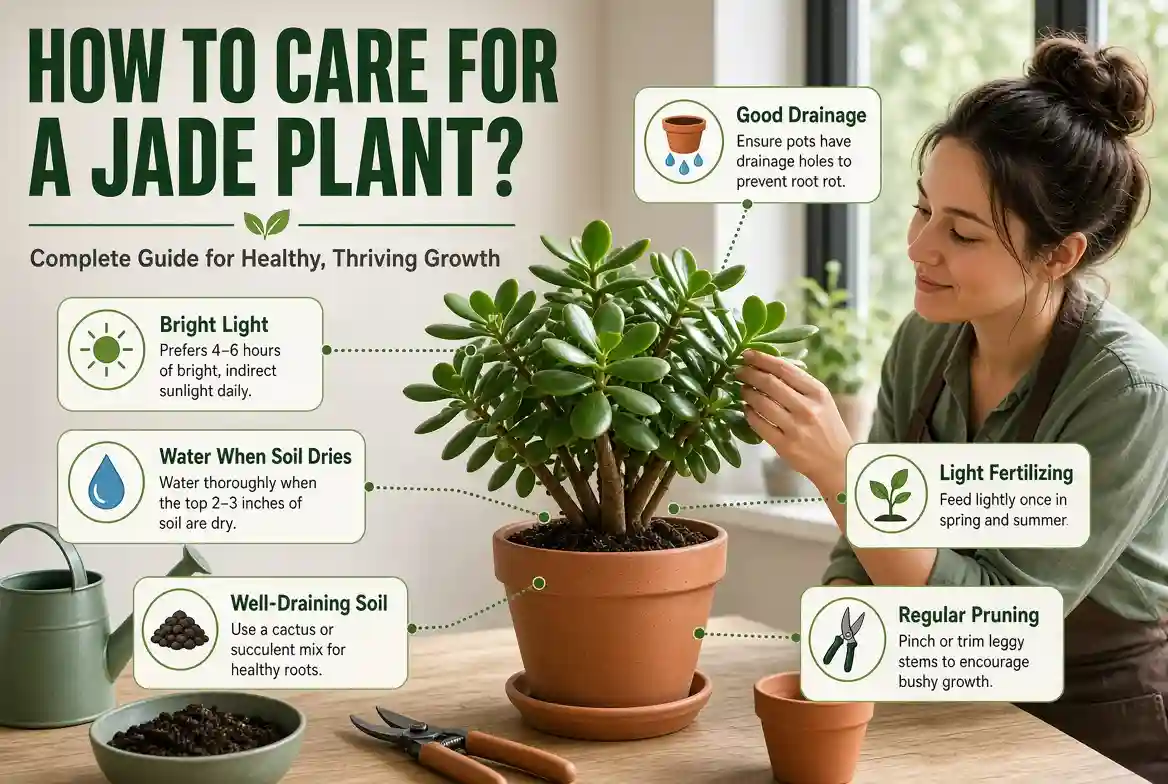
Jade plants perform best in strong natural light. A bright location near a suitable window can encourage compact growth and stronger stems.
The Missouri Botanical Garden recommends at least four hours of direct sunlight or about 12 hours of bright indirect light. The RHS also recommends bright light and notes that insufficient light can cause leggy growth. (Missouri Botanical Garden)
Where should you place a jade plant?
Good locations include:
- A bright south-facing window
- A bright west-facing window
- A sunny conservatory
- A very bright room with indirect light
If your plant has been kept in low light, introduce stronger direct sunlight gradually. Sudden exposure can cause leaf scorch.
Signs your jade plant needs more light
Watch for:
- Long gaps between leaves
- Thin or weak stems
- One-sided growth
- Pale-looking foliage
- The plant leaning toward a window
Practical tip: Rotate the pot every week or two. This encourages more even growth.
2. Water Your Jade Plant Correctly
Watering is where many beginners make mistakes.
Because jade plants store water in their leaves and stems, they can tolerate dry periods. Overwatering is more dangerous than occasional underwatering. (Missouri Botanical Garden)
The best watering method
Follow these steps:
- Check the soil before watering.
- Make sure the upper soil has dried substantially.
- Water thoroughly until water drains from the bottom.
- Empty the saucer or outer container.
- Wait until the soil dries again before watering.
Do not follow a rigid schedule such as “water every Sunday.”
Indoor conditions change with temperature, light, pot size, soil, and season.
How often should you water a jade plant?
There is no universal number of days.
During active growth, your plant may need watering more frequently than during winter. As growth slows in winter, watering should be reduced. (Missouri Botanical Garden)
Better rule: Check the soil and the plant instead of relying on the calendar.
What does an overwatered jade plant look like?
Possible warning signs include:
- Yellow or discolored leaves
- Soft leaves
- Mushy stems
- Leaves dropping unexpectedly
- Brown or black areas near the stem
- Soft, collapsing branches
Persistent overwatering can lead to root or stem rot. (Missouri Botanical Garden)
Image Suggestion: Side-by-side infographic showing a healthy jade plant versus an overwatered jade plant.
3. Use Fast-Draining Soil
Jade plants need soil that allows excess water to escape.
The RHS recommends well-drained growing conditions and cactus compost for jade plants. (RHS)
A suitable commercial cactus or succulent mix is usually a practical choice for beginners.
Why drainage matters
Imagine watering two identical jade plants.
One sits in dense, water-retaining soil.
The other sits in a fast-draining succulent mix.
The first plant may remain wet around its roots for too long. That creates conditions where root problems become more likely.
What makes good jade plant soil?
Look for a mix that:
- Drains quickly
- Does not stay soggy
- Provides enough support for the roots
- Is designed for cacti or succulents
Avoid using heavy garden soil alone in an indoor container.
4. Choose a Pot With Drainage Holes
Good soil cannot compensate for a pot that traps water.
Always choose a container with at least one functional drainage hole.
Why drainage holes matter
After watering, excess moisture needs somewhere to go.
A decorative pot without drainage can hold water around the roots. This is particularly risky for succulents.
If you use a decorative outer pot, place the plant in a draining nursery pot inside it.
Practical tip: Always check the bottom of the outer container after watering. Do not allow the plant to sit in collected water.
5. Keep the Temperature Comfortable
Jade plants generally do well at normal household temperatures.
The RHS recommends daytime temperatures around 18–24°C and cooler nighttime conditions, while advising against temperatures below about 10°C. (RHS)
Protect your plant from:
- Freezing temperatures
- Cold drafts
- Sudden temperature changes
- Direct hot air from heating vents
- Extreme heat behind glass
The Missouri Botanical Garden notes that jade plants tolerate a fairly broad temperature range, but average household conditions are preferred. (Missouri Botanical Garden)
6. Do Jade Plants Need High Humidity?
No.
Jade plants are adapted to storing water and generally do well in normal indoor humidity.
The RHS specifically notes that jade plants do not require high humidity or special humidity measures. (RHS)
That means you usually do not need:
- A humidifier
- Daily misting
- Pebble trays
- Frequent leaf spraying
In fact, focusing on drainage and proper watering is far more important.
7. Fertilize During Active Growth
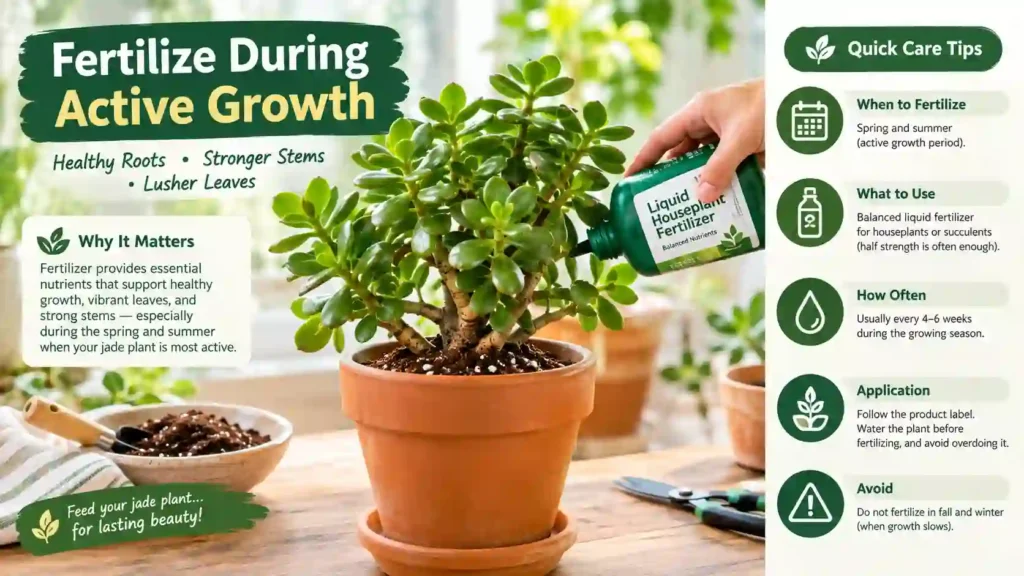
Jade plants do not need heavy feeding.
The RHS recommends a general liquid fertilizer during spring and summer. (RHS)
A practical approach is to use a balanced liquid houseplant fertilizer according to its label directions during active growth.
Avoid increasing fertilizer simply because the plant seems slow.
Why too much fertilizer can be a problem
Excess fertilizer can contribute to salt buildup in the soil and may damage roots.
Healthy jade plants generally benefit more from:
Good light + proper drainage + correct watering
than from frequent feeding.
8. Prune Your Jade Plant for Better Shape
Pruning is optional, but it can help shape a jade plant.
You can remove:
- Dead branches
- Damaged growth
- Weak stems
- Poorly positioned branches
- Excessively long shoots
Pruning can also encourage branching and help create a fuller appearance.
The Missouri Botanical Garden notes that jade plants can be pruned in spring. (Missouri Botanical Garden)
A useful pruning strategy
Instead of cutting large sections randomly, decide what shape you want first.
For a compact plant, remove selected growing tips and overly long shoots.
Always use clean, sharp tools.
Image Suggestion: Simple pruning diagram showing where to cut a jade stem to encourage branching.
9. Repot Only When It Actually Needs It
Jade plants are relatively slow-growing, so they do not need frequent repotting.
Repot when:
- Roots are becoming crowded
- Water runs straight through unusually quickly
- The plant repeatedly becomes unstable
- The existing soil has broken down
- The container no longer supports the plant properly
The Missouri Botanical Garden recommends repotting when roots occupy a large portion of the existing pot and moving up only to the next pot size. (Missouri Botanical Garden)
Avoid choosing a huge pot
A much larger container can hold more moisture than the plant needs.
A slightly larger pot is usually easier to manage.
10. Clean the Leaves Occasionally
Dust can accumulate on broad jade leaves.
Clean foliage can also make it easier to notice pests early.
Use a soft cloth or gentle stream of room-temperature water.
Avoid commercial leaf-shine products. The Missouri Botanical Garden specifically advises against using leaf shiners or oils on jade plants. (Missouri Botanical Garden)
Jade Plant Care at a Glance
| Care Need | What to Do |
|---|---|
| Light | Provide bright light with some direct sun |
| Water | Water thoroughly after soil dries |
| Soil | Use fast-draining succulent or cactus mix |
| Pot | Always use drainage holes |
| Temperature | Keep comfortably warm and protect from cold |
| Humidity | Normal indoor humidity is usually sufficient |
| Fertilizer | Feed lightly during active growth |
| Pruning | Remove dead or unwanted growth |
| Repotting | Repot when roots become crowded |
| Winter care | Reduce watering and feeding |
Common Jade Plant Problems and What They Mean
Yellow Leaves
Yellow leaves can have several causes, but excessive moisture is an important possibility.
Check:
- Soil moisture
- Drainage
- Watering frequency
- Root condition
- Light levels
Do not immediately add fertilizer when leaves turn yellow.
Wrinkled or Shriveled Leaves
Wrinkled leaves can indicate that the plant is using stored water.
Check the soil first.
If the soil is extremely dry, provide a thorough watering and allow excess water to drain.
If the soil is already wet, do not add more water. Investigate root health instead.
Leaves Falling Off
Leaf drop can result from several stresses.
Possible causes include:
- Overwatering
- Sudden environmental changes
- Poor lighting
- Temperature stress
- Root problems
Look at the entire growing environment rather than assuming watering is always the cause.
Long, Leggy Growth
Leggy growth usually indicates insufficient light.
Move the plant gradually toward a brighter location.
Do not simply prune the long stems without correcting the light problem. Otherwise, new growth may become leggy again.
Soft or Mushy Stem
A soft stem is a serious warning sign.
Check the roots and lower stem for signs of rot.
If healthy, firm sections remain, affected portions may need to be removed. The Missouri Botanical Garden recommends taking healthy upper-stem cuttings when severe overwatering has caused lower stem problems. (Missouri Botanical Garden)
Jade Plant Pests to Watch For
Jade plants can experience pests such as:
- Mealybugs
- Scale
- Aphids
- Thrips
- Spider mites
The Missouri Botanical Garden identifies these among the principal pests associated with jade plants. (Missouri Botanical Garden)
What should you do?
Inspect:
- Leaf joints
- Stem intersections
- Undersides of leaves
- New growth
Treat problems early and choose products specifically labeled for the plant and pest. Some succulents can be sensitive to certain insecticides. (Missouri Botanical Garden)
Seasonal Jade Plant Care
Spring
Spring is a good time to:
- Increase watering as growth resumes
- Begin appropriate fertilization
- Prune unwanted growth
- Check roots and soil
- Move the plant toward stronger light gradually
Summer
During active growth:
- Monitor soil more frequently
- Provide strong light
- Avoid prolonged wet soil
- Watch for pests
Autumn
As growth slows:
- Gradually reduce watering
- Reduce or stop routine feeding
- Watch for shorter daylight hours
Winter
Winter usually requires less intervention.
Keep the plant in a bright location and reduce watering as growth slows. The RHS and Missouri Botanical Garden both recommend significantly less winter watering. (Missouri Botanical Garden)
Image Suggestion: Four-panel seasonal infographic showing spring, summer, autumn, and winter jade plant care.
How to Encourage a Jade Plant to Flower
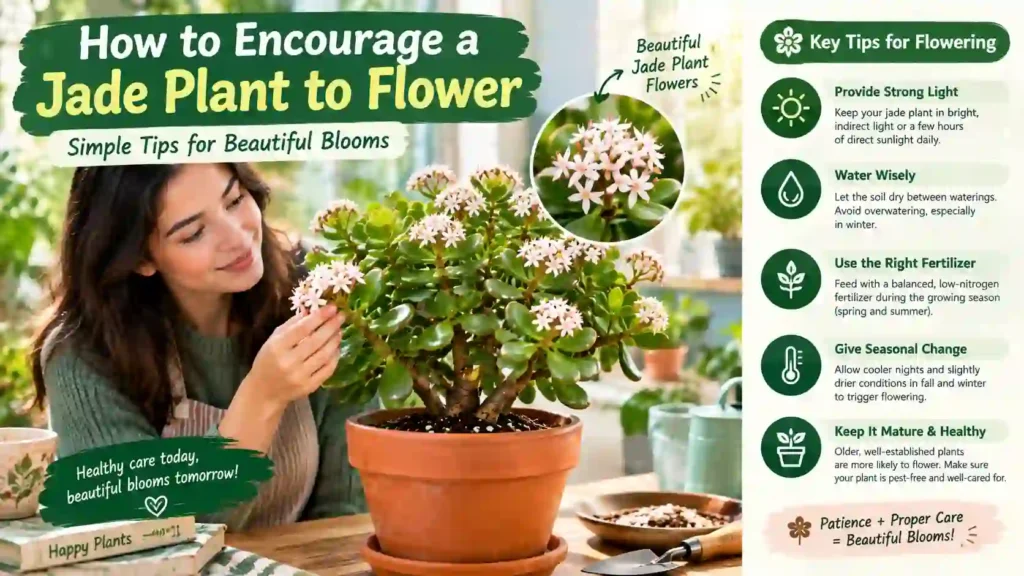
Mature jade plants can produce small white or pink flowers, but flowering indoors is not guaranteed.
The Missouri Botanical Garden notes that flowering is associated with mature plants and decreasing natural daylight. (Missouri Botanical Garden)
If your goal is flowering, focus on:
- Strong natural light.
- Healthy growth during the active season.
- Avoiding excessive watering.
- Allowing appropriate seasonal changes.
- Giving mature plants a quieter winter period.
Do not force flowering by stressing an unhealthy plant.
7 Common Jade Plant Care Mistakes
1. Watering on a Fixed Schedule
Plants do not lose water at the same rate every week.
Better: Check soil moisture first.
2. Using a Pot Without Drainage
This can trap excess water around the roots.
Better: Use a pot with drainage holes.
3. Keeping the Plant in a Dark Corner
A jade may survive for some time but develop weak, stretched growth.
Better: Provide strong natural light.
4. Keeping Soil Constantly Wet
Jade plants store water naturally.
Better: Allow the soil to dry substantially between thorough waterings.
5. Using Heavy Garden Soil Indoors
Dense soil may remain wet for too long.
Better: Choose a well-draining succulent or cactus mix.
6. Repotting Into a Huge Container
More soil can mean more retained moisture.
Better: Increase pot size gradually.
7. Treating Every Leaf Problem With Fertilizer
Yellow or weak leaves do not automatically mean nutrient deficiency.
Better: Check light, watering, drainage, roots, and pests first.
A Simple Jade Plant Care Routine
If you want an easy routine, use this checklist.
Weekly
- Check the soil.
- Inspect leaves and stems.
- Rotate the pot if growth is uneven.
- Look for pests.
Monthly
- Clean dusty leaves gently.
- Check drainage.
- Examine new growth.
- Review whether light conditions have changed.
Seasonally
- Adjust watering.
- Adjust feeding.
- Check whether the plant needs pruning.
- Reassess its location as sunlight changes.
This approach is more reliable than following a rigid watering calendar.
What Does a Healthy Jade Plant Look Like?
A healthy jade plant generally has:
- Firm, plump leaves
- Strong stems
- Compact growth
- Healthy green foliage
- No persistent mushiness
- No foul-smelling or constantly wet soil
- New growth appropriate for the season
Remember that occasional leaf loss does not automatically mean the plant is dying.
Look for patterns rather than judging the plant from one leaf.
Frequently Asked Questions
How often should I water a jade plant?
Water thoroughly when the soil has dried substantially. Then allow excess water to drain completely. Water less frequently during winter. (Missouri Botanical Garden)
Does a jade plant need direct sunlight?
Jade plants benefit from strong light and can grow well with several hours of direct sunlight. Acclimate them gradually if moving from low light to intense sun. (Missouri Botanical Garden)
Why are my jade plant leaves falling off?
Leaf drop can result from overwatering, poor light, temperature changes, or root problems. Examine the soil and growing conditions before changing your care routine.
Should I mist my jade plant?
Usually, no. Jade plants do not require high humidity or routine misting. (RHS)
What type of soil is best for jade plants?
Use a fast-draining succulent or cactus potting mix. Good drainage is more important than rich soil. (RHS)
Can jade plants grow indoors?
Yes. Jade plants are widely grown as houseplants and can perform well indoors when provided with sufficient light and appropriate watering. (Missouri Botanical Garden)
How do I make my jade plant bushier?
Provide strong light and prune selected growing tips. Correcting insufficient light is especially important because pruning alone will not prevent future leggy growth.
Can I keep a jade plant outside?
Yes, jade plants can be grown outdoors in suitable climates. Protect them from freezing temperatures and introduce outdoor sunlight gradually.
Final Verdict: How to Care for a Jade Plant Successfully
The secret to successful jade plant care is not complicated.
Give your plant strong light, fast-draining soil, a pot with drainage, and careful watering. Let the soil dry substantially before watering again. Reduce watering during winter and avoid constantly wet roots.
The most important lesson is simple: jade plants store water, so more water does not mean better growth.
If you correct light and watering first, many common jade plant problems become much easier to prevent and diagnose.
Related Topics Worth Exploring
- How to propagate a jade plant from a leaf
- Best soil for succulents
- How to revive an overwatered jade plant
- Jade plant pruning guide
- Why succulent leaves turn yellow
- How often to water indoor succulents
Sources: Missouri Botanical Garden and Royal Horticultural Society guidance on Crassula ovata care, watering, light, temperature, soil, pruning, pests, and seasonal management. (Missouri Botanical Garden)