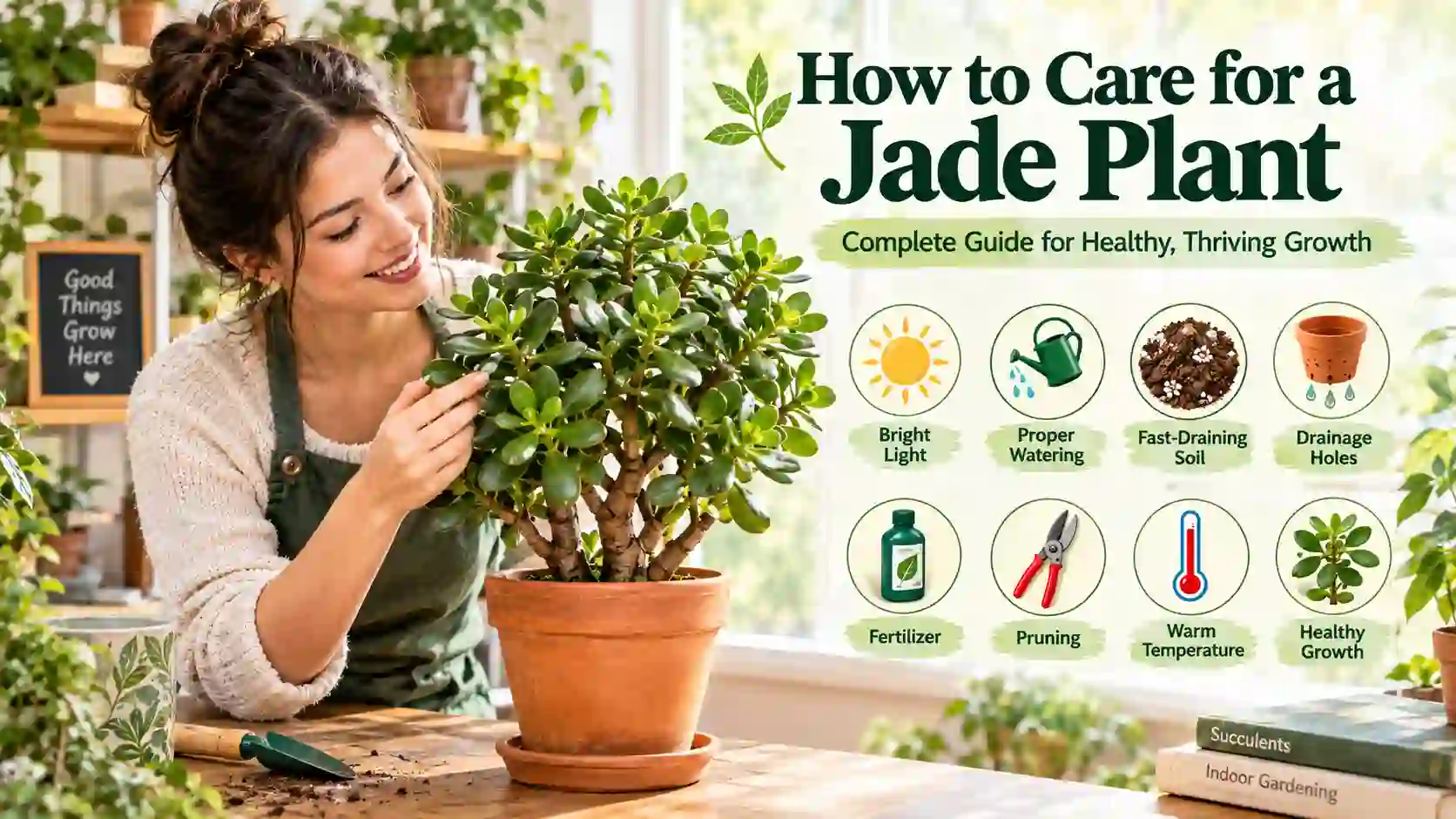
To care for a jade plant, give it bright light, well-draining soil, thorough but infrequent watering, and warm conditions. Let the potting mix dry substantially between waterings, especially during winter. Use a pot with drainage holes and avoid keeping the roots constantly wet. Jade plants do not need high humidity. With enough light and occasional feeding during active growth, a healthy jade can remain attractive for many years.
Learning how to care for jade plant is easier once you understand what makes this succulent different from ordinary houseplants.
Jade plants store water in their thick leaves and stems. That adaptation makes them more forgiving when you forget to water. However, it also creates a common problem: people assume a plant that stores water needs almost no water at all.
That is not quite right.
A jade plant can suffer when it stays extremely dry for too long. It can also develop root problems when its soil remains wet for extended periods. Clemson Extension identifies excessive or insufficient watering, poor drainage, and insect problems as major issues for jade plants.
The best approach is simple:
Give your jade plenty of light, use fast-draining soil, water thoroughly when the mix has dried, and avoid constantly wet roots.
This guide explains exactly how to do that, along with practical solutions for common jade plant problems.
Understanding the Jade Plant
The common jade plant is Crassula ovata, a succulent native to South Africa.
It has:
- Thick, fleshy leaves
- Woody stems
- Branching growth
- A tree-like appearance
- Small white or pale pink flowers on mature plants
- Excellent water-storage ability
The plant can eventually develop a miniature-tree appearance, which is one reason it is popular for indoor growing and bonsai-style training. The RHS lists jade as an evergreen succulent sub-shrub capable of becoming a substantial plant over time.
Several plants are sold under the jade name.
You may also encounter:
- Hobbit jade
- Gollum jade
- Tricolor jade
- Hummel’s Sunset
- Silver jade
Their exact appearance and growth habits differ, but most share similar succulent care principles.
Why knowing the species matters
A plant labeled simply “jade” may not always be Crassula ovata.
If your plant has unusual tubular leaves, variegation, blue-gray foliage, or another distinctive form, identify the cultivar before changing its care routine.
Image Suggestion
A realistic botanical infographic showing a jade plant with labels for fleshy leaves, woody stem, branches, roots, and new growth.
Jade Plant Care Requirements at a Glance
| Care Factor | Best Practice | Why It Matters |
|---|---|---|
| Light | Bright light with several hours of direct sun when acclimated | Prevents weak, stretched growth |
| Water | Water thoroughly, then allow soil to dry substantially | Reduces root-rot risk |
| Soil | Fast-draining succulent or cactus mix | Keeps roots oxygenated |
| Pot | Drainage holes required | Allows excess water to escape |
| Humidity | Average indoor humidity is usually sufficient | Jade does not need tropical humidity |
| Temperature | Warm indoor conditions with protection from cold | Supports healthy growth |
| Fertilizer | Feed lightly during active growth | Supports new leaves and branches |
| Pruning | Trim selectively to shape and encourage branching | Creates a fuller plant |
| Repotting | Only when necessary | Prevents unnecessary root disturbance |
Jade plants are considered relatively easy-care succulents, but light and watering are the two areas where mistakes have the biggest consequences.
1. Give Your Jade Plant Plenty of Light
Light is one of the most important parts of jade plant care.
Jades are light-loving succulents. They can tolerate bright indoor conditions, but they generally perform best with several hours of strong light.
The RHS recommends full light for jade plants, while Clemson Extension recommends full sun or bright filtered light and notes that four or more hours of direct sunlight can work well.
Where should you place a jade plant?
Good locations include:
- A bright south-facing window
- A sunny west-facing window
- A bright east-facing window
- A very bright conservatory
- A sunny outdoor position during suitable weather
A bright window is usually better than a dark shelf several feet away.
What happens when a jade gets too little light?
The plant may develop:
- Long gaps between leaves
- Thin or weak stems
- Small new leaves
- Leaning growth
- Loss of compact shape
This stretched growth is often called etiolation.
It is the plant’s response to searching for more light.
What happens with too much direct sunlight?
A jade that has not been acclimated can develop:
- Scorched patches
- Brown or pale areas
- Sudden leaf damage
This does not mean jade plants should always be kept away from direct sun.
Instead, acclimate them gradually when moving them from low light to intense sunlight.
Practical tip
Rotate the pot every week or two if the plant consistently grows toward the window.
This encourages more balanced growth.
Image Suggestion
Show three jade plants in bright direct light, filtered light, and low light, with visual examples of healthy compact growth versus stretched growth and sun scorch.
2. How Often Should You Water a Jade Plant?
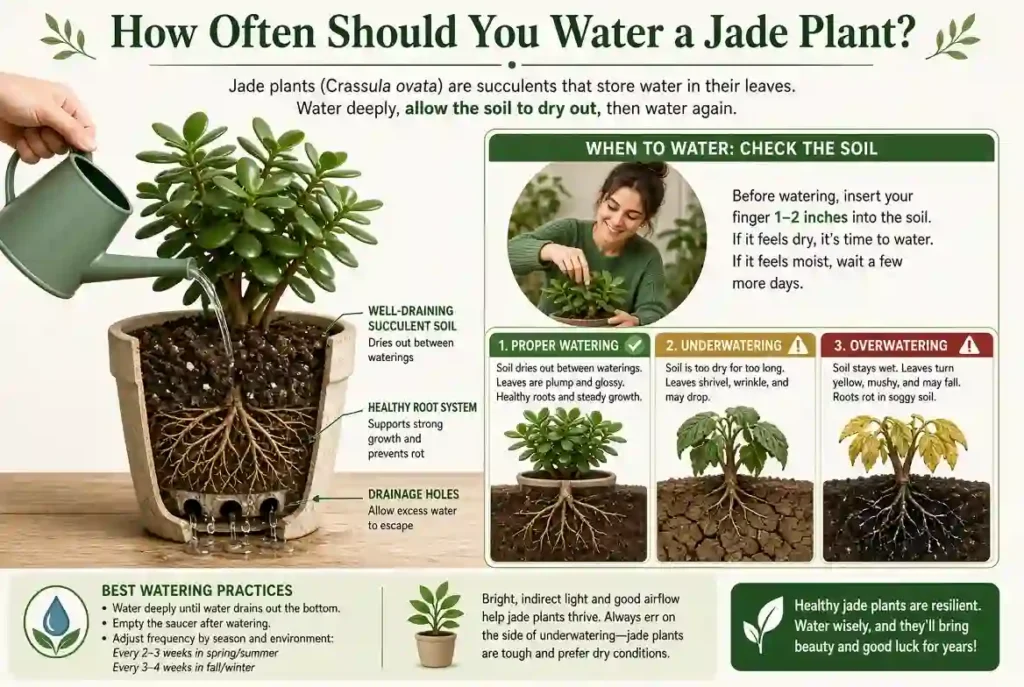
There is no universal watering schedule for jade plants.
The plant’s water requirement depends on:
- Pot size
- Soil composition
- Light
- Temperature
- Humidity
- Season
- Root health
A jade sitting in bright sunlight in a small clay pot may dry much faster than one sitting in a large plastic container.
The better question is:
Is the potting mix dry enough to water?
The RHS recommends allowing the compost to dry between waterings, with much less watering during winter. Clemson Extension similarly advises avoiding wet soil and allowing the soil to dry between winter waterings.
The correct watering method
When your jade needs water:
- Check the potting mix.
- Make sure it has dried substantially.
- Water slowly and thoroughly.
- Allow excess water to drain from the bottom.
- Empty water collected in the saucer.
- Wait until the soil dries again before watering.
Do not give the plant a tiny splash every few days.
That approach can keep the upper soil damp while the lower roots remain in a wet environment.
The biggest watering mistake
Many beginners think:
“The leaves look slightly soft, so I should water immediately.”
Check the soil first.
A jade with root damage can also appear wilted even when its soil is wet.
In that situation, adding more water makes the underlying problem worse.
3. How to Know When a Jade Plant Needs Water
You can use several clues.
Check the soil
Push your finger into the upper portion of the potting mix.
If it still feels noticeably moist, wait.
For larger pots, use a wooden skewer or moisture meter to check deeper into the root zone.
Check the pot weight
This becomes easier with experience.
A freshly watered pot feels noticeably heavier than a dry one.
Look at the leaves
Healthy jade leaves are firm and plump.
When the plant becomes significantly dehydrated, leaves may become:
- Less firm
- Wrinkled
- Thin
- Droopy
- Easier to detach
However, leaf symptoms should never replace checking the soil.
Image Suggestion
Create an infographic comparing a well-watered jade plant, underwatered jade with wrinkled leaves, and overwatered jade with yellowing or soft leaves.
4. Choose the Right Soil for a Jade Plant
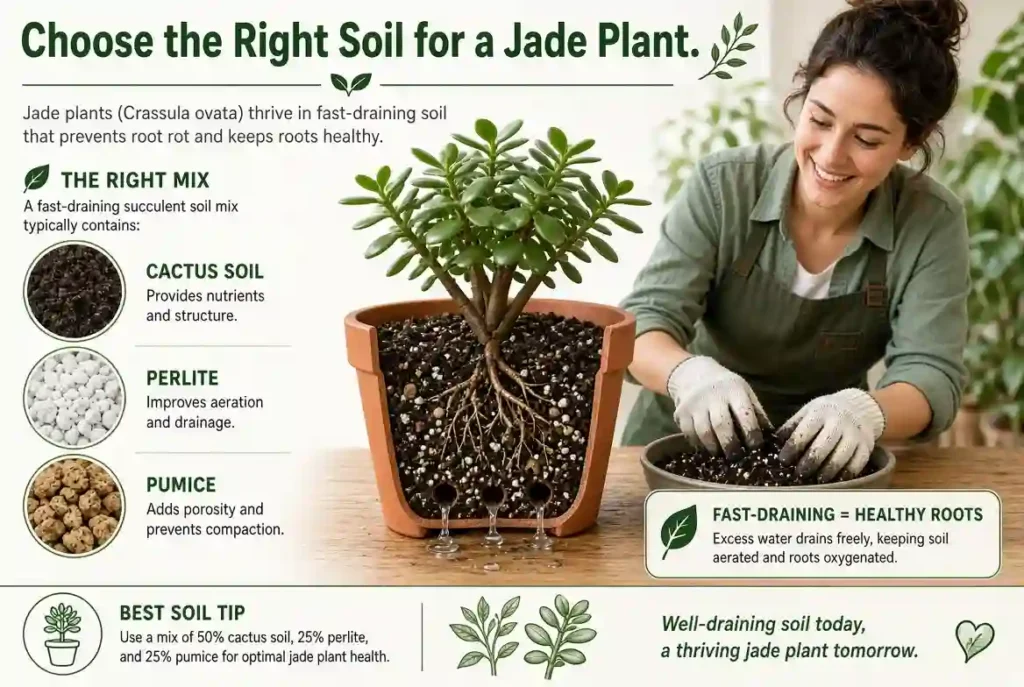
Jade plants need soil that drains quickly.
The roots should receive water, but excess moisture must be able to escape.
The RHS recommends cactus compost and well-drained growing conditions. Clemson Extension also recommends a very well-drained mix and suggests cactus mix as a practical option.
A practical jade plant soil mix
For indoor growing, you can use:
- A quality cactus or succulent mix
- Additional perlite or pumice if the mix holds too much moisture
- A small amount of suitable organic material when needed
The exact recipe is less important than the final structure.
You want a mix that:
- Drains freely
- Does not become muddy
- Does not stay wet for days
- Contains enough structure for the roots
Avoid heavy garden soil
Garden soil can become compacted in containers.
Compacted soil reduces air spaces and can keep jade roots wet for too long.
5. Choose the Right Pot
A good pot can make watering much easier.
Always choose a container with at least one functional drainage hole.
Terracotta pots are especially useful for succulent growers because their porous sides can allow moisture to escape more readily than some nonporous containers.
However, terracotta is not mandatory.
A plastic or ceramic pot can work well if the soil and watering routine are appropriate.
Avoid oversized pots
A huge container holds more soil.
More soil can mean more retained moisture around a relatively small root system.
Choose a pot only moderately larger than the root ball when repotting.
Important
Never place a drainage-hole pot inside a decorative container and leave standing water at the bottom.
Check it after watering and empty excess water.
6. Jade Plant Humidity: Keep It Simple

Unlike tropical houseplants, jade plants do not require high humidity.
The RHS specifically notes that jade plants can adapt to average indoor conditions and do not require special humidity measures or misting.
This makes jade particularly convenient for homes with relatively dry indoor air.
Should you mist a jade plant?
Usually, no.
Misting does not solve a humidity problem in a meaningful long-term way.
Instead, concentrate on:
- Good light
- Proper watering
- Air circulation
- Fast-draining soil
Avoid creating persistently damp foliage.
7. Maintain the Right Temperature
Jade plants prefer warm conditions.
The RHS recommends typical room temperatures around 18–24°C (65–75°F) during the day, with cooler nights but protection from temperatures below about 10°C (50°F).
Protect your plant from:
- Cold drafts
- Freezing temperatures
- Sudden temperature changes
- Very cold windows
- Hot air directly from heaters
Jade plants can tolerate some variation, but sudden environmental changes can cause stress and leaf drop.
8. How to Fertilize a Jade Plant
Jade plants are not heavy feeders.
Too much fertilizer can create more problems than too little.
The RHS recommends a general liquid fertilizer during spring and summer, while Clemson Extension recommends fertilizing approximately every three to four months.
A practical feeding routine
During active growth:
- Use a balanced houseplant fertilizer.
- Dilute it according to the product label.
- Apply it to moist soil.
- Avoid excessive applications.
- Reduce or stop feeding when growth slows significantly.
Do not fertilize a severely stressed or recently repotted plant immediately.
Give the roots time to settle.
Does fertilizer make a jade grow faster?
Not by itself.
If your jade lacks light, fertilizer will not solve the problem.
A plant needs adequate light to use the nutrients effectively.
9. How to Encourage a Jade Plant to Flower
Mature jade plants can produce small star-shaped white or pale pink flowers.
However, indoor flowering is not guaranteed.
The plant generally needs:
- Good light
- Sufficient maturity
- Healthy roots
- Appropriate seasonal conditions
- A period of slower growth
Why doesn’t my jade flower?
The most common issue is often insufficient light or an immature plant.
Many young plants sold in small containers simply have not reached flowering maturity.
A useful seasonal strategy
As autumn and winter arrive, growth naturally slows.
Keep the plant bright and avoid excessive watering.
Do not try to force flowers by severely dehydrating the plant.
Stress is not the goal.
The goal is to provide the seasonal conditions that encourage normal flowering while keeping the plant healthy.
Image Suggestion
Create a realistic infographic showing a mature jade plant with small white-pink star-shaped flowers, surrounded by icons for bright light, maturity, seasonal change, and careful winter watering.
10. How to Prune a Jade Plant
Pruning is not essential for survival, but it can dramatically improve the shape of a jade plant.
It is especially useful when you want a:
- Bushier plant
- Compact shape
- Stronger branching structure
- Tree-like appearance
- Bonsai-style form
How to prune
Use clean, sharp pruning scissors.
Look for:
- Long, weak branches
- Crossing branches
- Damaged growth
- Unbalanced sections
Make cuts just above a healthy leaf pair or branching point.
New branches can develop below the cut.
Do not remove too much at once
Heavy pruning can stress a plant.
For an overgrown jade, reshape it gradually rather than removing a large percentage of the plant in one session.
A useful observation
If your jade is becoming tall and sparse, check its light before reaching for the scissors.
Pruning can improve the shape, but it does not correct the cause of weak, stretched growth.
11. How to Repot a Jade Plant
Jade plants can remain in the same pot for a long time.
Clemson Extension notes that they can live happily while root-bound and suggests repotting when necessary, particularly as plants become older and top-heavy.
Signs your jade needs repotting
Look for:
- Roots emerging from drainage holes
- Severely compacted soil
- Water draining unusually quickly
- The plant becoming unstable
- A container that is clearly too small
- Soil that has broken down significantly
Repotting steps
- Choose a pot only slightly larger.
- Use fresh, well-draining succulent soil.
- Remove the jade carefully.
- Inspect the roots.
- Remove obviously dead or rotten roots if necessary.
- Place the plant at the same general depth.
- Fill around the root ball without compacting the mix excessively.
- Keep the plant in bright light.
- Allow the plant and soil to settle before returning to a normal watering routine.
Should you repot a jade every year?
Not necessarily.
There is no advantage to repotting a healthy jade simply because another year has passed.
Repot based on the plant’s condition.
12. How to Propagate a Jade Plant
Jade plants are relatively easy to propagate from stem or leaf cuttings.
The RHS lists seed, offsets, and root, stem, or leaf cuttings as propagation methods.
For home growers, stem cuttings are often the simplest approach.
Propagating from a stem cutting
- Select a healthy stem.
- Cut it with clean scissors.
- Allow the cut end to dry and form a callus.
- Place the cutting in a suitable well-draining medium.
- Keep it in bright, indirect or filtered light while it establishes.
- Water cautiously.
- Once rooted and growing, transition it toward stronger light gradually.
Avoid keeping a fresh cutting constantly wet.
A cutting without established roots has different water needs from a mature plant.
Leaf propagation
A healthy leaf can also produce new growth under suitable conditions, but it requires patience.
Not every leaf will successfully produce a new plant.
13. Why Are My Jade Plant Leaves Falling Off?
Leaf drop is a symptom, not a diagnosis.
Possible causes include:
- Overwatering
- Severe underwatering
- Sudden temperature changes
- Cold exposure
- Root problems
- Poor light
- Pest activity
- Environmental stress
Clemson Extension specifically identifies both excessive and insufficient water as causes of jade problems and notes that extreme dryness can lead to leaf drop.
If leaves are falling and the soil is wet
Investigate:
- Drainage
- Soil composition
- Root health
- Watering frequency
If leaves are falling and the soil is extremely dry
The plant may be experiencing drought stress.
Water thoroughly once the soil is appropriately dry, then monitor how quickly it dries afterward.
Important
Do not change five things at once.
Change the most likely problem first and observe the plant.
This makes troubleshooting much easier.
14. Why Are My Jade Plant Leaves Turning Yellow?
Yellow leaves can have several causes.
Overwatering
This is one of the first things to investigate.
If the soil remains wet for long periods, check the roots and drainage.
Natural aging
An occasional older leaf turning yellow is not necessarily alarming.
Low light
Insufficient light can weaken the plant and contribute to poor growth.
Root problems
Damaged roots can interfere with normal water and nutrient uptake.
What to do
Ask these questions:
- Is the soil still wet?
- Does the pot drain properly?
- Is the plant receiving strong light?
- Are the roots healthy?
- Are only older leaves affected?
That information is more useful than simply counting yellow leaves.
15. Why Are My Jade Plant Leaves Wrinkled?
Wrinkled leaves often indicate that the plant’s stored water reserves are being depleted.
Possible causes include:
- Soil remaining dry too long
- Roots damaged by rot
- Poor root development
- Sudden environmental stress
The important distinction is between dry soil and damaged roots.
A jade with dry soil and wrinkled leaves may need water.
A jade with wet soil and wrinkled leaves may have a root problem.
That distinction prevents a common mistake: watering a plant that cannot absorb water properly.
16. Why Is My Jade Plant Getting Leggy?
A leggy jade usually needs more light.
Signs include:
- Long stems
- Large gaps between leaves
- Leaning toward a window
- Sparse branches
- Small new leaves
Move the plant gradually toward a brighter location.
Once the light improves, prune excessively stretched growth if desired.
Do not expect a stretched branch to automatically become compact again.
The new growth needs enough light from the beginning.
Image Suggestion
Create a realistic before-and-after infographic showing a leggy jade plant in low light versus a compact, bushy jade grown in strong light.
17. Jade Plant Root Rot: What to Do
Root rot usually becomes a concern when soil remains excessively wet and poorly aerated.
Clemson Extension identifies overly frequent watering and slow-draining soil as major contributors to root rot in jade plants.
Warning signs
Watch for:
- Yellow leaves
- Sudden leaf drop
- Soft stems
- Persistent wet soil
- Unpleasant smell
- Dark, mushy roots
How to respond
- Remove the plant from its container.
- Remove wet soil carefully.
- Inspect the roots.
- Cut away clearly rotten tissue with clean tools.
- Repot in fresh, fast-draining mix.
- Use a container with drainage holes.
- Improve the light.
- Adjust your watering routine.
Do not simply move a rotting jade into another pot while keeping the same wet soil.
The underlying moisture problem must change.
18. Common Jade Plant Pests
Jades are generally resilient, but pests can still appear.
Common problems include:
- Mealybugs
- Aphids
- Spider mites
- Vine weevils in some growing situations
The RHS lists mealybugs, vine weevils, and aphids among potential pests, while Clemson Extension identifies mealybugs as a particularly common indoor problem.
Mealybugs
They often look like small white cottony clusters.
Check:
- Leaf joints
- Stem intersections
- Undersides of leaves
- New growth
Early detection makes treatment much easier.
Clemson Extension recommends removing mealybugs with a cotton swab and alcohol and cautions that insecticidal soap can damage jade plants.
Always test any treatment carefully and follow its label.
19. Jade Plant Care in Different Seasons
Your jade does not need exactly the same routine all year.
Spring
As growth increases:
- Provide strong light.
- Resume regular feeding.
- Monitor soil moisture more frequently.
- Prune if shaping is needed.
Summer
During bright, warm weather:
- Check the soil regularly.
- Water thoroughly when appropriate.
- Protect newly moved plants from sudden intense sun.
- Watch for pests.
Autumn
As temperatures and daylight change:
- Reduce watering as the soil dries more slowly.
- Gradually reduce feeding.
- Keep the plant in strong light.
Winter
Winter is usually the time to become more conservative with water.
Growth slows, so the soil may remain wet longer.
The RHS recommends watering much more sparingly during winter.
Keep the plant away from cold drafts and freezing conditions.
20. How to Care for a Jade Plant Outdoors
Jade plants can grow outdoors in suitable climates.
The key is to understand that an indoor jade may not be ready for intense outdoor sunlight immediately.
Before moving it outdoors
Acclimate it gradually.
Start with bright shade or filtered light.
Then slowly increase exposure to direct sunlight.
This reduces the risk of sudden leaf scorch.
Outdoor jade plants need:
- Excellent drainage
- Strong light
- Protection from freezing temperatures
- Appropriate watering
- Good air circulation
Bring container-grown jade indoors before freezing conditions.
21. How to Make a Jade Plant Bushier
A bushy jade is created through light plus strategic pruning.
Start with light.
If the plant is stretching toward a window, fix its lighting before pruning heavily.
Then:
- Select long or uneven branches.
- Cut just above a leaf node or branching point.
- Allow the plant to produce new branches.
- Rotate the container regularly.
- Continue shaping gradually.
Do not expect instant results.
Jade plants are relatively slow-growing, so good structure develops over time.
22. How to Make a Jade Plant Grow a Thick Trunk
A thick trunk develops with age and healthy growth.
You cannot create a mature trunk overnight with fertilizer.
Focus on:
- Strong light
- Appropriate watering
- Healthy roots
- Regular but moderate growth
- Strategic pruning
- Patience
As the plant grows, its stems become more woody.
A stable, heavy pot can also help prevent an older top-heavy jade from tipping. Clemson Extension specifically recommends a large, heavy pot for older top-heavy plants when repotting is needed.
23. Jade Plant Care Mistakes to Avoid
1. Watering on a fixed schedule
Calendar-based watering ignores changing environmental conditions.
Better: Check the soil.
2. Keeping jade in a dark room
Jades are light-loving plants.
Better: Give them strong natural light.
3. Using heavy garden soil
Dense soil can retain too much moisture.
Better: Use a well-draining succulent mix.
4. Using a pot without drainage
This makes watering much harder.
Better: Choose a container with drainage holes.
5. Misting frequently
Jade does not need tropical humidity.
Better: Focus on light and root health.
6. Fertilizing a weak plant heavily
More fertilizer does not fix poor roots or insufficient light.
Better: Correct the growing environment first.
7. Moving a low-light jade directly into intense sun
Sudden exposure can scorch leaves.
Better: Acclimate gradually.
8. Repotting unnecessarily
Jades can tolerate being somewhat root-bound.
Better: Repot when the plant actually needs it.
24. A Simple Weekly Jade Plant Care Routine
You do not need to spend hours caring for a jade plant.
Once a week
Look closely at:
- Leaf firmness
- New growth
- Pests
- Soil moisture
- Plant position
Before every watering
Ask:
Is the soil actually dry enough?
Once a month
Check:
- Root-zone drainage
- Leaf cleanliness
- Light exposure
- Plant shape
- Pest activity
During active growth
Feed according to your chosen fertilizer’s instructions.
Every few months
Rotate or reposition the plant if growth is becoming one-sided.
This routine catches most problems before they become serious.
25. Is a Jade Plant Safe Around Pets?
This is an important point for indoor gardeners.
The ASPCA lists jade plant (Crassula species commonly referred to as jade) as toxic to dogs, cats, and horses. Reported signs include vomiting, depression, and incoordination.
If you have pets that chew plants, keep jade somewhere they cannot reach.
If a pet has eaten part of the plant and shows concerning symptoms, contact a veterinarian or an appropriate animal poison-control service promptly.
26. Jade Plant Care Troubleshooting Chart
| Symptom | Likely Things to Check | First Step |
|---|---|---|
| Yellow leaves | Wet soil, poor drainage, aging leaves | Check soil and roots |
| Wrinkled leaves | Dry soil or damaged roots | Check soil moisture |
| Leaves dropping | Water stress, cold, root problems | Inspect environment |
| Long stems | Insufficient light | Move toward stronger light gradually |
| Brown spots | Sun scorch or other stress | Check recent light changes |
| Soft stem | Excess moisture or rot | Inspect roots |
| No flowers | Immaturity or inadequate light | Improve light and patience |
| White cottony pests | Mealybugs | Isolate and inspect closely |
| Plant leaning | One-sided light | Rotate plant and improve light |
| Soil stays wet | Heavy mix or oversized pot | Improve drainage |
The most useful troubleshooting habit is to look at the soil and roots before changing your watering routine.
Frequently Asked Questions About How to Care for Jade Plant
How often should I water a jade plant?
Water when the potting mix has dried substantially rather than following a fixed calendar. Water thoroughly and let excess water drain. During winter, watering usually becomes less frequent because growth slows.
Does a jade plant need direct sunlight?
Jade plants prefer strong light and can perform well with several hours of direct sunlight once acclimated. A very bright window is often ideal indoors.
Can a jade plant grow in low light?
It may survive, but prolonged low light can produce weak, stretched growth. Stronger light generally helps maintain a compact shape.
What is the best soil for a jade plant?
Use a fast-draining cactus or succulent mix. If the mix stays wet for too long, improve drainage with materials such as perlite or pumice.
Does jade plant need humidity?
No. Jade plants are well suited to average indoor humidity and do not require misting or special humidity treatment.
Why is my jade plant losing leaves?
Leaf drop can result from both excessive and insufficient water, temperature stress, poor roots, or other environmental problems. Check the soil before watering again.
Why are my jade plant leaves wrinkled?
Wrinkled leaves can indicate that the plant is using its stored water reserves. Check whether the soil is very dry. If the soil is already wet, investigate root health instead.
How do I make my jade plant bushier?
Give it strong light and prune selected branches above healthy growth points. New branching can develop below pruning cuts. Avoid heavy pruning all at once.
When should I repot my jade plant?
Repot when the plant becomes unstable, the roots become crowded, or the potting mix has deteriorated. Jade plants do not need annual repotting.
How can I make my jade plant flower?
Give a mature plant strong light and healthy growing conditions. Seasonal changes, including slower winter growth, can support flowering, but indoor flowering is not guaranteed.
Can I grow jade plants from cuttings?
Yes. Jade plants can be propagated from stem and leaf cuttings. Stem cuttings are generally a straightforward method for home growers.
Can jade plants grow outdoors?
Yes, in suitable warm climates. Acclimate indoor plants gradually to stronger outdoor sunlight and protect them from freezing temperatures.
Are jade plants toxic to cats and dogs?
Yes. The ASPCA lists jade plants as toxic to cats, dogs, and horses. Reported signs include vomiting, depression, and incoordination.
Conclusion: How to Care for Jade Plant Successfully
The secret to successful jade plant care is not complicated.
Think about the plant as a sun-loving succulent that stores water.
Give it strong light. Use fast-draining soil. Choose a pot with drainage holes. Water thoroughly when the soil has dried substantially, then wait before watering again.
Do not create a tropical environment around it. Jade plants generally prefer ordinary indoor humidity and warm conditions.
When problems appear, look at the whole growing environment rather than treating one symptom.
A wrinkled leaf does not automatically mean “water it.”
A yellow leaf does not automatically mean “add fertilizer.”
A leggy plant does not automatically need more fertilizer.
Often, the answer is found in light, soil, watering, and root health.
With those four areas under control, a jade plant can develop into a long-lived, tree-like succulent with thick stems, attractive foliage, and, when mature and conditions allow, delicate star-shaped flowers.