Quick Answer
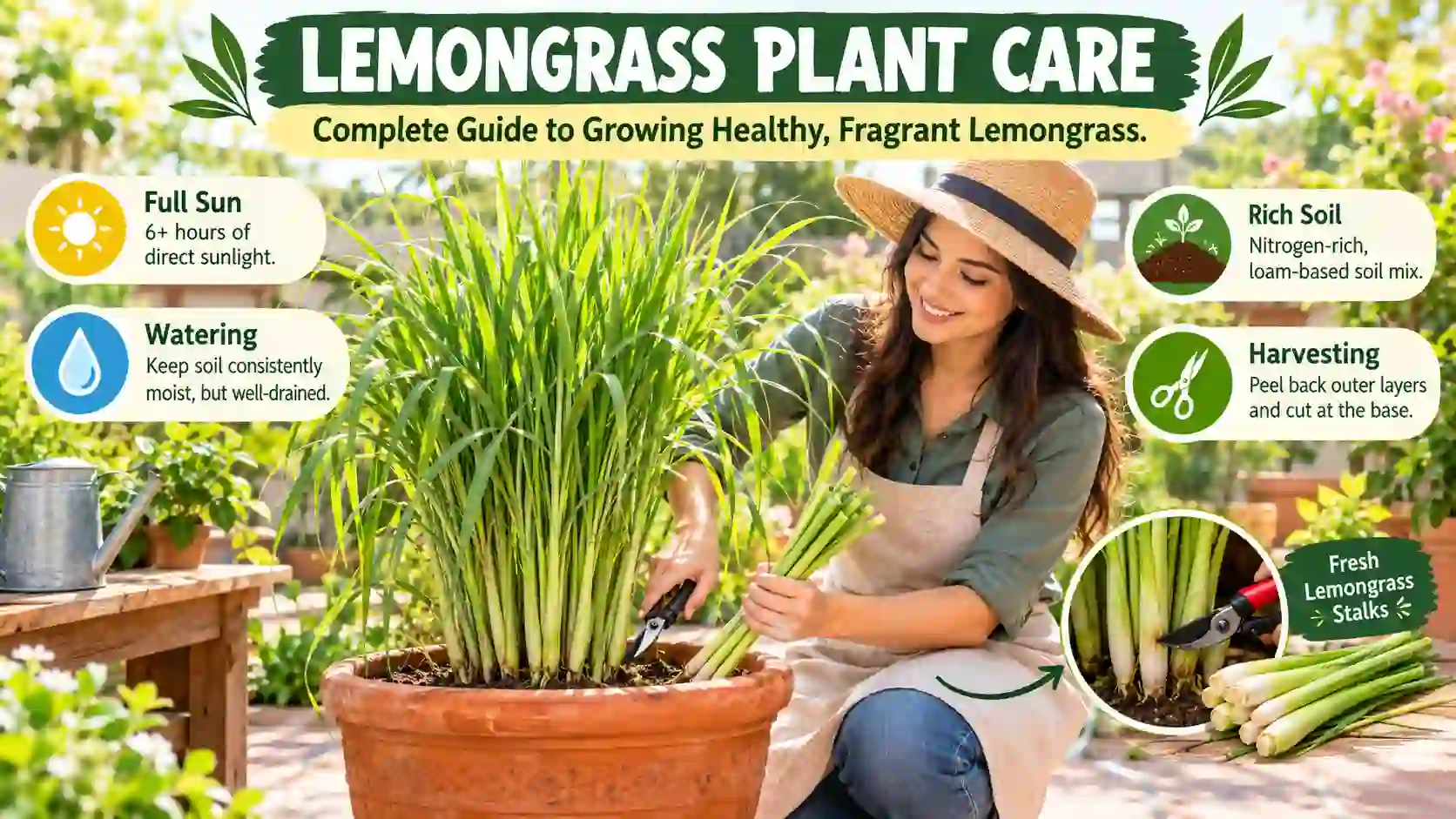
Lemongrass grows best in full sun, warm temperatures, well-draining soil, and consistent moisture. Water when the top inch of soil begins to dry, feed during active growth, and harvest outer stalks regularly. Protect lemongrass from frost and waterlogged soil, which can cause root problems. With enough warmth and sunlight, it is an easy, productive herb for gardens and containers.
Lemongrass plant care is relatively simple once you understand what this tropical grass actually needs. The plant grows quickly in warm conditions and can produce a steady supply of fragrant stalks for cooking, tea, and other household uses.
The biggest problems usually come from conditions that seem helpful at first. Too much water can leave roots sitting in soggy soil. Too little sunlight produces weak, sparse growth. Cold temperatures can also damage or kill plants that would otherwise remain productive for years.
This guide explains how to grow lemongrass successfully in garden beds and containers. You will learn how to choose a location, water and fertilize correctly, prune and harvest stalks, propagate new plants, and solve common problems.
Understanding Lemongrass Before You Grow It
Lemongrass is a clump-forming grass in the genus Cymbopogon. Several species are grown for culinary or aromatic purposes, with Cymbopogon citratus commonly associated with culinary lemongrass.
It develops numerous narrow, arching leaves from a dense base. Mature plants can become quite large when growing conditions are favorable.
The edible lower stalks are the part most commonly used in cooking.
What makes lemongrass different from many herbs?
Lemongrass behaves more like a warm-season grass than a delicate kitchen herb.
It generally appreciates:
- Strong sunlight
- Warm temperatures
- Regular moisture
- Good drainage
- Nutrient-rich soil
- Plenty of growing space
It also responds well to harvesting. Removing mature outer stalks encourages you to use the plant while allowing younger shoots to continue developing.
Image Suggestion: A labeled botanical illustration showing lemongrass roots, stalks, leaves, and growing crown.
Choosing the Right Location
Location is one of the most important parts of successful lemongrass plant care.
Full sun is ideal
Give lemongrass a location receiving approximately 6–8 hours of direct sunlight daily.
Strong sunlight supports:
- Faster growth
- Thicker stalks
- Stronger leaves
- Better overall plant density
A plant receiving insufficient light may remain alive but grow slowly and produce thinner stalks.
What about afternoon heat?
Lemongrass generally handles heat well when its roots have adequate moisture.
In very hot climates, intense afternoon conditions can increase water loss. Rather than automatically moving the plant into heavy shade, monitor the soil and leaves.
If the plant wilts repeatedly despite adequate soil moisture, some protection from extreme afternoon heat may help.
Avoid cold pockets
Do not place lemongrass where cold air collects during winter.
If your climate experiences frost or freezing temperatures, growing lemongrass in a container gives you much more control.
The Best Soil for Lemongrass
Lemongrass prefers soil that holds enough moisture for steady growth but allows excess water to drain away.
A good growing medium should be:
- Fertile
- Loose
- Well-draining
- Rich in organic matter
- Slightly acidic to neutral
Heavy clay can become a problem when drainage is poor.
Improving heavy soil
If your garden soil remains wet for long periods after watering or rain, improve drainage before planting.
In raised beds, incorporating suitable organic matter can improve soil structure. Containers should use a quality potting mix rather than dense garden soil.
Important: Adding large amounts of organic material does not automatically solve poor drainage. The entire root environment needs to drain properly.
How to Plant Lemongrass
You can establish lemongrass from nursery plants, divisions, or suitable stalk cuttings.
Planting a nursery plant
- Choose a healthy plant with several strong green shoots.
- Select a sunny location.
- Prepare loose, well-draining soil.
- Dig a hole slightly wider than the root ball.
- Place the plant at approximately the same depth it was growing.
- Backfill around the roots.
- Water thoroughly.
- Keep the soil consistently moist while the plant establishes.
Avoid burying the crown too deeply.
The crown is where new shoots emerge, and excessive moisture around this area can contribute to problems.
Growing Lemongrass From Store-Bought Stalks
One of the most interesting ways to propagate lemongrass is from fresh stalks.
Choose stalks that still have a healthy-looking base rather than completely dried or damaged pieces.
Simple propagation method
- Place the lower portion of the stalk in a small amount of clean water.
- Put it in a bright location.
- Change the water regularly.
- Watch for new roots and fresh growth.
- Once roots are established, transfer the stalk into well-draining soil.
- Keep it evenly moist while it adjusts.
Not every grocery-store stalk will root successfully.
Freshness, temperature, and the condition of the basal portion all influence the result.
Image Suggestion: Step-by-step infographic showing a lemongrass stalk developing roots in water and then being planted in soil.
How Much Sun Does Lemongrass Need?
Lemongrass performs best in full sun.
For most gardeners, this means choosing the brightest practical location available.
Signs of insufficient light
A plant receiving too little sunlight may show:
- Slow growth
- Thin stalks
- Fewer new shoots
- Loose or floppy growth
- Less vigorous overall development
If your lemongrass is growing indoors, place it near the brightest suitable window.
However, indoor plants may struggle to receive the intensity of sunlight available outdoors. A suitable grow light can help when natural light is inadequate.
Watering Lemongrass Correctly
Watering is simple when you focus on the soil rather than a rigid calendar.
Lemongrass likes consistent moisture, especially during active growth, but it does not want permanently saturated roots.
When to water
Check the upper layer of soil with your finger.
If the surface has started drying, check slightly deeper. Water thoroughly when the plant needs moisture rather than giving frequent tiny amounts.
During very hot weather, containers may need watering more often because they lose moisture faster than garden soil.
Avoid both extremes
Too little water can cause:
- Drooping leaves
- Dry leaf edges
- Slower growth
- Smaller stalks
Too much water can cause:
- Poor root health
- Yellowing
- Persistent wet soil
- Weak growth
- Root-related problems
A common beginner mistake is assuming that a tropical plant should always have wet soil. Warmth and humidity are not the same thing as waterlogged roots.
Fertilizing Lemongrass for Strong Growth
Lemongrass grows actively during warm weather and benefits from adequate nutrition.
A balanced fertilizer can support leaf and stalk production when used according to its label.
When to fertilize
Focus feeding during periods of active growth.
Reduce or stop routine fertilization when the plant is experiencing cold conditions or significantly slowing down.
Don’t overfeed
More fertilizer does not necessarily mean more lemongrass.
Excessive fertilizer can contribute to salt buildup and plant stress. It can also encourage lush growth without addressing problems such as poor light, inadequate drainage, or improper watering.
Expert Tip: If your plant is growing poorly, check sunlight, roots, moisture, and temperature before assuming fertilizer is the solution.
Lemongrass in Containers
Lemongrass is an excellent container plant because its growth can be controlled more easily.
Choose a container with:
- Drainage holes
- Enough depth for the root system
- Adequate width for clumping growth
- A quality potting mix
A small container can restrict growth as the plant matures.
Container care differs from garden care
Potted lemongrass generally dries out faster than plants growing in the ground.
Check the soil more frequently during hot weather.
At the same time, never compensate by keeping the pot constantly saturated.
Image Suggestion: Side-by-side illustration of healthy container-grown lemongrass and a poorly drained pot with standing water.
How to Prune Lemongrass
Lemongrass usually does not require complicated pruning.
The main goal is to remove damaged material and harvest mature stalks.
Remove damaged leaves
Trim dead, brown, or badly damaged leaves near their base using clean tools.
Avoid removing large amounts of healthy foliage unnecessarily.
Control an overgrown plant
If your lemongrass becomes extremely dense, harvesting mature outer stalks helps reduce congestion while providing useful kitchen material.
Regular harvesting can be more practical than aggressively cutting the entire plant.
How to Harvest Lemongrass
Harvesting correctly helps maintain a productive plant.
Look for mature outer stalks that have developed a substantial base.
Harvesting steps
- Select a mature outer stalk.
- Hold it close to the base.
- Cut or pull it away carefully.
- Remove damaged outer leaves.
- Keep the tender lower section for culinary use.
- Leave younger central shoots to continue growing.
Avoid removing every stalk at once.
Leaving an established central core gives the plant the opportunity to continue producing new growth.
Image Suggestion: Close-up infographic showing where to cut a mature lemongrass stalk without damaging the central crown.
How to Encourage Bushier Lemongrass
A healthy lemongrass clump naturally produces additional shoots from its base.
To encourage vigorous growth:
- Provide plenty of sunlight.
- Keep moisture consistent.
- Maintain fertile soil.
- Harvest mature outer stalks.
- Avoid severe root disturbance.
- Give the plant enough space.
If the plant is healthy but remains small, check whether the container is restricting the roots.
Repotting into a larger container during active growth can help when root space has become limiting.
Dividing Lemongrass Plants
Mature clumps can become crowded.
Division allows you to create additional plants while rejuvenating an overcrowded clump.
Basic division process
- Water the plant beforehand if the soil is very dry.
- Carefully remove the clump from the ground or container.
- Separate sections containing roots and healthy shoots.
- Replant divisions immediately.
- Water thoroughly.
- Keep them evenly moist while they establish.
Division is generally easier when the plant is actively growing.
Lemongrass Care Through the Seasons
Spring
As temperatures rise, lemongrass can resume vigorous growth.
This is a good time to:
- Remove winter-damaged foliage.
- Increase watering as growth resumes.
- Begin regular feeding.
- Repot container plants if needed.
- Divide overcrowded clumps.
Summer
Summer is usually the main growth period.
Pay particular attention to:
- Soil moisture
- Container watering
- Fertilization
- Harvesting
- Excessive heat
A mature plant can become surprisingly large during favorable summer conditions.
Autumn
As temperatures fall, growth may slow.
Begin preparing container plants for colder weather if your climate experiences frost.
Winter
Cold is one of the biggest challenges for lemongrass.
If freezing conditions are expected, container-grown plants can be moved to a protected location.
Outdoor plants in cold climates may not survive winter without appropriate protection.
Image Suggestion: Four-season lemongrass care infographic showing spring growth, summer harvesting, autumn preparation, and winter protection.
How to Protect Lemongrass From Cold
Lemongrass is a warm-climate plant, so temperature management becomes important outside tropical and subtropical regions.
If temperatures are expected to approach freezing, take precautions.
Container plants
Move containers into a protected area before damaging cold arrives.
A bright, sheltered location is preferable to leaving the plant exposed to freezing weather.
Garden plants
In climates where lemongrass is grown as a seasonal plant, gardeners may allow the plant to die back and replant later.
In milder climates, protection and suitable microclimates may allow it to survive longer.
Common Lemongrass Problems and Solutions
| Problem | Likely Cause | What to Do |
|---|---|---|
| Yellow leaves | Overwatering, poor drainage, aging foliage, or nutrient issues | Check soil moisture and drainage first |
| Brown leaf tips | Dry soil, low humidity, heat, or salt buildup | Check watering and root conditions |
| Drooping leaves | Lack of water, heat stress, or root problems | Inspect soil before watering |
| Slow growth | Poor light, cold temperatures, limited roots, or nutrition issues | Improve growing conditions |
| Thin stalks | Insufficient light or immature plant | Increase sunlight and allow time to establish |
| Soft or declining base | Excess moisture or root problems | Improve drainage and inspect roots |
| Sparse growth | Insufficient sunlight or limited resources | Move to a brighter location if possible |
The important lesson is to diagnose the growing environment before treating the symptom.
For example, yellow leaves do not automatically mean the plant needs fertilizer. If the soil is constantly wet, adding fertilizer may make the underlying problem worse.
Why Are My Lemongrass Leaves Turning Brown?
Brown leaves can develop for several different reasons.
Dry conditions
If soil dries excessively, leaf tips and edges may become brown.
Heat stress
Very high temperatures can increase water loss faster than the roots can replace it.
Poor root health
Waterlogged soil can damage roots and eventually cause foliage to decline.
Older leaves
Some older leaves naturally become less attractive as new growth develops.
Look at the whole plant, not one damaged leaf, before deciding what action to take.
Why Is My Lemongrass Turning Yellow?
Yellowing can result from several conditions.
Check these first:
- Is the soil constantly wet?
- Does the container have drainage holes?
- Is the plant receiving enough sunlight?
- Has the weather recently become cold?
- Is the plant severely root-bound?
- Is there evidence of nutrient deficiency?
The fastest solution is not always adding fertilizer.
If several leaves are yellow and the soil stays wet for days, drainage deserves attention before anything else.
Why Is My Lemongrass Not Growing?
Slow growth usually means one or more environmental conditions are limiting the plant.
Check sunlight first
Lemongrass needs strong light for vigorous growth.
Check temperature
Cold conditions can dramatically reduce growth.
Check root space
Container plants may become restricted when the root system fills the pot.
Check moisture
Both chronic dryness and chronic saturation can interfere with healthy development.
Check nutrition
If light, temperature, roots, and moisture are appropriate, insufficient nutrition may become more relevant.
Does Lemongrass Need High Humidity?
Lemongrass appreciates warm, humid conditions because it naturally grows well in tropical and subtropical environments.
However, outdoor plants do not need gardeners to create rainforest-level humidity.
Good soil moisture, adequate sunlight, airflow, and warm temperatures are generally more important than trying to maximize humidity.
For indoor plants, avoid creating stagnant, constantly wet conditions simply to increase humidity.
Lemongrass Plant Care: Indoor vs. Outdoor
| Factor | Indoor | Outdoor |
|---|---|---|
| Light | Brightest available window or supplemental light | Full sun |
| Watering | Check soil regularly | Adjust for rainfall and heat |
| Space | Container limits size | More room for large clumps |
| Temperature | Easier to protect | More exposed to cold |
| Humidity | Usually manageable | Naturally variable |
| Harvesting | Smaller plants may yield less | Mature plants can produce heavily |
Outdoor cultivation is generally easier when temperatures and sunlight are favorable.
Indoor growing becomes more useful when gardeners need to protect plants from cold.
Common Lemongrass Care Mistakes
1. Keeping the soil constantly wet
Lemongrass likes moisture, but roots also need oxygen.
Better approach: Water thoroughly, then allow excess water to drain.
2. Growing it in deep shade
A plant may survive but fail to produce the vigorous growth you expect.
Better approach: Provide strong direct sunlight.
3. Using a pot without drainage
Water has nowhere to escape.
Better approach: Always use a container with functional drainage holes.
4. Harvesting too aggressively
Removing every stalk can weaken the plant’s ability to maintain growth.
Better approach: Harvest mature outer stalks while leaving younger central growth.
5. Fertilizing a struggling plant immediately
Poor growth may actually be caused by cold, poor light, root damage, or water stress.
Better approach: Diagnose the growing environment first.
6. Ignoring winter temperatures
Warm-season growth does not mean the plant can tolerate freezing conditions.
Better approach: Move container plants indoors or provide suitable protection when necessary.
Expert Tips for Healthier Lemongrass
Give it more light before giving it more fertilizer
When a plant is weak and pale, gardeners often reach for fertilizer.
But nutrition cannot fully compensate for inadequate sunlight.
Watch the crown
The dense base where the stalks emerge tells you a lot about plant health.
Healthy new shoots should continue developing from the center.
Use the container as a diagnostic tool
If a potted plant dries extremely quickly and roots fill the container, it may need more root space.
If the soil remains wet for an unusually long time, drainage may be the problem.
Harvest as part of maintenance
Harvesting is not simply about collecting food.
Removing mature outer stalks can also help keep a large clump manageable.
Adjust care to weather
A fixed watering schedule is less reliable than observing soil moisture and environmental conditions.
A hot, windy week can dramatically increase water demand.
How Long Does Lemongrass Take to Grow?
Growth speed depends heavily on temperature, sunlight, moisture, nutrition, and the starting size of the plant.
A small division may take time to establish before producing substantial stalks.
Established plants can grow rapidly during warm weather.
Rather than focusing only on a specific number of days, watch for:
- New shoots emerging
- Increasing clump size
- Thickening stalk bases
- Healthy green leaves
- Active new growth from the crown
These are better indicators that your plant is progressing well.
Can You Grow Lemongrass From Cuttings?
Yes, lemongrass can sometimes be propagated from fresh stalk bases.
However, success is not guaranteed with every grocery-store stalk.
The base needs to remain viable, and warm conditions help encourage rooting.
Once roots develop, transfer the stalk into suitable soil and gradually establish it as a normal plant.
Can Lemongrass Grow in Pots?
Yes. Lemongrass is well suited to container growing.
Container cultivation is particularly useful for gardeners who need to:
- Control plant size
- Move plants indoors during cold weather
- Grow lemongrass on balconies
- Garden in limited spaces
- Maintain easier access for harvesting
Choose a sufficiently large container and make drainage a priority.
Is Lemongrass Easy to Grow?
For most gardeners, yes.
The plant is relatively forgiving when it receives the basic conditions it prefers:
Sun + warmth + moisture + drainage + nutrition = vigorous growth
The biggest challenge is usually not complicated pruning or specialized care. It is maintaining the right balance between moisture and drainage while providing enough sunlight and warmth.
Frequently Asked Questions
How often should I water lemongrass?
Water when the upper soil begins to dry rather than following a strict schedule. During hot weather, container-grown plants may need more frequent watering.
Does lemongrass need full sun?
Yes. Lemongrass generally performs best with around 6–8 hours of direct sunlight daily.
Can lemongrass survive winter?
It depends on the climate. Freezing temperatures can severely damage or kill lemongrass, so plants in cold regions often need protection or indoor overwintering.
Should I cut back lemongrass?
Remove dead or damaged foliage and harvest mature outer stalks. Avoid unnecessarily cutting all healthy growth.
Why are my lemongrass leaves turning brown?
Dry soil, intense heat, poor root health, salt buildup, and older foliage can all contribute. Check soil moisture and drainage before changing fertilizer.
Why is my lemongrass turning yellow?
Overwatering and poor drainage are common possibilities, but cold, insufficient light, nutrient problems, and root restriction can also contribute.
Can lemongrass grow indoors?
Yes, but it needs very bright light and enough container space. A sunny window or supplemental grow lighting may be necessary.
Does lemongrass come back every year?
In warm climates, established plants can continue growing as perennials. In climates with freezing winters, they may need protection or replacement.
How do I make lemongrass grow faster?
Provide strong sunlight, warm temperatures, consistent moisture, fertile well-draining soil, and adequate root space. Avoid trying to force growth with excessive fertilizer.
Can I grow lemongrass from supermarket stalks?
Yes, fresh stalks with viable bases can sometimes produce roots and new growth. Rooting success varies depending on stalk freshness and growing conditions.
Final Thoughts on Lemongrass Plant Care
Successful lemongrass plant care comes down to giving the plant the conditions it naturally prefers: plenty of sunlight, warmth, consistent moisture, fertile soil, and excellent drainage.
The most useful approach is to observe the plant rather than follow a rigid schedule. Check the soil before watering, watch new growth at the crown, and adjust care when weather changes.
For beginners, the most important lesson is simple: do not confuse a tropical plant’s love of moisture with a tolerance for waterlogged soil. Give lemongrass bright light, warm conditions, and healthy roots, and it can reward you with vigorous growth and a steady supply of aromatic stalks throughout the growing season.