Quick Answer
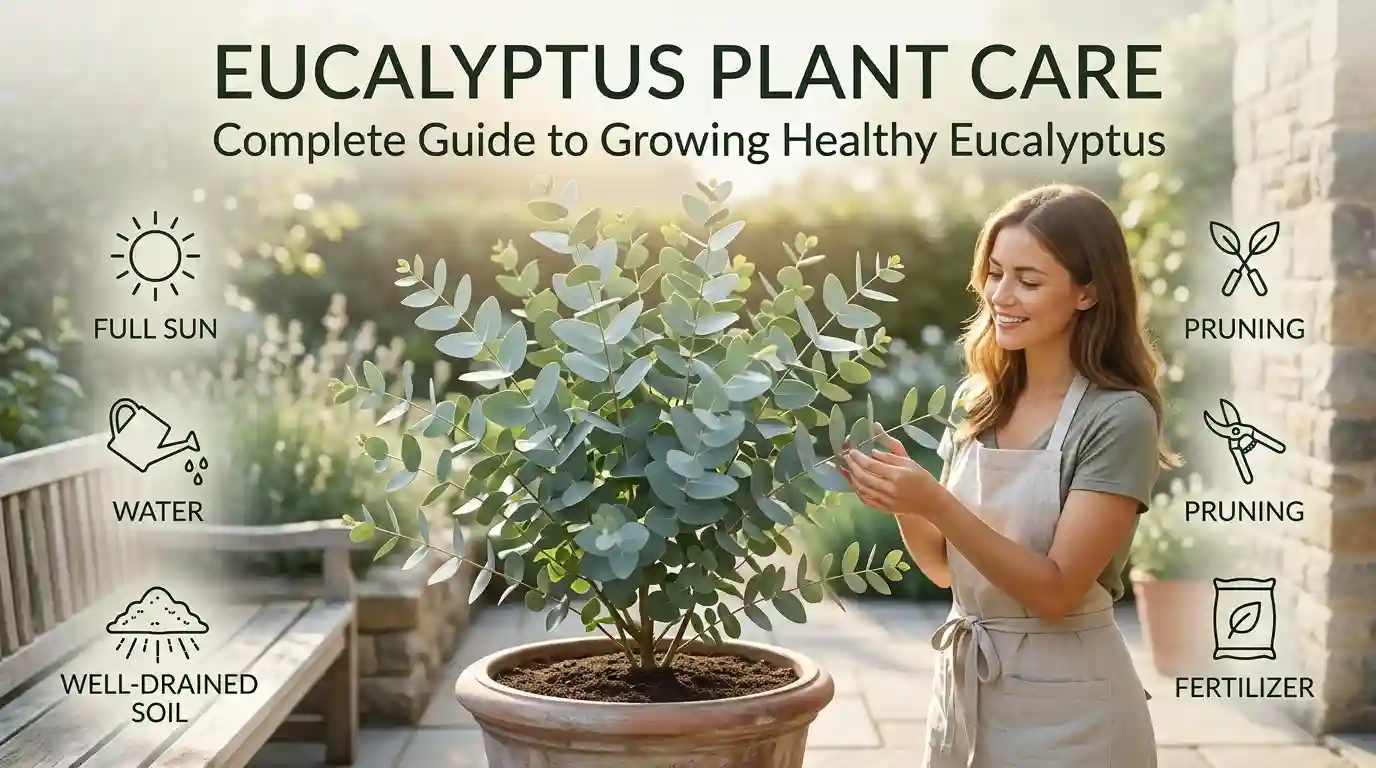
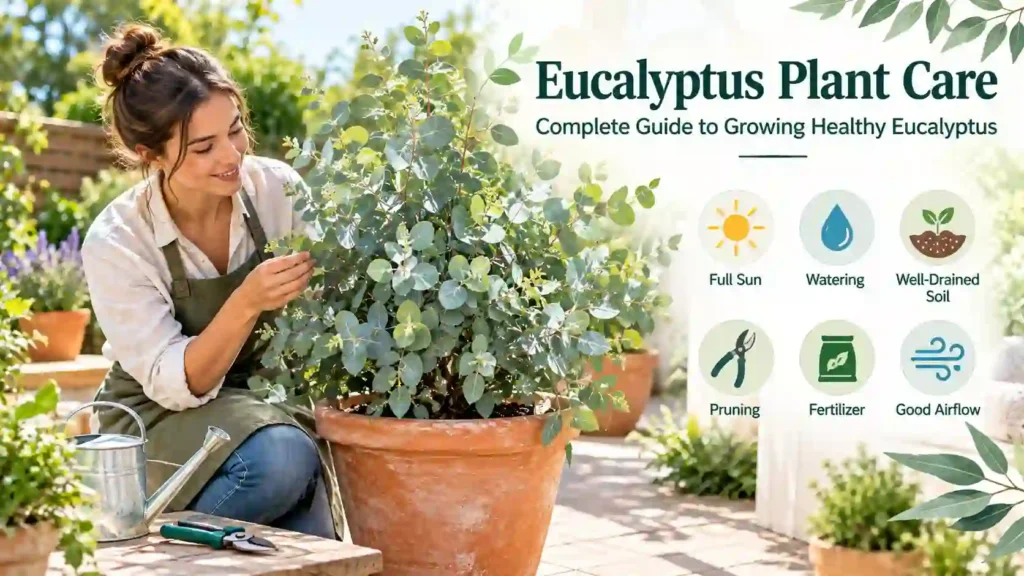
Eucalyptus plant care starts with full sun, excellent drainage, and careful watering. Most Eucalyptus species are vigorous plants that prefer bright light and can tolerate drought once established. Container-grown plants need more consistent moisture than established trees in the ground. Choose the species carefully, use a large container with drainage, prune regularly if you want juvenile foliage, and protect young plants from severe cold and drying winds.
Introduction
Eucalyptus is best known for its aromatic foliage, silvery-blue leaves, peeling bark, and unmistakable Australian character.
But growing one successfully requires a different mindset from caring for many popular houseplants.
The biggest mistake is treating Eucalyptus like a typical indoor tropical plant.
Most Eucalyptus species are sun-loving trees or shrubs, and many grow surprisingly quickly. Some species can eventually become enormous trees, while smaller cultivars are much better suited to containers. The plant sold in a small nursery pot may therefore have very different long-term needs from the plant you see growing outdoors.
That difference matters.
A young Eucalyptus may need regular watering while establishing, while an established tree may become remarkably drought tolerant. A container specimen may need frequent attention because its restricted root system dries faster. And a plant grown primarily for its rounded juvenile leaves may need regular pruning to retain that attractive foliage.
This guide explains how to provide the right conditions, avoid common mistakes, prune responsibly, and recognize problems before they become severe.
Understanding Eucalyptus Before You Plant It
Eucalyptus is a large genus containing hundreds of species of evergreen trees and shrubs, mostly native to Australia.
They are not all the same size or equally tolerant of cold.
Some remain relatively manageable shrubs, while others become large landscape trees. For example, Eucalyptus gunnii can become a very large tree, while compact cultivars such as Eucalyptus gunnii ‘Rengun’ are much more practical for smaller gardens and containers.
This creates the first important rule of Eucalyptus plant care:
Choose the species or cultivar according to the space you actually have, not the size of the plant at purchase.
If you have a balcony or small patio, a naturally compact cultivar is usually more sensible than buying a species capable of becoming a large tree and attempting to control it indefinitely.
Juvenile vs. adult foliage
Eucalyptus often produces a juvenile leaf form when young.
These leaves can be rounded, silvery, or blue-green and are especially popular for ornamental use and floral arrangements.
As the plant matures, many species develop longer, narrower adult leaves.
Regular hard pruning can encourage juvenile foliage in suitable Eucalyptus species.
Image Suggestion: Side-by-side botanical illustration showing juvenile rounded Eucalyptus leaves compared with mature elongated leaves.
Eucalyptus Light Requirements
Give Eucalyptus as Much Sun as Practical
Light is arguably the most important part of Eucalyptus plant care.
Most Eucalyptus species perform best in full sun. Shady locations can lead to weak, stretched growth and reduced foliage quality.
For an outdoor plant, choose an open position where it receives strong sunlight for much of the day.
For a container plant, place it in the brightest suitable position available.
A sunny patio, balcony, terrace, or south-facing location can work well depending on your climate and local sun intensity.
What happens when Eucalyptus does not get enough light?
You may notice:
- Long, weak stems
- Sparse foliage
- Smaller leaves
- Slower growth
- Poorly shaped plants
- Increased leaning toward the brightest direction
Do not try to compensate for insufficient light with extra fertilizer.
Fertilizer cannot replace sunlight.
Can Eucalyptus grow indoors?
A young Eucalyptus can sometimes be kept indoors temporarily, but permanent indoor cultivation is difficult for many species.
The main issue is not simply room temperature.
It is light intensity and space.
A bright-looking indoor room can still provide substantially less usable light than an outdoor position in full sun.
If you want to grow Eucalyptus indoors, treat it as a temporary container specimen unless you have exceptionally bright conditions and a naturally compact cultivar.
The Best Soil for Eucalyptus
Eucalyptus generally prefers well-drained soil.
Most species dislike prolonged waterlogging, although individual species vary in their tolerance. The RHS recommends well-drained conditions for Eucalyptus and notes that many species perform well across different soil types when drainage is adequate.
What makes good Eucalyptus soil?
For outdoor planting, ordinary garden soil can work if it drains reasonably well.
For containers, use a free-draining potting mix.
A practical container mix can include:
- Quality potting compost
- Bark-based material
- Perlite or horticultural grit
- Other coarse material that improves drainage
The goal is not to create extremely dry soil.
The goal is to prevent the root zone from remaining saturated.
Why drainage matters
Roots need both water and oxygen.
When soil stays saturated for too long, air spaces become filled with water. This can weaken roots and increase the risk of root-related problems.
A common beginner mistake is seeing wilted leaves and assuming the plant needs more water.
Sometimes the opposite is true.
If the soil is already wet, adding more water can make the underlying problem worse.
How to Water Eucalyptus
Watering depends heavily on whether the plant is:
- Newly planted
- Established in the ground
- Growing in a container
- Growing in a hot climate
- Experiencing winter dormancy or reduced growth
This is why a fixed schedule is unreliable.
Newly planted Eucalyptus
Young plants need regular watering while their roots establish.
Water deeply enough to moisten the root zone, then monitor the soil rather than watering automatically every day.
The RHS recommends watering newly planted Eucalyptus well during establishment and then reducing supplemental irrigation as plants become established.
Established Eucalyptus
Once established in suitable soil, many Eucalyptus trees are quite drought tolerant.
They generally need much less supplemental water than a young container plant.
However, drought tolerance does not mean a mature tree should never receive water.
Extended periods of severe heat or drought can still stress plants.
Container-grown Eucalyptus
Containers are different.
The roots have access to a limited amount of soil, so the plant can dry out much faster.
A container plant may therefore need watering while an established tree planted in the ground needs very little.
The University of Washington’s horticultural library specifically notes that container material, including terracotta, can significantly affect how quickly Eucalyptus dries.
A better watering test
Before watering:
- Check the soil several centimeters below the surface.
- Feel whether it is still noticeably moist.
- Consider recent weather and sunlight.
- Water thoroughly when the plant actually needs it.
- Allow excess water to escape.
- Never leave the container sitting in stagnant water.
Avoid two extremes
Too little water: Leaves wilt, growth slows, and young plants may suffer severe stress.
Too much water: Roots may remain oxygen-starved, increasing the risk of root problems.
Image Suggestion: Eucalyptus watering infographic comparing a healthy moist-but-draining root zone with waterlogged soil.
Eucalyptus Humidity Requirements
Unlike tropical houseplants, Eucalyptus does not usually need extremely high indoor humidity.
Outdoor Eucalyptus naturally experiences changing humidity, airflow, rainfall, and drying conditions.
For indoor container plants, ordinary household humidity may be acceptable if the plant receives enough light and good airflow.
Do not assume that misting leaves will solve every problem.
If leaves are declining indoors, check light and watering first.
Eucalyptus is often much more limited by inadequate light than by ordinary household humidity.
Temperature and Cold Protection
Temperature tolerance varies considerably between Eucalyptus species.
Some species are substantially hardier than others.
For example, Eucalyptus gunnii is regarded as one of the more cold-tolerant Eucalyptus options for northern-hemisphere gardens, while tender species may require frost-free conditions or protected growing.
Protect young plants from harsh conditions
Young Eucalyptus can be more vulnerable to:
- Frost
- Freezing temperatures
- Cold drying winds
- Sudden temperature changes
- Waterlogged winter soil
If you grow Eucalyptus in a container, move it to a sheltered location when severe winter weather threatens.
For containers, raising the pot slightly on feet or bricks can help keep drainage holes clear and reduce prolonged contact with saturated ground.
Do not guess hardiness from the common name
Always identify the botanical species or cultivar.
“Eucalyptus” is not one plant with one universal cold tolerance.
Choosing the Right Container
Eucalyptus can be grown successfully in containers, but container selection becomes increasingly important as the plant grows.
The RHS recommends large containers for Eucalyptus, with containers around 60 cm (2 ft) or more in diameter being suitable for many specimens.
Choose a container with:
- Drainage holes
- Strong construction
- Enough weight to prevent tipping
- Room for root development
- A size appropriate to the plant
Avoid immediately placing a small plant into an enormous container.
A huge volume of wet soil can stay moist for longer than the roots can use.
Container material matters
Terracotta dries more quickly than many non-porous containers.
That can be helpful in wet conditions but means you may need to monitor moisture more frequently during hot weather.
The best container is therefore not simply the most attractive one.
It is the one that matches your climate, watering habits, plant size, and drainage conditions.
Fertilizing Eucalyptus
Eucalyptus is not usually a heavy feeder when planted in suitable ground.
Established landscape trees often need little or no routine feeding. The RHS notes that established trees generally do not require fertilizer, although feeding may help a recently hard-pruned plant that is not growing strongly.
Container plants are different because their available nutrients are restricted by the small volume of growing medium.
A sensible approach
For a container-grown Eucalyptus:
- Use a balanced fertilizer during active growth.
- Follow the product’s dilution instructions.
- Avoid repeated heavy applications.
- Reduce feeding when growth slows.
- Do not fertilize a severely stressed plant simply because it looks unhealthy.
Excess fertilizer can contribute to salt accumulation and root stress.
More fertilizer does not automatically produce better foliage.
How to Prune Eucalyptus
Pruning is one of the most useful tools for managing Eucalyptus.
Without pruning, many species can become much larger than expected.
The RHS recommends pruning Eucalyptus in late winter to early spring for formative pruning, coppicing, or pollarding.
However, the correct method depends on what you want the plant to become.
Pruning for a Tree Shape
If you want a traditional single-trunked tree, formative pruning can help establish a clear structure.
Young Eucalyptus naturally develops a central leader.
Avoid unnecessarily cutting the main leader when your goal is a standard tree form because this can interfere with the desired structure.
Remove:
- Dead branches
- Damaged branches
- Crossing branches
- Poorly positioned growth
- Unwanted low branches
Make clean cuts rather than leaving damaged stubs.
Pruning Eucalyptus for Juvenile Foliage
If your main goal is attractive rounded juvenile foliage, the pruning strategy changes.
Some Eucalyptus respond well to hard pruning or coppicing, producing vigorous new shoots with juvenile leaves.
The RHS specifically identifies Eucalyptus gunnii and several other species as suitable for this approach.
Coppicing
Coppicing involves cutting the plant back heavily to encourage new stems from the base or lower framework.
This can:
- Control plant size
- Produce new shoots
- Encourage juvenile foliage
- Create a multi-stemmed form
Do not assume every mature Eucalyptus should be cut to the ground.
The species, age, health, climate, and desired form all matter.
Image Suggestion: Before-and-after Eucalyptus pruning infographic showing a tall specimen, correct hard-pruning point, and vigorous juvenile regrowth.
Why Is My Eucalyptus Losing Its Silver or Blue Color?
One of the most attractive features of many Eucalyptus varieties is their silvery-blue foliage.
If the new growth looks greener than expected, check the plant’s identity first.
Some Eucalyptus naturally transition from colorful juvenile leaves to greener adult foliage.
For example, Eucalyptus gunnii produces rounded blue-green juvenile foliage but develops more elongated gray-green adult leaves as it matures.
Therefore, a change in leaf appearance is not automatically a nutrient deficiency.
If the change happens suddenly
Check:
- Light exposure
- Recent pruning
- New growth type
- Watering
- Fertilizer
- Pest activity
- Whether the plant is producing juvenile or adult foliage
Hard pruning can be useful when a suitable species is grown primarily for juvenile foliage.
Why Are My Eucalyptus Leaves Turning Brown?
Brown foliage can have several causes.
Do not diagnose the problem from color alone.
Common possibilities
| Symptom | Possible Cause | What to Check |
|---|---|---|
| Crispy brown leaves | Water stress | Soil moisture and recent weather |
| Brown patches on exposed leaves | Sun or heat stress | Recent change in light |
| Brown foliage after frost | Cold injury | Minimum temperatures |
| Brown leaves with wet soil | Root stress | Drainage and soil condition |
| Browning with insects | Pest damage | Leaf undersides and stems |
| Widespread decline | Environmental stress | Light, water, roots, temperature |
Eucalyptus can experience environmental disorders involving drought, excess water, frost, leaf scorch, salinity, and nutrient problems.
The most useful question
Ask:
What changed before the leaves changed?
For example:
- Was the plant moved?
- Did the weather become extremely hot?
- Was it recently repotted?
- Did watering increase?
- Did it experience frost?
- Was it heavily pruned?
- Did it move from indoors to full sun?
The timeline often provides more information than the appearance of one damaged leaf.
Why Is My Eucalyptus Drooping?
Drooping can indicate dehydration, but it can also occur when roots are stressed by excessive moisture.
Check the soil before watering.
If the soil is dry
Water thoroughly and monitor the plant.
If the soil is wet
Do not automatically add more water.
Instead, investigate:
- Drainage
- Container size
- Soil structure
- Root condition
- Recent rainfall
- Frequency of watering
A wilted plant does not always mean a thirsty plant.
This is especially important with container Eucalyptus.
Eucalyptus Pests and Diseases
Eucalyptus is generally resilient, but pests and diseases can still occur.
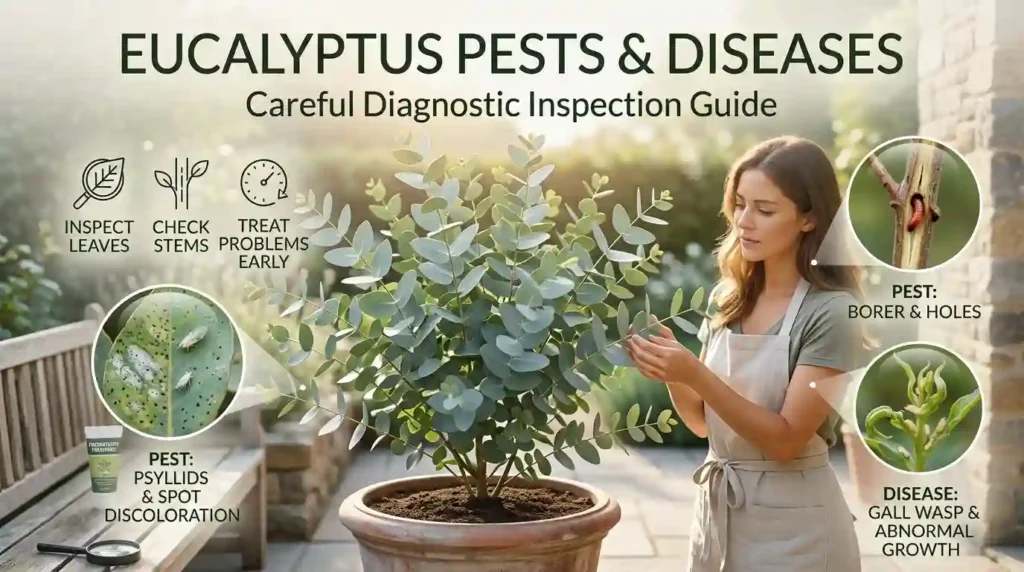
Potential problems include:
- Psyllids
- Gall-forming insects
- Borers
- Whiteflies
- Leaf-feeding insects
- Root and crown diseases
- Leaf spots
- Cankers
- Powdery mildew
UC Integrated Pest Management lists several important Eucalyptus pests and diseases, including psyllids, gall makers, borers, leaf spots, cankers, and root diseases.
How to inspect your plant
Check:
- Undersides of leaves
- New shoots
- Stems
- Branch junctions
- Areas of distorted growth
Look for:
- Sticky residue
- Discoloration
- Holes
- Swelling
- Webbing
- Unusual bumps
- Premature leaf drop
Treat the actual pest or disease rather than applying multiple products blindly.
Repotting Eucalyptus
Eucalyptus generally dislikes unnecessary root disturbance.
This is one reason choosing the final growing location carefully matters.
The University of Washington’s horticultural guidance recommends moving young plants into the garden while they are still relatively small because established Eucalyptus can be difficult to transplant.
Repot when necessary
Container plants may need repotting when:
- Roots fill the container
- Growth becomes restricted
- Water runs through unusually quickly
- The plant repeatedly dries out
- The container becomes unstable
Repot during active growth when possible.
Do not aggressively disturb the root ball unless there is a clear reason.
An important long-term consideration
If you intend to keep Eucalyptus permanently in a pot, choose a species or cultivar that fits container growing.
Do not rely on endless root pruning and top pruning to keep a naturally huge tree permanently tiny.
Planting Eucalyptus in the Ground
Choose the final site carefully.
Most Eucalyptus prefer:
- Full sun
- Free-draining soil
- Good airflow
- Protection from severe cold when required
- Enough room for mature growth
The RHS recommends planting in spring or summer so plants have time to establish before winter.
Before planting, check mature size
This step is often skipped.
A young Eucalyptus can look perfectly appropriate in a small garden.
Several years later, the same plant may be far too large for the location.
Consider:
- Mature height
- Mature spread
- Root-zone requirements
- Nearby buildings
- Overhead structures
- Utility infrastructure
- Neighboring plants
- Future pruning needs
Some Eucalyptus species can become very large, so site selection is part of plant care—not an afterthought.
Growing Eucalyptus in Hot Climates
Hot weather can be excellent for Eucalyptus, but newly planted trees still need attention.
During periods of extreme heat:
- Check young plants frequently.
- Water deeply when the soil becomes too dry.
- Avoid shallow daily watering.
- Protect newly transplanted plants from extreme stress.
- Monitor container plants more closely.
- Make sure pots do not become dangerously hot and dry.
Established Eucalyptus may tolerate drought well, but newly planted plants have not yet developed the same root system.
Do not use the drought tolerance of a mature tree as a reason to neglect a recently planted one.
Growing Eucalyptus in Containers
Container cultivation is one of the best ways to enjoy a manageable Eucalyptus in a small space.
It also requires more maintenance than growing the same plant in the ground.
Container care checklist
Light: Full sun whenever possible.
Water: Monitor regularly because containers dry faster.
Soil: Use a free-draining mix.
Pot: Choose a stable container with drainage holes.
Feeding: Feed moderately during active growth.
Pruning: Prune to control size and maintain the desired foliage.
Repotting: Repot when the root system genuinely needs more space.
Winter: Protect containers from severe cold and prolonged winter saturation when appropriate.
The RHS specifically recommends large containers for Eucalyptus and notes that container plants require different watering and winter management from established specimens in the ground.
A Simple Eucalyptus Care Routine
You do not need to constantly fuss over Eucalyptus.
A good routine is mostly about observing the plant and its environment.
Weekly
Check:
- Soil moisture
- New growth
- Leaf color
- Pests
- Container drainage
- Signs of heat or cold stress
Monthly
Evaluate:
- Whether the plant is becoming root-bound
- Whether pruning is needed
- Whether its current location still provides enough sun
- Whether fertilizer buildup is developing
- Whether the plant is growing into surrounding structures
Seasonally
Adjust:
- Watering
- Fertilizing
- Pruning
- Cold protection
- Container placement
This approach is more reliable than following a rigid watering calendar.
Common Eucalyptus Care Mistakes
1. Growing It in Too Much Shade
Eucalyptus is fundamentally a sun-loving plant.
Better approach: Give it the brightest suitable location available.
2. Keeping the Soil Constantly Wet
Eucalyptus likes moisture while establishing, but prolonged waterlogging is a different matter.
Better approach: Improve drainage and adjust watering to the plant’s stage of growth.
3. Ignoring Mature Size
The plant may be tiny when purchased and enormous later.
Better approach: Research the mature species or cultivar before planting.
4. Keeping a Large Tree Permanently in a Tiny Pot
Root restriction can turn long-term container growing into a constant maintenance battle.
Better approach: Choose a naturally smaller cultivar when space is limited.
5. Moving a Plant Without Acclimation
A plant moved from a protected location into intense sun can experience severe environmental stress.
Better approach: Increase sun exposure gradually.
6. Overfertilizing
More fertilizer does not guarantee faster or healthier growth.
Better approach: Feed according to the plant’s growing conditions and container needs.
7. Pruning Without Knowing the Goal
A tree intended to remain a standard specimen should not be pruned the same way as a plant grown for juvenile foliage.
Better approach: Decide whether you want a tree, shrub, or juvenile-foliage specimen before making major cuts.
8. Treating Every Brown Leaf as a Watering Problem
Brown foliage can result from drought, excess water, frost, pests, scorch, or other environmental problems.
Better approach: Diagnose the conditions around the plant first.
How to Revive a Struggling Eucalyptus
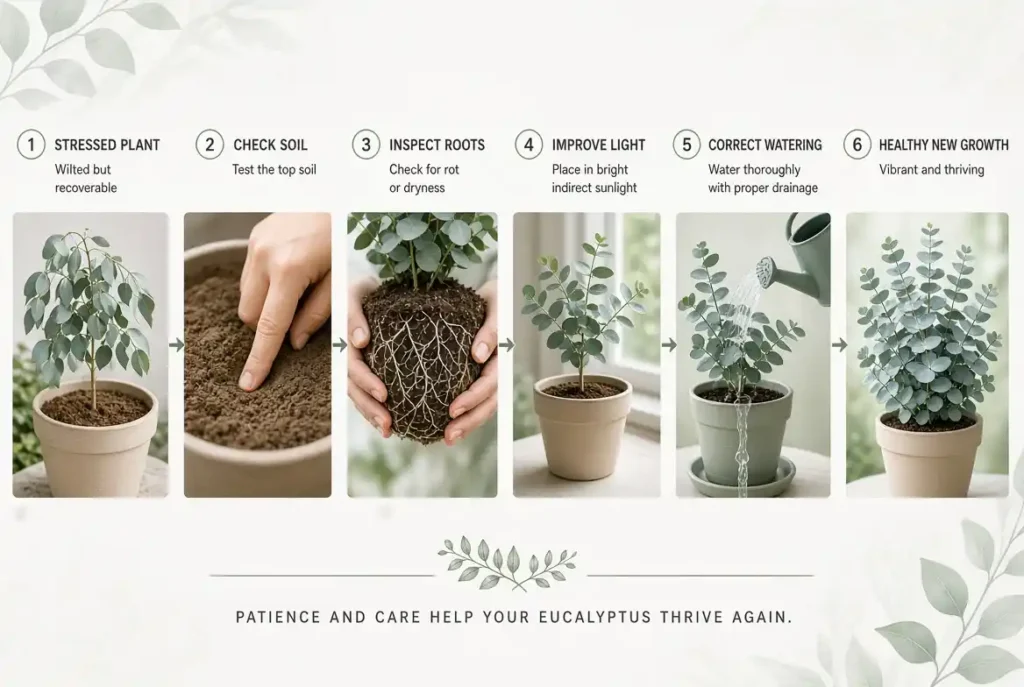
When an Eucalyptus looks unhealthy, avoid changing everything at once.
Use a systematic approach.
Step 1: Check the soil
Is it bone dry, moderately moist, or saturated?
Step 2: Check the roots
If the plant is in a container and remains wet for unusually long periods, inspect the root zone.
Healthy roots should not be treated as an afterthought.
Step 3: Check sunlight
Is the plant receiving full sun, or has it been moved into shade?
Step 4: Check temperature
Look for recent frost, extreme heat, cold winds, or sudden environmental changes.
Step 5: Inspect pests
Look closely at young growth and leaf undersides.
Step 6: Stop unnecessary interventions
Do not immediately add fertilizer, repot, prune heavily, and increase watering all at once.
Give the plant stable conditions and observe new growth.
Step 7: Judge recovery by new growth
Old damaged leaves may never look perfect again.
Healthy new growth is a much more useful sign that the plant is recovering.
How to Propagate Eucalyptus
Eucalyptus is most commonly propagated from seed.
The RHS recommends seed propagation for Eucalyptus gunnii, with germination under appropriate warm conditions.
Cuttings can be more challenging depending on the species and the maturity of the material.
For home gardeners, seed propagation is often the more straightforward approach when viable seed is available.
Basic seed-growing approach
- Use a clean, free-draining seed-starting medium.
- Sow seeds according to the species’ requirements.
- Keep the medium appropriately moist.
- Provide strong light after germination.
- Give seedlings good airflow.
- Transplant carefully as they develop.
- Avoid unnecessary root disturbance.
Image Suggestion: Step-by-step Eucalyptus propagation infographic showing seed sowing, germination, seedling growth, transplanting, and young plant development.
Eucalyptus Plant Care by Growing Situation
| Growing Situation | Main Priority | Biggest Risk |
|---|---|---|
| Young outdoor plant | Establishing roots | Drought stress |
| Established garden tree | Correct site and pruning | Excessive size |
| Container plant | Sun and watering | Rapid drying or root restriction |
| Indoor young plant | Maximum available light | Insufficient light |
| Cold climate | Species selection | Frost damage |
| Hot climate | Water management during establishment | Heat and drought stress |
| Juvenile foliage production | Pruning and sunlight | Losing desired foliage form |
This comparison highlights why there is no single watering schedule or care routine that works for every Eucalyptus.
Is Eucalyptus Safe for Pets?
This is important if you grow Eucalyptus around cats, dogs, or horses.
The ASPCA lists Eucalyptus species as toxic to dogs, cats, and horses. It identifies essential oils, including eucalyptol, as the toxic principle and lists signs such as salivation, vomiting, diarrhea, depression, and weakness.
Keep Eucalyptus and concentrated Eucalyptus oils away from pets that may chew plant material.
If a pet has eaten Eucalyptus or may have been exposed to concentrated Eucalyptus oil, contact a veterinarian promptly.
Frequently Asked Questions About Eucalyptus Plant Care
Does Eucalyptus need full sun?
Yes. Most Eucalyptus species perform best in full sun. Strong light helps support compact growth and healthy foliage.
How often should I water Eucalyptus?
There is no universal schedule. Young plants and container-grown Eucalyptus need more regular watering, while established plants can become drought tolerant. Always consider soil moisture, temperature, rainfall, and container conditions.
Can Eucalyptus grow indoors?
Young plants can be grown indoors temporarily, but many species are not ideal permanent houseplants because they require strong light and can become large. A compact cultivar and exceptionally bright location offer better possibilities.
Why are my Eucalyptus leaves turning brown?
Possible causes include drought, excessive moisture, frost, heat stress, pests, leaf scorch, salinity, or root problems. Look at the growing conditions before deciding on treatment.
Why is my Eucalyptus losing its blue color?
Some Eucalyptus naturally change from juvenile rounded leaves to mature greener foliage. Insufficient light can also affect foliage quality. Identify the species and determine whether the new leaves are juvenile or mature.
Does Eucalyptus like wet soil?
Eucalyptus generally prefers well-drained soil. Some species tolerate wetter conditions better than others, but prolonged waterlogging is usually undesirable.
Can Eucalyptus survive drought?
Many established Eucalyptus are drought tolerant. Newly planted specimens require more consistent watering while their roots establish.
Can Eucalyptus grow in a pot?
Yes. Many Eucalyptus can be grown in large containers, especially smaller cultivars. However, the plant will still have substantial growth potential, so regular pruning and eventual repotting may be necessary.
How do I keep Eucalyptus small?
Choose a naturally compact cultivar and use appropriate pruning. Coppicing can maintain juvenile foliage and a bushier form in suitable species.
When should I prune Eucalyptus?
Formative pruning, coppicing, and pollarding are generally carried out in late winter to early spring, before strong active growth begins.
Why is my Eucalyptus growing tall and thin?
Insufficient light is a likely factor. Eucalyptus naturally prefers strong sunlight, so a plant grown in shade may produce weaker, less compact growth.
Can I cut Eucalyptus back hard?
Some species tolerate hard pruning and coppicing very well. However, the correct technique depends on the species and your desired result. Do not assume every Eucalyptus should be treated identically.
Does Eucalyptus need fertilizer?
Established Eucalyptus growing in suitable ground generally needs little fertilizer. Container-grown plants have more limited nutrient reserves and may benefit from moderate feeding during active growth.
Can Eucalyptus survive winter?
That depends on the species and local climate. Some species are quite hardy, while others require frost-free or protected conditions. Identify the exact species or cultivar before relying on general Eucalyptus hardiness information.
Final Thoughts
Successful Eucalyptus plant care begins with recognizing what kind of plant you are growing.
It is not simply a decorative houseplant with fragrant leaves. Eucalyptus includes vigorous trees and shrubs with substantial long-term growth potential. Most species want strong sunlight, well-drained soil, careful watering, and enough room to develop.
For container plants, pay particular attention to moisture, drainage, pot size, and pruning. For outdoor trees, the biggest decisions are usually species selection, planting location, mature size, and long-term pruning.
If the leaves begin to brown, yellow, droop, or lose their expected color, resist the urge to immediately add water or fertilizer. Check the soil, roots, sunlight, temperature, and recent environmental changes first.
The best Eucalyptus care is not about constant attention. It is about putting the plant in the right environment and then responding intelligently as its needs change.
With the correct species, enough sun, good drainage, and thoughtful pruning, Eucalyptus can become an exceptionally attractive and long-lasting feature in a garden or container collection.