
Quick Answer
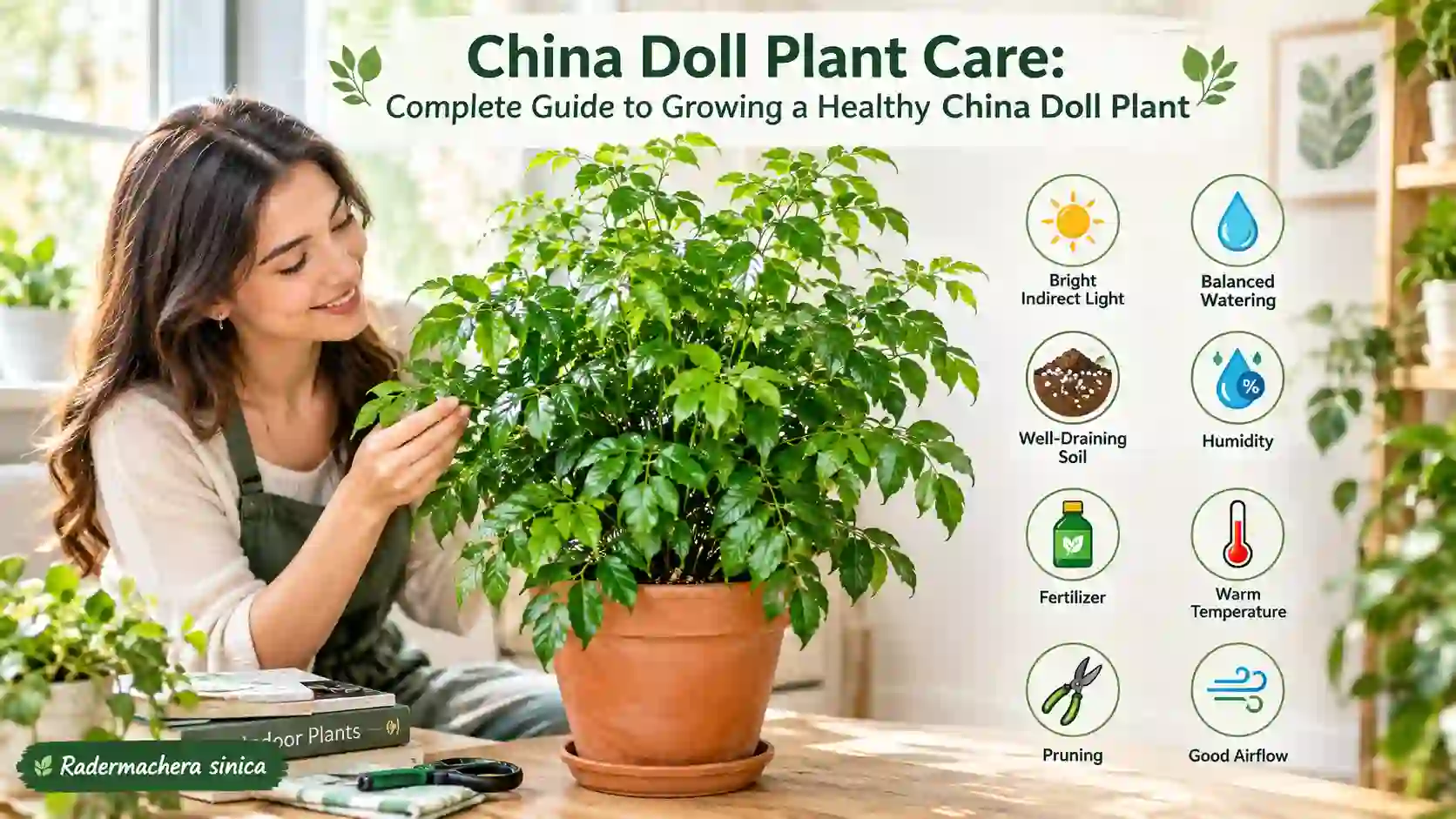
China doll plant care is mainly about bright indirect light, consistent but controlled watering, well-draining soil, warmth, and stability. The China doll plant (Radermachera sinica) dislikes sudden environmental changes and can drop leaves after moving, repotting, overwatering, or light changes. Keep the soil moist but not soggy, prune regularly to encourage branching, and provide good airflow. (Royal Horticultural Society)
Introduction
The China doll plant is popular because it looks like a miniature indoor tree.
Its glossy, finely divided leaves create a soft, almost fern-like canopy. With enough light and regular pruning, it can develop into a full, elegant houseplant rather than a sparse collection of tall stems.
But China doll plants have a reputation for suddenly dropping leaves.
That can be alarming.
A plant that looked perfect at the nursery may lose leaves soon after arriving home. Sometimes the cause is overwatering. Sometimes it is insufficient light. In other cases, the plant is simply reacting to a major environmental change.
This sensitivity is an important part of China doll plant care. The RHS specifically recommends bright, indirect light, a warm environment, good drainage, and avoiding unnecessary environmental changes because moving the plant can trigger leaf drop. (Royal Horticultural Society)
The goal is not to keep the soil permanently wet or constantly move the plant in search of better light.
Instead, successful care comes down to stable conditions and careful observation.
This guide explains exactly how to grow a healthy China doll indoors, including watering, light, humidity, soil, fertilizer, pruning, repotting, propagation, pests, leaf drop, yellow leaves, brown leaves, and other common problems.
What Is a China Doll Plant?
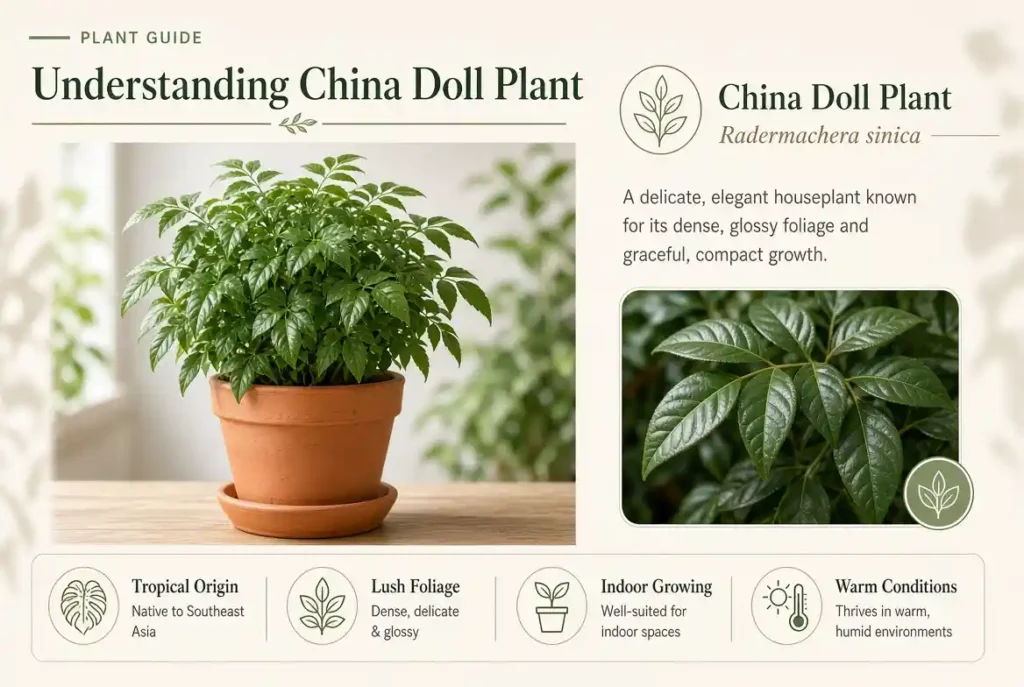
The China doll plant is Radermachera sinica, an evergreen species in the Bignoniaceae family.
It is native to southern China and Taiwan. In its natural environment, the species can become a large tree, reaching around 30 meters. Indoors, however, it is generally grown as a much smaller ornamental plant. (Royal Horticultural Society)
Its main attraction is the foliage.
The leaves are divided into numerous glossy leaflets, giving the plant a delicate appearance despite its tree-like growth habit.
China doll plant at a glance
| Feature | Details |
|---|---|
| Botanical name | Radermachera sinica |
| Common name | China doll plant |
| Family | Bignoniaceae |
| Native range | Southern China and Taiwan |
| Growth habit | Evergreen tree |
| Indoor use | Houseplant, conservatory, greenhouse |
| Light | Bright, indirect light |
| Soil | Moist but well-drained |
| Growth habit indoors | Upright and branching |
| Main challenge | Leaf drop from stress or inconsistent conditions |
| Pruning | Useful for maintaining a compact, bushy shape |
The RHS lists Radermachera sinica as suitable for houseplant and conservatory growing, with bright indirect light and a warm environment recommended for cultivation. (Royal Horticultural Society)
Image Suggestion: Botanical infographic showing a China doll plant with glossy compound leaves, woody stems, and labels for Radermachera sinica, foliage, stem, and root system.
The Most Important China Doll Plant Care Rule: Keep Conditions Stable
Many houseplants tolerate being moved around the home.
China doll plants often do not.
A sudden change from a bright nursery to a dim room can cause stress. Moving a plant from filtered light directly into intense sun can also create problems. Repotting immediately after bringing one home adds another environmental change.
The University of Illinois Extension specifically notes that China doll plants are sensitive to changes in location and watering. Its guidance describes leaf drop after a combination of moving, repotting, and overwatering. (Illinois Extension)
When you bring a new China doll home
Instead of immediately:
- Repotting it
- Pruning heavily
- Moving it between rooms
- Changing its light dramatically
- Fertilizing heavily
give it time to settle.
First establish a stable location with appropriate light.
Then observe how quickly the soil dries.
Only make additional changes when there is a clear reason.
Expert insight: With a sensitive plant, correcting one problem at a time makes diagnosis much easier.
China Doll Plant Light Requirements
Light is one of the most important factors in maintaining a dense China doll canopy.
The RHS recommends bright, indirect light for Radermachera sinica. Illinois Extension also recommends around 4–5 hours of bright indirect light indoors. (Royal Horticultural Society)
What does bright indirect light mean?
Place the plant near a bright window where it receives plenty of natural light without sitting in harsh, unfiltered midday sun for hours.
Good locations can include:
- Near an east-facing window
- Near a bright south-facing window with filtering
- Near a bright west-facing window with protection from intense afternoon sun
- A bright room with filtered daylight
The exact exposure depends on your window, climate, season, and indoor temperature.
Signs of insufficient light
A China doll receiving too little light may develop:
- Long gaps between leaves
- Thin or leggy stems
- Sparse growth
- Smaller new leaves
- Yellowing of some interior or lower foliage
Illinois Extension notes that leggy growth indoors is often associated with limited light. (Illinois Extension)
What about direct sunlight?
Some direct morning sunlight can be useful, particularly when filtered through a suitable window.
However, do not assume that a plant accustomed to indoor filtered light can immediately tolerate intense outdoor sun.
If you want to increase direct light, acclimate it gradually.
Image Suggestion: Bright-window infographic comparing a dense China doll in bright filtered light with a leggy plant growing in a dark corner.
How to Water a China Doll Plant
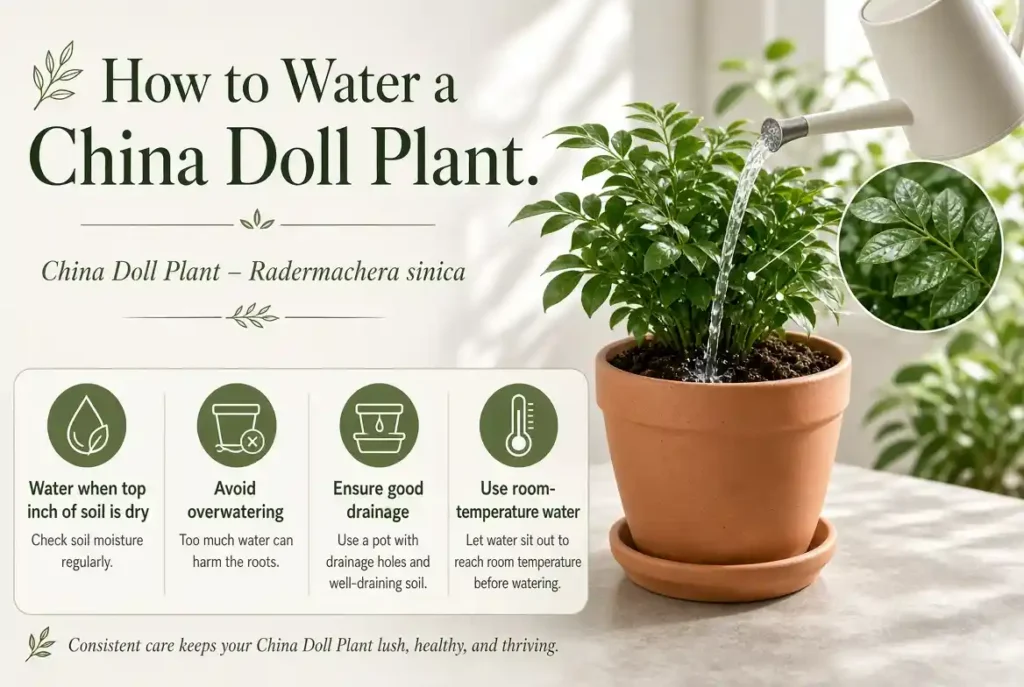
Watering is where many China doll problems begin.
The plant does not want to remain bone dry for long periods, but it also does not want permanently saturated soil.
The RHS recommends moist but well-drained growing conditions and warns that plants kept too moist may develop root rot. (Royal Horticultural Society)
The best watering method
Do not water according to the calendar alone.
Instead:
- Check the soil.
- Feel the upper layer with your finger.
- If the soil has dried sufficiently, water thoroughly.
- Allow excess water to drain from the pot.
- Empty standing water from the saucer.
- Wait until the plant needs water again.
The exact interval changes with:
- Pot size
- Soil composition
- Light intensity
- Temperature
- Humidity
- Season
- Root development
A plant beside a bright window in summer may dry much faster than the same plant in a dim room during winter.
Signs of underwatering
You may notice:
- Drooping foliage
- Dry or crispy leaves
- Curling leaves
- Rapid leaf drop
- Very dry potting mix
Signs of overwatering
Look for:
- Yellowing leaves
- Persistent wet soil
- Soft or dark stems near the soil
- Unpleasant-smelling soil
- Leaf drop despite wet soil
- Declining growth
The University of Illinois Extension specifically reports that overwatering can produce black leaves and leaf drop, while underwatering tends to produce dry, crispy foliage. (Illinois Extension)
Image Suggestion: Step-by-step China doll watering infographic showing “Check Soil → Water Thoroughly → Drain Completely → Wait Until Needed.”
The Best Soil for a China Doll Plant
China doll plants need a growing medium that holds enough moisture while allowing excess water to escape.
The RHS recommends peat-free multipurpose compost with additional sand or perlite to improve drainage. (Royal Horticultural Society)
A practical container mix
A suitable houseplant mix can contain:
- Quality potting mix
- Perlite or another drainage-improving material
- A modest amount of organic matter
The objective is not to create the fastest-draining soil possible.
The objective is balanced moisture and oxygen around the roots.
Avoid heavy soil
Dense garden soil can remain wet inside a container.
That increases the risk of root problems.
A potting mix designed for containers is generally easier to manage.
Drainage holes are essential
Even excellent soil cannot compensate for a pot without drainage.
Water must have a route out of the root zone.
Image Suggestion: Cross-section infographic showing healthy China doll roots in airy soil compared with roots sitting in compacted, waterlogged soil.
China Doll Plant Temperature Requirements
China doll is a warm-growing plant.
The RHS classifies Radermachera sinica under its H1B category, meaning it is suited to protected growing and can be grown outdoors during summer under appropriate conditions. (Royal Horticultural Society)
For indoor plants, avoid:
- Cold drafts
- Sudden temperature changes
- Air-conditioning blasts
- Strong heating vents
- Cold windows during winter
- Abrupt transitions between indoor and outdoor conditions
A stable room is usually better than a location where the plant repeatedly experiences temperature swings.
Can China doll grow outdoors?
Yes, in sufficiently warm climates.
But it is not a frost-hardy houseplant.
In colder climates, it should be protected and generally grown as an indoor or protected-container plant. Illinois Extension specifically notes that China doll is not hardy outdoors in cold Zone 5 conditions. (Illinois Extension)
Humidity and Airflow
China doll plants appreciate a warm, reasonably humid environment.
However, increasing humidity does not mean keeping the leaves constantly wet.
Good indoor airflow is equally important.
Practical ways to improve the environment
You can:
- Group compatible plants together.
- Use a humidifier when indoor air is very dry.
- Keep the plant away from heating vents.
- Maintain gentle air movement.
- Avoid placing foliage directly against a cold or damp window.
Do you need to mist a China doll?
Not necessarily.
Misting provides only a temporary change in moisture around the leaves.
If your home is consistently dry, a humidifier provides more predictable environmental control.
Avoid turning the plant into a permanently damp environment.
Image Suggestion: Bright indoor China doll plant with a humidifier, gentle airflow arrows, and a clean window-side setup.
How to Fertilize a China Doll Plant
China doll plants benefit from nutrition during active growth, but fertilizer should complement good light and healthy roots.
Do not use fertilizer to compensate for poor light or watering problems.
A balanced liquid houseplant fertilizer diluted according to its label can be used during active growth. Many growers use a reduced-strength application rather than frequent heavy feeding.
A sensible feeding approach
During active growth:
- Water the plant appropriately.
- Use a balanced fertilizer at the recommended dilution.
- Follow the product label.
- Avoid applying concentrated fertilizer to dry soil.
When growth slows substantially:
- Reduce feeding.
- Avoid routine heavy fertilization.
Signs of fertilizer buildup
Watch for:
- Brown leaf tips
- Scorched leaf margins
- White crust on soil
- Poor root health
- Stunted growth
If fertilizer salts accumulate, thoroughly flushing the container with clean water can help remove soluble salts, provided the pot drains freely.
Important: Exact fertilizer strength and frequency depend on the product formulation, growing medium, light, and plant growth rate. There is no single schedule that suits every China doll.
How to Prune a China Doll Plant
Pruning is one of the best tools for keeping a China doll compact and bushy.
The RHS recommends pinching shoot tips on young plants to encourage branching and cutting older plants back when needed to maintain their size. (Royal Horticultural Society)
Why China doll becomes leggy
A sparse plant can result from:
- Insufficient light
- Lack of pruning
- Uneven growth
- Natural upward growth
- Repeated loss of lower leaves
Do not simply prune a leggy plant and leave it in the same dark location.
Pruning changes the shape. Light determines how well the plant can regrow.
How to prune
- Use clean, sharp pruning shears.
- Identify long or weak shoots.
- Cut just above a healthy node or branching point.
- Remove dead or damaged growth.
- Step back and evaluate the overall shape.
- Avoid removing too much foliage at once.
Young plants respond particularly well to tip pinching because it encourages branching. (Royal Horticultural Society)
When should you prune?
The strongest shaping is generally easiest when the plant is actively growing.
Avoid combining aggressive pruning with several other major stresses at the same time.
Image Suggestion: Before-and-after China doll pruning infographic showing a tall sparse plant becoming a fuller, branching specimen.
How to Make a China Doll Plant Bushy
If your plant looks like a tall green stick with foliage concentrated at the top, do not panic.
First solve the light problem.
Then prune strategically.
Step 1: Improve light
Place the plant where it receives strong filtered light.
Step 2: Identify long stems
Look for shoots that extend significantly beyond the rest of the canopy.
Step 3: Pinch or cut above a node
This encourages new growth from lower points.
Step 4: Repeat gradually
Do not remove half the canopy in one session unless the plant genuinely requires major corrective pruning.
Step 5: Maintain the shape
Once new shoots develop, occasional tip pruning can keep the plant compact.
The combination of adequate light + strategic pruning is much more effective than pruning alone.
Why Is My China Doll Plant Dropping Leaves?
Leaf drop is probably the most searched-for China doll problem, and there is no single cause.
The plant can respond to several types of stress by shedding foliage.
Common causes include:
- Sudden relocation
- Overwatering
- Underwatering
- Poor drainage
- Insufficient light
- Temperature changes
- Repotting stress
- Root damage
- Pest problems
The RHS specifically warns that moving the plant or making environmental changes can lead to leaf drop. Illinois Extension likewise documents leaf drop following relocation, repotting, and overwatering. (Royal Horticultural Society)
Diagnose the pattern
Leaves are black or soft
Suspect excessive moisture or root stress.
Leaves are dry and crispy
Check for underwatering or severe environmental dryness.
Leaves drop soon after moving
Environmental shock is possible.
Plant is leggy and losing lower leaves
Check light first.
Soil remains wet for a long time
Inspect drainage and root health.
Expert tip: Do not respond to every episode of leaf drop by watering more. First determine whether the soil is actually dry.
Why Are China Doll Leaves Turning Yellow?
Yellow leaves can result from several problems.
Overwatering
This is one of the first things to investigate.
Check how long the soil remains wet after watering.
Insufficient light
Low light can contribute to yellowing and sparse interior foliage. Illinois Extension notes yellowing of lower or interior leaves as another possible indication of inadequate light. (Illinois Extension)
Natural aging
An occasional older leaf turning yellow is not necessarily a serious problem.
Root problems
If yellowing occurs alongside persistent wet soil, poor growth, or stem discoloration, investigate the roots.
Do not automatically fertilize yellow leaves.
Nutrition may be involved, but environmental problems are often the more important first check.
Why Are China Doll Leaves Turning Brown?
Brown leaves or tips can have several causes.
Dry soil
If the entire root ball becomes very dry, leaf edges may become crispy.
Dry indoor air
Very dry conditions can contribute to marginal browning.
Fertilizer buildup
Excess soluble salts can burn leaf margins.
Watering stress
Repeated cycles of extreme dryness followed by heavy watering can stress the plant.
Root problems
A damaged root system may fail to supply foliage properly.
Environmental changes
Sudden changes in light, temperature, or location can contribute to foliage decline.
Always examine the pattern rather than treating brown leaves as one specific disease.
Why Is My China Doll Plant Losing Leaves After Repotting?
Repotting can be stressful for China doll plants.
This becomes even more likely when repotting is combined with:
- Root disturbance
- A much larger pot
- Wet soil
- Sudden light changes
- A new location
- Heavy pruning
The University of Illinois Extension documents this type of stress response and recommends allowing the plant time to readjust rather than immediately adding more interventions. (Illinois Extension)
After repotting
Place the plant in appropriate bright indirect light.
Keep watering controlled.
Do not fertilize a severely stressed plant immediately.
Then watch for new growth.
New growth is a much more useful recovery signal than trying to make every damaged leaf look perfect again.
Repotting a China Doll Plant
China doll does not need to be repotted simply because a certain amount of time has passed.
Look at the plant and root system.
Signs it may need repotting
- Roots circling heavily inside the container
- Roots emerging from drainage holes
- Water running straight through unusually quickly
- Growth slowing despite good conditions
- Container becoming unstable
- Soil structure breaking down
How to repot
- Choose a pot only modestly larger than the current container.
- Confirm it has drainage holes.
- Prepare fresh, well-draining potting mix.
- Remove the plant carefully.
- Inspect the roots.
- Remove obviously dead or rotten material with clean tools.
- Position the plant at the same general depth.
- Fill around the root ball.
- Water appropriately.
- Return it to stable bright indirect light.
Avoid putting a small root system into a huge container.
Excess soil can hold moisture longer than the roots can use.
Image Suggestion: Step-by-step repotting infographic showing root inspection, fresh soil, correct pot size, and drainage.
How to Clean China Doll Leaves
The finely divided foliage can collect dust.
Dust reduces the clean appearance of the plant and can make it harder to inspect leaves for pests.
Safe cleaning method
Use:
- A soft damp cloth
- A gentle shower of room-temperature water
- A soft brush for delicate areas
Support the stems while cleaning.
Avoid aggressive rubbing.
Avoid leaf-shine products unless specifically recommended for the plant.
Clean foliage also makes it easier to spot early pest infestations.
China Doll Plant Pests
The RHS lists several pests that may affect Radermachera sinica, including:
- Aphids
- Mealybugs
- Scale insects
- Glasshouse red spider mite
Spider mites
These tiny pests can be difficult to see.
Look for:
- Fine stippling
- Dull foliage
- Fine webbing
- Increased leaf drop
They are more likely to become troublesome in warm, dry conditions.
Mealybugs
Look for small white, cotton-like clusters around stems and leaf joints.
Scale
Scale insects appear as small bumps attached to stems or leaves.
Aphids
Aphids often gather around soft new growth.
First response
When an infestation is light:
- Isolate the plant if necessary.
- Inspect the undersides of leaves.
- Remove visible pests.
- Rinse foliage gently when appropriate.
- Use an appropriate labeled insecticidal product if the infestation persists.
Repeat monitoring is important because one treatment rarely solves every pest problem.
Image Suggestion: Close-up diagnostic infographic showing aphids, mealybugs, scale, and spider-mite symptoms on China doll foliage.
China Doll Plant Diseases and Root Rot

Root problems are often connected to growing conditions rather than a mysterious disease appearing out of nowhere.
The RHS identifies root rot as a risk when Radermachera sinica is kept too moist. (Royal Horticultural Society)
A Florida Department of Agriculture plant pathology circular also documents Phytophthora root and crown rot in Radermachera sinica and notes that poorly drained or overwatered growing media can predispose plants to infection. (FDACS)
Warning signs
Watch for:
- Persistent yellowing
- Sudden leaf drop
- Soft or dark stems
- Poor growth
- Wet soil that does not dry normally
- Dark or damaged roots
What to do
If root rot is suspected:
- Stop routine watering.
- Remove the plant carefully.
- Inspect the root system.
- Remove severely damaged roots with clean tools.
- Repot into fresh, well-draining medium if enough healthy roots remain.
- Correct the underlying drainage problem.
Do not simply replace wet soil while keeping the same watering habits.
The growing conditions must change.
How to Propagate a China Doll Plant
The RHS lists semi-ripe cuttings as a propagation method for Radermachera sinica. (Royal Horticultural Society)
Propagation success depends on cutting maturity, humidity, temperature, moisture, and sanitation.
Propagation from cuttings
A practical approach is:
- Select a healthy semi-ripe shoot.
- Take a clean cutting.
- Remove lower foliage.
- Place the cutting into a suitable rooting medium.
- Maintain consistent moisture without saturation.
- Provide bright indirect light.
- Maintain warm conditions and suitable humidity.
- Wait for root development before treating it like an established plant.
Propagation is slower and less predictable than simply buying a healthy specimen, so beginners should not assume every cutting will root.
Image Suggestion: Propagation infographic showing healthy stem → cutting → rooting medium → new roots → young China doll plant.
Can China Doll Plants Grow Outdoors?
They can in suitable warm climates.
Remember that Radermachera sinica is fundamentally a warm-climate species and is commonly grown under protection outside tropical or subtropical conditions. The RHS recommends sheltered cultivation and lists it primarily for houseplant, conservatory, and greenhouse use in the UK. (Royal Horticultural Society)
If moving outdoors
Do not place an indoor plant immediately into intense outdoor sunlight.
Instead:
- Start in bright shade or filtered light.
- Gradually increase exposure.
- Protect it from strong wind.
- Monitor soil moisture.
- Bring it back indoors before cold conditions become a problem.
Sudden environmental changes can trigger leaf drop.
China Doll Plant Care in Hot Climates
Hot climates require careful placement.
A common mistake is assuming a tropical-looking plant should sit outdoors in the strongest afternoon sun.
For a container-grown China doll, intense heat can dry the pot quickly and increase environmental stress.
A better setup
Consider:
- Bright morning light
- Filtered afternoon light
- Good airflow
- Consistent moisture
- Protection from extreme heat
- A container that drains freely
If your climate is very hot, a bright shaded patio can be more appropriate than an exposed western wall.
China Doll Plant Care in Winter

Winter care is mainly about light, temperature, and watering adjustment.
As daylight decreases, growth may slow.
That means the plant may use water more slowly.
Winter checklist
- Keep the plant in bright light.
- Protect it from cold drafts.
- Keep it away from heating vents.
- Check soil before watering.
- Reduce watering if the soil stays wet longer.
- Avoid unnecessary repotting.
- Avoid heavy fertilization when growth has slowed.
Do not continue a summer watering routine simply because the calendar says the plant needs water.
Let the plant and soil tell you.
Common China Doll Plant Care Mistakes
Mistake 1: Watering on a fixed schedule
“Water every Sunday” sounds simple.
But soil does not dry at the same rate every week.
Better: Check the soil before watering.
Mistake 2: Keeping it in a dark corner
China doll is not a low-light plant.
Poor light can lead to sparse and leggy growth.
Better: Provide bright indirect light.
Mistake 3: Repotting immediately after purchase
A new environment is already a major change.
Better: Let the plant acclimate unless there is an urgent soil or root problem.
Mistake 4: Moving it constantly
Frequent relocation makes it difficult to maintain stable conditions.
Better: Find an appropriate location and leave the plant there.
Mistake 5: Pruning without fixing the light
Pruning can make a plant look temporarily better.
But inadequate light can cause new growth to become sparse again.
Better: Correct light first.
Mistake 6: Using a huge pot
A huge container can hold excess moisture around a relatively small root system.
Better: Increase pot size gradually.
Mistake 7: Fertilizing a stressed plant
Fertilizer does not cure root rot, poor lighting, or environmental shock.
Better: Correct the growing conditions first.
A Practical China Doll Plant Care Routine
You do not need a complicated daily schedule.
Every few days
Check:
- Soil moisture
- Leaf condition
- New growth
- Pests
- Room temperature
Weekly
Inspect:
- Undersides of leaves
- Stem joints
- Overall plant shape
- Light exposure
Rotate the plant only if needed to maintain balanced growth.
During active growth
Consider:
- Light feeding
- Tip pruning
- Removing damaged foliage
- Monitoring new shoots
During slower growth
Reduce intervention.
The plant may need less water and fertilizer as growth slows.
The five-question check
Whenever something looks wrong, ask:
- Is the light sufficient?
- Is the soil too wet or too dry?
- Has the plant recently moved?
- Is the temperature stable?
- Are pests or root problems present?
These questions solve a surprising number of China doll problems.
China Doll Plant Care: Problem-Solving Table
| Symptom | Most likely areas to investigate | First action |
|---|---|---|
| Sudden leaf drop | Relocation, watering, environmental shock | Stabilize conditions and inspect soil |
| Yellow leaves | Overwatering, low light, root stress | Check moisture and light |
| Crispy brown leaves | Dry soil, dry air, watering stress | Check root-ball moisture |
| Black leaves | Excess moisture or root problems | Inspect drainage and roots |
| Leggy growth | Insufficient light | Move to brighter indirect light |
| Slow growth | Low light, poor roots, nutrition | Check light and root health |
| Wet soil for many days | Poor drainage, oversized pot | Improve drainage |
| Fine webbing | Spider mites | Inspect foliage closely |
| White cottony insects | Mealybugs | Isolate and treat infestation |
| Brown tips | Dry conditions or fertilizer buildup | Check moisture and soil salts |
| Leaf drop after moving | Environmental shock | Keep conditions stable |
| Sparse lower growth | Low light or lack of pruning | Improve light and prune strategically |
How to Revive a Struggling China Doll Plant
Do not try ten treatments at once.
Start with diagnosis.
Step 1: Inspect the soil
Determine whether it is excessively wet or very dry.
Step 2: Check the roots if necessary
If soil stays wet for an unusually long time, inspect the roots.
Step 3: Evaluate light
Move the plant toward a brighter location if it is clearly growing in insufficient light.
Step 4: Stop unnecessary changes
Do not repeatedly move, repot, prune, and fertilize a stressed plant.
Step 5: Remove only clearly dead material
Keep healthy green growth.
Step 6: Watch for new growth
New shoots indicate that the plant still has active growth potential.
Step 7: Adjust gradually
Once the plant stabilizes, resume normal pruning and feeding.
The University of Illinois Extension recommends giving stressed China doll plants time to readjust and waiting for new growth before resuming fertilizer after significant stress. (Illinois Extension)
Image Suggestion: Before-and-after recovery infographic showing a stressed China doll progressing through soil inspection, light correction, root care, and new growth.
Indoor China Doll Plant Placement Guide
| Location | Suitability | What to Watch |
|---|---|---|
| Bright east window | Excellent | Monitor direct morning sun |
| Bright filtered south window | Excellent | Filter intense midday sun |
| Bright west window | Good with protection | Strong afternoon heat |
| Dark hallway | Poor | Leggy growth and leaf loss |
| Near radiator | Poor | Dry air and temperature stress |
| Near AC vent | Poor | Cold or drying airflow |
| Bright office window | Good | Check weekend watering |
| Sheltered bright patio | Good in warm climates | Acclimate gradually |
The best location is not necessarily the brightest point in the house.
It is the location where light, temperature, watering, and stability work together.
Frequently Asked Questions
How often should I water a China doll plant?
There is no universal number of days. Check the soil and water when the appropriate upper layer has dried enough, then water thoroughly and allow excess water to drain. Adjust the frequency for season, light, temperature, and pot size.
Does a China doll plant need direct sunlight?
It generally performs best in bright indirect light. Some gentle direct morning light may be suitable, but sudden exposure to intense sunlight can stress foliage. (Royal Horticultural Society)
Why is my China doll plant suddenly losing leaves?
Sudden leaf drop can follow overwatering, underwatering, relocation, repotting, poor light, or other environmental changes. Check the soil and recent changes before taking action. (Illinois Extension)
Why is my China doll plant turning yellow?
Start by checking soil moisture and light. Constantly wet soil can indicate root stress, while inadequate light can contribute to yellowing and sparse growth. (Illinois Extension)
How do I make my China doll plant bushier?
Provide adequate bright indirect light and pinch or prune suitable shoot tips to encourage branching. Pruning works best when the plant has enough light to support new growth. (Royal Horticultural Society)
Should I mist my China doll plant?
Misting is not essential. If indoor air is consistently dry, a humidifier provides more sustained humidity than occasional misting. Good airflow is also important.
Does a China doll plant like humidity?
It generally performs well in warm, reasonably humid conditions. However, humidity should not replace proper drainage or airflow.
Can I grow a China doll plant outdoors?
Yes, in warm climates with suitable conditions. In colder regions it should be protected and generally grown indoors or under shelter. The RHS recommends protected cultivation for this species. (Royal Horticultural Society)
When should I prune my China doll plant?
Prune during active growth when possible. Pinching young shoot tips encourages branching, while older plants can be cut back to maintain a manageable shape. (Royal Horticultural Society)
Why is my China doll plant leggy?
Insufficient light is a common cause of leggy indoor growth. Improve the light before relying heavily on pruning. (Illinois Extension)
Can I propagate China doll from cuttings?
Yes. The RHS lists semi-ripe cuttings as a propagation method for Radermachera sinica. (Royal Horticultural Society)
Is China doll plant toxic to cats and dogs?
The ASPCA’s searchable plant database is not an exhaustive list of every plant, so absence from its database should not automatically be interpreted as proof of safety. Because pets can react differently to plant material, prevent pets from chewing ornamental plants and contact a veterinarian or poison-control service if ingestion causes concern. (ASPCA)
Can a China doll plant recover after losing most of its leaves?
It can, provided the stems and roots remain healthy and the underlying problem is corrected. Look for viable stems and new growth rather than expecting damaged leaves to recover.
Conclusion
Successful China doll plant care is less about complicated routines and more about consistency.
Give Radermachera sinica bright indirect light, well-draining soil, controlled watering, warmth, and a stable location. Prune strategically when you want a fuller shape, and avoid treating every yellow or dropped leaf with more water or fertilizer.
The most important lesson is to diagnose before intervening.
A healthy China doll does not need constant attention. It needs the right conditions repeated consistently.
Once those conditions are in place, its glossy divided foliage and naturally elegant tree-like form can become one of the most attractive features in an indoor plant collection.