
Quick Answer
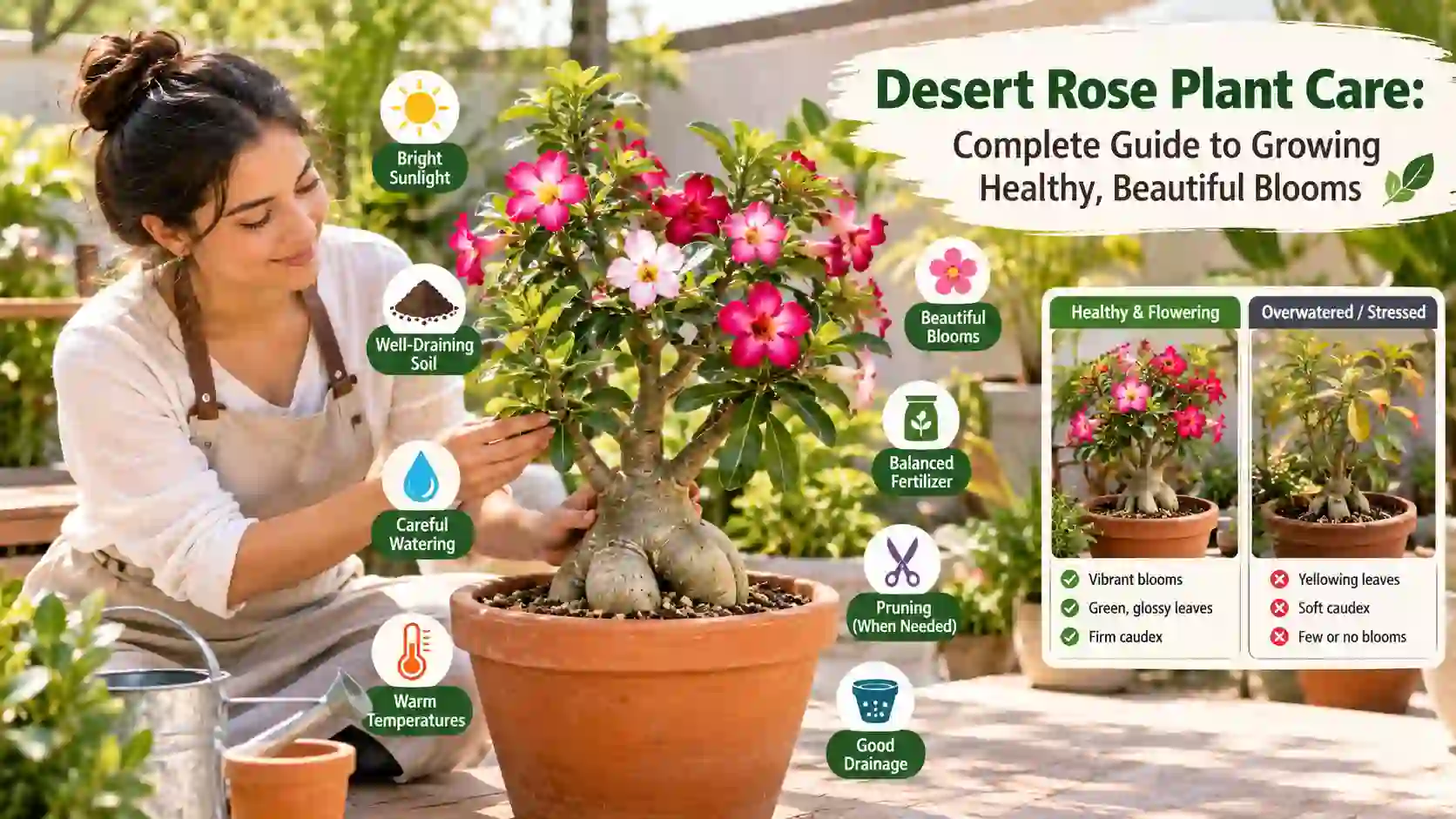
Desert rose plant care is mainly about strong sunlight, fast-draining soil, careful watering, warmth, and good airflow. Desert rose (Adenium obesum) grows best when the soil dries between thorough waterings. During active growth, provide regular but controlled moisture and light feeding. Reduce watering in cool or dormant periods, protect the plant from cold, and avoid permanently wet soil because excessive moisture can cause root and caudex rot.
Introduction
The desert rose is one of those plants that looks difficult to grow but becomes much easier once you understand its natural growth cycle.
Its swollen caudex stores water, while its thick leaves and colorful flowers are adapted to warm, relatively dry conditions. The same features that make it drought-tolerant can also make it vulnerable to overwatering.
Many beginners see drooping or wrinkled leaves and immediately add more water. That can be a mistake. A desert rose with damaged roots may look thirsty even when its soil is already wet.
Successful desert rose plant care is therefore about balance. Give it enough light to grow strongly, enough water to support active growth, and enough drying time to keep the roots healthy.
This guide explains how to grow desert rose indoors and outdoors, encourage flowering, manage the caudex, solve common problems, and adjust care throughout the year.
What Is a Desert Rose?
Adenium obesum is commonly known as desert rose. It is a succulent-like flowering plant known for its swollen trunk or caudex, thick branches, and showy flowers.
Despite its common name, it is not a true rose.
Its swollen base acts as a water-storage structure. This allows the plant to tolerate periods of dryness.
Key characteristics
| Feature | Desert Rose |
|---|---|
| Botanical name | Adenium obesum |
| Common name | Desert rose |
| Plant type | Succulent shrub |
| Main feature | Swollen caudex |
| Flowers | Pink, red, white, and combinations |
| Light | Bright light to strong direct sun |
| Soil | Very well-draining |
| Water | Moderate during active growth |
| Winter | Often reduced growth or dormancy |
| Temperature | Prefers warmth |
Important: Exact care can vary among species, hybrids, cultivars, and growing climates.
Image Suggestion: A realistic botanical infographic labeling the desert rose’s caudex, leaves, branches, flowers, roots, and drainage requirements.
How Much Sunlight Does a Desert Rose Need?
Light is one of the most important factors for healthy desert rose growth and flowering.
A mature desert rose generally performs best with strong light and several hours of direct sunlight.
Outdoor plants can often tolerate considerably more sun than plants that have been growing indoors.
Signs of insufficient light
A desert rose receiving too little light may develop:
- Long, weak branches
- Sparse foliage
- Reduced flowering
- Smaller leaves
- A less compact shape
- Slow growth
If the plant grows strongly toward a window, its lighting is probably uneven.
Acclimating a desert rose to stronger sunlight
Do not assume an indoor plant can immediately tolerate intense outdoor sun.
A safer transition is:
- Start with bright filtered light.
- Introduce gentle morning sun.
- Increase direct exposure gradually.
- Watch for bleaching or scorched patches.
- Continue increasing exposure as the plant adapts.
A plant that has spent months behind glass may be particularly sensitive to sudden changes.
Why sunlight affects flowering
Flower production requires sufficient energy.
A desert rose receiving inadequate light may survive but produce disappointing blooms.
If your plant is healthy yet rarely flowers, evaluate light before immediately adding fertilizer.
Image Suggestion: 16:9 comparison infographic showing a compact flowering desert rose in strong light versus a stretched, sparsely flowering plant in low light.
The Best Soil for Desert Rose
Desert rose roots need oxygen as well as water.
That makes soil structure extremely important.
A heavy, moisture-retaining mix can remain wet around the roots for too long. This is particularly dangerous during cool or cloudy weather.
Good desert rose soil should:
- Drain rapidly
- Resist compaction
- Allow air around roots
- Dry reasonably between waterings
- Support stable root growth
A practical mix can combine:
- Quality potting mix
- Pumice or perlite
- Coarse mineral material
- Grit or coarse sand suitable for horticultural use
The exact recipe is less important than the final drainage behavior.
A simple test
After watering, water should move through the container rather than sitting on the surface for a long time.
If the pot stays wet for many days, investigate the soil, container, light, and temperature.
Expert tip: Do not confuse a fast-draining soil with soil that contains almost no organic matter. Desert roses still benefit from a growing medium that can hold some moisture while allowing excess water to escape.
Image Suggestion: Soil cross-section showing an ideal gritty desert rose mix, healthy roots, drainage holes, and excess water leaving the pot.
How to Water a Desert Rose
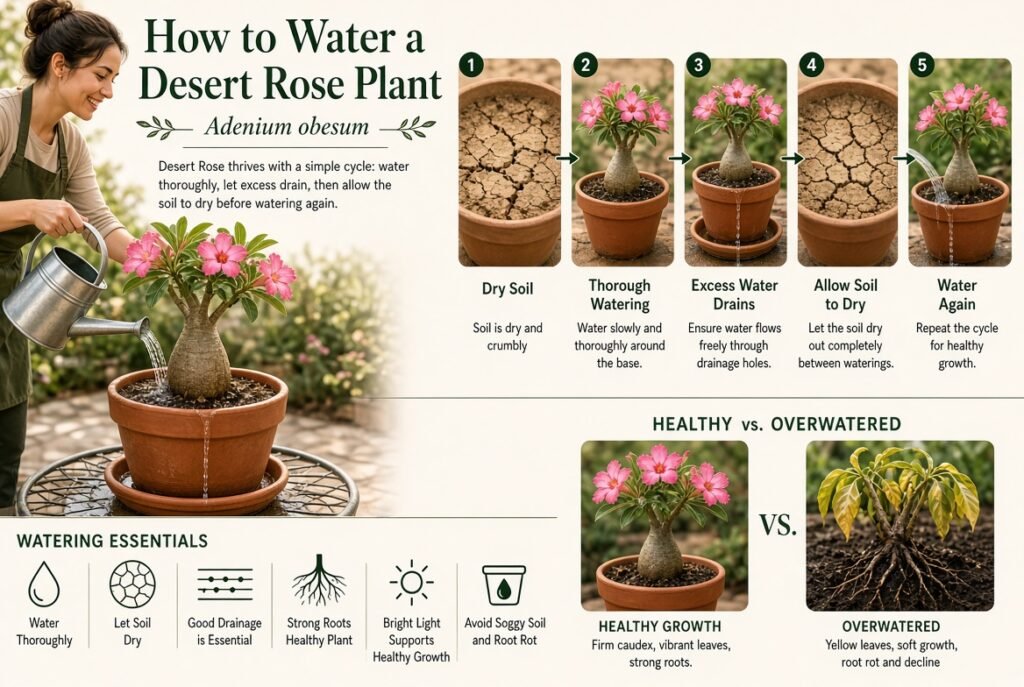
Watering is one of the most important parts of desert rose plant care.
The plant’s caudex stores water, but that does not mean it should remain completely dry throughout the growing season.
Instead, use a drying-and-watering cycle.
During active growth
When the growing medium has dried substantially:
- Water thoroughly.
- Allow excess water to drain.
- Empty the saucer.
- Let the soil dry again before watering.
Avoid giving tiny amounts of water every few days.
A shallow splash can moisten the upper soil while leaving deeper areas inconsistently hydrated.
How often should you water?
There is no reliable universal schedule.
Watering frequency changes with:
- Temperature
- Sunlight
- Humidity
- Pot size
- Soil composition
- Plant size
- Season
- Indoor versus outdoor conditions
A desert rose growing outdoors in hot sunlight may dry quickly.
The same plant indoors during cool weather may stay wet much longer.
Should You Water a Desert Rose in Winter?
Usually, watering should be reduced during cool periods when the plant’s growth slows or it enters dormancy.
Cold temperatures combined with wet soil are particularly risky.
Before watering during a cool period, consider:
- Is the soil actually dry?
- Is the plant actively growing?
- Is the room or outdoor environment warm?
- Is there enough sunlight for the plant to use the available water?
If the plant is dormant, it may require dramatically less water than it does during summer growth.
Important: Do not use a summer watering schedule throughout winter.
How to Tell When a Desert Rose Needs Water
Look at several clues rather than relying on one symptom.
Check the soil
Push a finger into the growing medium or use another appropriate method to assess moisture below the surface.
Check the plant
Mild wrinkling can occur when the plant is dry.
However, wrinkled leaves do not automatically mean you should water.
If the soil is wet and the plant looks dehydrated, root damage may be preventing water absorption.
That is why soil condition should be checked before watering.
How to Fertilize Desert Rose
Desert roses can benefit from fertilizer during active growth.
Fertilizer supports:
- New foliage
- Branch development
- Flower production
- Overall growth
But excessive fertilizer can create problems.
A sensible approach
Use a balanced or flowering-plant fertilizer at an appropriate dilution according to its label.
Feed primarily when the plant is actively growing.
Reduce or stop routine fertilizing when the plant is:
- Dormant
- Severely stressed
- Experiencing root problems
- Growing in very low light
Does fertilizer make a desert rose bloom?
Fertilizer alone does not guarantee flowers.
If a plant receives poor light, incorrect watering, or insufficient warmth, adding more fertilizer will not fix the underlying problem.
Think of fertilizer as a supporting factor rather than a flowering shortcut.
Temperature and Humidity Requirements
Desert rose is a warm-climate plant.
It generally grows best when temperatures are comfortably warm and conditions are bright.
Cold exposure can slow growth and cause leaf drop or other stress.
Protect the plant from cold
Move container plants into a protected location when temperatures become unsuitable for the particular plant.
Avoid placing a dormant desert rose in a cold, wet environment.
What about humidity?
Desert roses do not usually require the very high humidity preferred by tropical foliage plants.
Good airflow is more useful than constantly wetting the foliage.
Avoid unnecessary misting, especially when airflow is poor.
How to Grow Desert Rose in a Pot
Container growing is one of the most practical ways to manage desert rose.
It allows you to control:
- Soil
- Drainage
- Sun exposure
- Watering
- Winter protection
- Root development
Choosing a container
Use a container with effective drainage holes.
The pot should be large enough for healthy root development but not excessively oversized.
An enormous pot can hold a large volume of wet soil around a relatively small root system.
Terracotta versus plastic
Both can work.
Terracotta tends to dry faster because the material can exchange moisture with the surrounding air.
Plastic containers retain moisture longer.
Your watering habits should account for this difference.
Repotting a Desert Rose
Desert roses do not need to be repotted every year simply because the calendar says so.
Repot when there is a practical reason.
Consider repotting if:
- Roots are heavily crowded
- Drainage has deteriorated
- The pot is unstable
- The growing medium has broken down
- The plant has outgrown its container
Repotting steps
- Prepare a clean container.
- Use fresh, fast-draining soil.
- Carefully remove the plant.
- Inspect the roots.
- Remove clearly damaged or rotten tissue with clean tools.
- Allow appropriate damaged areas to dry before planting when necessary.
- Reposition the plant securely.
- Resume watering carefully.
Do not bury the caudex deeply simply to make the plant look taller.
The caudex is one of the plant’s defining features and should be positioned according to the plant’s health and growth stage.
Image Suggestion: Step-by-step 16:9 infographic showing desert rose removal from a pot, root inspection, fresh gritty soil, repotting, and correct caudex positioning.
Understanding the Desert Rose Caudex
The swollen base is called the caudex.
It stores water and gives desert rose its distinctive appearance.
A healthy caudex is generally firm.
Why the caudex matters
Changes in the caudex can provide useful clues about plant health.
A firm, stable caudex is reassuring.
A soft or collapsing caudex requires closer investigation, particularly when the soil has remained wet.
Do not overwater to enlarge the caudex
Some growers try to encourage a larger caudex by giving more water.
This is risky.
A swollen base does not mean the plant needs constant moisture.
Healthy development depends on the overall balance of:
- Genetics
- Light
- Water
- Soil
- Temperature
- Root health
- Time
How to Encourage Desert Rose to Bloom
Flowers are one of the main reasons people grow desert roses.
If yours is producing leaves but few flowers, check the fundamentals first.
1. Increase appropriate sunlight
Strong light is often essential for good flowering.
2. Avoid excessive watering
Constantly wet roots can weaken the plant and interfere with healthy growth.
3. Feed during active growth
A suitable fertilizer can support flowering when other conditions are already correct.
4. Allow the plant to mature
Young plants may not flower as heavily as established specimens.
5. Maintain warmth
Cold or low-light conditions can slow growth and delay flowering.
6. Prune strategically
Pruning can encourage branching, and more healthy branches can provide additional flowering sites.
Expert observation: If a desert rose produces vigorous, soft, elongated growth but few flowers, look at light and nitrogen availability before assuming it needs more fertilizer.
Image Suggestion: Before-and-after infographic showing a sparse desert rose and a compact, branching plant covered with pink flowers.
Pruning Desert Rose
Pruning is useful when you want to improve structure and encourage branching.
The best time depends on your climate and the plant’s active growth cycle.
Why prune?
Pruning can:
- Encourage branching
- Improve plant shape
- Remove damaged growth
- Create a fuller canopy
- Increase potential flowering sites
How to prune
Use clean, sharp pruning tools.
Remove:
- Dead branches
- Damaged growth
- Weak or poorly positioned shoots
For structural pruning, make deliberate cuts rather than repeatedly removing small pieces.
Important safety precaution
Desert rose contains toxic plant compounds.
Wear gloves when pruning and avoid contact with the plant’s sap.
Keep pruned material away from children and pets.
Propagating Desert Rose
Desert rose can be propagated by seed or cuttings.
Growing from seed
Seed propagation can produce interesting plants, particularly when working with variable genetics.
However, seedlings may not exactly reproduce the characteristics of the parent plant.
Growing from cuttings
Cuttings can provide a faster way to produce a plant from desirable growth.
A basic approach involves:
- Select healthy material.
- Make a clean cutting.
- Allow the cut surface to dry appropriately.
- Plant into a well-draining medium.
- Provide warmth and bright light.
- Water carefully while roots develop.
Root development varies with conditions.
Do not assume a cutting has rooted simply because leaves appear.
Image Suggestion: Four-panel propagation infographic showing healthy cutting selection, drying the cut end, planting in gritty soil, and new root development.
Desert Rose Problems and Troubleshooting
Why Are My Desert Rose Leaves Turning Yellow?
Yellow leaves can have several causes.
Potential causes include:
- Overwatering
- Poor drainage
- Low light
- Cold stress
- Natural aging
- Seasonal dormancy
Look at the whole plant rather than treating yellow leaves as proof of one specific problem.
What to check first
Examine:
- Soil moisture
- Drainage
- Recent weather
- Light exposure
- Temperature
- Root condition
If multiple leaves are yellow while the soil stays wet, investigate the roots before adding more water.
Why Is My Desert Rose Losing Leaves?
Leaf drop can occur naturally during dormancy.
It can also result from:
- Sudden environmental changes
- Cold temperatures
- Low light
- Overwatering
- Root damage
- Severe drought
- Pest activity
Season matters.
A desert rose losing leaves as temperatures fall may simply be responding to seasonal conditions.
A desert rose losing leaves while sitting in cold, constantly wet soil needs much closer attention.
Why Is My Desert Rose Caudex Soft?
A soft caudex is one of the symptoms that should not be ignored.
Possible causes include serious moisture or root problems.
What to do
Check the soil immediately.
If the soil is saturated:
- Stop routine watering.
- Move the plant to a warm, bright, protected environment.
- Inspect roots if symptoms continue.
- Remove clearly rotten tissue using sterile tools when appropriate.
- Repot into fresh, well-draining medium if necessary.
A soft caudex does not automatically tell you the exact cause, so examine the complete growing environment.
Image Suggestion: Educational comparison showing a firm healthy caudex versus a visibly soft, damaged caudex, with drainage and root-health callouts.
Why Are My Desert Rose Leaves Wrinkled?
Wrinkled leaves commonly suggest water stress, but there is an important distinction.
Dry soil + wrinkled leaves
The plant may need water.
Wet soil + wrinkled leaves
The roots may be compromised and unable to absorb water properly.
This is one of the most useful troubleshooting distinctions for beginners.
Do not respond to every wrinkled leaf by adding water.
Why Is My Desert Rose Not Flowering?
Check these factors:
| Possible Cause | What to Check |
|---|---|
| Insufficient light | Increase appropriate sunlight |
| Immature plant | Allow more time |
| Excess nitrogen | Review fertilizer |
| Poor root health | Inspect drainage and roots |
| Cold conditions | Maintain warmth |
| Seasonal dormancy | Wait for active growth |
| Excessive watering | Let soil dry appropriately |
Avoid changing five things at once.
Adjust the most likely environmental issue first, then observe the plant’s response.
Desert Rose Pests
Common pests can include:
- Aphids
- Mealybugs
- Scale insects
- Spider mites
- Other sap-feeding insects
Inspect:
- New shoots
- Leaf undersides
- Branch joints
- Flower buds
- Areas around the caudex
Early detection makes management much easier.
If you find an infestation, identify the pest before selecting a treatment. Different pests respond differently to control methods.
Common Desert Rose Care Mistakes
Watering too often
This is one of the most damaging habits.
Better approach: Water thoroughly, then allow appropriate drying.
Using ordinary garden soil
Dense soil can hold too much moisture.
Better approach: Use a fast-draining medium.
Keeping the plant in weak light
This often leads to poor growth and flowering.
Better approach: Provide strong light and acclimate gradually.
Fertilizing a stressed plant
Fertilizer cannot repair damaged roots.
Better approach: Fix the growing conditions first.
Ignoring seasonal dormancy
A plant that needs less water in winter can suffer if you continue summer watering.
Better approach: Match care to growth activity.
Overwatering after repotting
Fresh soil may already contain moisture.
Better approach: Consider the plant’s condition and soil moisture before watering.
Handling sap without protection
The sap can irritate skin and should not be ingested.
Better approach: Wear gloves and wash hands after handling the plant.
Desert Rose Care Through the Seasons
| Season | Main Focus |
|---|---|
| Spring | Increase light, watering, and feeding as growth resumes |
| Summer | Strong light, active watering, feeding, and airflow |
| Autumn | Watch for slowing growth and gradually reduce watering |
| Winter | Protect from cold and reduce watering significantly |
The exact timing depends on your local climate.
In warm tropical or subtropical environments, a desert rose may have a much longer active-growing period than one grown in a cooler climate.
Indoor vs Outdoor Desert Rose Care
| Factor | Indoors | Outdoors |
|---|---|---|
| Light | Brightest window or grow light | Strong natural sunlight |
| Rain | Controlled | Must account for rainfall |
| Humidity | Usually moderate | Climate-dependent |
| Temperature | Easier to control | Weather-dependent |
| Watering | Often less frequent | Can dry faster |
| Pest exposure | Usually lower | Can be higher |
| Winter protection | Easier | May require relocation |
Outdoor growing often produces stronger light exposure.
Indoor growing provides greater control.
Choose the environment that lets you consistently meet the plant’s basic needs.
A Simple Desert Rose Care Routine
Every week
Check:
- Soil moisture
- Leaf color
- New growth
- Pests
- Overall plant structure
Before watering
Ask:
- Is the soil dry enough?
- Is the plant actively growing?
- Is the temperature warm?
- Is the plant receiving strong light?
Monthly
Inspect:
- Caudex firmness
- Drainage holes
- Root-zone condition
- Branches
- Leaf undersides
- New shoots
During seasonal changes
Adjust:
- Water
- Fertilizer
- Light exposure
- Temperature protection
This routine prevents many problems before they become serious.
Expert Tips for Better Desert Rose Growth
Let the plant tell you what it needs
A fixed care schedule is less useful than observing the plant and its environment.
Prioritize roots before flowers
A flowering plant with unhealthy roots is not truly thriving.
Solve drainage and watering problems before trying to increase flowering.
Do not confuse dormancy with disease
Leaf drop during a cool or low-light season can be natural.
Look for additional symptoms before assuming something is wrong.
Keep records for difficult plants
If your desert rose repeatedly develops problems, note:
- Watering dates
- Temperature
- Light exposure
- Fertilizer
- Repotting
- Pruning
Patterns often become obvious after a few weeks.
Choose the right container for your climate
A pot that works in a dry, hot environment may stay wet too long in a humid climate.
Container material and soil structure should work together.
Is Desert Rose Safe Around Children and Pets?
Desert rose contains toxic compounds, and its sap should not be ingested.
Handle the plant carefully.
Use gloves when pruning or taking cuttings, and keep plant material away from children and pets.
If ingestion occurs, contact an appropriate medical or veterinary professional or poison-control service for guidance.
Frequently Asked Questions
How often should I water a desert rose?
Water when the soil has dried sufficiently during active growth. Water less frequently during cool or dormant periods.
Does desert rose need full sun?
Desert rose generally performs best with strong sunlight. Plants moved from indoor conditions should be acclimated gradually to intense direct sun.
Why is my desert rose not blooming?
Insufficient light, immature growth, cold conditions, excessive nitrogen, poor root health, and incorrect watering can all reduce flowering.
Can desert rose grow indoors?
Yes. Choose the brightest suitable location and provide excellent drainage. A grow light may help when natural light is inadequate.
What soil is best for desert rose?
Use a fast-draining growing medium containing substantial mineral material. The soil should hold some moisture without remaining saturated.
How do I make my desert rose grow faster?
Provide strong light, warmth, appropriate watering, healthy roots, and moderate feeding during active growth. Avoid excessive water and fertilizer.
Should I mist my desert rose?
Usually not. Desert rose does not require routine misting, and excessive moisture around the foliage can be counterproductive.
Why is my desert rose caudex soft?
A soft caudex can indicate serious moisture or root problems. Check the soil, drainage, temperature, and roots rather than immediately adding water.
Can I prune a desert rose?
Yes. Pruning can encourage branching and improve plant structure. Use clean tools and protect your skin from the plant’s sap.
When should I repot desert rose?
Repot when the plant has outgrown its container, drainage has deteriorated, or the growing medium needs replacement. Avoid unnecessary annual repotting.
Can desert rose survive winter?
It depends on the local temperature and cultivar. Protect the plant from unsuitable cold and reduce watering when growth slows.
Can desert rose grow from cuttings?
Yes. Healthy cuttings can be rooted under warm conditions in a suitable well-draining medium.
Why are my desert rose leaves turning yellow?
Overwatering, poor drainage, low light, cold, seasonal changes, and natural aging can all cause yellowing. Check the growing conditions before deciding on a treatment.
How long can a desert rose live?
With appropriate care, desert roses can remain productive for many years. Their longevity depends on species, growing conditions, climate, and disease prevention.
Related Plant-Care Topics
Readers growing desert rose may also benefit from guides about:
- Adenium pruning
- Succulent soil
- Root rot prevention
- Indoor succulent care
- How to water succulents
- Growing plants in containers
- Fertilizing flowering plants
- Propagating succulents from cuttings
These topics complement desert rose care because light, drainage, watering, and root health are closely connected.
Conclusion
Successful desert rose plant care starts with understanding the plant rather than following a rigid watering calendar.
Give your desert rose strong light, warmth, fast-draining soil, appropriate watering, moderate feeding during active growth, and reduced moisture during dormancy. Pay particular attention to the caudex and roots because problems there can become serious before they are obvious above the soil.