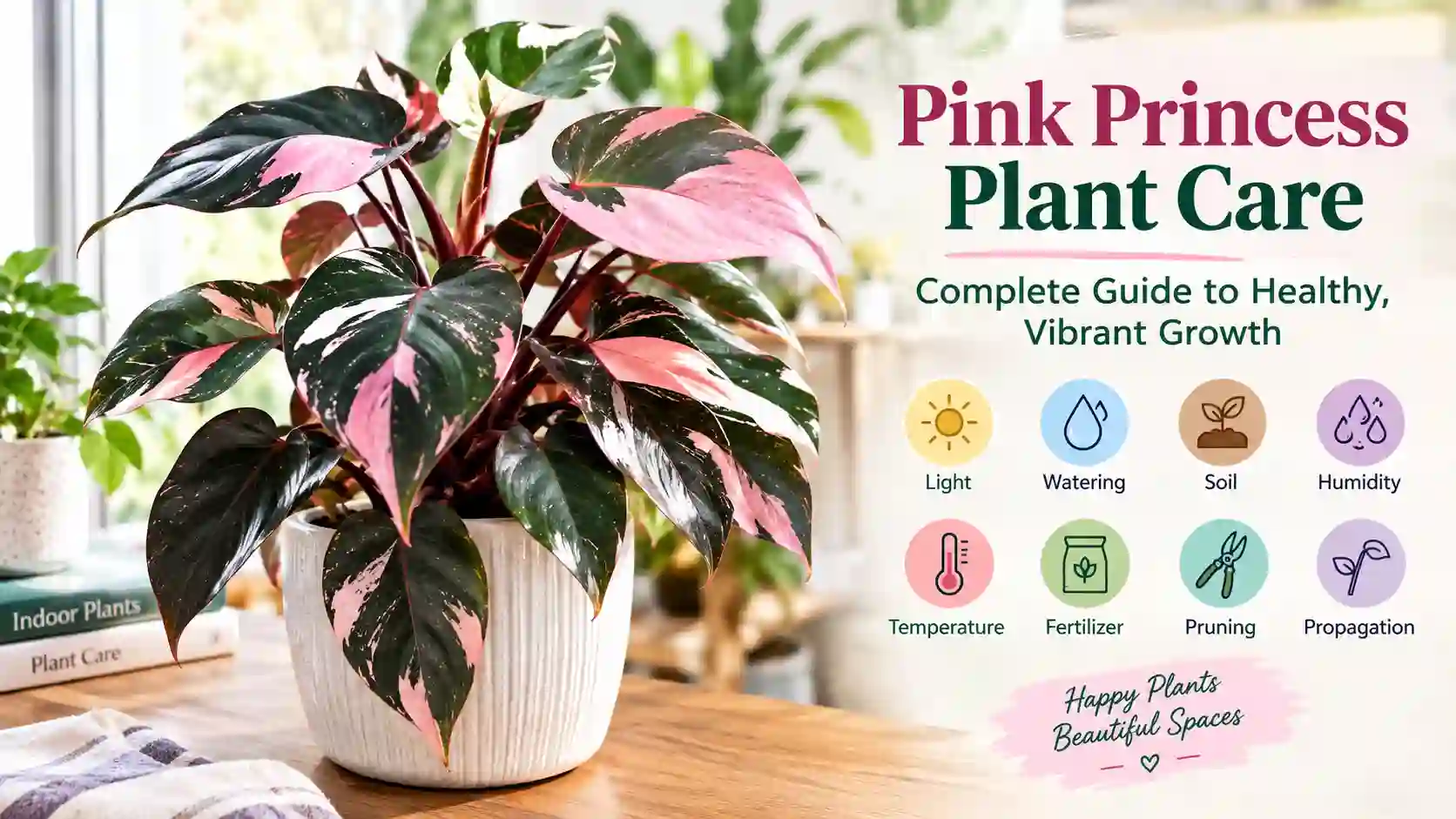
Pink Princess plant care is rewarding when you understand what makes this houseplant different. Its glossy, dark green to burgundy leaves feature striking pink patches, streaks, and splashes. This unusual coloring makes it a favorite among indoor plant collectors.
However, keeping a Pink Princess healthy involves more than watering it occasionally. Too little light may encourage greener new leaves, while harsh sunlight can damage delicate pink sections. Poor drainage can also cause root problems.
The good news is that you do not need a greenhouse to grow a beautiful plant. A suitable window, careful watering, airy soil, and consistent temperatures can provide a strong foundation.
This guide explains how to care for a Pink Princess, encourage balanced variegation, troubleshoot common problems, and propagate new plants successfully.
Quick Answer:
Pink Princess Philodendron grows best in bright, indirect light, warm temperatures, and a chunky, well-draining potting mix. Water when the top 1–2 inches of soil dries, and use a pot with drainage holes. Moderate to high humidity supports healthy foliage, while regular pruning and a climbing support encourage attractive growth. Pink variegation depends partly on the plant’s genetics, so proper care can support its color but cannot guarantee that every new leaf will be pink.
Seeders Info
+1
1. Understanding the Pink Princess Philodendron

The Pink Princess is a cultivated variety of Philodendron erubescens, grown primarily for its colorful foliage. It is a climbing aroid that develops new leaves along a growing stem.
Its pink areas contain less chlorophyll than green tissue. Consequently, the green portions play an important role in producing the energy the plant needs for growth.
What makes the Pink Princess special?
- Pink variegation: Irregular pink patches and streaks create distinctive patterns.
- Dark foliage: Green, burgundy, and nearly black tones contrast with the pink.
- Climbing growth: A moss pole or similar support can encourage upright growth.
- Individual patterns: Each leaf may develop a different balance of pink and green.
Remember that variegation varies naturally. Even a healthy plant may produce several mostly green leaves or a leaf with extensive pink coloring.
2. Pink Princess Plant Care at a Glance
| Care factor | Recommended conditions |
|---|---|
| Light | Bright, indirect light |
| Water | When the top 1–2 inches of soil dries |
| Soil | Airy, chunky, well-draining mix |
| Humidity | Moderate to high; around 50–70% is a useful target |
| Temperature | Approximately 65–80°F (18–27°C) |
| Fertilizer | Balanced houseplant fertilizer during active growth |
| Pruning | Remove damaged growth and manage poorly variegated stems |
| Repotting | When roots outgrow the pot or the mix deteriorates |
| Support | Moss pole, coir pole, or sturdy plant stake |
These are starting points rather than rigid rules. Adjust watering and environmental care according to your room, season, pot size, and plant growth.
3. How Much Light Does a Pink Princess Need?

Light is one of the most important factors in Pink Princess plant care. The plant needs enough light to support healthy growth and maintain attractive foliage.
Best lighting conditions
Place your plant near an east-facing window or a bright window with filtered sunlight. A sheer curtain can soften strong afternoon rays.
A grow light is useful when your home has limited natural light. Position it according to the manufacturer’s recommended distance and schedule.
Can direct sunlight damage a Pink Princess?
Yes. Gentle morning sunlight may be tolerated, but strong midday or afternoon sunlight can scorch leaves. Pink tissue may show damage particularly clearly.
Look for pale patches, crispy edges, or bleached areas after exposure to intense sunlight.
What happens when the plant receives too little light?
Low light can contribute to:
- Smaller leaves and slower growth.
- Longer spaces between leaves along the stem.
- New leaves with less visible pink.
- Soil that stays wet longer because the plant uses less water.
Practical tip: Increase light gradually rather than moving the plant directly into intense sunshine. Evaluate the next few leaves instead of expecting existing leaves to change their patterns.
Image suggestion: Create a comparison infographic showing a Pink Princess in bright indirect light, low light, and harsh direct sunlight.
4. How to Water a Pink Princess Plant

Overwatering is a common mistake with tropical houseplants. Pink Princess roots need both moisture and oxygen, so constantly wet soil can lead to root damage.
When should you water?
Check the top 1–2 inches of soil with your finger. If that layer feels dry, inspect the deeper mix before watering. If it remains wet, wait and check again.
Your plant may need water more frequently during warm, bright weather. Growth often slows during cooler, darker months, so the soil may take longer to dry.
The correct watering method
- Check soil moisture instead of following a fixed weekly schedule.
- Water evenly across the soil surface until excess water drains from the bottom.
- Allow the pot to drain fully and empty any collected water from the saucer.
- Check the soil again before the next watering.
Avoid giving tiny amounts of water every day. Shallow watering can leave parts of the root ball dry while other areas remain excessively wet.
Signs of watering problems
| Symptom | Possible explanation | What to do |
|---|---|---|
| Yellowing leaves and wet soil | Overwatering or root stress | Check drainage and inspect roots if symptoms persist |
| Limp leaves and very dry soil | Underwatering | Water thoroughly and monitor recovery |
| Brown, crispy edges | Low humidity, inconsistent watering, or other stress | Check moisture, humidity, and light exposure |
| Persistent wet soil | Dense mix, oversized pot, or insufficient light | Improve drainage and review growing conditions |
Do not diagnose a problem from one leaf alone. Check the soil, roots, recent environmental changes, and overall growth before changing your routine.
5. Best Soil for a Pink Princess Philodendron

Pink Princess plants grow best in a loose mix that retains some moisture without becoming compacted.
Ordinary potting soil can work if it drains well, but dense mixes may remain wet for too long indoors.
A practical DIY soil mix
Combine the following ingredients:
- 2 parts quality indoor potting mix or coco-coir-based mix.
- 1 part perlite or pumice.
- 1 part orchid bark.
This is a starting recipe, not a universal formula. Adjust it if your home is especially humid, your pot dries too slowly, or your climate is very warm and dry.
Why soil structure matters
A chunky mix creates air spaces around the roots. It also allows excess water to escape more readily.
Choose a pot with drainage holes. Avoid moving a small plant into an unnecessarily large container, as excess soil can remain wet long after the roots have used available moisture.
Repot when the roots become crowded, the mix breaks down, or drainage becomes difficult.
6. Ideal Temperature and Humidity

Pink Princess is a tropical plant that prefers warm, relatively stable conditions.
Aim for temperatures around 65–80°F (18–27°C). Protect it from cold drafts, sudden temperature swings, and direct blasts from air conditioners or heaters.
How much humidity is best?
Moderate to high humidity can help the leaves develop with fewer dry edges. A range of approximately 50–70% is a reasonable target for many indoor growing spaces.
If your home is dry, consider using a room humidifier. Grouping plants together may also modestly increase local humidity.
Misting is not a reliable long-term humidity solution. It raises moisture around leaves only briefly and does not replace proper watering or airflow.
Expert tip: If new leaves repeatedly stick while unfurling, check humidity, watering consistency, and pest activity before assuming humidity is the only cause.
7. How to Fertilize a Pink Princess Plant

Fertilizer supplies nutrients that support new leaves, stems, and roots. However, more fertilizer does not automatically produce more pink variegation.
A simple feeding routine
- Feed during active growth in spring and summer.
- Use a balanced houseplant fertilizer diluted according to its label.
- Apply it to appropriately moist soil rather than a severely dry root ball.
- Reduce or stop feeding when growth slows substantially.
- Flush the potting mix occasionally if mineral salts accumulate and drainage is good.
Excess fertilizer can cause root stress and brown leaf tips. If a white crust develops on the soil or pot rim, review your fertilizer concentration and water quality.
New growth that remains small may indicate insufficient light, root crowding, or watering problems rather than a nutrient deficiency.
8. How to Keep Pink Princess Leaves Pink

Maintaining attractive variegation is often the biggest challenge for Pink Princess owners.
The pink pattern is genetically variable. Environmental conditions influence how well the plant grows, but they cannot guarantee a particular color pattern in every leaf.
Pink Variegation & Reverting (2026)
+1
What helps maintain attractive variegation?
Provide sufficient indirect light. This supports growth without exposing the leaves to excessive heat or intense sun.
Keep roots healthy. A plant struggling with root damage may produce weak new growth regardless of its lighting.
Watch the newest leaves. Their patterns give you a better indication of current growth conditions than older foliage.
Prune selectively when needed. If a stem repeatedly produces entirely green leaves, consider pruning it back to a node with desirable variegation and a viable growth point.
What if the new leaves are completely green?
First, improve lighting if the plant has been growing in a dim location. Allow time for new growth to respond.
If the stem itself is producing consistently green growth, lighting alone may not restore the original pattern. Selective pruning can help redirect growth from a more-variegated section, but results are not guaranteed.
What if the leaves are almost entirely pink?
Highly pink leaves have less green tissue available for photosynthesis. They may be more vulnerable to stress and can struggle to support themselves over time.
Do not increase sunlight aggressively to make the plant pinker. Aim for balanced, healthy growth rather than maximum pink on every leaf.
9. Pruning and Training Your Pink Princess

Pruning helps remove damaged foliage, manage long stems, and encourage a more attractive growth pattern.
When should you prune?
Prune when stems become leggy, damaged leaves no longer contribute much to the plant, or a consistently green section needs managing.
Use clean, sharp pruning shears. Identify the nodes first, because these are the points where new growth can develop.
How to prune correctly
- Inspect the stem and identify its nodes.
- Decide which growth you want to keep.
- Make a clean cut near a suitable node without damaging it.
- Keep the remaining plant in good light and avoid overwatering.
- Monitor the next growth point before making additional cuts.
Should you use a moss pole?
A moss pole or sturdy climbing support can help guide the stem upward. Secure the stem gently without constricting it.
Support can improve the plant’s shape and make it easier to manage larger leaves. However, it does not guarantee stronger pink variegation.
Image suggestion: Show a step-by-step pruning diagram identifying the stem, node, growing tip, and correct cutting point.
10. How to Propagate a Pink Princess Plant

Stem cuttings are a practical way to propagate a Pink Princess. A successful cutting needs at least one viable node because new roots and shoots develop from node tissue.
A leaf without a node may stay green for a while, but it generally cannot develop into a complete new plant.
Propagation by stem cuttings
- Choose a healthy stem with at least one visible node and, ideally, an aerial root.
- Use clean pruning shears to cut just below the selected node.
- Place the node in clean water or a lightly moist propagation medium. Keep leaves above the water or medium.
- Provide warm conditions and bright, indirect light. Replace water regularly if using water propagation.
- Once roots are established and growing well, transfer a water-rooted cutting to an airy potting mix and monitor moisture carefully.
Rooting time varies with temperature, cutting condition, and growing method. Avoid transplanting a cutting simply because a few tiny roots have appeared; allow a healthy root system to develop first.
How do you preserve pink variegation when propagating?
Choose a cutting from a stem with attractive variegation. The node’s growth point matters because the new shoot develops from that tissue.
Even with a well-selected cutting, the next leaves may differ in color. Propagation cannot guarantee that the new plant will reproduce an identical leaf pattern.
11. Repotting a Pink Princess Philodendron

Repotting gives crowded roots more room and replaces potting mix that has broken down. However, repotting too often can disturb healthy roots unnecessarily.
Signs your plant needs repotting
- Roots emerge from drainage holes or circle densely inside the pot.
- The soil dries unusually quickly despite appropriate watering.
- The mix has become compacted and drains poorly.
- Growth slows alongside clear signs of root crowding.
Repotting steps
- Select a pot only slightly larger than the current root ball.
- Check the roots and trim away clearly dead or rotten sections with clean tools.
- Add fresh, airy potting mix.
- Position the plant at approximately its previous soil depth.
- Water appropriately, allow excess water to drain, and return it to bright indirect light.
Avoid adding a large volume of fertilizer immediately after repotting. Fresh potting mix may already contain nutrients, and damaged roots need time to recover.
12. Common Pink Princess Plant Problems and Solutions

A change in leaf color does not always mean your plant is dying. The key is to match the symptom with the growing conditions.
| Problem | Likely causes | Practical solution |
|---|---|---|
| Yellow leaves | Overwatering, root stress, or natural aging | Check soil moisture and drainage; assess whether one old leaf or several leaves are affected |
| Brown leaf edges | Dry air, inconsistent moisture, salt buildup, or light damage | Check humidity, watering, fertilizer use, and sunlight |
| Green new leaves | Natural variation or insufficient light | Improve indirect light and observe subsequent growth |
| Pink sections turning brown | Sun scorch, tissue damage, or moisture stress | Reduce harsh sunlight and check the root zone |
| Drooping foliage | Dry soil, damaged roots, or temperature stress | Check soil before watering and inspect other signs of stress |
| Small new leaves | Low light, root crowding, or weak growing conditions | Review lighting, roots, support, and feeding |
| Slow growth | Seasonal slowdown, insufficient light, or root problems | Check conditions and adjust only where necessary |
Why is my Pink Princess turning yellow?
Start by checking the soil. If it is consistently wet, inspect drainage and consider whether the potting mix is too dense.
If the soil is dry, water thoroughly and reassess. A single older leaf turning yellow may be normal, but widespread yellowing deserves closer inspection.
Why are the pink parts turning brown?
Pink tissue may be damaged by intense sunlight, inconsistent moisture, or other environmental stress. Pink sections are not automatically doomed to turn brown, and browning does not always indicate a watering problem.
Move the plant away from harsh direct sun if necessary. Check for dry soil, salt buildup, and pests before making additional changes.
Why is my Pink Princess growing slowly?
Growth naturally slows in cooler, darker months. A newly purchased plant may also take time to adjust to its new environment.
If growth remains weak during the active growing season, check light levels, root health, pot size, and fertilizer practices. Avoid increasing fertilizer before ruling out other causes.
13. Pink Princess Plant Care Through the Seasons

Your care routine should change as light, temperature, and growth patterns change.
| Season | Recommended care |
|---|---|
| Spring | Resume regular growth monitoring and begin light feeding if new growth appears |
| Summer | Check soil more frequently, protect leaves from harsh sun, and monitor heat |
| Autumn | Reduce fertilizer as growth slows and reassess watering frequency |
| Winter | Provide adequate light, protect from cold drafts, and let soil dry at an appropriate pace |
Seasonal timing depends on your location and indoor environment. In warm climates, growth may continue through much of the year, while cooler rooms can slow it significantly.
Practical tip: Do not reduce watering automatically just because the calendar says winter. Check how quickly your particular pot dries.
14. Common Mistakes to Avoid
Many Pink Princess problems begin with a well-intentioned adjustment that goes too far.
- Watering on a fixed schedule: Check the soil instead of assuming the plant needs water every week.
- Using heavy soil: Improve aeration and drainage rather than relying on frequent watering adjustments.
- Exposing the plant to harsh sunlight: Increase light gradually and protect the leaves from scorching.
- Expecting every leaf to be pink: Accept natural variation and prioritize healthy growth.
- Pruning without checking nodes: Identify the growth points before removing stem sections.
- Overfertilizing: Follow the product label and reduce feeding when growth slows.
- Changing everything at once: Adjust one or two relevant factors, then observe the plant’s response.
The last mistake is especially important. If you change the light, watering, fertilizer, and soil simultaneously, it becomes difficult to identify what actually helped.
15. Is Pink Princess Philodendron Safe for Pets?
Pink Princess belongs to the philodendron group, which is considered toxic to cats and dogs. Chewing the plant can cause oral irritation, pain, drooling, vomiting, and difficulty swallowing because of insoluble calcium oxalate crystals.
ASPCA
+1
Keep the plant out of reach of pets and young children. Wear gloves if your skin is sensitive when pruning, and wash your hands after handling plant sap.
If a pet chews the plant and develops symptoms, contact a veterinarian promptly.
16. Frequently Asked Questions
How often should I water a Pink Princess plant?
Water when the top 1–2 inches of soil has dried and the deeper mix is approaching the appropriate moisture level. Water thoroughly, then allow excess water to drain. The interval varies with light, temperature, pot size, and season.
How do I make my Pink Princess more pink?
Provide bright, indirect light and maintain healthy roots. Pink variegation also depends on the plant’s genetics, so no lighting or fertilizer method can guarantee more pink on every leaf.
Can Pink Princess grow indoors?
Yes. It grows well indoors when it receives adequate indirect light, warm temperatures, suitable humidity, and well-draining soil.
Why is my Pink Princess producing only green leaves?
Insufficient light may contribute, but natural variation or a consistently green growth point can also be responsible. Improve light gradually and observe new growth before deciding whether pruning is appropriate.
Does Pink Princess need a moss pole?
No, but a moss pole or another sturdy support can help guide its climbing growth. Attach the stem gently and provide enough space for new leaves to develop.
Is Pink Princess easy to care for?
It is manageable for beginners who can provide suitable light and avoid overwatering. Maintaining attractive variegation and diagnosing root problems may require additional attention.
Can I propagate Pink Princess from a single leaf?
A leaf without a node generally cannot produce a complete new plant. Choose a stem cutting with a viable node and, ideally, an aerial root.
Why are my Pink Princess leaves curling?
Curling may result from dry soil, root damage, temperature stress, low humidity, or pests. Check soil moisture and inspect the leaves carefully before deciding on a remedy.
How fast does Pink Princess grow?
Growth varies with light, temperature, root health, and the growing season. It may grow slowly in dim conditions or during winter, while suitable warmth and light support more active growth.
Is Pink Princess toxic to cats and dogs?
Yes. Chewing the leaves or stems can cause irritation and gastrointestinal symptoms. Keep the plant away from pets and contact a veterinarian if ingestion causes symptoms.
Conclusion: Grow a Healthy Pink Princess With Confidence
Successful pink princess plant care comes down to a few consistent habits: provide bright indirect light, water according to soil moisture, use an airy potting mix, and maintain warm growing conditions.
Pay special attention to new growth. Healthy roots and suitable lighting support a vigorous plant, while natural genetic variation determines how much pink appears on each leaf. Prune selectively when needed, and give climbing stems appropriate support.
Start by finding a bright location and checking your plant’s soil before watering. Small, thoughtful adjustments are usually more effective than changing your entire care routine at once.
With patience and consistent care, your Pink Princess can develop beautiful foliage and become a striking feature in your indoor plant collection.