Learning how to take care of a pothos plant is simple once you understand what this popular houseplant needs. Pothos (Epipremnum aureum) grows attractive trailing vines, tolerates a range of indoor conditions, and suits beginners who want greenery without a complicated care routine.
However, even a hardy pothos can develop yellow leaves, brown tips, bare vines, or slow growth when its environment is unsuitable. Overwatering is a common problem, but insufficient light, compacted soil, and pests can also affect its health.
The secret is not to follow a rigid watering schedule. Instead, learn to read the plant and its soil, adjust care to the season, and make small changes when growth slows.
This guide explains how to choose the right location, water correctly, encourage fuller vines, troubleshoot common problems, and keep your pothos healthy for years.
Quick Answer
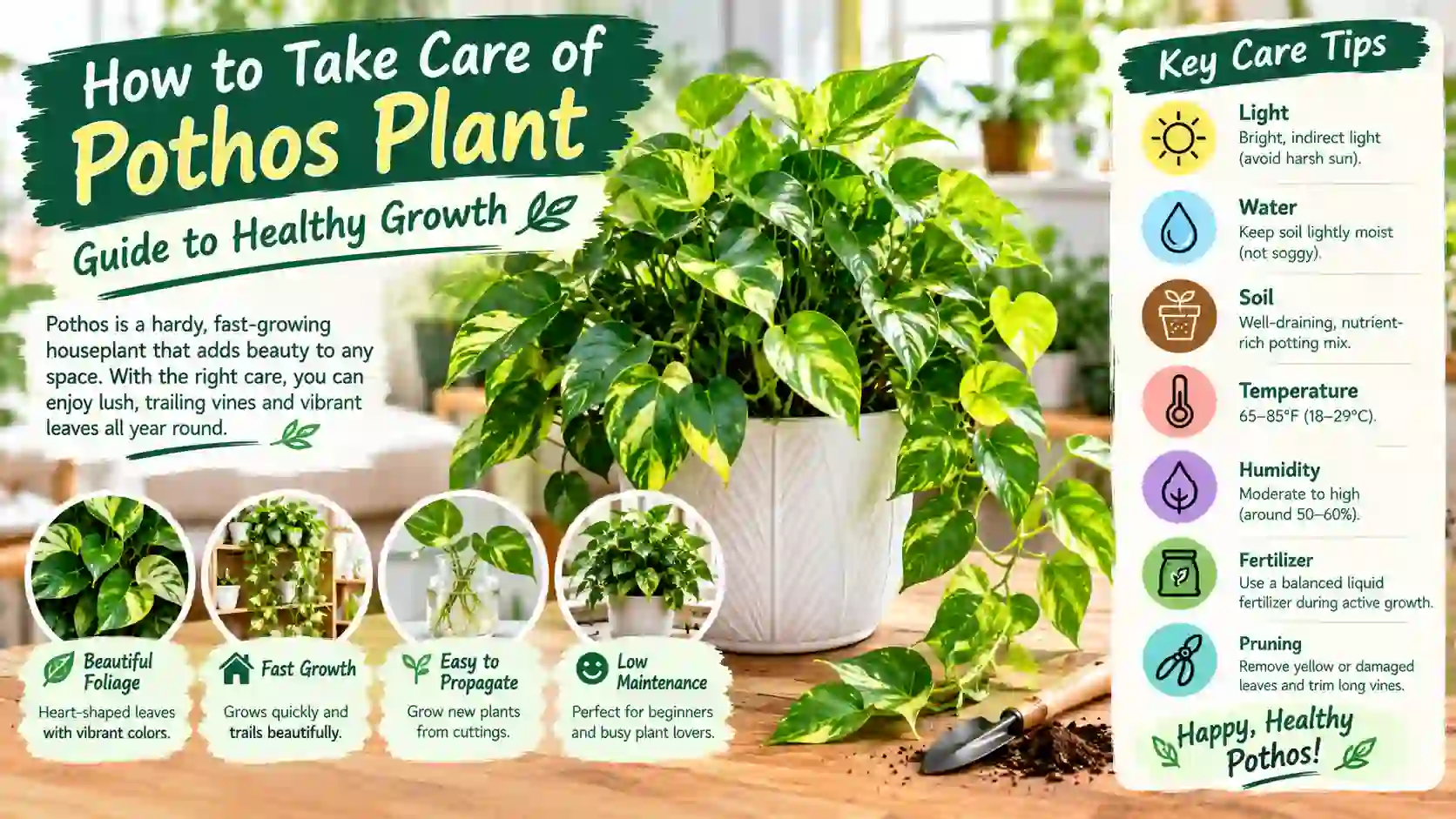
To take care of a pothos plant, place it in bright, indirect light, use well-draining potting soil, and water when the top 1–2 inches of soil feel dry. Keep it in a warm room, away from cold drafts, and feed it lightly during active growth. Choose a pot with drainage holes, remove yellow or damaged leaves, and check regularly for pests. Pothos is forgiving, but consistently wet soil can cause root rot and yellow leaves.
1. Give Your Pothos the Right Amount of Light


7
Light affects how quickly pothos grows, how large its leaves become, and how clearly its variegation shows.
Best lighting conditions
- Bright, indirect light: Ideal for steady growth and attractive foliage.
- Medium light: Suitable for many green pothos varieties, although growth may slow.
- Low light: Pothos can survive here, but vines may become leggy and leaves smaller.
- Strong direct sunlight: Can scorch leaves, especially when exposure increases suddenly.
A bright room near an east-facing window often works well. Near a south- or west-facing window, place the plant farther back or filter intense sunlight with a sheer curtain.
Clemson Cooperative Extension notes that lower light can reduce the coloring of variegated pothos varieties.
Home & Garden Information Center
+1
How to tell whether your pothos needs more light
Watch the new growth rather than judging only the older leaves.
Signs it may need brighter conditions include:
- Long gaps between leaves along the vine.
- Smaller leaves on new growth.
- Slower growth despite suitable watering.
- Less noticeable cream or yellow variegation.
Move the plant gradually toward a brighter spot. Sudden exposure to intense sunlight can cause pale, dry patches.
Practical tip: Rotate the pot a quarter turn every week or two if the plant grows unevenly toward a window. This encourages more balanced growth.
Image suggestion: A three-panel infographic comparing pothos in bright indirect light, low light, and harsh direct sunlight.
2. Water Pothos When the Soil Needs It
Watering is one of the most important parts of pothos care. Too much water can deprive roots of oxygen and encourage root rot, while prolonged dryness can cause drooping and brown edges.
How often should you water a pothos plant?
There is no universal watering schedule. Indoor temperature, light, pot size, soil mix, and the season all affect how quickly the soil dries.
| Growing conditions | What to expect |
|---|---|
| Bright light and warm temperatures | Soil usually dries faster |
| Low light or cooler weather | Soil stays wet longer |
| Small pot or root-filled pot | Soil may dry relatively quickly |
| Large pot with dense soil | Soil may remain wet for too long |
| Hanging basket near a warm window | Check moisture more frequently |
Use these conditions as clues, not a fixed calendar. Check the soil before watering.
Step-by-step watering method

Step 1: Check the soil
Feel the top 1–2 inches of potting mix. If it still feels moist, wait. If it feels dry, check a little deeper before deciding.

Step 2: Water thoroughly
Pour water evenly over the soil until excess water flows through the drainage holes. This moistens the root zone more evenly than giving frequent tiny sips.

Step 3: Let excess water drain
Empty the saucer or decorative outer pot. Do not leave the roots sitting in standing water.

Step 4: Wait before watering again
Let the upper layer of soil dry before repeating the process. Do not water simply because a certain number of days has passed.
This approach follows extension guidance to allow the soil to dry between waterings while thoroughly wetting the root zone.
Home & Garden Information Center
+1
Should you mist pothos leaves?
Misting is not necessary for healthy pothos growth. It provides only a brief increase in surface moisture and does little to change room humidity for long.
If your home is very dry and the leaves develop crispy edges, consider checking the light, watering pattern, and proximity to heating or cooling vents first. A room humidifier may help when low humidity is genuinely a problem.
Common mistake: Watering a drooping pothos without checking the soil. Both dry soil and damaged, waterlogged roots can cause drooping. Check moisture before adding more water.
Image suggestion: A watering infographic showing dry soil, thorough watering, drainage, and the soil drying before the next watering.
3. Choose Soil and a Pot That Protect the Roots
Pothos does not need an expensive specialty mix. It needs potting soil that holds enough moisture for the roots while allowing excess water and air to move through it.
What is the best soil for pothos?
A good starting point is a quality indoor potting mix with added perlite for better aeration and drainage.
Look for a mix that:
- Retains some moisture without staying soggy.
- Feels loose rather than dense or muddy.
- Allows water to drain freely.
- Does not compact heavily after repeated watering.
If the soil remains wet for many days, consider improving the mix or checking whether the pot is too large. Adding more fertilizer will not solve a drainage problem.
How to choose the right pot
Choose a pot with drainage holes. A decorative cachepot can be used outside the growing pot, but remove the inner pot for watering or empty any collected water afterward.
When repotting, choose a container only one size larger than the current root ball. An oversized pot holds more unused soil, which can stay wet and increase root problems.
When should you repot pothos?
Repot when you notice several signs together:
- Roots growing through drainage holes.
- Roots circling tightly around the root ball.
- Water passing through too quickly because the pot is densely root-filled.
- Growth slowing despite good light and appropriate care.
Many pothos plants can remain in the same pot for a year or two, depending on their growth and root development.
Home & Garden Information Center
+1
Repotting tip: If the plant is struggling, inspect the roots before moving it into a bigger container. Healthy roots are generally firm; rotten roots may be brown or black, soft, and unpleasant-smelling.
Image suggestion: A labeled pot cross-section showing drainage holes, airy potting mix, healthy roots, and excess water flowing out.
4. Maintain Warm Temperatures and Comfortable Humidity
Pothos is a tropical plant, so it grows best in a warm indoor environment. Average household humidity is often acceptable, and you usually do not need to create a greenhouse-like setup.
Ideal indoor conditions
| Factor | Practical recommendation |
|---|---|
| Temperature | Keep the room comfortably warm, roughly 65–85°F (18–29°C) |
| Humidity | Average household humidity is often adequate |
| Air movement | Gentle room airflow is helpful |
| Cold exposure | Avoid cold drafts and sudden temperature drops |
| Heat exposure | Keep foliage away from hot vents and radiators |
Clemson Cooperative Extension lists warm indoor temperatures and notes that pothos tolerates typical household humidity, although it can benefit from higher humidity.
Home & Garden Information Center
+1
What if your pothos has brown leaf tips?
Brown tips do not automatically mean the plant needs more humidity. Check for:
- Soil drying out too much between waterings.
- Root damage from prolonged wet soil.
- Strong direct sunlight.
- Hot or cold air blowing directly on the plant.
- Fertilizer buildup in the soil.
Correct the likely cause before changing several care conditions at once.
5. Fertilize Pothos Without Overfeeding
Pothos is not a heavy feeder. A balanced liquid houseplant fertilizer used at the label’s recommended dilution during active growth is usually sufficient.
When and how to fertilize
- Feed mainly during spring and summer when the plant is actively growing.
- Apply fertilizer to appropriately moist soil according to the product label.
- Reduce or stop feeding when growth slows in low-light or cool conditions.
- Avoid adding extra fertilizer to compensate for poor light or unhealthy roots.
Overfertilizing can cause salt buildup, brown leaf tips, or root injury. If you suspect fertilizer buildup, stop feeding and review the product instructions. For a plant in a pot with good drainage, flushing the mix with water may help remove excess soluble salts.
Expert tip: If a pothos has stopped growing, inspect light levels and roots before reaching for fertilizer. Nutrients cannot compensate for insufficient light or roots that cannot function properly.
Image suggestion: An infographic showing a healthy pothos beside a measuring cap and diluted houseplant fertilizer, with a warning against overfeeding.
6. Prune Pothos for Fuller, More Attractive Vines
Pothos naturally grows as a trailing or climbing vine. Without pruning, it can become long and sparse, particularly when light is limited.
Pruning removes unwanted growth and encourages new shoots from nodes along the remaining stems. It also gives you cuttings to propagate new plants.
How to prune pothos
- Use clean, sharp scissors or pruning shears.
- Identify the node, the small joint where a leaf and sometimes an aerial root emerge.
- Cut a long vine just above a node on the portion remaining on the plant.
- Remove yellow, damaged, or dead leaves as needed.
- Place suitable stem cuttings in water or moist potting mix if you want more plants.
Avoid removing too much foliage at once from a weak plant. If the vines are bare near the pot, improve light and consider rooting several cuttings to plant back into the same container once they have developed roots.
Should pothos climb or trail?
Both methods work well.

Trailing pothos
Ideal for hanging baskets, shelves, and tall plant stands. Keep the vines away from pets and walkways.

Climbing pothos
A moss pole or sturdy support guides the vines upward. With suitable conditions and maturity, climbing growth can produce larger leaves.
Clemson Extension notes that providing a climbing support can encourage a different growth habit and larger leaves as the plant matures.
Home & Garden Information Center
7. Propagate Pothos to Create New Plants
Pothos is easy to propagate from stem cuttings, making it useful for filling out a sparse pot or sharing with friends.
The key detail is the node. A leaf without a node will not produce a new vine because it lacks the necessary stem growth point.
How to propagate pothos in water

1. Take a suitable cutting
Cut a healthy stem section with at least one node. Including a leaf is useful because it supports the cutting while it develops roots.

2. Place the node in water
Submerge the node while keeping the leaf above the water. Place the container in bright, indirect light.

3. Watch for root growth
Refresh the water when it becomes cloudy and monitor the cutting for soft or discolored tissue. Rooting time varies with warmth and light.

4. Transfer to potting mix
Once the roots are established, plant the cutting in a small pot with drainage. Keep the mix lightly and evenly moist during the transition, not waterlogged.
You can also root cuttings directly in moist potting mix. Keep the mix from drying out completely while roots establish, and avoid saturating it.
For a fuller plant: Root several cuttings and plant them around the edge of the original pot. This often creates a fuller appearance more quickly than waiting for one long vine to branch.
Image suggestion: A four-step pothos propagation infographic showing stem nodes, water rooting, new roots, and planting.
8. Fix Common Pothos Plant Problems
Pothos symptoms can overlap, so avoid diagnosing a problem from one leaf alone. Look at the soil, roots, light exposure, and recent changes in care.


6
Pothos troubleshooting chart
| Symptom | Possible cause | What to do |
|---|---|---|
| Yellow leaves | Overwatering, poor drainage, or natural aging | Check soil moisture and drainage. Remove fully yellow leaves. |
| Drooping leaves | Dry soil, waterlogged roots, or temperature stress | Check the soil before watering. Inspect roots if the mix stays wet. |
| Brown, crispy tips | Inconsistent watering, excessive fertilizer, or environmental stress | Review watering, light, and feeding. Check for salt buildup. |
| Long, bare vines | Insufficient light or limited branching | Move to brighter indirect light and prune strategically. |
| Small new leaves | Low light, weak growth, or lack of climbing support | Improve light and growing conditions; consider a support pole. |
| Pale or faded variegation | Insufficient light or natural variation | Provide brighter indirect light without harsh sun. |
| Black or mushy stems | Possible stem or root rot | Remove affected tissue and check whether roots are healthy. |
| Sticky leaves or fine webbing | Possible pest infestation | Inspect leaf undersides and stems; isolate the plant if pests are present. |
These symptoms can have multiple causes. Clemson Cooperative Extension identifies root rot, yellow leaves, leaf scorch, and pests such as spider mites and mealybugs among potential pothos problems.
Home & Garden Information Center
Why are my pothos leaves turning yellow?
Yellow leaves are among the most common concerns. The first thing to check is how wet the soil stays after watering.
If several leaves yellow while the soil remains damp, poor drainage or excessive watering may be responsible. If one old leaf yellows occasionally while the rest of the plant grows normally, it may simply be aging.
Try this approach:
- Feel the soil several inches below the surface.
- Check that the pot has unobstructed drainage holes.
- Inspect the roots if the soil stays wet for an unusually long time.
- Adjust watering based on how quickly the soil dries.
- Avoid adding fertilizer until you have ruled out root and watering problems.
Do not remove every yellowing leaf immediately without investigating the cause. The pattern of symptoms can help you identify the underlying issue.
How do you save an overwatered pothos?
If the soil is wet and the plant is declining, stop watering until you assess the root zone.
- Remove the plant from standing water and empty its saucer.
- Inspect the roots if the soil is persistently saturated or the stems are becoming soft.
- Trim clearly rotten roots with clean tools.
- Repot into fresh, airy potting mix if the old mix is compacted or waterlogged.
- Use a pot with drainage holes and wait until the soil begins drying appropriately before watering again.
If the roots are firm and healthy, a change in watering habits may be enough. A severely damaged root system may not recover fully, so take healthy stem cuttings as a backup when possible.
Why is my pothos growing slowly?
Slow growth is not always a sign of poor health. Growth naturally slows during darker, cooler periods and may also be slower in compact cultivars.
Check these factors before changing the care routine:
- Light: Is the plant in a dim corner?
- Roots: Is the pot severely root-bound or does the soil stay wet?
- Temperature: Is the plant near a cold window or air-conditioning vent?
- Nutrition: Has the plant been actively growing in the same depleted mix for a long time?
- Pruning: Has the plant been cut back heavily and is now recovering?
Make one or two targeted changes and watch the next few leaves. This is more useful than changing the plant’s location, fertilizer, and watering schedule all at once.
9. Protect Pothos From Common Indoor Pests
Pothos is generally a resilient houseplant, but it can still attract pests, especially when surrounded by infested plants or grown in stressful conditions.
Watch for:
- Spider mites: Fine webbing, tiny moving dots, or pale stippling on leaves.
- Mealybugs: White, cotton-like clusters around leaf joints and stems.
- Scale insects: Small, fixed bumps attached to stems or leaf surfaces.
- Thrips: Silvery scarring, distorted growth, or tiny insects on leaves.
A practical pest-control routine
- Isolate the affected plant from other houseplants.
- Inspect the undersides of leaves, stems, and leaf joints.
- Remove small pest clusters manually where practical.
- Wash the foliage gently if the plant and potting setup allow it.
- If needed, use an insecticidal soap or other product labeled for the specific pest and indoor plants.
- Repeat inspections and treatment according to the product label.
Test sprays on a small area first, and avoid applying products in direct sunlight or to heat-stressed foliage. Do not assume one treatment will eliminate every pest or its eggs.
Image suggestion: A close-up infographic identifying spider mites, mealybugs, and scale insects on pothos leaves and stems.
10. Adjust Pothos Care Through the Seasons
Pothos can grow indoors throughout the year, but its needs change as light and temperature change.
Spring
As light and growth increase, check whether the plant needs pruning, repotting, or renewed feeding. Increase watering only when the soil dries faster.

Summer
Warm conditions and brighter light may speed up soil drying. Check moisture more frequently, especially for hanging baskets or plants near warm windows.

Autumn
Growth may slow as daylight decreases. Reduce fertilizer if growth slows and check soil before following your summer watering routine.

Winter
Water less often when the soil takes longer to dry. Keep the plant away from cold drafts and avoid placing leaves against cold glass.
These are general seasonal patterns, not fixed rules. In warm climates or brightly lit homes, pothos may continue growing through much of the year. Let the actual conditions in your room guide your routine.
11. Keep Pothos Safe Around Pets and Children
Pothos contains insoluble calcium oxalate crystals. Chewing or swallowing the plant can cause irritation of the mouth and throat, pain, drooling, and difficulty swallowing.
Illinois
+1
For safer placement:
- Put trailing vines where pets and young children cannot reach them.
- Collect fallen leaves and pruning scraps promptly.
- Wash your hands after handling damaged stems or sap.
- If a pet or child chews the plant, contact a veterinarian or medical professional for appropriate advice, particularly if symptoms develop.
Pothos is a beautiful decorative plant, but it should not be treated as edible or harmless to chew.
12. Common Pothos Care Mistakes to Avoid
Even an easy-care plant can struggle when small mistakes become habits.
- Watering on a strict schedule: Water according to soil moisture, not the day of the week.
- Keeping the pot in standing water: Empty the saucer after watering to protect the roots.
- Choosing a dark corner: Pothos tolerates low light, but brighter indirect light usually supports better growth.
- Using dense garden soil indoors: Choose a suitable potting mix that drains and allows air to reach the roots.
- Planting in a pot that is too large: Excess soil can retain moisture around a small root system.
- Overfertilizing: More fertilizer does not automatically mean faster or healthier growth.
- Ignoring sparse vines: Pruning, adequate light, and rooted cuttings can improve the plant’s appearance.
- Confusing all yellow leaves with underwatering: Check the soil before adding water.
- Assuming misting solves every problem: Correct the underlying cause of dry or damaged leaves instead.
- Leaving damaged growth unchecked: Inspect stems, roots, and leaf undersides when the plant begins declining.
The best habit is to observe your plant regularly. A quick check of the soil, leaves, and new growth can prevent many common problems.
13. Frequently Asked Questions About Pothos Care
How often should I water a pothos plant?
Water when the top 1–2 inches of soil feel dry, then water thoroughly and allow excess water to drain. The interval depends on light, temperature, pot size, and soil.
Can pothos grow in low light?
Yes. Pothos tolerates low light, but growth may slow, leaves may become smaller, and variegated varieties may lose some of their distinctive coloring. Bright, indirect light is generally better.
Home & Garden Information Center
+1
Does pothos need direct sunlight?
No. Bright, indirect light is ideal. Gentle morning sunlight may be tolerated in some locations, but intense direct sunlight can scorch the leaves.
Why is my pothos not growing new leaves?
Insufficient light is a common reason, but root problems, cool temperatures, and seasonal changes can also slow growth. Check the plant’s conditions before increasing fertilizer.
How can I make my pothos fuller?
Prune long vines above nodes and root healthy cuttings. Once rooted, plant several cuttings back into the pot to create a fuller appearance. Adequate indirect light also supports stronger growth.
Should I cut off yellow pothos leaves?
Remove fully yellow or dead leaves with clean scissors. However, investigate why they are yellowing, especially if several leaves change color in a short period.
Can pothos grow in water permanently?
Pothos can grow in water for extended periods when cared for properly. Keep the nodes and roots submerged, refresh the water regularly, and provide indirect light. Water-grown plants may need a suitable nutrient source over time, and their care differs from that of plants growing in potting mix.
Is pothos a good plant for beginners?
Yes. It tolerates a range of indoor conditions and is relatively easy to propagate. Beginners are most likely to have problems when they overwater it or keep it in poorly draining soil.
Is pothos toxic to cats and dogs?
Yes. Pothos contains calcium oxalate crystals that can irritate the mouth and digestive tract if chewed or swallowed. Keep it out of pets’ reach and seek veterinary advice if ingestion occurs.
Illinois
+1
Can pothos live in a bathroom?
It can, provided the bathroom has enough natural or artificial light and suitable airflow. Humidity may be beneficial, but a dim bathroom with constantly damp soil is not ideal.
When should I repot my pothos?
Repot when roots crowd the container, emerge through drainage holes, or the plant’s growth and watering behavior suggest it has outgrown the pot. Move it into a container only one size larger, with drainage holes.
14. Related Plant Care Guides
Readers who want to build a healthier indoor garden may also benefit from these related topics:
- How to propagate pothos from stem cuttings
- Why pothos leaves turn yellow
- How to fix root rot in houseplants
- Best soil mixes for indoor plants
- How to grow pothos on a moss pole
- Pothos vs. heartleaf philodendron: key differences
- Best indoor plants for beginners
These are useful internal-link opportunities if your website has related articles. Add links only where the destination genuinely answers the reader’s next question.
Conclusion:
Learning how to take care of a pothos plant comes down to a few consistent habits: provide bright, indirect light, water when the soil begins to dry, use an airy potting mix, and choose a container with drainage holes.
Prune long vines when needed, feed lightly during active growth, and inspect the leaves whenever the plant begins to look unhealthy. Remember that yellow leaves, drooping, and slow growth can have several causes, so check the soil and roots before changing your routine.
With the right balance of light, moisture, and occasional maintenance, pothos can produce attractive trailing vines for years. Start by checking your plant’s current light and soil moisture, then make small adjustments based on what you observe.
Recommended Image Opportunities

Show a healthy trailing pothos in a stylish pot, natural window light, and a clean indoor setting. Add small icons for light, water, soil, and pruning.

Show a soil-moisture check, thorough watering, drainage, and the soil drying before the next watering.

Illustrate a stem cutting with a visible node, water rooting, developing roots, and planting in potting mix.

Compare healthy foliage with yellow leaves, brown tips, and drooping leaves. Label possible causes without suggesting every symptom has only one cause.