Quick Answer
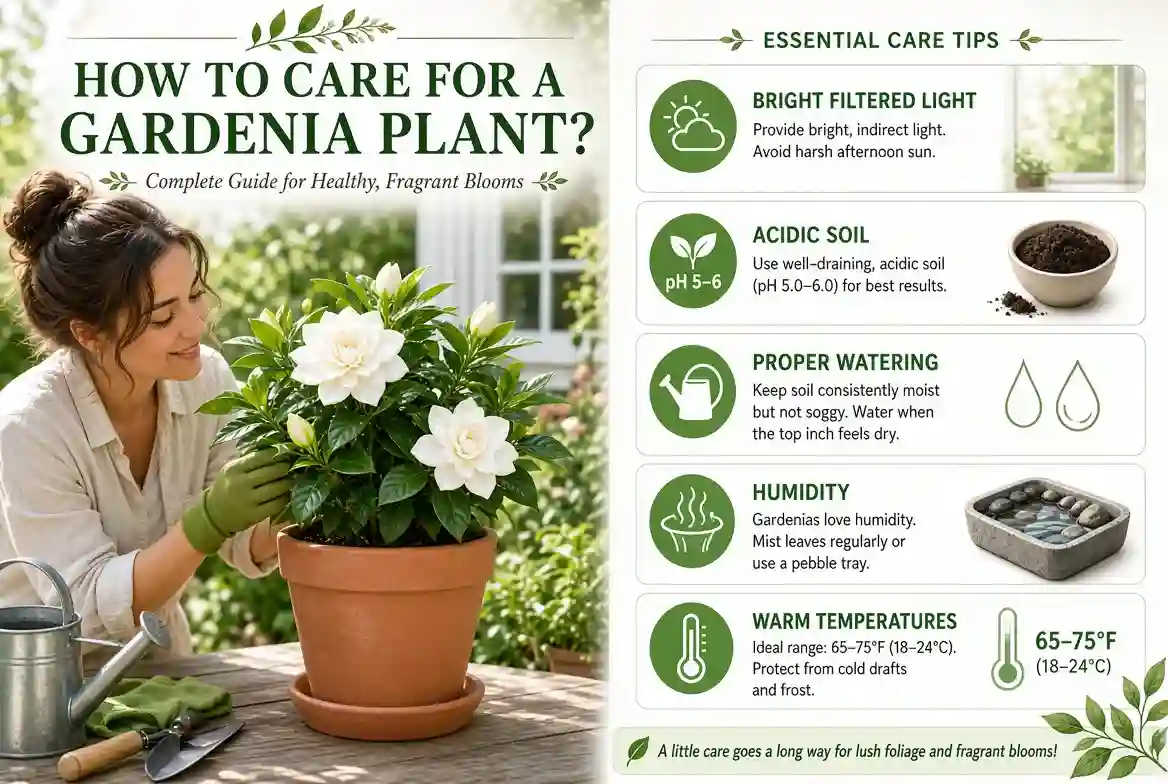
Gardenia plant care is mainly about getting light, moisture, soil acidity, humidity, temperature, and feeding right. Gardenias prefer bright filtered light, acidic and well-drained soil, consistent moisture, warm temperatures, and higher humidity. Avoid both drought and waterlogged roots. With stable conditions and regular care, gardenias can produce glossy foliage and wonderfully fragrant white flowers. (RHS)
Introduction
Gardenias are famous for their glossy green leaves and intensely fragrant white flowers. They can make a patio, garden, conservatory, or bright indoor space feel special.
They can also be surprisingly demanding.
A gardenia may look healthy one week and suddenly develop yellow leaves, dropped buds, wilted foliage, or fewer flowers. These problems often come from small changes in watering, light, temperature, or soil conditions.
That is why successful gardenia plant care is less about following a rigid watering schedule. It is about creating stable growing conditions and watching how the plant responds.
This guide explains how to care for gardenias from planting and watering to pruning, fertilizing, flowering, and troubleshooting.
What Does a Gardenia Plant Need to Thrive?
Gardenias, especially Gardenia jasminoides, are evergreen shrubs that prefer warm, humid conditions. Their basic needs are straightforward, but they need to stay balanced.
| Care Need | What Gardenia Prefers | Why It Matters |
|---|---|---|
| Light | Bright, filtered light | Supports foliage and flowering |
| Soil | Acidic, well-drained soil | Helps roots access nutrients |
| Water | Consistently moist soil | Prevents drought stress |
| Humidity | High, stable humidity | Reduces leaf and bud stress |
| Temperature | Warm and stable | Protects buds and growth |
| Fertilizer | Acid-forming fertilizer | Supports healthy growth |
| Pruning | Light pruning after flowering | Maintains shape and encourages branching |
| Airflow | Good air circulation | Helps reduce fungal problems |
Gardenias dislike extremes. Waterlogged soil, prolonged dryness, intense heat, deep shade, and sudden temperature changes can all create problems. (RHS)
Image Suggestion: Create an infographic showing a healthy gardenia surrounded by icons for light, water, acidic soil, humidity, temperature, and fertilizer.
1. Choose the Right Location
Location is one of the biggest factors in gardenia plant care.
Gardenias need plenty of light, but intense hot sunlight can scorch foliage and increase water stress. A bright location with filtered or partial sunlight is usually more suitable.
For outdoor plants, morning sun with afternoon protection can work well in hot climates. Clemson Extension recommends light to partial shade, especially protection from strong afternoon conditions. (Home & Garden Information Center)
Good locations include:
- A bright room near a window
- A sheltered patio
- A partially shaded garden bed
- A greenhouse or conservatory
- An east-facing outdoor position
- A location protected from harsh afternoon sun
Avoid placing gardenias where they experience constant deep shade.
Too little light can reduce flowering and cause weak growth.
Practical tip: If your gardenia receives strong afternoon sun and its leaves begin looking stressed, try moving it to a location with gentler light.
2. Give Your Gardenia the Right Soil
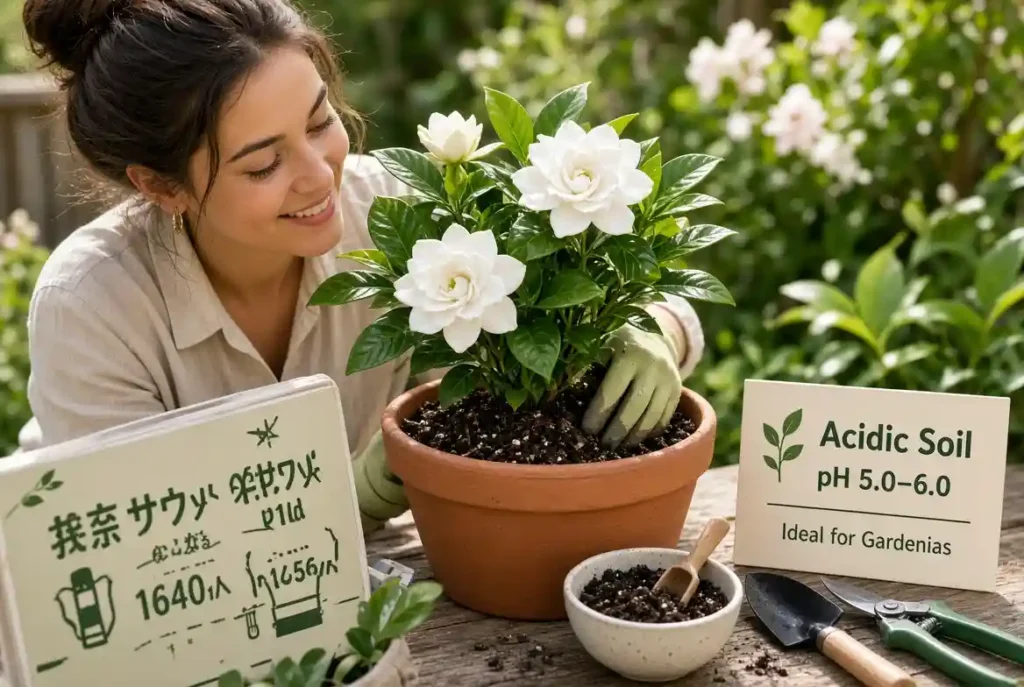
Gardenias are acid-loving plants.
They generally perform best in acidic, well-drained growing media. For container-grown gardenias, an ericaceous or acid-loving-plant potting mix is a practical choice. The RHS recommends peat-free ericaceous compost for gardenias. (RHS)
Gardenias also dislike waterlogged roots.
Good soil should be:
- Acidic
- Moisture-retentive
- Well drained
- Rich in organic matter
- Loose enough for healthy root growth
For outdoor planting, Clemson Extension recommends acidic soil with a pH below 6.0 and good drainage. (Home & Garden Information Center)
Why soil pH matters
Incorrect soil pH can make certain nutrients harder for the plant to absorb.
This can result in yellowing leaves even when nutrients are technically present in the soil.
If your gardenia repeatedly develops yellow new leaves, check both watering and soil pH before simply adding more fertilizer.
Image Suggestion: Show a gardenia root system growing in acidic, well-drained soil beside a pH scale highlighting the acidic range.
3. How to Water a Gardenia Plant
Watering is one of the most important parts of gardenia plant care.
Gardenias prefer consistently moist soil. However, moist does not mean saturated.
The RHS recommends keeping the compost moist during active growth while avoiding waterlogging. During winter, watering should be reduced without allowing the growing medium to become completely dry. (RHS)
A better watering method
Instead of watering automatically every Monday or every three days:
- Check the soil first.
- Feel the upper layer of the growing medium.
- Water when it is beginning to dry.
- Water thoroughly.
- Allow excess water to drain away.
- Empty standing water from the saucer.
The exact frequency depends on your climate, pot size, soil mix, temperature, and light.
Signs of watering problems
Too little water may cause:
- Wilting
- Brown leaf edges
- Drooping foliage
- Bud drop
Too much water may cause:
- Yellow leaves
- Weak growth
- Root problems
- Persistent wet soil
Clemson Extension also identifies improper watering and poorly drained soil as important contributors to gardenia problems. (Home & Garden Information Center)
What about tap water?
Hard water can gradually affect soil acidity.
4. Gardenia Humidity Requirements
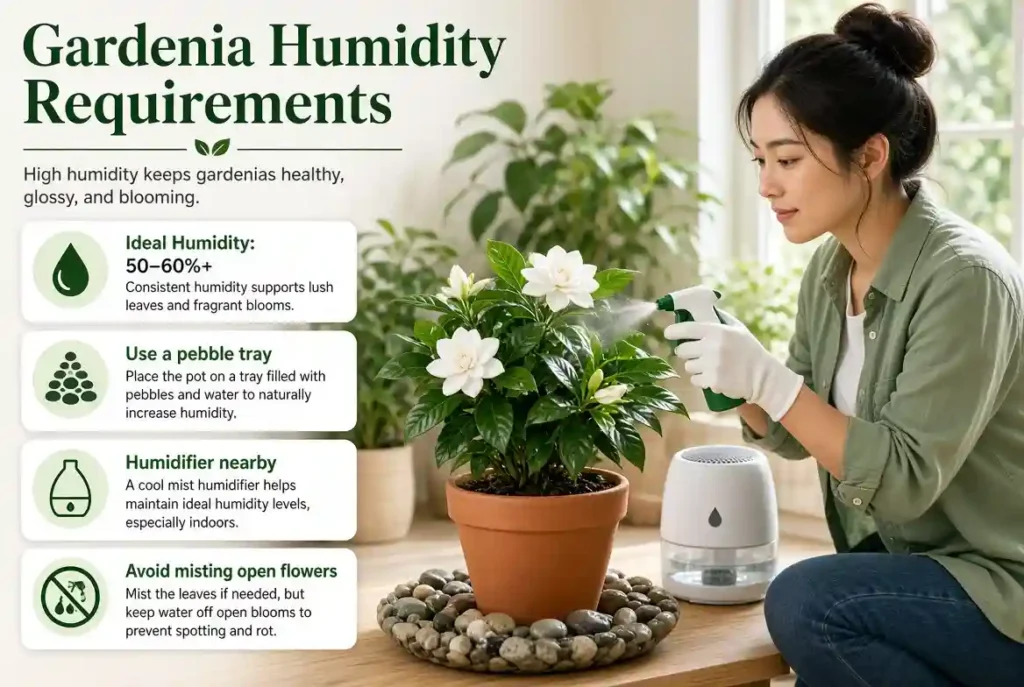
Gardenias appreciate high humidity.
This becomes particularly important when growing them indoors, where heating and air conditioning can create dry air.
Ways to increase humidity
- Use a humidifier.
- Place the plant near other plants.
- Use a suitable pebble tray.
- Keep it away from heating vents.
- Avoid placing it directly beside an air conditioner.
- Maintain good air movement around the foliage.
The RHS recommends high, consistent humidity for gardenias. It also notes that misting can be used in hot weather, but water should not be left on flowers because it can discolor the petals. (RHS)
An important balance
High humidity does not mean stagnant air.
A humid room with poor airflow can encourage fungal problems. Give the plant enough space for air to circulate around its leaves.
5. Maintain the Right Temperature
Gardenias prefer warm, relatively stable temperatures.
The RHS gives approximately 21–24°C (70–75°F) during the day, with cooler nighttime conditions around 15–18°C (59–65°F) being suitable. Sudden temperature changes can damage flower buds. (RHS)
Protect gardenias from:
- Cold drafts
- Sudden temperature drops
- Hot heating vents
- Extreme afternoon heat
- Rapid indoor-to-outdoor changes
If you move a gardenia outside for summer, acclimate it gradually rather than immediately placing it in a dramatically different environment.
This reduces environmental stress.
6. How to Fertilize Gardenias
Gardenias benefit from regular feeding during active growth.
Because they prefer acidic conditions, use a fertilizer designed for acid-loving plants, following the product label.
Clemson Extension recommends a light spring application of an acid-forming fertilizer and notes that a second application may be useful several weeks later. It advises against fertilizing in fall because this can encourage tender growth before winter. (Home & Garden Information Center)
The RHS also recommends regular feeding during spring and summer for container-grown gardenias. (RHS)
Avoid this common mistake
More fertilizer does not automatically mean more flowers.
Excess fertilizer can damage roots and create nutrient imbalances.
If the leaves are yellow, first determine whether the problem is caused by:
- Poor drainage
- Incorrect soil pH
- Overwatering
- Low light
- Iron availability
Then correct the underlying problem.
7. How to Encourage More Gardenia Flowers
Gardenia flowers depend on several conditions working together.
A plant that receives fertilizer but lacks adequate light may still flower poorly.
For better flowering, focus on:
- Bright filtered light
- Stable temperatures
- Consistent soil moisture
- High humidity
- Appropriate acidic soil
- Regular but controlled feeding
- Minimal root disturbance
Gardenias can also drop buds when exposed to fluctuating temperatures, inconsistent watering, dry air, or other environmental stress. (RHS)
Why do gardenia buds fall off?
Common causes include:
- Sudden temperature changes
- Dry soil
- Excessively wet soil
- Dry air
- Heat stress
- Poor light
- Moving the plant while it is budding
If a gardenia is covered with healthy buds, avoid suddenly changing its location.
Practical insight: Once a gardenia begins forming buds, consistency becomes especially important.
8. Pruning and Deadheading Gardenias
Gardenias generally need only moderate pruning.
The best time to prune is usually after flowering, particularly for outdoor shrubs. Clemson Extension recommends pruning after flowering to remove faded flowers and straggly growth. (Home & Garden Information Center)
Remove:
- Dead branches
- Damaged growth
- Weak or crossing stems
- Faded flowers
- Unwanted long shoots
Avoid heavy pruning simply to make the plant look smaller.
Gardenias can be sensitive to root disturbance, and unnecessary stress can reduce their performance. (Home & Garden Information Center)
Deadheading
Removing faded flowers keeps the plant looking tidy and may encourage continued flowering.
The RHS recommends regularly removing fading flowers. (RHS)
Image Suggestion: Show a simple three-step pruning diagram: faded flower → clean pruning cut → healthy new growth.
9. Repotting a Potted Gardenia
Container gardenias eventually need fresh growing media or a larger pot.
The RHS recommends repotting in spring and choosing a container only slightly larger than the current one. Oversized containers can hold excessive moisture around the roots. (RHS)
Repot when:
- Roots are tightly congested.
- Water runs straight through the pot.
- Growth becomes unusually slow.
- The growing medium has deteriorated.
- The plant has clearly outgrown its container.
Repotting steps
- Choose a pot with drainage holes.
- Select an acidic, well-drained potting mix.
- Remove the plant carefully.
- Avoid unnecessary root disturbance.
- Place it at the same planting depth.
- Fill around the root ball.
- Water thoroughly.
- Keep it in a stable location while it adjusts.
Do not jump from a small pot to an enormous container.
10. Gardenia Plant Care Through the Seasons
Your care routine should change with the weather.
| Season | Main Focus |
|---|---|
| Spring | Repotting, feeding, new growth |
| Summer | Watering, humidity, flowering, pest checks |
| Autumn | Reduce feeding and prepare for cooler weather |
| Winter | Bright light, stable temperature, careful watering |
Spring
Spring is a useful time for repotting and beginning regular feeding.
Check whether roots have filled the container.
Summer
Watch moisture closely.
Hot weather can dry containers quickly, while intense sunlight can increase stress.
Autumn
Reduce feeding as growth slows.
Avoid encouraging soft new growth late in the season.
Winter
Gardenias still need light.
Water less frequently than during active growth, but do not allow the root ball to become completely dry.
11. Gardenia Problems: Symptoms and Solutions
Gardenia problems often provide clues about what the plant needs.
| Symptom | Possible Cause | What to Check |
|---|---|---|
| Yellow leaves | Overwatering, root stress, iron deficiency | Soil moisture and pH |
| Brown leaf edges | Dry soil or environmental stress | Watering and humidity |
| Buds falling | Temperature or moisture fluctuations | Location and watering |
| Few flowers | Low light, stress, poor conditions | Light and temperature |
| Wilting despite wet soil | Root problems or excessive moisture | Drainage and roots |
| Sticky leaves | Sap-feeding pests | Inspect leaf undersides |
| Black sooty coating | Sooty mold associated with pests | Check for insects |
| Weak growth | Low light or unsuitable temperature | Location |
The RHS identifies yellow leaves, brown foliage, bud drop, poor flowering, and wilting as common gardenia problems. Clemson Extension also lists root rots, powdery mildew, stem canker, sooty mold, bud drop, and iron chlorosis among gardenia problems. (RHS)
12. Why Are My Gardenia Leaves Turning Yellow?
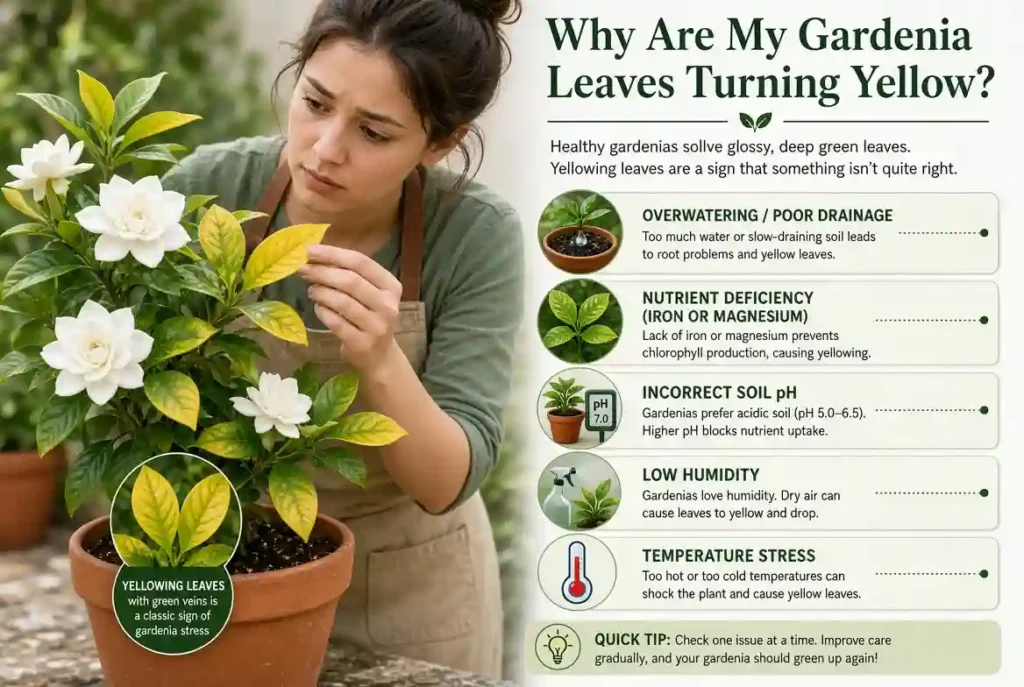
Yellow leaves have several possible causes.
Do not immediately assume your plant needs more fertilizer.
If older leaves are yellow
Check:
- Watering frequency
- Root health
- Drainage
- Light levels
If new leaves are yellow with greener veins
Iron availability may be involved, especially when soil conditions are too alkaline.
Gardenias grown in unsuitable pH conditions may struggle to access iron. Clemson Extension notes iron deficiency as a cause of yellow new foliage. (Home & Garden Information Center)
What to do
Start with the growing conditions.
Check the soil before adding supplements.
Correcting the root environment is often more useful than repeatedly treating the leaves.
13. Why Is My Gardenia Not Blooming?
A healthy-looking gardenia can still refuse to flower.
Start by checking the following:
1. Light
Too little light can reduce flowering.
2. Temperature
Hot nights can interfere with flowering. The RHS specifically identifies high nighttime temperatures as one possible reason for poor flowering. (RHS)
3. Watering
Repeated drying and soaking can stress the plant.
4. Humidity
Dry air can contribute to poor flowering and bud problems.
5. Fertilizer
Too much fertilizer can encourage foliage at the expense of balanced growth.
6. Recent relocation
A gardenia may react poorly to sudden environmental changes.
Give it stable conditions before changing several things at once.
14. Common Gardenia Care Mistakes
Mistake 1: Watering on a fixed schedule
Every plant uses water at a different rate.
Better approach: Check the growing medium and environmental conditions first.
Mistake 2: Keeping the roots constantly wet
Gardenias like moisture, but they also need oxygen around their roots.
Better approach: Use a well-drained container and growing medium.
Mistake 3: Putting the plant in harsh afternoon sun
Strong heat can increase stress.
Better approach: Provide bright light with protection from intense heat.
Mistake 4: Using unsuitable alkaline soil
Gardenias prefer acidic growing conditions.
Better approach: Use an appropriate acidic growing medium and monitor soil conditions.
Mistake 5: Fertilizing every time leaves turn yellow
Yellowing has many causes.
Better approach: Diagnose the problem first.
Mistake 6: Moving the plant repeatedly
Constant environmental changes can cause stress and bud drop.
Better approach: Find a suitable location and keep conditions stable.
Mistake 7: Ignoring pests
Gardenias can attract sap-feeding insects such as aphids, scale, mealybugs, and spider mites. (RHS)
Inspect the leaves regularly, especially underneath them.
15. Gardenia Pests and Disease Problems
Gardenias can experience both insect and disease problems.
Common pests
Watch for:
- Aphids
- Scale insects
- Mealybugs
- Spider mites
- Whiteflies
Look for:
- Sticky residue
- Distorted leaves
- Tiny insects
- Webbing
- Pale or speckled foliage
Common diseases
Gardenias can also develop:
- Root rot
- Powdery mildew
- Stem canker
- Gray mold
- Sooty mold
Clemson Extension’s updated gardenia disease guidance emphasizes well-drained soil, avoiding overwatering, minimizing plant stress, and maintaining appropriate growing conditions. (Home & Garden Information Center)
Important: Do not treat every yellow or damaged leaf with a pesticide or fungicide. First determine whether the problem is environmental.
16. Indoor Gardenia Care vs Outdoor Gardenia Care
Gardenias can be grown indoors or outdoors, but their requirements differ.
| Feature | Indoor Gardenia | Outdoor Gardenia |
|---|---|---|
| Light | Bright filtered light | Partial or filtered sunlight |
| Humidity | Often needs extra humidity | Usually benefits from naturally humid conditions |
| Watering | Requires close monitoring | Depends on rainfall and soil |
| Temperature | Easier to control | More exposed to weather |
| Soil | Acidic potting mix | Acidic, well-drained soil |
| Winter care | Usually easier | May need frost protection |
| Pest monitoring | Frequent checks | Frequent checks |
The RHS describes gardenias as tender shrubs often grown as houseplants, while Clemson Extension discusses their use as landscape shrubs in suitable climates. (RHS)
17. How to Care for Gardenias in Hot Climates
Hot climates require extra attention.
A gardenia may tolerate warmth but struggle when heat, dry air, intense sunlight, and rapid moisture loss occur together.
During very hot weather:
- Protect the plant from intense afternoon sun.
- Check soil moisture more frequently.
- Increase humidity where practical.
- Maintain airflow.
- Use mulch around outdoor gardenias.
- Avoid unnecessary repotting during extreme heat.
- Monitor leaves for scorching and wilting.
For outdoor gardenias, Clemson Extension recommends a 2–3 inch layer of suitable mulch such as pine straw, compost, or ground bark. (Home & Garden Information Center)
18. A Simple Weekly Gardenia Care Routine
You do not need to inspect every detail every day.
A simple weekly check can catch many problems early.
Every week:
1. Check the soil
Make sure it is moist but not waterlogged.
2. Inspect the leaves
Look underneath for pests.
3. Check new growth
Yellow new leaves can indicate a soil or nutrient issue.
4. Examine flower buds
Watch for unexplained bud drop.
5. Check the location
Make sure sunlight and temperature remain suitable.
6. Remove faded flowers
Deadhead when needed.
7. Check drainage
Never allow the pot to sit in standing water.
This routine takes only a few minutes but can prevent small problems from becoming serious ones.
19. Gardenia Plant Care Checklist
Use this quick checklist when caring for your plant:
- Provide bright filtered light.
- Protect it from extreme afternoon heat.
- Use acidic, well-drained soil.
- Keep the soil consistently moist.
- Never leave roots sitting in water.
- Maintain good humidity.
- Avoid sudden temperature changes.
- Feed during active growth as appropriate.
- Prune after flowering when needed.
- Remove faded flowers.
- Inspect regularly for pests.
- Repot only when necessary.
- Use rainwater where practical in hard-water areas.
- Reduce watering and feeding as growth slows.
Frequently Asked Questions
How often should I water a gardenia?
Water when the growing medium begins to dry, then water thoroughly. Avoid both completely dry soil and constantly saturated soil. Your climate, container, light, and temperature determine how often watering is needed.
Do gardenias need full sun?
Gardenias need plenty of light but can suffer under intense hot sunlight. Bright filtered light or partial shade is often preferable, particularly in hot climates. (RHS)
What is the best soil for gardenias?
Use an acidic, well-drained growing medium designed for acid-loving plants. Container gardenias can benefit from an ericaceous potting mix. (RHS)
Why are my gardenia buds dropping?
Bud drop can result from sudden temperature changes, inconsistent watering, dry air, excessive heat, or other environmental stress. Keeping conditions stable is one of the most important preventive measures. (RHS)
Can gardenias grow indoors?
Yes. Gardenias can grow indoors when provided with bright light, warmth, humidity, acidic soil, and consistent moisture. They can be challenging houseplants because they respond poorly to major changes in their growing conditions. (RHS)
Why are my gardenia leaves turning yellow?
Overwatering, poor drainage, unsuitable soil pH, and iron deficiency can all cause yellowing. Check the roots, soil moisture, drainage, and growing medium before adding fertilizer. (RHS)
Should I mist my gardenia?
Misting may temporarily increase moisture around the foliage, but it should not replace proper humidity management. Avoid wetting the flowers because water can discolor the petals. (RHS)
When should I prune a gardenia?
For outdoor shrubs, pruning after flowering is generally appropriate. Remove faded flowers, dead growth, and unwanted branches without excessive pruning. (Home & Garden Information Center)
Can gardenias survive winter?
This depends heavily on the species, cultivar, and climate. Many gardenias are tender and need protection from freezing conditions. Some cultivars have greater cold tolerance than others. (RHS)
Final Thoughts on Gardenia Plant Care
Successful gardenia plant care comes down to consistency.
Give your gardenia bright filtered light, acidic well-drained soil, steady moisture, good humidity, warm temperatures, and appropriate feeding. Avoid the temptation to solve every problem with more water or fertilizer.
When leaves turn yellow, buds drop, or flowering decreases, look at the entire growing environment rather than treating one symptom in isolation.
A gardenia that receives stable conditions can reward you with glossy evergreen foliage and intensely fragrant flowers. The key is not complicated care. It is careful observation and avoiding extremes. (RHS)
Image Suggestion: Create a final infographic showing a healthy blooming gardenia with five care essentials: Light + Water + Acidic Soil + Humidity + Stable Temperature.