Quick Answer
Cordyline plant care is mainly about providing bright filtered light, warm temperatures, moderate-to-high humidity, and consistently moist but well-drained soil. Water when the top layer of soil begins to dry, but never leave the roots sitting in water. Feed during active growth, protect tropical varieties from cold drafts, and remove damaged leaves regularly. With the right balance of light, moisture, warmth, and humidity, Cordyline can produce colorful, healthy foliage for years.
Introduction
Cordyline plants are popular because few foliage plants offer the same combination of tropical form and dramatic color. Depending on the variety, their long leaves can be green, burgundy, pink, red, purple, cream, or beautifully striped.
The problem is that colorful Cordylines can also be surprisingly sensitive indoors.
A plant may look healthy when you bring it home but develop brown tips, yellow leaves, curling foliage, or fading colors within a few weeks. These problems are often caused by an imbalance between light, watering, humidity, and temperature rather than a single serious disease.
Good Cordyline plant care starts with understanding what the plant is actually responding to.
For this guide, the focus is primarily on Cordyline fruticosa, often sold as the Ti plant or Hawaiian Ti. These tropical Cordylines are commonly grown as houseplants. Other species, such as Cordyline australis, have different outdoor-growing characteristics and can tolerate conditions that tropical Ti plants cannot.
What Is a Cordyline Plant?
Cordyline is a genus of evergreen plants known for their upright growth and long, strap-shaped leaves.
The plants can eventually develop woody stems or trunks, giving mature specimens a palm-like appearance. Tropical types are especially valued as ornamental foliage plants because their leaves can display striking combinations of green, red, pink, purple, bronze, yellow, and cream.
One important point is that Cordyline and Dracaena are not the same plant, even though they can look remarkably similar.
If you are unsure which plant you own, check the plant label or botanical name before changing its care routine. Different Cordyline species and cultivars can have different light and temperature preferences.
Cordyline fruticosa vs. Cordyline australis
| Feature | Cordyline fruticosa | Cordyline australis |
|---|---|---|
| Common name | Ti plant, Hawaiian Ti | Cabbage tree, cabbage palm |
| Typical use | Houseplant or tropical outdoor plant | Outdoor landscape plant |
| Leaf colors | Often highly colorful | Commonly green, bronze, or variegated |
| Cold tolerance | Low | Much higher |
| Indoor suitability | Excellent | Possible when young |
| Humidity needs | Moderate to high | Generally less demanding outdoors |
| Best environment | Warm, humid, sheltered | Mild outdoor climates |
Important: Do not assume every Cordyline needs identical care. Your plant’s species and cultivar matter.
Image Suggestion: Close-up comparison of Cordyline fruticosa and Cordyline australis showing their different leaf shapes, growth habits, and typical uses.
How to Care for a Cordyline Plant
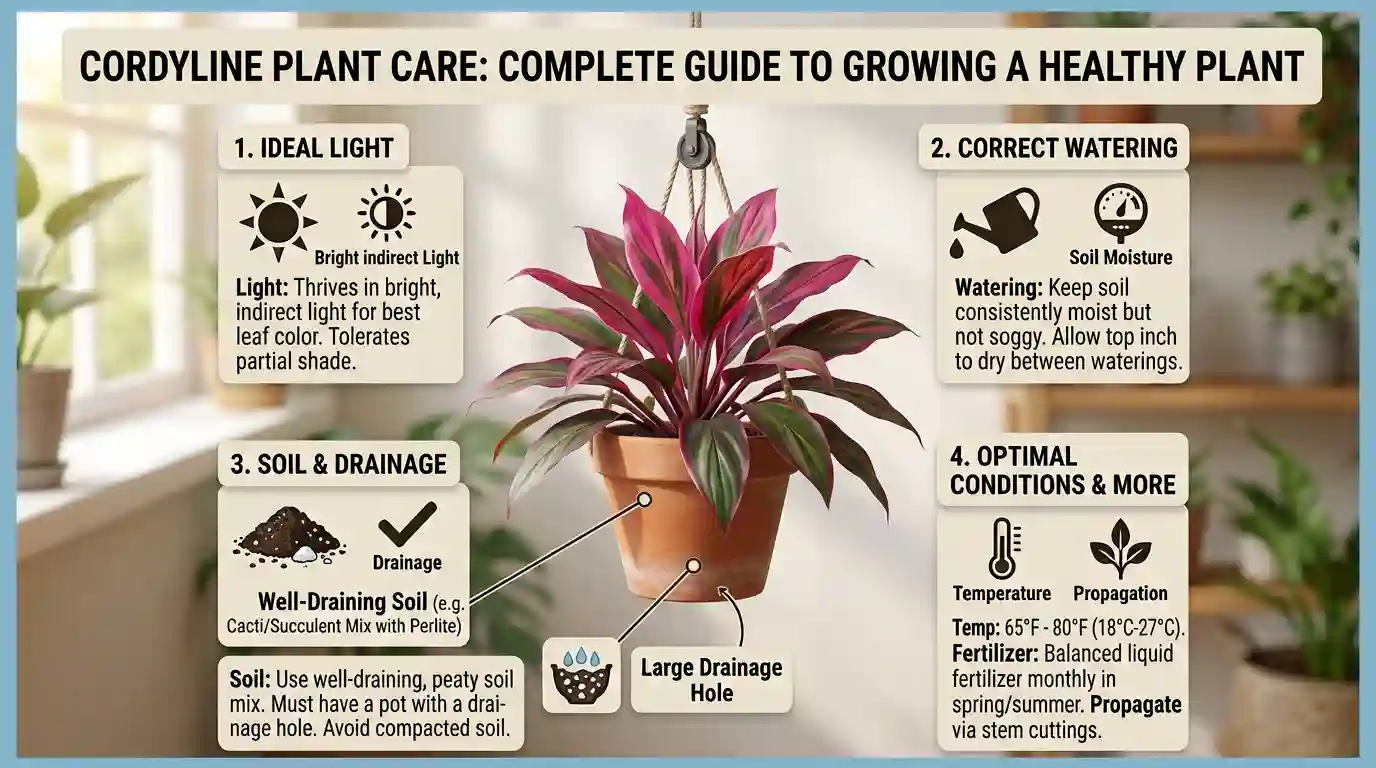
The easiest way to remember Cordyline care is to think about five conditions:
Light + Water + Humidity + Warmth + Drainage
If these five factors remain balanced, many common Cordyline problems become much easier to prevent.
1. Give Cordyline Bright, Filtered Light
Light is one of the biggest factors affecting Cordyline health and leaf color.
Tropical Cordyline varieties generally perform well in bright indirect or filtered light. A position near a bright window can work extremely well, provided intense sunlight does not scorch the foliage.
Colorful varieties need enough light to maintain their attractive patterns.
Signs your Cordyline needs more light
Watch for:
- New leaves becoming less colorful
- Long gaps between leaves
- Weak or stretched growth
- Smaller new leaves
- A plant leaning strongly toward a window
- Variegated leaves becoming predominantly green
Low light does not always kill a Cordyline quickly. Instead, the plant may gradually become less attractive and grow more slowly.
Can Cordyline tolerate direct sunlight?
Yes, but it depends on the variety, climate, and how quickly the plant was acclimated.
A Cordyline grown indoors under filtered light can suffer leaf scorch if suddenly placed in strong afternoon sun.
If you want to move your plant outdoors, introduce stronger light gradually over several days or weeks.
Best indoor location
A bright room near an east- or west-facing window is often a useful starting point.
Near a very bright south-facing window, use a sheer curtain if the leaves receive harsh midday or afternoon sunlight.
Practical tip: If the plant is colorful but the new growth is becoming noticeably greener, evaluate light before immediately adding fertilizer.
2. Water When the Top Soil Begins to Dry
Cordyline likes moisture, but it does not like constantly saturated roots.
This distinction is extremely important.
Beginners sometimes assume that a tropical plant should remain wet all the time. In reality, continuously waterlogged soil can reduce oxygen around the roots and encourage root problems.
How to water Cordyline correctly
- Check the top layer of soil with your finger.
- If the surface has begun to dry, inspect the soil slightly deeper.
- Water thoroughly when the plant needs it.
- Allow excess water to drain from the bottom.
- Empty the saucer or cachepot afterward.
- Wait until the soil begins drying again before watering.
Avoid following a rigid calendar such as “water every Sunday.”
Your plant may need water more frequently during hot, bright weather and less frequently during cool, darker periods.
How much water should you use?
Water enough to thoroughly moisten the root zone and allow excess water to escape through the drainage holes.
Do not give a large plant a tiny amount of water every day.
That approach can leave some areas of the root ball dry while keeping the upper soil damp.
Water quality can matter
Some Cordylines can develop brown leaf tips when exposed to certain mineral or chemical components in tap water.
If your plant repeatedly develops brown tips despite appropriate watering, consider testing your water or trying filtered, rain, or distilled water.
However, do not automatically assume that every brown tip is caused by tap water. Low humidity, excessive fertilizer, inconsistent watering, root problems, and environmental stress can create similar symptoms.
Image Suggestion: Step-by-step Cordyline watering infographic showing soil inspection → thorough watering → drainage → emptying excess water → allowing the soil to partially dry.
3. Maintain Moderate to High Humidity
Cordyline fruticosa comes from tropical environments, so very dry indoor air can cause problems.
Low humidity may contribute to:
- Brown leaf edges
- Crispy leaf tips
- Curling leaves
- Increased stress
- Poor-looking new foliage
This becomes especially noticeable when plants are kept near heating or strong air-conditioning.
How to increase humidity
You have several options:
- Use a room humidifier.
- Group plants together.
- Keep the plant in a naturally humid room.
- Place a pebble tray nearby.
- Keep the plant away from dry heating vents.
- Improve overall room humidity rather than repeatedly misting individual leaves.
A humidifier is usually more predictable than occasional misting.
Does misting Cordyline work?
Misting may temporarily increase moisture around the foliage, but it does not provide the same sustained humidity as changing the room’s relative humidity.
If brown tips are persistent, measure the room rather than relying on how humid the air feels.
Practical observation: A Cordyline sitting directly beside an air conditioner can struggle even when the rest of the room seems comfortable.
4. Keep Cordyline Warm
Tropical Cordyline varieties prefer warm conditions.
They should be protected from:
- Frost
- Cold drafts
- Very cold windows
- Sudden temperature changes
- Direct blasts from air conditioners
- Cold, wet soil
For tropical Ti plants, temperatures around normal comfortable indoor-room conditions are generally much safer than cold conditions.
A useful rule is simple:
If the room feels uncomfortably cold to you, a tropical Cordyline may also be unhappy.
Do not place the plant directly against a cold window during winter.
Likewise, avoid putting it immediately beside a heater or radiator. Hot, dry air can stress the foliage.
5. Use a Well-Draining Potting Mix
Cordyline needs moisture without stagnant water.
A suitable indoor mix should hold enough moisture for the plant while allowing excess water and air to move through the root zone.
A quality houseplant potting mix can work well when combined with materials that improve drainage and structure.
Possible components include:
- Quality potting mix
- Coco coir
- Perlite
- Fine bark
- Other suitable drainage amendments
The exact recipe matters less than the final result.
The soil should not become a dense, muddy mass that remains wet for a long time.
What makes a good Cordyline container?
Always look for:
Drainage holes.
A decorative pot without drainage can become a serious problem if water accumulates around the roots.
If you want to use a decorative cachepot, keep the Cordyline in a separate nursery pot with drainage.
How to Fertilize Cordyline
Cordyline benefits from regular feeding when it is actively growing.
A balanced liquid houseplant fertilizer can be used according to the product’s directions.
Do not assume that more fertilizer means more colorful leaves.
Excess fertilizer can accumulate in the soil and contribute to root stress or leaf-tip damage.
A practical feeding routine
During active growth:
- Feed periodically with a balanced fertilizer.
- Follow the product’s dilution instructions.
- Avoid feeding severely stressed or recently repotted plants immediately.
- Reduce or stop routine feeding when growth slows significantly.
The exact feeding frequency should depend on the fertilizer concentration, growing conditions, and plant response.
Signs of fertilizer problems
Too much fertilizer may contribute to:
- Brown or scorched leaf margins
- Salt buildup on soil
- Weak or damaged roots
- Sudden foliage decline
If fertilizer buildup is suspected, thoroughly flushing the potting mix with clean water can help remove soluble salts, provided the container drains properly.
How to Prune a Cordyline
Cordyline does not require aggressive pruning to remain healthy.
Pruning is mainly useful for improving appearance, removing damaged foliage, or controlling height.
Remove individual damaged leaves
Use clean, sharp scissors or pruning shears.
Cut damaged leaves close to their natural attachment point without unnecessarily injuring the stem.
What if the Cordyline becomes too tall?
Leggy or overgrown plants can sometimes be cut back.
Do not throw away healthy stem sections automatically. Cordyline can be propagated from suitable stem cuttings, depending on the species and growing conditions.
Cutting back a tall plant can also encourage new growth from lower points on the stem.
Important: Make major pruning cuts during active growth when possible rather than during a period of cold stress.
Image Suggestion: Cordyline pruning diagram showing where to remove yellow leaves and where to make a clean stem cut on an overgrown plant.
When and How to Repot Cordyline
Cordyline does not need to be repotted simply because a certain amount of time has passed.
Instead, look for signs that the current container is becoming restrictive.
Signs your Cordyline may need repotting
- Roots circling heavily inside the pot
- Roots emerging from drainage holes
- Water running through the pot unusually quickly
- Soil drying much faster than before
- Growth slowing despite good care
- The plant becoming unstable in its container
Choose a new pot only moderately larger than the current one.
A dramatically oversized pot holds more soil than the roots can use, which can make moisture management harder.
Best time to repot
Spring or the beginning of active growth is generally a convenient time.
After repotting:
- Use fresh, well-draining mix.
- Keep the plant in appropriate light.
- Water thoroughly once.
- Allow excess water to drain.
- Avoid heavy fertilizing until the plant begins settling and growing again.
Why Are My Cordyline Leaves Turning Brown?
Brown leaves are one of the most common Cordyline problems.
But “brown leaves” is a symptom, not a diagnosis.
The location and pattern of the browning provide useful clues.
| Symptom | Possible Cause | What to Check |
|---|---|---|
| Brown crispy tips | Dry air, inconsistent moisture, water quality, fertilizer buildup | Humidity, watering, water source, soil salts |
| Brown patches | Sun scorch or environmental stress | Recent change in light |
| Yellow lower leaves | Natural aging or excessive moisture | Soil moisture and drainage |
| Many yellow leaves | Overwatering or root stress | Soil staying wet |
| Curling leaves | Dryness, low humidity, heat, stress | Moisture and room conditions |
| Faded colors | Insufficient light | Window position |
| Soft dark roots | Root problems | Remove plant and inspect roots |
| Tiny insects/webbing | Spider mites or other pests | Inspect leaf undersides |
Do not treat every brown leaf with more water.
That is one of the easiest ways to turn a minor humidity problem into a root problem.
Why Are My Cordyline Leaves Turning Yellow?
Occasional yellowing of an old leaf is not automatically a crisis.
Older leaves naturally age and eventually decline.
The concern is when multiple leaves turn yellow at the same time.
Check the soil first
If the soil remains wet for long periods, excessive watering or poor drainage may be contributing to the problem.
Check:
- Drainage holes
- Soil texture
- Watering frequency
- Pot size
- Root condition
If the roots are consistently deprived of oxygen, the plant can begin losing foliage.
Other possible causes
Yellowing can also result from:
- Sudden environmental changes
- Insufficient light
- Nutrient issues
- Temperature stress
- Root damage
- Pest problems
Look at the whole plant instead of diagnosing it from one yellow leaf.
Why Is My Cordyline Losing Its Color?
Color loss is particularly frustrating because colorful foliage is often the main reason people buy Cordyline.
The first thing to check is light.
A colorful cultivar placed in a dark room may survive but produce less vibrant foliage.
Move it gradually toward a brighter location with filtered light.
Do not respond by immediately increasing fertilizer.
Fertilizer supplies nutrients. It does not replace adequate light.
A useful test
Observe the newest leaves.
If new leaves are consistently less colorful than older leaves, the current growing environment may not be providing enough light or may not suit that cultivar.
Common Cordyline Pests
Cordyline can be affected by common indoor-plant pests, including:
- Spider mites
- Scale insects
- Mealybugs
- Thrips
- Aphids
Check the undersides of leaves and areas where leaves meet stems.
Early signs of pests
Look for:
- Fine webbing
- Sticky residue
- Tiny moving insects
- Cotton-like clusters
- Brown scale-like bumps
- Distorted new growth
- Speckled or dull foliage
Early detection makes treatment much easier.
If you bring home a new plant, inspect it carefully before placing it beside an established collection.
How to Clean Cordyline Leaves
Large Cordyline leaves collect dust easily.
Dust reduces the plant’s clean appearance and can make it harder to notice early pest problems.
Use a soft, damp cloth and gently support each leaf while wiping.
Avoid harsh leaf-shine products.
You can also give suitable plants a gentle shower with room-temperature water, provided the pot drains properly and the environment allows the foliage to dry afterward.
Do not scrub delicate leaves aggressively.
Cordyline Plant Care in Different Seasons
Your care routine should change with the environment.
Spring
Spring is a good time to:
- Repot if necessary
- Resume regular feeding
- Increase watering as growth accelerates
- Prune overgrown stems
- Move plants outdoors gradually where climate permits
Summer
During hot weather:
- Check soil more frequently.
- Protect leaves from extreme afternoon sun.
- Watch for dry indoor air from air conditioning.
- Monitor pests.
- Maintain good drainage.
A plant in bright light may use water much faster than one sitting several feet away from a window.
Autumn
As light levels decrease:
- Watch soil moisture carefully.
- Avoid automatically maintaining the same watering schedule.
- Inspect the plant for pests.
- Prepare tropical varieties for colder nights.
Winter
For tropical Cordyline:
- Protect it from cold drafts.
- Keep it in bright light.
- Reduce watering if growth slows.
- Avoid keeping the soil constantly wet.
- Keep it away from heating vents.
- Maintain reasonable humidity.
Winter is often when indoor Cordylines develop problems because people continue watering at their summer rate while the plant’s growth and water use have decreased.
Can Cordyline Grow Outdoors?
Yes, but the answer depends heavily on the species and climate.
Tropical Cordyline fruticosa is much more sensitive to cold than some outdoor Cordyline species.
In warm, frost-free climates, it can be grown outdoors in suitable filtered or partial light.
In cooler climates, grow tropical Cordyline in a container so it can be moved indoors when temperatures become unsuitable.
Outdoor plants should also be protected from sudden exposure to intense sunlight if they were previously grown indoors.
Growing Cordyline in hot climates
Hot weather does not automatically mean full sun is appropriate.
A plant may tolerate high temperatures while still suffering from intense direct sunlight.
Morning sun and filtered afternoon light can provide a useful compromise for colorful tropical cultivars.
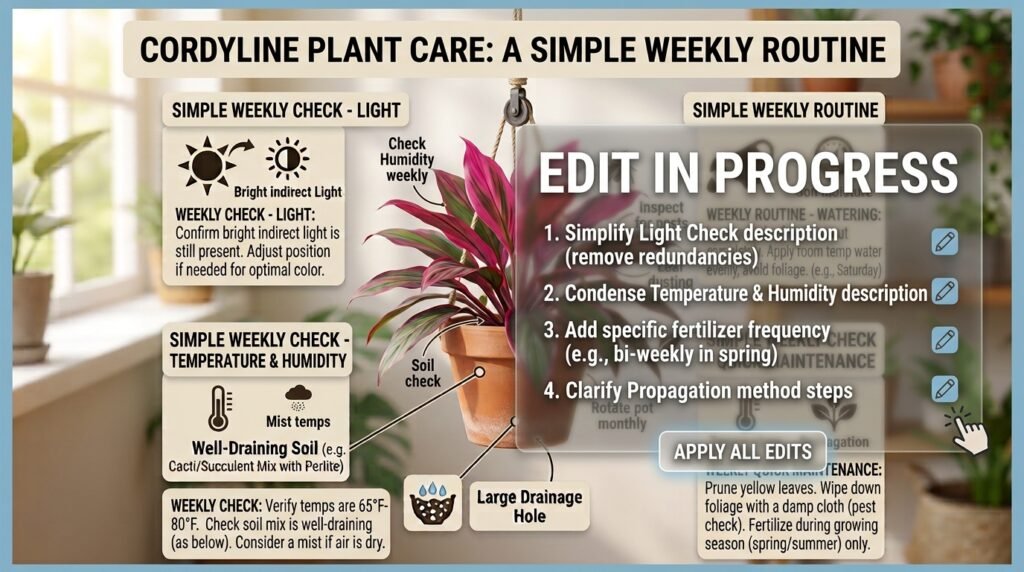
Cordyline Plant Care: A Simple Weekly Routine
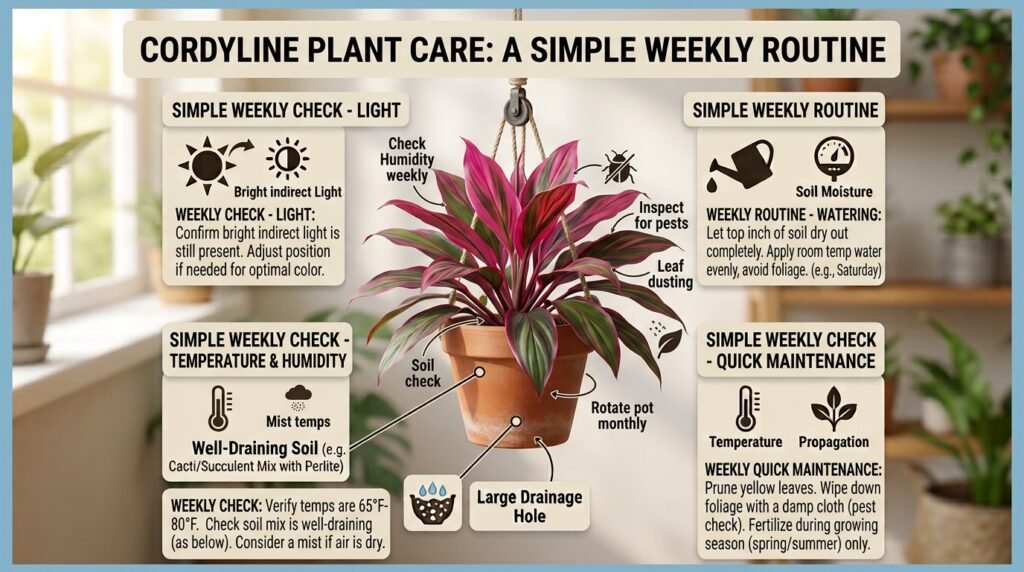
You do not need to inspect your plant for an hour every week.
A quick routine can catch most problems early.
Once a week
1. Check the soil
Feel the top layer rather than watering automatically.
2. Inspect the leaves
Look for browning, yellowing, curling, spots, or pests.
3. Check the light
Make sure nearby furniture or curtains have not significantly reduced available light.
4. Look underneath leaves
Pests often hide where you cannot see them from above.
5. Rotate the pot
Turning the plant occasionally can encourage more even growth.
Once a month
- Inspect the root zone if the plant seems unhealthy.
- Clean dusty leaves.
- Check for fertilizer buildup.
- Review whether the plant has outgrown its position.
- Examine new growth for changes in color or shape.
This small amount of attention is often more useful than reacting after the plant has already declined.
Common Cordyline Care Mistakes
Mistake 1: Watering on a Fixed Schedule
“Every three days” or “once a week” may work temporarily, but plant water use changes.
Better approach: Check the soil and environmental conditions first.
Mistake 2: Keeping the Soil Permanently Wet
Cordyline likes moisture, but saturated soil can create root problems.
Better approach: Water thoroughly, then allow some drying before watering again.
Mistake 3: Putting a Colorful Variety in Deep Shade
The plant may survive but lose its strongest colors.
Better approach: Provide bright filtered light.
Mistake 4: Moving It Suddenly Into Strong Sun
A plant adapted to indoor filtered light can scorch after sudden exposure to intense sunlight.
Better approach: Acclimate it gradually.
Mistake 5: Increasing Fertilizer When Leaves Look Pale
Pale foliage does not always mean nutrient deficiency.
Better approach: Check light, roots, watering, and pests before fertilizing more heavily.
Mistake 6: Ignoring Brown Tips
A few brown tips may be cosmetic, but widespread browning can signal environmental stress.
Better approach: Investigate humidity, watering consistency, water quality, fertilizer buildup, and temperature.
Mistake 7: Using a Decorative Pot Without Drainage
Standing water can remain hidden inside the container.
Better approach: Use a nursery pot with drainage inside the decorative pot.
How to Revive a Struggling Cordyline
If your Cordyline looks unhealthy, do not change everything at once.
That makes it difficult to identify the actual problem.
Instead, follow this sequence.
Step 1: Check the roots and soil
Is the soil extremely wet or completely dry?
Does water drain freely?
Does the container have drainage holes?
Step 2: Evaluate light
Is the plant sitting in a dark corner?
Has its light changed recently?
Step 3: Check temperature
Is it beside an air conditioner, cold window, heater, or draft?
Step 4: Inspect for pests
Check both sides of leaves and the stems.
Step 5: Correct one major problem at a time
For example, if the soil is staying wet, improve drainage and watering before adding fertilizer.
Step 6: Watch the new growth
New leaves provide better information than damaged older leaves.
If new growth appears healthy, your changes are probably moving the plant in the right direction.
Propagating Cordyline
Cordyline can be propagated from suitable stem sections or cuttings.
This is especially useful when a mature plant becomes too tall and you want to create additional plants.
A healthy stem can be divided into appropriate sections, with careful attention to which end is the top.
Depending on the variety and propagation method, new roots and shoots can develop under warm, humid conditions.
Propagation is best attempted when the plant is actively growing.
Image Suggestion: Step-by-step Cordyline propagation infographic showing a healthy stem, cutting sections, correct orientation, rooting medium, and new shoots.
Is Cordyline Safe for Pets?
This is an important consideration for homes with cats or dogs.
The ASPCA lists Ti plant and Cordyline australis among plants considered toxic to dogs and cats, with saponins identified as the toxic principle.
Reported signs can include vomiting, drooling, appetite changes, and other gastrointestinal or systemic symptoms.
Keep Cordyline away from pets that chew plants.
If you suspect your pet has eaten part of the plant, contact a veterinarian or an appropriate animal poison-control service promptly.
Indoor Cordyline Placement Ideas
The best position is not simply the prettiest corner of your home.
Choose a location that satisfies the plant’s environmental needs.
Bright living room
Excellent when the plant is positioned near a bright window with filtered light.
Bathroom
A naturally humid bathroom can work well if it also receives sufficient light.
Bedroom
Suitable if the room has enough natural light and stable temperatures.
Office
Possible near a bright window, but avoid placing the plant directly beside strong air-conditioning.
Outdoor covered patio
A good option in warm climates when the plant receives bright filtered light and protection from extreme weather.
Cordyline Care Checklist
Use this quick checklist when evaluating your plant:
| Care Factor | What Cordyline Generally Needs |
|---|---|
| Light | Bright filtered or indirect light |
| Water | Regular moisture with some drying between waterings |
| Soil | Moisture-retentive but well-draining |
| Humidity | Moderate to high for tropical varieties |
| Temperature | Warm and stable |
| Fertilizer | Balanced feeding during active growth |
| Pot | Drainage holes essential |
| Pruning | Remove damaged foliage and control excessive growth |
| Repotting | When roots become crowded or soil performance declines |
| Pests | Regular inspection for mites, scale, mealybugs, thrips, and aphids |
Frequently Asked Questions About Cordyline Plant Care
How often should I water a Cordyline?
Water when the upper layer of soil has started to dry rather than following a fixed calendar. Water thoroughly and allow excess water to drain completely.
Does Cordyline need direct sunlight?
Not necessarily. Tropical Cordyline varieties generally perform well in bright filtered or indirect light. Very strong direct sunlight can scorch foliage, particularly when a plant has not been acclimated.
Why are my Cordyline leaves turning brown?
Brown tips can result from dry air, inconsistent watering, water quality, fertilizer buildup, or environmental stress. Check the plant’s entire growing environment before choosing a treatment.
Why is my Cordyline turning yellow?
One old yellow leaf can be normal aging. Widespread yellowing can indicate excessive moisture, poor drainage, insufficient light, root stress, or another environmental problem.
Why is my Cordyline losing its red or pink color?
Insufficient light is one possibility. Colorful cultivars generally need adequate light to maintain strong foliage coloration. Move the plant gradually into brighter filtered light.
Can Cordyline grow in low light?
It may survive in lower light, but tropical colorful cultivars generally look better and maintain stronger coloration in bright filtered light.
Does Cordyline like humidity?
Yes. Tropical Cordyline varieties generally appreciate moderate to high humidity. Dry indoor air can contribute to brown tips and stressed foliage.
Can I grow Cordyline outdoors?
Yes, depending on the species and climate. Tropical Cordyline fruticosa is best suited to warm, frost-free conditions or container growing where it can be protected from cold.
Should I cut brown leaves off my Cordyline?
You can remove severely damaged leaves with clean, sharp scissors. If only the tips are brown, you can trim the damaged portion while leaving healthy green tissue intact.
Can I cut the top off a Cordyline?
Yes. Mature Cordyline can often tolerate pruning, particularly during active growth. Cutting back an overly tall stem can encourage new growth, and suitable cut stem sections may also be used for propagation.
How do I make my Cordyline grow faster?
Provide the conditions that support active growth: adequate light, warm temperatures, appropriate watering, good drainage, sufficient humidity, and moderate fertilization during the growing season.
Avoid trying to force growth with excessive fertilizer.
Can Cordyline live indoors permanently?
Yes. Tropical Cordyline varieties can make excellent long-term houseplants when provided with sufficient light, warmth, humidity, and appropriate watering.
Final Verdict
Successful Cordyline plant care is less about complicated routines and more about maintaining the right environmental balance.
Give your plant bright filtered light, warm conditions, appropriate humidity, well-draining soil, and thorough but controlled watering. Pay particular attention to changes in the leaves because they often reveal environmental problems before the entire plant declines.
If your Cordyline develops brown tips, yellow leaves, fading colors, or curling foliage, do not immediately reach for fertilizer or water. First examine the soil, roots, light, humidity, temperature, and pests.
For tropical Cordyline varieties, the biggest long-term mistake is usually treating them like drought-tolerant plants. The second is keeping them constantly wet.
Once you understand that balance, Cordyline becomes much easier to manage—and its colorful foliage can remain one of the most striking features in your indoor plant collection.