
Quick Answer
To care for a bamboo plant indoors, first identify whether you have lucky bamboo (Dracaena sanderiana) or true bamboo. Lucky bamboo prefers bright, indirect light, moderate moisture, warm temperatures, and good drainage. It can grow in soil or water. Keep soil lightly moist but never soggy, or change water regularly if growing it hydroponically. Avoid harsh direct sunlight, excessive fertilizer, and poor-quality water.
Introduction
Bamboo plants are popular because they look elegant, require relatively little maintenance, and fit naturally into homes and offices.
However, the name “bamboo” causes one common problem: not every plant sold as bamboo is actually bamboo.
The popular indoor plant called lucky bamboo is Dracaena sanderiana. It is a tropical dracaena, not a member of the grass family that contains true bamboo.
This distinction matters because the two plants have very different care requirements.
Lucky bamboo can live comfortably indoors with indirect light and can even grow in water. True bamboo usually needs much stronger light, outdoor growing conditions, adequate soil volume, and careful management of its spreading roots.
If your plant has smooth green canes, narrow leaves, and is growing in a decorative container on a desk or shelf, you probably have lucky bamboo.
This guide explains how to care for it properly, including watering, light, soil, fertilizer, humidity, pruning, repotting, propagation, seasonal care, and common problems.
First, Identify Which “Bamboo” You Have
Before changing your care routine, identify the plant.
| Feature | Lucky Bamboo | True Bamboo |
|---|---|---|
| Botanical identity | Dracaena sanderiana | Various bamboo genera |
| Plant family | Asparagaceae | Grass family |
| Typical use | Indoor houseplant | Outdoor landscape plant |
| Light | Bright, indirect light | Usually moderate to full light, depending on species |
| Water | Soil or water culture | Soil-grown |
| Growth habit | Cane-like stems | Woody-looking hollow culms |
| Root system | Compact | Rhizomatous |
| Indoor suitability | Excellent | Species-dependent |
| Spreading concern | Minimal | Running types can spread aggressively |
Lucky bamboo is native to tropical Africa despite its common name. It is commonly grown indoors and can be maintained in either water or soil.
True bamboo includes both clumping and running types. Running bamboo spreads through underground rhizomes and may require physical containment.
If your plant came in a small glass container with stones and water, treat this article primarily as a lucky bamboo care guide.
What Does Lucky Bamboo Need to Grow Well?
Lucky bamboo is forgiving, but it still needs the right balance of light, moisture, temperature, and nutrition.
The four priorities are:
- Bright but indirect light
- Consistent moisture without stagnant conditions
- Warm, stable temperatures
- Moderate feeding during active growth
A common beginner mistake is assuming that a plant advertised as “easy care” can survive anywhere.
It cannot.
Lucky bamboo can tolerate relatively low light, but prolonged poor lighting can weaken growth. Direct sun can scorch the leaves.
Water quality also deserves more attention than many beginners realize.
How Much Light Does a Bamboo Plant Need?
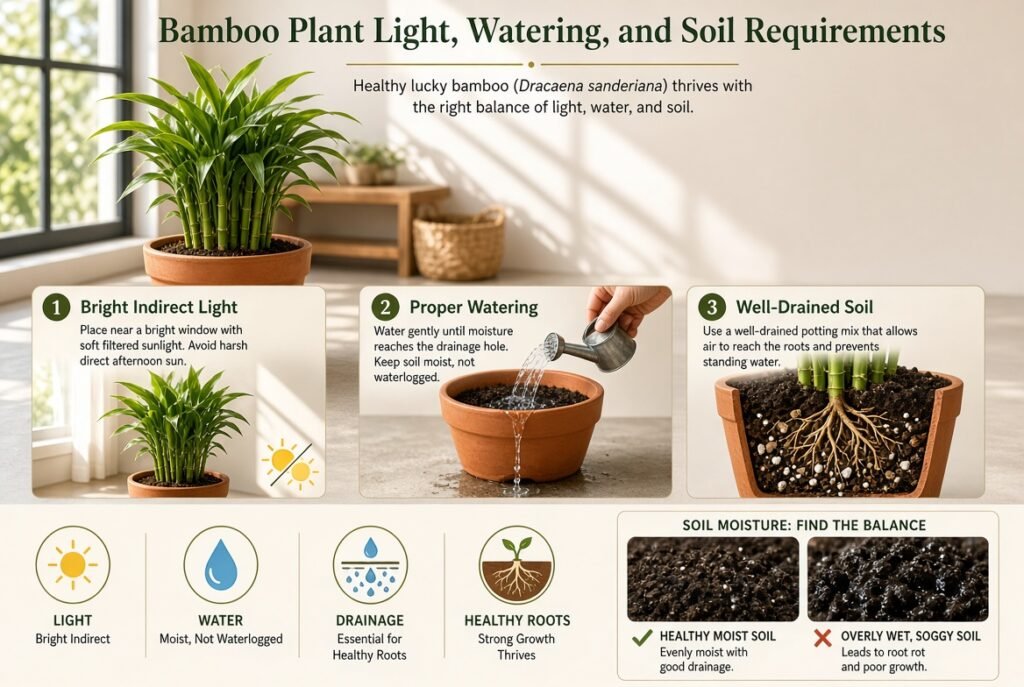
Lucky bamboo grows best in bright, indirect light.
Place it near a bright window where sunlight is filtered through curtains or reaches the plant without intense direct exposure.
Good locations include:
- Near an east-facing window
- A few feet from a bright south-facing window
- Near a bright north-facing window
- A bright office with filtered daylight
- A room with consistent indirect natural light
Avoid intense direct sunlight
Strong direct sun can scorch lucky bamboo leaves.
Signs of excessive light include:
- Brown patches
- Bleached-looking foliage
- Crispy leaf edges
- Yellowing after sudden exposure to sun
If the plant currently sits in direct sunlight, do not move it from intense sun into a very dark room.
Instead, move it gradually toward filtered or indirect light.
What if your room is dark?
Lucky bamboo tolerates lower light better than many houseplants.
However, tolerance is not the same as ideal growth.
A plant kept in very low light may grow slowly and produce weaker, less attractive foliage.
If natural light is insufficient, a suitable artificial grow light can help.
Image Suggestion: A simple indoor light-placement infographic showing bright indirect light, filtered window light, and harmful direct afternoon sun.
How to Water a Bamboo Plant
Watering is one of the most important parts of lucky bamboo care.
The correct method depends on whether your plant grows in soil or water.
If your bamboo grows in soil
Check the upper layer of soil before watering.
When the top inch feels dry, water thoroughly until excess water drains from the bottom.
Then empty the saucer.
Do not keep the root system sitting in standing water.
A practical routine is better than watering according to a fixed calendar.
A plant may need water more frequently in warm, bright conditions and less frequently during periods of slow growth.
If your bamboo grows in water
Keep enough clean water around the roots to prevent them from drying out.
Change the water regularly rather than simply topping up the container forever.
A weekly water change is a practical routine for water-grown lucky bamboo.
Clean the container whenever you notice algae, sediment, cloudiness, or unpleasant odors.
What type of water should you use?
Lucky bamboo can be sensitive to chemicals commonly found in some tap water.
If you repeatedly notice brown tips or yellow leaves while using tap water, consider switching to:
- Filtered water
- Distilled water
- Rainwater where safe and appropriate
Water quality can make a noticeable difference with sensitive dracaenas.
The biggest watering mistake
Do not assume more water means faster growth.
In soil, constantly wet conditions reduce oxygen around the roots and can contribute to root or stem problems.
In water culture, stagnant dirty water can create an unhealthy environment.
The goal is moisture, not neglecting oxygen around the roots.
How to Grow Lucky Bamboo in Water
Water-grown lucky bamboo is popular because it looks attractive in glass containers.
It is also easy to maintain when the water stays clean.
Step 1: Choose a stable container
Select a container that keeps the stems upright.
A narrow base can make tall arrangements unstable.
Step 2: Add clean water
Use enough water to cover the roots.
Avoid unnecessarily submerging large sections of the stems.
Step 3: Add stones if needed
Clean pebbles can help support the stems and prevent the arrangement from tipping.
They also give roots something to grow around.
Step 4: Change the water regularly
Replace the water approximately once a week.
Rinse the container and gently clean away accumulated residue.
Step 5: Watch the roots
Healthy roots are generally firm and show normal coloration.
Soft, dark, foul-smelling roots indicate that something is wrong.
At that point, remove unhealthy tissue with clean tools and refresh the growing environment.
Step 6: Feed sparingly
Water-grown plants have little nutritional reserve compared with plants growing in soil.
Use a weak liquid houseplant fertilizer rather than applying concentrated fertilizer.
More fertilizer is not better.
How to Grow Lucky Bamboo in Soil
Growing lucky bamboo in soil can be simpler for long-term care because the plant has access to a more complete root environment.
Choose:
- A quality indoor potting mix
- A container with drainage holes
- A pot only slightly larger than the root system
Avoid heavy garden soil in an indoor container.
Watering soil-grown bamboo
Allow the upper inch of soil to become slightly dry before watering.
Then water thoroughly.
Let excess water escape through the drainage holes.
Never allow the pot to sit continuously in collected water.
Why drainage matters
Roots need both moisture and oxygen.
Poorly draining soil stays saturated longer, increasing the risk of root decline.
A drainage hole is more useful than a decorative pot with no way for excess water to escape.
Best Soil for a Bamboo Plant
For lucky bamboo, use a well-drained indoor potting mix.
A suitable commercial houseplant mix is usually sufficient.
You can improve drainage by using a mix containing materials such as:
- Perlite
- Fine bark
- Coco coir
- Other well-draining components
Do not create an extremely dry, gritty mixture designed for desert succulents.
Lucky bamboo appreciates moisture.
It simply does not appreciate stagnant, airless soil.
A common container mistake
Do not add a thick layer of gravel to the bottom of a pot to “improve drainage.”
This does not solve a poorly draining soil problem.
Instead, choose a container with proper drainage and use an appropriate potting mix.
How Often Should You Fertilize Bamboo?
Lucky bamboo does not require heavy feeding.
Overfertilizing is one of the easiest ways to create unnecessary problems.
For soil-grown plants, a diluted houseplant fertilizer during active growth is generally sufficient.
For water-grown plants, use an even weaker solution.
Always follow the fertilizer label and avoid repeatedly increasing the dose because growth appears slow.
Signs of excessive fertilizer
Watch for:
- Brown leaf tips
- Yellowing
- Salt deposits around the container
- Declining roots
- Sudden leaf damage
If fertilizer buildup is suspected in soil, thoroughly flush the growing medium with clean water and allow excess water to drain completely.
Temperature and Humidity Requirements
Lucky bamboo prefers warm, stable indoor conditions.
Keep it away from:
- Cold drafts
- Air-conditioning vents
- Heating vents
- Very cold windows
- Sudden temperature changes
Normal comfortable indoor temperatures are usually suitable.
Does lucky bamboo need high humidity?
It can tolerate ordinary household conditions, but extremely dry air may contribute to brown leaf tips.
If your home becomes very dry:
- Move the plant away from heating vents.
- Group plants together.
- Improve room humidity when necessary.
- Avoid relying on constant leaf misting as the only solution.
Humidity should support good growing conditions, not compensate for poor watering or inadequate light.
How to Prune a Bamboo Plant
Pruning helps control height and maintain an attractive shape.
Use sharp, clean scissors or pruning shears.
Remove:
- Yellow leaves
- Dead leaves
- Damaged foliage
- Weak or unwanted shoots
- Overgrown stems when necessary
If a cane has become too tall, it can be cut back above a growth point.
New shoots can develop from suitable nodes below the cut.
Do not repeatedly remove large amounts of healthy foliage simply to make the plant look smaller.
Prune gradually.
A useful shaping strategy
If several canes are growing at different heights, make selective cuts rather than trimming everything to exactly the same height.
Natural variation usually creates a more attractive arrangement.
Image Suggestion: A step-by-step pruning diagram showing a tall lucky bamboo cane, the correct cutting point, and new growth developing below the cut.
How to Repot a Bamboo Plant
Lucky bamboo does not need frequent repotting.
Repot when:
- Roots completely fill the container.
- Roots circle densely around the pot.
- Water drains unusually quickly.
- Soil has broken down.
- The plant repeatedly dries out too quickly.
- The container becomes unstable because of the plant’s size.
Choose a pot only one size larger.
A dramatically oversized pot can hold more moisture than the roots can use.
Repotting steps
- Water the plant lightly before repotting if the soil is extremely dry.
- Remove the plant carefully.
- Inspect the roots.
- Remove damaged or rotting roots with clean tools.
- Add fresh, well-drained potting mix.
- Position the plant at the same general depth.
- Fill around the roots without compacting the soil excessively.
- Water thoroughly.
- Return the plant to bright, indirect light.
Give the plant time to recover rather than immediately applying heavy fertilizer.
How to Propagate Lucky Bamboo
Lucky bamboo is commonly propagated from stem or shoot cuttings.
Choose a healthy section with a viable growth point.
Basic propagation method
- Select a healthy shoot.
- Use clean, sharp scissors.
- Make a clean cut above a suitable node.
- Remove lower leaves that would sit underwater.
- Place the cutting in clean water.
- Keep it in bright, indirect light.
- Change the water regularly.
- Wait for roots to develop.
New roots may develop within a few weeks under suitable conditions.
Once the cutting has a useful root system, it can remain in water or be transferred to soil.
Bamboo Plant Care Through the Seasons
Lucky bamboo is usually grown indoors, so seasonal changes are less dramatic than with outdoor bamboo.
However, your watering and feeding routine should still respond to environmental changes.
Spring
As daylight increases:
- Check soil moisture more often.
- Resume regular feeding if the plant is actively growing.
- Prune damaged or weak growth.
- Consider repotting if roots are crowded.
- Clean dusty leaves.
Summer
Higher temperatures and brighter light can increase water use.
Check the plant more frequently rather than automatically increasing watering.
Keep it away from harsh afternoon sun.
If moving the plant outdoors, place it in a shaded or protected location and acclimate it gradually.
Fall
Growth may slow as light levels decrease.
Reduce fertilizer if active growth declines.
Check the plant for pests before moving it indoors from outside.
Winter
Indoor light can become weaker.
Move the plant closer to a bright indirect-light source if necessary.
Reduce watering frequency if the soil remains wet longer.
Keep the plant away from cold drafts and heating vents.
The calendar should guide observation, not replace it.
Why Are My Bamboo Plant Leaves Turning Yellow?
Yellow leaves are a symptom, not a diagnosis.
The cause depends on the plant’s growing conditions.
1. Too much water
This is one of the first things to investigate in soil-grown lucky bamboo.
Check whether the soil stays wet for long periods.
Also inspect the roots for signs of deterioration.
2. Poor water quality
Lucky bamboo can react poorly to certain chemicals in water.
If yellowing repeatedly occurs after watering with tap water, try filtered or distilled water.
3. Excessive sunlight
Strong direct sunlight can damage lucky bamboo foliage.
Move the plant into bright, indirect light.
4. Nutritional problems
Plants grown in water for long periods may eventually require nutrients.
However, do not respond to yellow leaves by immediately applying large amounts of fertilizer.
5. Natural aging
An occasional older lower leaf can yellow and fall naturally.
Look at the overall plant rather than diagnosing the entire plant from one aging leaf.
Why Are the Leaves Turning Brown?
Brown tips usually indicate environmental stress.
Possible causes include:
- Low humidity
- Water-quality issues
- Excess fertilizer
- Too much direct sun
- Inconsistent watering
- Root problems
Start with the simplest observations.
Ask:
Has the plant recently moved?
Did the watering routine change?
Is it receiving direct sunlight?
Has the fertilizer concentration increased?
Has the water source changed?
This approach is more useful than treating every brown leaf with the same solution.
Why Is My Bamboo Plant Drooping?
Drooping can result from several different problems.
Check the soil first
If the soil is very dry, underwatering may be responsible.
If the soil is constantly wet, root problems may be involved.
Check the light
Insufficient light can produce weak growth.
Check the temperature
Cold drafts or sudden temperature changes can stress tropical plants.
Check the roots
If the plant remains weak despite adequate moisture and light, inspect the root system during repotting.
Bamboo Plant Leaves Curling: What Does It Mean?
Curling leaves often indicate water stress or environmental stress.
Check:
- Soil moisture
- Room temperature
- Humidity
- Direct sunlight
- Recent relocation
- Water quality
Outdoor bamboo can also curl leaves when it is losing water faster than the roots can replace it.
Do not immediately increase watering without checking the soil.
Common Bamboo Plant Pests
Lucky bamboo is relatively easy to maintain, but pests can still appear.
Watch for:
- Spider mites
- Mealybugs
- Aphids
- Scale insects
Inspect the undersides of leaves and the areas where leaves meet stems.
Early detection makes control much easier.
A practical pest routine
If you find pests:
- Isolate the plant.
- Remove visible insects where practical.
- Rinse foliage gently if appropriate.
- Continue inspecting every few days.
- Use an appropriate insecticidal soap or other labeled treatment when necessary.
- Follow the product label carefully.
Do not treat a pest problem with increasingly strong chemicals without first identifying the pest.
Image Suggestion: Close-up comparison showing healthy bamboo leaves, spider-mite damage, mealybugs, and scale.
Can Bamboo Grow in Low Light?
This depends entirely on which bamboo you have.
Lucky bamboo
Lucky bamboo tolerates relatively low light and can remain attractive in indoor spaces with limited direct sunlight.
However, bright indirect light is generally better for strong, attractive growth.
True bamboo
Outdoor bamboo requirements vary by species.
Many true bamboos perform best with considerably more light than a typical dark office corner provides.
This is another reason identifying the plant matters.
Can You Keep Bamboo in a Bedroom?
Yes, lucky bamboo can generally be grown indoors in bedrooms if the environmental conditions are appropriate.
Choose a location with:
- Bright indirect light
- Stable temperatures
- Good airflow
- Suitable humidity
- No harsh direct sun
Do not place the plant directly against a heating or cooling vent.
If pets have access to the room, remember that lucky bamboo is considered toxic to pets.
Lucky Bamboo vs. True Bamboo: Which Care Routine Should You Follow?
Use this quick guide:
You probably have lucky bamboo if:
- It is sold as an indoor decorative plant.
- It has several smooth, green canes.
- The stems are braided or spiraled.
- It grows in water and pebbles.
- It fits easily on a desk or shelf.
- The leaves are narrow and arranged along cane-like stems.
You probably have true bamboo if:
- It grows outdoors.
- It produces tall woody culms.
- It spreads from underground rhizomes.
- It forms a grove or dense clump.
- The plant can reach several feet or much more.
If it is true bamboo, do not follow the indoor lucky-bamboo watering routine automatically.
How to Care for True Bamboo Outdoors
True bamboo requires a different approach.
Choose a species appropriate for your climate and available space.
Light
Requirements vary by species, but many landscape bamboos perform well with substantial sunlight.
Water
Newly planted bamboo needs consistent moisture while establishing.
Once established, watering depends on rainfall, soil type, temperature, and species.
Soil
Bamboo generally performs well in fertile, well-drained soil that retains adequate moisture without remaining saturated.
Mulch
A moderate organic mulch layer can help conserve moisture and protect the root zone.
Keep mulch away from direct contact with the main stems.
Fertilizer
Bamboo can be a heavy feeder, particularly when grown for vigorous ornamental growth.
Apply fertilizer according to the species, soil conditions, and product directions rather than guessing at high doses.
Clumping Bamboo vs. Running Bamboo
This is one of the most important decisions when planting true bamboo.
Clumping bamboo
Clumping types expand relatively slowly from a compact root structure.
They are generally easier to contain in a landscape.
Running bamboo
Running bamboo spreads through underground rhizomes.
Those rhizomes can travel beyond the original planting area.
A beautiful bamboo screen can become a difficult management problem if the species is planted without considering its spreading habit.
Before planting running bamboo, investigate appropriate containment methods for your region and species.
Image Suggestion: Split infographic comparing clumping bamboo’s compact root system with running bamboo’s spreading rhizomes.
Common Bamboo Care Mistakes to Avoid
Mistake 1: Treating lucky bamboo like outdoor bamboo
Lucky bamboo is a dracaena.
Its indoor requirements are very different from those of landscape bamboo.
Mistake 2: Putting lucky bamboo in direct sun
Bright indirect light is safer.
Intense direct sunlight can scorch foliage.
Mistake 3: Watering on a strict schedule
Plants do not consume exactly the same amount of water every week.
Check the soil and environmental conditions.
Mistake 4: Leaving soil permanently soggy
Constantly saturated soil can damage roots.
Use drainage holes and empty the saucer.
Mistake 5: Overfertilizing yellow leaves
Yellow leaves do not automatically mean fertilizer deficiency.
Water quality, light, and root problems may be more important.
Mistake 6: Ignoring water quality
If your lucky bamboo repeatedly develops brown tips or yellow foliage, investigate the water source.
Mistake 7: Keeping water-grown bamboo in dirty water
Water culture requires maintenance.
Replace the water regularly and clean the container when necessary.
Mistake 8: Repotting into a huge container
A large pot can retain excessive moisture.
Increase pot size gradually.
Mistake 9: Ignoring pests
Inspect leaves and stems regularly.
Small pest populations are easier to control than established infestations.
Mistake 10: Planting running bamboo without planning
True running bamboo can spread through underground rhizomes.
Choose the species and containment strategy before planting.
A Simple Weekly Bamboo Care Routine
You do not need to spend hours caring for lucky bamboo.
Once a week, perform a quick inspection.
Weekly checklist
- Check the light.
- Feel the soil if grown in a pot.
- Check the water level if grown hydroponically.
- Replace water when appropriate.
- Look for yellow or brown leaves.
- Inspect stems and leaf undersides for pests.
- Remove dead foliage.
- Check that drainage holes are functioning.
- Rotate the container if growth is leaning toward the light.
This short routine catches most problems before they become serious.
How to Know Your Bamboo Is Healthy
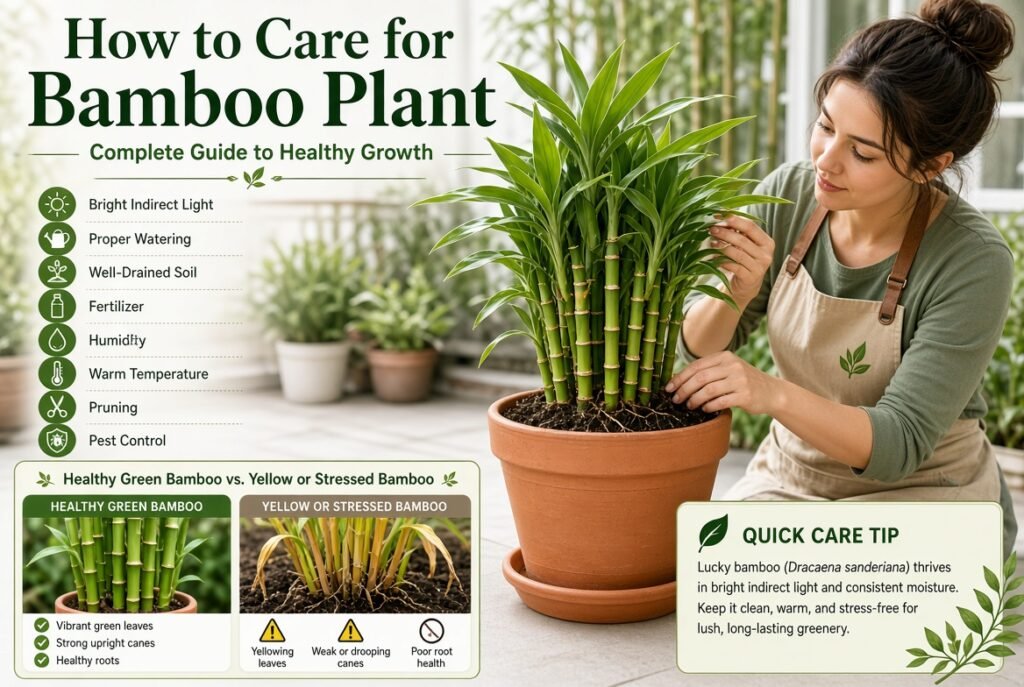
A healthy lucky bamboo should generally show:
- Firm green stems
- Healthy green leaves
- New growth during active periods
- No foul-smelling water
- No mushy roots
- No persistent standing water
- No widespread leaf discoloration
- No obvious pest infestation
Remember that one old yellow leaf does not necessarily mean the entire plant is unhealthy.
Look for patterns.
A gradual decline across multiple leaves is much more meaningful than an isolated aging leaf.
Expert Tip: Change One Variable at a Time
When a bamboo plant begins declining, beginners often make several changes simultaneously.
They move it to a new window, add fertilizer, increase watering, change the soil, mist the leaves, and repot it.
That makes diagnosis harder.
Instead, inspect the plant systematically.
Start with:
- Light
- Water
- Roots
- Temperature
- Water quality
- Fertilizer
- Pests
Correct the most obvious problem first.
Then observe the plant before making several additional changes.
This simple approach prevents many cases of “helpful” overcare.
Frequently Asked Questions
How often should I water a bamboo plant?
For soil-grown lucky bamboo, check the top inch of soil and water when it becomes dry. Water thoroughly and allow excess water to drain. The exact interval changes with light, temperature, pot size, and season.
Does bamboo need direct sunlight?
Lucky bamboo does not need direct sunlight. Bright, indirect light is generally the safer choice. Strong direct sun can scorch its leaves.
Can lucky bamboo grow only in water?
No. Lucky bamboo can grow in water or a well-drained potting mix. Water culture requires regular water changes and careful attention to water quality.
Why is my bamboo turning yellow?
Possible causes include excessive moisture, poor water quality, excessive sunlight, nutrient problems, or natural aging. Check the growing conditions before adding fertilizer.
Should I use tap water for lucky bamboo?
It depends on your local water quality. If your plant repeatedly develops brown tips or yellow leaves, try filtered or distilled water and compare its response.
How do I make my bamboo grow faster?
Give it appropriate light, consistent moisture, suitable temperatures, and modest nutrition during active growth. Avoid forcing growth with excessive fertilizer.
Can I put lucky bamboo outside?
Yes, temporarily in suitable warm conditions. Choose a shaded or protected location and acclimate it gradually. Bring it indoors before temperatures become too cold.
How do I make lucky bamboo grow more leaves?
Provide suitable indirect light and avoid excessive pruning. Healthy plants generally produce better foliage when their basic growing conditions are stable.
How do I revive a dying bamboo plant?
First identify the problem instead of immediately watering or fertilizing it. Check the roots, soil moisture, light, temperature, water quality, and pests. Remove severely damaged material and correct the underlying condition.
Is lucky bamboo actually bamboo?
No. Lucky bamboo is Dracaena sanderiana, a tropical dracaena from the asparagus family. It only resembles bamboo because of its cane-like stems.
Can true bamboo be grown indoors?
Some smaller species can be grown in containers, but true bamboo generally requires more space and stronger growing conditions than lucky bamboo. Species selection is critical.
Is running bamboo safe to plant in a small garden?
Running bamboo requires careful planning because underground rhizomes can spread beyond the original planting area. A clumping species may be more manageable where containment space is limited.
Conclusion
The easiest way to successfully care for a bamboo plant is to identify the plant first.
If you have lucky bamboo, focus on bright indirect light, clean water, appropriate moisture, good drainage, warm conditions, and light feeding. Avoid direct sun, permanently soggy soil, excessive fertilizer, and neglected water containers.
If you have true bamboo, think more like a landscape gardener. Species, sunlight, soil, water, mature size, and rhizome behavior all matter.
Most bamboo problems are not caused by a lack of complicated care. They usually come from one basic mismatch between the plant and its environment.