Quick Answer
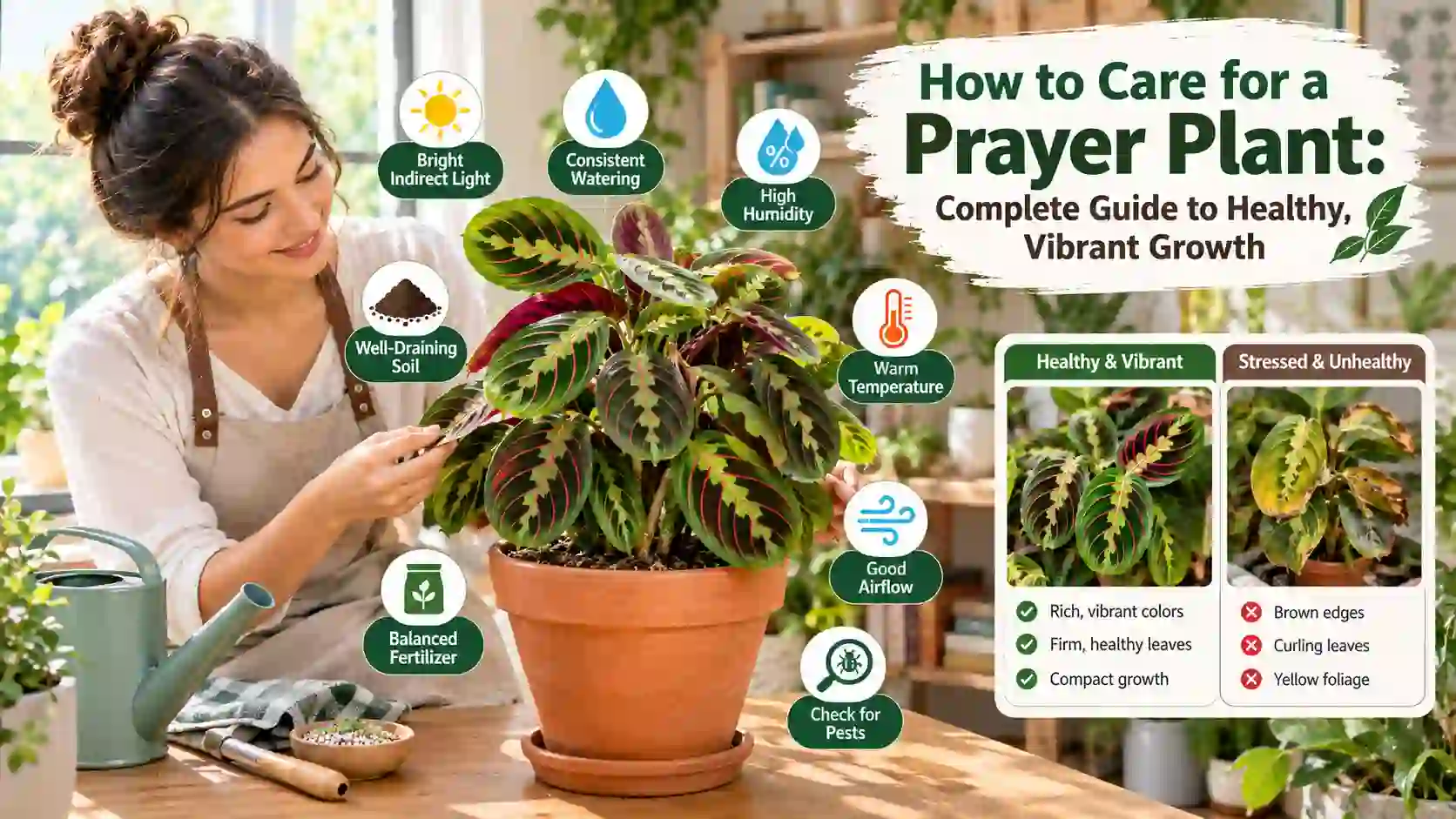
To learn how to care for a prayer plant, provide bright indirect light, consistently lightly moist but well-drained soil, moderate to high humidity, and warm temperatures. Water when the upper layer of soil begins to dry, avoid harsh direct sunlight, and protect the plant from cold drafts. Prayer plants also benefit from good airflow, occasional feeding during active growth, and regular inspection for pests and dry leaf edges.
Introduction
Prayer plant is loved for its beautifully patterned leaves and fascinating daily movement. Many prayer plants raise or fold their leaves in the evening, which gives them their common name.
They are also among the houseplants that can become frustrating when their environment is slightly wrong.
Brown leaf edges, curling leaves, yellow foliage, slow growth, and drooping are common complaints. The problem is that these symptoms can have several different causes. A brown edge does not always mean the plant needs more water, and a drooping prayer plant does not always need watering.
The key to how to care for a prayer plant is learning to balance moisture, humidity, light, temperature, and soil drainage. Once those conditions are stable, prayer plants can produce lush foliage and maintain their striking patterns for years.
Understanding the Prayer Plant
Prayer plant is a common name primarily associated with plants in the genus Maranta. Different varieties have distinctive leaf markings, colors, and growth habits.
They are tropical plants that naturally grow in warm, humid environments with filtered or dappled light.
This explains many of their indoor-care preferences.
They generally appreciate:
- Bright filtered light
- Warm temperatures
- Higher humidity
- Even moisture
- Well-draining soil
- Protection from harsh afternoon sunlight
Their natural environment provides moisture without exposing them to the intense drying conditions of an open, full-sun landscape.
Image Suggestion: A realistic botanical infographic labeling prayer plant leaves, stems, roots, soil, humidity, and indirect-light requirements.
How Much Light Does a Prayer Plant Need?

Light is one of the first things to evaluate when a prayer plant starts struggling.
Prayer plants generally prefer bright indirect light.
A location near a bright window can work well if direct sunlight is filtered by a sheer curtain or other barrier.
Why direct sunlight can cause problems
Strong direct sunlight can scorch delicate foliage.
You may notice:
- Brown patches
- Faded leaf markings
- Bleached areas
- Crispy leaf edges
- Curling or stress after sudden exposure
This does not mean prayer plants should live in darkness.
Too little light can also cause problems.
Signs of insufficient light
A prayer plant receiving inadequate light may develop:
- Slow growth
- Smaller new leaves
- Less vibrant coloration
- Long, weak stems
- Soil that stays wet for unusually long periods
That last symptom is particularly important.
A plant using less water because of weak light can remain in damp soil longer, increasing the risk of root problems.
The ideal position
Try:
Bright room + filtered sunlight + protection from intense afternoon rays.
An east-facing window can be particularly convenient because it often provides gentler morning sunlight.
For a very bright south- or west-facing window, move the plant farther back or filter the sunlight.
Image Suggestion: 16:9 infographic showing three locations—bright indirect light, harsh direct sunlight, and low light—with healthy, scorched, and stretched prayer plants.
What Soil Is Best for a Prayer Plant?
Prayer plants need moisture, but their roots should not remain submerged in saturated soil.
The ideal growing medium balances two needs:
Moisture retention + air-filled drainage.
A suitable houseplant mix can contain:
- Quality indoor potting mix
- Coco coir or another moisture-retaining component
- Perlite or pumice
- A small amount of fine bark or another aerating material
The exact recipe is less important than the result.
The soil should stay lightly moist while still allowing excess water to escape.
Why heavy soil causes trouble
Dense soil can remain saturated around the roots.
This may lead to:
- Poor root oxygenation
- Root deterioration
- Yellowing leaves
- Wilting despite wet soil
- Slow growth
If water sits on top of the soil or takes an unusually long time to drain, investigate the growing medium and drainage holes.
How Often Should You Water a Prayer Plant?
Prayer plants prefer more consistent moisture than drought-tolerant succulents.
However, consistently moist does not mean constantly wet.
The best approach is to check the soil before watering.
A practical watering method
- Check the upper layer of soil.
- If it has begun to dry, examine deeper moisture.
- Water thoroughly when the plant needs it.
- Allow excess water to drain.
- Empty the saucer or decorative cachepot.
- Monitor the soil again before the next watering.
Do not water simply because it has been seven days.
Indoor conditions change throughout the year.
Factors that affect watering frequency
Your prayer plant may dry faster when:
- The room is warm
- Light is strong
- Airflow is good
- The pot is small
- The plant is actively growing
It may dry more slowly when:
- Temperatures are cool
- Light is weak
- Humidity is high
- The pot is large
- Growth has slowed
This is why a fixed watering schedule often causes problems.
What Type of Water Is Best for Prayer Plants?
Prayer plants can sometimes be sensitive to minerals and salts in water.
Depending on your local water quality, repeated use of mineral-heavy tap water may contribute to leaf-edge browning or mineral buildup in the soil.
Possible options include:
- Filtered water
- Rainwater where safely collected
- Distilled water when appropriate
- Good-quality tap water if your plant tolerates it
You do not necessarily need special water if your tap water is suitable.
Watch the leaves
If your plant consistently develops brown edges despite appropriate moisture and humidity, water quality is one factor worth investigating.
A white or crusty buildup on the soil can also indicate mineral accumulation.
Expert tip: Avoid changing several variables simultaneously. If the plant suddenly improves after changing water, humidity, or light, you will have a better idea which factor was contributing to the problem.
Humidity: One of the Biggest Prayer Plant Care Factors
Prayer plants generally appreciate moderate to high humidity.
Dry indoor air can contribute to:
- Brown leaf tips
- Crispy margins
- Curling leaves
- Poor-looking new growth
This becomes especially noticeable during periods when indoor heating or air conditioning reduces humidity.
Ways to increase humidity
You can use:
- A humidifier
- Grouped plants
- A naturally humid room
- A pebble tray with water below the pot level
A humidifier provides the most controllable option when the surrounding air is consistently dry.
Does misting work?
Misting may temporarily increase moisture around the foliage, but its effect is usually short-lived.
It should not be considered a substitute for maintaining suitable ambient humidity.
Avoid keeping leaves constantly wet, especially when airflow is poor.
The Best Temperature for a Prayer Plant
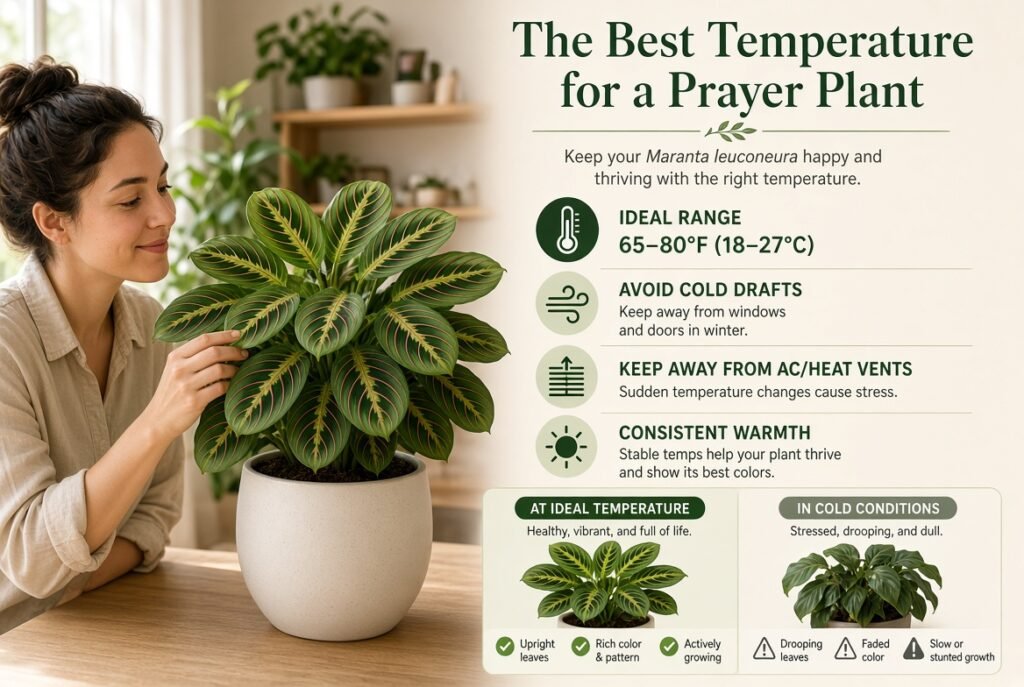
Prayer plants prefer warm, stable conditions.
Avoid placing them near:
- Cold drafts
- Exterior doors
- Very cold windows
- Air-conditioning vents
- Radiators
- Strong heating vents
Sudden temperature changes can cause stress even when the average room temperature seems acceptable.
Why stable temperatures matter
Tropical plants respond to their environment over time.
A plant repeatedly exposed to cold drafts may show:
- Curling leaves
- Drooping
- Discoloration
- Slower growth
- Leaf loss
A stable indoor location is often better than moving the plant around frequently.
How to Fertilize a Prayer Plant
Prayer plants benefit from nutrients during active growth.
A balanced liquid houseplant fertilizer can be used according to the product’s label instructions.
Avoid applying excessive fertilizer.
Too much fertilizer can lead to salt accumulation and root stress.
When to fertilize
Feed primarily during active growth.
Reduce or pause feeding when:
- Growth has slowed significantly
- Light levels are poor
- The plant is stressed
- The plant has recently experienced root problems
A common mistake
Some growers respond to pale or slow growth by immediately increasing fertilizer.
But poor light, root problems, temperature stress, or watering issues can cause similar symptoms.
Always check the growing environment first.
Choosing the Right Pot
A prayer plant needs a container with functional drainage holes.
Decorative pots without drainage can trap water around the roots.
If you love using a decorative cachepot, keep the plant in a nursery pot with drainage and remove it when watering.
Should a prayer plant be root-bound?
Prayer plants can tolerate being somewhat snug in their pots, but severe root crowding can eventually restrict water and nutrient uptake.
Look for:
- Roots circling heavily around the container
- Roots emerging from drainage holes
- Water running through the pot unusually quickly
- Growth slowing despite good conditions
These signs may indicate that repotting is appropriate.
How to Repot a Prayer Plant
Repotting does not need to be complicated.
Step-by-step
- Choose a container only modestly larger than the current one.
- Make sure it has drainage holes.
- Prepare fresh, well-draining soil.
- Gently remove the plant.
- Inspect the root system.
- Loosen severely compacted roots carefully.
- Remove obviously damaged roots with clean tools if needed.
- Position the plant at approximately the same depth.
- Fill around the roots with fresh soil.
- Water appropriately and return the plant to suitable light.
Avoid oversized containers
A huge pot can hold excess moisture for too long.
For a prayer plant, moving up one reasonable pot size is often more useful than dramatically increasing the container size.
Image Suggestion: Step-by-step 16:9 infographic showing prayer plant removal, healthy roots, new pot, fresh soil, drainage holes, and correct planting depth.
Why Are Prayer Plant Leaves Curling?
Leaf curling is one of the most common prayer plant complaints.
Possible causes include:
- Dry soil
- Low humidity
- Excessive light
- Heat stress
- Cold stress
- Root problems
- Water-quality issues
Start with the soil
If the soil is very dry, the plant may be experiencing water stress.
If the soil is wet, watering again could make the problem worse.
Then examine the environment
Ask:
- Is the plant near a heater?
- Is it receiving harsh direct sun?
- Is humidity very low?
- Has it recently been moved?
- Is there a cold draft?
Treat the underlying condition rather than the curled leaves themselves.
Why Are Prayer Plant Leaves Turning Brown?
Brown leaf edges are particularly common when environmental conditions are too dry or inconsistent.
Potential causes include:
- Low humidity
- Mineral-heavy water
- Underwatering
- Excessive fertilizer
- Root stress
- Direct sunlight
- Physical damage
Brown edges versus brown patches
Crispy edges: Often associated with dry air, inconsistent moisture, or mineral buildup.
Large bleached or brown patches: More likely to involve sun exposure, physical damage, or severe stress.
The pattern matters.
Image Suggestion: Realistic troubleshooting infographic showing brown leaf tips, sunburn patches, underwatering, and healthy prayer plant foliage with labeled causes.
Why Are Prayer Plant Leaves Turning Yellow?
Yellow leaves do not automatically mean the plant needs fertilizer.
Common causes include:
- Overwatering
- Poor drainage
- Low light
- Root problems
- Natural aging
- Temperature stress
If several leaves become yellow while the soil remains wet, check the root environment.
If only an older lower leaf is yellow while new growth is healthy, natural aging may be involved.
Why Is My Prayer Plant Drooping?
A prayer plant may droop because of:
- Dry soil
- Root problems
- Temperature stress
- Recent environmental changes
- Insufficient light
- Severe overwatering
Check the soil before watering.
This simple step prevents one of the most common houseplant mistakes: watering a plant that is already sitting in wet soil.
Wet soil + drooping leaves
This combination deserves more attention than dry soil + drooping leaves.
If roots are damaged, they may not absorb water effectively even when plenty of water surrounds them.
Why Is My Prayer Plant Not Moving at Night?
Prayer plants are famous for their leaf movements.
These movements are related to changes in light and the plant’s internal biological rhythms.
However, movement can vary between plants and environmental conditions.
A plant that does not visibly fold its leaves at night is not necessarily unhealthy.
Check its:
- Light
- Temperature
- Watering
- Humidity
- Overall leaf condition
Healthy growth matters more than dramatic nightly movement.
Why Is My Prayer Plant Losing Leaves?
Leaf loss can result from:
- Sudden environmental changes
- Cold temperatures
- Dry conditions
- Root problems
- Pests
- Low light
- Overwatering
Think about what changed immediately before the symptoms appeared.
For example, if the plant looked healthy until it was moved next to an air conditioner, temperature and airflow deserve attention.
Prayer Plant Pests to Watch For
Prayer plants can attract common indoor plant pests.
Potential pests include:
- Spider mites
- Mealybugs
- Scale insects
- Aphids
- Fungus gnats
Inspect regularly
Look closely at:
- Leaf undersides
- New growth
- Leaf joints
- Stems
- Soil surface
Spider mites can be especially problematic in dry conditions.
Look for:
- Fine webbing
- Tiny moving dots
- Speckled leaves
- Dull foliage
Early detection makes pest management considerably easier.
How to Prune a Prayer Plant
Prayer plants generally need light maintenance rather than aggressive pruning.
Remove:
- Completely dead leaves
- Severely damaged foliage
- Diseased material
- Very weak growth when necessary
Use clean scissors or pruning shears.
What about brown leaves?
You can remove an entire badly damaged leaf at its base.
If only the tip is brown, trimming the damaged section can improve appearance, but it will not reverse the underlying cause.
If new leaves continue developing brown edges, fix the environmental issue rather than repeatedly trimming symptoms.
How to Propagate a Prayer Plant
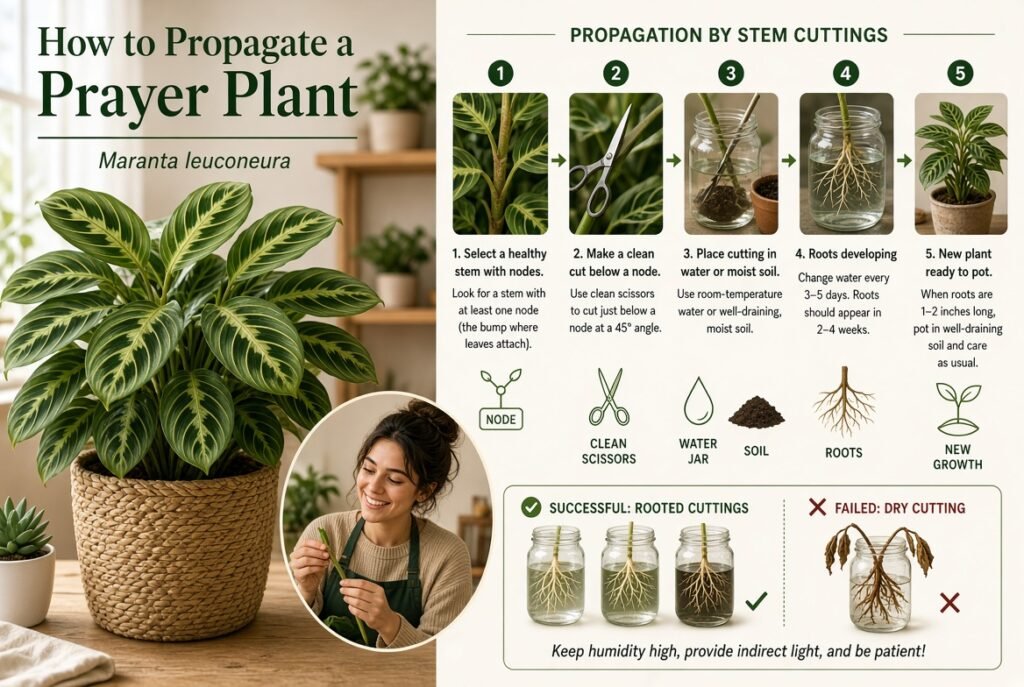
Many prayer plants can be propagated through stem cuttings or division, depending on the particular plant.
Propagation by division
Division is often practical when a mature plant has multiple established sections.
A basic approach:
- Remove the plant carefully.
- Identify natural divisions.
- Separate sections with healthy roots.
- Pot each division in appropriate soil.
- Maintain warm, stable conditions.
- Keep moisture consistent without saturating the soil.
Propagation from stem cuttings
Select a healthy stem section with appropriate nodes.
Place the cutting in a suitable propagation medium or water, depending on the method being used.
Once roots develop sufficiently, transfer the plant carefully into a suitable growing medium.
Image Suggestion: Four-step propagation infographic showing a mature prayer plant, division of rooted sections, potting, and new healthy growth.
How to Care for a Prayer Plant in Winter
Winter care often requires a change in routine.
Indoor conditions may become:
- Drier
- Cooler
- Less bright
This combination can create problems.
During winter
Consider:
- Moving the plant closer to suitable bright light
- Increasing humidity if indoor air becomes dry
- Keeping it away from cold drafts
- Watering according to soil moisture rather than summer habits
- Reducing fertilizer if growth slows
Do not compensate for lower light by keeping the soil constantly wet.
Prayer Plant Care in Different Rooms
| Location | Main Advantage | Main Risk |
|---|---|---|
| Bright bedroom | Stable indoor conditions | Dry air |
| Bathroom with window | Higher humidity | Insufficient light |
| Living room | Easy monitoring | Air conditioning |
| Kitchen | Often warmer and humid | Temperature fluctuations |
| Near sunny window | Strong light | Direct-sun damage |
| Dark corner | Decorative placement | Weak growth |
A bathroom can be excellent only if it also provides adequate light.
High humidity cannot compensate for insufficient light.
A Simple Weekly Prayer Plant Care Routine
You do not need to fuss over a prayer plant every day.
Once or twice a week
Check:
- Soil moisture
- Leaf condition
- New growth
- Pests
- Humidity and temperature conditions
Before watering
Ask:
- Is the upper soil beginning to dry?
- Is the deeper soil still saturated?
- Has the plant recently received water?
- Is the plant actively growing?
Once a month
Inspect:
- Leaf undersides
- Stems
- Drainage
- Root-zone condition
- New growth
- Soil surface
This routine helps you notice problems before they become severe.
The Most Common Prayer Plant Care Mistakes
1. Keeping the soil constantly wet
Prayer plants like moisture, but their roots still need oxygen.
Better approach: Maintain even moisture while allowing appropriate surface drying.
2. Putting the plant in harsh sunlight
Direct afternoon sun can scorch the foliage.
Better approach: Use bright filtered or indirect light.
3. Keeping it in a dark corner
Low light can slow growth and prolong soil moisture.
Better approach: Move it closer to a bright window while filtering harsh sunlight.
4. Watering according to a calendar
Every seven days is not always correct.
Better approach: Check the soil first.
5. Ignoring humidity
Dry indoor air can produce crispy leaf edges.
Better approach: Improve ambient humidity when necessary.
6. Fertilizing stressed plants
Nutrients do not repair damaged roots.
Better approach: Correct light, moisture, temperature, and drainage first.
7. Using a pot without drainage
This makes overwatering much easier.
Better approach: Use a container with functional drainage holes.
8. Changing everything at once
If you move the plant, repot it, change water, increase fertilizer, and add a grow light simultaneously, it becomes difficult to identify what helped.
Better approach: Change the most likely problem first and observe.
Prayer Plant Care: A Troubleshooting Table
| Symptom | Possible Causes | First Thing to Check |
|---|---|---|
| Brown edges | Low humidity, dry soil, water quality | Soil and humidity |
| Yellow leaves | Wet soil, low light, aging | Root-zone moisture |
| Curling leaves | Dryness, heat, light stress | Soil moisture |
| Drooping | Dryness, root damage, temperature | Soil moisture |
| No new growth | Low light, poor roots, low temperature | Light and roots |
| Few flowers | Indoor conditions, plant maturity | Light and overall health |
| Leaf spots | Sun, pests, disease, physical damage | Pattern and location |
| Leaves falling | Cold, root stress, sudden change | Recent environmental changes |
| Fine webbing | Spider mites | Leaf undersides |
| Wet soil for many days | Poor drainage, low light, oversized pot | Soil and pot |
Advanced Tips for Healthier Prayer Plants
Think in terms of stability
Prayer plants often respond poorly to constantly changing conditions.
A stable environment is usually more beneficial than occasional bursts of perfect care.
Consistent:
- Moisture
- Light
- Temperature
- Humidity
can make a significant difference.
Watch new growth
New leaves are valuable indicators of current conditions.
Older leaves may carry damage from previous stress.
If new leaves emerge healthy while older leaves remain slightly damaged, the plant may already be recovering.
Rotate the plant carefully
If light comes primarily from one direction, occasional rotation can help maintain more balanced growth.
Do not rotate constantly.
Give the plant time to respond to its environment.
Clean dusty leaves
Dust can accumulate on broad leaves.
Gently cleaning foliage can improve appearance and allows you to inspect for pests.
Avoid aggressive rubbing because prayer plant leaves can be delicate.
Can Prayer Plants Grow Under Grow Lights?
Yes.
Grow lights can be useful when natural light is insufficient.
Place the plant at an appropriate distance from the light and follow the manufacturer’s guidance for the particular fixture.
Watch the plant rather than assuming stronger light is always better.
Signs of excessive light can include:
- Faded markings
- Bleached areas
- Scorching
Signs of inadequate light can include:
- Slow growth
- Weak stems
- Reduced leaf development
The goal is adequate light, not maximum light.
Can You Put a Prayer Plant Outside?
Yes, in a suitable warm climate.
However, an indoor-grown prayer plant should be acclimated gradually.
Outdoor conditions can expose it to:
- Stronger sunlight
- Wind
- Rain
- Temperature changes
- Pests
Choose a sheltered location with bright filtered light rather than immediately placing it in intense midday sun.
Bring it indoors before temperatures become unsuitable.
How to Keep Prayer Plant Leaves Looking Vibrant
The attractive patterns on prayer plant leaves depend on healthy growth.
For vibrant foliage:
- Provide suitable indirect light.
- Maintain consistent moisture.
- Avoid prolonged drought.
- Avoid saturated soil.
- Maintain suitable humidity.
- Protect the plant from harsh sun.
- Feed moderately during active growth.
- Inspect regularly for pests.
Leaf color is an outcome of good growing conditions, not something fertilizer can create by itself.
Frequently Asked Questions
How often should I water a prayer plant?
Water when the upper portion of the growing medium begins to dry while deeper soil is not already saturated. Environmental conditions determine the exact frequency.
Does a prayer plant need direct sunlight?
Usually, it performs better in bright indirect or filtered light. Strong direct sunlight can scorch its leaves.
Why are my prayer plant leaves turning brown?
Low humidity, inconsistent watering, mineral-heavy water, fertilizer buildup, excessive sunlight, and root stress can all contribute to brown leaves.
Should I mist my prayer plant?
Misting is optional and provides only temporary humidity. A humidifier or naturally humid environment is generally more effective for maintaining consistent humidity.
Why is my prayer plant curling its leaves?
Curling can result from dry soil, low humidity, heat, excessive light, cold, or root problems. Check the soil before watering.
Can prayer plants grow in low light?
They can tolerate lower light than some flowering plants, but they generally grow better in bright indirect light. Very low light can lead to slow growth and prolonged soil moisture.
What soil is best for prayer plants?
Use a well-draining indoor potting mix that retains some moisture while allowing excess water and air to move through the root zone.
Why is my prayer plant drooping even though the soil is wet?
Wet soil combined with drooping can indicate root stress or poor oxygen availability. Check drainage and the condition of the root system before adding more water.
How do I make my prayer plant bushier?
Provide appropriate light, consistent care, and prune or pinch suitable growth when necessary. Division can also create fuller-looking containers.
Do prayer plants like bathrooms?
They can appreciate bathroom humidity, but only if the room provides enough light. A dark bathroom is not an ideal permanent location.
Can I propagate a prayer plant?
Yes. Depending on the type, prayer plants can often be propagated through division or suitable stem cuttings.
Should I fertilize a prayer plant?
Moderate feeding during active growth can support healthy foliage. Avoid excessive fertilizer and do not use fertilizer to compensate for poor light or root problems.
Why is my prayer plant not folding its leaves at night?
Leaf movement varies with species, plant condition, light, and environment. Lack of dramatic movement does not automatically indicate poor health.
How do I prevent brown tips on prayer plant leaves?
Maintain appropriate soil moisture, improve humidity when necessary, avoid harsh direct sun, and consider water quality if mineral buildup or persistent browning occurs.
Related Plant-Care Topics
If you’re growing prayer plants alongside other tropical houseplants, these topics can also help:
- Calathea care
- Maranta propagation
- How to increase indoor humidity
- Indoor plant watering
- Houseplant soil and drainage
- How to treat spider mites
- Brown leaf tips on houseplants
- Best plants for humid rooms
These topics are particularly useful because prayer plant problems often overlap with general indoor-plant issues involving humidity, light, watering, and pests.
Final Takeaway
Learning how to care for a prayer plant is less about following a strict schedule and more about creating a stable environment.
Focus on bright indirect light, evenly moist but well-drained soil, suitable humidity, warm temperatures, good airflow, and moderate feeding during active growth.
When problems appear, investigate the conditions rather than treating the visible symptom alone. Brown edges may involve humidity or water quality. Curling may indicate dryness or environmental stress. Yellow leaves can point to excessive moisture or poor drainage.
Most importantly, remember that a prayer plant does not need perfect conditions every day. It needs consistent, suitable conditions over time. Once you understand how light, water, humidity, temperature, and soil interact, caring for this beautiful tropical houseplant becomes much more predictable.