
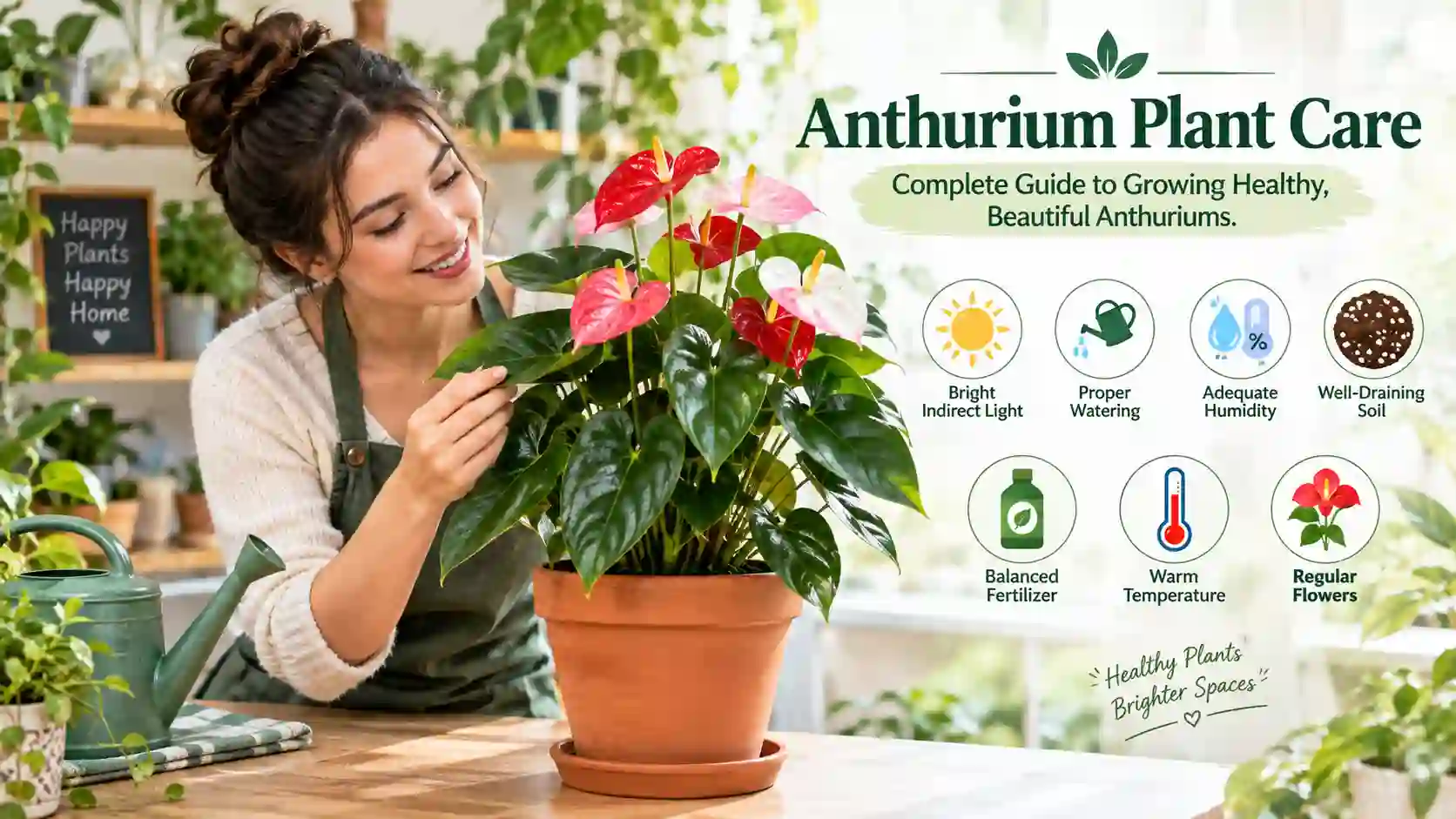
Anthurium plant care is mainly about providing bright indirect light, well-draining soil, consistent but careful watering, warmth, and moderate to high humidity. Water when the upper layer of soil begins to dry rather than keeping the roots constantly wet. Use an airy, acidic potting mix and protect the plant from harsh direct sunlight and cold drafts. With enough light and proper feeding, healthy anthuriums can produce colorful spathes for much of the year.
Anthuriums are popular indoor plants because they combine glossy foliage with long-lasting, colorful blooms.
Their bright red, pink, white, or orange “flowers” can look almost artificial. However, the colorful part is actually a modified leaf called a spathe. The upright structure in its center is the spadix, where the tiny flowers develop.
The classic flamingo flower, Anthurium andraeanum, is especially popular as a houseplant.
Despite their tropical appearance, anthuriums are not difficult when their basic needs are understood. Most problems come from a few repeated mistakes. These include poor drainage, insufficient light, overwatering, dry air, and exposure to cold temperatures.
This guide explains how to care for anthuriums from the first day you bring one home. It also covers yellow leaves, brown tips, root rot, pests, lack of flowers, repotting, and propagation.
Understanding Your Anthurium
Anthurium is a large genus in the Araceae family. Different species have very different appearances.
The classic flowering types have:
- Glossy, heart-shaped leaves
- Colorful spathes
- A central spadix
- Short or moderately long stems
- A compact growth habit
Other anthuriums are grown mainly for their foliage. Some have large, velvety leaves with striking veins rather than brightly colored spathes.
For example, Anthurium andraeanum is commonly grown for its colorful flowering display, while Anthurium crystallinum is prized for its decorative foliage.
This difference matters because not every anthurium has the same care requirements.
A simple rule is:
The more unusual the species, the more important it is to identify the plant before applying a generic care routine.
Image Suggestion
Create an educational botanical infographic showing an anthurium with labels for the leaf, spathe, spadix, stem, crown, and roots.
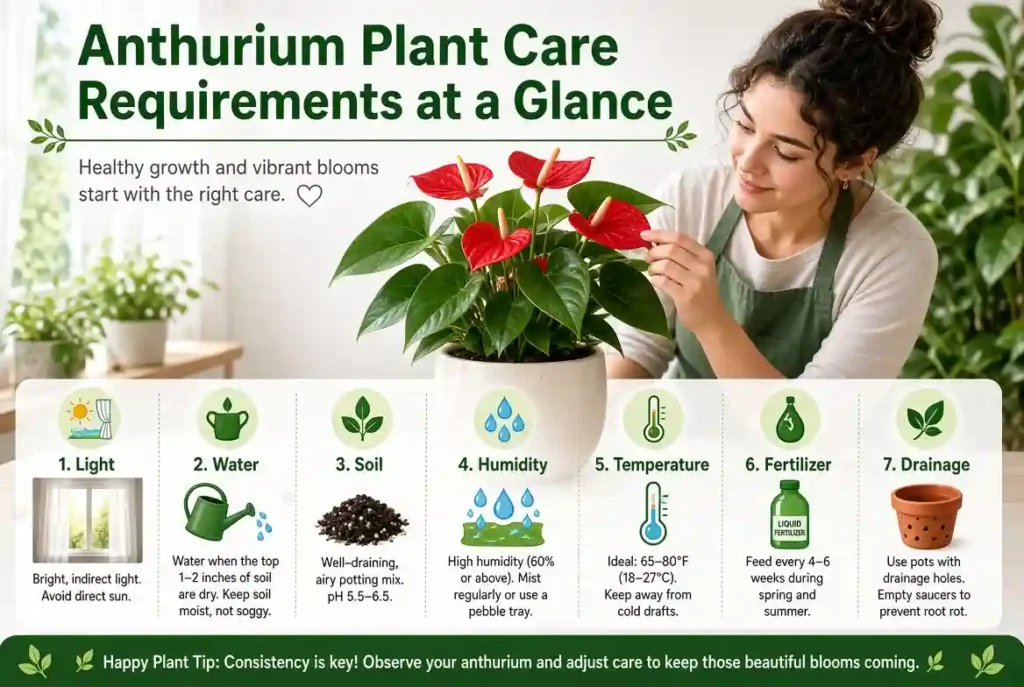
Anthurium Plant Care Requirements at a Glance
| Care Factor | What Anthurium Needs | Why It Matters |
|---|---|---|
| Light | Bright, indirect light | Supports healthy growth and flowering |
| Water | Water when the upper soil begins drying | Prevents both drought stress and root rot |
| Soil | Airy, acidic, fast-draining mix | Keeps roots oxygenated |
| Humidity | Moderate to high humidity | Reduces crispy leaf edges |
| Temperature | Warm, stable conditions | Protects tropical growth |
| Fertilizer | Regular feeding during active growth | Supports leaves and flowers |
| Pot | Drainage holes are essential | Prevents standing water |
| Repotting | Usually every 2–3 years or when rootbound | Refreshes the growing environment |
| Pruning | Remove damaged leaves and spent flower stems | Keeps the plant clean and healthy |
These requirements align with guidance from the RHS and university extension resources.
1. Give Your Anthurium Bright, Indirect Light
Light is one of the biggest factors controlling anthurium growth.
Anthuriums naturally grow in tropical environments where they receive filtered or dappled light. Indoor plants therefore perform best with bright light that is not harsh and direct.
An east-facing window can work particularly well. You can also place the plant near a bright south or west window if sheer curtains filter strong sunlight.
What happens with too much light?
Strong direct sunlight can scorch the foliage.
You may notice:
- Pale or bleached patches
- Brown crispy areas
- Yellowing leaves
- Dry-looking foliage
Move the plant farther from the window if this happens.
What happens with too little light?
Low light can be more subtle.
The plant may remain alive but produce:
- Smaller new leaves
- Slower growth
- Fewer flowers
- Longer gaps between blooms
NC State Extension notes that insufficient light reduces growth and flowering.
Practical light test
If you can comfortably read near the plant during daylight without turning on a lamp, the location may have useful indirect light.
If the area looks gloomy throughout the day, your anthurium may need a brighter position.
Expert tip: Move the plant gradually when changing its light level. A sudden transition from shade to strong sunlight can cause leaf damage.
Image Suggestion
Infographic showing three locations: bright indirect light, harsh direct sun, and insufficient light, with healthy and damaged anthurium leaves.
2. Water Your Anthurium Without Drowning It
Watering is where many beginners struggle.
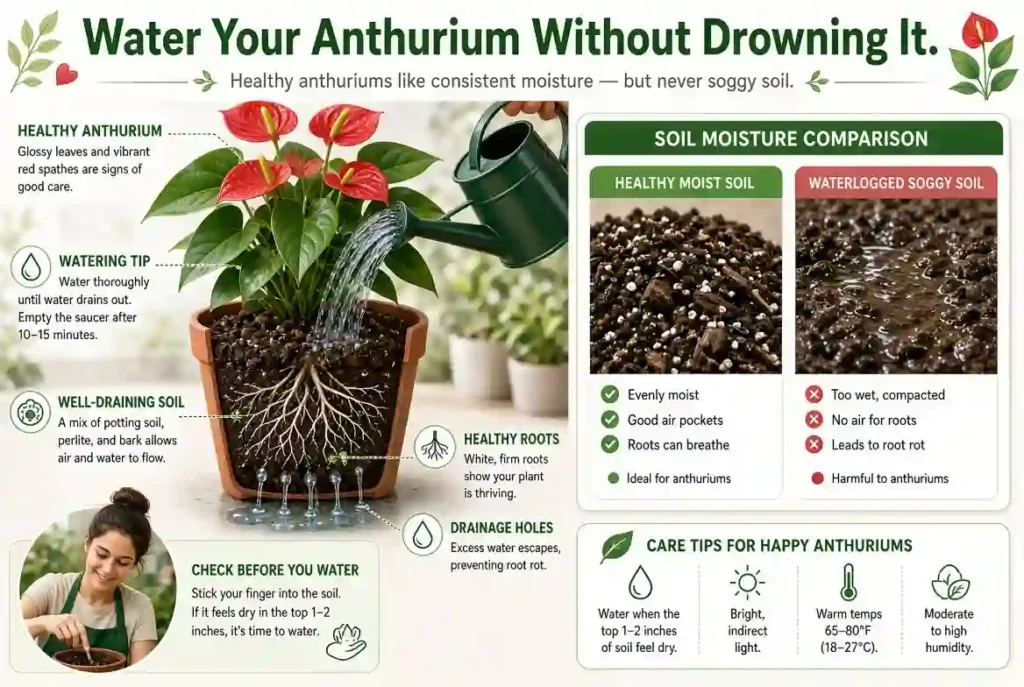
Anthuriums like moisture, but they do not want permanently saturated roots.
The goal is to keep the root environment slightly moist while allowing excess water to drain away.
The RHS recommends checking the compost several centimeters below the surface and watering when it is approaching dryness.
How to water an anthurium
Follow these steps:
- Check the top layer of soil with your finger.
- If it is still clearly wet, wait.
- When the upper layer begins drying, water thoroughly.
- Let excess water drain through the pot.
- Empty standing water from the saucer.
- Return the plant to its normal location.
Do not water according to a rigid calendar.
Your plant may need water more frequently during warm, bright weather and less frequently during cooler, darker periods.
Why overwatering causes problems
Roots need oxygen as well as water.
When soil remains saturated for too long, air spaces disappear. Roots become stressed and may eventually rot.
Typical warning signs include:
- Yellowing leaves
- Soft or collapsing stems
- Persistent wet soil
- Unpleasant soil odor
- Wilting despite wet soil
Overwatering is particularly dangerous when the pot has poor drainage.
What about underwatering?
A severely dry plant may develop:
- Drooping leaves
- Curling foliage
- Brown edges
- Dry roots
- Slow growth
Do not allow anthuriums to remain bone dry for long periods.
The practical goal is not “water less.” It is “water according to soil moisture.”
3. Choose an Airy, Fast-Draining Soil Mix
Anthurium roots need both moisture and oxygen.
That means ordinary dense garden soil is usually a poor choice for indoor containers.
A good mix should hold some moisture without becoming compacted.
The RHS recommends an acidic, open mix containing peat-free ericaceous compost, perlite, and orchid bark.
A practical anthurium potting mix
You can use approximately:
- 2 parts acidic or ericaceous potting compost
- 1 part perlite
- 1 part medium orchid bark
The bark creates air spaces.
Perlite improves drainage.
The organic component retains some moisture and nutrients.
Why soil structure matters more than simply “good soil”
Two plants can receive the same amount of water but behave very differently.
A plant growing in compact soil may stay wet for days.
Another plant in an airy bark-based mix may drain quickly and retain the right amount of moisture.
That is why watering advice cannot be separated from the potting mix.
4. Maintain Warm Temperatures

Anthuriums are tropical plants and prefer warm, stable conditions.
The RHS recommends keeping them in warm conditions and protecting them from cold drafts.
A useful indoor target is approximately 18–30°C (65–86°F), while avoiding sudden temperature changes.
Keep your plant away from:
- Cold windows during winter
- Air-conditioning vents
- Strong fans
- Exterior doors with cold drafts
- Radiators
- Direct hot air
Cold stress can slow growth and cause leaf damage.
Important seasonal point
A plant that grows quickly during warm, bright months may slow considerably during winter.
Do not automatically continue the same watering schedule year-round.
Lower light and slower growth usually mean the soil takes longer to dry.
5. Give Your Anthurium Enough Humidity
Anthuriums naturally prefer humid environments.
Dry indoor air can cause:
- Brown leaf tips
- Crispy edges
- Curling leaves
- Slower development of new foliage
University extension guidance commonly recommends humid conditions, while the RHS also identifies humid air as an important part of successful cultivation.
How to increase humidity
You can:
- Use a humidifier.
- Group several plants together.
- Place the plant in a naturally humid bathroom.
- Use a pebble tray with water below the pot level.
A humidifier is generally easier to control for a collection of tropical plants.
Does misting solve low humidity?
Misting can temporarily wet the leaf surface, but it does not provide the same consistent humidity as controlling the room environment.
If your home is consistently dry, focus on improving the surrounding humidity rather than relying only on occasional misting.
Important: Never let the bottom of the pot sit directly in water.
6. Fertilize for Healthy Growth and Flowers
Anthuriums need nutrients for continuous growth and flowering.
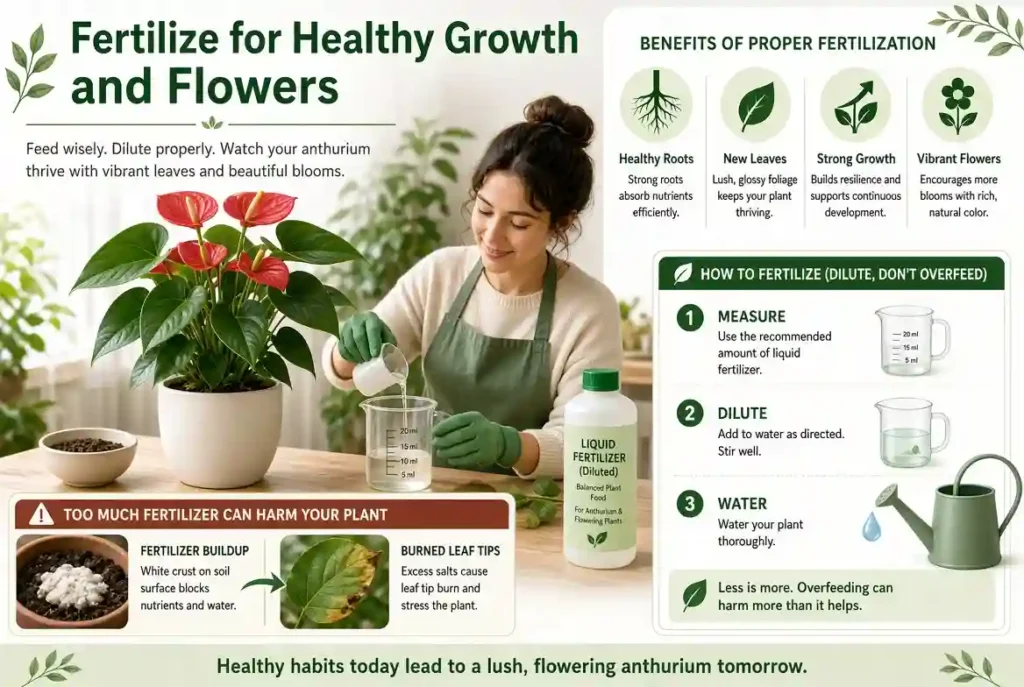
During active growth, a balanced or suitable orchid-type fertilizer can be useful. The RHS recommends feeding regularly during the growing season and gives orchid fertilizer as one option.
A simple feeding routine
During active growth:
- Use a diluted liquid fertilizer.
- Follow the product’s recommended dilution.
- Apply it to already-moistened soil rather than extremely dry roots.
- Reduce feeding when growth slows.
Do not assume that more fertilizer means more flowers.
Excess fertilizer can contribute to salt buildup and root stress.
Signs you may be overfertilizing
Watch for:
- Brown leaf margins
- Crusty deposits on the soil
- Damaged roots
- Sudden leaf deterioration
If fertilizer salts accumulate, flushing the pot thoroughly with clean water can help remove excess soluble salts, provided the pot drains freely.
7. How to Encourage an Anthurium to Bloom
A healthy anthurium can flower repeatedly when its basic needs are balanced.
If your plant has leaves but no flowers, examine the growing conditions before immediately adding more fertilizer.
Check these factors first
1. Light
Low light is one of the most common reasons flowering slows.
2. Plant maturity
A young plant may need time to establish itself.
3. Nutrition
A plant growing for a long period without nutrients may eventually show weaker growth.
4. Temperature
Cold or unstable conditions can interfere with tropical growth.
5. Root health
A plant with damaged or constantly waterlogged roots cannot reliably produce strong new growth.
A common mistake
Some growers move a flowering plant into a dark corner because they want to “protect” its flowers.
That may preserve the existing display for a while, but inadequate light can reduce future flowering.
Keep the plant in bright indirect light even when it is already blooming.
8. How to Repot an Anthurium
Most anthuriums do not need frequent repotting.
The RHS recommends repotting approximately every two to three years, while NC State also suggests repotting when the plant becomes rootbound.
Signs your plant may need repotting
Look for:
- Roots circling tightly around the pot
- Roots emerging from drainage holes
- Soil drying unusually quickly
- Strongly compacted potting mix
- The plant becoming unstable
- Water running straight through the pot
How to repot
- Choose a pot only slightly larger than the current container.
- Make sure it has drainage holes.
- Prepare a fresh, airy potting mix.
- Carefully remove the plant.
- Inspect the roots.
- Trim clearly dead or rotting roots with clean tools.
- Place the plant at approximately the same depth.
- Fill around the root ball without heavily compacting the mix.
- Water appropriately.
- Return the plant to bright indirect light.
Avoid jumping into a very large pot.
An oversized container can hold excess moisture for too long and increase the risk of root problems.
Image Suggestion
Step-by-step repotting infographic showing anthurium root inspection, fresh bark-based soil, correct pot size, and drainage holes.
9. Pruning and Cleaning Your Anthurium
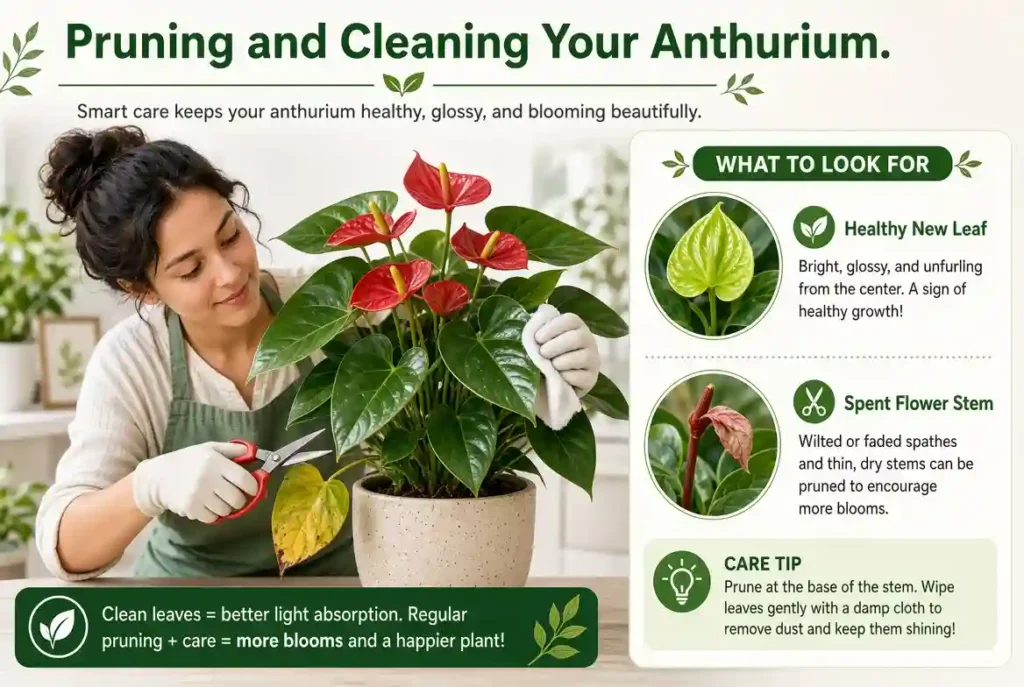
Anthuriums generally need little formal pruning.
Instead, focus on removing plant parts that are dead, damaged, or no longer useful.
Remove:
- Completely dead leaves
- Severely damaged leaves
- Yellowing leaves that are clearly declining
- Spent flower stems
Cut damaged leaves close to their base using clean, sharp scissors.
Avoid removing healthy green leaves simply because they are older.
Clean the leaves
Large glossy leaves collect dust.
Dust can make the plant look dull and can interfere with the normal function of the leaf surface.
Wipe leaves gently with a clean, damp cloth.
Avoid aggressive rubbing because it can damage delicate foliage.
10. Common Anthurium Problems and What They Mean
Plant symptoms rarely have only one possible cause.
Use the pattern of symptoms rather than treating every yellow leaf with more water or fertilizer.
| Problem | Possible Cause | What to Check |
|---|---|---|
| Yellow leaves | Overwatering, aging leaves, poor roots | Soil moisture and roots |
| Brown tips | Dry air, inconsistent watering, salt buildup | Humidity and watering |
| Brown patches | Sunburn, leaf damage, disease | Light and leaf condition |
| Drooping with wet soil | Root stress | Roots and drainage |
| Drooping with dry soil | Underwatering | Soil moisture |
| No flowers | Low light, stress, immature plant | Light and overall health |
| Slow growth | Low light, cold, poor roots | Location and roots |
| Crispy leaves | Dry air or drought stress | Humidity and watering |
| Black or mushy roots | Root rot | Potting mix and drainage |
| Sticky leaves | Possible insect infestation | Inspect undersides |
11. Why Are My Anthurium Leaves Turning Yellow?
Yellow leaves are one of the most common anthurium complaints.
Do not automatically assume the plant needs more water.
If several leaves turn yellow while the soil stays wet
Check for overwatering and poor drainage.
Persistent moisture can damage roots and eventually reduce the plant’s ability to absorb water normally.
If older leaves slowly yellow
One older leaf occasionally turning yellow can be part of normal aging.
Look at the plant as a whole.
If new leaves look healthy and only an occasional old leaf declines, the situation may not be serious.
If new growth is also weak
Investigate:
- Root health
- Light
- Fertilization
- Temperature
- Water quality
12. Why Are Anthurium Leaf Tips Turning Brown?
Brown tips often indicate environmental stress rather than one specific disease.
Possible causes include:
- Low humidity
- Irregular watering
- Excess fertilizer salts
- Root problems
- Exposure to dry air
Start with the simplest checks.
Feel the soil.
Inspect the roots if the soil remains wet for a long time.
Check whether the plant sits near an air-conditioner or heater.
Also consider your water quality. The RHS recommends rainwater or filtered water, particularly where tap water is hard or alkaline.
13. Anthurium Root Rot: What to Do
Root rot is often associated with prolonged excessive moisture.
If your anthurium has yellowing leaves, persistent wet soil, and a declining appearance, inspect the roots.
Healthy roots should not be mushy and collapsing.
Root rescue steps
- Remove the plant from its pot.
- Gently remove wet soil.
- Inspect the entire root system.
- Trim rotten roots with sterilized scissors.
- Remove badly damaged foliage.
- Repot into fresh, airy mix.
- Use a container with drainage holes.
- Place the plant in bright indirect light.
- Water more carefully after repotting.
Do not compensate for damaged roots by keeping the soil constantly wet.
The remaining roots need oxygen so they can recover.
14. Anthurium Pests to Watch For
Anthuriums can experience several common houseplant pests.
Potential problems include:
- Mealybugs
- Scale
- Spider mites
- Aphids
- Thrips
- Whiteflies
NC State Extension specifically lists several of these pests among potential anthurium problems.
Early inspection is easier than treatment later
Check:
- Leaf undersides
- New growth
- Leaf joints
- Stems
- Areas around the crown
Look for:
- Tiny insects
- Cotton-like clusters
- Sticky residue
- Fine webbing
- Distorted new leaves
Isolate a visibly infested plant from other houseplants.
Early detection makes pest management much easier.
15. Anthurium Care Through the Seasons
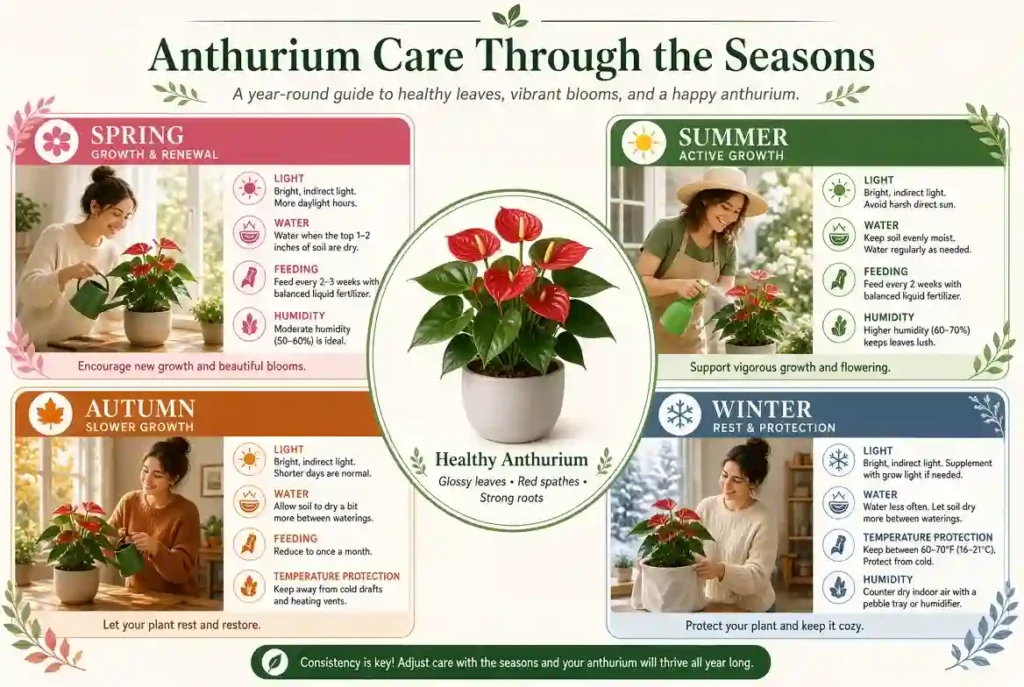
Your care routine should change with the environment.
Spring
As light and growth increase:
- Increase watering only as needed.
- Begin regular feeding.
- Check whether the plant needs repotting.
- Watch for new growth and pests.
Summer
During hot, bright weather:
- Monitor soil more frequently.
- Protect leaves from harsh direct sunlight.
- Maintain adequate humidity.
- Watch for rapid drying.
A plant may need water more often during hot weather, but do not water automatically every few days.
Autumn
As growth slows:
- Monitor soil before watering.
- Gradually reduce feeding.
- Check for drafts as temperatures fall.
Winter
Winter care often requires the biggest adjustment.
- Reduce watering frequency when the soil dries slowly.
- Protect the plant from cold windows and drafts.
- Keep it away from heating vents.
- Provide adequate indoor light.
- Avoid unnecessary repotting unless there is a serious root problem.
RHS guidance specifically recommends watering more sparingly during winter and maintaining warm conditions.
16. How to Propagate an Anthurium
Anthuriums can be propagated in several ways, including division, stem or rhizome cuttings, offsets, and seed depending on the species.
For most home growers, division or suitable offsets are more practical than growing from seed.
Propagation by division
When repotting:
- Examine the plant for natural divisions.
- Separate sections with their own roots where possible.
- Use clean tools.
- Pot each division into an appropriately sized container.
- Use airy, well-draining mix.
- Keep conditions warm and humid.
- Provide bright indirect light.
Avoid dividing a small, weak plant simply because you want more plants.
Propagation works best when the parent plant is healthy and sufficiently established.
17. Water Quality Can Matter More Than Beginners Expect
Many houseplant guides focus only on how often to water.
The quality of the water can also matter.
Anthuriums prefer acidic growing conditions, and the RHS recommends rainwater or filtered water, particularly where tap water is hard or alkaline.
If you notice recurring leaf-tip problems despite good watering and humidity, consider your water source.
Practical options include:
- Rainwater
- Filtered water
- Another suitable low-mineral water source
Do not assume that switching water alone will fix every brown tip. Environmental conditions still matter.
18. Anthurium Care for Beginners: The Simplest Routine
If you are new to anthuriums, avoid making the routine complicated.
Use this checklist:
Every few days
Look at the plant.
Check for:
- Drooping
- Pests
- New growth
- Damaged leaves
Before watering
Check the soil.
Do not water simply because several days have passed.
Every few weeks
Inspect:
- Leaf undersides
- Soil condition
- Drainage
- Root exposure
- General growth
During active growth
Feed according to your fertilizer’s label.
Every few months
Clean dusty leaves and check whether the plant still receives adequate light.
This simple routine is often more effective than constantly adjusting the plant.
19. Five Anthurium Care Mistakes to Avoid
Mistake 1: Keeping the soil constantly wet
Anthuriums need moisture, not waterlogged roots.
Better approach: Allow the upper layer of the growing mix to begin drying before watering again.
Mistake 2: Putting the plant in harsh sunlight
More light does not always mean more growth.
Better approach: Provide bright filtered or indirect light.
Mistake 3: Using a heavy soil mix
Dense soil can retain too much water.
Better approach: Use bark, perlite, and a suitable organic component to create an airy mix.
Mistake 4: Fertilizing a stressed plant heavily
Extra fertilizer cannot repair damaged roots.
Better approach: Fix light, watering, temperature, and root health first.
Mistake 5: Following a fixed watering calendar
Your home’s temperature, humidity, light, pot size, and soil determine how quickly the plant dries.
Better approach: Check the soil before watering.
20. A Practical Anthurium Care Routine
For an established indoor anthurium, your routine can be surprisingly simple.
Light
Keep it in bright indirect light.
Water
Check the soil regularly and water thoroughly when the upper layer begins drying.
Soil
Use an airy, acidic, fast-draining mix.
Humidity
Aim for consistently humid conditions, especially in dry indoor environments.
Temperature
Keep the plant warm and protect it from drafts.
Feeding
Fertilize during active growth according to the fertilizer label.
Pruning
Remove dead foliage and spent flower stems.
Repotting
Repot when the plant becomes rootbound or the potting mix breaks down, generally every few years.
These fundamentals cover most of what an indoor anthurium needs.
Frequently Asked Questions About Anthurium Plant Care
How often should I water an anthurium?
Water when the upper portion of the potting mix begins to dry. The exact interval varies with temperature, humidity, light, pot size, and soil. Avoid keeping the roots constantly saturated.
Does anthurium need direct sunlight?
No. Anthuriums generally prefer bright indirect light. Strong direct sunlight can scorch the leaves, while very low light can reduce growth and flowering.
Why is my anthurium not flowering?
Start by checking light. Insufficient light commonly reduces flowering. Also examine temperature, nutrition, root health, and the plant’s maturity.
How much humidity does anthurium need?
Anthuriums prefer humid conditions. Dry air can cause brown leaf tips and stressed foliage. A humidifier can provide more consistent humidity than occasional misting.
Can anthurium grow indoors?
Yes. Anthuriums are popular indoor plants when given bright indirect light, warm temperatures, suitable humidity, and well-draining soil.
Why are my anthurium leaves turning brown?
Brown leaves or tips can result from dry air, inconsistent watering, strong sunlight, fertilizer buildup, or root problems. Look at the complete growing environment before choosing a treatment.
Should I cut off dead anthurium flowers?
Yes. Removing completely spent flower stems keeps the plant tidy and directs its resources toward healthy growth. Cut the stem near its base using clean scissors.
Can I use regular potting soil for anthurium?
A standard potting mix may be too dense on its own. Anthuriums perform better in an airy, well-draining mix that allows both moisture retention and root aeration.
How often should I fertilize an anthurium?
Feed during active growth according to the fertilizer manufacturer’s dilution and frequency instructions. Avoid excessive feeding, especially when the plant is stressed or growing slowly.
Are anthuriums toxic to pets?
Yes. Anthuriums contain compounds that can be harmful if eaten and may irritate the mouth or digestive tract. Keep them away from pets and children, and wear gloves when handling them if irritation is a concern.
How often should I repot an anthurium?
Many established anthuriums can remain in the same container for roughly two to three years, although rootbound plants or deteriorated potting mix may require earlier repotting.
Can anthuriums grow in low light?
They may survive in lower light, but growth and flowering can suffer. Bright indirect light is a better target for a healthy flowering plant.
Conclusion : Final Thoughts on Anthurium Plant Care
Successful anthurium plant care does not require a complicated routine.
The most important goal is balance.
Give your plant enough light to grow without scorching the leaves. Keep the soil moist without leaving the roots waterlogged. Use an airy growing mix, maintain warmth and humidity, and feed during active growth.
When something goes wrong, avoid treating the symptom immediately.
A yellow leaf does not always mean the plant needs water. Brown tips do not always mean it needs fertilizer. Drooping does not always mean the soil is dry.
Instead, examine the entire growing environment.
Once you understand how light, water, soil, humidity, temperature, and roots work together, anthurium care becomes much easier. A healthy plant will reward that consistency with glossy foliage and colorful, long-lasting spathes.