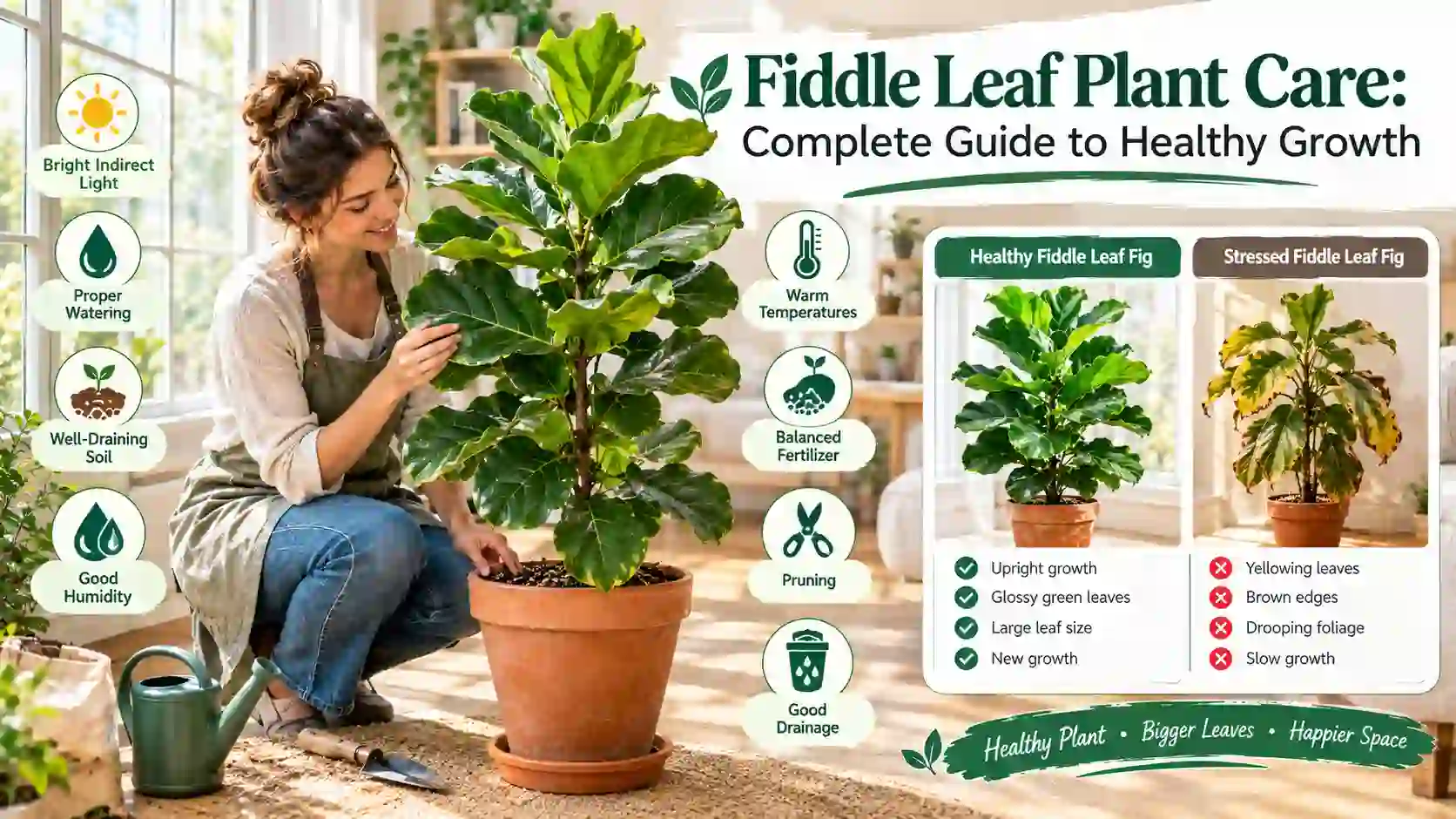
The fiddle leaf plant, commonly called the fiddle leaf fig, is one of the most recognizable indoor foliage plants. Its large, violin-shaped leaves can create a dramatic focal point in a living room, bedroom, office, or bright entryway.
But its reputation for being difficult is not entirely undeserved.
Many problems begin with a simple mismatch between the plant and its environment. A fiddle leaf fig placed in a dim corner may slowly lose leaves. One watered on a fixed schedule may develop yellowing or brown-spotted foliage. A plant moved repeatedly can react to every change by dropping leaves.
It requires understanding what the plant is telling you.
This guide explains how to provide the right light, water, soil, humidity, temperature, fertilizer, pruning, and repotting routine. It also explains how to diagnose common problems before they become serious.
Quick Answer:
Let the upper few inches of soil dry before watering thoroughly, then allow excess water to drain completely. Keep the plant away from cold drafts and sudden environmental changes. Consistent care matters more than frequent watering, heavy fertilizing, or constant repositioning.
What Is a Fiddle Leaf Plant?
The fiddle leaf fig is Ficus lyrata, a tropical tree species known for its oversized, fiddle-shaped leaves.
In nature, it grows in warm climates and can become a substantial tree. Indoors, it is usually grown as a decorative foliage plant and can eventually become a tall statement plant when given enough light and suitable conditions.
Its large leaves are beautiful but also reveal problems quickly.
Dust, low light, underwatering, overwatering, pests, and environmental stress can all become visible on the foliage.
Key characteristics
| Feature | Fiddle Leaf Fig |
|---|---|
| Botanical name | Ficus lyrata |
| Common names | Fiddle leaf fig, fiddle leaf plant |
| Plant family | Moraceae |
| Light | Bright, indirect light with gradual tolerance for some direct sun |
| Water | Thoroughly when the upper soil has dried |
| Soil | Well-draining, aerated potting mix |
| Humidity | Moderate to high humidity is beneficial |
| Temperature | Warm, stable indoor conditions |
| Growth habit | Upright, woody, tree-like |
| Propagation | Stem cuttings and other vegetative methods |
| Toxicity | Sap can irritate skin and is considered toxic if ingested |
Important: “Fiddle leaf plant” usually refers to the fiddle leaf fig, Ficus lyrata. Cultivars and dwarf forms can have somewhat different growth habits, but the basic care principles remain similar.
Where Should You Put a Fiddle Leaf Fig?
Placement is one of the most important decisions you will make.
A fiddle leaf fig may survive in moderate light for a while, but survival is not the same as vigorous growth.
Choose a location near a bright window where the plant receives plenty of natural light without being exposed to extreme afternoon heat through glass.
A few feet from a bright window often works well. Large east- or south-facing windows can provide particularly useful light, depending on your climate and the amount of shade outside.
Look for these signs of a good location
- New leaves appear regularly during active growth.
- Existing leaves remain firm and reasonably upright.
- The plant does not stretch dramatically toward the window.
- Leaf color remains rich and consistent.
- Growth is reasonably balanced rather than heavily leaning.
Avoid frequent relocation
Fiddle leaf figs can react poorly to sudden environmental changes.
If you move a plant from a dim room to strong sunlight overnight, the leaves may scorch. Likewise, moving it between rooms with very different temperatures or humidity can cause stress.
Practical tip: If you need to move the plant, make the change gradually whenever possible.
Image Suggestion
A bright living room showing a healthy fiddle leaf fig positioned near a large window, with labels for bright indirect light, window distance, airflow, and protection from harsh afternoon sun.
How Much Light Does a Fiddle Leaf Fig Need?
Give your plant bright, filtered or indirect light for much of the day. Some fiddle leaf figs can adapt to several hours of direct sunlight, especially when introduced gradually, but sudden exposure to intense sunlight can damage previously shaded leaves.
Bright light produces better growth
Strong natural light helps the plant maintain photosynthesis and supports new foliage.
A plant receiving inadequate light may:
- Grow slowly.
- Produce smaller leaves.
- Lean toward the window.
- Develop long spaces between leaves.
- Drop older leaves.
- Struggle to use water efficiently.
Can fiddle leaf figs tolerate direct sunlight?
Yes, but acclimation matters.
A plant raised indoors behind filtered light may scorch if suddenly placed in intense midday sun.
If you want to increase direct sunlight:
- Start with gentle morning sun.
- Increase exposure gradually.
- Watch the leaves for pale or brown patches.
- Protect the plant from extreme heat through glass.
- Adjust according to your local climate.
The goal is not to give the plant the most sunlight possible.
The goal is to give it enough useful light without causing leaf damage.
How to Water a Fiddle Leaf Plant
Watering is where many fiddle leaf figs go wrong.
The biggest mistake is watering according to the calendar rather than the soil.
A plant may need water every few days in one environment and much less frequently in another.
Factors such as pot size, soil composition, temperature, humidity, light, season, and root health all affect drying speed.
The basic watering method
- Check the soil before watering.
- Feel several inches below the surface.
- If the upper layer has dried but deeper soil remains slightly moist, assess the plant and pot weight.
- When watering is needed, water thoroughly.
- Continue until water drains from the bottom.
- Empty the saucer or decorative cachepot.
- Allow excess water to drain completely.
Do not give a large plant a tiny splash of water every few days.
That can wet only the upper soil while leaving deeper areas unevenly moist.
How often should you water?
There is no universal weekly schedule.
As a starting point, many indoor fiddle leaf figs need watering roughly every 1–2 weeks, but this can vary considerably.
A plant in bright light during warm weather may dry much faster than one in a cool, dim room.
Always check the soil rather than blindly following a schedule.
A useful test
Push your finger several inches into the soil.
You can also use a wooden stick or inspect the pot’s weight.
If the soil is still noticeably wet deep inside the pot, wait.
If the upper soil has dried and the pot feels substantially lighter, the plant may be ready for another thorough watering.
Why Is Overwatering So Dangerous?
Fiddle leaf figs do not necessarily die because they receive too much water in a single watering.
The bigger problem is soil that stays wet for too long.
Constantly saturated soil reduces the air available around roots. Poor drainage can then contribute to root decline and secondary problems.
Signs that may indicate excessive moisture
- Yellowing leaves.
- Brown patches.
- Leaves dropping unexpectedly.
- Soil that remains wet for many days.
- Musty-smelling soil.
- Soft or declining roots.
- Slow growth despite frequent watering.
However, these symptoms are not exclusive to overwatering.
For example, brown leaves can also result from underwatering, low humidity, salt buildup, physical damage, or environmental stress.
Look at the entire growing environment before diagnosing the problem.
How to Choose Soil for a Fiddle Leaf Fig
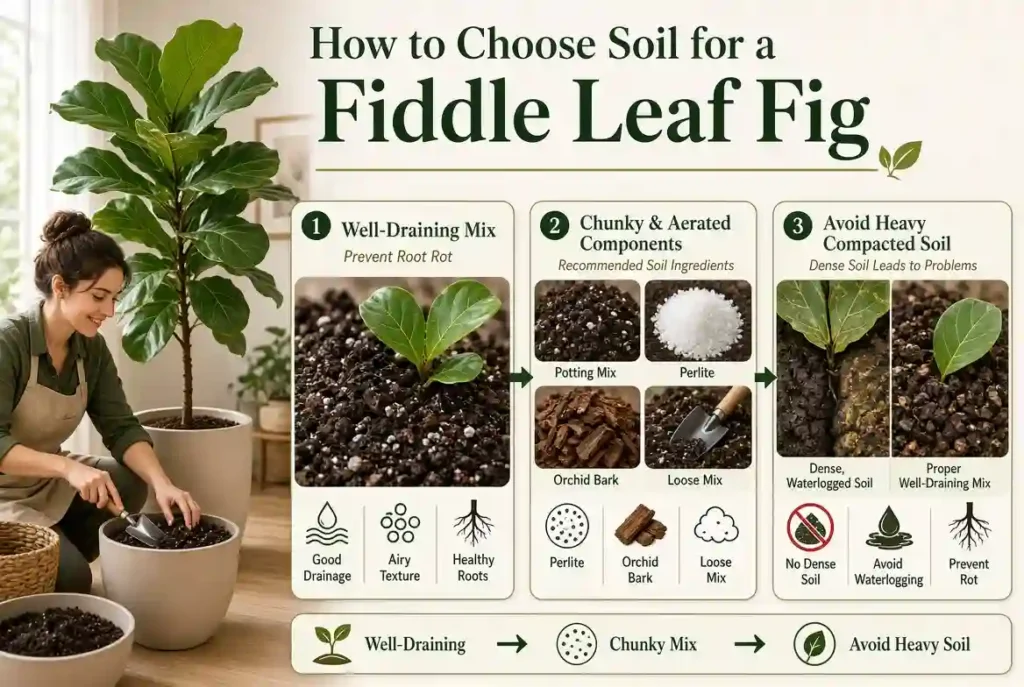
Fiddle leaf figs need a potting mix that holds enough moisture for healthy roots while allowing excess water and air to move through the root zone.
Avoid dense garden soil in indoor containers.
A useful mix can contain:
- Quality indoor potting mix.
- Pine bark or another coarse organic component.
- Perlite or pumice for additional aeration.
- A modest amount of moisture-retaining organic material.
The exact recipe is less important than the final result.
The mix should not become a heavy, compact mass after repeated watering.
What good soil should do
Good soil should:
- Drain excess water.
- Maintain some moisture between waterings.
- Provide oxygen around roots.
- Support healthy root development.
- Resist severe compaction.
A pot with excellent drainage cannot completely compensate for extremely dense soil.
Choosing the Right Pot
Pot selection directly affects watering.
A container should have at least one functional drainage hole.
Do not assume a layer of rocks at the bottom fixes a pot without drainage. It does not replace an actual drainage opening.
Avoid oversized pots
A huge container holds more soil than the plant’s root system can use.
That soil can remain wet for too long.
Choose a pot that provides enough room for the roots without dramatically increasing the volume of unused soil.
When repotting, moving up only one reasonable pot size is often safer than jumping into a very large container.
How to Repot a Fiddle Leaf Fig
Repotting is not something you need to do every year automatically.
Consider repotting when:
- Roots are tightly circling the root ball.
- Roots are emerging from drainage holes.
- Water runs through unusually quickly because the root mass has filled the container.
- Growth has slowed despite appropriate light and nutrition.
- The pot has become unstable because the plant is top-heavy.
- The existing soil has broken down severely.
Step-by-step repotting
- Choose a container with drainage holes.
- Select a well-draining potting mix.
- Gently remove the plant from its existing container.
- Inspect the roots.
- Remove only clearly damaged or dead roots.
- Place the plant at approximately its previous soil depth.
- Fill around the root ball with fresh mix.
- Water thoroughly.
- Allow excess water to drain.
- Return the plant to a suitable location.
Do not immediately make several changes
Repotting is already an environmental change.
Avoid combining repotting with a dramatic move into intense sunlight, heavy pruning, aggressive fertilizing, and major watering changes all at once.
Give the plant time to settle.
How Much Humidity Does a Fiddle Leaf Fig Need?

Fiddle leaf figs come from warm tropical and subtropical environments, so they generally appreciate moderate to higher humidity.
However, humidity is only one part of the equation.
A plant receiving excellent humidity but sitting in poorly drained wet soil can still develop serious problems.
Helpful ways to increase humidity
- Group compatible plants together.
- Use a properly sized humidifier.
- Keep plants away from extremely dry heating vents.
- Maintain reasonable airflow around the foliage.
- Avoid creating constantly wet surfaces around the plant.
A humidifier is generally more effective than occasional misting when you need a sustained increase in room humidity.
Do fiddle leaf figs need misting?
No.
Misting can temporarily wet the leaves, but it does not reliably maintain higher humidity for long periods.
If humidity is genuinely low, improving the room’s overall humidity is more useful.
What Temperature Is Best for a Fiddle Leaf Fig?
Keep fiddle leaf figs in a warm, relatively stable environment.
Avoid placing them directly beside:
- Air-conditioning vents.
- Heaters.
- Frequently opened exterior doors.
- Cold windows during winter.
- Strong drafts.
Sudden temperature changes can contribute to leaf stress and drop.
A comfortable indoor temperature is usually more important than chasing an exact number.
Practical rule: If the location feels uncomfortable because of a strong cold or hot draft, it probably is not the best place for your fiddle leaf fig.
How to Fertilize a Fiddle Leaf Fig
Fertilizer supports new growth, but more fertilizer does not automatically mean a healthier plant.
A fiddle leaf fig growing in bright light and actively producing new foliage has greater nutritional demand than a plant sitting in low light.
During active growth, use a balanced fertilizer formulated for houseplants according to its label directions.
Some fiddle leaf fig growers prefer fertilizers with a higher nitrogen emphasis, such as formulations marketed around a 3-1-2 nutrient ratio. However, the complete nutrient profile, application rate, growing conditions, and soil quality all matter.
Good fertilizing practice
- Fertilize during active growth.
- Follow the product’s dilution instructions.
- Do not fertilize severely stressed or recently repotted plants immediately.
- Reduce or stop feeding when growth naturally slows.
- Flush the soil periodically if fertilizer salts accumulate.
Signs of fertilizer buildup
You may notice:
- White crust around the soil surface.
- Brown leaf margins.
- Declining foliage despite adequate watering.
- Poor root performance.
Do not respond to these symptoms by adding even more fertilizer.
How to Clean Fiddle Leaf Fig Leaves
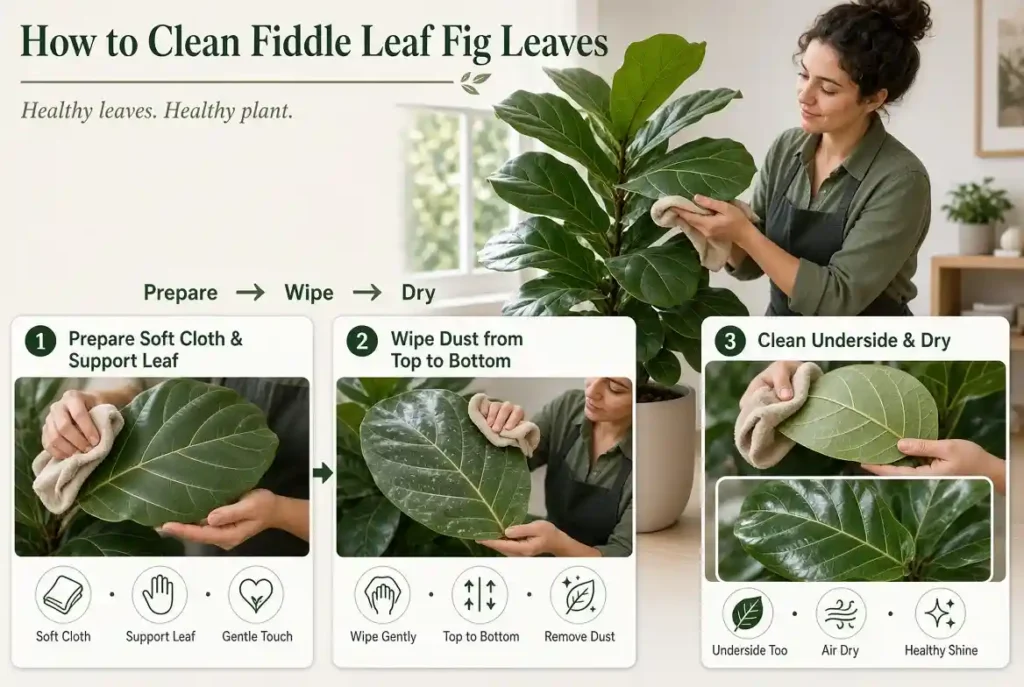
Large leaves collect dust easily.
A thick layer of dust can reduce the amount of light reaching the leaf surface and makes it harder to inspect for pests.
Use a soft, damp cloth to gently wipe the leaves.
Support the leaf from underneath while cleaning.
Avoid unnecessary leaf-shine products
Many commercial leaf-shine products can leave residues on foliage.
Plain water and gentle cleaning are usually sufficient.
Cleaning also gives you an opportunity to inspect the underside of leaves for:
- Spider mites.
- Scale.
- Mealybugs.
- Sticky residue.
- Webbing.
- Discoloration.
How to Prune a Fiddle Leaf Fig
Pruning can help shape a fiddle leaf fig and encourage branching.
Do not prune simply because a leaf looks old.
Older leaves naturally decline as the plant grows.
Prune when you want to:
- Remove damaged or dead growth.
- Improve the plant’s shape.
- Encourage branching.
- Control excessive height.
- Remove badly positioned stems.
Use clean, sharp pruning tools.
Make cuts deliberately rather than repeatedly removing small pieces from the same stem.
How to encourage branching
A healthy, actively growing plant can sometimes be encouraged to produce lateral shoots by carefully pruning the main stem.
However, pruning cannot compensate for poor light.
If the plant is severely light-starved, improve its growing conditions before expecting vigorous branching.
Why Is My Fiddle Leaf Fig Dropping Leaves?
Leaf drop is one of the most common complaints.
The important question is not simply, “Why is it dropping leaves?”
It is:
What changed?
Common triggers include:
- Sudden relocation.
- Low light.
- Overwatering.
- Underwatering.
- Root problems.
- Temperature changes.
- Drafts.
- Pest infestations.
- Repotting stress.
- Sudden changes in humidity.
Some older leaves may naturally yellow and fall as the plant develops new growth.
A useful diagnostic approach
Think back over the previous few weeks.
Ask:
- Did I move the plant?
- Did watering frequency change?
- Has the soil stayed wet unusually long?
- Has the light changed?
- Was the plant recently repotted?
- Did temperatures change?
- Are there signs of pests?
- Are new leaves healthy?
The timeline often provides more information than the leaf itself.
Why Are Fiddle Leaf Fig Leaves Turning Brown?
Brown edges
- Dry soil.
- Low humidity.
- Salt accumulation.
- Excessive fertilizer.
- Environmental stress.
Brown spots in the middle of leaves
Possible causes include:
- Root stress.
- Excess moisture.
- Leaf damage.
- Fungal or bacterial problems.
- Inconsistent watering.
Do not diagnose a disease from one photograph or one brown spot alone.
Check the roots, soil moisture, watering pattern, light, airflow, and progression of symptoms.
Why Are Fiddle Leaf Fig Leaves Turning Yellow?
Yellow leaves can occur for several reasons.
Common possibilities include:
- Excess moisture.
- Poor root health.
- Low light.
- Natural aging of older foliage.
- Nutritional problems.
- Environmental stress.
One yellow lower leaf is not automatically an emergency.
A pattern of multiple yellowing leaves, especially combined with wet soil and leaf drop, deserves closer investigation.
Quick diagnostic table
| Symptom | Possible Cause | What to Check |
|---|---|---|
| Yellow lower leaves | Excess moisture or natural aging | Soil moisture and leaf age |
| Yellow leaves plus wet soil | Root stress | Drainage and roots |
| Brown dry edges | Dryness or low humidity | Watering and humidity |
| Brown spreading spots | Root or leaf problem | Soil, roots, airflow |
| Small new leaves | Insufficient light or nutrition | Window exposure and feeding |
| Leaf drop after moving | Environmental stress | Recent location changes |
| Sticky leaves | Possible pests | Inspect undersides |
Treat this as a diagnostic starting point rather than a guaranteed diagnosis.
Why Are My Fiddle Leaf Fig Leaves Curling?
Curling can indicate environmental stress.
Check:
- Soil moisture.
- Humidity.
- Temperature.
- Light intensity.
- Root condition.
- Pest activity.
If the leaves are curling while the soil is extremely dry, watering may be the immediate issue.
If the soil is constantly wet, adding more water will make the underlying problem worse.
Always inspect the soil before reaching for the watering can.
How to Get Bigger Leaves on a Fiddle Leaf Fig
Large leaves are strongly influenced by the plant’s growing conditions.
If you want impressive foliage, concentrate on the basics rather than using a special “leaf growth” trick.
Focus on these five factors
1. Strong light
Adequate light gives the plant the energy needed for active growth.
2. Healthy roots
Damaged roots cannot reliably support vigorous foliage.
3. Consistent moisture
Avoid extreme cycles of bone-dry soil followed by prolonged saturation.
4. Adequate nutrition
Feed actively growing plants appropriately rather than overfertilizing.
5. Stable conditions
Constant relocation can interrupt growth.
A fiddle leaf fig cannot be forced to produce giant leaves simply by watering more.
How to Propagate a Fiddle Leaf Fig
Fiddle leaf figs can be propagated from stem cuttings.
Basic stem-cutting method
- Choose a healthy stem with several nodes.
- Make a clean cut using sterilized pruning shears.
- Remove unnecessary lower leaves.
- Place the cutting in an appropriate propagation medium.
- Keep the medium lightly moist rather than saturated.
- Provide bright, indirect light.
- Maintain warm conditions.
- Wait for roots and new growth to develop.
Propagation takes patience.
Do not pull the cutting out repeatedly to check for roots. Disturbing developing roots can slow establishment.
Water propagation vs. soil propagation
Water propagation makes root development easy to observe.
Soil or propagation-medium methods can allow roots to develop in an environment closer to where the plant will ultimately grow.
Neither method guarantees success.
The health of the cutting, warmth, light, moisture, and timing all matter.
Common Fiddle Leaf Plant Care Mistakes
1. Watering on a fixed calendar
“Every Sunday” sounds simple, but plants do not consume water at identical rates every week.
Better approach: Check soil moisture and environmental conditions first.
2. Keeping the plant in a dark corner
A fiddle leaf fig may remain alive for some time in low light, but growth can suffer.
Better approach: Place it in the brightest suitable location available.
3. Using a pot without drainage
Excess water has nowhere to go.
Better approach: Always use a container with functional drainage.
4. Repotting too frequently
Repeated root disturbance can create unnecessary stress.
Better approach: Repot when the plant or root system actually needs it.
5. Moving the plant constantly
Plants need time to adapt.
Better approach: Choose a suitable location and allow the plant to settle.
6. Overfertilizing
More fertilizer does not equal faster growth.
Better approach: Follow the fertilizer label and feed according to active growth.
7. Ignoring the roots
Leaves show symptoms, but roots often reveal the underlying problem.
Better approach: When watering problems persist, inspect drainage and root health.
Fiddle Leaf Fig Pests
Healthy plants can still develop pest problems.
Common houseplant pests include:
- Spider mites.
- Scale insects.
- Mealybugs.
- Aphids.
- Thrips.
Inspect both the top and underside of leaves.
Signs of pest activity
Watch for:
- Fine webbing.
- Tiny moving insects.
- Cotton-like clusters.
- Sticky honeydew.
- Speckled leaves.
- Silvery damage.
- Distorted new growth.
If you find pests, isolate the affected plant from nearby houseplants and identify the pest before selecting a treatment.
Early detection makes control much easier.
Image Suggestion
Close-up educational infographic showing a fiddle leaf fig leaf with common pest signs, including spider mite webbing, scale, mealybugs, and leaf stippling.
Seasonal Fiddle Leaf Fig Care
Your care routine should change with the environment.
Spring
Spring often brings stronger light and increased growth.
- Check whether the plant needs repotting.
- Begin or increase feeding as active growth starts.
- Monitor soil drying speed.
- Gradually increase sunlight if necessary.
Summer
Summer can dramatically increase water consumption.
- Check soil more frequently.
- Protect leaves from extreme heat.
- Monitor humidity.
- Watch for pests.
- Rotate the plant occasionally for balanced growth.
Fall
Growth may begin slowing.
- Watch how quickly the soil dries.
- Reduce fertilizer if growth decreases.
- Avoid automatically maintaining summer watering frequency.
Winter
Indoor heating can create dry air while lower light slows water use.
- Keep the plant away from heating vents.
- Check soil before watering.
- Avoid leaving roots constantly wet.
- Provide the brightest suitable window.
- Watch for cold drafts.
The calendar is only a guide.
The plant’s environment should determine the routine.
Fiddle Leaf Fig Indoor Care Routine
A simple routine is easier to maintain than constant plant monitoring.
Weekly
- Check the soil.
- Inspect leaves for pests.
- Look for new growth.
- Check for unusual leaf spots.
- Rotate the plant slightly if needed.
Every few weeks
- Clean dusty leaves.
- Inspect the drainage area.
- Check for fertilizer buildup.
- Evaluate whether light conditions have changed.
Seasonally
- Reassess watering frequency.
- Adjust feeding.
- Check for pests.
- Evaluate whether the plant has outgrown its location.
- Consider pruning or repotting when appropriate.
The goal is consistency, not obsession.
Expert Tips for Healthier Fiddle Leaf Figs
Let light guide your watering
A plant in strong light generally uses water differently from one in a dark corner.
Never separate watering decisions from light conditions.
Rotate gradually
Turning the plant occasionally can help maintain more even growth, but large sudden changes in light exposure are unnecessary.
Support tall plants
A tall fiddle leaf fig can become top-heavy.
Use a stable container and provide support if the trunk needs help while developing strength.
Don’t panic over one damaged leaf
Older foliage can naturally decline.
Look at the overall plant:
- Is new growth healthy?
- Are roots functioning?
- Is the plant producing leaves?
- Is the soil drying appropriately?
- Are pests present?
The whole plant tells a better story than one leaf.
Make one major change at a time
If a plant is struggling, changing everything simultaneously makes diagnosis difficult.
Improve the most obvious problem first.
For example, if the plant is sitting in very low light, address light before adding multiple fertilizers or supplements.
A Simple Fiddle Leaf Plant Care Checklist
Use this checklist when evaluating your plant:
- Bright, suitable natural light
- No severe temperature drafts
- Pot has drainage holes
- Soil drains efficiently
- Soil is allowed to partially dry between waterings
- Watering is thorough when needed
- Excess water drains completely
- Humidity is reasonable
- Fertilizer is used appropriately during active growth
- Leaves are checked regularly for pests
- Dust is removed from large leaves
- Plant is not constantly being moved
- Roots are inspected when persistent problems occur
If most of these conditions are met, you have already solved many of the problems that commonly affect fiddle leaf figs.
Frequently Asked Questions
How often should I water a fiddle leaf fig?
Water when the upper portion of the soil has dried rather than following a fixed calendar. Many indoor plants need water around every one to two weeks, but light, temperature, pot size, soil, and season can change that significantly.
Do fiddle leaf figs need direct sunlight?
They can tolerate some direct sunlight when acclimated gradually. Bright indirect light is a reliable starting point, while sudden exposure to intense direct sun can scorch leaves.
Why is my fiddle leaf fig losing leaves?
Leaf loss can result from watering problems, low light, root stress, temperature changes, drafts, pests, repotting, or sudden relocation. Consider what changed recently before choosing a treatment.
Why are the leaves of my fiddle leaf fig turning brown?
Brown leaves can result from underwatering, low humidity, fertilizer buildup, environmental stress, root problems, or leaf damage. Examine the soil and roots rather than assuming every brown spot has the same cause.
Can fiddle leaf figs grow indoors?
Yes. They can grow successfully indoors when provided with strong natural light, appropriate watering, good drainage, warmth, and stable conditions.
Should I mist my fiddle leaf fig?
Misting is not necessary. It provides only temporary surface moisture and does not reliably maintain room humidity. A humidifier is more effective when additional humidity is genuinely needed.
When should I repot a fiddle leaf fig?
Repot when roots have substantially filled the container, drainage has become problematic, the plant has become unstable, or the existing soil has deteriorated. Avoid repotting simply because a calendar says it is time.
How do I make my fiddle leaf fig grow taller?
Provide strong light, healthy roots, appropriate watering, adequate nutrition, and enough space for vertical growth. Pruning can change branching and shape, but it cannot replace good growing conditions.
Can I cut off damaged fiddle leaf fig leaves?
You can remove severely damaged or dead leaves with clean pruning shears. However, do not remove healthy leaves unnecessarily because they contribute to photosynthesis.
Are fiddle leaf figs toxic to pets?
Fiddle leaf figs contain irritating sap and are considered toxic if eaten. Keep them away from pets and children who may chew plant material, and avoid contact with the sap when pruning.
Related Plant-Care Topics
Readers growing fiddle leaf figs may also benefit from guides covering:
- How to care for a rubber plant
- How to care for a monstera
- How to care for a bird of paradise
- How to care for a money tree
- How to fix yellow leaves on houseplants
- How to identify and treat common houseplant pests
- Best indoor plants for bright rooms
These topics are especially useful when building a broader indoor plant-care routine.
Conclusion
Give the plant plenty of appropriate light. Use a container with drainage and an airy soil mix. Water thoroughly when the soil has partially dried instead of watering automatically. Keep temperatures stable, provide reasonable humidity, feed during active growth, and inspect the leaves regularly.
Most importantly, learn to read the plant.
A fiddle leaf fig that receives the right conditions will usually show you through steady new growth, healthy foliage, and stronger structure. When problems appear, investigate the environment before reaching for another product.
The best fiddle leaf fig care routine is the one you can apply consistently—and adjust when the plant’s conditions change.