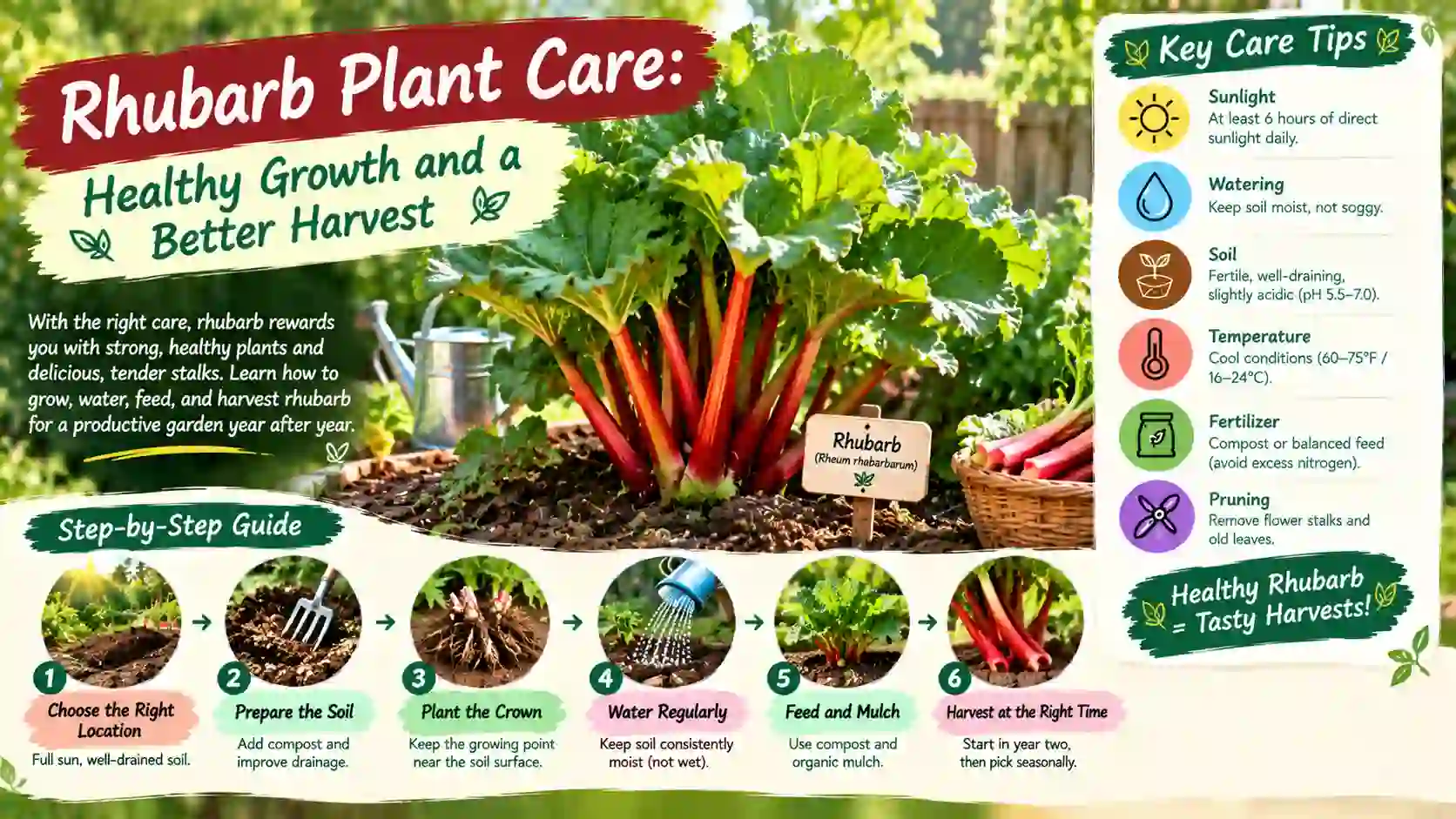
Rhubarb (Rheum rhabarbarum) is a long-lived perennial vegetable grown for its thick, tart stalks. Gardeners use those stalks in pies, crumbles, sauces, jams, and other cooked dishes. Its large, decorative leaves also make it an attractive addition to a vegetable garden.
The key to successful rhubarb growing is understanding its climate needs. Rhubarb grows best in cool conditions and generally needs winter chilling to produce reliable spring growth. It may struggle in regions with long, hot summers or mild winters, even when watering and fertilizing are correct.
Washington State University
+1
This guide explains how to choose a planting site, care for rhubarb throughout the year, encourage strong stalks, troubleshoot common problems, and harvest safely.
Important climate note: Rhubarb is naturally suited to temperate regions. If you garden in a hot area such as Lahore, Pakistan, the local summer heat and limited winter chilling may make reliable production difficult. Choose a cooler microclimate and treat growing it as an experiment rather than assuming standard temperate-region advice will work unchanged.
Washington State University
+2
Quick Answer:
Rhubarb plant care involves growing this hardy perennial in fertile, well-drained soil, providing adequate sunlight, watering during dry weather, and feeding it with compost. Plant rhubarb crowns where they have room to spread, remove flower stalks when they appear, and avoid harvesting during the first year. Harvest lightly in the second year and more generously once established. Only the stalks are eaten; never eat rhubarb leaves, which contain potentially toxic levels of oxalic acid.
Illinois
+2
1. Understanding Rhubarb Before You Plant
Rhubarb grows from a thick underground crown with roots and buds. Each growing season, the crown produces large leaves on fleshy stalks. Those leaves capture sunlight and replenish the crown’s energy reserves for the following year.
That is why rhubarb needs patience. Removing too many stalks from a young plant reduces the energy available for root and crown development. A plant can look leafy and healthy yet remain weak if it is harvested too heavily.
A well-established rhubarb plant can produce for many years with suitable conditions and regular maintenance.
Washington State University
+1
Rhubarb growing requirements at a glance
| Care factor | What rhubarb needs |
|---|---|
| Light | Full sun in cool climates; some afternoon shade can help where summers are hot |
| Soil | Fertile, organic-rich, well-drained soil |
| Water | Consistent moisture without waterlogging |
| Temperature | Cool-season growing conditions and winter chilling |
| Fertilizer | Compost or a balanced fertilizer guided by soil needs |
| Spacing | Around 3 feet (90 cm) between plants as a starting point |
| Harvest | None in year one; light harvest in year two; fuller harvest after establishment |
| Lifespan | Often many years when well cared for |
Washington State University
+3
Image suggestion: A labeled rhubarb plant showing its crown, stalks, broad leaves, and deep root system.
2. Choosing the Best Location for Rhubarb
Rhubarb is a perennial, so choose its location carefully. Moving an established crown can interrupt growth, and a mature plant needs substantial space.
How much sunlight does rhubarb need?
In cool climates, rhubarb grows best with approximately six to eight hours of direct sunlight daily. Light supports strong leaf growth and helps the plant build reserves for future harvests.
Yard and Garden
+1
However, intense heat changes the equation. When temperatures rise above about 90°F (32°C), rhubarb growth can slow or stop. In hot regions, afternoon shade may reduce heat stress, although shade cannot fully replace the winter chilling this plant needs.
Washington State University
+1
Practical tip: Choose a location with morning sunlight, good airflow, and protection from extreme afternoon heat if your summers are hot. Avoid planting beside large trees that compete for moisture and nutrients.
What soil is best for rhubarb?
Rhubarb prefers fertile soil that holds moisture but drains freely. Heavy, waterlogged soil deprives roots of oxygen and increases the risk of crown rot.
Before planting:
- Remove persistent weeds and their roots.
- Loosen the soil deeply so roots can spread.
- Mix in well-rotted compost or manure.
- Improve drainage with a raised bed if water collects after rain.
- Avoid fresh manure directly against the crown.
A soil test can help determine whether additional nutrients are needed. Adding fertilizer without knowing the soil’s condition may encourage excessive foliage or create nutrient imbalances.
Penn State Extension
+2
Image suggestion: A rhubarb planting-site infographic comparing fertile, well-drained soil with waterlogged soil and a raised bed.
3. How to Plant Rhubarb Correctly
The easiest way to establish rhubarb is to plant a healthy crown or a division from a vigorous, disease-free plant. Named varieties are usually more predictable than seedlings grown from seed.
RHS Guide
+1
When should you plant rhubarb?
In temperate climates, early spring or autumn is generally suitable, depending on local weather and whether you’re planting a dormant bare-root crown or a container-grown plant. Avoid planting during hot, dry weather.
For regions with mild winters and very hot summers, the challenge is not simply choosing a planting date. Rhubarb needs sufficient winter chilling to grow reliably. Check whether your chosen cultivar suits your climate before investing in several plants.
Step-by-step planting instructions

Step 1: Select a healthy crown
Choose a firm crown with healthy roots and at least one sound growing bud. Avoid soft, mushy, or rotten sections.

Step 2: Prepare the planting hole
Loosen the soil and incorporate mature compost. Make the hole wide enough to spread the roots without bending them sharply.

Step 3: Set the crown at the correct depth
Position the growing point at or just above the soil surface, following the instructions for your plant. Burying the crown too deeply can encourage rot.

Step 4: Water and mulch
Water thoroughly after planting. Add a layer of organic mulch around the plant, leaving the crown uncovered.
Space plants approximately 75–90 cm (30–35 inches) apart, or farther apart for vigorous varieties. Mature rhubarb can spread considerably, so allow room for the leaves and airflow.
RHS Guide
+1
4. Watering Rhubarb for Strong, Thick Stalks
Rhubarb needs enough water to maintain large, healthy leaves. Those leaves supply the energy that supports the crown and next year’s growth.
The goal is consistently moist soil, not permanently wet soil.
How often should you water rhubarb?
Watering frequency depends on rainfall, temperature, soil texture, and plant age.
- Newly planted rhubarb: Water regularly during dry weather while roots establish.
- Established garden plants: Water deeply during prolonged dry spells.
- Container-grown rhubarb: Check the compost more frequently because pots dry faster than garden beds.
- During hot weather: Monitor soil moisture closely, but don’t compensate for heat by keeping the crown saturated.
In some temperate gardens, roughly one inch of water per week, including rainfall, is a useful starting point during active growth. Adjust this to local conditions rather than following it rigidly.
UMN Extension
+2
The correct watering technique
- Check the soil several centimeters below the surface.
- If it is beginning to dry, water slowly around the root zone.
- Allow excess water to drain away.
- Recheck the soil before watering again.
Avoid repeatedly splashing water over the crown. Persistent wetness around the base encourages fungal and other rot problems.
Common mistake: A wilted rhubarb plant does not always need more water. If the soil is already soggy, the roots may be damaged. Check the soil first instead of automatically watering again.
Image suggestion: A three-panel infographic showing dry soil, deep watering around the root zone, and waterlogged soil that can cause crown rot.
5. Fertilizing Rhubarb for Healthy Growth
Rhubarb benefits from fertile soil, but more fertilizer does not automatically produce better stalks.
Nitrogen supports leafy growth. Too much can encourage excessive foliage and contribute to flowering problems in susceptible plants. A thick canopy is useful only if the plant also develops a strong, healthy crown.
Best fertilizer for rhubarb
Start with well-rotted compost or manure applied around the plant in spring. A general-purpose fertilizer may help if the soil is deficient or growth is poor.
Follow these practices:
- Apply compost around the root zone without covering the crown.
- Use commercial fertilizer according to its label and soil-test recommendations.
- Avoid piling fertilizer against the stalk bases.
- Water after applying granular fertilizer if the label recommends it.
- Do not keep increasing fertilizer when stalks remain thin; investigate plant age, overcrowding, heat, and water stress first.
A mulch layer around 5–7 cm (2–3 inches) deep can conserve moisture and suppress weeds. Keep it clear of the crown to reduce the risk of rot.
RHS Guide
+2
6. Seasonal Rhubarb Plant Care
Rhubarb’s growth follows the seasons, especially in climates with cold winters. Adjust care to the plant’s growth stage instead of treating it like a vegetable that must produce continuously.
| Season | What to do |
|---|---|
| Late winter or early spring | Check crowns for healthy buds, clear damaged debris, and add compost |
| Spring | Support new growth, water when needed, and remove emerging flower stalks |
| Early summer | Harvest established plants selectively and stop when stalks become thin |
| Hot summer | Reduce harvesting, maintain appropriate soil moisture, and provide relief from excessive heat where practical |
| Autumn | Let healthy leaves replenish the crown; remove foliage after it naturally dies back |
| Winter | Allow dormancy in suitable climates and avoid waterlogged soil |
Penn State Extension
+2
Should you remove rhubarb flowers?
Yes, unless you specifically want to collect seed. Cut flower stalks near their base as soon as you notice them, taking care not to damage nearby shoots.
Flowering uses resources that could otherwise support crown development and stalk production. It is more common in some varieties and can be associated with plant age, growing conditions, or excessive nitrogen.
RHS Guide
+1
Image suggestion: A seasonal rhubarb care calendar with spring shoots, summer foliage, autumn dieback, and winter dormancy.
7. Growing Rhubarb in Pots
You can grow rhubarb in a container, but it needs a substantial pot. Small decorative pots dry out quickly and restrict the root system of this large perennial.
Container requirements
- Pot size: Choose a container at least 50 cm (20 inches) wide and deep.
- Drainage: Use a pot with several unobstructed drainage holes.
- Growing medium: Choose a fertile, moisture-retentive but well-drained potting mix.
- Placement: Provide good light while protecting the plant from severe heat.
- Watering: Check the mix regularly during active growth.
- Feeding: Refresh the growing medium and feed according to the plant’s growth and the product label.
A large pot is not a substitute for the cool conditions rhubarb needs. If summers are extremely hot and winters lack sufficient chilling, a container may make moisture and root management easier but will not necessarily produce a reliable harvest.
RHS Guide
+1
Why is my potted rhubarb struggling?
If the leaves wilt during hot afternoons, check the root-zone moisture and the pot’s temperature. Dark containers in direct sun can become very hot.
If growth remains weak despite suitable moisture, investigate drainage, nutrition, root health, and winter chilling. Avoid moving the plant repeatedly or applying strong fertilizer without identifying the cause.
8. How to Harvest Rhubarb Without Weakening the Plant
Harvesting too early or too heavily is one of the most common rhubarb-growing mistakes.
When can you harvest rhubarb?
Use the plant’s age and strength as your guide:
- First growing year: Do not harvest. Let the plant establish its roots and crown.
- Second year: Harvest lightly only if the plant is vigorous.
- Third year onward: A well-established plant can usually support a fuller harvest during its normal season.
Specific harvest windows depend on climate and variety. In many temperate regions, the main harvest is in spring and early summer. Stop harvesting when stalks become thin or the plant shows signs of weakening.
Illinois
+2
How to harvest rhubarb correctly

1. Select mature outer stalks
Choose sound, well-developed stalks and leave young central growth to continue developing.

2. Pull with a gentle twist
Grasp the stalk close to its base and pull outward with a gentle twisting motion. Avoid damaging the crown.

3. Remove the leaves immediately
Trim off the leaf blades and discard them safely. Keep only the stalks for culinary use.
As a general rule, remove no more than about one-third to one-half of the mature stalks at a time, depending on plant vigor and local guidance. Leave plenty of healthy leaves to feed the crown.
Washington State University
+2
Are rhubarb stalks poisonous in summer?
The claim that healthy rhubarb stalks automatically become poisonous in summer is a misconception. However, summer stalks may be tougher, and continued harvesting during heat can weaken the plant. Avoid consuming any stalks damaged by freezing or showing soft, mushy decay.
Yard and Garden
+1
Safety warning: Never eat rhubarb leaves, raw or cooked. They contain high levels of oxalic acid and related compounds that can cause poisoning. Keep the leaves away from children and pets.
Illinois
+1
Image suggestion: A harvest infographic showing mature outer stalks being pulled, leaves removed, and healthy inner growth left intact.
9. Propagating Rhubarb by Division
Division is usually the best way to reproduce a desirable rhubarb plant. It produces plants genetically identical to the parent, unlike seed-grown plants, which can vary.
Established crowns may become crowded or produce thin stalks. Dividing them can restore vigor by creating more space for new growth.
RHS Guide
+1
How to divide a rhubarb crown
- Choose a healthy, established plant during dormancy or the recommended cool-season planting window.
- Lift the crown carefully with a spade or garden fork.
- Separate it into sections using a clean, sharp tool.
- Make sure each division has healthy roots and at least one sound growing bud.
- Discard soft, rotten, or badly damaged sections.
- Replant each division promptly at the correct depth and water well.
Avoid dividing a weak or heat-stressed plant. Allow new divisions time to establish before harvesting.
Image suggestion: A labeled diagram of a rhubarb crown divided into healthy sections, each with roots and a growing bud.
10. Common Rhubarb Problems and How to Fix Them
Rhubarb is generally robust when grown in suitable conditions, but poor drainage, hot weather, pests, and excessive harvesting can affect its performance.
Washington State University
+1
| Problem | Likely cause | What to do |
|---|---|---|
| Thin, weak stalks | Young plant, overcrowding, depleted reserves, or poor growing conditions | Stop harvesting, check soil fertility, and divide an overcrowded crown |
| Wilting leaves | Drought, heat stress, or root damage | Check soil moisture and drainage before watering |
| Crown or root rot | Waterlogged soil or poor drainage | Improve drainage and remove severely rotten material |
| Flower stalks appearing | Variety, plant age, or growing conditions | Remove flower stalks promptly |
| Slow summer growth | Excessive heat or drought | Reduce harvesting, monitor moisture, and provide afternoon shade where useful |
| Split stalks | Fluctuating growing conditions or frost damage | Maintain more consistent moisture and discard damaged, mushy stalks |
| Slugs or snails | Feeding on young shoots, especially in damp conditions | Inspect plants and use suitable, locally approved controls |
RHS Guide
+2
Why is my rhubarb not growing?
Start with the climate. If you live in a hot region with mild winters, the plant may not receive the conditions needed for normal growth. More fertilizer will not correct insufficient winter chilling.
Next, inspect the crown. Healthy buds should be firm, while a soft, dark, foul-smelling crown may indicate rot. Also check for compacted soil, standing water, nearby tree roots, and excessive harvesting.
Make one or two targeted changes at a time so you can identify which factor is limiting growth.
11. Common Rhubarb Plant Care Mistakes to Avoid
- Harvesting in the first year: This diverts energy from establishment.
- Planting the crown too deeply: Deep planting can encourage crown rot and delay growth.
- Keeping soil constantly wet: Rhubarb needs moisture and oxygen around its roots.
- Using too much nitrogen fertilizer: Excessive feeding can disrupt balanced growth.
- Cutting away healthy leaves after harvest: The leaves replenish energy reserves for the following season.
- Ignoring climate suitability: A healthy planting technique cannot compensate for a climate that is consistently too hot.
- Harvesting every stalk: Leave enough foliage and young growth to maintain the crown.
- Eating the leaves: Rhubarb leaf blades are not edible and can cause poisoning.
These mistakes are avoidable when care is based on plant age, soil conditions, and seasonal growth rather than a fixed watering or harvesting schedule.
Illinois
+3
12. Frequently Asked Questions About Rhubarb Plant Care
Does rhubarb need full sun?
Rhubarb generally grows best in full sun in cool climates. In regions with intense summer heat, some afternoon shade can reduce stress, although it does not replace the plant’s need for suitable winter chilling.
How often should I water rhubarb?
Water newly planted rhubarb regularly during dry weather. Established plants need deep watering during prolonged dry spells, while container plants require more frequent checks. Keep the soil moist but never waterlogged.
What is the best fertilizer for rhubarb?
Compost or well-rotted manure is a good starting point. Use a balanced or other suitable fertilizer if soil conditions indicate a need, and follow its label. Avoid excessive nitrogen.
Can rhubarb grow in hot climates?
It may survive in some warm regions, but persistent heat can stop growth and reduce productivity. Mild winters may also provide insufficient chilling. Choose a suitable cultivar and a cool microclimate, and expect less reliable results where conditions are unsuitable.
Why are my rhubarb stalks thin?
Thin stalks can result from a young plant, overcrowding, low fertility, drought, heat stress, or excessive harvesting. Stop picking stalks, check the growing conditions, and divide an overcrowded crown when appropriate.
Should I cut back rhubarb leaves?
Do not remove healthy leaves during active growth. After the foliage naturally dies back, remove the old leaves as part of seasonal cleanup. Always remove the leaf blades from harvested stalks before using the stalks in food.
Can rhubarb grow in containers?
Yes. Use a large pot with good drainage and a fertile potting mix. Container-grown rhubarb needs regular moisture checks and enough space for its roots, but climate suitability remains important.
How long does a rhubarb plant live?
A well-cared-for plant can produce for many years, sometimes a decade or longer. Dividing overcrowded crowns and maintaining suitable growing conditions can help keep plants productive.
UMN Extension
+1
Are rhubarb leaves safe for composting?
Yes, ordinary home composting of rhubarb leaves is generally considered acceptable. Keep them out of food preparation and away from children and pets, and allow them to decompose fully before using finished compost.
Yard and Garden
+1
Conclusion:
Successful rhubarb plant care starts with the right climate, fertile soil, reliable drainage, and patience. Give the crown room to establish, maintain appropriate moisture, feed the plant sensibly, and remove flower stalks when they appear. Most importantly, protect healthy foliage and avoid harvesting too heavily.
If your climate provides cool growing conditions and sufficient winter chilling, rhubarb can reward you with years of harvests. In hotter regions, evaluate climate suitability first and focus on keeping the crown healthy rather than forcing rapid growth.