Quick Answer
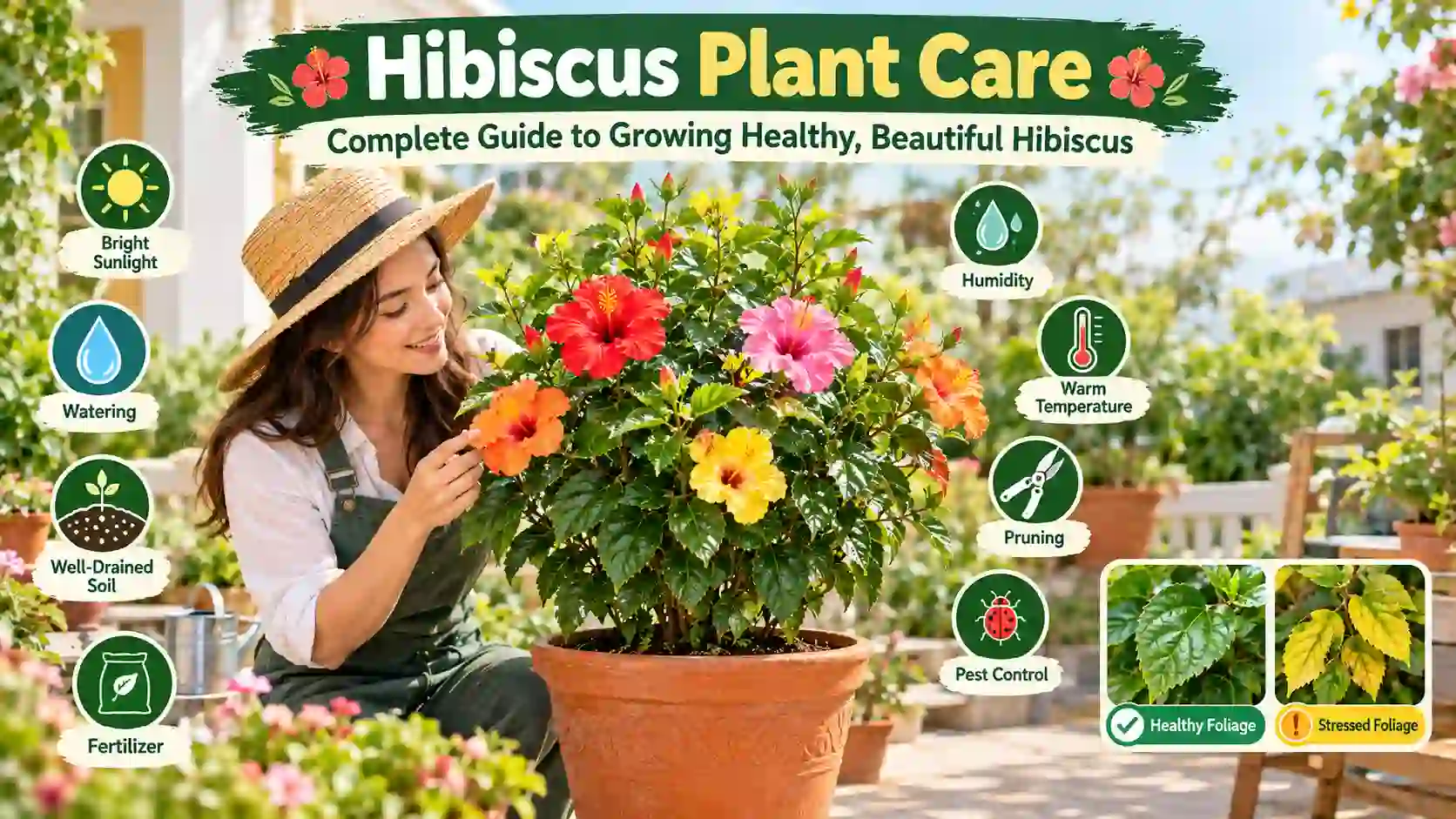
Hibiscus plant care is mainly about providing plenty of light, consistent moisture, good drainage, warmth, regular feeding, and timely pruning. Tropical hibiscus (Hibiscus rosa-sinensis) grows best in warm conditions and bright light, while hardy hibiscus has different seasonal needs. Avoid letting the soil become bone dry or waterlogged. Feed actively growing plants regularly, inspect leaves for pests, and prune strategically to encourage branching and flowering.
Introduction
Hibiscus is one of those plants that can look spectacular when its basic needs are met.
Large flowers, glossy foliage, and a long flowering season make hibiscus a popular choice for patios, gardens, balconies, and sunny indoor spaces. However, many growers become frustrated when a healthy-looking plant suddenly drops buds, develops yellow leaves, or stops flowering.
The problem is often not a single missing fertilizer or special product.
Hibiscus responds strongly to changes in light, temperature, watering, humidity, and root conditions. A plant that receives excellent care in one location can struggle after being moved to another.
The first step in successful hibiscus plant care is understanding which type you have. Tropical hibiscus, especially Hibiscus rosa-sinensis, behaves differently from hardy perennial hibiscus. Tropical types are evergreen and sensitive to cold, while hardy hibiscus can die back to the ground during winter and return from its roots.
This guide focuses primarily on tropical hibiscus because it is widely sold as a container and houseplant. It also explains where hardy hibiscus care differs.
Image Suggestion: A realistic 16:9 infographic showing a healthy tropical hibiscus with icons for sunlight, water, drainage, fertilizer, humidity, temperature, pruning, and pest inspection.
Know Which Hibiscus You Are Growing
Before changing your watering or fertilizer routine, identify the type of hibiscus.
| Feature | Tropical Hibiscus | Hardy Hibiscus |
|---|---|---|
| Common botanical group | Hibiscus rosa-sinensis | Several hardy perennial species and hybrids |
| Foliage | Usually evergreen | Often deciduous |
| Cold tolerance | Low | Much higher |
| Flower behavior | Large flowers, often short-lived | Large summer flowers |
| Winter behavior | Needs protection in cold climates | Often dies back and regrows |
| Container growing | Excellent | Possible, but larger varieties need space |
| Main care concern | Warmth, light, moisture, pests | Sun, moisture, winter dormancy |
Tropical hibiscus is a warm-climate plant. RHS lists Hibiscus rosa-sinensis as a tender plant and recommends bright conditions, humidity, ventilation, and protection from cold.
Hardy hibiscus has a different growth cycle. In colder climates, the top growth can die back during winter while the root system survives and produces new shoots the following season.
Practical tip: If your hibiscus loses all its stems during winter but produces new shoots from the ground in spring, it may be a hardy type rather than a tropical hibiscus.
What Does Hibiscus Need to Grow Well?
Successful hibiscus plant care comes down to balancing several conditions.
The basic formula is:
Bright light + warm temperatures + evenly moist soil + good drainage + regular nutrition + airflow
None of these factors works completely on its own.
For example, adding fertilizer will not solve poor flowering if the plant receives inadequate light. Likewise, frequent watering will not fix wilting if damaged roots cannot absorb water.
A useful way to troubleshoot hibiscus is to ask:
- Is the plant receiving enough light?
- Is the soil staying appropriately moist?
- Can excess water drain freely?
- Is the plant warm enough?
- Is it receiving nutrients during active growth?
- Are pests damaging new growth?
- Has the plant recently been moved or exposed to environmental stress?
This approach is more reliable than changing several things at once.
How Much Sunlight Does Hibiscus Need?
Hibiscus generally performs best with bright light and several hours of direct sunlight.
For indoor tropical hibiscus, a sunny southern or western exposure can provide the intensity needed for strong flowering. University of Minnesota Extension recommends at least four to five hours of bright direct light indoors, noting that more light generally improves blooming.
Outdoor hibiscus can usually handle considerably more sun, provided the plant is acclimated gradually.
Signs of insufficient light
A hibiscus receiving too little light may develop:
- Long, weak stems
- Sparse foliage
- Smaller flowers
- Fewer flower buds
- Bud drop
- Slow growth
- A plant that leans toward the brightest window
Too much sudden sunlight can also cause problems
A hibiscus moved directly from an indoor location to intense outdoor sun may experience leaf scorch or stress.
Instead, gradually increase its exposure.
A practical transition can look like this:
- Start in bright filtered light.
- Move to a location with morning sun.
- Increase direct sunlight over several days.
- Watch the foliage for scorching.
- Move toward stronger sun as the plant acclimates.
Gradual acclimation is particularly important when moving container hibiscus outdoors after spending time indoors.
Image Suggestion: A 16:9 visual comparison showing hibiscus in low light, ideal bright light, and suddenly exposed intense sunlight.
How to Water a Hibiscus Plant
Watering is one of the most important parts of hibiscus plant care.
Hibiscus generally prefers soil that remains consistently moist but not saturated. Allowing the root ball to become extremely dry can cause stress and bud drop, while constantly wet soil reduces air around the roots and increases the risk of root problems.
How to know when to water
Do not water simply because it is a particular day of the week.
Instead, check the soil.
Insert your finger into the upper layer of the potting mix. If the surface and upper portion have started to dry while the deeper root zone remains slightly moist, it may be time to water.
The exact frequency changes with:
- Temperature
- Sun exposure
- Pot size
- Soil composition
- Humidity
- Wind
- Plant size
- Season
A small pot sitting in hot sun may require water much more frequently than a large container in partial shade.
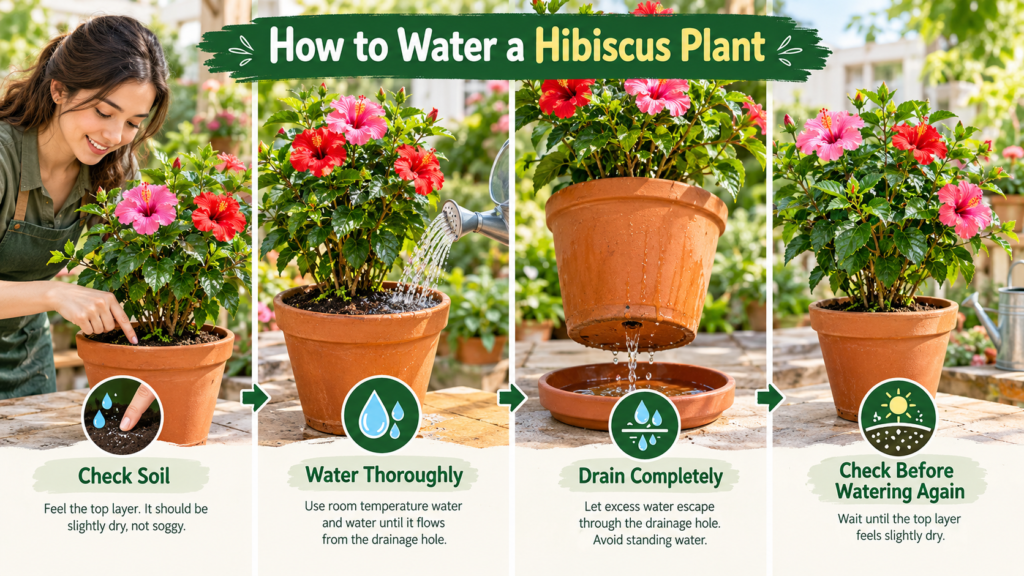
The correct watering method
When watering a container hibiscus:
- Water the soil thoroughly.
- Continue until water drains from the bottom.
- Allow excess water to leave the container.
- Empty standing water from a saucer.
- Do not water again simply because the surface looks dry.
Thorough watering helps wet the entire root zone and can also flush soluble salts from the potting mix.
Avoid both extremes
Too little water:
Leaves wilt, buds may drop, growth slows, and the plant becomes stressed.
Too much water:
Leaves may yellow, roots may become unhealthy, and growth can decline even though the soil remains wet.
Expert observation: A wilted hibiscus does not automatically mean it needs more water. Check the soil first. If the pot is already saturated, adding more water can make the underlying problem worse.
Image Suggestion: Step-by-step watering infographic showing dry soil → thorough watering → drainage → checking soil before watering again.
Choose a Well-Draining Soil Mix
Hibiscus needs access to water, but its roots also need oxygen.
That makes well-drained, moisture-retentive soil more useful than either extremely sandy soil or dense, waterlogged soil.
University of Minnesota Extension recommends a rich, well-drained growing medium for hibiscus.
A practical container mix can contain:
- Quality potting mix
- Organic material such as compost
- Perlite or another drainage component
The goal is a mix that holds enough moisture for active growth while allowing excess water to escape.
Why drainage holes matter
A beautiful decorative pot is not enough if water has nowhere to go.
Always use a container with drainage holes for a container-grown hibiscus.
If water repeatedly collects around the roots, the plant can decline even when the foliage initially looks healthy.
Signs your soil may be unsuitable
Watch for:
- Water remaining on the surface for a long time
- Soil that stays saturated for days
- Persistent yellowing
- Slow growth
- Bad-smelling soil
- Roots that look dark and unhealthy after inspection
How to Fertilize Hibiscus
Hibiscus is a vigorous flowering plant and can benefit from regular feeding during active growth.
University of Minnesota Extension describes hibiscus as a heavy feeder and recommends balanced fertilizer during active outdoor growth, with less frequent feeding indoors and during winter.
The important point is consistency rather than excessive fertilizer.
A practical feeding approach
During active growth:
- Use a balanced fertilizer according to its label.
- Diluted liquid fertilizer can be convenient for container plants.
- Follow the product’s recommended frequency.
- Reduce feeding when growth slows.
- Avoid fertilizing a severely stressed or drought-stressed plant.
Container plants can lose nutrients through repeated watering because nutrients can leave with drainage water.
Should you use a high-phosphorus fertilizer?
Not automatically.
A common gardening mistake is assuming that more phosphorus always means more flowers.
Flowering depends on the whole growing environment. If the plant lacks sufficient light or has unhealthy roots, changing fertilizer alone is unlikely to solve the problem.
A balanced fertilizer used appropriately is usually a more sensible starting point than repeatedly increasing one nutrient.
Image Suggestion: Hibiscus feeding infographic showing active growth versus winter feeding, with a simple fertilizer application illustration.
The Best Temperature for Hibiscus
Warmth is essential for tropical hibiscus.
Cold conditions can interfere with growth and flower-bud development. University of Minnesota Extension recommends warm indoor conditions and notes that sudden changes in temperature or humidity can contribute to stress and bud drop.
RHS also identifies tropical hibiscus as a tender plant requiring protection from cold conditions.
Protect tropical hibiscus from:
- Frost
- Cold drafts
- Sudden temperature changes
- Cold windows
- Air-conditioning vents
- Heating vents
- Abrupt indoor-to-outdoor transitions
If you grow tropical hibiscus outdoors in a warm climate, sudden weather changes can still cause stress.
Why buds drop after moving the plant
A hibiscus can form buds and then drop them after a major environmental change.
Possible triggers include:
- Lower light
- Temperature changes
- Irregular watering
- Excessive heat
- Cold exposure
- Drafts
- Root stress
Do not immediately assume the plant needs more fertilizer.
First examine its environment.
Does Hibiscus Need High Humidity?
Tropical hibiscus appreciates humid conditions, especially when grown indoors.
RHS recommends bright, humid conditions with good ventilation for tropical hibiscus.
Humidity becomes particularly relevant when indoor air is very dry.
You can improve the environment by:
- Grouping compatible plants
- Using a humidifier
- Keeping the plant away from dry heating vents
- Maintaining appropriate airflow
- Using a pebble tray if suitable for your setup
However, humidity should not replace good ventilation.
Very humid, stagnant air can create other problems.
Important distinction: A humid environment does not mean the potting soil should remain saturated.
Air humidity and root-zone moisture are separate parts of plant care.
How to Prune Hibiscus for Bushier Growth
Pruning is one of the most useful ways to control hibiscus shape.
Tropical hibiscus can become leggy when growth is weak or light is inadequate. Selective pruning encourages branching and can help maintain a compact form.
University of Minnesota Extension recommends late-winter pruning for bushier growth, while RHS describes shortening previous-season growth and removing thin or overcrowded shoots.
How to prune tropical hibiscus
- Remove dead or damaged growth.
- Identify long, weak, or crowded stems.
- Cut back selected stems above healthy leaf nodes.
- Maintain an open shape.
- Avoid removing too much healthy growth at once unless a hard renovation prune is intentional.
- Expect flowering to be delayed after significant pruning.
The important trade-off
Pruning can improve future branching, but it can also remove developing flower buds.
That means a heavily pruned plant may take longer to flower again.
If your priority is immediate flowering, use lighter pruning.
If your priority is rebuilding a leggy plant, stronger pruning may be appropriate.
Should You Deadhead Hibiscus?
Tropical hibiscus flowers are naturally short-lived.
Individual flowers commonly last about a day before fading, even when the plant itself is healthy.
This can surprise new growers.
A flower disappearing the next day does not necessarily mean something is wrong.
Remove faded flowers when they become unattractive or when you want to keep the plant tidy.
Hardy hibiscus can also benefit from deadheading. Extension guidance notes that removing faded flowers can improve appearance and encourage additional blooms.
How to Repot Hibiscus
Repot when the plant has clearly outgrown its container or the potting mix has deteriorated.
Possible signs include:
- Roots emerging from drainage holes
- Water passing through extremely quickly
- Roots tightly circling the root ball
- The plant becoming unstable
- Growth slowing despite otherwise good care
Choose a container only moderately larger than the current one.
Moving a small root system into a very large container can make moisture management harder because the excess soil may remain wet longer.
After repotting:
- Use fresh, well-draining mix.
- Position the plant at the same general depth.
- Water thoroughly.
- Allow excess water to drain.
- Return it to suitable light.
- Avoid immediately applying excessive fertilizer.
Image Suggestion: 16:9 repotting infographic showing root-bound hibiscus, appropriately sized new pot, fresh soil mix, and drainage holes.
Hibiscus Plant Care Through the Seasons
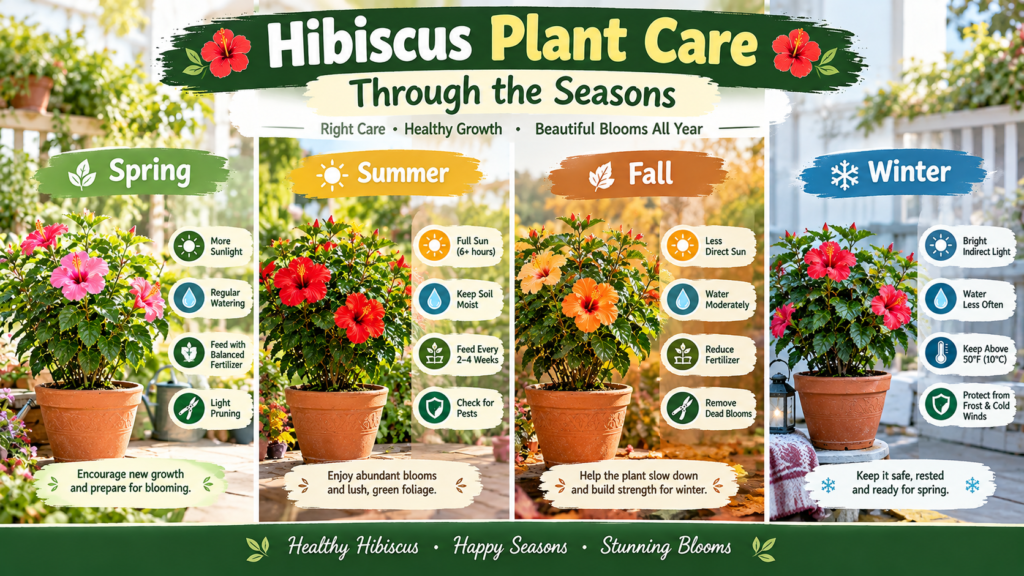
Your routine should change with the plant’s growth rate.
Spring
Spring is the time to increase attention as growth accelerates.
Focus on:
- Increasing light
- Gradually increasing watering
- Beginning regular feeding
- Pruning when appropriate
- Checking for pests
- Repotting if necessary
RHS recommends increasing watering as light and temperatures rise and beginning feeding after repotting once the plant has had time to establish.
Summer
Summer can be the most productive flowering period.
Monitor:
- Soil moisture
- Heat stress
- Fertilizer needs
- Pests
- Sun exposure
- Wind
Hot, dry conditions can increase water loss dramatically, particularly for container plants.
Autumn
If growing tropical hibiscus in a climate with cool winters, begin preparing before temperatures become too low.
Inspect the plant carefully for insects before bringing it indoors.
Moving outdoor plants indoors can also cause leaf yellowing or leaf drop because light, humidity, airflow, and temperature change. This transition does not automatically mean the plant is dying.
Winter
Tropical hibiscus usually needs less water when growth slows.
RHS recommends reducing watering as growth slows and allowing the upper layer of the growing medium to dry before watering again. Feeding should also be reduced or stopped during winter dormancy.
Keep tropical hibiscus away from:
- Cold drafts
- Frost
- Hot radiators
- Heating vents
- Very dark rooms
Why Is My Hibiscus Not Flowering?
A hibiscus that produces leaves but few flowers usually needs environmental troubleshooting.
1. Insufficient light
This is one of the first things to check.
Hibiscus needs strong light to produce abundant flowers.
2. Too much nitrogen
Excessive feeding can encourage vegetative growth without solving the underlying flowering problem.
3. Temperature stress
Cold conditions can prevent buds from developing normally.
4. Inconsistent watering
Repeated cycles of severe drying followed by heavy watering can stress the plant.
5. Recent pruning
Heavy pruning can remove developing flowering shoots and delay blooming.
6. Root problems
Poor drainage or damaged roots can reduce overall plant performance.
7. Recent relocation
A hibiscus may temporarily respond to changes in light, temperature, humidity, or watering after being moved.
Best approach: Change one major factor at a time and observe the plant for several weeks.
Why Are Hibiscus Buds Dropping?
Bud drop is one of the most frustrating hibiscus problems.
It can happen when conditions change rapidly.
Common triggers include:
- Too little light
- Excessive heat
- Cold temperatures
- Irregular watering
- Overwatering
- Drafts
- Sudden changes in humidity
- Moving the plant
- Pest pressure
University of Minnesota Extension specifically identifies temperature, water, light, and environmental changes as factors associated with hibiscus bud drop.
What to do
Instead of immediately adding fertilizer:
- Check the soil moisture.
- Check the drainage holes.
- Assess light intensity.
- Look underneath leaves for pests.
- Check for temperature changes.
- Keep the plant in a stable location.
- Maintain a consistent watering routine.
Why Are Hibiscus Leaves Turning Yellow?
Yellow leaves can have many causes, so the color alone is not enough for diagnosis.
Possible causes include:
- Excessive watering
- Abrupt moisture changes
- Temperature changes
- Drafts
- Low light
- Nutrient shortage
- Natural leaf turnover
- Root stress
- Pest damage
University of Minnesota Extension notes that yellowing can occur after changes in soil moisture, temperature, or drafts, and that some seasonal yellowing can be normal during transitions.
Common Hibiscus Pests
Hibiscus can attract several common plant pests.
RHS lists aphids, red spider mites, and whiteflies among potential problems for tropical hibiscus.
Other pests may include:
- Scale insects
- Mealybugs
- Thrips
Aphids
Aphids often gather around tender new growth.
Look for:
- Curled leaves
- Small insects on shoots
- Sticky honeydew
- Distorted young growth
Severe aphid feeding can cause curled or yellow leaves and weakened growth.
Spider mites
Spider mites are especially troublesome during hot, dry conditions.
Look for:
- Tiny pale speckles
- Yellowing or bronzed foliage
- Fine webbing
- Mites beneath leaves
Spider mites are tiny and can be difficult to see without close inspection.
Whiteflies
These tiny insects often fly away when foliage is disturbed.
Check the undersides of leaves.
Mealybugs
Look for white, cotton-like clusters around leaf joints and stems.
How to Control Hibiscus Pests
Start with observation rather than immediately reaching for a strong pesticide.
For a small infestation:
- Isolate an indoor plant from other plants.
- Inspect leaf undersides.
- Wash foliage with an appropriate stream of water.
- Remove heavily infested material when practical.
- Monitor repeatedly.
- Use a labeled insecticidal soap or horticultural oil if needed.
Insecticidal soaps work through direct contact, so thorough coverage is important. Extension guidance also warns against homemade soap mixtures because they can damage plants.
For spider mites, washing foliage and improving growing conditions can help reduce populations.
Always follow the pesticide label for the specific plant, pest, application rate, and environment.
Image Suggestion: Pest-identification infographic showing aphids, spider mites, whiteflies, and mealybugs with close-up symptoms on hibiscus leaves.
Common Hibiscus Care Mistakes
Mistake 1: Watering on a fixed schedule
Plants do not consume identical amounts of water every week.
Better approach: Check soil moisture and adjust according to weather, light, pot size, and growth.
Mistake 2: Keeping the soil constantly wet
Hibiscus likes moisture but does not need permanently saturated roots.
Better approach: Use a well-draining mix and water thoroughly when appropriate.
Mistake 3: Moving indoor hibiscus straight into intense sun
Sudden environmental changes can cause stress and foliage loss.
Better approach: Acclimate gradually.
Mistake 4: Fertilizing a struggling plant excessively
More fertilizer does not automatically mean faster recovery.
Better approach: Fix light, water, temperature, and root conditions first.
Mistake 5: Ignoring the undersides of leaves
Many pests hide where they are difficult to notice.
Better approach: Inspect both sides of leaves regularly.
Mistake 6: Assuming every dropped flower means poor care
Individual tropical hibiscus flowers are naturally short-lived.
Better approach: Judge the plant by its overall growth and ability to continue producing buds.
Mistake 7: Pruning heavily immediately before flowering
Heavy pruning can remove developing flowering growth.
Better approach: Prune according to your goal: shaping, rejuvenating, or maximizing immediate flowers.
A Simple Weekly Hibiscus Care Routine
You do not need to inspect your hibiscus for hours every week.
A quick routine is enough.
Once or twice a week
Check the soil
Determine whether the plant actually needs water.
Inspect new growth
Look for aphids, distortion, or unusual discoloration.
Check leaf undersides
Look for mites, whiteflies, scale, or mealybugs.
Assess the light
Make sure nearby growth or seasonal changes have not significantly reduced exposure.
Look at the buds
If buds are dropping, investigate environmental changes.
Check drainage
Make sure water can leave the container freely.
This simple routine catches many problems before they become severe.
Advanced Tips for Better Hibiscus Growth
Keep conditions stable
Hibiscus often responds better to consistency than constant adjustment.
Avoid repeatedly moving the plant between:
- Full sun
- Shade
- Indoors
- Outdoors
- Air-conditioned rooms
- Hot patios
Frequent environmental changes can create stress even when each individual location seems suitable.
Train the plant early
Pinching or selectively pruning young growth can encourage branching.
More branches can create more potential flowering points later.
Rotate indoor plants
If one side receives much more light than another, gently rotate the pot periodically to encourage more even growth.
Watch the weather, not just the calendar
A watering schedule that works during mild spring weather may fail during a hot summer.
Container plants can dry considerably faster during periods of high heat and wind.
Inspect plants before bringing them indoors
Outdoor hibiscus can carry pests inside.
Inspect leaves, stems, and soil before moving the plant indoors. Quarantining returning plants can also reduce the risk of spreading pests to other houseplants.
Can Hibiscus Grow Indoors?
Yes. Tropical hibiscus can be grown indoors, but flowering indoors can be more difficult than outdoor growth.
The biggest challenge is usually light.
Place the plant in the brightest suitable location available and maintain warmth and reasonable humidity.
RHS notes that tropical hibiscus can be grown indoors but can be challenging in ordinary homes because it requires bright, humid conditions and good ventilation.
If your indoor hibiscus produces leaves but refuses to flower, evaluate light before assuming fertilizer is the problem.
Can Hibiscus Grow in Pots?
Yes. Tropical hibiscus is particularly well suited to containers.
Container growing gives you more control over:
- Soil
- Drainage
- Placement
- Winter protection
- Pruning
- Watering
But containers also dry faster and have limited nutrient reserves.
This means container hibiscus needs closer monitoring than an established plant growing in the landscape.
Hibiscus Care for Hot Climates
In hot climates, hibiscus can grow vigorously, but heat creates its own challenges.
During extreme heat:
- Check soil moisture more frequently.
- Protect newly transplanted plants from sudden intense exposure.
- Maintain adequate drainage.
- Watch for spider mites.
- Avoid allowing the root ball to become severely dry.
- Monitor leaves for heat or sun stress.
Hot, dry conditions can encourage spider mite problems, while stressed plants are generally more vulnerable.
A plant in full afternoon sun may require significantly more attention than the same cultivar in milder morning sunlight.
Tropical Hibiscus vs Hardy Hibiscus: Which Care Is Different?
The biggest mistake is treating all hibiscus as if they have the same winter requirements.
Tropical hibiscus
Needs:
- Warm temperatures
- Bright light
- Protection from frost
- Consistent moisture
- Regular feeding during active growth
- Indoor protection in cold climates
Hardy hibiscus
Generally needs:
- Full sun
- Moist but well-drained soil
- Regular water during active growth
- Adequate nutrition
- Winter protection appropriate to the cultivar and climate
Hardy hibiscus can die back naturally during winter and return from its root system.
Image Suggestion: Side-by-side 16:9 infographic comparing tropical hibiscus and hardy hibiscus, including foliage, flowers, winter behavior, light, watering, and temperature.
How to Propagate Hibiscus from Cuttings
Tropical hibiscus can be propagated from stem cuttings.
RHS recommends softwood or semi-ripe cuttings, while University of Minnesota Extension describes vegetative cuttings as a practical propagation method.
Basic method
- Select a healthy stem.
- Take a several-inch cutting from suitable new growth.
- Remove unnecessary lower foliage.
- Place the cutting into a light, well-draining propagation medium.
- Maintain warmth and moisture.
- Provide bright but suitable light.
- Wait for roots to develop.
- Pot the rooted cutting into an appropriate container.
RHS notes that warm conditions and high humidity can encourage rooting, with bottom heat around 24–27°C used in its propagation guidance.
Do not keep the propagation medium waterlogged.
When Should You Repot, Prune, or Fertilize Hibiscus?
| Task | Best General Timing | Important Consideration |
|---|---|---|
| Repotting | Beginning of active growth | Use fresh, well-drained mix |
| Pruning tropical hibiscus | Late winter or before strong new growth | Heavy pruning delays flowers |
| Fertilizing | Active growth | Follow product label |
| Reducing fertilizer | Slow-growth periods | Avoid unnecessary feeding |
| Increasing watering | As growth and temperatures rise | Check soil first |
| Pest inspection | Year-round | Inspect new growth and leaf undersides |
Exact timing depends on climate and whether you grow tropical or hardy hibiscus.
RHS recommends repotting tropical hibiscus around late winter or early spring and increasing watering as light and temperatures increase.
Hibiscus Troubleshooting Chart
| Problem | Likely Causes | What to Check First |
|---|---|---|
| Yellow leaves | Wet soil, moisture swings, temperature changes, nutrition | Soil moisture and drainage |
| Buds falling | Temperature, water, light, environmental stress | Recent changes |
| No flowers | Low light, stress, poor conditions, excessive pruning | Light exposure |
| Wilting | Dry soil, root damage, heat stress | Soil before watering |
| Leggy growth | Insufficient light | Move gradually toward brighter light |
| Brown leaf edges | Dry conditions, root stress, environmental stress | Soil and humidity |
| Fine webbing | Spider mites | Leaf undersides |
| Sticky leaves | Aphids or other sap feeders | New growth |
| White cotton-like clusters | Mealybugs | Stems and leaf joints |
| Slow growth | Poor light, root issues, temperature, nutrition | Growing environment |
What Hibiscus Care Really Comes Down To
The healthiest hibiscus plants are usually not the result of complicated routines.
They are the result of getting a few fundamentals right:
- Give tropical hibiscus strong light.
- Keep the soil consistently but moderately moist.
- Use a container with drainage.
- Avoid prolonged waterlogging.
- Feed during active growth.
- Keep tropical varieties warm.
- Protect them from sudden environmental changes.
- Prune strategically.
- Inspect leaves and new growth for pests.
- Adjust care as seasons and weather change.
The most useful mindset is to observe before reacting.
If the leaves are yellow, inspect the roots and soil before adding fertilizer.
If buds fall, examine temperature, light, and watering before assuming the plant is hungry.
This simple diagnostic approach prevents many common hibiscus-care mistakes.
Frequently Asked Questions About Hibiscus Plant Care
How often should I water my hibiscus?
Water when the growing medium has begun to dry rather than following a rigid calendar. Water thoroughly until excess drains from the container, then allow the plant to drain completely. Frequency varies with temperature, light, pot size, and season.
Does hibiscus need full sun?
Hibiscus generally performs best with strong light. Tropical hibiscus benefits from several hours of bright direct light, while outdoor plants can often grow well in full sun. Acclimate plants gradually when moving them into stronger sunlight.
Why is my hibiscus dropping flower buds?
Bud drop can result from temperature changes, inadequate light, inconsistent watering, excessive heat, drafts, or other environmental stress. Check the plant’s conditions before increasing fertilizer.
Why are my hibiscus leaves turning yellow?
Yellow leaves can result from overwatering, moisture fluctuations, temperature changes, drafts, low light, nutrient problems, or normal seasonal transitions. Inspect the soil and growing conditions before treating the plant.
How do I make my hibiscus bloom more?
Provide strong light, warm conditions, consistent moisture, adequate nutrition, and healthy roots. Avoid excessive pruning when you want immediate flowers because pruning can remove developing flower-bearing growth.
Should I cut off dead hibiscus flowers?
Yes, you can remove faded flowers to keep the plant tidy. Individual tropical hibiscus flowers are naturally short-lived, often lasting only about a day.
Can I grow hibiscus indoors?
Yes. Tropical hibiscus can grow indoors when provided with strong light, warmth, humidity, and good ventilation. Flowering can be more difficult indoors because light intensity is often lower.
Can hibiscus survive winter?
It depends on the type. Tropical hibiscus is sensitive to cold and may need to be moved indoors or protected. Hardy hibiscus can survive winter in appropriate climates by dying back and regrowing from the roots.
What fertilizer is best for hibiscus?
A balanced fertilizer can work well during active growth when applied according to the product label. Avoid assuming that a high-phosphorus fertilizer alone will solve flowering problems. Light, temperature, watering, and root health are equally important.
Why is my hibiscus growing leaves but no flowers?
Insufficient light is one of the first factors to investigate. Other possibilities include temperature stress, excessive nitrogen, recent heavy pruning, inconsistent watering, and root problems.
Does hibiscus like humidity?
Tropical hibiscus appreciates humid conditions, particularly indoors. However, good ventilation remains important. High humidity should not be confused with keeping the soil constantly wet.
How do I get a leggy hibiscus bushier?
Prune selected long or weak stems above healthy nodes and provide stronger light. Late-winter pruning is commonly recommended for encouraging a bushier plant.
Related Topics to Explore
Readers growing hibiscus may also benefit from guides covering:
- How to water tropical plants correctly
- How to identify and control spider mites
- How to prune flowering shrubs
- How to choose well-draining potting soil
- How to grow tropical plants indoors
- How to prevent yellow leaves on houseplants
- How to improve flowering on container plants
Final Thoughts
Good hibiscus plant care is less about finding a single perfect fertilizer or watering schedule and more about creating stable growing conditions.
Start with light, drainage, moisture, and warmth. Then add regular feeding and thoughtful pruning as the plant grows.
When something goes wrong, resist the temptation to change everything at once. Inspect the soil, roots, light, temperature, and leaves first. Most hibiscus problems become much easier to solve once you identify the environmental change behind the symptom.
With the right conditions, a hibiscus can produce vigorous foliage and repeated waves of striking flowers while remaining manageable in a container or garden.