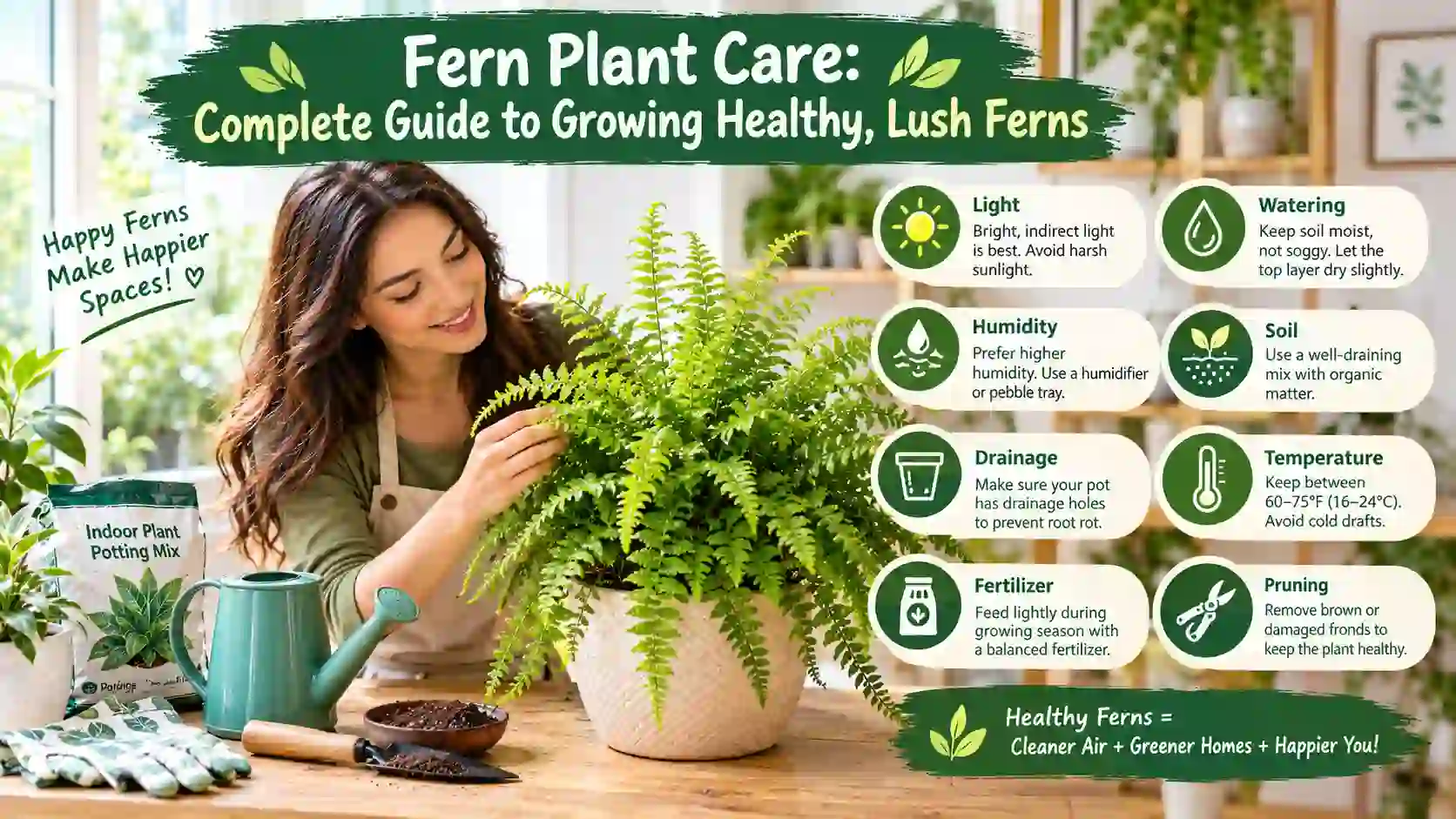
Fern plant care depends on the species, but most popular indoor ferns prefer bright, indirect light, consistent moisture, good drainage, and moderate to high humidity. Keep the soil moist when required without keeping it waterlogged. Protect ferns from harsh direct sunlight, cold drafts, heaters, and sudden environmental changes. Most importantly, identify your fern first because Boston, maidenhair, bird’s nest, and staghorn ferns can have different watering needs.
Ferns are popular because few plants create such a lush, woodland look indoors or outdoors.
Their graceful fronds can transform a dull corner into a vibrant green space. Yet many people struggle to keep ferns healthy after bringing them home.
The common advice sounds simple: keep a fern moist and humid.
That advice is incomplete.
Ferns grow in many different habitats. Some grow on damp forest floors, while others naturally grow on tree branches. Some tolerate occasional dry conditions, while others react badly when their growing medium dries completely.
This difference explains why one fern can thrive under the same conditions that cause another to decline.
Successful fern plant care starts with identifying the fern and then matching its environment to its natural growing habits.
This guide covers light, watering, humidity, soil, temperature, fertilizer, pruning, repotting, seasonal care, common problems, and species-specific needs. It also explains how to diagnose problems instead of guessing.
Understanding Ferns Before You Start
The word “fern” describes a large group of plants rather than one specific houseplant.
Ferns reproduce through spores rather than flowers and seeds. Their new fronds commonly emerge as tightly coiled structures called croziers. They can grow in woodland soil, wetlands, rocky habitats, and on trees.
That diversity matters when choosing a care routine.
Common ferns grown indoors include:
- Boston fern
- Bird’s nest fern
- Maidenhair fern
- Button fern
- Lemon button fern
- Blue star fern
- Rabbit’s foot fern
- Staghorn fern
These plants may look similar at a glance, but their requirements are not identical.
For example, Boston fern generally appreciates consistently moist growing media, while many epiphytic ferns are adapted to receiving water quickly and then drying somewhat between waterings.
The first rule of fern care
Never create a watering routine before identifying your fern.
Check the plant label, botanical name, or nursery information.
This one step can prevent many watering problems.
Image Suggestion: Create a labeled comparison infographic featuring Boston fern, bird’s nest fern, maidenhair fern, blue star fern, rabbit’s foot fern, and staghorn fern.
Fern Plant Care Requirements at a Glance
| Care Factor | What Most Indoor Ferns Prefer | Important Exception |
|---|---|---|
| Light | Bright, indirect light | Some tolerate lower light |
| Water | Consistent moisture for many species | Epiphytic types may need drying between waterings |
| Humidity | Moderate to high | Exact needs vary by species |
| Soil | Moisture-retentive but well-draining | Epiphytic ferns need especially open mixes |
| Temperature | Stable, moderate warmth | Hardy outdoor species tolerate colder conditions |
| Fertilizer | Light feeding during active growth | Avoid heavy feeding |
| Pot | Drainage hole | Mounted epiphytes may not need conventional pots |
| Airflow | Gentle circulation | Avoid strong hot or cold drafts |
This table is a starting point, not a substitute for species-specific care.
How Much Light Do Ferns Need?
Most popular indoor ferns prefer bright, indirect light.
Think about the light beneath a forest canopy.
The environment is bright, but leaves are protected from intense midday sun.
An east-facing window can work particularly well. A bright west-facing location may also work if strong afternoon sunlight is filtered. South-facing rooms may require more distance from the window or a sheer curtain. RHS recommends bright, indirect light for many tropical epiphytic ferns.
What happens with too little light?
A fern receiving inadequate light may develop:
- Slow growth
- Weak fronds
- Sparse foliage
- Pale growth
- Long, stretched fronds
Research-based growing guidance for Boston fern associates low light with long, weak fronds.
What happens with too much light?
Excessive direct sunlight may cause:
- Crispy edges
- Bleached areas
- Brown patches
- Scorched foliage
Spring sunlight can become significantly stronger than winter sunlight. University of Minnesota Extension recommends moving shade-loving houseplants gradually when increasing their light exposure.
Practical test
If your fern is near a window and develops crispy, bleached patches, move it farther away or filter the sunlight.
If it grows weakly and remains sparse, gradually move it toward a brighter location.
Do not change from deep shade to intense sunlight overnight.
How to Water Ferns Correctly
Watering is probably the most misunderstood part of fern plant care.
Many people hear that ferns love water and interpret this as “keep the pot soaking wet.”
That is not the same thing as keeping a fern properly hydrated.
Moist soil is not waterlogged soil
Healthy roots need both moisture and oxygen.
When soil remains saturated for long periods, air spaces fill with water. This can create conditions that encourage root problems.
RHS specifically warns that waterlogged conditions can cause fern roots to rot.
Step-by-step watering method
1. Check the growing medium
Put your finger into the soil rather than watering automatically according to the calendar.
For many moisture-loving ferns, water when the growing medium begins to dry.
For some epiphytic ferns, allow the compost to become almost dry before watering thoroughly.
2. Water the root zone
Apply water to the growing medium rather than repeatedly wetting the foliage.
Water thoroughly enough to moisten the root ball.
3. Let excess water escape
Water should flow from the drainage holes.
Empty the saucer if water remains underneath.
4. Check again before watering
Do not water simply because several days have passed.
Temperature, humidity, light, pot size, and season all change how quickly soil dries.
The best rule
Let the plant and soil determine watering frequency, not the calendar.
How Often Should You Water a Fern?
There is no reliable universal schedule.
A fern in a small pot near a bright window may need water much sooner than the same fern in a large container in a dim room.
As a general approach:
- Check frequently during active growth.
- Check less often when growth slows.
- Water more carefully during hot, dry weather.
- Reduce watering when the soil stays wet for longer.
- Always consider the species.
Boston fern requires relatively consistent moisture, while many epiphytic ferns should not remain constantly wet.
Real-world example
Imagine watering your fern every Sunday.
During summer, the soil may be dry by Saturday.
During winter, the same pot may still be damp on Sunday.
Watering both plants simply because it is Sunday ignores what is happening around the roots.
Should You Use Tap Water for Ferns?
Water quality can matter, particularly for sensitive ferns.
Some epiphytic ferns prefer acidic growing conditions, and RHS recommends rainwater or filtered water where possible. Hard, alkaline water can gradually affect the growing medium.
If you notice mineral deposits around the pot or repeated leaf problems despite good care, consider whether your water is contributing.
However, don’t automatically assume tap water is the cause of every brown leaf.
Check light, moisture, humidity, temperature, and fertilizer first.
How Much Humidity Do Ferns Need?
Many tropical ferns appreciate higher humidity.
This is one reason a fern may thrive in a naturally humid bathroom but struggle beside a dry heating vent.
RHS recommends humid conditions for many tropical epiphytic ferns and notes that browning can occur when indoor air becomes too dry.
Winter can be especially difficult.
Indoor heating lowers relative humidity, which can stress humidity-loving plants such as ferns. University of Minnesota Extension recommends grouping plants, using pebble trays correctly, or using a humidifier when additional humidity is needed.
Practical ways to increase humidity
Use a humidifier
A humidifier provides more consistent humidity than occasional misting.
This is particularly useful when several humidity-loving plants share the same room.
Group plants
Place several compatible plants together.
This can create a more humid local environment.
Use a pebble tray
Place pebbles in a shallow tray.
Add water without allowing the plant pot to sit directly in the water.
Use a naturally humid room
A bright bathroom can be excellent for many tropical ferns.
But humidity alone is not enough.
The room must also provide suitable light and airflow.
Does Misting Help Ferns?
Misting may temporarily increase moisture around the foliage, but it is not a replacement for maintaining suitable room humidity.
If your home is consistently dry, a humidifier is usually a more dependable solution.
Also avoid keeping foliage continuously wet without adequate airflow.
Penn State Extension lists several fern diseases associated with wet foliage or environmental conditions and recommends avoiding practices that encourage disease spread.
Better approach: Improve overall humidity and maintain gentle airflow rather than relying entirely on repeated misting.
Best Soil for Ferns
Ferns generally need a growing medium that balances moisture retention and drainage.
The exact recipe depends on the fern.
For many common indoor ferns, a quality houseplant mix amended with materials that improve aeration can work well.
For epiphytic ferns, the requirements are more specialized.
RHS recommends an open, moisture-retentive but well-draining, slightly acidic mix for many epiphytic ferns. Its suggested mix includes peat-free ericaceous compost, perlite, and medium-grade orchid bark.
What makes good fern soil?
A useful mix should:
- Hold enough moisture for the roots.
- Drain excess water.
- Maintain air spaces.
- Resist severe compaction.
- Support healthy root growth.
Avoid heavy garden soil in indoor pots
Garden soil can become dense inside containers.
Compacted soil drains poorly and can create an unhealthy root environment.
Drainage is not optional
Choose a container with drainage holes.
A beautiful decorative pot cannot compensate for permanently waterlogged soil.
Image Suggestion: Create a soil cross-section diagram showing airy potting mix, healthy fern roots, moisture, air spaces, and drainage holes.
Choosing the Right Pot
A fern’s pot should match its root system.
Don’t automatically choose a huge container because you want the plant to grow faster.
A large amount of unused soil can remain wet for a long time.
RHS recommends moving epiphytic ferns into a container only slightly larger than the root ball and warns against overpotting because it can contribute to root problems.
Signs your fern may need repotting
Look for:
- Roots emerging from drainage holes.
- A tightly packed root ball.
- Soil that dries unusually quickly.
- The plant becoming unstable.
- Growth slowing despite suitable care.
- Water passing through the pot unusually fast.
Best time to repot
Spring is often a convenient time because many plants are entering active growth.
But don’t repot simply because spring has arrived.
Repot when the plant actually needs more root space or fresh growing medium.
Temperature and Airflow for Ferns
Most tropical indoor ferns prefer stable temperatures.
Avoid placing them directly beside:
- Radiators
- Heaters
- Air conditioners
- Cold windows
- Frequently opened exterior doors
- Strong fans
Many tropical epiphytic ferns perform well around 16–30°C (60–85°F), according to RHS guidance.
Why sudden temperature changes matter
A fern may tolerate a room temperature well but react badly when its environment changes suddenly.
For example, moving a fern from a warm indoor room directly onto a cold balcony can cause stress even if the daytime temperature seems comfortable.
Gentle air circulation is useful.
Direct hot or cold airflow is not.
How to Fertilize Ferns
Ferns generally don’t need heavy feeding.
During active growth, use a suitable houseplant fertilizer according to its label.
Start conservatively rather than assuming more fertilizer produces faster growth.
University of Minnesota Extension recommends gentle feeding for actively growing houseplants and warns that excessive fertilizer can contribute to salt buildup.
Penn State Extension also identifies over-fertilization as a cause of fern leaf-tip burn.
A simple feeding strategy
During active growth:
- Use a balanced fertilizer suitable for houseplants.
- Follow the label dilution.
- Feed only when the plant is actively growing.
- Reduce feeding when growth slows.
- Avoid repeated heavy applications.
If leaf tips repeatedly turn brown after fertilizing, check for fertilizer buildup before adding more nutrients.
How to Prune a Fern
Ferns generally need little pruning.
Remove:
- Completely brown fronds
- Dead leaves
- Severely damaged foliage
- Diseased material
Use clean scissors or pruners.
Cut damaged fronds close to their base without damaging emerging growth.
Don’t remove healthy green fronds unnecessarily
Green foliage is still producing energy for the plant.
If only the tips are brown, you can trim the damaged portions for appearance rather than removing the entire frond.
But remember:
Pruning fixes appearance. It does not fix the cause.
If dry air caused the damage, correct the humidity problem.
If excessive fertilizer caused it, correct the feeding routine.
Why Are My Fern Leaves Turning Brown?
Brown leaves are one of the most common fern problems.
Unfortunately, brown leaves don’t provide one single diagnosis.
Possible causes include:
- Dry air
- Underwatering
- Excessive watering
- Direct sunlight
- Cold drafts
- Heat exposure
- Hard water
- Excess fertilizer
- Root problems
RHS lists several of these causes for browning in epiphytic ferns, including excessive watering, hard water, direct sun, low humidity, cold drafts, and heat sources.
Use this diagnostic process
Step 1: Feel the soil.
Is it extremely dry, comfortably moist, or constantly wet?
Step 2: Check the light.
Is the plant receiving harsh direct sunlight?
Step 3: Check humidity.
Is it sitting next to a heater or air conditioner?
Step 4: Check fertilizer.
Have you recently increased feeding?
Step 5: Inspect the roots.
If the soil stays wet and the plant is declining, root problems may be involved.
Don’t respond to every brown leaf by adding water.
That can make an already waterlogged fern worse.
Why Are My Fern Leaves Turning Yellow?
Yellowing may result from several types of stress.
Common possibilities include:
- Excessive moisture
- Poor drainage
- Root damage
- Insufficient light
- Nutrient imbalance
- Natural aging
Start by checking the soil.
The soil is consistently wet, investigate drainage and root health.
If the soil is very dry, correct watering.
If the plant is receiving very little light, gradually move it toward brighter indirect light.
Avoid making five major changes simultaneously.
Changing everything at once makes it difficult to determine what helped.
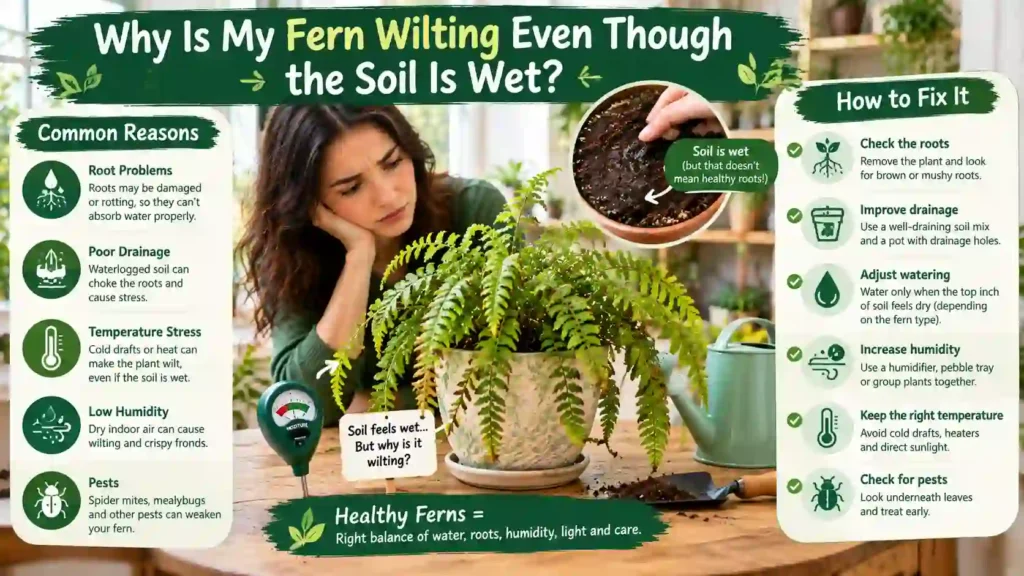
Why Is My Fern Wilting Even Though the Soil Is Wet?
This is an important warning sign.
A wilted plant does not always need more water.
If the soil is wet but the fern continues to wilt, the roots may be damaged or oxygen-starved.
Root problems can interfere with normal water uptake.
Penn State Extension identifies Pythium root rot in ferns as a condition associated with yellowing, stunting, wilting, and brown, rotted roots.
What to do
Remove the plant from the pot if the problem is severe.
Inspect the root system.
Healthy roots should not be broadly mushy or decayed.
If significant root damage is present, remove affected material with clean tools and repot into fresh, appropriately draining medium.
Then correct the watering problem that caused the prolonged saturation.
Why Is My Fern Losing Leaves?
Some older fronds naturally decline.
Sudden widespread leaf loss is different.
Check for:
- A recent location change
- Low humidity
- Watering problems
- Poor drainage
- Temperature stress
- Pest activity
- Insufficient light
Ferns can react to sudden changes in their environment.
For example, a plant that was growing comfortably in a humid nursery may struggle after being moved into a dry, air-conditioned room.
Give it stable conditions rather than repeatedly moving it around.
Fern Pests to Watch For
Indoor ferns can experience several pests.
Potential problems include:
- Scale insects
- Mealybugs
- Spider mites
- Fungus gnats
- Snails and slugs outdoors
UF/IFAS identifies scale, mites, mealybugs, snails, and slugs among pests associated with sword fern.
Inspect before treating
Look beneath fronds and around the plant’s crown.
Watch for:
- Fine webbing
- Sticky residue
- White cotton-like insects
- Small brown bumps
- Distorted new growth
- Tiny crawling insects
If possible, isolate an infested houseplant from other plants while you investigate the problem.
How to Care for Ferns Through the Seasons
Fern plant care should change as environmental conditions change.
Spring
Spring brings stronger light and increasing growth.
This is a good time to:
- Check for root crowding.
- Repot if necessary.
- Resume light fertilization.
- Remove damaged fronds.
- Gradually increase light exposure.
Don’t suddenly move a fern into intense sunlight.
University of Minnesota Extension recommends gradual light transitions because shade-loving plants can scorch when exposed to stronger spring sunlight too quickly.
Summer
Summer often increases water loss.
Check containers more frequently.
Outdoor containers can dry considerably faster than indoor pots, especially during hot weather.
Protect tropical indoor ferns from harsh afternoon sun.
Autumn
As daylight decreases, growth often slows.
Adjust watering according to soil moisture rather than maintaining a summer schedule.
Inspect plants for pests before bringing outdoor plants back inside.
Winter
Winter can be the hardest season for tropical ferns.
Dry indoor air, lower light, heaters, and temperature changes can all create stress.
University of Minnesota Extension specifically identifies ferns as humidity-loving houseplants that may struggle with low indoor humidity during winter.
Move the plant away from radiators and cold drafts.
Check the soil more carefully because lower light and cooler conditions can slow water use.
Indoor Fern Care vs Outdoor Fern Care
Not every fern should be treated like a houseplant.
| Feature | Indoor Tropical Fern | Outdoor Hardy Fern |
|---|---|---|
| Light | Bright indirect or filtered | Usually shade or dappled shade |
| Soil | Well-draining container mix | Organic-rich garden soil |
| Humidity | Often important | Usually supplied naturally |
| Water | Frequent monitoring | Extra water during establishment or drought |
| Temperature | Stable warmth | Depends on species |
| Fertilizer | Light feeding during active growth | Often little needed in fertile soil |
| Main Challenge | Dry air and watering mistakes | Drought, winter, pests, site conditions |
RHS notes that many garden ferns prefer light or dappled shade and moisture-retentive soil, although species vary considerably.
How to Care for Popular Fern Types
Boston Fern Care
Boston fern is one of the most recognizable indoor ferns.
It generally benefits from consistently moist, well-drained growing media.
UF/IFAS notes that insufficient water can reduce growth and that low light can produce long, weak fronds.
Focus on:
- Consistent moisture
- Bright filtered light
- Humidity
- Good drainage
- Light feeding during growth
Bird’s Nest Fern Care
Bird’s nest fern has broad, upright fronds emerging from a central rosette.
It prefers:
- Bright indirect light
- Moist but well-drained growing medium
- Warm temperatures
- Higher humidity
Avoid repeatedly pouring water directly into the central crown.
Image Suggestion: Close-up diagram showing the bird’s nest fern crown and correct watering location.
Maidenhair Fern Care
Maidenhair fern has delicate foliage and is less forgiving of inconsistent moisture and dry indoor air.
Pay close attention to:
- Soil moisture
- Humidity
- Gentle light
- Temperature stability
If the plant repeatedly dries out, recovery can become difficult.
Blue Star Fern Care
Blue star fern is an attractive option for indoor growers who want a less traditional fern appearance.
It generally prefers:
- Bright indirect light
- Good humidity
- Consistent but controlled moisture
- Well-draining soil
Avoid treating it like a plant that can sit in constantly saturated soil.
Staghorn Fern Care
Staghorn fern is very different from a typical potted fern.
It is an epiphytic fern, meaning it naturally grows attached to trees rather than rooted in ordinary ground soil.
RHS recommends bright indirect light, high humidity, free-draining growing material, and careful watering for epiphytic ferns.
This is why staghorn ferns are often mounted on boards or grown in specialized arrangements.
Image Suggestion: A labeled comparison between a potted Boston fern and a mounted staghorn fern showing their different root environments.
10 Fern Care Mistakes to Avoid
1. Watering every fern on the same schedule
Species and environments differ.
2. Keeping the soil permanently wet
Moisture-loving does not mean waterlogged.
3. Assuming brown leaves always mean underwatering
Brown foliage can have many causes.
4. Putting a fern in harsh afternoon sun
Shade-loving foliage can scorch quickly.
5. Ignoring humidity
Dry indoor air can produce crispy edges and declining foliage.
6. Using a container without drainage
Excess water needs somewhere to go.
7. Over-fertilizing
More fertilizer can cause salt-related damage rather than healthier growth.
8. Placing ferns beside heaters
Hot, dry air can stress delicate fronds.
9. Changing the plant’s location repeatedly
Constant environmental changes create additional stress.
10. Treating an epiphytic fern like a ground fern
Staghorn, bird’s nest, and other epiphytic types may have different moisture and growing-medium requirements.
A Simple Weekly Fern Care Routine
You don’t need to spend hours caring for a fern.
A short weekly inspection can catch problems early.
Check the soil
Feel the growing medium.
Don’t water automatically.
Check the fronds
Look for:
- Brown tips
- Yellowing
- Spots
- Pests
- New growth
- Wilting
Check the light
Make sure seasonal changes haven’t exposed the plant to stronger direct sun.
Check humidity
Look for dry air, especially near heaters and air conditioners.
Check the drainage
Make sure water can escape freely.
Check for pests
Inspect both sides of the fronds.
This routine is more useful than following a rigid calendar because it responds to what the plant is actually experiencing.
Advanced Tip: Read New Growth
One of the most useful ways to judge fern health is to watch new fronds.
Older leaves may show damage from conditions that have already changed.
New growth tells you more about the plant’s current environment.
If new growth is:
Strong and green:
Your current conditions are probably suitable.
Small and weak:
Check light, nutrition, root health, and temperature.
Brown before fully expanding:
Check humidity, moisture, temperature, and root conditions.
Distorted:
Inspect for pests and environmental stress.
This approach prevents you from overreacting to old cosmetic damage.
What to Do When a Fern Looks Unhealthy
Instead of immediately watering or fertilizing, follow this diagnostic order:
1. Identify the fern
Know what species or cultivar you’re growing.
2. Check the soil
Is it dry, evenly moist, or saturated?
3. Check the roots
If the soil remains wet and the plant declines, inspect the root system.
4. Check the light
Look for both insufficient light and sun scorch.
5. Check humidity
Consider heaters, air conditioners, and dry winter air.
6. Check temperature
Avoid cold drafts and direct heat.
7. Check fertilizer
Think about recent feeding and possible salt buildup.
8. Inspect for pests
Look underneath fronds and around the crown.
This process turns “my fern is dying” into a manageable troubleshooting exercise.
Frequently Asked Questions About Fern Plant Care
How often should I water my fern?
There is no universal schedule. Check the growing medium first. Many ground-growing or moisture-loving ferns prefer consistent moisture, while many epiphytic ferns should be allowed to dry somewhat before thorough watering.
Do ferns need direct sunlight?
Most popular indoor ferns prefer bright, indirect or filtered light. Strong direct sunlight can scorch delicate fronds.
Why are my fern leaves turning brown?
Brown leaves can result from dry air, watering problems, direct sunlight, cold drafts, excessive fertilizer, hard water, or root problems. Check the complete growing environment before changing your watering routine.
Do ferns need high humidity?
Many tropical indoor ferns prefer higher humidity. This is particularly important when indoor heating creates dry air during winter.
Can a fern grow in a bathroom?
Yes. A bright bathroom can provide suitable humidity for many tropical ferns. However, adequate light and airflow are still necessary.
Why is my fern wilting when the soil is wet?
Wet soil combined with wilting can indicate root stress or root damage. Check drainage and inspect the roots rather than adding more water. Pythium root rot, for example, can cause yellowing, wilting, stunting, and rotted roots.
Should I cut off brown fern leaves?
Remove completely dead or severely damaged fronds with clean scissors. If only the tips are brown, trimming the damaged section can improve appearance while you correct the underlying problem.
What is the best soil for ferns?
Most container ferns need a moisture-retentive but well-draining growing medium. Many epiphytic ferns prefer an open, slightly acidic mix with excellent drainage.
Should I fertilize my fern?
Ferns can benefit from light fertilization during active growth. Avoid heavy applications because excessive fertilizer can cause salt buildup and leaf-tip burn.
Can ferns grow in low light?
Some ferns tolerate lower light than others, but very low light can produce weak or slow growth. Boston fern, for example, develops weaker, longer fronds under insufficient light.
How can I make my fern fuller?
Provide appropriate light, consistent moisture, suitable humidity, good nutrition, and adequate root space. Healthy new fronds will gradually improve the plant’s fullness.
Can I put my indoor fern outside?
Some ferns can spend suitable seasons outdoors, but acclimate them gradually. Start in a sheltered, shaded or filtered-light location. Sudden exposure to strong outdoor sunlight can scorch foliage.
How do I know if my fern has root rot?
Persistent wet soil combined with yellowing, wilting, poor growth, or brown and rotted roots can indicate root disease. Inspect the roots if the plant declines despite adequate moisture.
Final Thoughts on Fern Plant Care
The secret to successful fern plant care is not watering more often or creating a complicated routine.
It is learning to read the plant.
Start by identifying your fern. Then provide the light, moisture, humidity, soil, temperature, and nutrition appropriate for that particular type.
For most indoor ferns, the foundation is simple:
- Bright, indirect light
- Appropriate soil moisture
- Excellent drainage
- Suitable humidity
- Stable temperatures
- Light feeding during active growth
- Regular inspection for pests and disease
Most importantly, don’t diagnose a fern problem from one symptom.
Brown leaves can mean dry air, excessive water, strong sunlight, fertilizer buildup, cold drafts, or other stress. Yellow leaves can have several causes too.
Look at the soil, roots, light, humidity, temperature, and recent changes together.
That habit will make you a much better fern grower than following a fixed watering calendar ever could.