
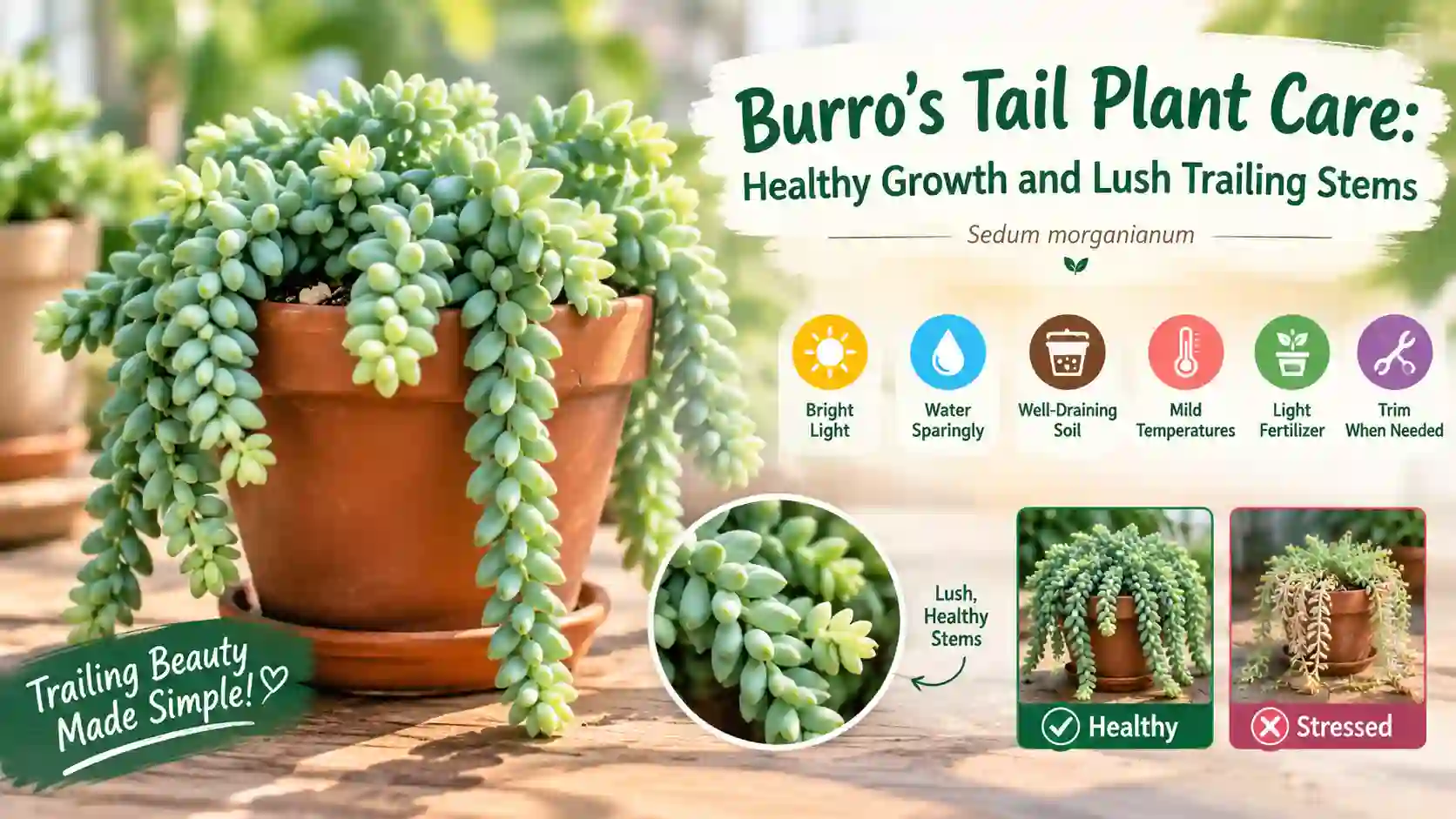
Burro’s tail is a distinctive succulent known for its long, cascading stems and plump, blue-green leaves. It looks beautiful in hanging baskets, elevated planters, and bright indoor spaces.
However, this succulent has one unusual challenge: its leaves detach with very little pressure. Moving the pot, brushing against a stem, or repotting carelessly can leave leaves scattered across the floor.
Watering can also be confusing. Its fleshy leaves store moisture, so frequent watering may cause more harm than good. Too little light can make the stems stretch and lose their compact appearance.
The good news is that burro’s tail becomes easier to maintain once you understand its natural growth habits. This guide explains how to provide the right light, water, soil, temperature, and seasonal care while preventing common problems.
Quick Answer:
Burro’s tail (Sedum morganianum) thrives in bright light, well-draining succulent soil, and careful watering. Let the soil dry out completely before watering thoroughly again, and always use a pot with drainage holes. Keep the plant in a warm location, avoid frequent handling, and fertilize lightly during active growth. Its delicate leaves fall off easily, so choose a stable shelf or hanging basket where the trailing stems can grow undisturbed.
1. Understand Burro’s Tail Before Growing It


Burro’s tail is a tender, trailing succulent native to Mexico and parts of Central America. Its botanical name is Sedum morganianum, and it belongs to the Crassulaceae family.
Its thick leaves overlap along hanging stems, creating the appearance of braided tails. Mature stems can become quite long, making the plant especially attractive in elevated containers.
Key characteristics
- Common names: Burro’s tail, donkey’s tail, and lamb’s tail.
- Plant type: Evergreen succulent.
- Foliage: Fleshy, blue-green leaves with a natural, powdery coating.
- Growth habit: Trailing or cascading.
- Flowers: Small pink to reddish flowers may appear on mature plants.
- Best growing conditions: Bright light, porous soil, and careful watering.
The powdery coating on the leaves helps create their soft, silvery appearance. Avoid rubbing it off unnecessarily.
Burro’s tail vs. baby burro’s tail
Baby burro’s tail is commonly associated with Sedum burrito, also sold as Sedum morganianum ‘Burrito’. It generally has shorter stems and rounder, more tightly packed leaves.
Both plants need similar care, including bright light, excellent drainage, and minimal handling.
Image suggestion: Create a labeled comparison showing burro’s tail with elongated leaves beside baby burro’s tail with rounder leaves.
2. Provide the Right Amount of Light
Light has a major influence on the shape, color, and density of burro’s tail. Although it tolerates some shade, it grows more compactly in bright conditions.
Best indoor light
Place your plant near a bright window where it receives plenty of natural light. An east-facing window can provide gentle morning sun, while a bright south- or west-facing window may work with suitable distance or filtering.
A few hours of gentle direct sunlight can be beneficial. However, intense sunlight through hot glass may scorch a plant that has not adapted to it.
How to introduce more sunlight
If your plant has been growing in a dim room, increase its exposure gradually.
- Start with bright, indirect light.
- Introduce a short period of gentle morning sunlight.
- Increase exposure over several days or weeks.
- Watch for pale, bleached, or scorched patches.
- Reduce direct exposure if the leaves show signs of sun damage.
Gradual adjustment is particularly important when moving a plant outdoors. Sudden exposure to stronger sunlight can damage the foliage.
Signs your burro’s tail needs better light
- Stems become longer and thinner.
- Leaves grow farther apart.
- New growth looks weaker than older growth.
- The plant stretches toward the nearest window.
This stretched growth is called etiolation. It cannot be reversed in existing stems, but improving the light helps new growth become more compact.
Expert tip: Rotate the pot gently when necessary to encourage even growth, but avoid repeatedly lifting or turning a plant with long, fragile stems.
Image suggestion: Show a compact burro’s tail growing in bright light beside a stretched, sparse plant in a dim room.
3. Water Burro’s Tail Correctly
Watering is one of the most important parts of burro’s tail plant care. Its fleshy leaves store water, so the plant can tolerate dry periods better than continuously wet soil.
The goal is to water deeply, then allow the potting mix to dry completely before watering again. Wisconsin Horticulture identifies overwatering and root rot as common problems for this succulent.
How often should you water burro’s tail?
There is no reliable schedule that works for every home. Watering frequency depends on light, temperature, pot size, soil composition, and the season.
| Growing conditions | Watering approach |
|---|---|
| Warm, bright growing season | Check the soil regularly and water when it has dried completely |
| Cool weather or winter | Water less often as growth slows |
| Small pot with gritty soil | Check more frequently because it may dry quickly |
| Large pot or dense soil | Check carefully because moisture may remain longer |
Do not water simply because two weeks have passed. Check the soil first.
Step-by-step watering method
- Check the soil several centimeters below the surface and, when possible, deeper in the pot.
- If the mix remains damp, wait.
- When the mix is completely dry, pour water evenly over the soil.
- Allow excess water to escape through the drainage holes.
- Empty the saucer or outer pot so the roots do not sit in water.
Watering thoroughly encourages moisture to reach the root zone. Letting the mix dry afterward reduces the risk of root rot.
How to recognize underwatering
A thirsty burro’s tail may develop leaves that look less plump, slightly wrinkled, or shriveled. If the soil is dry and the stems remain firm, thorough watering may help the plant recover.
How to recognize overwatering
Watch for these warning signs:
- Leaves become soft, translucent, or mushy.
- Stems turn dark or feel soft near the soil.
- Leaves fall off while the soil remains wet.
- The potting mix stays damp for many days.
If these symptoms appear, do not automatically add more water. Check the roots and soil moisture first.
Important: A few dropped leaves do not prove that the plant needs water. Leaf loss can also result from handling, poor light, or root damage.
Image suggestion: Create a watering infographic with three stages: check dry soil, water thoroughly, and allow complete drainage and drying.
4. Choose Well-Draining Soil and a Suitable Pot
Burro’s tail needs a growing medium that releases excess water quickly. Ordinary potting soil may retain too much moisture when used alone, especially in a cool room or a large container.
Wisconsin Horticulture recommends a cactus mix or a regular potting mix amended with materials such as perlite or pumice to improve drainage.
What soil is best for burro’s tail?
Use a commercial cactus and succulent mix, or make a simple blend using:
- Two parts quality potting mix.
- One part perlite or pumice.
Adjust the blend if your climate, pot, or growing conditions cause it to stay wet for too long. The finished mix should drain freely rather than becoming compact and muddy.
Avoid adding fine sand as your main drainage amendment. Fine particles can fill spaces between larger particles and make the mix less porous.
Choose a pot with drainage holes
A drainage hole is essential for reliable watering. Decorative containers without holes can trap water around the roots.
Good container choices include:
- Terracotta pots with drainage holes.
- Lightweight hanging baskets with suitable drainage.
- Shallow, stable planters with open drainage.
Terracotta can help the soil dry faster because moisture can evaporate through its sides. However, the correct watering interval still depends on the plant’s environment.
Should burro’s tail grow in a small pot?
Generally, yes. This succulent does not need an oversized container. A pot that is only slightly larger than its root system is easier to manage because it contains less excess soil that can stay wet.
Image suggestion: Show a burro’s tail in a pot with drainage holes beside a close-up of airy succulent soil containing visible perlite or pumice.
5. Maintain Suitable Temperature and Humidity
Burro’s tail prefers warm conditions and does not tolerate freezing temperatures. It can grow indoors year-round, provided it receives enough light and avoids cold drafts.
Ideal temperature
Aim for comfortable indoor temperatures and protect the plant from sudden cold changes.
- Keep it away from freezing conditions.
- Avoid placing it against cold windows during winter.
- Keep it away from strong heating vents that rapidly dry or heat the plant.
- Acclimate it gradually before moving it outdoors.
In many climates, burro’s tail can spend warm months outside in a sheltered location. Bring it indoors before cold nights become a concern.
Does burro’s tail need high humidity?
No. It does not require the high humidity that many tropical houseplants prefer. Good airflow and soil that dries properly are more important than frequent misting.
Avoid misting the leaves as a routine care method. Water droplets do not replace proper root watering, and handling or spraying can disturb the plant’s delicate leaf coating.
Practical tip: If your home is humid, pay extra attention to soil drying and ventilation. If your home is dry, the plant usually does not need a humidifier.
6. Fertilize Lightly During Active Growth
Burro’s tail grows relatively slowly and does not need heavy feeding. Too much fertilizer is unnecessary and can encourage weak growth or cause salts to build up in the potting mix.
Wisconsin Horticulture recommends light feeding once or twice during the growing season.
How to fertilize burro’s tail
- Choose a fertilizer labeled for cacti and succulents.
- Follow the product label and use a conservative dose.
- Apply it only when the plant is actively growing.
- Avoid fertilizing dry, stressed, or unhealthy plants.
- Reduce or stop feeding during winter dormancy or slow growth.
You do not need to fertilize every time you water. Excess fertilizer cannot compensate for poor light, unsuitable soil, or damaged roots.
Common mistake: A plant that is not growing quickly does not always need more fertilizer. First check its light, temperature, and root health.
Image suggestion: A simple infographic showing a succulent fertilizer bottle, healthy burro’s tail growth, and a seasonal feeding reminder.
7. Encourage Long, Full, Trailing Stems
The appeal of burro’s tail comes from its cascading stems covered in closely packed leaves. Strong light, careful watering, and protection from physical damage help maintain this appearance.
How to encourage fuller growth
- Give the plant bright light to prevent excessive stretching.
- Avoid frequent movement or handling.
- Use a stable pot that can support the weight of mature stems.
- Keep the soil well-drained.
- Remove damaged or rotting growth with clean tools.
Burro’s tail naturally produces trailing stems, so a long plant is not necessarily an unhealthy plant. However, sparse leaves and unusually stretched growth may indicate insufficient light.
Should you prune burro’s tail?
Routine pruning is usually unnecessary. Trim a damaged or excessively long stem only when there is a clear reason, such as rot, breakage, or a need for propagation.
Use clean scissors or pruning shears. Support the stem gently rather than squeezing its leaves.
If you cut a healthy stem, you can use it to grow another plant.
Will burro’s tail flower indoors?
Mature plants may produce small pink to reddish flowers, usually during warmer parts of the year. Indoor flowering is uncommon, and not every healthy plant will bloom.
Bright light, maturity, and suitable seasonal conditions may encourage flowering, but blooms are not guaranteed.
Expert tip: Focus on healthy foliage and sturdy growth rather than forcing flowering with extra fertilizer or excessive sunlight.
8. Repot Burro’s Tail Without Losing Too Many Leaves
Repotting can be stressful because the stems and leaves break easily. Fortunately, burro’s tail often grows well while slightly root-bound, so it rarely needs frequent repotting.
When should you repot?
Consider repotting when:
- Roots fill the container and growth becomes restricted.
- The potting mix has broken down or drains poorly.
- Water runs through the pot without wetting the mix evenly.
- Root rot or another soil-related problem requires fresh medium.
- The container is unstable or too small for the plant’s weight.
A crowded-looking canopy alone does not mean the roots need more space.
Step-by-step repotting guide

Step 1: Prepare the new pot
Choose a container with drainage holes that is only slightly larger than the root ball. Prepare fresh cactus and succulent mix.

Step 2: Support the stems
Work slowly and support the stems from underneath. Avoid pulling the plant upward by its trailing branches.

Step 3: Position the roots
Set the root ball at the previous planting depth and fill the gaps with fresh mix. Do not pack the soil tightly.

Step 4: Let the plant settle
Keep it in bright, indirect light while it recovers. If roots were cut or damaged, allow wounds to dry before watering. Follow the condition of the roots and potting mix rather than a rigid calendar.
Wisconsin Horticulture advises waiting about a week after repotting before watering, then watering sparingly while the plant re-establishes. This is particularly relevant when roots have been disturbed.
Image suggestion: A four-panel repotting infographic illustrating preparation, gentle handling, fresh succulent soil, and post-repotting recovery.
9. Propagate Burro’s Tail From Stems or Leaves
One of the advantages of burro’s tail is that fallen leaves and healthy stem cuttings can produce new plants. Propagation is also a useful way to replace sparse sections or grow new plants from a mature specimen.
However, fallen leaves do not all root successfully. Leaves that are crushed, rotten, or damaged at the base are less likely to develop into healthy plants.
Method 1: Stem cutting propagation
Stem cuttings usually provide a faster route to a plant with trailing growth.
- Choose a healthy stem with several intact leaves.
- Cut a section using clean scissors.
- Remove a few leaves from the bottom portion to expose the stem.
- Leave the cut end in a dry, shaded, airy place until it forms a callus, often for a day or two.
- Insert the bare end into dry or lightly moist, well-draining succulent mix.
- Place it in bright, indirect light and avoid keeping the soil wet.
- Check gently for root development over the following weeks.
The cutting may need support to stay in place. Avoid repeatedly pulling it out to check for roots, because this can damage new root growth.
Method 2: Propagation from individual leaves
- Collect healthy leaves that detach cleanly from the stem.
- Allow the broken ends to dry and callus.
- Lay the leaves on the surface of a suitable propagation mix.
- Provide bright, indirect light and good airflow.
- Keep the medium from staying waterlogged, and wait for roots and new growth to develop.
Leaf propagation is slower than stem propagation, and some leaves will fail to grow. Patience is essential.
Why are my burro’s tail cuttings not rooting?
Possible reasons include:
- The cutting was damaged or unhealthy.
- The cut end remained wet and began to rot.
- The soil was too dense.
- The cutting received too little light.
- The cutting was disturbed before roots developed.
Practical tip: Start several leaf cuttings at once if you want to increase your chances of success. Keep the healthiest ones and remove any that become soft or rotten.
Image suggestion: Show the progression from a detached leaf or stem cutting to callusing, rooting, and new succulent growth.
10. Common Burro’s Tail Problems and How to Fix Them
Most burro’s tail problems can be traced to watering, light, physical handling, or poor drainage. The most useful clue is not the leaf symptom alone, but the condition of the soil and stem.
| Problem | Likely cause | What to do |
|---|---|---|
| Leaves fall off when touched | Fragile foliage or physical disturbance | Move the plant to a protected spot and handle stems from underneath |
| Leaves become soft and mushy | Overwatering or root rot | Stop watering, inspect roots, and replace soggy soil if needed |
| Leaves wrinkle or shrivel | Dry soil, damaged roots, or prolonged stress | Check soil moisture and root health before watering |
| Stems grow long and sparse | Insufficient light | Increase light gradually |
| Leaves become pale or bleached | Excessive direct sunlight or heat stress | Move to gentler light and acclimate slowly |
| Stems turn dark near the soil | Possible stem or root rot | Remove the plant from wet soil and inspect for damaged tissue |
| White cottony patches appear | Possible mealybugs | Isolate the plant and inspect stem joints and leaf bases |
| Growth slows in winter | Reduced light and seasonal growth | Reduce watering and avoid unnecessary fertilizer |
These are diagnostic starting points, not definitive diagnoses. Burro’s tail can lose leaves from minor contact, while similar-looking symptoms can arise from very different growing conditions.
Why is my burro’s tail dropping leaves?
This is one of the most common concerns with this plant.
First, look at how the leaves fall:
- Leaves fall after the pot is moved: Physical disturbance is a likely explanation.
- Leaves fall while the soil is wet: Check for overwatering and root damage.
- Leaves fall while the plant is stretched and pale: Insufficient light may be contributing.
- Leaves look shriveled and the mix is completely dry: The plant may need water, provided the roots are healthy.
Avoid trying to catch up by watering more often. If the soil is already wet, additional water can worsen the problem.
Why is my burro’s tail turning yellow?
Yellowing can result from excessive sunlight, persistent soil moisture, or root stress.
Check whether the affected leaves are firm or soft. Pale, scorched-looking leaves on the sun-facing side suggest excessive light or heat. Yellow, soft leaves combined with wet soil point toward a possible watering problem.
Correct the underlying condition rather than removing every yellow leaf immediately.
How do I treat root rot?
If the stem base is soft or the soil smells unpleasant, inspect the roots.
- Remove the plant gently from its pot.
- Examine the roots and stem base for dark, mushy tissue.
- Use clean tools to remove clearly rotted sections.
- Let damaged areas dry appropriately before replanting.
- Use fresh, well-draining succulent mix and a clean pot with drainage.
- Resume careful watering only after the plant has had time to recover.
Severe rot can be difficult to reverse. Healthy stem sections may be worth saving as cuttings.
How do I deal with mealybugs?
Mealybugs may appear as small, white, cotton-like clusters around leaf bases and stems. Inspect the plant closely, isolate it from other houseplants, and remove visible pests carefully.
Use a treatment labeled for mealybugs on ornamental plants, following its instructions. Test sprays on a small area first, since succulent leaves can be sensitive to some products.
Recheck the plant regularly because pests can hide between closely packed leaves.
Image suggestion: Create a troubleshooting chart showing healthy leaves, overwatered leaves, sun-stressed foliage, and a stretched plant, with one practical fix for each.
11. Seasonal Burro’s Tail Plant Care
Your plant’s water needs change as light and temperature change. A schedule that works during a bright summer may leave the roots wet for too long in winter.
Spring
- Check whether the plant needs repotting.
- Resume light feeding if active growth begins.
- Increase light exposure gradually if moving it outdoors.
- Propagate healthy cuttings when conditions support growth.
Summer
- Provide bright light, with protection from harsh heat if needed.
- Check soil moisture more often during hot, bright weather.
- Protect hanging stems from wind and accidental contact.
- Watch for pests and signs of sunburn.
Autumn
- Reduce watering as growth slows.
- Stop or reduce fertilizer when active growth declines.
- Move outdoor plants to shelter before cold nights arrive.
Winter
- Provide the brightest suitable indoor location.
- Water less frequently because the soil may dry slowly.
- Avoid cold drafts and freezing temperatures.
- Do not fertilize unless the plant is actively growing and conditions justify it.
Wisconsin Horticulture recommends reducing watering in winter and bringing outdoor plants inside before temperatures fall too low.
12. Common Mistakes to Avoid
Even a beginner can grow burro’s tail successfully by avoiding a few preventable problems.
- Watering on a fixed schedule: Check soil dryness instead of following a calendar.
- Using a pot without drainage: Trapped water increases the risk of root rot.
- Keeping it in a dark corner: Poor light encourages stretched, sparse growth.
- Moving it repeatedly: Frequent handling can dislodge leaves.
- Giving it intense sunlight suddenly: Acclimate the plant gradually.
- Using too much fertilizer: This succulent needs only light feeding during active growth.
- Repotting too often: Slightly crowded roots are usually less troublesome than oversized pots filled with wet soil.
- Mistaking leaf drop for thirst: Examine soil moisture before deciding to water.
The best routine is simple: provide bright light, use a fast-draining mix, water thoroughly only when dry, and let the stems grow undisturbed.
13. Is Burro’s Tail Suitable for Beginners?
Yes, burro’s tail can be a good choice for beginners who understand succulent watering and can give it a suitable location.
Its drought tolerance and modest feeding needs make ongoing care relatively straightforward. However, its fragile foliage makes it less suitable for busy walkways, frequently used shelves, or homes where people and pets often brush against trailing stems.
Choose another succulent if you need a plant that tolerates frequent handling. If you love cascading greenery and can provide a protected spot, burro’s tail can become a long-lasting feature in your collection.
Frequently Asked Questions About Burro’s Tail Plant Care
How often should I water a burro’s tail plant?
Water when the soil has dried completely, then water thoroughly and let the excess drain. The interval varies with temperature, light, soil, and pot size. Reduce watering during cool, low-light periods.
Does burro’s tail need direct sunlight?
It benefits from bright light and can tolerate some gentle direct sunlight. Introduce stronger sunlight gradually to prevent bleaching or scorching. A bright window is often a good indoor location.
Why does my burro’s tail lose leaves so easily?
Its leaves attach relatively delicately to the stems. Bumping, moving, or handling the plant can dislodge them. Place it somewhere protected and support the stems from underneath when necessary.
Can burro’s tail grow indoors?
Yes. It is commonly grown as a houseplant. Give it a bright location, well-draining soil, and a pot with drainage holes. Avoid dim corners and consistently wet soil.
Can burro’s tail grow outdoors?
Yes, in suitable warm conditions. Use a sheltered location with good drainage and gradually acclimate the plant to outdoor sunlight. Protect it from cold temperatures and freezing weather.
How do I make burro’s tail grow faster?
Provide adequate light, warm conditions, and a well-draining growing medium. Water when the soil is completely dry and fertilize lightly during active growth. Growth is naturally moderate, so avoid forcing it with excessive water or fertilizer.
How long can burro’s tail stems grow?
Stems can reach several feet under favorable conditions, although length varies with the plant, growing environment, and maturity. A stable hanging basket or elevated pot gives mature stems room to cascade.
Can I grow burro’s tail from fallen leaves?
Yes. Healthy leaves that detach cleanly can develop roots and new growth, although leaf propagation takes patience and not every leaf succeeds. Stem cuttings are another reliable propagation option.
Should I mist my burro’s tail?
Routine misting is unnecessary. Focus on light, proper watering, drainage, and airflow. Avoid handling the foliage more than needed because its leaves can detach easily.
Is burro’s tail toxic to cats and dogs?
Do not assume a plant is safe to chew because it is a succulent. Plant identification and toxicity information can vary between species and common names. Keep the plant out of reach of pets and children, and consult a veterinarian or poison-control service if ingestion causes concern.
Conclusion:
Successful burro’s tail plant care comes down to a few consistent habits: provide bright light, choose porous soil, water only after the mix dries completely, and protect the fragile stems from unnecessary contact.
Do not worry if a few leaves fall while you learn how to handle the plant. Instead, look for patterns. Persistent leaf loss with wet soil needs a different response from leaf loss after moving the pot.
With suitable light, good drainage, and patient care, Sedum morganianum can develop long, attractive trailing stems that make a striking addition to an indoor succulent collection.


Light requirements infographic
Compare compact growth in bright light with sparse, stretched growth caused by insufficient light.

Propagation guide image
Show healthy stem cuttings, detached leaves, and gritty soil to help readers understand the propagation process.