
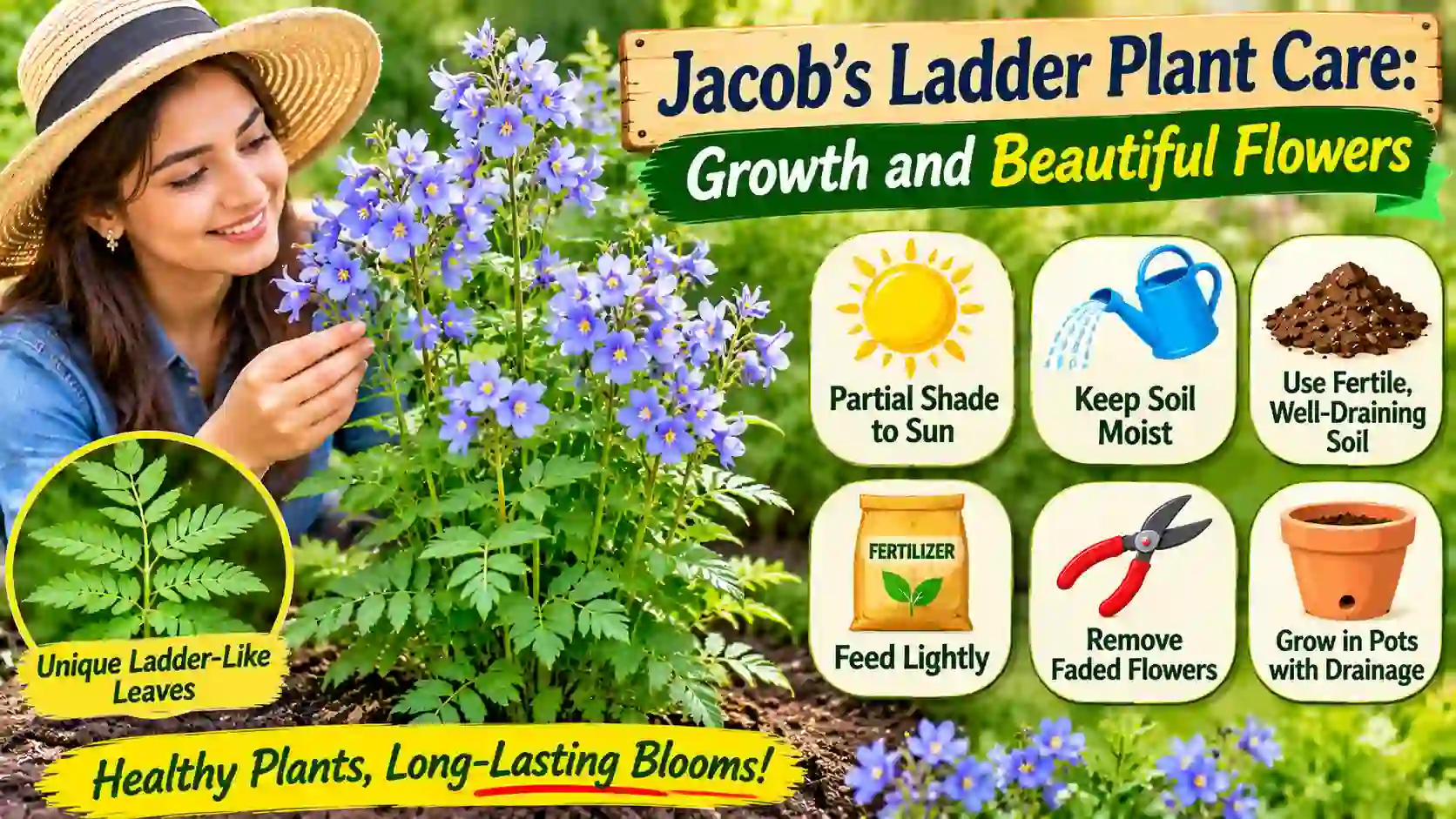
Jacob’s ladder is a charming perennial known for its delicate blue flowers and unusual foliage. Its leaves feature small leaflets arranged in pairs along a central stem. This pattern resembles the rungs of a ladder, giving the plant its familiar name.
Although Jacob’s ladder is relatively easy to grow in suitable conditions, it has one important requirement: it needs consistent moisture and protection from excessive heat.
Gardeners sometimes place it in a sunny, dry border and wonder why the leaves turn brown or the plant stops flowering. The problem is often the growing location rather than a lack of fertilizer.
Good Jacob’s ladder plant care starts with understanding its natural preferences. This guide explains how to choose the right location, prepare the soil, manage watering, encourage flowers, propagate new plants, and solve common growing problems.
Quick Answer:
Jacob’s ladder (Polemonium caeruleum) grows best in partial shade, fertile soil, and consistently moist but well-draining conditions. Water regularly during dry weather, especially while the plant establishes. Remove faded flower stems to keep the plant tidy and reduce unwanted self-seeding. In hot climates, protect it from intense afternoon sun because excessive heat can cause leaf scorch and early foliage decline.
What Is Jacob’s Ladder?
Jacob’s ladder is a herbaceous perennial belonging to the Polemoniaceae family. Its botanical name is Polemonium caeruleum.
The plant is valued for its attractive foliage and clusters of small, bell-shaped flowers. Blue and lavender-blue are common flower colors, although white-flowered forms are also available.
Main characteristics
| Feature | Description |
|---|---|
| Botanical name | Polemonium caeruleum |
| Common name | Jacob’s ladder |
| Plant type | Herbaceous perennial |
| Family | Polemoniaceae |
| Foliage | Green, pinnate leaves |
| Flower colors | Blue, lavender-blue, white |
| Blooming season | Late spring to early summer, depending on climate |
| Mature height | Approximately 1.5–3 feet, depending on variety |
| Sunlight | Partial shade to full sun in suitable cool conditions |
| Soil | Fertile, moist, well-draining |
| Growth habit | Upright, clump-forming |
| Propagation | Seeds and division |
The exact height and flowering period vary between species, cultivars, and growing regions.
Why Is It Called Jacob’s Ladder?
Its common name comes from the arrangement of its leaflets.
Each compound leaf has smaller leaflets positioned along a central stem. These pairs resemble the rungs of a ladder.
The foliage remains attractive even when the plant is not flowering. This makes Jacob’s ladder useful in woodland gardens, cottage gardens, and shaded flower borders.
Image Suggestion: A close-up botanical photograph showing the ladder-like arrangement of Jacob’s ladder leaves alongside its blue flowers.
Choose the Right Location
Location is one of the most important factors in successful Jacob’s ladder plant care.
The plant naturally grows in cooler environments and appreciates protection from harsh afternoon conditions. A suitable location helps maintain healthy leaves and supports reliable flowering.
Best sunlight conditions
Jacob’s ladder grows well in:
- Partial shade with morning sunlight.
- Dappled light beneath open trees.
- Bright locations protected from intense afternoon sun.
- Cooler gardens with consistently moist soil.
In mild climates, it can tolerate more direct sunlight when the soil stays moist.
However, excessive heat and strong afternoon sunlight may cause foliage to scorch.
How much sunlight does Jacob’s ladder need?
A practical starting point is approximately 3–6 hours of gentle sunlight or bright filtered light.
Adjust this according to your climate:
| Growing condition | Expected result |
|---|---|
| Morning sun | Usually excellent |
| Dappled sunlight | Very suitable |
| Partial shade | Often ideal |
| Intense afternoon sun | May cause leaf scorch |
| Deep shade | May reduce flowering |
Expert tip
Watch the leaves rather than following a fixed sunlight schedule.
If the leaf edges become dry and brown during hot weather, the plant may be receiving too much direct sunlight or losing moisture too quickly.
Move container plants into a cooler position. For garden plants, consider temporary shade or a more suitable planting location.
Image Suggestion: Jacob’s ladder growing beneath a lightly shaded tree, with morning sunlight falling across its blue flowers.
Use Fertile, Moist, Well-Draining Soil
Jacob’s ladder prefers soil that holds enough moisture without becoming waterlogged.
Its roots need regular access to water, but they also need oxygen. Soil that remains saturated can encourage root problems and weaken the plant.
What type of soil is best?
Choose soil that is:
- Rich in organic matter.
- Moisture-retentive.
- Loose enough for root growth.
- Well-draining.
- Moderately fertile.
A loamy soil enriched with compost is a good choice.
How to improve garden soil
If your soil dries too quickly, mix in mature compost or leaf mold before planting.
These materials improve moisture retention and soil structure.
For heavy clay soil, improve drainage before planting. Avoid placing Jacob’s ladder in a low area where rainwater collects.
For sandy soil, organic matter can help prevent rapid drying.
Does Jacob’s ladder need acidic soil?
No. It does not require strongly acidic soil.
The plant can grow in a range of soil conditions. Good fertility, moisture, and drainage are more important than trying to achieve an exact pH.
Image Suggestion: A gardening infographic showing suitable loamy soil, compost, healthy roots, and a drainage comparison.
How to Water Jacob’s Ladder Correctly
Watering is especially important because Jacob’s ladder has relatively low drought tolerance.
The plant performs best when the soil remains evenly moist. Allowing the root zone to dry completely can cause wilting, brown leaf tips, and premature foliage decline.
However, constantly saturated soil is also harmful.
How often should you water?
There is no single watering schedule for every garden.
Watering frequency depends on:
- Temperature.
- Rainfall.
- Soil type.
- Plant maturity.
- Sunlight exposure.
- Container size.
During dry weather, check the soil every few days.
If the upper layer begins to dry, water thoroughly around the root zone.
Newly planted Jacob’s ladder needs closer attention because its roots have not fully established.
Step-by-step watering method
- Check the soil around the plant.
- Water when the upper layer begins to dry.
- Apply water slowly near the base.
- Moisten the root zone thoroughly.
- Allow excess water to drain.
- Check the soil again before watering.
Avoid repeatedly giving the plant tiny amounts of water. Deep watering encourages moisture to reach the root zone.
Signs of underwatering
- Drooping leaves.
- Brown or crispy leaf tips.
- Dry soil around the roots.
- Premature foliage decline.
- Wilting during warm afternoons.
Signs of overwatering
- Soil remains wet for several days.
- Leaves become yellow and limp.
- Stems weaken near the base.
- Growth slows despite moist soil.
- Roots may become damaged.
Expert watering tip
Do not assume every wilted plant needs more water.
Check the soil first. If it is already wet, adding more water may make the problem worse.
Image Suggestion: A two-panel infographic showing a healthy Jacob’s ladder plant with moist soil and an underwatered plant with drooping, brown leaf tips.
Maintain Suitable Temperature and Humidity
Jacob’s ladder is a temperate perennial that generally performs best in cool to moderate conditions.
It is winter-hardy in many regions, but prolonged hot weather can be difficult for it.
The plant may continue growing in warm weather, but its foliage often becomes less attractive when temperatures remain high.
Ideal growing conditions
- Cool to mild spring temperatures.
- Moderate summer temperatures.
- Consistent soil moisture.
- Good airflow.
- Protection from extreme afternoon heat.
Jacob’s ladder does not need unusually high humidity. However, dry conditions combined with hot sunlight can increase moisture stress.
Growing Jacob’s ladder in hot climates
Gardeners in hot regions should take extra care when choosing a planting location.
Try these practical steps:
- Grow it where it receives morning sunlight.
- Provide afternoon shade.
- Keep the root zone cool with organic mulch.
- Water regularly during dry spells.
- Avoid placing containers against hot walls or concrete.
- Maintain good airflow around the foliage.
In climates with very hot summers, Jacob’s ladder may behave more like a cool-season garden plant. It can struggle even when watering is adequate.
A shaded, cooler microclimate improves its chances, but it cannot completely overcome unsuitable summer temperatures.
Image Suggestion: A seasonal care infographic showing Jacob’s ladder protected beneath light shade during summer and growing actively in cool spring weather.
How to Fertilize Jacob’s Ladder

Jacob’s ladder does not need heavy feeding.
If the soil is fertile and contains plenty of organic matter, the plant may grow well with little additional fertilizer.
Too much fertilizer can encourage soft foliage at the expense of balanced growth.
Best fertilizer
Use a balanced, slow-release fertilizer when the soil is poor.
Alternatively, apply a thin layer of mature compost around the plant in spring.
How to fertilize step by step
- Remove weeds around the plant.
- Apply a small amount of compost around the root zone.
- Keep the material away from direct contact with the stems.
- Water lightly if the soil is dry.
- Observe the plant before adding more fertilizer.
Avoid excessive nitrogen. It can encourage leafy growth without improving flowering.
When should you fertilize?
Spring is generally the most useful time for light feeding, especially when new growth begins.
Do not repeatedly fertilize a struggling plant without identifying the actual problem.
Poor flowering may result from excessive shade, heat, drought, or plant maturity rather than a nutrient deficiency.
Image Suggestion: A gardener applying a thin layer of compost around a healthy Jacob’s ladder plant in a shaded garden.
How to Encourage More Jacob’s Ladder Flowers
Jacob’s ladder produces attractive clusters of blue flowers during its main flowering season.
Healthy foliage and suitable growing conditions help support better flowering.
However, flowers may become fewer when the plant experiences excessive heat, drought, or deep shade.
Ways to encourage flowering
Provide suitable light
Choose partial shade or gentle morning sunlight. Very dark locations may produce foliage but fewer flowers.
Maintain soil moisture
Do not allow the root zone to become completely dry during active growth and flowering.
Avoid excessive fertilizer
Heavy feeding, particularly with high-nitrogen fertilizer, can encourage foliage instead of balanced flowering.
Remove faded flower stems
Deadheading keeps the plant tidy and reduces unwanted self-seeding.
Divide overcrowded clumps
Older clumps may benefit from division when growth becomes crowded or flowering declines.
When does Jacob’s ladder bloom?
The common Polemonium caeruleum generally blooms in late spring to early summer.
The exact timing depends on local temperatures, cultivar, and growing conditions.
In cooler regions, flowers may appear during spring. In warmer regions, flowering may finish earlier.
Image Suggestion: A close-up image of blue Jacob’s ladder flowers with yellow stamens, surrounded by fresh green foliage.
Pruning and Deadheading Jacob’s Ladder
Jacob’s ladder does not require complicated pruning.
Simple maintenance keeps the plant attractive and helps prevent unwanted seedlings.
Remove faded flowers
Once the flowers finish blooming, cut the spent flower stems back toward the foliage.
This improves the plant’s appearance and reduces seed production.
If you want the plant to spread naturally, leave some flower heads to mature and release seeds.
Remove damaged leaves
Remove foliage that is:
- Completely brown.
- Severely damaged.
- Diseased.
- Dead or collapsed.
Use clean, sharp pruning scissors.
Should you cut Jacob’s ladder back after flowering?
You can cut flower stems back after blooming.
Some plants produce fresh foliage afterward, and certain growing conditions may encourage another flush of flowers.
However, a second bloom is not guaranteed.
At the end of the growing season, remove dead foliage and tidy the planting area.
Image Suggestion: A step-by-step pruning illustration showing faded flower stalks being trimmed above healthy green foliage.
How to Grow Jacob’s Ladder in Pots
Jacob’s ladder can grow in containers when its moisture and temperature requirements are met.
Container growing is particularly useful when you need to move the plant away from intense sunlight.
Choose the right pot
Select a container with drainage holes.
A medium-sized pot with enough room for the root system is a good starting point. Choose a larger container if the plant is already mature.
Avoid decorative pots without drainage unless you use a properly drained inner nursery pot.
Best potting mix
Use a quality potting mix that retains moisture while allowing excess water to escape.
A practical mixture can include:
- Two parts quality potting mix.
- One part compost.
- A small amount of perlite or another drainage amendment.
Adjust the mixture according to how quickly it dries in your climate.
Container care tips
- Place the pot in partial shade.
- Check moisture more frequently than garden soil.
- Water thoroughly when the upper layer begins to dry.
- Empty standing water from the saucer.
- Protect the pot from excessive heat.
- Repot when roots become crowded.
Why do potted Jacob’s ladder plants wilt quickly?
Containers dry faster than garden beds, particularly during warm or windy weather.
Dark containers can also heat up in direct sunlight.
If your plant repeatedly wilts, move it into a cooler position and check the moisture level.
Image Suggestion: A healthy Jacob’s ladder plant in a medium terracotta pot on a shaded patio, with labels identifying drainage, potting mix, sunlight, and watering.
How to Propagate Jacob’s Ladder
You can grow new Jacob’s ladder plants from seeds or by dividing established clumps.
Division is usually the more straightforward option when you already have a healthy mature plant.
Method 1: Growing from seeds
Seed propagation is useful when you want several plants.
Follow these steps:
- Collect mature seeds from dry flower heads.
- Store them in a cool, dry place until sowing.
- Sow seeds in suitable seed-starting compost.
- Cover them lightly with compost or vermiculite.
- Keep the growing medium consistently moist.
- Place the container in a suitable cool location.
- Transplant seedlings when they are large enough to handle.
Germination requirements can vary by seed batch and species. Some seeds benefit from a period of cold, moist conditions.
Check the seed supplier’s instructions for the particular variety.
Method 2: Propagation by division
Division allows you to create new plants from an established clump.
The best time is generally spring, when new growth begins, or another cool period when the plant is not under heat stress.
Steps:
- Water the plant before dividing.
- Carefully lift the clump from the soil.
- Separate it into smaller sections.
- Make sure each section has healthy roots and growing points.
- Replant the divisions at their previous depth.
- Water thoroughly.
- Keep the soil consistently moist while they establish.
Avoid making divisions too small. Weak sections may struggle to recover.
Which propagation method is better?
| Method | Main advantage | Best for |
|---|---|---|
| Seeds | Produces many new plants | Expanding a garden |
| Division | Produces established plant sections | Rejuvenating mature clumps |
Image Suggestion: A propagation infographic showing Jacob’s ladder seeds, young seedlings, and a mature clump being divided into smaller plants.
Common Jacob’s Ladder Problems and How to Fix Them
Most Jacob’s ladder problems are connected to moisture, sunlight, heat, or poor airflow.
Identifying the symptoms early makes treatment easier.
Why Are Jacob’s Ladder Leaves Turning Yellow?
Yellow leaves can have several causes.
Common reasons include:
- Overwatering.
- Poor drainage.
- Drought stress.
- Excessive heat.
- Natural aging of older leaves.
How to fix it:
Check the soil before changing your watering routine.
If it remains wet, improve drainage and reduce unnecessary watering.
If the soil is dry, water deeply and protect the plant from excessive heat.
Remove completely yellow leaves once the underlying problem is addressed.
Why Are Jacob’s Ladder Leaves Turning Brown?
Brown leaf tips and edges often indicate moisture stress or excessive sunlight.
Dry soil, hot winds, and strong afternoon sun can all contribute.
How to fix it:
- Check soil moisture.
- Water when needed.
- Add organic mulch.
- Provide afternoon shade.
- Remove severely damaged foliage.
If brown patches spread rapidly, inspect the leaves for signs of disease.
Why Is Jacob’s Ladder Wilting?
Wilting usually indicates that the plant is losing water faster than it can replace it.
However, wet soil can also cause wilting when damaged roots cannot absorb water properly.
How to fix it:
Push a finger into the soil before watering.
If the soil is dry, water thoroughly.
If it is wet, investigate drainage and root health instead of adding more water.
Why Is Jacob’s Ladder Not Flowering?
A plant with healthy foliage but few flowers may be receiving insufficient light.
Other possible causes include:
- Excessive nitrogen.
- Immature plants.
- Heat stress.
- Drought.
- Crowded growth.
How to fix it:
Provide suitable light, maintain consistent moisture, and avoid excessive fertilizer.
Do not immediately assume the plant needs a stronger feeding schedule.
Why Is Jacob’s Ladder Losing Leaves in Summer?
Foliage decline can occur as temperatures rise, especially in hot climates.
This plant naturally prefers cooler growing conditions.
How to fix it:
Provide shade during the hottest part of the day, maintain moisture, and keep the root zone cool.
Some foliage decline may still occur during extreme heat.
Pests and Diseases That Affect Jacob’s Ladder
Jacob’s ladder is generally not troubled by many serious pests or diseases.
However, unsuitable growing conditions can make foliage problems more noticeable.
Powdery mildew
Powdery mildew appears as a white or gray powdery coating on leaves.
It often develops when airflow is poor and conditions favor fungal growth.
Prevention:
- Provide enough space between plants.
- Avoid crowding.
- Water near the soil rather than repeatedly wetting foliage.
- Remove badly affected leaves.
- Avoid excessive nitrogen fertilizer.
Leaf spot
Leaf spot can appear as brown, black, or irregular marks on foliage.
Affected leaves may gradually turn yellow and die.
Prevention and treatment:
Remove infected plant material and avoid overhead watering when possible.
Improve airflow and prevent leaves from remaining wet for long periods.
If symptoms continue spreading, identify the disease before selecting a treatment.
Slugs and snails
Slugs and snails may chew holes in soft leaves, particularly in damp, shaded gardens.
Look for irregular holes and slime trails.
Control methods:
- Remove hiding places near the plant.
- Check plants in the evening.
- Hand-pick slugs when practical.
- Use suitable slug-control methods according to local guidance.
General pest prevention
Healthy growing conditions are the best starting point.
Avoid overcrowding, excessive moisture, and unnecessary pesticide use.
Image Suggestion: A plant-health comparison showing healthy Jacob’s ladder leaves, powdery mildew, leaf spots, and slug damage.
Seasonal Jacob’s Ladder Plant Care
Seasonal care helps the plant grow well throughout the year.
Its needs change as new growth develops, flowers appear, and temperatures rise.
| Season | Recommended care |
|---|---|
| Spring | Check new growth, add compost, divide established clumps if needed |
| Early summer | Maintain moisture, enjoy flowering, remove faded stems |
| Late summer | Protect from heat, check for dry soil, remove damaged leaves |
| Autumn | Tidy dead foliage, collect mature seeds if desired |
| Winter | Allow the perennial to rest and avoid unnecessary watering |
Spring care
Spring is the main period for fresh growth.
Remove old debris and apply a light layer of compost around the plant.
This is also a suitable time to divide established clumps.
Summer care
Summer requires closer attention to moisture and heat.
Water during dry spells and protect the plant from harsh afternoon sunlight.
In hot regions, a shaded location can make a major difference.
Autumn care
Remove dead foliage and collect seeds if you want to grow more plants.
Avoid disturbing the roots unnecessarily when the plant is preparing for dormancy.
Winter care
Jacob’s ladder is a hardy perennial in suitable climates.
Its above-ground foliage may die back naturally, while the roots survive and produce new growth when conditions improve.
Avoid keeping dormant plants excessively wet.
Common Jacob’s Ladder Growing Mistakes
Even experienced gardeners can struggle with Jacob’s ladder when they overlook its preference for cool, moist conditions.
Avoid these common mistakes:
1. Planting in intense afternoon sunlight
Strong heat can scorch foliage and shorten its attractive growing season.
Better approach: Choose partial shade or morning sunlight.
2. Allowing soil to dry completely
Jacob’s ladder has limited drought tolerance.
Better approach: Check soil moisture regularly, especially during warm weather.
3. Keeping roots constantly wet
Consistently saturated soil can damage roots.
Better approach: Use moisture-retentive but well-draining soil.
4. Applying too much fertilizer
Heavy feeding can encourage excessive foliage.
Better approach: Use compost or light, balanced feeding when necessary.
5. Ignoring summer heat
A plant may struggle even when its watering routine is correct.
Better approach: Provide afternoon shade and protect the root zone.
6. Dividing plants during extreme heat
New divisions can lose moisture before their roots recover.
Better approach: Divide during a cooler period.
7. Expecting the same performance in every climate
Jacob’s ladder is better suited to temperate conditions than prolonged extreme heat.
Better approach: Select a cool microclimate and understand that summer performance may be limited in hot regions.
Is Jacob’s Ladder Suitable for Your Garden?

Jacob’s ladder is a useful choice for gardeners who want attractive foliage and delicate flowers in partially shaded areas.
It works particularly well in:
- Woodland gardens.
- Cottage gardens.
- Shaded flower borders.
- Perennial beds.
- Wildlife-friendly gardens.
- Suitable patio containers.
Its blue flowers can complement hostas, ferns, astilbes, and other plants that appreciate similar growing conditions.
Is Jacob’s ladder good for beginners?
Yes, when planted in a suitable location.
It does not require complicated pruning or frequent feeding.
The main challenge is maintaining consistent soil moisture and avoiding excessive heat.
Is Jacob’s ladder suitable for hot climates?
It can be challenging to grow in regions with prolonged hot summers.
A cool, shaded location and careful moisture management can help, but the plant may still struggle during extreme heat.
Gardeners in very warm climates should consider growing it as a seasonal cool-weather perennial rather than expecting strong year-round foliage.
Frequently Asked Questions
1. Is Jacob’s ladder a perennial or an annual?
Jacob’s ladder is a herbaceous perennial. Its foliage may die back seasonally, but the roots can survive and produce new growth in suitable climates.
2. Does Jacob’s ladder prefer sun or shade?
It generally prefers partial shade, especially in regions with hot summers. It can tolerate more sunlight in cooler climates when the soil stays moist.
3. How often should I water Jacob’s ladder?
Water when the upper soil layer begins to dry. Check more frequently during warm or dry weather because the plant has limited drought tolerance.
4. Why are my Jacob’s ladder leaves turning yellow?
Yellow leaves may result from overwatering, poor drainage, drought, heat, or natural aging. Check the soil before changing your watering routine.
5. Does Jacob’s ladder come back every year?
Yes. It is a perennial that can return each growing season when planted in suitable conditions and climate zones.
6. When does Jacob’s ladder flower?
It generally blooms in late spring to early summer. Local weather and the particular variety affect flowering time.
7. Can Jacob’s ladder grow in pots?
Yes. Use a container with drainage holes and moisture-retentive potting mix. Protect the plant from intense afternoon heat and check soil moisture regularly.
8. How do I make Jacob’s ladder bloom more?
Provide suitable light, maintain consistent moisture, and avoid excessive nitrogen fertilizer. Remove faded flower stems to keep the plant tidy.
9. Can Jacob’s ladder grow in full shade?
It can tolerate substantial shade, but very deep shade may reduce flowering. Bright filtered light or partial shade usually provides a better balance.
10. How do you propagate Jacob’s ladder?
You can grow it from seeds or divide established clumps. Division is often the easier method for producing new plants similar to the parent.
11. Should I cut Jacob’s ladder back after flowering?
Yes, you can remove faded flower stems after blooming. This improves appearance and reduces self-seeding. Leave some seed heads if you want natural spreading.
12. Does Jacob’s ladder attract pollinators?
Its flowers can provide nectar and pollen for visiting insects, including bees and other pollinators.
13. Is Jacob’s ladder drought-tolerant?
No. It has relatively low drought tolerance. Prolonged dry soil can cause wilting, brown leaf tips, and dormancy.
14. Why does my Jacob’s ladder look unhealthy in summer?
High temperatures, dry soil, and intense sunlight can cause summer decline. Provide afternoon shade and maintain soil moisture to reduce stress.
15. Is Jacob’s ladder easy to grow?
It is relatively easy in cool or temperate gardens with suitable shade and moist, well-drained soil. It becomes more challenging in hot climates.
Conclusion
Successful Jacob’s ladder plant care depends on choosing the right location and maintaining suitable soil moisture.
Give the plant partial shade, fertile soil, and regular water during dry periods. Avoid excessive fertilizer, waterlogged roots, and intense afternoon heat.
Remove faded flowers when needed, divide mature clumps carefully, and monitor the foliage for signs of stress.
Most importantly, remember that Jacob’s ladder is a cool-climate perennial. When its growing conditions match its natural preferences, it rewards gardeners with attractive ladder-like leaves and beautiful clusters of blue flowers.