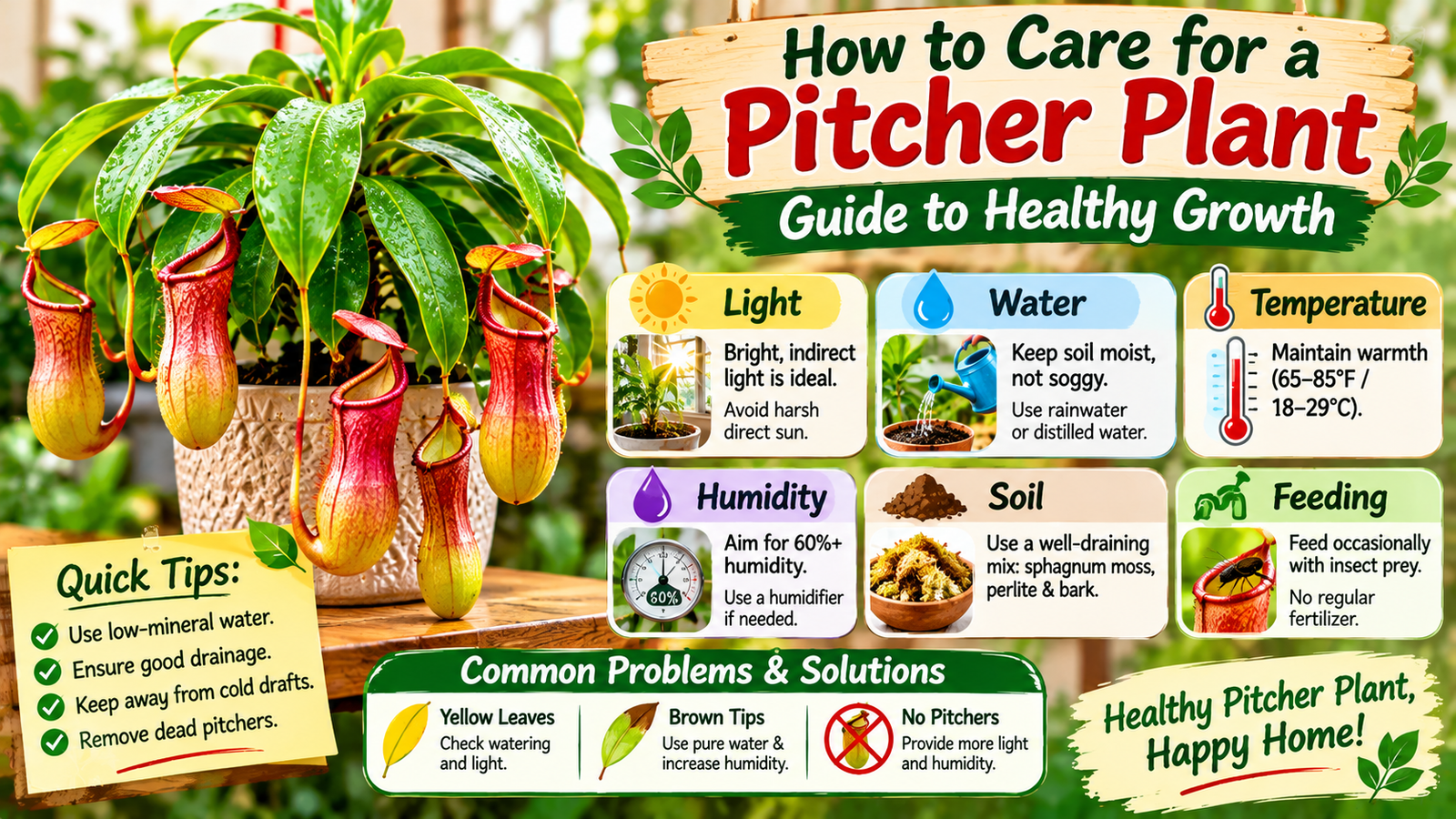
Pitcher plants are fascinating carnivorous plants with leaves shaped like containers. These specialized pitchers attract and trap insects, helping the plants obtain nutrients in naturally nutrient-poor environments.
Their unusual appearance makes them popular with plant collectors, but their care can confuse beginners. A pitcher plant may stop producing pitchers, develop brown traps, or decline after being watered with ordinary tap water.
One important detail makes all the difference: not every pitcher plant grows under the same conditions. Tropical Nepenthes and North American Sarracenia have very different needs. Treating them as identical houseplants can lead to poor growth.
This guide explains how to identify your pitcher plant, choose the right growing conditions, maintain healthy pitchers, and solve common problems. It also covers watering, soil, feeding, humidity, propagation, and seasonal care.
Quick Answer:
To care for a pitcher plant, provide bright light, consistently moist growing conditions, low-mineral water, and an airy, nutrient-poor growing medium. Most tropical pitcher plants (Nepenthes) prefer warm temperatures and higher humidity, while North American pitcher plants (Sarracenia) need strong direct sunlight and a cool winter dormancy. Identify your variety first because their care requirements differ significantly.
1. Identify Which Type of Pitcher Plant You Have
Before changing your plant’s care routine, identify its type. The common name pitcher plant describes several unrelated carnivorous plants, and their needs are not interchangeable.
| Type | How to recognize it | General growing conditions |
|---|---|---|
| Tropical pitcher plant (Nepenthes) | Hanging or upright cups attached to leaf tips on a climbing or trailing vine | Warmth, bright filtered light, humidity, moist but airy growing medium |
| North American pitcher plant (Sarracenia) | Upright trumpet-shaped pitchers growing from a central base | Strong direct sunlight, wet bog-like conditions, seasonal winter dormancy |
| Australian pitcher plant (Cephalotus follicularis) | Small, ground-level pitchers with toothed-looking rims | Bright light, airy soil, careful watering, good airflow |
How to recognize a typical store-bought pitcher plant
Many indoor shops sell Nepenthes hybrids. Their pitchers hang from tendrils at the ends of leaves, often with colorful rims and lids.
Sarracenia usually has tall, upright pitchers that look like trumpets or tubes. These plants are generally better suited to a sunny outdoor growing area than a typical indoor shelf.
This distinction matters especially in warm regions. A tropical Nepenthes may enjoy a warm room, while many Sarracenia need a cool winter rest. Check the plant label or ask the seller for its botanical name before choosing a location.
Practical tip: If the label only says “pitcher plant,” take a clear photograph of the whole plant and its pitchers. Identifying the genus is the most useful first step toward correcting its care.
2. How Much Sunlight Does a Pitcher Plant Need?
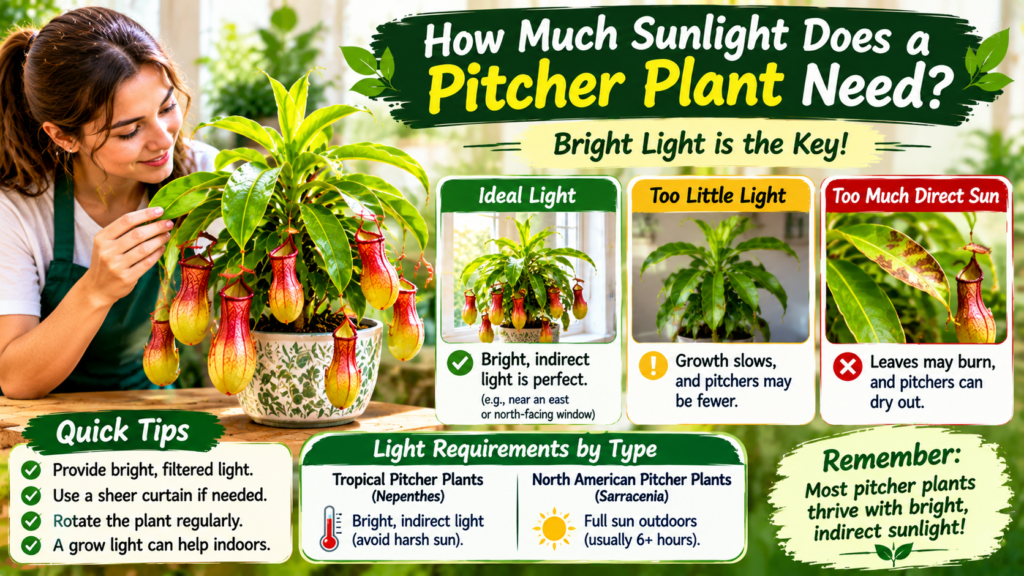
Light requirements depend strongly on the type of pitcher plant.
Light for tropical pitcher plants (Nepenthes)
Most Nepenthes prefer bright, filtered light rather than intense midday sun. An east-facing window is often a good starting location. A bright west-facing window can also work if strong afternoon rays are filtered.
Watch for these signs:
- Healthy growth: New leaves develop normally, and new pitchers form at leaf tips.
- Insufficient light: Growth becomes weak, leaves may become smaller, and pitcher production can decline.
- Excessive direct sun: Leaves develop bleached or brown scorched patches.
A grow light can help when natural light is limited. Keep it at an appropriate distance and adjust exposure gradually rather than placing it very close to the leaves immediately.
Light for North American pitcher plants (Sarracenia)
Most Sarracenia need several hours of direct sunlight and generally perform best in a sunny outdoor position. Insufficient light often produces weaker, less colorful pitchers.
Acclimate nursery-grown plants gradually before exposing them to strong outdoor sun. Sudden exposure can scorch foliage that developed under greenhouse shade.
Important: Do not use the same light advice for every pitcher plant. Bright filtered light suits many tropical Nepenthes, while strong direct sunlight is essential for most Sarracenia. Home & Garden Information Center+2
Image suggestion: A comparison infographic showing filtered window light for Nepenthes and full outdoor sun for Sarracenia.
3. How to Water a Pitcher Plant Correctly
Water quality is one of the most important parts of pitcher plant care. These plants evolved in nutrient-poor environments and can be sensitive to minerals dissolved in ordinary tap water.
What water should you use?
Choose one of these options:
- Rainwater collected in a clean container
- Distilled water
- Reverse-osmosis water
- Deionized water suitable for plant watering
Avoid mineral water and ordinary tap water unless you have verified that its dissolved mineral content is suitably low for your species. Boiling tap water does not remove dissolved minerals.
If you have a TDS meter, it can help you check dissolved solids, although it does not identify every individual mineral. When in doubt, use distilled or reverse-osmosis water.
How to water a tropical pitcher plant
For most Nepenthes:
- Check the growing medium with your finger.
- Water when the upper surface begins to lose moisture, before the mix dries completely.
- Pour water evenly over the growing medium.
- Allow excess water to drain freely.
- Empty the saucer or outer pot.
- Check again as the medium dries.
The goal is evenly moist, airy growing conditions—not a permanently waterlogged root system.
How to water a Sarracenia pitcher plant
Sarracenia has different watering requirements because it naturally grows in wet bog environments.
- Place the pot in a shallow tray containing rainwater or another suitable low-mineral water.
- Keep the growing medium consistently wet during active growth.
- Do not let the roots dry out.
- Adjust watering according to the species and its dormancy requirements.
The tray method that suits Sarracenia should not automatically be used for Nepenthes. Tropical pitcher plants generally need better drainage and should not remain in standing water. United States Botanic Garden+3
Image suggestion: A two-panel watering infographic comparing overhead watering for Nepenthes with the water-tray method for Sarracenia.
4. Choose the Right Soil and Potting Mix
Ordinary houseplant soil is unsuitable for most pitcher plants. Standard potting mixes often contain fertilizer, compost, or other ingredients that provide more nutrients than carnivorous plant roots can tolerate.
A suitable medium should retain enough moisture while allowing air to reach the roots.
Best growing medium for tropical pitcher plants
A practical starting mix for many Nepenthes hybrids is:
- 60% long-fiber sphagnum moss
- 20% perlite
- 20% orchid bark
This is a starting recipe, not a universal formula. Some species prefer different proportions, and experienced growers may use other airy carnivorous-plant mixes.
Best growing medium for Sarracenia
A common mix is:
- One part unfertilized sphagnum peat moss
- One part perlite or thoroughly washed silica sand
Use ingredients without added fertilizer, wetting agents, or compost.
Which pot should you choose?
| Pot type | Advantages | Things to consider |
|---|---|---|
| Plastic pot | Lightweight and holds moisture | Check drainage and avoid standing water for Nepenthes |
| Glazed ceramic | Attractive and retains moisture | Ensure the material does not leach minerals |
| Terracotta | Allows faster evaporation | Can dry the growing medium too quickly and may release minerals |
For many Nepenthes, a plastic pot with drainage holes is a practical choice. For Sarracenia, use a container that can sit in a water tray.
Common mistake: Adding garden soil or regular compost to make the mix richer. Pitcher plants do not need rich soil. Their specialized roots are adapted to nutrient-poor conditions.Home & Garden Information Center+3
Image suggestion: A labeled soil infographic comparing suitable sphagnum-based mixes with unsuitable ordinary potting soil.
5. Temperature and Humidity Requirements
Temperature and humidity influence how well tropical pitcher plants grow and produce new pitchers. However, Nepenthes species come from different elevations, so their preferred conditions are not identical.
Tropical pitcher plants
Many commonly sold hybrids adapt to warm household temperatures. As a general starting point, aim for:
- Warm daytime conditions around 70–85°F (21–29°C).
- Comfortable nights without sudden cold drafts.
- Humidity around 60% or higher when possible.
- Gentle airflow to reduce stagnant, damp conditions.
Lowland species generally prefer warmer conditions. Highland species need cooler nights and may struggle in rooms that remain hot throughout the day and night.
For example, a highland species may stop producing healthy pitchers in a consistently warm room even when watering and light appear suitable.
How to improve indoor humidity
If your indoor air is dry, consider:
- Using a room humidifier.
- Grouping tropical plants together while allowing airflow.
- Growing the plant in a suitable greenhouse or plant cabinet.
- Monitoring humidity with a digital hygrometer.
Misting is not a dependable way to maintain humidity. It raises moisture around the leaves only briefly and does not replace stable environmental humidity.
What about Sarracenia?
Most Sarracenia are outdoor plants adapted to seasonal changes. They generally need full sun and a cool winter dormancy rather than tropical indoor humidity.
Do not keep them in a permanently warm room simply because they are sold as houseplants. Home & Garden Information Center+3
Image suggestion: A temperature and humidity infographic comparing tropical lowland and highland Nepenthes with outdoor Sarracenia.
6. Should You Feed a Pitcher Plant?
Pitcher plants capture insects and digest them to obtain nutrients that are scarce in their natural growing environments.
However, you do not need to feed every pitcher regularly. A plant growing outdoors may catch enough insects naturally. Indoor plants may need occasional feeding if they rarely encounter prey.
What can you feed a pitcher plant?
For tropical Nepenthes, suitable occasional food options include:
- Small flies
- Small crickets
- Suitable dried insects intended for carnivorous plants
- Other appropriately sized insects
Choose prey that is small enough to fit comfortably inside the pitcher. Avoid filling pitchers with large insects.
How often should you feed it?
There is no universal feeding schedule. A healthy plant that catches insects naturally may not need additional food.
If your indoor Nepenthes catches very little prey, occasional small feedings during active growth may help. Avoid repeatedly feeding every pitcher.
Can you feed a pitcher plant meat?
No. Never feed it hamburger, chicken, fish, or other pieces of human food.
These foods can rot inside the pitcher and create bacterial problems. Pitcher plants are adapted to digest small prey, not large pieces of processed or cooked meat.
Important: Never pour ordinary plant fertilizer into pitcher traps. Some specialized growers use carefully diluted products, but feeding methods vary by species and experience level.
Image suggestion: A close-up educational illustration showing appropriately sized insect prey entering a healthy pitcher, with a warning against feeding meat.
7. Why Is My Pitcher Plant Not Producing Pitchers?
One of the most common concerns among pitcher plant owners is the absence of new pitchers.
A plant may continue producing leaves while its pitchers become smaller or stop developing altogether. This usually indicates that one or more environmental conditions need attention.
Common reasons for missing pitchers
1. Insufficient light
Low light is a common reason tropical pitcher plants fail to develop healthy pitchers.
Move the plant gradually toward brighter filtered light. Avoid exposing it suddenly to intense midday sunlight.
2. Low humidity
Some Nepenthes hybrids tolerate ordinary household humidity, but others need more moisture in the air to produce pitchers consistently.
Measure humidity rather than guessing. A humidifier or suitable plant cabinet may help.
3. Incorrect temperature
A highland species kept in constant warmth may struggle to produce healthy pitchers. Identify the species or hybrid before changing the temperature.
4. Recent relocation
A newly purchased plant may need time to adjust to different light, humidity, and temperature conditions.
Avoid repeatedly moving it between rooms. Choose a suitable location and give it time to settle.
5. Root problems
Damaged roots cannot support healthy new growth. Constantly saturated growing medium can contribute to root rot, especially in tropical pitcher plants.
How to encourage new pitchers
- Maintain bright, appropriate light.
- Use low-mineral water.
- Keep the growing medium appropriately moist.
- Provide suitable humidity.
- Match temperatures to the plant’s species.
- Avoid excessive feeding and unnecessary repotting.
Expert tip: Look at the newest leaves. If they are healthy and developing normally, your plant may simply need more time to produce pitchers. If new leaves are also small, distorted, or discolored, investigate the growing conditions more carefully.
Image suggestion: A before-and-after comparison showing a Nepenthes with healthy developing pitchers and one with leaves but no pitchers.
8. How to Maintain and Care for Existing Pitchers
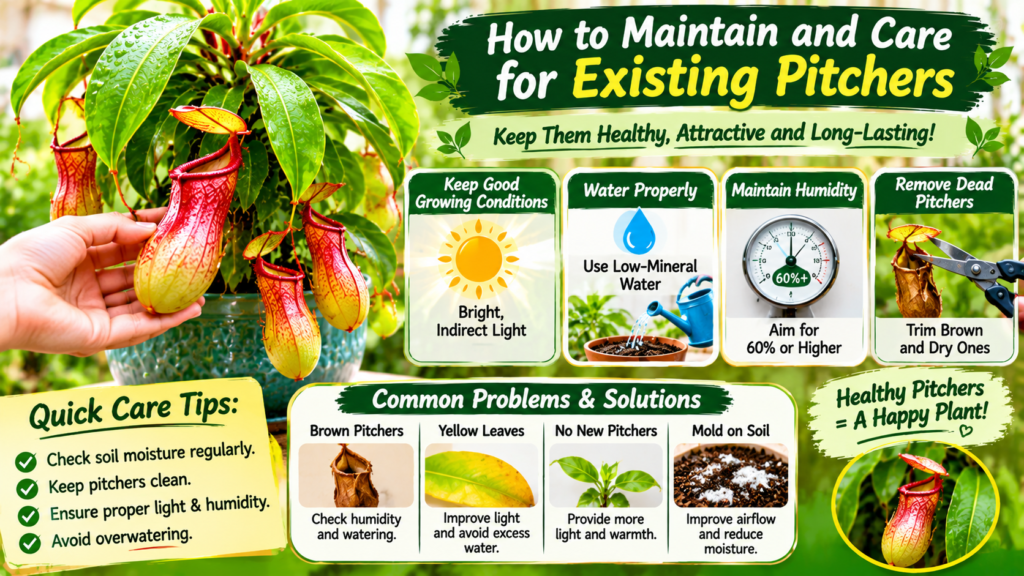
Pitchers are modified leaves. Like ordinary leaves, they eventually age and die.
A brown or drying pitcher does not automatically mean the entire plant is unhealthy.
Why do pitcher plants develop brown pitchers?
Possible reasons include:
- Natural aging
- Environmental changes
- Low humidity
- Insufficient light
- Water stress
- Root damage
If one older pitcher turns brown while new leaves and pitchers look healthy, natural aging is likely.
However, if every pitcher dries out soon after forming, review light, humidity, watering, and temperature.
Should you cut off dead pitchers?
Yes. You can remove completely brown and dried pitchers to improve appearance.
Follow these steps:
- Use clean, sharp scissors.
- Identify the completely dead portion.
- Cut away the dead pitcher without damaging the healthy leaf.
- Avoid removing green tissue unnecessarily.
- Dispose of damaged material.
Do not remove every old pitcher simply because it looks imperfect. Some partially green pitchers can continue functioning for a while.
Practical observation: A new pitcher may take time to develop fully after appearing at the end of a leaf tendril. Avoid touching, squeezing, or repeatedly opening developing pitchers.
Image suggestion: A labeled photograph showing a healthy green pitcher, a naturally aging brown pitcher, and a developing new pitcher.
9. Seasonal Care and Winter Dormancy
Seasonal care depends on the type of pitcher plant you own.
Tropical Nepenthes
Most commonly grown tropical Nepenthes do not require the same cold winter dormancy as Sarracenia.
During cooler months:
- Keep the plant away from cold drafts.
- Reduce watering only when the growing medium dries more slowly.
- Maintain suitable light.
- Continue monitoring humidity.
- Avoid unnecessary fertilizer when growth slows.
Do not deliberately expose tropical species to freezing temperatures.
North American Sarracenia
Most Sarracenia need a winter rest period. During dormancy, growth slows, and many pitchers naturally turn brown.
This is not necessarily a sign of disease.
During dormancy:
- Provide the appropriate cool conditions for the species.
- Maintain moisture in the growing medium.
- Reduce watering adjustments according to the plant’s seasonal needs.
- Remove completely dead foliage when appropriate.
- Resume stronger growing-season care when new growth begins.
What if you live in a warm climate?
In consistently warm regions, growing Sarracenia can be more challenging because winter may not provide the cool conditions these plants need.
A warm room or tropical greenhouse is not a substitute for proper dormancy. If you are buying a pitcher plant for a warm climate, a suitable Nepenthes hybrid may be a more practical choice.
Check the specific plant’s temperature requirements before purchasing it. Botanical Conservatory+3
Image suggestion: A seasonal comparison showing tropical Nepenthes growing indoors throughout the year and Sarracenia entering winter dormancy outdoors.
10. How to Repot a Pitcher Plant
Pitcher plants do not need frequent repotting. Moving them unnecessarily can disturb their sensitive roots and temporarily slow growth.
Repot when:
- The growing medium has broken down.
- Roots are crowded.
- The plant has outgrown its container.
- Drainage has become poor.
- The medium has developed persistent problems.
Step-by-step repotting process
- Prepare a fresh, species-appropriate carnivorous plant mix.
- Moisten the new medium with distilled or rainwater.
- Gently remove the plant from its old container.
- Avoid pulling or damaging healthy roots.
- Remove loose, deteriorated growing medium carefully.
- Position the plant at its previous growing depth.
- Fill around the roots without compacting the mix.
- Water with suitable low-mineral water.
- Return it to an appropriate light and temperature environment.
For Nepenthes, use a loose, airy mix and a pot with drainage holes.
For Sarracenia, use an appropriate bog-plant mix and maintain its wet growing conditions.
Common mistake: Using regular houseplant potting soil during repotting. Even high-quality indoor potting mix can contain nutrients that are unsuitable for carnivorous plants.
Image suggestion: A five-step repotting infographic showing preparation, removal, root inspection, fresh medium, and finished planting.
11. How to Propagate a Pitcher Plant
You can propagate some pitcher plants at home, although the method depends on the genus.
Propagating Nepenthes through stem cuttings
Many tropical pitcher plant hybrids can be propagated through stem cuttings.
- Choose a healthy, established plant.
- Use clean, sharp pruning shears.
- Take a suitable stem cutting with healthy nodes.
- Remove excess lower foliage.
- Place the cutting in moist, airy sphagnum moss or another suitable propagation medium.
- Maintain warmth, bright filtered light, and appropriate humidity.
- Monitor the cutting for root and shoot development.
Rooting time varies. Avoid repeatedly pulling the cutting out to check for roots.
Propagating Sarracenia
Sarracenia is commonly propagated through division of established plants.
- Remove the plant carefully from its container.
- Identify natural growing points or rhizome divisions.
- Separate suitable sections with healthy roots.
- Replant each division in an appropriate carnivorous plant mix.
- Maintain strong light and consistently moist conditions.
Propagation is generally easiest when the plant is actively recovering from its seasonal rest and beginning new growth.
Practical tip: Do not propagate a weak or severely stressed plant. Allow it to recover first so the cutting or division has a better chance of establishing.
Image suggestion: A propagation infographic comparing Nepenthes stem cuttings with Sarracenia rhizome division.
12. Common Pitcher Plant Problems and How to Fix Them
Pitcher plants can show visible signs of stress when their environment is unsuitable. The following table helps narrow down possible causes.
| Problem | Possible cause | Recommended action |
|---|---|---|
| Yellow leaves | Water stress, root problems, or natural aging | Check the roots and growing medium |
| Brown pitcher tips | Natural aging or environmental stress | Assess the whole plant before making changes |
| No new pitchers | Insufficient light, humidity, or unsuitable temperature | Review conditions for the species |
| Black or mushy roots | Root rot or prolonged saturation | Inspect roots and correct drainage |
| Dry growing medium | Insufficient watering | Rehydrate with low-mineral water |
| Pale or weak growth | Insufficient light or other stress | Adjust light gradually |
| Mold on growing medium | Poor airflow or persistently damp conditions | Improve airflow and inspect the medium |
| Deformed new growth | Environmental stress or pests | Inspect closely and review care conditions |
Why are my pitcher plant leaves turning yellow?
Yellow leaves can indicate natural aging, root damage, or unsuitable growing conditions.
Check whether the growing medium is too dry or constantly saturated. Also inspect the roots if several leaves are yellowing at once.
Why are my pitcher plant pitchers turning black?
An older pitcher may naturally darken as it reaches the end of its life. However, blackening that spreads rapidly across new growth or the plant’s base may indicate serious stress or rot.
Check drainage, temperature, and the condition of the growing medium.
Why is my pitcher plant wilting?
Wilting can result from dehydration, damaged roots, heat stress, or sudden environmental changes.
Do not immediately add more water without checking the medium. A plant with root rot may wilt even when its soil is wet.
What should I do if my pitcher plant has mold?
A small amount of surface growth may indicate that the medium is staying too damp with limited airflow.
Remove visibly affected debris, improve airflow, and check whether the medium is breaking down. Persistent or spreading mold may require replacing unsuitable growing medium.
Important: Diagnose the problem before changing several care conditions at once. If you increase light, watering, humidity, and fertilizer simultaneously, it becomes difficult to identify what actually helped or harmed the plant.
Image suggestion: A plant-health diagnostic chart showing yellow leaves, black pitchers, root rot, and healthy new growth.
13. Common Mistakes to Avoid When Caring for Pitcher Plants
Pitcher plants are not difficult once their natural growing conditions are understood. Most beginner problems come from treating them like ordinary tropical houseplants.
Avoid these mistakes:
- Using ordinary tap water: Minerals can accumulate and damage sensitive roots.
- Using regular potting soil: Fertilized soil can be unsuitable for carnivorous plants.
- Giving every variety the same sunlight: Tropical and North American pitcher plants have different light needs.
- Allowing Nepenthes roots to remain waterlogged: Constant saturation can contribute to root rot.
- Keeping Sarracenia in low light: Insufficient sunlight often results in weak pitchers.
- Feeding meat: Pitchers are adapted to digest small prey, not human food.
- Ignoring winter dormancy: Many Sarracenia need a seasonal rest to remain healthy long term.
- Repotting too frequently: Unnecessary root disturbance can slow recovery.
- Expecting every old pitcher to remain green: Individual pitchers naturally age and die.
- Ignoring the plant label: Species identification helps prevent major care mistakes.
The most important rule is simple: recreate the conditions your particular pitcher plant evolved to grow in.
Frequently Asked Questions About Pitcher Plant Care
Are pitcher plants easy to care for?
Some are relatively easy once their needs are understood. Many Nepenthes hybrids adapt to indoor conditions, while Sarracenia need strong sunlight and seasonal dormancy. Choosing the right type makes care much easier.
How often should I water a pitcher plant?
It depends on the genus. Most Nepenthes prefer consistently moist but well-drained growing medium. Sarracenia generally prefer wet growing conditions and can sit in a shallow tray of low-mineral water during active growth.
Can I grow a pitcher plant indoors?
Yes. Many tropical Nepenthes grow well indoors with bright filtered light, suitable humidity, warm conditions, and low-mineral water. Most Sarracenia are better grown outdoors in strong sunlight.
Do pitcher plants need direct sunlight?
Most Sarracenia need several hours of direct sunlight daily. Many tropical Nepenthes prefer bright, filtered light and can suffer leaf damage from excessive harsh sunlight.
What kind of water is best for pitcher plants?
Rainwater, distilled water, and reverse-osmosis water are generally suitable. Avoid mineral-rich tap water and bottled mineral water.
Should I put water inside my pitcher plant’s pitchers?
Healthy pitchers usually produce their own digestive fluid. Avoid routinely filling them with tap water. If a pitcher has lost its fluid, follow species-specific guidance rather than automatically adding water.
Do pitcher plants need fertilizer?
They generally do not need ordinary soil fertilizer. They obtain nutrients from captured prey. Some growers use specialized, diluted feeding methods for certain Nepenthes, but beginners should avoid applying standard houseplant fertilizer.
Why is my pitcher plant not catching insects?
A plant does not need to catch insects constantly to remain healthy. If it is growing well and producing new pitchers, occasional prey capture is normal. Avoid manually filling every pitcher with insects.
Can pitcher plants survive winter?
It depends on the species. Many Sarracenia need a cool winter dormancy. Tropical Nepenthes generally need warm conditions and should be protected from cold exposure.
How long do pitcher plant pitchers last?
Their lifespan varies by species, growing conditions, and the individual pitcher. Some remain functional for weeks or months before naturally browning and drying.
Can I grow a pitcher plant in a terrarium?
Some smaller tropical pitcher plants can grow in suitable terrarium-style environments, but many Nepenthes become too large. Ensure adequate airflow and avoid keeping the roots waterlogged. Most Sarracenia are unsuitable for permanently warm, enclosed terrariums.
Are pitcher plants safe for pets?
Many commonly grown pitcher plants are generally regarded as non-toxic, but identification matters because the common name covers different species. Keep plants and growing supplies out of reach of pets and consult a veterinarian if ingestion causes concern.
Conclusion
Learning how to care for a pitcher plant starts with identifying its type. Tropical Nepenthes generally need warm conditions, bright filtered light, humidity, and moist but well-drained growing medium. North American Sarracenia need strong direct sunlight, wet bog-like conditions, and a proper winter dormancy.
Use rainwater or another suitable low-mineral water, avoid ordinary potting soil, and never feed your plant meat or excessive fertilizer. Most importantly, observe new growth and pitcher development instead of reacting to every aging trap.
With the right environment and consistent care, your pitcher plant can produce healthy foliage and fascinating new pitchers for years.