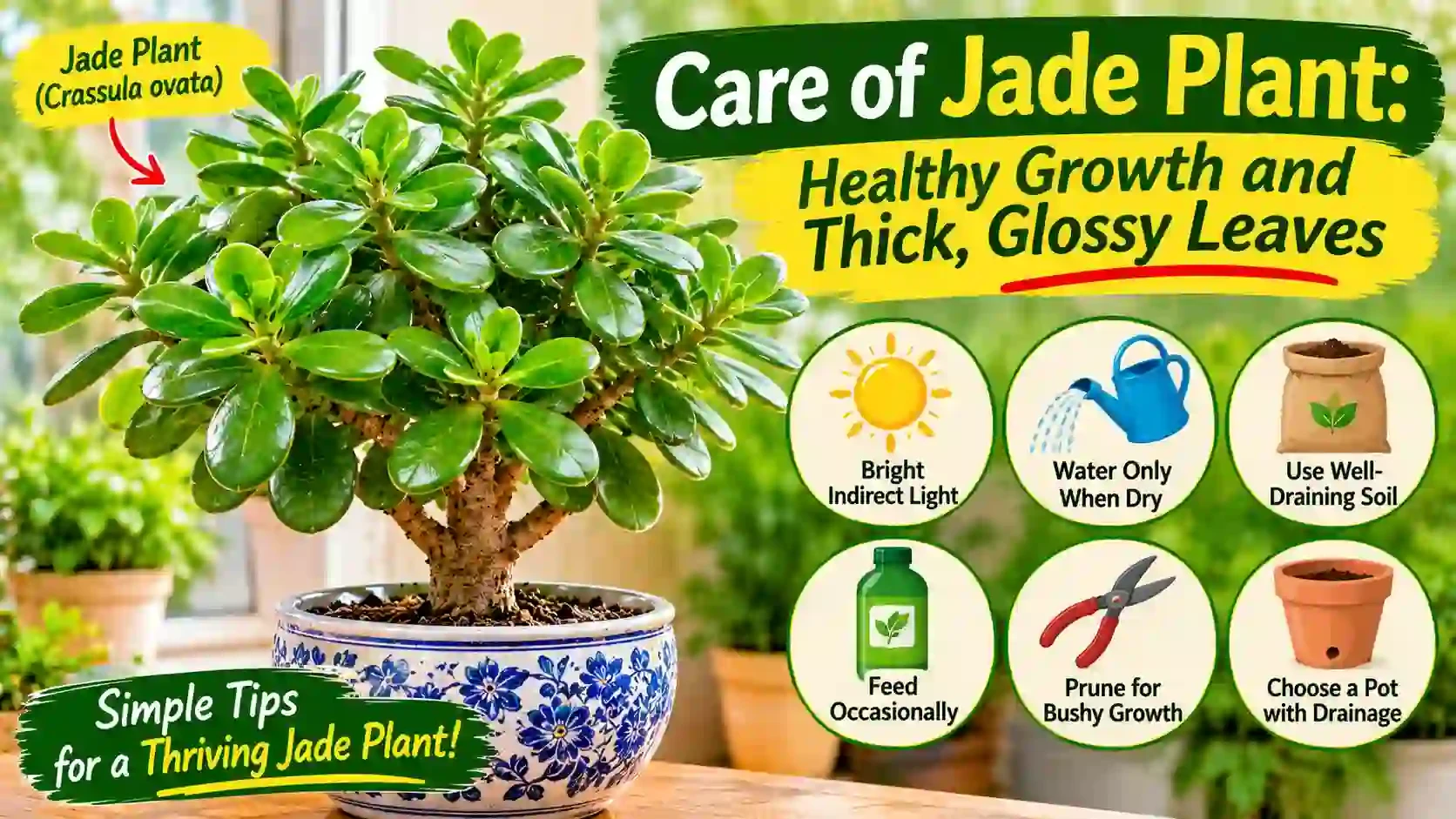
A jade plant can live for many years and gradually develop the appearance of a miniature tree. Its thick branches, rounded leaves, and compact shape make it a popular indoor succulent.
However, even an easy-care jade plant can develop problems when its growing conditions are unsuitable. Too much water can damage its roots. Poor lighting can produce weak, stretched stems. Heavy soil can keep moisture around the roots for too long.
Understanding the care of jade plant helps prevent these problems before they become serious. You do not need an elaborate routine or expensive gardening products. You need the right growing conditions and a little patience.
This guide explains how to grow a healthy jade plant indoors and outdoors. It also covers watering, sunlight, soil, propagation, pruning, seasonal care, and common problems.
Quick Answer:
The best care of jade plant (Crassula ovata) involves bright light, well-draining soil, and careful watering. Place it near a sunny window where it receives several hours of light. Water thoroughly when the soil has dried out, and always use a pot with drainage holes. Feed lightly during active growth, prune when necessary, and protect the plant from frost. These habits encourage thick stems, fleshy leaves, and healthy long-term growth.
1. Understand the Jade Plant Before Growing It
The jade plant, scientifically known as Crassula ovata, is a succulent native to South Africa and Mozambique. It belongs to the Crassulaceae family.
Its thick leaves and fleshy stems store water. This adaptation helps the plant survive periods of limited rainfall.
Unlike many leafy houseplants, jade plants do not need consistently moist soil. Their roots need oxygen and time to dry between waterings.
What makes jade plants special?
- Fleshy leaves: Their leaves store water and usually feel firm when the plant is healthy.
- Thick stems: Mature plants develop woody stems that resemble a small tree trunk.
- Slow growth: They grow gradually, especially indoors.
- Long lifespan: With suitable conditions, a jade plant can remain in a home for many years.
- Occasional flowering: Mature plants may produce small white or pink star-shaped flowers under suitable conditions.
Popular jade plant varieties
| Variety | Appearance | Growing characteristic |
|---|---|---|
| Common Jade | Rounded, glossy green leaves | Classic branching growth |
| Hobbit Jade | Curled, tubular leaves | Unusual sculptural shape |
| Gollum Jade | Long, finger-like leaves | Compact and distinctive |
| Sunset Jade | Green leaves with yellow and red tones | Attractive leaf coloration in strong light |
| Variegated Jade | Green leaves with cream or yellow markings | Needs bright light to maintain good growth |
Practical tip: Check the plant label before buying. Different cultivars can have different leaf shapes and growth habits, but most follow similar basic care requirements.
Image suggestion: A comparison infographic showing common jade, Hobbit, Gollum, Sunset, and variegated jade varieties.
2. Choose the Right Location and Sunlight
Light is one of the most important factors in jade plant care. A jade plant can survive in lower light for a while, but it usually develops stronger, more compact growth with brighter conditions.
How much sunlight does a jade plant need?
Aim for approximately four or more hours of direct sunlight when the plant has gradually adapted to it. Bright indirect light can also support growth, especially when direct sun is limited.
A bright south- or west-facing window can be a suitable location in many homes. Adjust the position if the glass makes the leaves excessively hot.
Signs your jade plant needs more light
- Stems become long and stretched.
- Branches lean toward the window.
- Leaves become widely spaced.
- New growth looks weak or unusually pale.
- The plant loses its compact shape.
These symptoms often indicate insufficient light rather than a fertilizer deficiency.
Can jade plants tolerate direct sunlight?
Yes. Established jade plants generally appreciate direct sunlight. However, a plant grown in a dim room can suffer leaf scorch if moved suddenly into intense sunlight.
Acclimate it gradually:
- Begin with a short period of gentle morning sun.
- Increase exposure gradually over one or two weeks.
- Watch for bleached, brown, or scorched patches.
- Move it to slightly less intense light if damage appears.
Best indoor locations
- A bright windowsill with several hours of sunlight.
- A sunny room with good natural light.
- A sheltered balcony with gradually introduced sunlight.
- A bright conservatory or sunroom.
Expert tip: Rotate the pot occasionally. This helps different sides receive light and encourages more balanced growth.
Image suggestion: A jade plant beside a bright window, with examples of healthy compact growth and stretched growth caused by insufficient light.
3. Water Your Jade Plant Correctly
Watering is where many beginners make mistakes. Because jade plants store water in their leaves and stems, they do not need frequent watering.
Keeping the soil wet for long periods can cause root rot. However, leaving the plant severely dry for too long can also cause shriveled leaves and poor growth.
When should you water a jade plant?
Water when the soil has dried out thoroughly. Check the soil rather than following a fixed weekly schedule.
For a small pot, insert your finger into the soil. For a larger pot, use a wooden stick or moisture meter to check deeper layers.
The surface can look dry while the soil near the bottom remains wet.
How to water a jade plant step by step
- Check the soil: Make sure the growing medium has dried out.
- Water slowly: Pour water evenly over the soil rather than repeatedly wetting one small area.
- Water thoroughly: Continue until excess water runs from the drainage holes.
- Empty the saucer: Do not allow the pot to sit in standing water.
- Wait before watering again: Let the soil dry before the next watering.
How often should you water a jade plant?
There is no reliable schedule for every home. Watering frequency depends on light, temperature, pot size, soil, and season.
| Growing conditions | Watering approach |
|---|---|
| Warm, bright conditions | Check soil more frequently because it may dry faster |
| Cool winter conditions | Water less often as growth slows |
| Small terracotta pot | Check more frequently because it dries relatively quickly |
| Large plastic pot | Check carefully because moisture may remain longer |
| Poorly draining soil | Correct the soil rather than trying to manage it with a strict schedule |
Signs of overwatering
- Soft or mushy leaves.
- Yellowing leaves that drop easily.
- Dark, soft stems near the soil.
- Soil that stays wet for many days.
- An unpleasant smell from the growing medium.
Signs of underwatering
- Wrinkled or shriveled leaves.
- Leaves that feel thinner than usual.
- Dry, compacted soil.
- Gradual leaf loss during prolonged drought.
Important: Wrinkled leaves can sometimes occur when damaged roots cannot absorb water. Do not automatically add more water. Check the soil and roots before deciding what the plant needs.
Image suggestion: A four-step watering infographic showing soil checking, thorough watering, drainage, and waiting for the soil to dry.
4. Use Well-Draining Soil for Strong Roots
Jade plants need soil that drains quickly. Ordinary garden soil or dense indoor potting mix may retain too much moisture.
A suitable growing medium allows water to pass through while keeping enough structure and nutrients for the roots.
What is the best soil for jade plants?
A commercial cactus and succulent mix is a convenient starting point.
If your mix holds too much water, improve its drainage by adding materials such as:
- Pumice.
- Perlite.
- Fine horticultural grit.
- Small amounts of coarse mineral material.
Simple homemade jade plant soil mix
Try this starting recipe by volume:
| Ingredient | Proportion | Purpose |
|---|---|---|
| Quality potting mix | 40% | Provides organic matter |
| Pumice or perlite | 30% | Improves aeration |
| Coarse horticultural grit | 20% | Helps drainage and structure |
| Fine bark or additional mineral material | 10% | Improves texture |
Adjust the recipe according to your local materials and how quickly the mix dries.
Avoid using fine beach sand or heavy garden soil. These can make the mixture dense rather than improving drainage.
How do you know the soil is unsuitable?
Look for these warning signs:
- Water remains on the surface.
- Soil stays wet for an unusually long time.
- The mix becomes hard and compacted.
- The plant develops soft stems or declining roots.
Expert tip: A well-draining mix is especially important in humid environments and during periods of limited sunlight.
Image suggestion: A labeled soil-mix diagram showing potting mix, pumice, perlite, and coarse grit.
5. Select a Pot With Proper Drainage
The right pot protects the roots and supports the plant as it becomes heavier.
Jade plants can become top-heavy as their stems mature. A stable container helps prevent the plant from tipping over.
Which pot is best for a jade plant?
Terracotta pots are a popular choice because their porous sides allow moisture to evaporate. They can help the soil dry more quickly.
Ceramic pots can also work well, especially when they have drainage holes and sufficient weight.
Plastic pots are lightweight and retain moisture longer. They are suitable when watering is adjusted to the slower drying rate.
What size pot should you use?
Choose a pot that comfortably accommodates the root system without leaving a large amount of unused soil.
A pot that is too large can hold excess moisture around a relatively small root system.
Essential pot features
- At least one unobstructed drainage hole.
- Enough room for healthy root growth.
- A stable base for mature plants.
- Suitable material for your watering habits.
Never rely on stones placed at the bottom of a pot to solve poor drainage. A drainage hole and suitable soil are much more important.
6. Maintain Suitable Temperature and Humidity
Jade plants prefer warm conditions and adapt well to ordinary indoor humidity.
They do not need frequent misting. In fact, misting does not solve dry-air problems and can leave unnecessary moisture on the foliage.
Ideal temperature conditions
A comfortable indoor temperature is generally suitable. Avoid sudden temperature changes and cold drafts.
Protect jade plants from freezing temperatures. Extended cold exposure can damage leaves and stems.
What about humidity?
Average household humidity is usually adequate.
Avoid placing the plant in a poorly ventilated, constantly damp location. Good airflow helps the growing medium dry and reduces the risk of moisture-related problems.
Temperature and humidity tips
- Keep the plant away from freezing windows during cold weather.
- Avoid placing it directly beside heating vents.
- Provide good airflow without exposing it to harsh drafts.
- Do not mist the leaves as a routine care requirement.
- Protect outdoor plants from heavy rain and prolonged cold.
Image suggestion: A healthy jade plant indoors with simple temperature, airflow, and humidity icons.
7. Fertilize Your Jade Plant Without Overfeeding
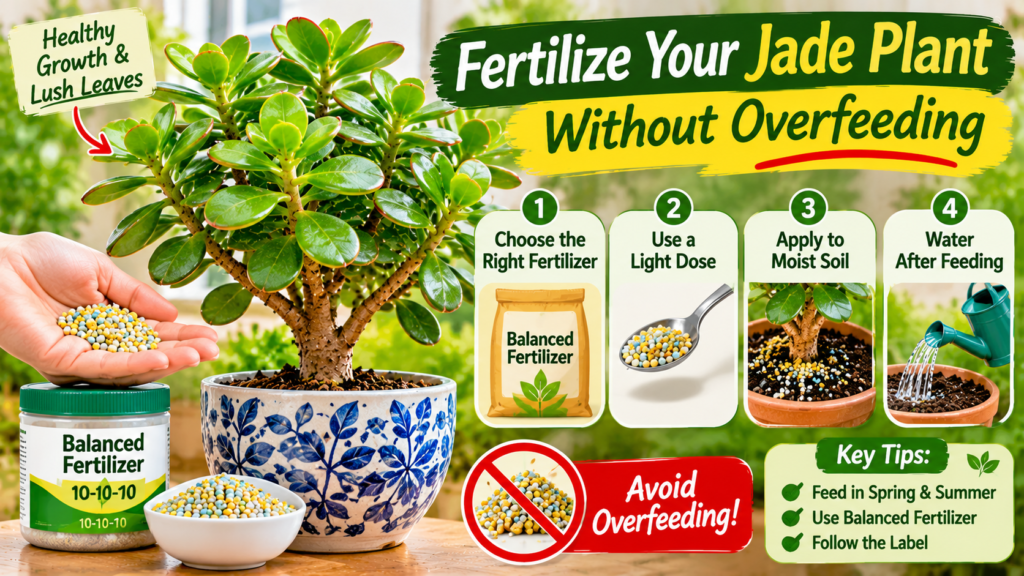
Jade plants are not heavy feeders. They grow well without large amounts of fertilizer.
Too much fertilizer can encourage weak growth and cause excess salts to accumulate in the soil.
When should you fertilize?
Feed during active growth, generally in spring and summer. Reduce or stop feeding when growth slows during cooler, darker periods.
A balanced liquid houseplant fertilizer or a fertilizer formulated for succulents can work.
How to fertilize correctly
- Select a suitable balanced liquid fertilizer.
- Dilute it according to the product label.
- Apply it to appropriately moist soil.
- Avoid applying concentrated fertilizer directly to roots.
- Stop feeding if the plant is stressed or unhealthy.
Follow the fertilizer label rather than assuming stronger concentrations produce faster growth.
Signs of excessive fertilizer
- Brown leaf tips.
- White crust on the soil surface.
- Weak or unusually soft growth.
- Damaged roots.
- Poor plant condition despite regular feeding.
Expert tip: A plant suffering from root rot, severe underwatering, or pest damage needs its underlying problem corrected before fertilizer is considered.
Image suggestion: A gardener applying diluted liquid fertilizer to a healthy potted jade plant.
8. Prune Your Jade Plant for a Fuller Shape
Pruning helps control the size and shape of a jade plant. It can also encourage branching when cuts are made thoughtfully.
You do not need to prune a healthy plant simply because it has grown taller.
When is the best time to prune?
Spring and early active growth are generally suitable times.
Avoid heavy pruning when the plant is already stressed or growing slowly.
How to prune a jade plant
- Inspect the plant and identify damaged or unwanted branches.
- Use clean, sharp pruning shears.
- Cut just above a healthy leaf node or branching point.
- Remove dead or diseased material carefully.
- Allow cut surfaces to dry and heal.
Avoid removing too much foliage at once. A severe haircut can reduce the plant’s ability to recover.
How to encourage a thicker jade plant trunk
A strong trunk develops gradually as the plant matures.
To support it:
- Provide sufficient light.
- Avoid excessive fertilizer.
- Allow the plant to develop naturally.
- Prune selectively to create a balanced branching structure.
- Use a stable pot that supports the growing canopy.
Practical observation: A jade plant that leans heavily toward a window may need better light before it needs pruning. Correcting its location can prevent repeated uneven growth.
Image suggestion: Before-and-after jade plant pruning illustration showing a leggy plant and a balanced, branching plant.
9. Repot Your Jade Plant When Necessary
Jade plants often tolerate being slightly root-bound. They do not need a larger pot every year.
Repotting is useful when the soil has deteriorated, the plant becomes unstable, or roots fill the container.
When should you repot?
Look for these signs:
- Roots emerge from drainage holes.
- Water passes through the pot unusually quickly because the mix has broken down.
- The plant becomes unstable or top-heavy.
- The soil remains compacted despite proper watering.
- Root health needs inspection.
Many jade plants can be repotted every two to three years, but the plant’s condition matters more than the calendar.
Step-by-step repotting guide
- Choose a pot only slightly larger than the root ball.
- Make sure it has drainage holes.
- Remove the plant carefully from its old container.
- Inspect the roots and remove clearly rotten sections with clean tools.
- Place the plant in fresh succulent soil.
- Position it at approximately the same depth as before.
- Allow damaged roots and disturbed areas to settle before resuming normal watering.
Do not immediately soak a plant with freshly damaged roots. Give it time to recover, then water according to the soil’s dryness.
10. Propagate Jade Plants From Cuttings
Propagation is an easy way to create new jade plants from an established, healthy plant.
You can use stem cuttings or individual leaves. Stem cuttings are generally more straightforward when you want a new plant with a recognizable shape.
Method 1: Stem cutting propagation
- Choose a healthy stem without signs of pests or disease.
- Cut a section several inches long using clean shears.
- Remove leaves from the lower portion.
- Place the cutting in a dry, shaded spot until the cut surface forms a dry callus.
- Insert the callused end into a well-draining succulent mix.
- Keep the mix lightly managed and avoid keeping it wet.
- Once roots establish, gradually follow normal jade plant care.
Do not pull the cutting repeatedly to check for roots. This can damage developing root growth.
Method 2: Leaf propagation
- Select a healthy, mature leaf.
- Remove it cleanly from the stem.
- Allow the broken end to dry and callus.
- Place the leaf on or lightly against suitable succulent soil.
- Provide bright indirect light.
- Avoid excessive moisture while roots and new growth develop.
Leaf propagation can take time and may not succeed with every leaf.
When is the best time to propagate?
Spring and early summer are often convenient because the plant is entering active growth.
Image suggestion: A propagation infographic showing a healthy stem cutting, a callused cutting, early roots, and a young jade plant.
11. Understand Seasonal Jade Plant Care
Jade plants respond to changes in light and temperature. Their watering and feeding needs should change with the seasons.
Spring care
Spring is a good time for active growth and maintenance.
- Increase watering only as the soil dries.
- Resume light feeding if the plant is growing.
- Prune unwanted branches.
- Repot if the plant needs fresh soil.
- Gradually introduce stronger outdoor light.
Summer care
Warm weather can increase water loss, especially in small pots.
- Check the soil more frequently.
- Protect the plant from extreme heat behind glass.
- Provide airflow.
- Avoid leaving the pot in standing water.
- Acclimate the plant before placing it outdoors.
Autumn care
Growth may slow as daylight decreases.
- Reduce fertilizer.
- Check the soil before watering.
- Inspect for pests before bringing outdoor plants inside.
- Move the plant away from cold drafts.
Winter care
Jade plants often grow more slowly in winter.
- Reduce watering as the soil dries more slowly.
- Stop or greatly reduce fertilizer.
- Provide the brightest available indoor location.
- Protect the plant from frost.
- Avoid placing it beside cold windows or heating vents.
Important: Seasonal care depends on your actual indoor conditions. A warm, bright room may support more growth than a cool, dim room during winter.
12. Grow Jade Plants Outdoors
Jade plants can grow outdoors in suitable warm climates. They are attractive in containers, succulent gardens, and sheltered garden areas.
However, outdoor growing requires attention to sunlight, rain, and temperature.
Where should you place an outdoor jade plant?
Choose a sheltered location with bright light and suitable sunlight exposure.
Morning sunlight is a useful starting point for plants that have been grown indoors. Gradually increase exposure if the plant tolerates it.
Outdoor growing tips
- Use a container with drainage holes.
- Select a fast-draining succulent mix.
- Protect the plant from prolonged heavy rain.
- Avoid sudden exposure to intense afternoon sunlight.
- Bring container-grown plants inside before cold or freezing weather.
- Check leaves and stems regularly for pests.
Can jade plants grow in garden beds?
They can grow in suitable warm, frost-free locations with excellent drainage. Heavy, waterlogged soil is unsuitable.
In regions with seasonal heavy rainfall, container growing often gives better control over moisture.
13. Encourage Your Jade Plant to Flower
Mature jade plants sometimes produce small star-shaped flowers in clusters. Their color is usually white or pale pink.
Indoor flowering is not guaranteed. A plant may remain healthy for years without producing flowers.
What encourages flowering?
- A mature, established plant.
- Bright light during the growing season.
- Suitable watering without waterlogging.
- A cooler, brighter seasonal rest period.
- Reduced fertilizer during slower growth.
Avoid deliberately stressing your plant or withholding water excessively to force blooms.
Expert tip: Focus on healthy roots, strong stems, and consistent light first. Flowering should be treated as a bonus rather than a measure of successful care.
Image suggestion: A mature jade plant with clusters of delicate white-pink flowers in a bright indoor setting.
14. Common Jade Plant Problems and How to Fix Them
Most jade plant problems relate to watering, lighting, soil, or pests. Identifying the symptoms correctly helps prevent unnecessary treatment.
| Problem | Possible cause | What to do |
|---|---|---|
| Yellow leaves | Overwatering, poor drainage, or natural aging | Check soil moisture and inspect the roots |
| Wrinkled leaves | Underwatering or damaged roots | Check whether the soil is dry or wet |
| Drooping stems | Weak light, root problems, or excess moisture | Improve light and inspect the growing medium |
| Leaves falling off | Sudden environmental changes or watering problems | Review recent changes and soil condition |
| Brown, dry patches | Sun scorch or physical damage | Adjust sunlight exposure gradually |
| Leggy growth | Insufficient light | Move to a brighter location |
| Mushy stem base | Possible stem or root rot | Remove damaged tissue and correct drainage |
| No new growth | Seasonal slowdown, low light, or root stress | Check growing conditions and allow recovery |
Why are jade plant leaves turning yellow?
Yellow leaves can indicate excess moisture, poor drainage, or root damage.
First, check the soil several inches below the surface. If it is wet, stop watering and inspect the drainage.
If the roots are brown, soft, or unpleasant-smelling, root rot may be developing.
Older leaves occasionally turn yellow and drop naturally. A few older leaves are not necessarily a sign of serious trouble.
Why is my jade plant dropping leaves?
Leaf drop can result from overwatering, prolonged drought, sudden temperature changes, or insufficient light.
Check the soil before changing your watering routine. Also consider whether you recently moved the plant or exposed it to a new environment.
Why is my jade plant growing tall and thin?
This growth pattern usually indicates insufficient light.
Move the plant toward a brighter location gradually. Once new growth develops, the plant may become more compact.
Pruning alone will not solve the problem if the light remains inadequate.
Why is my jade plant soft and mushy?
Soft leaves and stems can indicate excess moisture and damaged roots.
Remove the plant from its pot if you suspect serious root rot. Inspect the roots, remove rotten sections with clean tools, and repot in fresh, well-draining soil.
If the main stem is severely rotten, healthy stem cuttings may offer a way to save part of the plant.
15. Common Jade Plant Pests and Diseases
Jade plants are generally resilient, but pests can appear indoors and outdoors.
Mealybugs
Mealybugs look like small white cottony patches around leaf joints and stems.
Treatment:
- Isolate the affected plant.
- Remove visible insects carefully.
- Use an appropriate insecticidal soap according to its label.
- Repeat inspections and treatment as directed.
Scale insects
Scale insects appear as small, firm bumps attached to stems or leaves.
Treatment:
- Inspect stems and leaf undersides.
- Remove individual insects carefully.
- Use a suitable labeled treatment if the infestation persists.
Spider mites
Spider mites are tiny pests that can cause pale stippling and fine webbing.
Treatment:
- Isolate the plant.
- Inspect the undersides of leaves.
- Clean affected foliage carefully.
- Use a labeled treatment suitable for indoor plants.
Aphids
Aphids may gather around tender new growth.
Treatment:
- Remove small infestations manually or with a gentle stream of water.
- Avoid leaving the soil waterlogged.
- Apply an appropriate treatment if needed.
Root rot
Root rot is often associated with prolonged wet soil and poor drainage.
Prevention:
- Use an appropriate succulent mix.
- Choose a pot with drainage holes.
- Water according to soil dryness.
- Empty excess water from the saucer.
Image suggestion: A close-up pest identification chart showing mealybugs, scale insects, spider mites, and healthy jade leaves.
16. Common Mistakes to Avoid When Caring for Jade Plants
Even experienced indoor gardeners can make mistakes when caring for succulents.
Watering on a fixed schedule
A weekly routine may work in one home but cause root problems in another.
Better approach: Check the soil and consider the temperature, light, and pot material.
Using ordinary garden soil
Dense soil can hold water around the roots.
Better approach: Use a well-draining cactus or succulent mix.
Keeping the plant in a dark corner
Low light can cause weak stems and stretched growth.
Better approach: Provide a bright location and introduce direct sunlight gradually.
Choosing a pot without drainage
Excess water becomes trapped around the roots.
Better approach: Always select a container with drainage holes.
Moving the plant suddenly into strong sunlight
A plant adapted to indoor shade may develop scorched leaves.
Better approach: Increase sunlight exposure gradually.
Feeding too frequently
Too much fertilizer can damage roots and produce weak growth.
Better approach: Feed lightly during active growth and follow the product label.
Repotting too often
Frequent repotting can disturb roots without providing a real benefit.
Better approach: Repot when the plant or soil actually needs it.
17. Is a Jade Plant Safe for Pets?
No. Jade plants are considered toxic to cats and dogs if eaten.
The ASPCA lists jade plant as toxic to dogs, cats, and horses. Reported signs can include vomiting, depression, and loss of coordination.
Keep the plant out of reach of pets. If an animal eats part of the plant, contact a veterinarian for advice rather than waiting for symptoms.
Important: Do not confuse the jade plant (Crassula ovata) with other plants that share common names such as money tree or money plant.
18. A Simple Jade Plant Care Routine
You do not need to check your jade plant constantly. A simple inspection routine can help you catch problems early.
| When | What to check |
|---|---|
| Weekly | Check soil dryness, leaves, and signs of pests |
| Every few weeks | Rotate the pot if growth is leaning toward the light |
| During active growth | Assess whether light and watering support healthy new growth |
| Every few months | Inspect drainage, soil condition, and plant shape |
| Every 2–3 years or as needed | Consider repotting if roots or soil condition require it |
Use this routine as a guide rather than a strict calendar. Your plant’s actual growing conditions should determine its care.
Frequently Asked Questions About Care of Jade Plant
1. How often should I water a jade plant?
Water when the soil has dried out thoroughly. The exact interval depends on light, temperature, pot size, soil, and season. Always check the soil before watering.
2. Does a jade plant need direct sunlight?
Jade plants generally grow best with several hours of sunlight or very bright indirect light. Introduce direct sunlight gradually to prevent leaf scorch.
3. Can I grow a jade plant indoors?
Yes. Jade plants make suitable indoor succulents when they receive bright light, well-draining soil, and careful watering.
4. Why are my jade plant leaves falling off?
Leaf drop can result from overwatering, underwatering, sudden temperature changes, or insufficient light. Check soil moisture and review recent environmental changes.
5. What is the best soil for a jade plant?
Use a fast-draining cactus or succulent mix. Add pumice or perlite if the mix retains too much moisture.
6. Should I mist my jade plant?
No. Jade plants do not need regular misting. Average indoor humidity is generally sufficient.
7. Can jade plants grow in low light?
They may survive in lower light, but growth can become stretched and weak. A brighter location is better for a compact, healthy plant.
8. How do I make my jade plant bushier?
Provide sufficient light and prune selected stems above suitable branching points during active growth. New branches may develop below the cuts.
9. When should I repot my jade plant?
Repot when roots fill the container, soil deteriorates, drainage becomes poor, or the plant becomes unstable. Many plants need repotting only every two to three years.
10. Can I grow a jade plant from a leaf?
Yes. A healthy leaf can produce roots and eventually a new plant. Allow the cut end to dry before placing it on suitable succulent soil.
11. Why is my jade plant turning red?
Some jade plants develop reddish leaf edges when exposed to stronger light. This can be a normal response, provided the leaves remain firm and healthy.
12. Can jade plants survive outdoors?
Yes, in suitable warm climates. They need well-drained soil, appropriate sunlight, and protection from frost and prolonged heavy rain.
13. How fast does a jade plant grow?
Jade plants are relatively slow-growing. Their growth rate depends on light, temperature, watering, nutrition, and overall root health.
14. Why is my jade plant not growing?
Low light, seasonal dormancy, root problems, and unsuitable soil can slow growth. Check these conditions before adding fertilizer.
15. Is a jade plant toxic to cats and dogs?
Yes. Jade plants are toxic to cats and dogs if ingested. Keep them out of pets’ reach and contact a veterinarian if ingestion occurs.
Conclusion
Successful care of jade plant depends on a few consistent habits. Give it bright light, use well-draining soil, and water only after the soil has dried out. Choose a stable pot with drainage holes and avoid unnecessary fertilizer or frequent repotting.
Pay attention to changes in the leaves and stems. Firm leaves, sturdy branches, and balanced growth are encouraging signs. If the plant becomes stretched, soft, or discolored, check its growing conditions before making major changes.
With suitable light, careful watering, and occasional maintenance, a jade plant can become a beautiful, long-lasting feature in your indoor garden.