The corn plant is a popular indoor houseplant known for its upright cane-like stems and long, arching leaves. Its tropical appearance makes it a natural fit for living rooms, bedrooms, offices, and other indoor spaces.
Despite its sturdy appearance, a corn plant can develop brown leaf tips, yellow leaves, weak growth, or soft stems when its growing conditions are unsuitable. These problems often result from watering mistakes, poor drainage, excessive sunlight, or mineral buildup in the soil.
Good corn plant indoor care is less about following a strict schedule and more about understanding what the plant needs in your home. A plant near a bright window may use water faster than one in a dim corner. Similarly, a pot that stays wet for days requires a different response from one that dries quickly.
This guide explains how to choose the right location, water correctly, maintain healthy roots, encourage attractive growth, and troubleshoot common problems before they become severe.
Quick Answer:
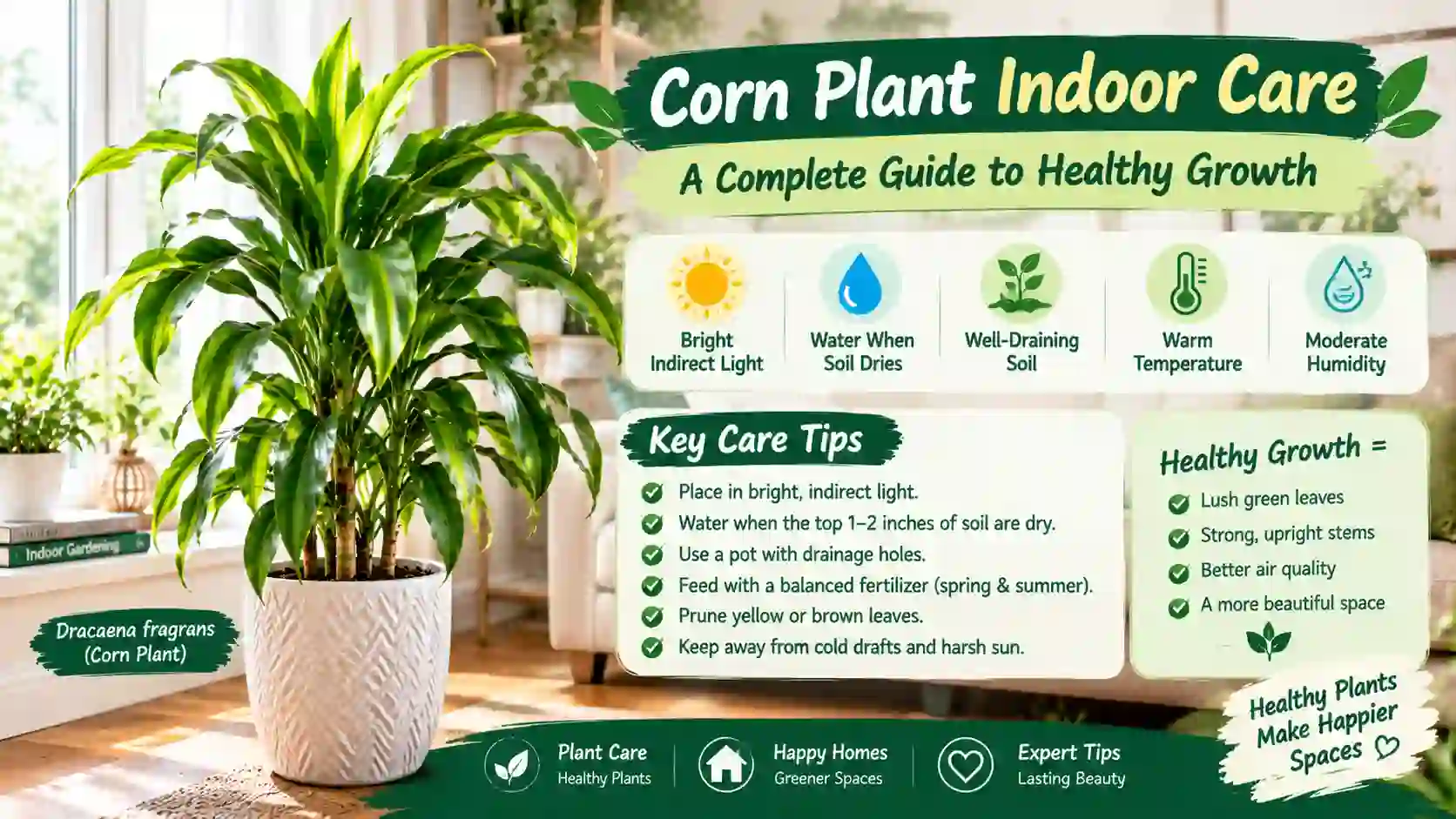
For successful corn plant indoor care, grow your corn plant (Dracaena fragrans) in bright, indirect light and water when the top 1–2 inches of soil feel dry. Use a well-draining potting mix, a container with drainage holes, and a comfortably warm room. Avoid soggy soil, harsh direct sunlight, and cold drafts. With consistent care, this popular houseplant can develop attractive green foliage and a tall, tree-like shape indoors.
Understand Your Indoor Corn Plant
The indoor corn plant, botanically known as Dracaena fragrans, is a tropical plant native to parts of Africa. It is grown for its attractive foliage rather than for edible corn.
Several varieties are common in homes:
- Dracaena fragrans ‘Massangeana’: Green leaves with a broad yellow stripe through the center.
- Dracaena fragrans ‘Janet Craig’: Broad, dark green leaves with a solid green appearance.
- Dracaena fragrans ‘Lemon Lime’: Green leaves with bright yellow-green striping.
- Dracaena fragrans ‘Warneckii’: Narrower leaves with green and cream or pale gray-green stripes.
These varieties share similar basic care requirements, although their growth patterns and light preferences can vary slightly.
Corn plants grow slowly indoors. They can develop tall, woody canes and long leaves, making them suitable for corners and areas where a vertical accent is desirable.
Practical insight: A corn plant does not need to produce new leaves every week to be healthy. Slow growth is normal, especially in winter or in rooms with moderate light. Judge its condition by the firmness of its canes, the appearance of new growth, and the health of its leaves.
Image suggestion: A labeled comparison of Massangeana, Janet Craig, Lemon Lime, and Warneckii corn plant varieties.
How Much Light Does a Corn Plant Need Indoors?
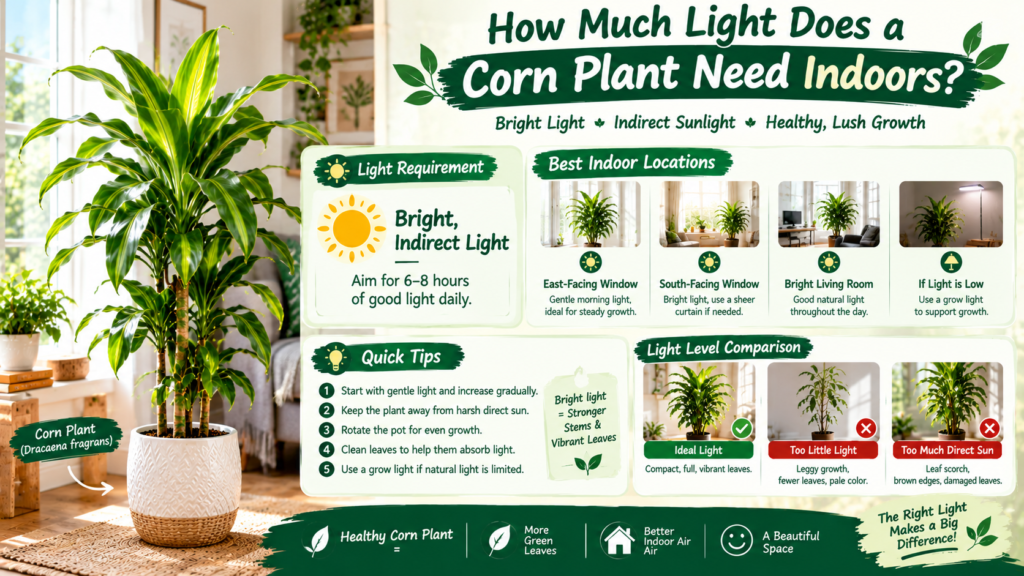
Corn plants grow best in bright, indirect light. They can tolerate lower-light rooms, but growth may become slower, and variegated varieties may lose some of their vibrant coloring.
A location near a bright window is usually a good starting point. Filtered light through a sheer curtain can help protect the foliage from intense direct sun.
Best indoor locations for a corn plant
- East-facing window: Often provides gentle morning sunlight and bright ambient light.
- South- or west-facing window: Can work well when the plant is set back from strong direct sunlight or protected with a sheer curtain.
- Bright living room: Suitable if the plant receives plenty of natural light throughout the day.
- Office with limited windows: May require a suitable grow light if natural light is insufficient.
A dim corner far from windows may look attractive, but it can limit long-term growth. Artificial room lighting alone often does not provide enough intensity for vigorous plant growth.
Signs your corn plant needs a lighting adjustment
| Symptom | Possible explanation | What to do |
|---|---|---|
| Slow or stretched growth | Insufficient light | Move it gradually toward brighter indirect light |
| Fading leaf stripes | Light may be too low for a variegated variety | Provide brighter indirect light |
| Bleached or scorched patches | Excessive direct sunlight | Filter sunlight or move the plant back |
| Leaning toward a window | Uneven light exposure | Rotate the pot periodically |
Expert tip: Change light exposure gradually. Moving a plant directly from a dim room into strong afternoon sunlight can scorch leaves that were not acclimated to that intensity.
Image suggestion: A three-panel infographic comparing ideal indirect light, insufficient light, and harsh direct sunlight for corn plants.
How to Water a Corn Plant Indoors
Watering is one of the most important parts of corn plant indoor care. These plants prefer soil that partially dries between waterings rather than soil that remains constantly wet.
Overwatering can deprive roots of oxygen and encourage root rot. Allowing the root ball to become extremely dry for prolonged periods can also cause leaf tips to brown and foliage to wilt.
When should you water a corn plant?
Use this simple process:
- Check the top 1–2 inches of soil with your finger.
- If the soil still feels moist, wait and check again later.
- If the upper layer feels dry, check that the deeper soil is not still saturated.
- Water slowly and evenly across the soil surface.
- Allow excess water to drain fully from the pot.
- Empty the saucer or decorative outer pot so the roots do not sit in standing water.
The plant may need watering every week or two in some homes, but this is only a rough guide. Temperature, light, pot size, soil composition, and season all affect drying time.
Why watering on a fixed schedule can fail
Imagine two corn plants of the same size. One sits beside a bright window in a warm room, while the other stands in a cooler corner. The first may dry faster, while the second may remain damp for much longer.
Watering both plants every Sunday without checking their soil can lead to overwatering in one pot and underwatering in the other.
What kind of water is best?
Corn plants can be sensitive to fluoride and accumulated soluble salts, which may contribute to brown leaf tips. If browning persists despite appropriate watering and humidity, consider your water quality.
Depending on what is available, you can try filtered water with low mineral content, rainwater collected safely, or another suitable low-fluoride source. Avoid assuming that all bottled or filtered water is fluoride-free; water composition varies.
Image suggestion: A step-by-step watering diagram showing soil checking, thorough watering, drainage, and an empty saucer.
Choose the Right Soil and Pot
Corn plants need a potting mix that retains some moisture while allowing excess water to drain. Dense soil that stays saturated for long periods can suffocate roots and increase the risk of root rot.
A suitable potting mix
A practical starting mix includes:
- Two parts quality indoor potting mix
- One part perlite or pumice
- Optional orchid bark for extra structure and airflow
Adjust the proportions to suit the mix you already have. The goal is a loose, stable medium that does not remain waterlogged after watering.
Avoid using heavy garden soil alone in a container. It can compact, drain poorly, and behave differently indoors than it does in an outdoor garden bed.
What type of pot works best?
Choose a pot with drainage holes. Terracotta can help the soil dry faster, while plastic or glazed ceramic pots generally retain moisture longer.
Neither material is automatically better. Choose based on how quickly your plant’s soil dries in its current environment.
When should you repot?
Consider repotting when:
- Roots emerge from the drainage holes.
- The root ball is tightly packed.
- Water runs through the pot unusually quickly because little soil remains.
- Growth declines despite suitable light, watering, and nutrition.
- The existing soil has broken down or drains poorly.
Move the plant into a container only one size larger than the current pot. An oversized pot holds more wet soil around the roots, which can increase the risk of overwatering.
Image suggestion: A side-by-side illustration of healthy, airy potting mix and compacted, waterlogged soil around corn plant roots.
Ideal Temperature and Humidity
Corn plants prefer warm indoor conditions and generally adapt well to ordinary household temperatures.
| Condition | Practical recommendation |
|---|---|
| Daytime temperature | Around 65–80°F (18–27°C) |
| Cold exposure | Protect from chilly drafts and sudden temperature changes |
| Humidity | Average household humidity is often acceptable |
| Airflow | Provide gentle air circulation without harsh drafts |
Avoid placing the plant directly beside air-conditioning vents, heaters, frequently opened cold windows, or exterior doors exposed to cold weather.
Dry air may contribute to crispy leaf edges, but it is not the only possible cause. Water quality, inconsistent watering, salt buildup, and root damage should also be considered.
Should you mist your corn plant?
Misting provides only a brief increase in surface moisture and usually does little to raise room humidity for long. It is not essential for healthy growth.
If your home is consistently very dry, a humidifier can provide a more stable improvement. Keep the plant away from cold, damp conditions and ensure leaves can dry normally.
Practical tip: Before buying a humidifier, check whether humidity is actually low. If your corn plant has brown tips but the room has comfortable humidity, investigate watering and water quality first.
Image suggestion: A temperature and humidity guide showing a corn plant positioned away from heaters and cold drafts.
How to Fertilize a Corn Plant Indoors
Corn plants are not heavy feeders, especially when growing in moderate indoor light. A balanced liquid houseplant fertilizer can support healthy foliage during active growth.
A simple feeding routine
- Feed during spring and summer when the plant is actively growing.
- Follow the fertilizer label and avoid applying more than recommended.
- Reduce or stop feeding during winter if growth slows significantly.
- Do not fertilize a severely stressed plant until you understand the cause of the problem.
- Water appropriately and ensure the pot drains after feeding.
Excess fertilizer can cause salt buildup, root stress, and brown leaf tips. Adding more fertilizer is not a reliable way to fix pale leaves if the plant is actually suffering from poor light or damaged roots.
If a white crust forms on the soil surface or around the pot rim, accumulated mineral salts may be contributing to the problem. Review fertilizer use and water quality before feeding again.
Image suggestion: A corn plant fertilizing infographic with a measuring cap, diluted liquid fertilizer, and a spring-to-summer feeding calendar.
Pruning and Keeping Your Corn Plant Attractive
Pruning helps maintain the appearance of a corn plant and removes foliage that is dead or badly damaged. It can also be used to manage the height of an established plant.
How to prune safely
- Use clean, sharp scissors or pruning shears.
- Remove fully dead or badly damaged leaves near their base.
- Trim brown tips by following the natural leaf shape, if desired.
- Avoid cutting deeply into healthy green tissue.
- Remove only what is necessary at one time.
Brown tips can be trimmed for appearance, but they may return if the underlying cause remains. Check water quality, soil moisture, and fertilizer use when browning continues.
What if your corn plant becomes too tall?
A tall corn plant can sometimes be cut back by shortening a cane with clean tools. New shoots may develop below the cut, although results vary with plant health, growing conditions, and the cane being pruned.
Do not remove a large amount of healthy foliage unnecessarily. If the plant is already weak, first improve its growing conditions and let it recover.
Important: Wear gloves if you have sensitive skin, and keep pruning debris away from children and pets.
Image suggestion: Before-and-after images showing a tall corn plant before pruning and a fuller plant after new shoots develop.
Common Corn Plant Problems and How to Fix Them
Corn plants often show visible symptoms before their condition becomes serious. The key is to investigate the growing conditions rather than treating every symptom as a separate disease.
Why are my corn plant’s leaves turning yellow?
Yellow leaves can develop for several reasons, including overwatering, poor drainage, low light, or natural aging.
Start by checking the soil. If it remains wet for several days and the lower leaves are yellowing, inspect drainage and review your watering routine. If only an occasional old leaf yellows while new growth looks healthy, the change may be normal.
Fix: Correct the underlying growing conditions before applying fertilizer or other treatments.
Why does my corn plant have brown leaf tips?
Brown tips are common on indoor corn plants. Possible causes include fluoride sensitivity, mineral salts, inconsistent watering, fertilizer buildup, and very dry conditions.
Fix: Check soil moisture, reduce unnecessary fertilizer, and consider using lower-mineral water. Trim the damaged tips if you prefer a neater appearance.
Why are the leaves drooping?
Drooping can result from underwatering, overwatering, root damage, or temperature stress. Do not automatically water a drooping plant.
Fix: Feel the soil first. If it is dry, water thoroughly and let the pot drain. If it is wet and the plant continues to decline, inspect the roots and drainage.
Why is my corn plant growing slowly?
Slow growth is normal for many indoor corn plants, particularly in winter. However, very low light, poor roots, or a lack of nutrients during active growth can slow it further.
Fix: Provide brighter indirect light, maintain healthy roots, and fertilize moderately during active growth if needed.
Why are the stems becoming soft?
Soft, darkening canes can indicate serious tissue damage or rot, especially when the soil remains saturated.
Fix: Remove standing water and inspect the plant. If roots or cane sections are rotting, cut away damaged material with clean tools where appropriate. A badly rotted cane may not recover.
Troubleshooting table
| Problem | Likely causes | First action |
|---|---|---|
| Yellow lower leaves | Natural aging or excess moisture | Check soil and drainage |
| Brown leaf tips | Mineral salts, fluoride, watering stress | Review water quality and care routine |
| Pale or faded foliage | Insufficient light or other stress | Assess light exposure |
| Limp, drooping leaves | Dry soil, saturated roots, or temperature stress | Check moisture before watering |
| Soft cane | Possible rot | Inspect roots and damaged tissue |
| Tiny insects or sticky leaves | Possible pest infestation | Isolate the plant and identify the pest |
Image suggestion: A diagnostic chart with healthy foliage, yellow leaves, brown tips, drooping leaves, and soft cane symptoms.
How to Identify and Manage Common Corn Plant Pests
Indoor corn plants can attract several pests, particularly when growing conditions are stressful or infested plants are brought into the home.
Watch for these warning signs:
- Spider mites: Fine webbing, tiny specks, and stippled leaves.
- Mealybugs: White, cotton-like clusters around leaf joints and stems.
- Scale insects: Small, shell-like bumps attached to stems or leaves.
- Thrips: Silvery scarring, distorted new growth, and tiny insects.
What should you do if you find pests?
- Move the affected plant away from nearby plants.
- Inspect leaf undersides, leaf joints, and stems.
- Remove visible pests where practical.
- Use an appropriate treatment labeled for the identified pest and plant.
- Repeat inspections because eggs and hidden insects may survive the first treatment.
- Clean the surrounding area and monitor neighboring plants.
Always follow product-label directions. Test a treatment on a small area first when appropriate, and avoid spraying plants in intense direct sunlight unless the label specifically permits it.
Prevention tip: Inspect new houseplants before placing them beside your existing collection. A short quarantine period can help prevent pests from spreading throughout your home.
Image suggestion: A close-up infographic identifying spider mites, mealybugs, and scale insects on corn plant leaves and stems.
Seasonal Corn Plant Indoor Care
Indoor conditions change with the seasons, even when the plant remains in the same room.
Spring
As growth resumes, check whether the plant needs repotting and begin moderate feeding if it is actively growing. Increase light exposure gradually if the plant has spent winter in a dimmer location.
Summer
Warm rooms and brighter light may cause soil to dry faster. Check moisture more frequently, but do not water automatically just because the weather is hot.
Autumn
As daylight decreases, growth may slow. Reassess watering frequency and avoid continuing a heavy summer feeding routine when the plant is no longer growing actively.
Winter
Soil often dries more slowly in cooler or dimmer rooms. Protect the plant from cold drafts and keep it away from heating vents that blow hot, dry air directly onto the foliage.
The most useful seasonal adjustment is to observe how quickly the soil dries. This gives you a better watering guide than a calendar alone.
Can You Propagate a Corn Plant Indoors?
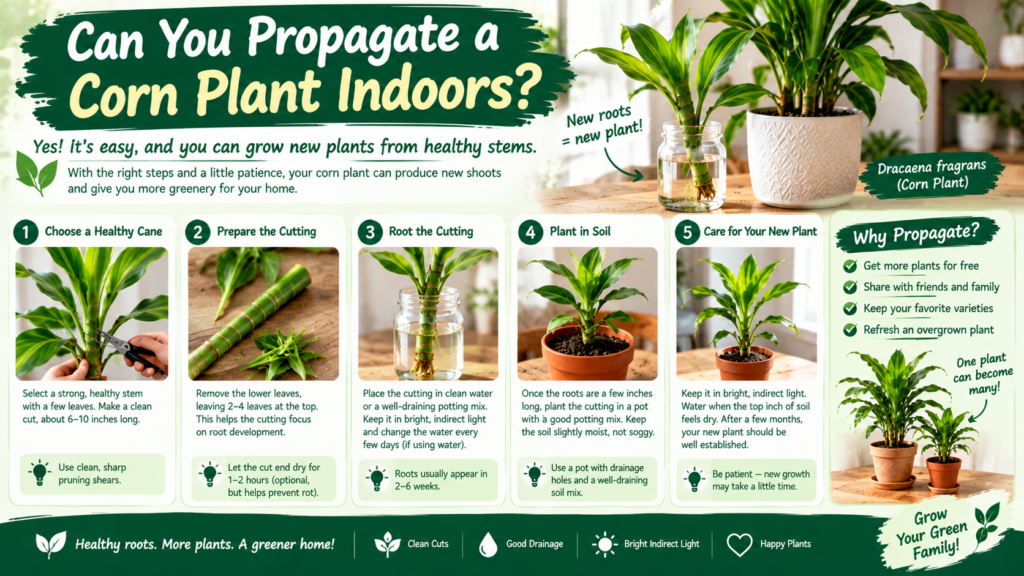
Yes. Established corn plants can often be propagated using cane sections or suitable stem cuttings. Propagation can be useful when pruning an overgrown plant or trying to produce additional plants.
Basic cane propagation
- Select a healthy cane or stem section.
- Use clean cutting tools to prepare the cutting.
- Place the cutting in an appropriate propagation medium or water, depending on the method.
- Keep it warm and provide bright, indirect light.
- Maintain appropriate moisture without leaving the cutting in stagnant conditions.
- Check for root and shoot development over time.
Propagation success depends on the cutting’s condition, temperature, and care. It may take weeks or longer for clear growth to appear.
If the original plant has rot or suspected disease, avoid using affected sections for propagation.
Image suggestion: A step-by-step illustration showing healthy corn plant cane cuttings, rooting, and young shoots.
Is the Corn Plant Safe for Pets?
Corn plants (Dracaena fragrans) are considered toxic to cats and dogs if chewed or eaten. They contain compounds called saponins that can cause gastrointestinal symptoms.
Possible signs of ingestion include vomiting, drooling, reduced appetite, and digestive upset.
If you have pets that chew houseplants:
- Place the plant where pets cannot reach it.
- Remove fallen leaves promptly.
- Avoid assuming that a tall plant is safe simply because its upper foliage is out of reach.
- Contact a veterinarian if your pet eats part of the plant or develops symptoms.
If you have small children, also keep pots, fertilizer, and pest-treatment products out of reach.
Practical tip: If your cat repeatedly chews leaves, choosing a non-toxic alternative and keeping the corn plant inaccessible is safer than relying on deterrents alone.
Common Corn Plant Care Mistakes to Avoid
Even an easy-care houseplant can struggle when several small mistakes happen together.
- Watering too often: Check the soil before watering instead of following a rigid schedule.
- Keeping the plant in a dark corner: Provide bright, indirect light for healthier growth.
- Using a pot without drainage holes: Choose a container that allows excess water to escape.
- Repotting into an oversized container: Increase pot size gradually to avoid keeping excessive soil wet.
- Applying fertilizer to a stressed plant: Diagnose the problem first.
- Ignoring water quality: Persistent brown tips may warrant checking mineral content and fertilizer buildup.
- Pruning too aggressively: Remove damaged foliage carefully and avoid unnecessary cuts to healthy canes.
- Expecting rapid growth: Corn plants are often slow-growing indoors, especially during winter.
One particularly common mistake is treating every brown leaf tip as a sign of underwatering. If the soil is already moist, adding more water can make the actual problem worse.
Frequently Asked Questions About Corn Plant Indoor Care
How often should I water an indoor corn plant?
Water when the top 1–2 inches of soil feel dry and the deeper soil is not still saturated. The interval varies with light, temperature, pot size, and season, so check the soil rather than relying on a fixed weekly schedule.
Can a corn plant survive in low light?
It can tolerate lower light, but growth is usually slower and variegated leaves may lose some color. A brighter location with indirect light generally supports better long-term growth.
How much sunlight does a corn plant need indoors?
Bright, indirect light is ideal. A position near a bright window usually works well, but protect the foliage from intense direct sunlight that can cause scorching.
Why are the tips of my corn plant turning brown?
Brown tips may result from fluoride sensitivity, mineral buildup, inconsistent watering, excess fertilizer, or dry conditions. Check the soil, review fertilizer use, and consider trying suitable low-mineral water.
Should I mist my corn plant every day?
Daily misting is not necessary. It provides only a temporary increase in surface moisture and does not reliably raise room humidity. A humidifier is more effective if humidity is consistently too low.
When should I repot my corn plant?
Repot when roots crowd the container, emerge from drainage holes, or the potting mix no longer drains properly. Choose a container only one size larger and use a well-draining mix.
Can I cut the top off my corn plant?
Yes, a healthy corn plant can often be pruned by shortening a cane. New shoots may form below the cut, but the result varies. Use clean tools and avoid removing excessive healthy growth.
Is corn plant indoor care suitable for beginners?
Yes. Corn plants are generally forgiving when given appropriate light, careful watering, and good drainage. Beginners should focus on avoiding waterlogged soil and choosing a suitable location.
Is a corn plant the same as a corn crop?
No. The indoor corn plant is Dracaena fragrans, an ornamental tropical plant. It is unrelated to the edible corn commonly grown in vegetable gardens, despite the resemblance of its leaves to corn foliage.
Can I keep a corn plant in an air-conditioned room?
Yes, provided the room stays comfortably warm and the plant is not directly exposed to cold air from a vent. Check the soil regularly because indoor climate control can change drying rates.
Conclusion
Successful corn plant indoor care depends on a few consistent habits: provide bright, indirect light, water only when the soil needs it, use a well-draining potting mix, and protect the plant from cold drafts and harsh sunlight.
When problems appear, examine the roots, soil moisture, light, and water quality before making several changes at once. This helps you identify the real cause and avoid adding stress to an already struggling plant.
With suitable conditions and patient care, your corn plant can remain an attractive indoor feature for years.