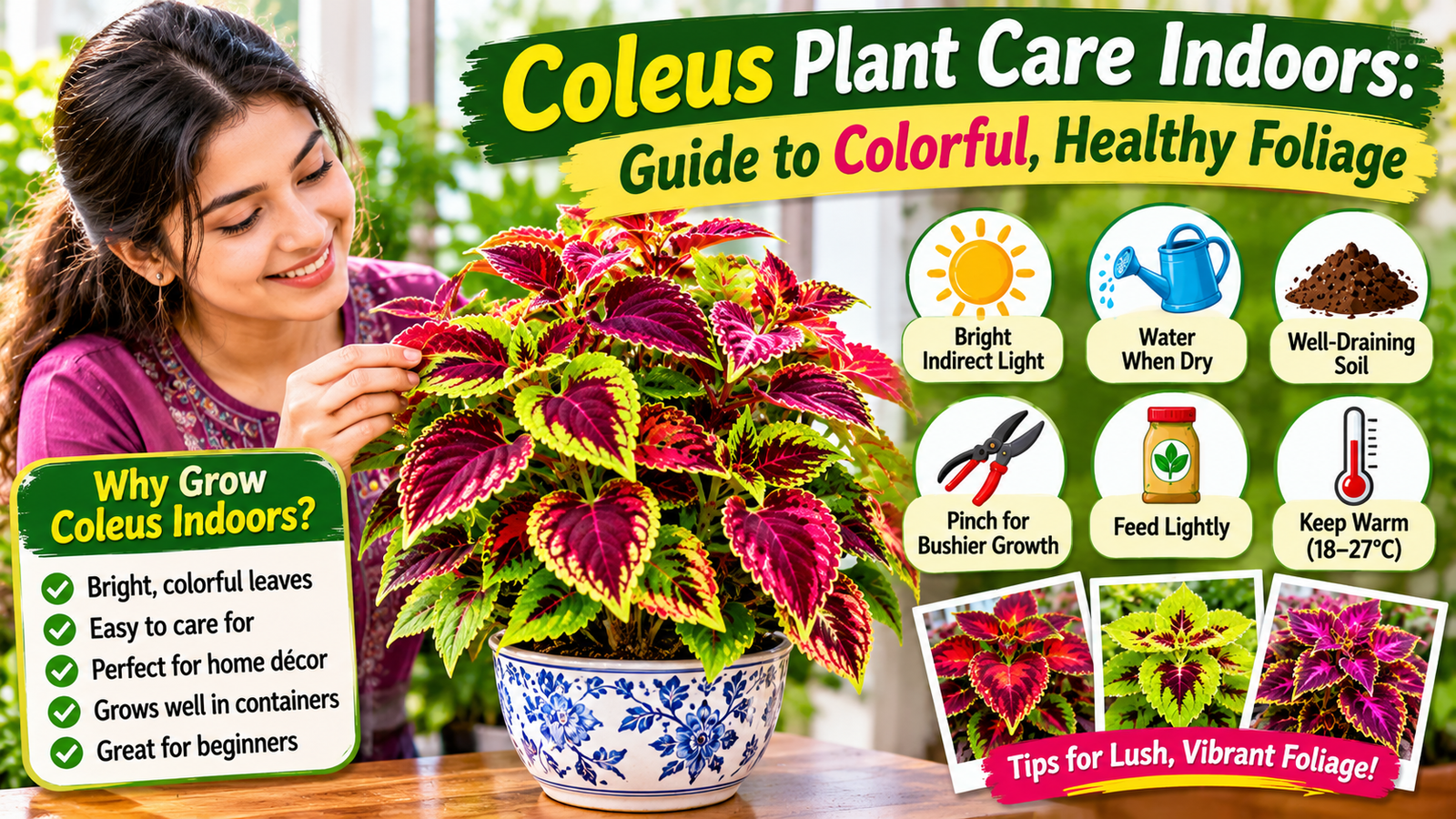
Coleus is a popular foliage plant known for its colorful leaves, striking patterns, and relatively easy care. Its leaves can display combinations of green, burgundy, pink, red, yellow, orange, and purple.
Growing coleus indoors lets you enjoy these colors throughout the year. However, indoor conditions differ from outdoor gardens. Limited sunlight, dry air, irregular watering, and restricted airflow can affect leaf color and plant shape.
The good news is that coleus responds quickly to improved care. A plant that becomes leggy can often grow fuller after pruning. A plant with faded leaves may regain its color when moved to better light.
This guide explains how to grow coleus indoors, choose the right location, water correctly, maintain colorful foliage, propagate new plants, and solve common problems.
Quick Answer:
Coleus plants grow well indoors when they receive bright, indirect light, warm temperatures, and consistently moist but well-drained soil. Place your plant near an east-facing window or a bright spot with filtered sunlight. Water when the top inch of soil begins to dry, pinch growing tips to encourage bushy growth, and feed lightly during active growth. Avoid cold drafts, harsh midday sun, and waterlogged soil.
Understanding the Indoor Coleus Plant
Coleus (Coleus scutellarioides) is a tropical foliage plant in the mint family, Lamiaceae. It is native to tropical and subtropical parts of Asia and northern Australia.
Gardeners grow coleus mainly for its decorative leaves rather than its flowers. Its foliage can have dramatic color combinations, including:
- Deep burgundy with bright pink centers.
- Lime green with dark purple edges.
- Red leaves with golden margins.
- Orange, copper, and yellow patterns.
- Green leaves with contrasting veins.
Different cultivars have different growth habits. Some grow upright, others form compact mounds, and trailing types work well in hanging baskets.
Why Is Coleus Suitable for Indoor Growing?
Coleus adapts well to containers and can grow as a houseplant when it receives enough light. Its colorful foliage also makes it useful for decorating windowsills, shelves, and bright rooms.
However, coleus is not a low-light plant. A dim corner may keep it alive temporarily, but the stems often become stretched and the leaves lose their strongest colors.
The accepted botanical name is Coleus scutellarioides. Older labels may use Plectranthus scutellarioides or Solenostemon scutellarioides. Gardening Solutions+1
How Much Light Does Indoor Coleus Need?
Light is one of the biggest factors affecting indoor coleus growth. Bright, indirect light helps maintain vivid leaf colors and compact growth.
A position near an east-facing window is often a good starting point. A bright south- or west-facing window can also work if a sheer curtain filters intense sunlight.
Best Indoor Lighting Conditions
| Window location | Suitability | Practical advice |
|---|---|---|
| East-facing | Excellent | Gentle morning sunlight is useful |
| North-facing | Variable | Use the brightest available position |
| South-facing | Good with filtering | Protect leaves from harsh direct sun |
| West-facing | Good with filtering | Watch for afternoon leaf scorch |
The ideal light exposure also depends on the cultivar. Some newer varieties tolerate more direct sun, while traditional varieties often prefer partial shade. Gardening Solutions+1
Signs Your Coleus Needs More Light
- Stems become long and thin.
- Leaves grow farther apart.
- The plant leans toward the window.
- New leaves appear smaller or less colorful.
- Growth becomes weak and uneven.
Move the plant gradually toward a brighter location. Do not suddenly expose a shade-grown coleus to strong midday sunlight.
Expert tip: If your room receives little natural light, use a suitable full-spectrum grow light. Position it according to the manufacturer’s recommendations and provide a consistent daily lighting period.
How to Water Coleus Plants Indoors
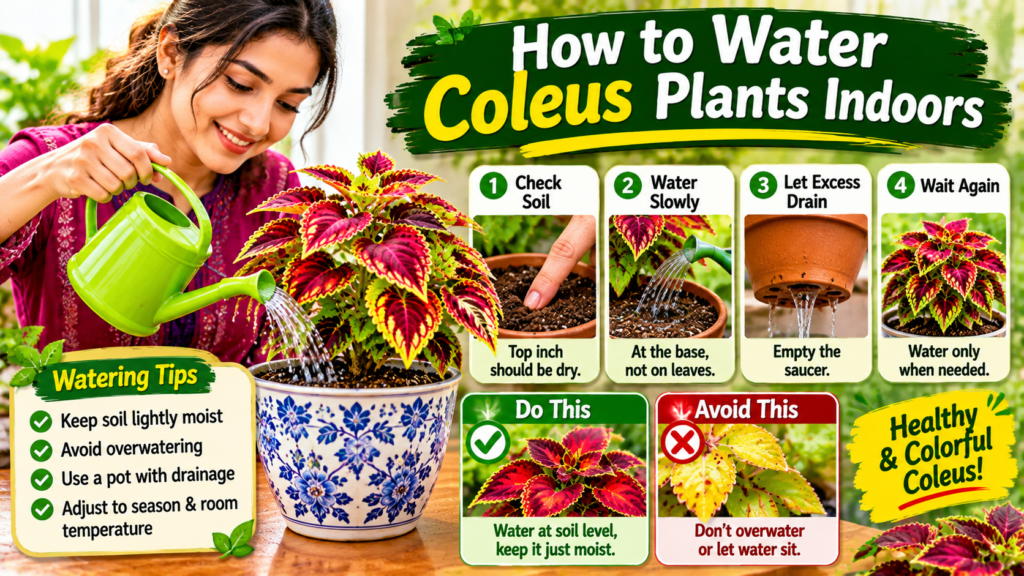
Coleus prefers consistently lightly moist soil. It does not appreciate prolonged dryness, but its roots can suffer when the growing medium remains saturated.
The goal is to keep the soil evenly moist without leaving the roots sitting in water.
Step-by-Step Watering Method
- Check the top inch of soil with your finger.
- If it feels dry, water the plant thoroughly.
- Pour slowly until excess water drains from the bottom.
- Empty the saucer or decorative outer pot.
- Check the soil again before the next watering.
Avoid watering just because the surface looks dry. The soil below the surface may still contain enough moisture.
How Often Should You Water Indoor Coleus?
There is no reliable fixed schedule for every home.
| Indoor conditions | Watering approach |
|---|---|
| Bright, warm room | Check soil frequently |
| Cool room | Allow more time between watering |
| Small container | Check more often |
| Large container | Check deeper before watering |
| Low-light room | Avoid keeping soil constantly wet |
Coleus grown in containers can dry out faster than plants in garden beds. Clemson Extension recommends watering when the top inch of soil is dry while avoiding poorly drained soil and excessive watering. Home & Garden Information Center+1
Common mistake: Allowing the plant to wilt repeatedly before watering. Repeated severe drying can cause leaf drop and damage tender growth.
What Is the Best Soil for Indoor Coleus?
Coleus grows best in a rich, loose potting mix that holds some moisture while allowing excess water to drain.
A mixture that dries too quickly can stress the plant. On the other hand, dense soil that remains soggy can damage its roots.
Recommended Potting Mix
Try this simple starting mixture:
| Ingredient | Amount | Benefit |
|---|---|---|
| Quality indoor potting mix | 2 parts | Provides the main growing medium |
| Perlite | 1 part | Improves aeration and drainage |
| Fine compost or coco coir | ½ part | Helps retain some moisture |
Choose a clean, lightweight mix rather than heavy garden soil.
What Soil Conditions Should You Avoid?
- Dense clay-like soil.
- Garden soil that becomes compacted in pots.
- Mixes that remain waterlogged.
- Containers with blocked drainage holes.
- Very sandy mixtures that dry before the plant can use the water.
Practical observation: If water runs straight through the pot but the plant still wilts quickly, the mix may have become too dry or water-repellent. Rehydrate it thoroughly and consider repotting into a more balanced medium.
Choosing the Right Pot for Indoor Coleus
A suitable pot supports healthy roots and makes watering easier.
Choose a container with drainage holes and enough space for the roots to grow. A pot that is much larger than the root ball can hold excess wet soil for too long.
Best Container Options
- Terracotta pots: Porous walls allow moisture to evaporate more quickly.
- Plastic pots: Retain moisture longer and are lightweight.
- Ceramic pots: Decorative and suitable when they have drainage holes.
- Hanging baskets: Useful for trailing coleus varieties.
When repotting, select a container only one size larger than the current pot. Check the roots first rather than automatically moving the plant into a large container.
Ideal Temperature and Humidity for Indoor Coleus
Coleus is a warm-weather plant. It grows best in comfortable indoor temperatures and can struggle when exposed to cold drafts.
A practical temperature range for indoor growing is approximately 18–27°C (65–80°F).
Temperature Tips
- Keep the plant away from cold windows during chilly weather.
- Avoid placing it beside air-conditioning vents.
- Protect it from sudden temperature changes.
- Keep it away from heaters that produce intense dry heat.
- Avoid leaving it outdoors during cold nights.
Does Indoor Coleus Need High Humidity?
Coleus appreciates moderate humidity, but it can often adapt to ordinary indoor conditions.
If the air is very dry, you may notice crispy leaf edges or increased spider mite activity.
To improve the growing environment:
- Group several plants together without crowding them.
- Use a room humidifier if the air is consistently dry.
- Maintain good airflow around the foliage.
- Avoid leaving the pot standing in water.
Misting is not a reliable way to maintain humidity because its effect is brief.
How to Fertilize Indoor Coleus for Healthy Leaves
Coleus grows relatively quickly when light, warmth, and moisture are suitable. Regular but moderate feeding can support healthy stems and colorful foliage.
Use a balanced liquid houseplant fertilizer during active growth. Follow the product instructions, and begin with a diluted application if your plant is sensitive or the soil already contains fertilizer.
Fertilizing Routine
- Feed during active spring and summer growth.
- Reduce or stop feeding when growth slows.
- Avoid fertilizing a severely wilted or stressed plant.
- Do not combine several fertilizer products.
- Flush the pot occasionally if fertilizer salts accumulate.
Excess fertilizer can cause brown leaf edges, weak growth, and salt buildup around roots.
Expert tip: Coleus is grown mainly for its leaves. Choose a balanced fertilizer rather than relying on a high-phosphorus flowering formula.
How to Prune Coleus Indoors for Bushier Growth
Pruning is one of the best ways to maintain a compact indoor coleus. Without occasional pinching, many varieties develop long stems with fewer side branches.
Removing the growing tip encourages dormant buds near leaf nodes to produce new shoots.
Step-by-Step Pruning
Step 1: Identify long stems
Look for stems that extend beyond the plant’s natural shape or have large gaps between leaves.
Step 2: Pinch above a leaf node
Remove the soft growing tip just above a pair of healthy leaves. This encourages branching.
Coleus Plant Care: Sun-Tolerant Truths & Simple Tips
Step 3: Trim overly long growth
Use clean scissors to shorten stems that make the plant uneven.
How to Prune Leggy Coleus for Bushier Growth
Step 4: Allow new branches to develop
Place the plant in bright light and continue normal care while new side shoots grow.
Avoid removing too much foliage at once. Heavy pruning can temporarily reduce the plant’s ability to produce energy.
Should You Remove Coleus Flowers Indoors?
Coleus produces small flowers on upright spikes, usually when the plant reaches maturity or experiences certain seasonal conditions.
The flowers are not harmful, but many indoor growers prefer the colorful leaves.
Why Remove Flower Spikes?
Removing flower spikes can help keep the plant focused on attractive foliage and maintain a tidy appearance.
To remove them:
- Identify the flower stalk.
- Follow it down to a suitable leaf node.
- Cut it off with clean scissors.
- Continue normal watering and light care.
You do not need to remove every flower spike immediately. If you enjoy the flowers, you can leave some to bloom.
University extension guidance also recommends removing flower spikes and pinching stems when the goal is fuller foliage. UMN Extension+2
How to Propagate Coleus Indoors from Stem Cuttings
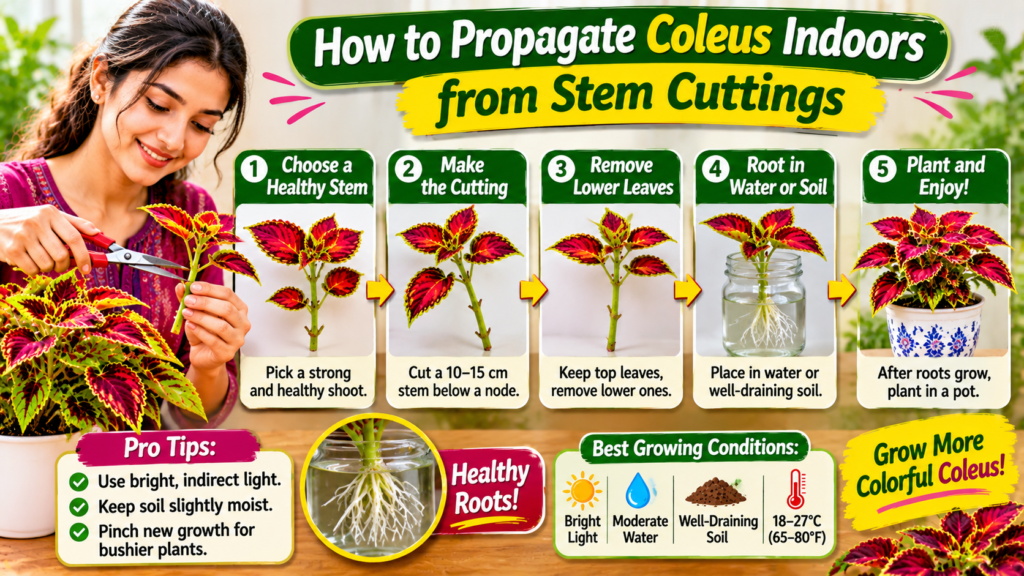
Coleus is easy to propagate from healthy stem cuttings. This gives you a simple way to create new plants or replace an older plant that has become woody and unattractive.
You can root cuttings in water or directly in a suitable propagation medium.
Propagation in Water
Step 1: Select a healthy stem
Choose a firm, healthy shoot without pests, disease, or damaged leaves.
Step 2: Make the cutting
Cut a section approximately 10–15 cm long, preferably just below a leaf node.
Step 3: Remove lower leaves
Remove the leaves that would sit below the waterline. Keep the upper leaves intact.
Step 4: Place in clean water
Submerge the exposed lower stem while keeping the leaves above the water. Place it in bright, indirect light.
Step 5: Transfer to potting mix
When the cutting has developed several healthy roots, plant it carefully in a small pot.
Change the water when it becomes cloudy. Avoid leaving the cutting in direct, intense sunlight.
Can You Propagate Coleus Directly in Soil?
Yes. Place a fresh cutting in a moist, airy propagation medium and keep it warm in bright, indirect light.
The medium should remain lightly moist, not saturated. New leaf growth and gentle resistance when tugging the cutting can indicate successful rooting.
University of Minnesota Extension reports that coleus cuttings can root in approximately two to three weeks under suitable conditions. UMN Extension+1
Common Pests That Affect Indoor Coleus
Indoor coleus can attract sap-feeding insects, especially when the air is dry or plants are crowded.
Check the undersides of leaves, growing tips, and stem joints regularly. Early detection makes pest control much easier.
Common Coleus Pests
| Pest | Signs to look for | Practical response |
|---|---|---|
| Aphids | Small insects clustered on tender shoots | Rinse them off or use labeled insecticidal soap |
| Spider mites | Fine webbing and tiny pale speckles | Isolate the plant and treat the foliage |
| Whiteflies | Small white insects flying when disturbed | Inspect leaf undersides and use suitable controls |
| Mealybugs | White cotton-like patches | Remove visible insects and treat affected areas |
| Fungus gnats | Small flies around moist soil | Allow the soil surface to dry slightly and avoid overwatering |
How to Control Indoor Coleus Pests
- Move the affected plant away from other houseplants.
- Inspect the entire plant, including leaf undersides.
- Rinse away pests with a gentle stream of water when practical.
- Remove heavily infested leaves.
- Apply a suitable insecticidal soap according to its label.
- Repeat inspections and treatments as directed.
Test any treatment on a small section of foliage first. Some coleus varieties have delicate leaves that may react to sprays.
Important: Avoid spraying plants in strong sunlight or high heat. Let treated foliage dry in a shaded, well-ventilated location.
Common Coleus Problems and How to Fix Them
When coleus develops a problem indoors, look at its recent growing conditions before changing everything. A sudden change in light, watering, or temperature can affect the leaves within days.
Why Are My Coleus Leaves Turning Yellow?
Yellow leaves can result from excessive watering, poor drainage, insufficient light, or normal aging.
How to fix it:
- Check the soil several centimeters below the surface.
- Make sure the pot drains freely.
- Remove leaves that are completely yellow.
- Move the plant to brighter indirect light if necessary.
- Inspect the roots if yellowing continues.
If the soil is wet and the lower leaves are turning yellow, overwatering is a strong possibility.
Why Are Coleus Leaves Turning Brown?
Brown leaf edges or patches can indicate several problems.
Possible causes include:
- Dry soil or irregular watering.
- Strong direct sunlight.
- Excess fertilizer salts.
- Very dry indoor air.
- Physical damage to the leaves.
How to fix it: Identify the likely cause before making changes. If the leaves are scorched on the window-facing side, filter the sunlight. If the soil is extremely dry, water thoroughly and adjust your watering routine.
Why Is My Indoor Coleus Wilting?
Wilting does not always mean the plant needs more water.
A plant can wilt because the soil is too dry, but waterlogged roots can also prevent normal water uptake.
How to fix it:
- Feel the soil before watering.
- Water thoroughly if the root zone is dry.
- If the soil is saturated, stop watering and check drainage.
- Inspect roots for soft, dark, damaged tissue.
- Keep the plant away from extreme heat and cold drafts.
Why Is My Coleus Becoming Leggy?
Leggy growth is one of the most common indoor coleus problems.
It happens when stems stretch toward a light source, often because the room is too dim.
How to fix it:
- Move the plant closer to a bright window.
- Rotate the pot periodically.
- Pinch long stems above healthy leaf nodes.
- Use a grow light if natural light is inadequate.
Do not rely on pruning alone. Without better light, new growth may become leggy again.
Why Are My Coleus Leaves Losing Their Color?
Faded foliage can result from inadequate light, excessive direct sun, nutrient problems, or natural differences between cultivars.
How to fix it: Provide bright, filtered light and avoid heavy fertilizer applications. Compare new leaves with older foliage to see whether the problem is continuing.
Why Is My Coleus Dropping Leaves?
Leaf drop can follow sudden environmental changes, prolonged drought, overwatering, cold exposure, or pest damage.
Check whether the plant has recently been moved, repotted, exposed to air-conditioning, or left near a cold window.
Indoor Coleus Troubleshooting Chart
| Problem | Likely cause | First action |
|---|---|---|
| Yellow leaves | Wet soil or poor drainage | Check roots and moisture |
| Brown edges | Dryness, salts, or heat | Check watering and fertilizer |
| Leggy stems | Insufficient light | Increase bright indirect light |
| Wilting | Dry roots or root damage | Check soil before watering |
| Faded colors | Unsuitable light | Adjust window position |
| Sticky leaves | Possible aphids or other pests | Inspect growing tips |
| Fine webbing | Possible spider mites | Isolate and inspect closely |
| Sudden leaf drop | Temperature or watering stress | Review recent changes |
Seasonal Indoor Coleus Care
Indoor coleus does not experience outdoor seasons in exactly the same way. However, changes in daylight, temperature, and indoor heating or cooling can affect its growth.
Spring
Spring is a good time to encourage fresh growth.
- Repot if roots have filled the container.
- Take stem cuttings for new plants.
- Begin regular feeding if growth becomes active.
- Pinch growing tips to encourage branching.
Summer
Coleus often grows vigorously in warm, bright conditions.
- Check soil moisture more frequently.
- Protect foliage from harsh afternoon sun.
- Watch for spider mites and whiteflies.
- Prune long stems to maintain shape.
Autumn
Growth may slow as daylight decreases.
- Reduce fertilizer if growth slows.
- Remove damaged or aging leaves.
- Check for pests before bringing outdoor plants inside.
- Move plants away from cold windows.
Winter
Indoor coleus may grow more slowly in winter, especially near poorly lit windows.
- Provide the brightest suitable location.
- Water according to soil moisture, not the summer schedule.
- Avoid cold drafts.
- Use supplemental lighting if necessary.
- Delay heavy pruning until active growth resumes.
In warm regions, coleus can continue growing throughout the year indoors if light and temperature remain suitable.
Common Indoor Coleus Care Mistakes to Avoid
Many coleus problems come from a few avoidable habits. Correcting these mistakes can improve the plant’s appearance without expensive products.
1. Placing coleus in a dark corner
Coleus needs bright light to maintain attractive foliage. Move it closer to a suitable window instead of expecting it to thrive in low light.
2. Watering on a fixed schedule
A watering routine that works in summer may keep soil too wet in winter. Check the soil before every watering.
3. Using a pot without drainage
Excess water collects around the roots and increases the risk of root damage. Choose a container with open drainage holes.
4. Exposing leaves to harsh sunlight
Traditional shade-loving varieties can scorch under strong direct sunlight. Introduce brighter conditions gradually.
5. Ignoring long stems
Unpruned plants can become uneven and sparse. Pinch growing tips to encourage side branches.
6. Applying too much fertilizer
More fertilizer does not automatically mean better leaf color. Excess feeding can damage roots and cause leaf-edge problems.
7. Keeping the plant near cold air
Coleus prefers warmth. Avoid cold drafts from windows, doors, and air-conditioning units.
8. Forgetting to inspect the undersides of leaves
Pests often hide where they are difficult to see. Check both sides of the foliage during regular maintenance.
Is Coleus Safe Around Pets and Children?
Coleus identification matters when considering household safety. Several plants have similar common names, and toxicity information can be confused between species.
The ornamental houseplant discussed in this guide is Coleus scutellarioides. North Carolina State Extension lists it as having low-severity poisonous characteristics and notes that leaf contact may cause skin irritation in some people. North Carolina Extension Gardener Plant Toolbox+1
The ASPCA entry commonly found under the name “Coleus” refers to Coleus amboinicus (Indian borage), not the ornamental Coleus scutellarioides. These plants should not be treated as interchangeable when checking pet safety. ASPCA+1
For a cautious household approach:
- Keep ornamental coleus away from pets that chew plants.
- Discourage children from eating leaves.
- Wash your hands after handling the plant if irritation occurs.
- Contact a veterinarian if a pet eats an unidentified plant and develops symptoms.
- Keep the plant label with its botanical name for accurate identification.
Expert Tips for Fuller and More Colorful Indoor Coleus
If you want your coleus to look full and vibrant rather than tall and sparse, focus on consistent growing conditions.
Here are practical techniques that make a difference:
- Choose the right cultivar: Some coleus varieties naturally grow compactly, while others develop long or trailing stems.
- Provide consistent light: Keep the plant near a bright window and rotate it to encourage balanced growth.
- Pinch early: Start pinching young plants once they have several healthy pairs of leaves.
- Avoid excessive nitrogen: Too much fertilizer can produce soft growth rather than a balanced plant.
- Maintain even moisture: Do not allow the root ball to become completely dry for extended periods.
- Refresh older plants: Take healthy cuttings before a mature plant becomes woody or unattractive.
- Remove flower spikes when desired: This helps maintain a foliage-focused appearance.
- Check new plants carefully: Inspect leaves and stems before placing a newly purchased coleus near your other houseplants.
An especially useful technique: Keep a backup cutting from a favorite variety. Coleus grows quickly from cuttings, so you can replace an aging plant without starting from seed.
Frequently Asked Questions :
Can coleus grow indoors all year?
Yes. Coleus can grow indoors throughout the year when it receives enough light, warmth, and moisture. Growth may slow during darker months, so adjust watering and feeding accordingly.
How much sunlight does indoor coleus need?
Coleus prefers bright, indirect light. An east-facing window is often a good choice. Some varieties tolerate more direct sunlight, but intense afternoon exposure can scorch sensitive foliage.
How often should I water indoor coleus?
Water when the top inch of soil begins to dry. Water thoroughly and allow excess moisture to drain. The frequency depends on temperature, light, pot size, and soil.
Why is my indoor coleus losing its color?
Insufficient light is a common reason for faded foliage. Excessive direct sunlight, nutrient problems, and cultivar differences can also affect leaf color.
Should I mist my coleus plant?
Regular misting is unnecessary. It provides only temporary humidity and can leave foliage wet. Use a room humidifier if your indoor air is consistently dry.
How do I make coleus grow bushier?
Pinch the growing tips above healthy leaf nodes. This encourages side branches and creates a fuller appearance. Provide enough light so the new growth remains compact.
Can coleus grow in water?
Yes. Healthy stem cuttings can develop roots in clean water. You can keep a cutting in water temporarily or transfer it into a suitable potting mix after roots develop.
Why are my coleus leaves turning yellow and falling off?
Overwatering, poor drainage, insufficient light, and sudden temperature changes can cause yellowing and leaf drop. Check the soil and inspect the roots before changing your watering routine.
Should I remove flowers from indoor coleus?
You can remove flower spikes if you prefer a foliage-focused plant. Removing them also helps maintain a neat appearance, but flowering itself is a natural part of the plant’s life cycle.
What is the best fertilizer for indoor coleus?
A balanced liquid houseplant fertilizer is suitable during active growth. Apply it according to the label and avoid excessive feeding.
Can I prune coleus heavily?
Coleus tolerates pruning, but avoid removing most of its foliage at once. Gradual trimming is safer and gives the plant time to produce new shoots.
Is coleus suitable for beginners?
Yes. Coleus is a good beginner-friendly houseplant because it grows readily and is easy to propagate. Beginners should pay particular attention to light and watering.
How long does an indoor coleus plant live?
Coleus can continue growing for years in suitable indoor conditions, although individual plants may become woody or less attractive as they mature. Regular pruning and propagation help maintain fresh, healthy plants.
Conclusion
Successful coleus care indoors depends on providing the right balance of light, water, warmth, and regular maintenance.
Place your plant in bright, indirect light, use a rich but well-draining potting mix, and water when the top inch of soil begins to dry. Pinch growing tips to encourage bushier growth and feed moderately during active growth.
Watch for leggy stems, yellow leaves, pests, and signs of excess moisture. These problems are easier to correct when noticed early.
Most importantly, do not be afraid to prune and propagate your coleus. A few healthy cuttings can produce new plants and help preserve your favorite leaf colors.
With consistent care, your indoor coleus can remain a beautiful focal point with colorful, healthy foliage throughout the year.