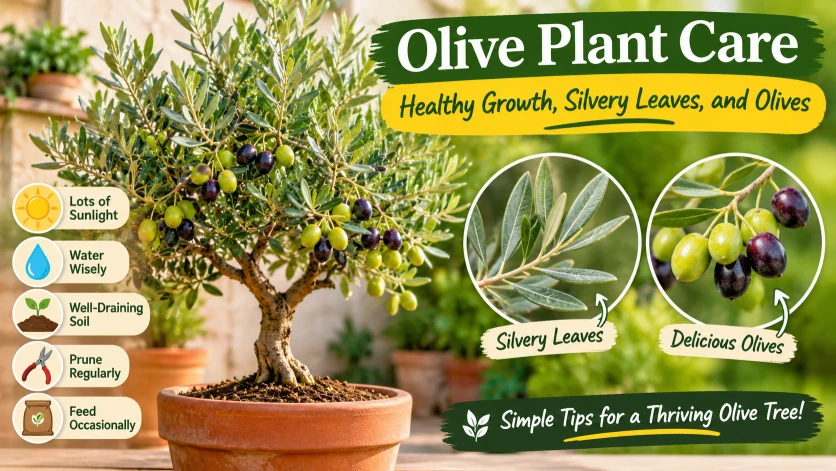
Olive trees are popular for their elegant appearance, silvery-green leaves, and ability to bring a Mediterranean feel to gardens, patios, and indoor spaces.
However, growing a healthy olive tree requires more than occasional watering. These trees love sunlight, dislike constantly wet soil, and need suitable temperatures to thrive.
Many beginners make the mistake of treating olive trees like ordinary tropical houseplants. They place them in dim corners, water them too frequently, or use heavy potting soil. These conditions can lead to yellow leaves, root problems, weak growth, and poor fruit production.
The good news is that olive trees are relatively low-maintenance once their growing conditions are right.
This guide explains how to grow olive plants indoors and outdoors, choose suitable soil, manage watering, encourage healthy foliage, solve common problems, and improve the chances of fruit production.
Whether you have a young potted olive tree or an established garden specimen, you will learn how to keep it healthy throughout the year.
Quick Answer:
Olive plant care starts with plenty of sunlight, well-draining soil, and careful watering. Olive trees (Olea europaea) grow best in at least 6–8 hours of direct sunlight daily. Water deeply when the upper soil has dried, avoid waterlogged roots, and use a pot with drainage holes. Provide moderate feeding during active growth, prune lightly, and protect young trees from severe frost. With proper care, olive trees can develop attractive silvery foliage and produce fruit in suitable climates.
Understanding the Olive Plant
The olive tree, botanically known as Olea europaea, is an evergreen tree native to the Mediterranean region and parts of western Asia.
It is well adapted to sunny environments, relatively dry conditions, and soils that drain efficiently.
Its narrow, leathery leaves have green upper surfaces and silvery undersides. Mature trees can develop attractive twisted trunks and spreading branches.
Important characteristics:
- Botanical name: Olea europaea
- Plant type: Evergreen fruit tree
- Family: Oleaceae
- Native region: Mediterranean and western Asia
- Foliage: Narrow, leathery, silvery-green leaves
- Light requirement: Full sun
- Water requirement: Moderate, with good drainage
- Growth habit: Shrub or small to medium-sized tree
- Fruit: Olives, depending on variety and growing conditions
Olive trees are drought-tolerant once established. However, young plants and container-grown trees need regular attention because their roots have limited access to moisture.
An important distinction is that drought tolerance does not mean an olive tree should remain completely dry throughout its growing season.
Choosing the Right Location for Your Olive Tree
Location is one of the most important decisions in successful olive plant care.
An olive tree growing in the correct location generally develops stronger branches, healthier foliage, and better resistance to environmental stress.
Growing Olive Trees Outdoors
Outdoor olive trees perform best in open locations with plenty of direct sunlight.
Choose a position that receives at least 6–8 hours of sunlight daily. Morning and afternoon sunlight help support strong growth.
Look for a location with:
- Good air circulation.
- Well-draining garden soil.
- Protection from strong, damaging winds.
- Enough room for the mature canopy.
- Minimal standing water after rainfall.
Avoid planting an olive tree in a low-lying area where rainwater collects.
If your garden has heavy clay soil, consider improving drainage or growing the tree in a raised bed.
Growing Olive Trees Indoors
Olive trees can grow indoors, but maintaining enough sunlight is often challenging.
Place your plant beside the brightest available window, preferably one receiving several hours of direct sunlight.
A south-facing window in the Northern Hemisphere is often a good choice.
Rotate the pot occasionally so all sides receive balanced light. This helps prevent uneven growth.
If natural light is insufficient, a suitable full-spectrum grow light can supplement sunlight.
Expert tip: If an indoor olive tree develops long, weak branches or begins dropping leaves, check its light exposure before increasing fertilizer or watering.
An olive tree is generally better suited to spending warm months outdoors than remaining permanently inside a dim room.
How Much Sunlight Does an Olive Plant Need?
Sunlight is essential for healthy olive tree growth. It supports photosynthesis, strong branches, leaf development, flowering, and fruit formation.
Ideal Sunlight Requirements
| Growing condition | Recommended light |
|---|---|
| Outdoor garden | 6–8+ hours of direct sun |
| Sunny patio | Full sun |
| Indoor location | Brightest available window |
| Grow light | Supplement when natural light is insufficient |
Olive trees prefer full sun rather than filtered shade.
If your plant receives insufficient sunlight, you may notice:
- Long, weak branches.
- Smaller leaves.
- Sparse foliage.
- Slow growth.
- Reduced flowering.
- Poor fruit development.
What If the Sun Is Too Strong?
Established olive trees tolerate intense sunlight and heat relatively well. However, young plants can experience stress when suddenly exposed to extreme afternoon temperatures.
In very hot climates, introduce young plants to direct sunlight gradually.
During exceptionally hot weather:
- Maintain consistent soil moisture without waterlogging.
- Protect newly planted trees from severe afternoon heat.
- Avoid moving an indoor plant directly into intense outdoor sunlight.
- Check container moisture more frequently.
Expert tip: If your olive tree is growing indoors, moving it outdoors during suitable warm weather can improve its light exposure. Acclimatize it gradually to prevent leaf scorch.
Best Soil for Olive Plant Care
Olive trees need soil that allows excess water to escape quickly.
Their roots require oxygen. When soil remains saturated, oxygen becomes limited, increasing the risk of root damage and fungal problems.
Ideal Soil Characteristics
Good olive tree soil should be:
- Well-draining and reasonably fertile.
- Slightly acidic to alkaline, around pH 6–8.
- Loose enough to support root development.
- Capable of retaining some moisture without becoming soggy.
- Free from excessive compacted clay.
Olive trees tolerate different soil types, but drainage is more important than achieving a perfect soil mixture.
DIY Olive Tree Potting Mix
For container-grown olive trees, try this practical mixture:
| Ingredient | Quantity |
|---|---|
| Quality loam-based potting soil | 50% |
| Horticultural grit or coarse sand | 25% |
| Perlite or pumice | 25% |
This mixture provides structure, airflow, and drainage.
Avoid using fine construction sand because it can compact the mixture rather than improve drainage.
For garden planting, improve heavy soil with suitable organic matter and coarse mineral material where appropriate. Do not create a small pocket of loose soil inside heavy clay without addressing the surrounding drainage.
Common mistake: Adding gravel only at the bottom of a poorly draining pot does not solve waterlogged soil. Use a drainage-friendly mix throughout the root zone and ensure the container has open drainage holes.
Choosing the Right Pot for an Olive Tree
Olive trees grow successfully in containers when their roots have enough room and excess water can drain away.
A suitable container also provides stability because mature olive trees can become top-heavy.
What Size Pot Should You Choose?
Select a pot slightly larger than the existing root ball.
A container approximately 30–35 cm wide and deep can suit a young olive tree, provided its roots fit comfortably. Larger established trees need larger containers.
Consider these features:
- Multiple drainage holes.
- A sturdy, stable base.
- Enough depth for healthy root development.
- Weather-resistant construction.
- Space for gradual root growth.
Terracotta is attractive and breathable, but it dries out faster than plastic. Plastic containers retain moisture longer and are easier to move.
When Should You Repot an Olive Tree?
Repot when you notice:
- Roots emerging from drainage holes.
- Roots circling tightly around the root ball.
- Water passing through unusually quickly.
- Growth slowing despite suitable light and nutrition.
- The plant becoming unstable in its container.
Repotting is usually best during active growth in spring.
Choose a container only moderately larger than the previous one. An excessively large pot can retain unused moisture around the roots.
How to Water an Olive Plant Correctly
Watering is one of the most important parts of olive plant care.
Although olive trees tolerate dry conditions after establishment, they still need water to support new leaves, root development, flowering, and fruit formation.
The correct watering schedule depends on your climate, pot size, soil mixture, and growing season.
Watering Young Olive Trees
Young olive trees need more consistent moisture than established trees.
During their first growing season:
- Check the soil regularly.
- Water when the upper 2–5 cm becomes dry.
- Apply water slowly around the root zone.
- Allow excess water to drain.
- Check the soil again before watering.
Avoid letting newly planted trees experience prolonged drought while their roots establish.
Watering Mature Olive Trees
Established outdoor olive trees can tolerate dry periods.
However, prolonged drought can reduce growth and fruit development.
Water during extended dry weather, especially when the tree is flowering or developing fruit.
Deep watering is generally more useful than frequent, shallow watering.
Watering Indoor and Potted Olive Trees
Container-grown trees dry out faster than trees planted in the ground.
Use your finger or a moisture meter to check the soil before watering.
When the upper few centimeters are dry, water thoroughly until excess moisture escapes through the drainage holes.
Empty standing water from the saucer.
Seasonal Watering Guide
| Season | Watering approach |
|---|---|
| Spring | Increase watering as new growth begins |
| Summer | Check frequently, especially during heat |
| Autumn | Gradually reduce watering as growth slows |
| Winter | Water sparingly, according to soil moisture |
These are general guidelines rather than a fixed calendar. In hot climates, an olive tree may continue growing actively beyond the usual summer period.
Signs of Overwatering and Underwatering
| Problem | Common signs | What to do |
|---|---|---|
| Overwatering | Yellow leaves, persistently wet soil, root decline | Reduce watering and improve drainage |
| Underwatering | Dry soil, curling leaves, crispy edges | Water thoroughly and monitor moisture |
| Correct watering | Firm leaves and steady growth | Maintain the existing routine |
Expert tip: Do not water an olive tree simply because its leaves look slightly droopy. Check the soil first. Both excessive moisture and severe dryness can cause similar symptoms.
How to Fertilize an Olive Tree for Healthy Growth
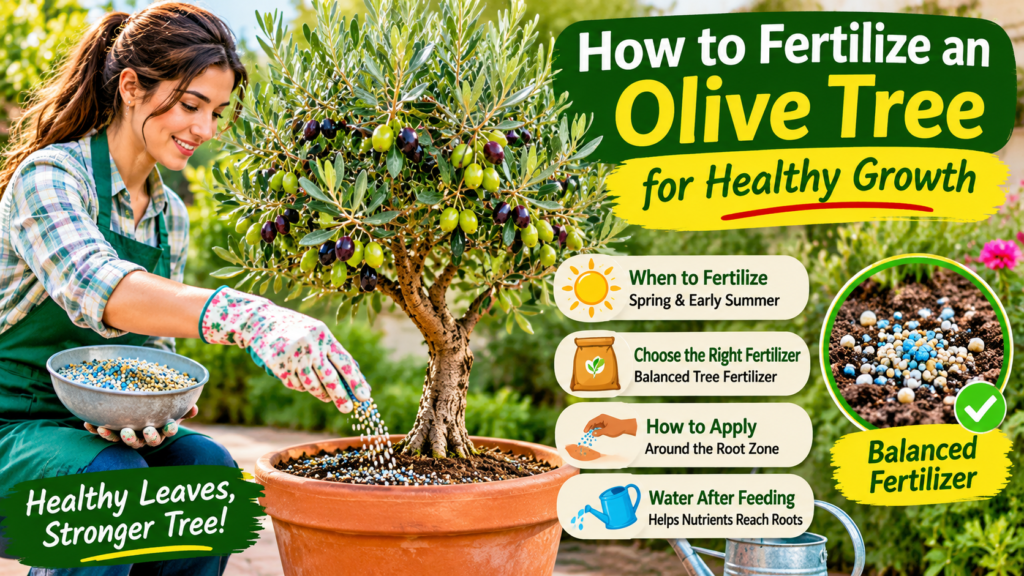
Olive trees do not require heavy feeding. However, container-grown plants can gradually use up available nutrients.
A balanced fertilizer supports healthy foliage and root development when applied appropriately.
Best Fertilizer for Olive Trees
Choose a balanced, slow-release fertilizer suitable for trees or container-grown shrubs.
A fertilizer containing nitrogen, phosphorus, and potassium can support general growth.
Nitrogen is particularly important for leaf and shoot development, but excessive nitrogen may encourage leafy growth at the expense of flowering and fruiting.
When to Fertilize
- Spring: Begin feeding when active growth starts.
- Early summer: Continue feeding if the plant needs additional nutrients.
- Late summer: Reduce or stop feeding as growth slows.
- Winter: Avoid routine fertilization when growth is inactive.
Always follow the fertilizer label for application rates.
How to Apply Fertilizer
- Check whether the soil is already moist.
- Apply the recommended amount around the root zone.
- Keep fertilizer away from direct contact with the trunk.
- Water according to the product instructions.
- Monitor the leaves for signs of nutrient imbalance.
For an established olive tree growing in fertile garden soil, routine fertilizer may not be necessary.
For container plants, refreshing the upper layer of potting mix each spring can also replenish nutrients.
Common mistake: Fertilizing a struggling olive tree without identifying the problem. Yellow leaves may result from poor drainage, root damage, or unsuitable watering rather than nutrient deficiency.
How to Prune an Olive Tree Without Damaging It
Pruning keeps an olive tree attractive, improves airflow, and helps sunlight reach its inner branches.
Olive trees naturally develop an open branching structure, so they rarely need aggressive pruning.
Best Time to Prune
Prune in late spring or early summer after the risk of severe frost has passed.
In warmer climates, choose a period when the tree is actively growing but not under extreme heat stress.
Step-by-Step Pruning Guide
Step 1: Remove dead branches
Cut away dead, broken, or diseased growth using clean, sharp pruning tools.
Step 2: Remove crossing branches
Branches rubbing against each other can create wounds and restrict airflow.
Remove the weaker or poorly positioned branch.
Step 3: Open the canopy
Thin selected branches to allow sunlight and air to reach the centre.
Step 4: Remove unwanted suckers
Cut away shoots growing from the base or lower trunk if you want to maintain a clear tree shape.
Step 5: Maintain the natural form
Avoid removing too much healthy growth in one session.
Should You Hard-Prune an Olive Tree?
Usually, no.
Severe pruning can stimulate vigorous upright shoots and reduce the plant’s ability to produce flowers and fruit.
For a container-grown olive tree, light tip pruning can help control its height and encourage branching.
If a tree has become badly overgrown, restore its shape gradually rather than removing most of its canopy at once.
Growing an Olive Tree Indoors vs. Outdoors
Olive trees can grow in both environments, but each has different advantages and challenges.
| Feature | Indoor olive tree | Outdoor olive tree |
|---|---|---|
| Sunlight | Often limited | Naturally abundant |
| Growth | Can be slower | Usually stronger |
| Watering | Depends on indoor conditions | Depends on weather and soil |
| Air circulation | Sometimes restricted | Generally better |
| Space | Suitable for compact varieties | More room for mature growth |
| Fruit production | Often unreliable | Better with suitable climate |
| Maintenance | Light management is important | Weather protection may be needed |
Which is better?
Outdoor growing is generally preferable when your climate provides suitable temperatures and plenty of sunlight.
Indoor growing is useful when you need to protect a container-grown tree from unsuitable weather. However, an olive tree should not be treated as a low-light indoor plant.
Temperature and Humidity Requirements
Olive trees prefer warm growing conditions and tolerate dry air better than many tropical plants.
They are adapted to Mediterranean climates, where summers are warm and winters are relatively cool.
Ideal Temperature
Olive trees generally grow well in temperatures around 15–30°C during active growth.
Established trees tolerate some cold, but young trees and container-grown roots are more vulnerable to freezing conditions.
Severe frost can damage leaves, young shoots, and branches.
Does an Olive Tree Need High Humidity?
No. Olive trees do not require tropical humidity.
Normal outdoor humidity is usually suitable when the plant has good airflow.
Indoor plants may struggle in stuffy environments with poor ventilation, especially if their soil stays wet.
Protecting Olive Trees From Extreme Conditions
- Move potted trees to sheltered positions during severe cold.
- Protect young plants from sudden temperature changes.
- Avoid placing indoor trees beside heating vents.
- Maintain good airflow around the canopy.
- Prevent containers from remaining saturated during cold weather.
Seasonal Olive Plant Care Guide
Olive trees have different needs throughout the year. Adjusting care to seasonal conditions helps maintain healthy growth.
| Season | Main care tasks |
|---|---|
| Spring | Repot if needed, resume watering, begin feeding |
| Summer | Provide full sun, monitor moisture, prune lightly |
| Autumn | Reduce feeding, monitor fruit development, remove damaged growth |
| Winter | Reduce watering, protect young trees from frost |
Spring Care
Spring is an important period for new growth.
- Check for damaged branches.
- Refresh the upper layer of container soil.
- Start regular moisture checks.
- Apply fertilizer if needed.
- Inspect the roots if the plant shows signs of poor drainage.
Summer Care
Summer provides strong sunlight and active growth.
- Keep the plant in a sunny position.
- Water container-grown trees when needed.
- Monitor for scale insects.
- Avoid excessive fertilizer.
- Protect young plants from extreme heat during establishment.
Autumn Care
As temperatures begin to fall, growth may slow.
Reduce watering according to soil moisture and stop unnecessary feeding.
If your tree produces fruit, monitor its development and harvest at the appropriate maturity.
Winter Care
Olive trees are evergreen, so they do not need to become completely dry during winter.
However, their water requirements generally decrease when growth slows.
Keep container-grown trees protected from severe frost and ensure drainage holes remain clear.
How to Encourage an Olive Tree to Produce Flowers and Fruit
Many people grow olive trees for their attractive foliage, but producing olives is another rewarding goal.
However, healthy leaves do not automatically mean a tree will produce fruit. Flowering and fruit development depend on variety, maturity, climate, pollination, and seasonal conditions.
1. Provide Enough Sunlight
Full sunlight supports flower development and fruit production.
Keep your tree in a location receiving at least 6–8 hours of direct sunlight.
2. Choose a Suitable Variety
Some olive varieties are more productive in particular climates.
Examples include:
- Arbequina: Popular for its relatively compact growth and oil production.
- Picual: Widely grown for oil and known for productive trees.
- Koroneiki: A Mediterranean variety valued for olive oil.
- Mission: A dual-purpose variety used for table olives and oil.
- Manzanillo: Commonly grown for table olives.
Check local nursery availability and whether the variety suits your winter temperatures and growing conditions.
3. Understand Pollination
Some olive varieties are self-fertile, while others benefit from cross-pollination.
Growing two compatible varieties near each other can improve fruit set in certain cultivars.
Olive pollen is primarily transferred by wind, so good air circulation around flowering branches is helpful.
4. Avoid Excessive Nitrogen
Too much nitrogen can encourage leafy growth instead of balanced flowering and fruiting.
Use fertilizer carefully and avoid excessive feeding.
5. Understand Winter Chill Requirements
Many olive varieties need a period of cool winter weather to flower reliably.
Their chilling requirements differ, so a variety that grows well in one climate may flower poorly in another.
This is particularly important in warmer subtropical regions.
Important: If your olive tree grows healthy leaves but never produces flowers, check its age, variety, winter conditions, and sunlight before assuming it needs more fertilizer.
Common Olive Plant Problems and How to Fix Them
Olive trees are relatively resilient, but unsuitable growing conditions can cause foliage problems, weak growth, and pest infestations.
The best solution is to identify the underlying cause rather than treating every symptom with fertilizer or additional water.
1. Why Are My Olive Tree Leaves Turning Yellow?
Yellow leaves can develop because of excessive watering, poor drainage, nutrient deficiencies, or natural leaf aging.
Olive trees naturally replace older leaves, so occasional yellow leaves are not always a warning sign.
Possible causes:
- Waterlogged soil.
- Damaged roots.
- Insufficient sunlight.
- Nutrient deficiencies.
- Natural shedding of older leaves.
How to fix it:
- Check soil moisture before watering.
- Inspect the drainage holes.
- Move indoor plants to a brighter location.
- Remove completely dead leaves.
- Check for root damage if yellowing continues.
If many leaves turn yellow together, investigate watering and root health first.
2. Why Are Olive Tree Leaves Falling Off?
Leaf drop can result from environmental stress, drought, overwatering, sudden temperature changes, or insufficient light.
Indoor olive trees are particularly vulnerable when moved from a bright outdoor location to a dim room.
How to fix it:
- Provide sufficient direct sunlight.
- Avoid sudden changes in location.
- Maintain appropriate soil moisture.
- Check for pests on the undersides of leaves.
- Improve airflow around the plant.
A few older leaves dropping in spring may be part of the normal renewal process.
3. Why Are Olive Tree Leaves Turning Brown?
Brown leaves or crispy edges can indicate water stress, excessive heat, salt buildup, or root problems.
Container-grown trees are especially susceptible because their soil dries more quickly.
How to fix it:
- Check whether the root ball has become excessively dry.
- Water thoroughly when necessary.
- Ensure excess water drains freely.
- Avoid overfertilizing.
- Acclimatize plants gradually to stronger sunlight.
If only the oldest leaves are affected, natural aging may be responsible.
4. Why Is My Olive Tree Not Growing?
Slow growth is not necessarily a problem. Olive trees naturally grow more slowly than many ornamental plants.
However, prolonged periods without new growth may indicate:
- Insufficient sunlight.
- Poor root development.
- Nutrient deficiencies.
- Waterlogged soil.
- An overcrowded container.
- Seasonal dormancy or reduced activity.
Solution: Evaluate the plant’s growing conditions before increasing fertilizer. Improving sunlight and root conditions often makes a greater difference.
5. Scale Insects on Olive Trees
Scale insects are small pests that attach themselves to leaves and woody stems.
They may appear as tiny brown, black, or pale bumps.
Heavy infestations can weaken the plant and cause yellowing. Some species also produce sticky honeydew.
How to control them:
- Inspect stems and leaf undersides.
- Remove small infestations manually.
- Prune badly affected branches when appropriate.
- Use horticultural oil or insecticidal soap if necessary, following the product label.
- Repeat inspections to catch newly emerging pests.
Test sprays on a small area first, especially during hot weather.
6. Olive Leaf Spot and Other Fungal Problems
Olive leaf spot, also known as peacock spot, is a fungal disease that can cause circular dark markings on leaves.
Severe infections may lead to premature leaf drop and reduced tree vigor.
Prevention and management:
- Avoid unnecessarily wetting foliage.
- Improve airflow through the canopy.
- Remove badly affected fallen leaves.
- Avoid excessive canopy density.
- Use locally approved treatments when necessary.
Do not assume every dark leaf mark is fungal. Inspect the pattern and growing conditions before choosing a treatment.
Quick Olive Tree Troubleshooting Table
| Symptom | Possible cause | Recommended action |
|---|---|---|
| Yellow leaves | Overwatering or nutrient problems | Check drainage and roots |
| Leaf drop | Environmental stress | Stabilize light and watering |
| Brown edges | Drought or heat stress | Check moisture and exposure |
| Sticky leaves | Scale insects or honeydew | Inspect and control pests |
| Black circular spots | Possible olive leaf spot | Improve airflow and remove infected leaves |
| Weak growth | Low light or root problems | Improve growing conditions |
| No flowers | Variety or climate issues | Check maturity and winter conditions |
How to Propagate an Olive Tree
You can propagate olive trees through stem cuttings or seeds. However, stem cuttings are generally more useful when you want a new tree that retains the characteristics of its parent.
Propagating Olive Trees From Stem Cuttings
Semi-ripe cuttings are commonly taken during summer when new stems have begun to firm.
Step 1: Select a healthy branch
Choose a healthy, disease-free stem from the current season’s growth.
Step 2: Prepare the cutting
Cut a section approximately 10–15 cm long.
Step 3: Remove lower leaves
Remove the leaves from the lower portion while keeping a few leaves near the top.
Step 4: Prepare the growing medium
Use a clean, free-draining propagation mixture.
Step 5: Plant the cutting
Insert the lower end into the growing medium and gently firm the soil.
Step 6: Maintain suitable moisture
Keep the medium lightly moist rather than saturated.
Step 7: Provide indirect light
Place the cutting in a warm, bright location away from harsh direct sunlight.
Rooting can take several weeks or longer. Not every cutting will succeed.
Can You Grow an Olive Tree From Seed?
Yes, but growing olive trees from seeds is slower and less predictable.
Seeds may require careful preparation and suitable germination conditions.
Seed-grown trees may also differ from their parent plants and may take many years to produce fruit.
For a more predictable result, purchase a healthy nursery-grown tree or propagate from a known variety.
Common Mistakes to Avoid When Growing Olive Trees
Even though olive trees are relatively low-maintenance, a few mistakes can affect their long-term health.
1. Keeping the Plant in Low Light
Olive trees need strong sunlight.
A dark room or shaded corner can cause weak branches and sparse foliage.
2. Watering Too Frequently
Olive trees tolerate some dryness.
Constantly wet soil deprives roots of oxygen and increases the risk of root problems.
3. Using Heavy, Compact Soil
Dense soil retains excessive moisture and restricts airflow.
Choose a suitable free-draining growing medium.
4. Choosing an Oversized Pot
A very large pot may retain moisture for too long around a small root system.
Increase container size gradually as the tree grows.
5. Applying Too Much Fertilizer
Excess fertilizer can damage roots and encourage excessive vegetative growth.
Always follow recommended application rates.
6. Pruning Too Aggressively
Heavy pruning can remove productive branches and stimulate vigorous upright shoots.
Maintain the natural canopy with selective pruning.
7. Expecting Indoor Olive Trees to Produce Fruit Easily
Indoor conditions often provide insufficient light and may not provide suitable seasonal temperatures.
Grow an olive tree outdoors whenever the climate allows.
Expert Tips for Maintaining a Healthy Olive Tree
A few practical habits can make olive plant care easier and help prevent common problems.
- Check moisture rather than following a fixed watering schedule. Weather and container conditions change throughout the year.
- Prioritize sunlight. Strong light is essential for compact growth and flowering.
- Keep drainage holes clear. Blocked holes can create hidden root problems.
- Avoid unnecessary feeding. Fertilizer cannot compensate for poor growing conditions.
- Inspect leaves regularly. Early pest detection makes treatment easier.
- Rotate indoor containers. This helps maintain balanced growth.
- Prune selectively. Preserve healthy branches and the natural shape.
- Watch young trees during extreme weather. Their roots and shoots are less established than those of mature trees.
One particularly useful habit is to record watering dates and observe how quickly the soil dries. After a few weeks, you will understand your tree’s moisture needs much better.
Suggested Images and Internal Linking Opportunities
For a professional gardening article, these custom visuals can improve reader understanding:
| Article section | Recommended image |
|---|---|
| Olive plant introduction | Healthy mature olive tree with silvery foliage |
| Sunlight requirements | Olive tree receiving direct sunlight |
| Soil requirements | Well-draining soil mixture |
| Watering | Correct watering technique |
| Fertilizing | Applying balanced fertilizer |
| Pruning | Removing crossing and damaged branches |
| Troubleshooting | Healthy versus yellowing olive leaves |
| Propagation | Olive stem cuttings in propagation pots |
Related internal articles to consider:
- How to Care for a Rubber Plant
- Lavender Plant Care: Complete Growing Guide
- How to Grow a Ficus Tree Indoors
- Jade Plant Care: Watering, Sunlight, and Soil
- Best Soil for Succulents and Drought-Tolerant Plants
These are suggested article topics; replace the placeholder links with your published website URLs.
Frequently Asked Questions About Olive Plant Care
1. How often should I water an olive plant?
Water when the upper few centimeters of soil become dry. Young and container-grown trees need more frequent checks than established garden trees. Always allow excess water to drain.
2. Can olive trees grow indoors?
Yes. Olive trees can grow indoors near a bright window receiving several hours of direct sunlight. However, outdoor growing is generally better for long-term health and fruit production.
3. Do olive trees need full sun?
Yes. Olive trees perform best with at least 6–8 hours of direct sunlight daily. Insufficient light can cause weak growth, sparse foliage, and reduced flowering.
4. What is the best soil for an olive tree?
Olive trees prefer well-draining, moderately fertile soil. A loam-based mixture containing horticultural grit, perlite, or pumice works well for container growing.
5. Why is my olive tree losing leaves?
Leaf loss can result from overwatering, underwatering, insufficient sunlight, temperature changes, or natural leaf replacement. Check soil moisture and growing conditions before treating the problem.
6. How fast do olive trees grow?
Olive trees are generally slow-growing. Their growth rate depends on variety, sunlight, temperature, soil quality, and water availability. Container-grown trees may grow more slowly than trees planted in the ground.
7. Can olive trees survive winter?
Established olive trees tolerate some cold weather, but severe frost can damage their leaves and branches. Young and container-grown trees need additional protection in colder conditions.
8. Do olive trees need fertilizer?
Not always. Trees growing in fertile garden soil may need little additional feeding. Container-grown trees benefit from appropriate fertilizer or fresh potting mix during active growth.
9. How long does an olive tree take to produce fruit?
The timing depends on the variety, propagation method, maturity, and climate. Grafted or cutting-grown nursery trees may fruit earlier than seed-grown trees, which can take many years.
10. Why does my olive tree have flowers but no olives?
Possible reasons include poor pollination, unsuitable temperatures, insufficient winter chilling, excessive heat during flowering, or an unsuitable variety. Some cultivars also benefit from cross-pollination.
11. Can olive trees grow in hot climates?
Yes. Olive trees tolerate warm and relatively dry conditions. However, extreme heat, dry winds, and inadequate moisture during flowering can reduce fruit development.
12. Should I mist my olive tree?
No. Regular misting is unnecessary because olive trees do not require high humidity. Focus on sunlight, proper watering, and good air circulation.
Conclusion:
Successful olive plant care depends on understanding the tree’s natural Mediterranean growing requirements.
Provide plenty of direct sunlight, use well-draining soil, and water according to actual moisture levels. Choose an appropriately sized container, fertilize moderately, and prune only when necessary.
Pay particular attention to drainage and light exposure because these two factors influence long-term plant health.
If you grow your olive tree indoors, provide the brightest available location and consider moving it outdoors during suitable weather.
Remember that healthy foliage does not always guarantee fruit production. Variety selection, winter conditions, and pollination also influence flowering and harvests.
With the right growing conditions and consistent attention, your olive tree can become a beautiful, long-lasting addition to your home or garden.