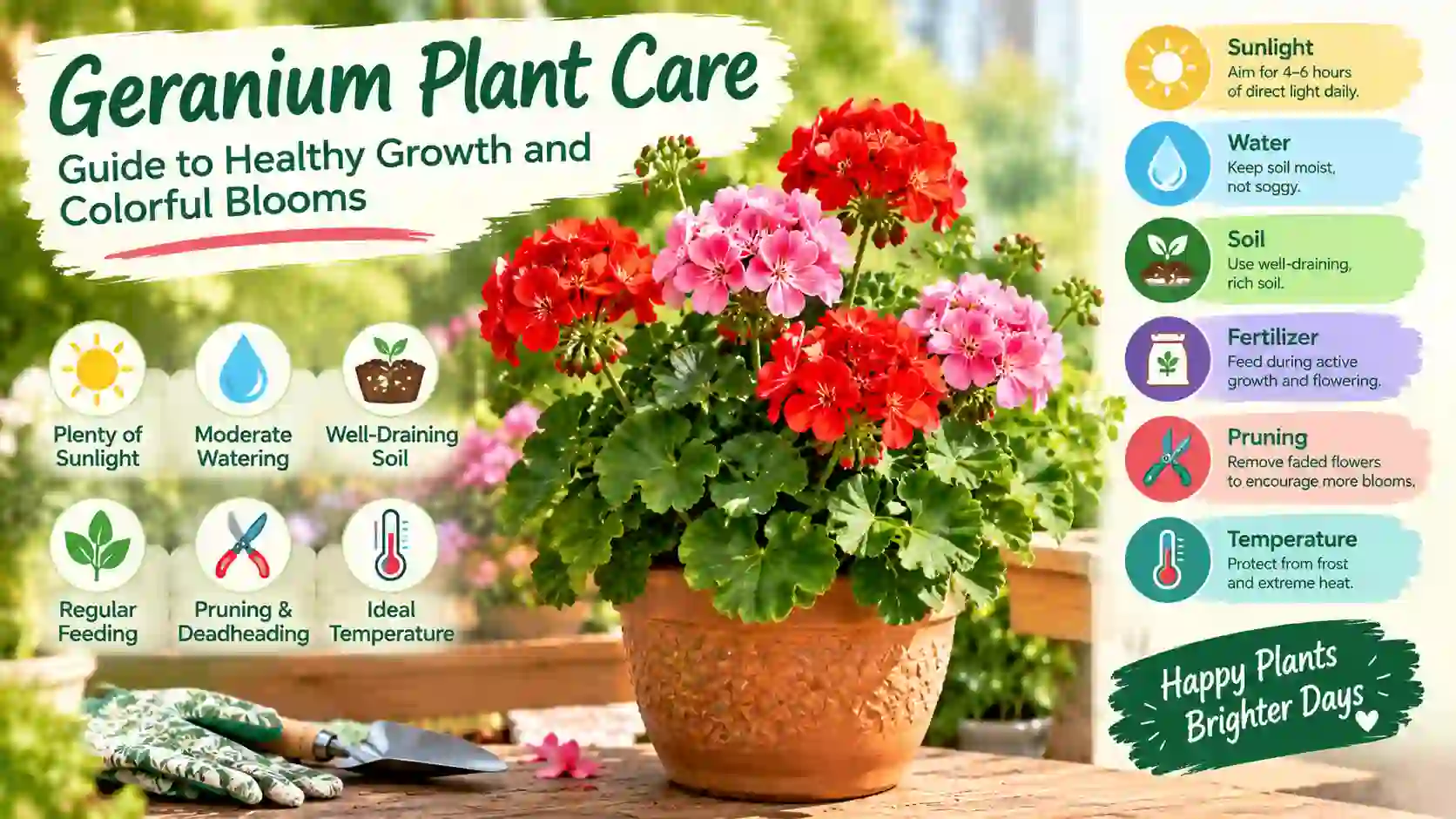
Geraniums are favorite plants for garden borders, window boxes, hanging baskets, and colorful patio containers. Their bright flowers and attractive foliage can provide months of color when growing conditions are right.
However, even a healthy-looking geranium can develop yellow leaves, stop flowering, or suffer from root rot if its care routine is unsuitable. Watering too frequently, growing the plant in deep shade, and neglecting faded flowers are common mistakes.
Understanding the type of geranium you own is equally important. The plants commonly sold as flowering geraniums are usually Pelargonium species, while hardy garden geraniums belong to the genus Geranium. These related groups have different growth habits and care needs.
This guide explains how to care for geraniums indoors and outdoors, encourage continuous flowering, troubleshoot common problems, and keep plants healthy through changing seasons.
Quick Answer:
Geranium plant care is straightforward when you provide plenty of sunlight, well-draining soil, moderate watering, and regular deadheading. Most common garden geraniums, also called zonal or bedding geraniums (Pelargonium species), grow best with around 4–6 hours of direct sunlight daily. Water when the top layer of soil begins to dry, feed during active growth, and remove faded flowers to encourage more blooms. Protect plants from frost, excessive heat, and waterlogged roots.
1. Know Which Type of Geranium You Are Growing
Before choosing a watering schedule or pruning routine, identify your plant. The word geranium commonly refers to two different groups of flowering plants.
| Type | Main features | General care |
|---|---|---|
| Zonal geranium (Pelargonium × hortorum) | Upright growth, rounded leaves, bright flower clusters | Sunny position, moderate watering, regular deadheading |
| Ivy geranium (Pelargonium peltatum) | Trailing stems and glossy leaves | Bright light, excellent drainage, suitable hanging baskets |
| Regal geranium (Pelargonium × domesticum) | Large, often ruffled flowers | Bright light, cooler conditions for reliable flowering |
| Scented-leaf geranium (Pelargonium species) | Fragrant foliage and smaller flowers | Bright light, careful watering, occasional pruning |
| Hardy geranium (Geranium species) | Garden perennials with spreading or mounding growth | Outdoor conditions suited to the species, generally moist but well-drained soil |
The most important distinction is that common bedding geraniums are usually Pelargonium, while hardy geraniums are true Geranium species. Their requirements are not identical.
This article focuses primarily on flowering Pelargonium varieties because they are the plants most people mean when searching for geranium plant care.
Image suggestion: A labeled comparison of zonal, ivy, regal, scented-leaf, and hardy geraniums, showing their different leaves and growth habits.
2. How Much Sunlight Do Geraniums Need?
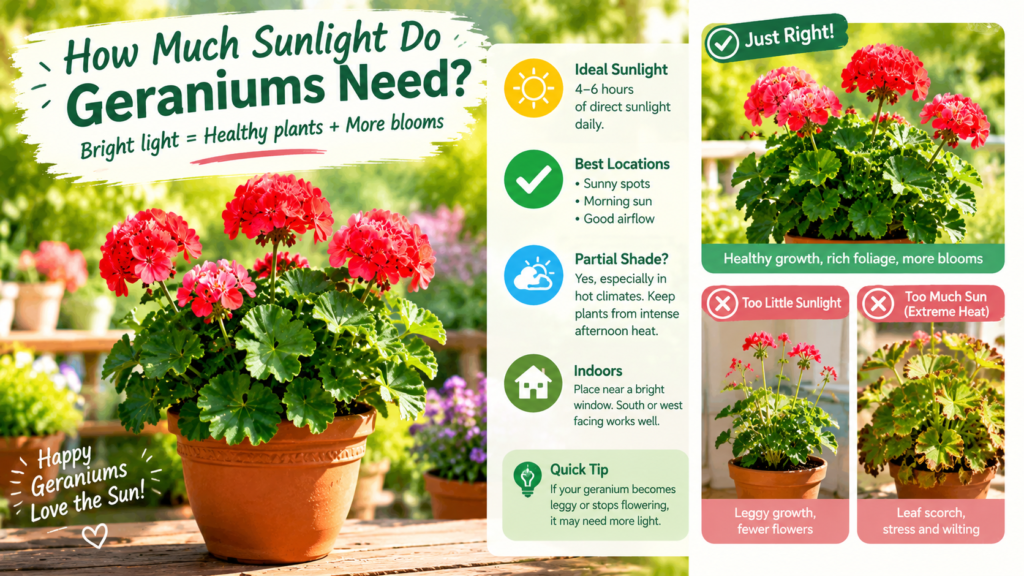
Sunlight helps geraniums produce strong stems, healthy leaves, and abundant flowers. Insufficient light is one of the most common reasons a geranium grows lots of foliage but produces few blooms.
Best light conditions
Most common flowering geraniums grow well with approximately four to six hours of direct sunlight daily. Many tolerate more sun when temperatures are moderate and moisture is adequate.
Choose a location that provides:
- Morning sunlight for steady growth.
- Bright light throughout the day.
- Good airflow around the foliage.
- Protection from extreme afternoon heat when necessary.
Can geraniums grow in partial shade?
Yes, but flowering may decrease when light levels are too low. A spot with morning sun and bright afternoon shade can work well in hot climates.
If the stems become long and thin, the plant leans toward a window, or flower production declines, insufficient light may be the cause.
Geranium light requirements indoors
Place indoor geraniums near a bright, sunny window. South- or west-facing windows may provide sufficient light in some locations, but intense afternoon sun through glass can overheat the plant.
Rotate the pot occasionally so growth remains balanced.
Practical tip: If your geranium receives strong sunlight but wilts during the hottest part of the day, check the soil before watering. Heat stress and dry soil can look similar, but they require different responses.
Image suggestion: A three-panel infographic comparing a flowering geranium in full sun, a leggy geranium in low light, and a heat-stressed geranium.
3. How to Water Geranium Plants Correctly
Watering is one of the most important parts of geranium plant care. Geraniums need moisture for active growth, but their roots are vulnerable to prolonged saturation.
The goal is to water thoroughly when needed and allow excess water to drain away.
Watering geraniums in pots
Follow this routine:
- Check the top 2–3 cm of potting mix with your finger.
- If the surface has dried, check deeper to determine whether watering is needed.
- Water thoroughly until excess water escapes through the drainage holes.
- Empty the saucer or decorative outer pot.
- Check again as the soil dries, adjusting for weather and plant growth.
Do not water automatically every morning. A small pot exposed to sun may dry quickly, while a larger pot in cool weather can remain moist much longer.
Watering geraniums in garden beds
Geraniums planted in the ground often need less frequent watering than container plants.
Water deeply when the root zone begins to dry, particularly during hot weather or prolonged periods without rain. Avoid frequent, shallow watering that wets only the surface.
How often should you water geraniums?
There is no universal schedule. During hot weather, containers may need checking daily, while cooler conditions can extend the interval between waterings.
Use soil moisture, temperature, pot size, and plant growth to guide your decisions.
Signs of watering problems
| Symptom | Possible cause | What to do |
|---|---|---|
| Yellow leaves with wet soil | Overwatering or root stress | Improve drainage and allow the mix to dry appropriately |
| Wilting with dry soil | Underwatering | Water thoroughly and reassess moisture retention |
| Soft, dark stem bases | Possible stem or root rot | Inspect the plant and remove severely affected tissue |
| Brown leaf edges | Heat, drought, or fertilizer salts | Check moisture and review feeding |
| Lower leaves yellowing gradually | Aging leaves or environmental stress | Check the overall growth pattern and soil condition |
Expert tip: A wilted plant does not always need water. If the soil is already wet, adding more water can make root damage worse.
Image suggestion: A watering infographic comparing properly moist soil, dry potting mix, and waterlogged roots.
4. What Is the Best Soil for Geraniums?
Geraniums grow best in a porous growing medium that drains freely while retaining enough moisture for healthy roots.
Dense soil can hold excess water around the roots, particularly in pots without sufficient drainage. Extremely sandy soil, on the other hand, may dry too quickly during hot weather.
Ideal soil characteristics
Choose a mix that is:
- Well-draining and reasonably fertile.
- Loose enough for roots to receive oxygen.
- Capable of retaining some moisture without becoming soggy.
- Suitable for container or garden growing.
Best potting mix for geraniums
For containers, a quality multipurpose potting mix is a good starting point. If it retains too much water, incorporate an appropriate amount of perlite or another horticultural drainage amendment.
Avoid using heavy garden soil alone in pots because it can compact and restrict drainage.
Why drainage holes matter
A decorative pot without drainage holes can trap water around the roots. Even a good potting mix cannot compensate for a container that remains waterlogged.
Use a pot with drainage holes, or keep the plant in a removable nursery pot inside a decorative cover.
Practical tip: If the soil remains wet for several days and the leaves begin yellowing, inspect the drainage and root health before adding fertilizer.
Image suggestion: A soil infographic showing a healthy, airy potting mix beside compacted, waterlogged soil.
5. Best Temperature and Humidity for Geraniums
Most flowering geraniums prefer moderate temperatures and good airflow. They can tolerate warm weather, but prolonged heat may reduce flowering and increase watering needs.
Temperature requirements
Geraniums generally perform well in mild to warm conditions. Protect them from frost, and avoid leaving container plants in excessively hot, enclosed spaces.
If daytime temperatures rise sharply:
- Provide morning sunlight and some afternoon protection.
- Keep containers away from heat-reflecting walls.
- Check soil moisture more frequently.
- Avoid placing plants in unventilated glass enclosures.
Do geraniums need high humidity?
Most common Pelargonium varieties grow well in ordinary outdoor humidity. They do not generally need regular misting.
Excess moisture on leaves combined with poor airflow can encourage fungal diseases, especially in crowded plants.
Caring for geraniums in hot climates
In regions with very hot summers, including parts of South Asia, geraniums may benefit from bright morning light and afternoon shade during the hottest weeks.
Do not confuse heat stress with a permanent decline. A plant that wilts during intense midday heat but recovers later may need a cooler position rather than more frequent watering.
Image suggestion: A temperature-care infographic showing a healthy geranium in morning sunlight, a heat-stressed plant, and a well-ventilated patio location.
6. How to Fertilize Geraniums for More Flowers
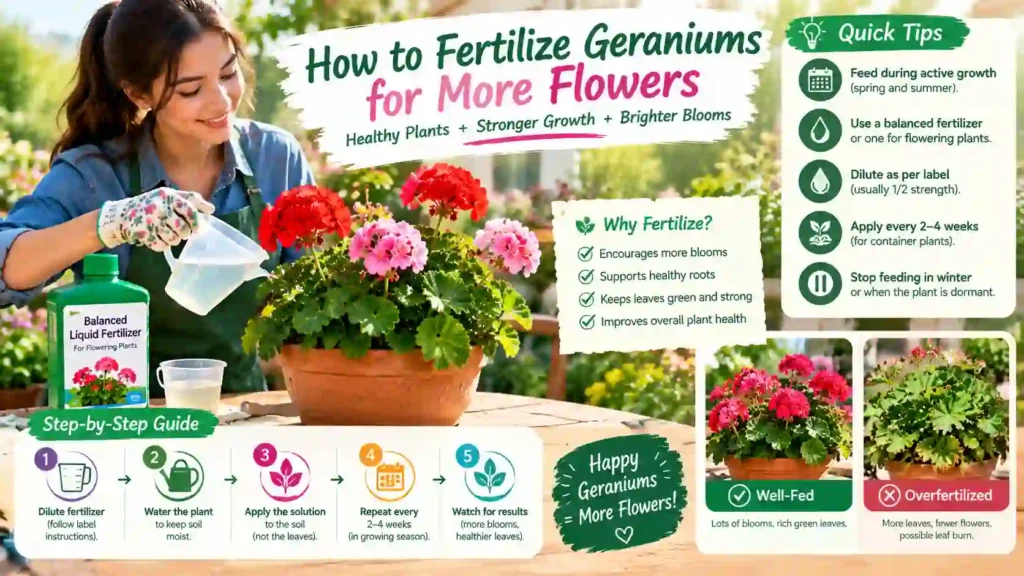
Fertilizer supports foliage, root development, and flower production. However, more fertilizer does not necessarily mean more blooms.
Excess nitrogen can encourage lush leaf growth at the expense of flowering, while excessive fertilizer salts may damage roots and leaf edges.
Choosing a fertilizer
Use a balanced fertilizer or a fertilizer formulated for flowering container plants. Follow the product label for dilution and frequency.
A practical routine is to:
- Begin feeding when the plant is actively growing.
- Apply diluted liquid fertilizer according to the label.
- Feed container plants as needed during their growing and flowering period.
- Reduce feeding when growth slows.
- Avoid fertilizing a severely stressed or waterlogged plant until its underlying problem is addressed.
Garden-grown geraniums in fertile soil may need less supplemental fertilizer than container plants.
Why is my geranium growing leaves but not flowers?
Possible causes include:
- Insufficient sunlight.
- Excessive nitrogen fertilizer.
- Overwatering.
- Very high temperatures.
- Lack of regular deadheading.
- A plant that needs pruning to encourage fresh growth.
Check light and watering first. Increasing fertilizer without correcting these problems may produce more foliage without improving flowering.
Image suggestion: A comparison infographic showing a balanced, flowering geranium and a leafy plant affected by excessive nitrogen.
7. How to Make Geraniums Bloom Continuously
Geraniums can flower for long periods when light, watering, feeding, and pruning are balanced.
Five ways to encourage more blooms
1. Provide enough sunlight. Bright light supports flower development. Move leggy plants gradually to a brighter location.
2. Water according to soil moisture. Keep roots hydrated during active growth without allowing the potting mix to remain saturated.
3. Feed moderately. Use a suitable fertilizer according to its label rather than applying concentrated feed frequently.
4. Remove faded flower clusters. Deadheading directs the plant away from unnecessary seed production and improves its appearance.
5. Prune when growth becomes leggy. Selective trimming encourages branching and can help create a fuller plant.
How to deadhead geraniums
Deadheading means removing faded flower heads before they produce seed.
- Follow the flower stalk down to its base.
- Use clean fingers or pruning scissors to remove the spent cluster.
- Avoid damaging nearby buds and healthy leaves.
- Inspect the plant for decaying flowers and diseased foliage.
Regular deadheading is especially useful for common bedding geraniums, which often produce additional flower clusters during suitable growing conditions.
Should you cut off flower buds?
No. Remove spent flowers, not healthy unopened buds. If a plant is dropping buds, investigate heat, moisture stress, pests, or other growing problems before pruning.
Image suggestion: A step-by-step deadheading infographic showing a faded geranium flower cluster, the correct cutting point, and fresh buds.
8. How to Prune Geraniums for Bushier Growth
Pruning helps geraniums maintain a compact shape, produce side shoots, and recover from leggy growth.
The right approach depends on the plant’s condition. A compact, flowering geranium may need only deadheading, while a stretched or overgrown plant may benefit from stronger trimming.
Step-by-step pruning
- Use clean, sharp pruning scissors.
- Remove dead, damaged, or diseased stems.
- Shorten long, leggy shoots just above a healthy leaf node.
- Leave enough healthy foliage for the plant to continue growing.
- Place the plant in suitable light and adjust watering as new growth develops.
A leaf node is the point where a leaf or side shoot emerges from the stem. Cutting just above a healthy node can encourage new branches.
When should you prune geraniums?
Light pruning can be done during active growth. More substantial shaping is usually best when the plant can recover in favorable conditions.
Avoid heavy pruning immediately before a period of extreme heat or cold. A severely stressed plant needs stable conditions before it can respond well to trimming.
Should you prune geraniums in autumn?
If you grow geraniums as tender perennials, a trim before bringing them indoors can make overwintering easier. Remove unhealthy growth, but avoid unnecessary severe cutting when the plant is already stressed.
Practical tip: If a geranium has become tall and sparse, improve its light exposure as well as pruning it. Cutting back a plant that remains in deep shade often leads to more weak growth.
Image suggestion: A before-and-after infographic showing a leggy geranium being pruned into a compact, branching plant.
9. How to Grow Geraniums Indoors
Geraniums can grow indoors, but they generally need brighter light than many common foliage houseplants.
Indoor care essentials
- Light: Place the pot near a bright window.
- Water: Let the surface of the potting mix dry slightly before watering again.
- Soil: Use a porous, free-draining potting mix.
- Airflow: Keep the plant away from stagnant, humid corners.
- Pruning: Pinch or trim leggy shoots to encourage branching.
- Pests: Inspect leaf undersides and new growth regularly.
Why is my indoor geranium not flowering?
Insufficient light is a common reason. A room may look bright to people while still providing limited light for flowering plants.
Move the plant closer to a sunny window or consider a suitable grow light if natural light is inadequate.
Also check for overwatering and excessive fertilizer. These problems can weaken roots or encourage leafy growth without many flowers.
Can geraniums grow in a bathroom?
A bright bathroom may work, but a dark bathroom is usually unsuitable. High humidity does not replace the need for light, and prolonged dampness with poor ventilation can increase disease risk.
Image suggestion: An indoor geranium placement guide comparing a sunny windowsill, a dim corner, and a poorly ventilated bathroom.
10. How to Grow Geraniums Outdoors
Geraniums thrive in outdoor containers, window boxes, and suitable garden beds when light, drainage, and weather conditions match their needs.
Growing geraniums in garden beds
Choose a well-drained site with adequate sunlight. Space plants according to their mature size so air can circulate around their foliage.
Water during prolonged dry periods, and remove spent flowers regularly to maintain the display.
Growing geraniums in pots and hanging baskets
Container growing offers greater control over soil and placement.
- Choose a pot with drainage holes.
- Use a quality potting mix.
- Select a container large enough for the mature plant.
- Check moisture more frequently during warm weather.
- Rotate pots if growth becomes uneven.
- Provide shelter from strong winds when stems or flower clusters are exposed.
Ivy geraniums are particularly suitable for hanging baskets because their stems trail over the edges.
Should you grow geraniums in the ground or in pots?
| Growing method | Advantages | Main consideration |
|---|---|---|
| Garden beds | Larger root zone and less frequent watering | Soil drainage and seasonal weather |
| Containers | Easier to move and control soil conditions | Soil dries more quickly |
| Hanging baskets | Attractive trailing growth | Frequent moisture checks may be necessary |
| Indoor pots | Protection from outdoor extremes | Adequate light can be difficult to provide |
Choose the method that best suits your space and climate. In areas with cold winters, containers make it easier to move tender geraniums to a protected location.
11. Seasonal Geranium Plant Care Calendar
Geranium care changes with temperature, daylight, and growth rate. The following calendar is a general guide for common flowering Pelargonium varieties.
| Season | Recommended care |
|---|---|
| Spring | Resume active feeding as growth develops, prune lightly if needed, and gradually increase outdoor exposure |
| Summer | Maintain appropriate moisture, deadhead regularly, and protect plants from extreme heat |
| Autumn | Reduce feeding as growth slows, remove damaged foliage, and prepare tender plants for winter |
| Winter | Protect from frost, reduce watering to match slower growth, and provide the brightest suitable location |
Can geraniums survive winter?
Many common Pelargonium varieties are frost-sensitive. In cold climates, they may need to be brought indoors or kept in a frost-free greenhouse.
Hardy Geranium species are different and often survive winter outdoors when suited to the local climate.
If you live in a warm region without frost, your geranium may continue growing for much of the year. Extreme heat, however, can slow flowering and increase water requirements.
How to overwinter a tender geranium
- Inspect the plant for pests and disease.
- Remove dead or unhealthy growth.
- Move it to a bright, frost-free location before cold weather arrives.
- Reduce watering as growth slows.
- Avoid leaving the roots constantly wet.
- Gradually reintroduce the plant to outdoor sunlight when conditions become suitable.
The plant may flower less during winter, especially when indoor light is limited. Focus on maintaining healthy growth rather than forcing continuous blooms.
Image suggestion: A four-season geranium care infographic showing spring pruning, summer flowering, autumn preparation, and winter protection.
12. Common Geranium Problems and How to Fix Them
Most geranium problems become easier to solve when you examine the growing conditions before applying treatments.
Why are my geranium leaves turning yellow?
Yellow leaves can result from overwatering, poor drainage, nutrient issues, insufficient light, or natural aging.
What to do: Check the soil moisture and drainage first. If the mix stays wet, inspect the roots and adjust watering. If only a few older leaves turn yellow while new growth remains healthy, the cause may be less serious.
Why are my geranium leaves turning brown?
Brown edges or patches may indicate drought, excessive heat, fertilizer salts, or disease.
What to do: Check the root zone, review fertilizer use, and inspect whether the damage is spreading. Avoid assuming every brown patch is caused by a lack of water.
Why is my geranium wilting even though the soil is wet?
Wet soil and wilting can indicate root damage or rot. When roots lose their ability to absorb water, the plant may wilt despite having plenty of moisture around them.
What to do: Stop adding water, check the drainage holes, and inspect the roots if the plant continues declining. Healthy roots are generally firm, while severely rotted roots may appear dark and mushy.
Why is my geranium not flowering?
Common causes include inadequate light, excessive nitrogen, extreme heat, and a lack of deadheading.
What to do: Improve light exposure, review fertilizer use, and remove faded flower clusters. Give the plant time to respond rather than making several changes at once.
Why is my geranium growing tall and leggy?
Leggy growth usually indicates inadequate light, although pruning and variety can also affect the plant’s shape.
What to do: Move it to a brighter location gradually, trim long stems above healthy nodes, and rotate the pot for balanced growth.
Why are the leaves curling?
Curling may result from heat stress, pests, inconsistent watering, or disease.
What to do: Examine the undersides of leaves and new growth for insects. Check the soil moisture and consider whether the plant has recently experienced extreme temperatures.
Common pests and diseases
Geraniums may be affected by aphids, whiteflies, spider mites, mealybugs, and caterpillars. Fungal diseases can also occur when foliage remains wet or airflow is poor.
Inspect plants regularly and isolate affected containers when necessary. Remove heavily damaged material and use a treatment labeled for the identified pest or disease if needed.
For persistent problems, accurate identification is important because insect damage, fungal spots, and physiological stress can look similar.
Troubleshooting table
| Problem | Possible cause | First step |
|---|---|---|
| Yellow leaves | Overwatering, nutrient problems, or aging | Check soil and inspect the pattern |
| Brown edges | Heat, drought, or fertilizer salts | Review moisture and feeding |
| Few flowers | Low light or excess nitrogen | Improve light and adjust fertilizer |
| Leggy stems | Insufficient light | Move to a brighter position |
| Wilting in wet soil | Root damage or rot | Inspect drainage and roots |
| Sticky leaves | Possible aphids or whiteflies | Inspect leaf undersides |
| Leaf spots | Possible fungal or bacterial disease | Improve airflow and inspect the spread |
Image suggestion: A geranium troubleshooting infographic showing yellow leaves, brown edges, leggy growth, pest damage, and healthy foliage.
13. How to Propagate Geraniums from Cuttings
Propagating geraniums from stem cuttings is an inexpensive way to create new plants from a healthy parent. This method works especially well for common flowering Pelargonium varieties.
Step-by-step propagation
- Choose a healthy stem. Select a non-flowering shoot with several healthy leaves and no visible pests or disease.
- Make the cutting. Use clean scissors to cut a section approximately 8–12 cm long, just below a leaf node.
- Remove lower leaves. Leave a few healthy leaves near the top and remove foliage that would sit below the growing medium.
- Let the cut end dry briefly if appropriate. Pelargonium cuttings often benefit from a short drying period, particularly in humid conditions, before planting.
- Plant in a suitable medium. Use a clean, well-draining propagation mix.
- Provide bright indirect light. Protect the cutting from harsh direct sun while roots develop.
- Water carefully. Keep the medium lightly moist, not saturated.
- Check for root development. New growth and gentle resistance when the cutting is tugged can indicate rooting.
Avoid pulling on the cutting repeatedly, as this may damage developing roots.
Can you propagate geraniums in water?
Some geranium cuttings can develop roots in water, but a well-draining propagation medium often makes it easier to manage moisture and transplant the cutting without prolonged water-root adjustment.
For the best results, take several cuttings rather than relying on one. Not every cutting will root successfully.
Image suggestion: A propagation infographic showing stem selection, cutting below a node, removal of lower leaves, planting, and root development.
14. Are Geraniums Safe for Pets?
Common garden geraniums in the genus Pelargonium can be toxic to cats and dogs if eaten. Ingestion may cause gastrointestinal upset, and some exposures can produce additional symptoms.
If you have pets:
- Place plants where animals cannot chew the leaves or stems.
- Clean up fallen foliage and discarded cuttings.
- Wear gloves if handling the plant irritates your skin.
- Contact a veterinarian if your pet eats the plant and develops symptoms.
Do not confuse common flowering Pelargonium with hardy Geranium species. They are different groups of plants, and their toxicity profiles may differ.
Frequently Asked Questions About Geranium Plant Care
How often should I water geraniums?
Water when the top layer of potting mix begins to dry and the root zone needs moisture. Container geraniums may need more frequent watering during hot weather. Avoid keeping the soil constantly wet.
Do geraniums need full sun?
Most common flowering geraniums perform best with around four to six hours of direct sunlight daily. They can tolerate more sun when conditions are suitable, while afternoon shade can help during extreme heat.
Why is my geranium not blooming?
Insufficient sunlight, excessive nitrogen fertilizer, heat stress, and poor watering can reduce flowering. Check the light first, then review watering and feeding before making further changes.
Can geraniums grow indoors all year?
Yes, provided they receive sufficient light, suitable temperatures, and good drainage. Indoor geraniums may flower less during darker months, so a bright window or grow light can help.
Should I remove dead geranium flowers?
Yes. Remove faded flower clusters to improve the plant’s appearance and encourage further flowering. Avoid cutting away healthy leaves while deadheading.
How do I make geraniums bushier?
Trim long stems just above healthy leaf nodes and provide adequate sunlight. Pinching young shoot tips can encourage branching, while removing only spent flowers may be enough for compact plants.
What is the best fertilizer for geraniums?
A balanced fertilizer or one formulated for flowering container plants is suitable for many geraniums. Follow the product instructions, and avoid excessive nitrogen, which can encourage leaves at the expense of flowers.
Can geraniums survive in hot weather?
Yes, but prolonged extreme heat can reduce flowering and increase water needs. Provide morning sunlight, good airflow, and afternoon protection when necessary.
Do geraniums come back every year?
Common Pelargonium varieties are tender perennials in frost-free climates. They may survive for several years with suitable care, but cold winters can kill them outdoors. Hardy Geranium species are generally better suited to surviving winter in appropriate garden climates.
When should I prune geraniums?
Light pruning can be done during active growth. Trim leggy stems when necessary, remove damaged foliage, and deadhead faded flowers regularly. Avoid heavy pruning when the plant is severely stressed.
Why are my geranium leaves turning yellow after watering?
Yellowing after watering may indicate that the soil stays too wet or the roots have been damaged. Check drainage and allow the mix to dry appropriately before watering again.
Can I grow geraniums from cuttings?
Yes. Take healthy stem cuttings, remove the lower leaves, and plant them in a clean, well-draining propagation medium. Provide bright indirect light and careful watering while roots develop.
Conclusion
Successful geranium plant care comes down to a few consistent habits: provide adequate sunlight, use well-draining soil, water according to moisture levels, and remove faded flowers regularly.
Pay attention to your plant’s response rather than following a rigid schedule. Yellow leaves, weak stems, and reduced flowering can have several causes, so inspect the soil, light exposure, and overall growth before making changes.
If you grow tender flowering geraniums, protect them from frost and extreme heat. With appropriate seasonal care, regular pruning, and balanced feeding, you can maintain healthy foliage and enjoy colorful blooms for an extended period.