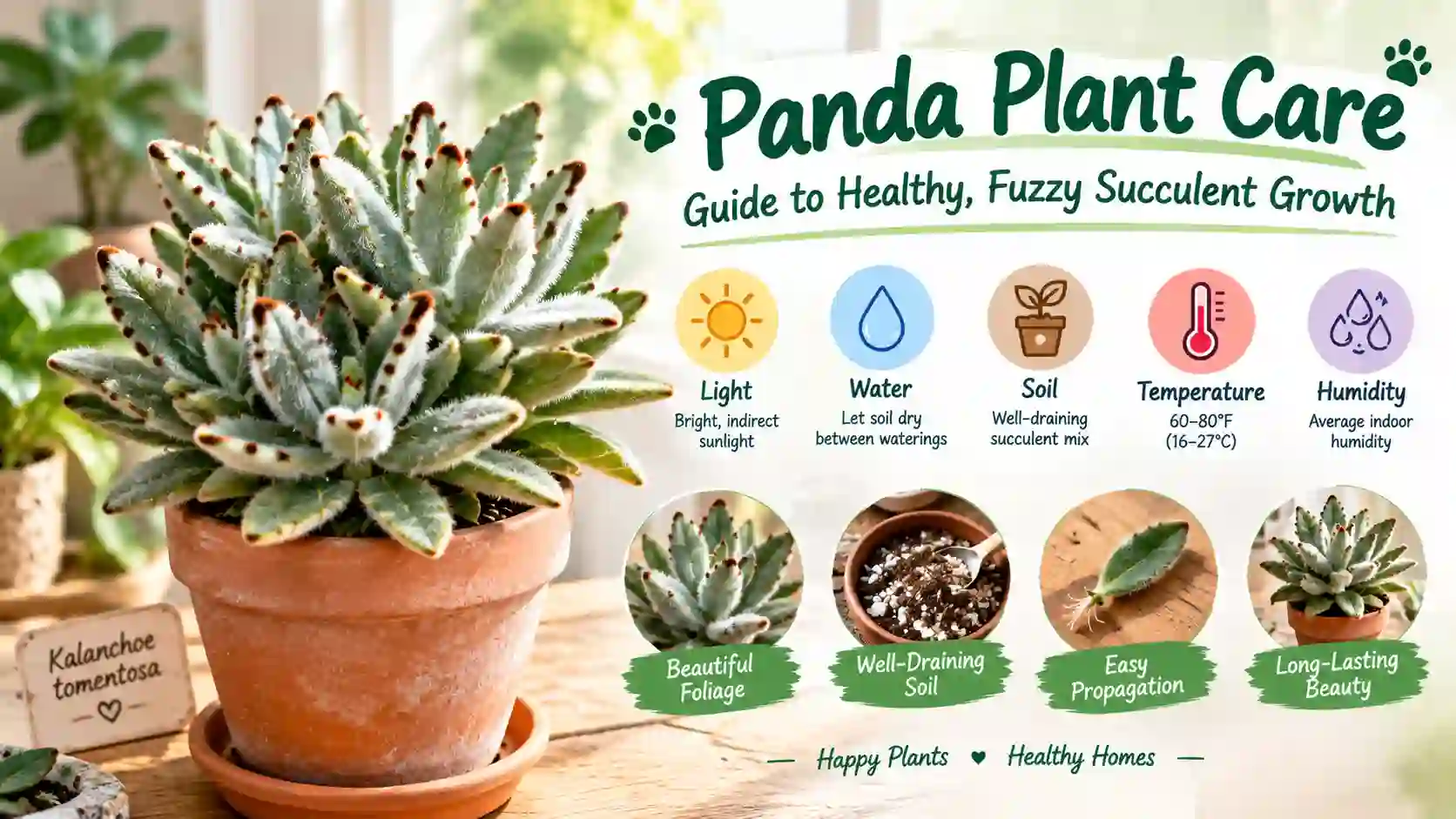
Panda plants stand out from many other succulents because their leaves have a soft, velvety appearance. Their thick foliage stores water, helping them tolerate short dry periods once established.
However, that water-storing ability can create problems for beginners. Frequent watering, dense potting soil, and low indoor light can lead to weak growth or root rot.
Another common mistake is misting the fuzzy leaves. Their fine hairs can retain moisture, so keeping the foliage wet is unnecessary and may encourage problems under poor airflow.
The secret to successful panda plant care is simple: provide strong indirect light, let the soil dry between watering, and give the roots plenty of air. The following sections explain how to create those conditions and recognize problems before they become serious.
Quick Answer:
Panda plants (Kalanchoe tomentosa) grow best in bright light, warm temperatures, and gritty, well-draining succulent soil. Water thoroughly when the soil has dried out, and always use a pot with drainage holes. Protect the fuzzy leaves from prolonged moisture, provide good airflow, and avoid overwatering. With suitable conditions, this slow-growing succulent can maintain its attractive silver-green foliage and brown leaf-edge markings for years.
1. Understanding the Panda Plant

The panda plant, botanically known as Kalanchoe tomentosa, is a succulent native to Madagascar. It belongs to the Crassulaceae family and is grown primarily for its decorative foliage.
Its leaves are covered with fine hairs that create a soft, felt-like texture. Brown or rusty markings commonly appear near the leaf tips and edges.
Why is the panda plant popular?
- Distinctive foliage: Silvery-green leaves contrast with dark brown edges.
- Compact growth: Young plants fit easily on desks, shelves, and windowsills.
- Drought tolerance: Thick leaves store water for periods between watering.
- Low maintenance: It needs little pruning when light and watering are appropriate.
Panda plants usually grow slowly, especially indoors. Do not assume a healthy plant is failing simply because it produces new leaves gradually.
Is a panda plant a succulent?
Yes. Its fleshy leaves store water, which is why it needs less frequent watering than many tropical houseplants.
This also means its roots are vulnerable to prolonged saturation. A succulent soil mix and a pot with drainage holes are more important than frequent feeding or misting.
Image suggestion: A botanical close-up identifying the panda plant’s fuzzy leaves, water-storing tissue, and brown leaf margins.
2. Panda Plant Care at a Glance
| Care factor | Recommended conditions |
|---|---|
| Light | Bright indirect light; some gentle direct sunlight |
| Watering | Water thoroughly after the soil dries out |
| Soil | Gritty, fast-draining cactus or succulent mix |
| Temperature | Approximately 60–80°F (16–27°C) |
| Humidity | Average indoor humidity is usually suitable |
| Fertilizer | Diluted succulent fertilizer during active growth |
| Pruning | Remove damaged stems and trim leggy growth |
| Propagation | Stem cuttings or leaf cuttings |
| Pot | Terracotta or another pot with drainage holes |
| Growth rate | Generally slow to moderate under suitable conditions |
These recommendations are starting points. Your plant’s watering needs depend on light exposure, pot size, soil composition, temperature, and the season.
3. How Much Sunlight Does a Panda Plant Need?

Light is one of the biggest factors affecting panda plant growth. Adequate light helps the stems remain compact and the leaves develop properly.
Best lighting conditions
Place your panda plant near a bright window where it receives plenty of indirect sunlight. An east-facing window often works well because it provides gentle morning sun.
A bright south- or west-facing window may also be suitable if strong afternoon rays are filtered through a sheer curtain.
Panda plants can tolerate some direct sunlight after acclimation. However, intense sunlight through glass can scorch leaves, particularly if the plant has been growing in a dim room.
What happens when a panda plant gets too little light?
Insufficient light can cause:
- Stretched stems with larger gaps between leaves.
- Slower growth and weaker-looking foliage.
- Leaning toward the nearest window.
- Reduced compactness and an uneven shape.
If your plant becomes leggy, move it gradually toward a brighter location. Existing stretched stems will not become shorter, but new growth may become more compact.
Can you grow a panda plant under artificial light?
Yes. A suitable full-spectrum grow light can help when natural sunlight is limited.
Follow the manufacturer’s distance and timing recommendations, and observe the leaves for signs of excessive light or heat.
Expert tip: Rotate the pot occasionally to encourage more balanced growth. Avoid rotating it constantly, because the plant still needs time to adjust to its light direction.
4. How to Water a Panda Plant Correctly

Watering mistakes are among the most common causes of panda plant decline. Its fleshy leaves store water, so the roots do not need constantly moist soil.
When should you water a panda plant?
Wait until the potting mix has dried out throughout most or all of the root zone. Check below the surface with a wooden skewer or your finger, and consider the pot’s weight.
A small plant in a warm, bright room may dry much faster than a larger plant in a cool room. For this reason, watering every seven days without checking the soil can be risky.
The soak-and-dry watering method
- Check the soil to confirm it has dried out sufficiently.
- Pour water evenly over the soil until excess water flows from the drainage holes.
- Allow the pot to drain completely, and empty the saucer.
- Wait until the soil dries again before watering.
Avoid giving the plant tiny amounts of water every day. Thorough watering followed by an appropriate drying period encourages a more consistent moisture pattern throughout the root ball.
Should you mist a panda plant?
No. Misting is unnecessary because the plant stores water in its leaves. Moisture trapped among the fine hairs can take longer to evaporate when airflow is poor.
Direct water toward the soil rather than routinely wetting the foliage.
Watering differences by season
During warm, bright months, your panda plant may use water more quickly. During winter or other periods of slow growth, the soil can remain dry for much longer.
Reduce watering according to the plant’s actual drying rate rather than following a fixed seasonal schedule.
5. Best Soil for a Panda Plant

Panda plants need soil that drains rapidly and leaves air around the roots. Dense potting soil can hold excessive moisture, especially in cool rooms or low-light conditions.
Recommended succulent soil mix
You can use a commercial cactus and succulent mix or prepare a simple blend using:
- 2 parts quality cactus or succulent potting mix.
- 1 part pumice or perlite.
- 1 part coarse horticultural grit or fine orchid bark suitable for succulent mixes.
This is a flexible starting recipe rather than a strict formula. Adjust the proportions if the mix stays wet too long or dries unusually quickly.
Use clean, suitable horticultural materials rather than fine sand, which can sometimes compact the mix instead of improving drainage.
Why drainage matters
Healthy roots need oxygen as well as water. When soil remains saturated, oxygen availability falls and root tissues may begin to decay.
A gritty mix helps excess water escape and allows the root zone to dry between waterings.
Which pot is best?
A terracotta pot with drainage holes is an excellent option. Its porous walls can help the soil dry more quickly than it would in some plastic or glazed pots.
Plastic pots can also work well, but you may need to water less frequently because they retain moisture longer.
Choose a container only slightly larger than the root ball. An oversized pot holds extra soil that may remain wet after the plant has absorbed the water it needs.
Image suggestion: Show a panda plant growing in gritty succulent soil, with pumice, perlite, and a drainage-hole terracotta pot beside it.
6. Ideal Temperature and Humidity for Panda Plants

Panda plants generally prefer warm indoor conditions and do not require unusually high humidity.
Best temperature range
A range of approximately 60–80°F (16–27°C) suits many indoor panda plants. Protect them from frost and prolonged cold exposure.
Keep the plant away from cold drafts, air-conditioning vents, and heaters that create sudden temperature changes.
Does a panda plant need high humidity?
No. Average household humidity is usually adequate.
Unlike tropical foliage plants that benefit from humid environments, panda plants are adapted to relatively dry conditions. Increasing humidity excessively may slow soil drying and make moisture management more difficult.
Should you put a panda plant in a bathroom?
Only if the bathroom has enough bright light and good ventilation. Many bathrooms are too dim for healthy succulent growth, and consistently humid conditions may slow soil drying.
A bright bedroom, living room, or windowsill is often a better choice.
7. How to Fertilize a Panda Plant

Panda plants do not need heavy feeding. Excess fertilizer can damage roots, contribute to mineral buildup, and encourage growth that is less compact.
When should you fertilize?
Feed during active growth, usually in spring and summer when indoor conditions are favorable.
Use a balanced fertilizer formulated for succulents or cacti, diluted according to the product label. If your plant is growing slowly in a cool, dim room, additional fertilizer is unlikely to solve the problem.
Signs of fertilizer problems
Watch for:
- Brown leaf tips without an obvious watering explanation.
- A white crust on the soil surface or pot rim.
- Weak growth after repeated heavy feeding.
- Damaged roots in a mix that has accumulated salts.
If you suspect excess fertilizer, stop feeding and review your watering practices. Where drainage is good, flushing the potting mix with clean water may help remove accumulated soluble salts.
Practical tip: Do not fertilize a severely stressed plant until you have identified and addressed the main problem.
8. How to Prune a Panda Plant

Pruning helps maintain the shape of a panda plant and removes damaged or unhealthy growth. Since the plant grows relatively slowly, aggressive trimming is rarely necessary.
When should you prune?
Prune when the plant develops stretched stems, damaged sections, or an uneven shape. Spring and summer are often convenient times because healthy plants are more likely to resume active growth.
How to prune safely
- Inspect the plant and identify the stems that need trimming.
- Use clean, sharp pruning scissors.
- Cut leggy stems just above a suitable node.
- Remove dead or severely damaged material.
- Allow cut surfaces to dry before resuming normal care, and avoid keeping the soil wet while the plant recovers.
Healthy cuttings can sometimes be used for propagation.
Can pruning make a panda plant bushier?
Pruning can encourage branching from suitable nodes, helping the plant develop a fuller shape. However, results depend on the plant’s health, light levels, and growing conditions.
If your plant is leggy, improve its light exposure as well as pruning. Cutting back stems without correcting insufficient light may simply lead to more stretched growth.
9. How to Propagate a Panda Plant

Propagation allows you to grow new panda plants from an existing healthy plant. Stem cuttings are often the more predictable option, while leaf propagation can be slower and less reliable.
Propagation using stem cuttings
- Choose a healthy stem and cut a section using clean scissors.
- Remove lower leaves if necessary, leaving enough exposed stem for planting.
- Allow the cut surface to dry and form a callus before planting.
- Place the cutting in a small pot filled with a dry or barely moist, well-draining succulent mix.
- Keep it in bright indirect light and avoid excessive watering while roots develop.
- Once roots establish and new growth appears, gradually resume the normal care routine.
Rooting time varies according to temperature, cutting condition, and growing environment. Avoid pulling the cutting out repeatedly to check for roots.
Can you propagate panda plants from leaves?
Yes, leaf propagation is possible, but success is not guaranteed. A leaf must remain sufficiently intact, and some leaves may shrivel without producing a new plant.
Choose a healthy leaf, allow the broken end to callus, and place it on or slightly into a suitable propagation medium according to the method you prefer.
Keep the medium from becoming waterlogged. Be patient, because leaf propagation may take considerably longer than stem propagation.
Why do panda plant cuttings rot?
Cuttings may rot if they are planted before the cut surface dries, kept in wet soil, or placed in a poorly ventilated environment.
Allowing the cut end to callus and using an airy medium reduces these risks.
10. Repotting a Panda Plant

Panda plants grow slowly, so they do not need frequent repotting. Moving them into a new container too often can disturb healthy roots without providing much benefit.
When should you repot?
Consider repotting when:
- Roots emerge from the drainage holes or densely circle the root ball.
- The potting mix has broken down or no longer drains properly.
- Water runs through the pot unusually quickly because the root ball has become crowded.
- The plant becomes unstable or the existing container is damaged.
How to repot correctly
- Choose a pot only slightly larger than the existing root ball.
- Remove the plant carefully and inspect its roots.
- Trim away clearly rotten roots with clean tools.
- Place the plant in fresh, well-draining succulent mix.
- Keep the plant in bright indirect light while it adjusts.
If roots were damaged during repotting, allow cut surfaces to dry before watering. Otherwise, avoid leaving the plant dry for an unnecessarily long period if its roots remain healthy.
Expert tip: Repotting is an opportunity to correct soil problems. If the previous mix stayed wet for too long, replace it with a more suitable, airy blend.
11. Common Panda Plant Problems and How to Fix Them

Panda plant problems often develop gradually. Checking the soil, light, and roots together is more reliable than diagnosing a problem from a single leaf.
| Problem | Possible cause | What to do |
|---|---|---|
| Yellow leaves | Overwatering, root stress, or natural aging | Check soil moisture and drainage |
| Soft, mushy leaves | Excess moisture or tissue damage | Inspect the roots and reduce unnecessary watering |
| Wrinkled leaves | Underwatering or damaged roots | Check whether the soil is dry or wet before watering |
| Brown, crispy patches | Sunburn, physical damage, or severe dryness | Review light exposure and moisture |
| Leggy stems | Insufficient light | Gradually move the plant to a brighter location |
| Leaves falling off | Water stress, sudden temperature changes, or handling | Review recent changes and check soil conditions |
| White fuzzy patches | Possible mealybugs or other pests | Inspect leaf joints and stems carefully |
| Slow growth | Low light, seasonal slowdown, or root problems | Check light, temperature, and root health |
Why is my panda plant turning yellow?
Yellow leaves can indicate overwatering, root damage, or natural aging. If several leaves turn yellow while the soil remains wet, check drainage and inspect the roots.
If only one old lower leaf changes color and the rest of the plant looks healthy, the change may be part of normal leaf aging.
Do not automatically add fertilizer. Nutrient deficiency is only one possible cause, and fertilizing a plant with damaged roots may worsen its condition.
Why is my panda plant losing leaves?
Leaf drop may follow excessive watering, prolonged drought, cold exposure, or sudden changes in growing conditions.
Check whether the leaves are soft and translucent or dry and shriveled. Soft leaves with wet soil suggest a different problem from dry leaves on a plant that has been neglected for too long.
Why are my panda plant leaves turning brown?
Brown areas may result from intense direct sunlight, physical damage, or severe moisture stress. The location and texture of the damage can provide useful clues.
Move the plant away from harsh sunlight if scorch is likely. If the brown areas are soft or spreading near the base, investigate possible rot.
Why is my panda plant growing tall and thin?
Leggy growth usually indicates insufficient light. Succulents often stretch toward a light source when conditions are too dim.
Move the plant gradually to a brighter position and rotate it occasionally. Prune excessively stretched stems if needed, and use suitable cuttings to propagate a more compact plant.
How do you recognize mealybugs?
Mealybugs often appear as small, white, cotton-like clusters around leaf joints, stems, and sheltered areas.
Inspect the plant closely. If pests are present, isolate the plant, remove visible insects with an appropriate method, and repeat inspections to catch newly emerging pests.
Avoid applying oily treatments in strong sunlight, as some products can damage succulent foliage.
12. Seasonal Panda Plant Care

Your plant’s needs change as temperature, daylight, and growth patterns change.
| Season | Care priorities |
|---|---|
| Spring | Check whether the plant needs repotting and resume feeding if active growth begins |
| Summer | Provide bright light, monitor heat, and water when the soil has dried |
| Autumn | Reduce feeding as growth slows and check soil moisture more frequently before watering |
| Winter | Protect from cold drafts, provide the brightest suitable light, and water less often if drying slows |
Seasonal changes depend on your indoor climate. A panda plant in a warm, bright room may continue growing during winter, while one in a cool, dim room may become nearly dormant.
The important principle is to respond to the plant rather than follow a rigid calendar.
13. Is the Panda Plant Safe for Pets?
Panda plant (Kalanchoe tomentosa) is considered toxic to cats and dogs if ingested. Kalanchoe species contain compounds that can cause illness, and the severity depends on the plant, the amount eaten, and the animal.
Keep the plant away from pets that chew foliage. If you suspect ingestion, contact a veterinarian or an appropriate animal poison service for advice.
Also keep the plant out of reach of young children, and wash your hands after handling damaged plant material.
14. Common Panda Plant Care Mistakes to Avoid
Many problems can be prevented by correcting a few habits.
- Watering too frequently: Allow the soil to dry before watering again.
- Using dense soil: Choose a gritty mix that allows water to drain and air to reach the roots.
- Growing in deep shade: Provide enough bright light to maintain compact growth.
- Misting the leaves: Water the soil instead of routinely wetting the fuzzy foliage.
- Choosing an oversized pot: Match the container to the root system.
- Overfertilizing: Feed lightly during active growth rather than trying to force faster development.
- Ignoring root problems: A plant can wilt even when the soil is wet if its roots are damaged.
- Pruning without improving light: Correct the cause of leggy growth as well as trimming the stems.
A useful approach is to make one change at a time. If you change the soil, watering schedule, and light exposure simultaneously, it becomes harder to understand what helped.
15. Frequently Asked Questions About Panda Plant Care
How often should I water a panda plant?
Water when the soil has dried out throughout most or all of the root zone. Water thoroughly, allow excess water to drain, and wait until the mix dries again. The interval depends on your plant’s environment.
Does a panda plant need direct sunlight?
Panda plants prefer bright light and can tolerate some gentle direct sunlight after acclimation. Protect them from prolonged, intense sunlight that may scorch their leaves.
Why is my panda plant not growing?
Panda plants naturally grow slowly. Insufficient light, cool conditions, root damage, and unsuitable soil can slow growth further. Check these conditions before adding fertilizer.
Can panda plants grow indoors?
Yes. They make good indoor succulents when placed in a bright location and grown in well-draining soil. A sunny windowsill or a bright spot near a window is often suitable.
Do panda plants like humidity?
They generally do well in average indoor humidity. Special humidity equipment and regular misting are unnecessary.
Should I remove brown leaves from my panda plant?
Remove dead or severely damaged leaves with clean tools when necessary. If browning continues, investigate sunlight, watering, and root health instead of repeatedly removing affected leaves.
How do I make my panda plant bushier?
Provide adequate light and prune leggy stems above suitable nodes. Pruning may encourage branching, but the results depend on the plant’s condition and growing environment.
Can a panda plant survive without sunlight?
It cannot thrive indefinitely without suitable light. A grow light can supplement or replace inadequate natural light, but a dark room is not an appropriate long-term location.
Is the panda plant easy to care for?
Yes, it is generally beginner-friendly. Its main requirements are bright light, well-draining soil, and careful watering. Avoiding overwatering is especially important.
How long does a panda plant live?
With suitable care, a panda plant can live for many years. Longevity depends on growing conditions, root health, pest management, and whether the plant receives adequate light.
16. Recommended Images for Your Panda Plant Care Article
Use these custom image placements to make your article more engaging and help readers understand important care techniques.

Featured image — Panda Plant Care
Place below the H1. Show a healthy panda plant with fuzzy silver-green leaves, brown edges, and a terracotta pot.

Light requirements
Place in Section 3. Illustrate bright indirect light and gentle sunlight for healthy, compact growth.

Watering and soil infographic
Place in Sections 4–5. Show dry soil, thorough watering, drainage, and the importance of letting the mix dry.

Propagation guide
Place in Section 9. Show stem cuttings, a callused leaf, and small pots containing succulent soil.

Common problems and solutions
Place in Section 11. Compare healthy foliage with symptoms of overwatering, insufficient light, and leaf damage.
Suggested Internal Links
For a plant-care website, consider linking this article to related guides such as:
- Aloe Vera Plant Care: Complete Growing Guide
- Snake Plant Care: How to Grow a Healthy Snake Plant
- Jade Plant Care: Watering, Light, and Propagation
- Best Soil Mix for Succulents
- How to Propagate Succulents From Leaves and Cuttings
- Why Are My Succulent Leaves Turning Yellow?
Use relevant anchor text where each link answers a natural follow-up question.
Conclusion:
Successful panda plant care depends on three essentials: bright light, well-draining soil, and careful watering. These conditions help maintain the plant’s distinctive fuzzy leaves while reducing the risk of root rot and weak growth.
Choose a pot with drainage holes, avoid unnecessary misting, and allow the soil to dry before watering again. If your plant becomes leggy, improve its light exposure. If the leaves become soft or yellow, check the roots and soil moisture before changing your routine.
With a suitable growing environment and a little patience, your panda plant can remain a beautiful, low-maintenance addition to your indoor succulent collection.