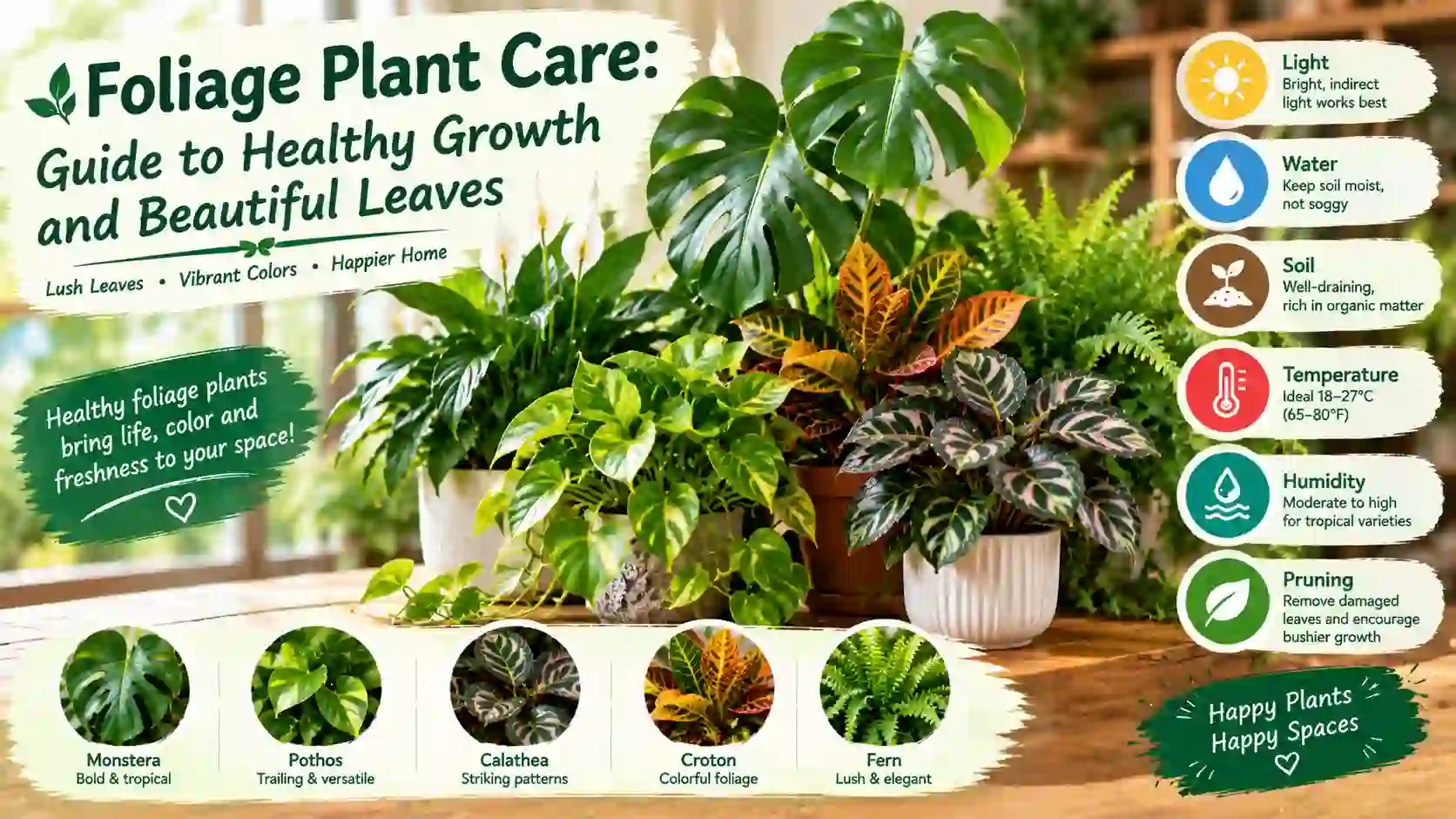
Foliage plant care focuses on growing plants for their attractive leaves, striking patterns, varied textures, and lush appearance. From glossy pothos and elegant peace lilies to colorful crotons, ferns, and patterned calatheas, foliage plants can transform ordinary rooms into inviting green spaces.
Yet attractive foliage does not always mean a plant is healthy. Brown leaf tips, yellowing leaves, weak stems, slow growth, and sudden leaf drop can signal problems with watering, light, drainage, or temperature.
The biggest mistake is treating every foliage plant the same way. A snake plant can tolerate much drier soil than a fern, while a variegated plant may need more light than a solid-green variety. Even two plants in the same room can require different care.
This guide explains how to choose the right growing conditions, establish a practical care routine, solve common problems, and keep foliage plants looking healthy throughout the year.
Quick Answer:
Foliage plants grow best when their light, watering, soil, temperature, and humidity match their individual needs. Most indoor foliage plants prefer bright, indirect light, a well-draining potting mix, and containers with drainage holes. Check soil moisture before watering, fertilize during active growth, and inspect leaves regularly for pests. Because different plants have different requirements, identify your plant before following a fixed watering or feeding schedule.
1. What Are Foliage Plants?


Foliage plants are plants grown primarily for the appearance of their leaves rather than for flowers or fruit. Their appeal comes from leaf color, shape, size, texture, patterns, and growth habit.
Some have large, dramatic leaves. Others produce delicate fronds, trailing vines, or colorful foliage that changes with the light.
Common types of foliage plants
| Plant type | Examples | Main care consideration |
|---|---|---|
| Trailing foliage plants | Pothos, heartleaf philodendron | Bright, indirect light and moisture suited to the species |
| Upright tropical plants | Dieffenbachia, rubber plant | Adequate light, stable warmth, and careful watering |
| Patterned foliage plants | Calathea, maranta | Consistent moisture and attention to humidity |
| Succulent foliage plants | Snake plant, jade plant | Allow the growing medium to dry appropriately |
| Ferns | Boston fern, maidenhair fern | Many need more consistent moisture and humidity |
| Colorful foliage plants | Croton, coleus | Suitable light to maintain strong leaf color |
These groups are useful starting points, not strict rules. Always consider the specific species and cultivar because their requirements can differ.
Why do people grow foliage plants?
Foliage plants offer several practical benefits:
- They provide long-lasting color without relying on flowers.
- Different leaf shapes and textures add visual interest to rooms.
- Trailing varieties work well on shelves and in hanging baskets.
- Upright plants can fill empty corners or complement furniture.
- Many varieties can be grown successfully in containers.
Important: A plant marketed as easy-care still needs suitable light, water, and root conditions. Low-maintenance does not mean maintenance-free.
2. Choose the Right Light for Your Foliage Plants

Light is one of the most important factors in foliage plant care because plants use it to produce the energy needed for growth. Many indoor foliage plants prefer bright, indirect light, but some tolerate lower light and others need several hours of gentle direct sun.
Understanding indoor light levels
- Bright, indirect light: The area is well lit, but strong sunlight does not fall directly on the leaves for long periods.
- Medium light: The plant receives moderate daylight, often a short distance from a window.
- Low light: The area receives limited natural light. Only suitable species should be placed here.
- Direct sunlight: Sunlight strikes the leaves directly. Some plants tolerate it, while others can scorch.
A room that looks bright to your eyes may still provide limited light for a plant, particularly several feet away from a window.
How to match plants to light
| Light condition | Plants that may suit it |
|---|---|
| Bright, indirect light | Monstera, pothos, many philodendrons |
| Medium light | Peace lily, some dracaena varieties |
| Lower light | ZZ plant, cast-iron plant, some snake plants |
| Brighter light with acclimation | Croton, some rubber plants, many succulents |
These are general guides. A plant’s variety, season, window direction, and distance from the glass all affect how well it grows.
Signs your plant needs a different location
| Symptom | Possible explanation |
|---|---|
| Long, weak stems | Insufficient light |
| Smaller new leaves | Low light, root restriction, or other growth stress |
| Loss of variegation | Some variegated plants may produce greener growth in lower light |
| Bleached or scorched patches | Excessive direct sunlight or heat |
| Slow growth | Low light, seasonal slowdown, or root problems |
Practical tip: Change a plant’s position gradually. Moving a plant from a dim room into intense direct sun can damage leaves that have adapted to lower light.
Image suggestion: A 16:9 infographic comparing bright indirect light, medium light, and low light, with examples of suitable foliage plants.
3. Water Foliage Plants According to Their Needs
Watering is where many indoor gardeners run into trouble. Some foliage plants prefer evenly moist soil, while others need the mix to dry considerably between waterings.
The correct frequency depends on the plant species, pot size, growing medium, temperature, humidity, and available light. University of Maryland Extension advises checking soil moisture rather than watering automatically on a fixed schedule.
How to water correctly

Step 1: Check the soil
Touch the soil or use a suitable moisture meter. Check below the surface because the top can feel dry while the lower root zone remains wet.

Step 2: Water when needed
Apply water evenly around the root zone. For most foliage plants, water thoroughly when their specific moisture requirements indicate it is time.

Step 3: Allow excess water to escape
Use pots with drainage holes and empty excess water from the saucer or decorative outer pot. Roots should not remain submerged.

Step 4: Recheck before watering again
Do not water simply because several days have passed. Check moisture again and adjust for changing weather and plant growth.
How often should you water foliage plants?
There is no single watering frequency that works for every plant. Use this table as a starting point, then adjust it to your conditions.
| Plant group | General watering approach |
|---|---|
| Ferns that prefer moisture | Keep the growing medium consistently moist without waterlogging |
| Pothos and many philodendrons | Let the upper portion of the mix dry before watering again |
| Peace lilies | Water when the upper soil begins to dry; avoid repeated severe wilting |
| Snake plants and ZZ plants | Allow much more of the mix to dry between waterings |
| Succulent foliage plants | Let the mix dry thoroughly or nearly thoroughly, depending on species |
Why overwatering is so damaging
Overwatering is not simply about using too much water at one time. The main problem is keeping the root zone wet for too long. Water-filled spaces in the growing medium leave less oxygen available to roots, which can cause root decline and encourage rot.
To prevent this:
- Use a pot with drainage holes.
- Choose a mix suited to the plant.
- Check soil moisture before watering.
- Do not leave water sitting in saucers.
- Reduce watering when growth slows and the soil dries more slowly.
What if water runs straight through the pot?
Very dry potting mix can become difficult to rewet. Water may run down the sides without moistening the root ball.
Apply water slowly in stages, allowing the mix to absorb it. If the medium has become severely compacted or broken down, repotting may be more effective than repeatedly adding water.
Image suggestion: A watering diagram showing soil being checked, a root ball being watered, and excess water draining from the pot.
4. Select the Best Soil and Pot for Healthy Roots
Healthy leaves begin with healthy roots. The growing medium must hold enough moisture and nutrients for the plant while allowing air to reach the roots.
Most indoor foliage plants grow better in a formulated potting mix than in ordinary garden soil. Garden soil often compacts in containers, reducing aeration and drainage.
What makes a good foliage plant potting mix?
A suitable mix generally provides:
- Moisture retention: Keeps water available between waterings.
- Aeration: Maintains air spaces around roots.
- Drainage: Allows excess water to leave the container.
- Stability: Supports roots and the plant’s structure.
- Nutrient retention: Holds nutrients without becoming excessively dense.
Different plants need different balances. A fern may benefit from a mix that stays moist longer, while a snake plant needs a more freely draining medium.
A general potting mix for many tropical foliage plants
For plants such as pothos and many philodendrons, a useful starting mix is:
- 2 parts quality indoor potting mix
- 1 part perlite or pumice
- 1 part fine orchid bark
Adjust this recipe to your plant and environment. A moisture-loving plant may need a mix that holds more water, while a plant prone to root rot may need more aeration.
This is a starting point rather than a universal formula.
Which pot should you choose?
| Container | Advantages | Considerations |
|---|---|---|
| Terracotta | Porous walls help the mix dry faster | May require more frequent watering |
| Plastic | Lightweight and retains moisture longer | Can stay wet longer in low light |
| Glazed ceramic | Decorative and retains moisture | Must have drainage holes for most plants |
| Hanging basket | Suitable for trailing foliage | May dry quickly, especially in warm air |
Choose a pot that fits the root system instead of selecting a much larger container simply to encourage growth. Excess soil around a small root ball can stay wet longer than expected.
When should you repot?
Repot when roots crowd the container, the mix drains poorly, or the plant dries out unusually quickly because the root ball has filled the pot.
Signs include roots emerging from drainage holes, water passing through without being absorbed, or growth slowing despite suitable light and feeding.
Move the plant into a pot only modestly larger than the existing one. Repotting into an oversized container does not automatically make a plant grow faster.
5. Maintain Suitable Temperature and Humidity
Most common tropical foliage plants prefer stable indoor temperatures and dislike sudden cold drafts or intense heat from heaters and air-conditioning vents. Many grow well at ordinary comfortable room temperatures, but species-specific requirements still matter.
Temperature tips
- Keep tropical foliage plants away from cold drafts.
- Avoid placing leaves against hot window glass in strong sunlight.
- Protect sensitive plants from cold outdoor temperatures.
- Avoid abrupt changes when moving plants between indoor and outdoor environments.
- Remember that growth often slows during cooler, darker periods.
Does every foliage plant need high humidity?
No. Humidity needs vary widely. Ferns and some tropical plants may struggle in very dry air, while snake plants and many succulents tolerate ordinary household humidity.
If a plant develops brown leaf tips, first check watering, root health, fertilizer buildup, and exposure to hot or dry airflow. Low humidity is only one possible cause.
How can you raise humidity?

Useful options include:
- A room humidifier: Provides the most controllable increase in humidity.
- Grouping plants: Can create a slightly more humid microclimate.
- A suitable room: Bathrooms or kitchens may offer higher humidity if they also have enough light.
- A humidity meter: Helps you measure actual conditions rather than guessing.
Misting leaves is generally a poor long-term humidity strategy because the effect is brief. Repeatedly wetting foliage can also increase disease risk under some conditions.
6. Fertilize Foliage Plants for Strong, Balanced Growth
Fertilizer supplies nutrients that plants need to produce leaves, stems, and roots. However, fertilizer is not a substitute for adequate light or healthy roots.
Plants growing in fresh potting mix may already have some nutrients available. Others, especially those kept in containers for long periods, may eventually need supplemental feeding.
How to fertilize safely
- Check the plant’s growth. Feed when it is actively growing rather than automatically throughout the year.
- Choose a suitable fertilizer. A balanced houseplant fertilizer is appropriate for many common foliage plants.
- Follow the label. Use the recommended concentration and frequency for the product and plant.
- Avoid feeding stressed roots. Correct severe dryness, waterlogging, or pest problems first.
- Reduce feeding when growth slows. Many indoor plants need less fertilizer during low-light periods.
University of Illinois Extension recommends fertilizing houseplants during active growth and avoiding excessive feeding, which can damage roots.
Signs of too much fertilizer
Excess fertilizer can cause brown leaf tips, salt buildup on the soil surface or pot rim, and root damage. These symptoms can resemble underwatering or low humidity.
If you suspect fertilizer buildup, stop feeding. If the plant and pot have good drainage, thoroughly water the medium to flush out excess soluble salts, allowing all water to drain away. Severe problems may require fresh potting mix.
Common mistake: Feeding a plant more often because it is growing slowly. If light is inadequate or roots are unhealthy, additional fertilizer may worsen the problem.
Image suggestion: An infographic showing correct fertilizer dilution, a healthy leafy plant, and salt buildup caused by excessive feeding.
7. Clean, Prune, and Maintain Healthy Leaves
Leaves collect dust, and damaged foliage can make a healthy plant look neglected. Regular inspection also helps you spot pests and problems before they spread.
How to clean foliage plants
- Support each leaf gently while wiping it with a soft, damp cloth when appropriate.
- Use lukewarm water and avoid harsh household cleaners or leaf-shine products.
- For plants with small or delicate leaves, a gentle rinse may be easier.
- Let foliage dry in a well-ventilated location.
- Avoid rubbing fuzzy or delicate leaves aggressively.
Not every plant should be cleaned the same way. Plants with hairy leaves, fragile foliage, or a tendency to develop spots when wet may need a softer, drier cleaning method.
When should you prune?
Prune to remove dead, diseased, damaged, or excessively long growth. Light pruning can also encourage branching in plants that respond to pinching.
Use clean scissors or pruning shears. Cut damaged stems back to healthy tissue, and avoid removing large amounts of healthy foliage at once.
Should you remove yellow leaves?
Remove leaves that are fully yellow, dead, or badly damaged. However, do not assume every yellow leaf signals a serious problem. Older leaves sometimes yellow naturally as plants produce new growth.
If several leaves turn yellow together, investigate the cause before removing more foliage. Watering, light, root health, and nutrient conditions are useful places to start.
8. How to Repot a Foliage Plant Step by Step
Repotting provides fresh growing medium and room for expanding roots. Done at the right time, it can improve root health and help a plant resume normal growth.

Step 1: Inspect the root ball
Slide the plant out carefully. Look for crowded roots, healthy firm roots, or signs of rot such as soft, dark, damaged tissue.

Step 2: Prepare the new pot
Choose a container with drainage holes and fill it partly with a mix suited to the plant’s moisture needs.

Step 3: Set the plant at the correct depth
Keep the crown and stem base at their previous soil level. Fill around the roots without compressing the mix excessively.

Step 4: Help the plant settle
Water according to the plant’s needs and the condition of the new mix. Place it in suitable light and avoid heavy feeding until it resumes healthy growth.
Should you repot a plant immediately after buying it?
Not always. A healthy plant may benefit from a period of adjustment before repotting. However, if the nursery mix is severely waterlogged, roots are rotting, or drainage is blocked, addressing the problem promptly may be necessary.
Quarantine new plants away from your established collection for a short observation period when possible. This helps you detect pests before they spread to other plants.
9. Propagate Foliage Plants to Grow Your Collection
Propagation lets you create new plants from an existing one. The best method depends on the species: some trailing plants root readily from stem cuttings, while others are better propagated by division or offsets.
Propagation by stem cuttings

For plants such as pothos and many heartleaf philodendrons:
- Select a healthy stem with at least one viable node.
- Cut below the node using clean scissors.
- Remove leaves that would sit underwater or beneath the growing medium.
- Place the node in clean water or suitable propagation mix.
- Provide bright, indirect light and warmth.
- Monitor for root development and signs of rot.
- Transfer water-rooted cuttings into potting mix once roots are sufficiently developed.
A leaf without a node cannot produce a new vine in many common vining plants. Include a node when taking a cutting.
Propagation by division
Some ferns, peace lilies, and other clump-forming plants can be divided when repotting. Each section must retain healthy roots and viable growing points.
Do not divide every plant simply because it has become large. Some species dislike root disturbance, and others require different propagation techniques.
Which method should you use?
| Method | Suitable examples | Key consideration |
|---|---|---|
| Stem cuttings | Pothos, many philodendrons | Include a viable node |
| Division | Peace lily, some ferns | Each section needs roots and growing points |
| Offsets or plantlets | Spider plant | Separate plantlets once sufficiently developed |
| Leaf propagation | Certain begonias and other specific species | Success depends on the plant species |
Practical tip: Propagate during active growth when conditions are warm and bright. Avoid taking numerous cuttings from a plant that is already weak or suffering from root problems.
10. Diagnose Common Foliage Plant Problems

A change in leaf color, texture, or growth is a clue rather than a diagnosis. Several problems can create similar symptoms, so inspect the soil, roots, light, and foliage together.
| Problem | Possible causes | What to check first |
|---|---|---|
| Yellow leaves | Overwatering, underwatering, low light, aging, or nutrient problems | Soil moisture and whether the issue affects old or new leaves |
| Brown leaf tips | Dry air, inconsistent watering, fertilizer salts, or water-quality issues | Humidity, watering habits, and buildup on the pot |
| Brown crispy patches | Direct sun, heat, or severe drying | Window exposure and soil moisture |
| Drooping leaves | Dry soil, waterlogged roots, heat, or cold stress | Root-zone moisture before watering |
| Small new leaves | Low light, restricted roots, or poor growing conditions | Light level and root space |
| Leaf drop | Sudden environmental change, cold drafts, or root stress | Recent changes in location and watering |
| Pale or faded foliage | Light mismatch, nutrient problems, or pest damage | Leaf pattern, new growth, and pest activity |
| Sticky leaves | Possible honeydew from aphids, scale insects, or mealybugs | Undersides of leaves and stem joints |
| Fine webbing or speckled leaves | Possible spider mites | Leaf undersides and new growth |
| White cottony patches | Possible mealybugs | Leaf joints, stems, and sheltered crevices |
Why are my foliage plant leaves turning yellow?
Yellowing can result from several different causes. One old leaf turning yellow may be normal, while widespread yellowing can indicate a more serious problem.
Use this troubleshooting sequence:
- Check soil moisture. Is the root zone very wet or unusually dry?
- Check drainage. Does excess water leave the container easily?
- Review light. Has the plant been moved into shade or harsh sun?
- Inspect roots if necessary. Soft, dark roots may indicate rot.
- Look for pests. Examine the undersides of leaves and stem joints.
- Review fertilizer use. Recent heavy feeding may have caused salt buildup.
Avoid applying fertilizer, pesticide, and extra water all at once. Changing several things together makes it harder to identify the real cause.
What causes brown leaf tips?
Brown tips may develop when roots experience irregular moisture, fertilizer salts accumulate, or a humidity-sensitive plant grows in dry air. Heat from an air vent can also contribute.
Check the soil and the plant’s specific humidity requirements first. If only the tips are damaged, you can trim the brown tissue carefully without cutting into healthy leaf tissue.
How do you deal with pests?
Inspect plants regularly, particularly new growth and the undersides of leaves.
- Isolate an infested plant from nearby plants.
- Identify the pest before choosing a treatment.
- Remove small numbers of visible insects where practical.
- Use a suitable insecticidal product only according to its label.
- Reinspect the plant because some pests require repeated treatment.
Always check whether a pesticide is appropriate for indoor use and for the particular plant. Avoid applying products in intense sunlight or high heat when the label warns against it.
11. Adjust Foliage Plant Care to the Seasons
Indoor conditions change throughout the year, even when temperatures seem comfortable. Seasonal changes in daylight, room temperature, and evaporation affect watering and growth.
| Season | Recommended care |
|---|---|
| Spring | Check whether plants need repotting; resume feeding when active growth begins |
| Summer | Monitor drying soil, intense window sunlight, and heat stress |
| Autumn | Check light levels as daylight decreases and reduce feeding when growth slows |
| Winter | Water according to slower drying, protect plants from cold drafts, and provide suitable light |
What changes in hot climates?
In hot regions, such as much of Pakistan, plants near west-facing windows or exposed balconies may experience intense afternoon heat. Small pots can dry quickly, while plants in air-conditioned rooms may experience dry airflow or temperature fluctuations.
To manage these conditions:
- Check soil moisture more frequently during hot, dry weather.
- Protect sensitive foliage from harsh direct sun.
- Keep plants away from strong air-conditioning airflow.
- Use pots and growing media suited to the plant’s water needs.
- Avoid repotting or heavy feeding during severe heat stress unless necessary to correct an urgent problem.
Do not assume that hot weather means every plant needs daily watering. The root zone must be checked, particularly for succulents and other plants that prefer drier soil.
12. A Simple Weekly Foliage Plant Care Checklist
A short inspection routine helps you catch problems early without disturbing your plants unnecessarily.
Weekly plant inspection
0 of 6
Check soil moisture
Test each plant individually instead of watering all pots together.
Inspect leaves for pests
Look beneath leaves, around new growth, and at stem joints.
Check light and temperature
Notice harsh sun, cold drafts, or hot air from vents.
Remove dead foliage
Use clean scissors and avoid removing healthy leaves unnecessarily.
Check pots and drainage
Make sure water can escape and saucers are not holding standing water.
Look for new growth
Compare new leaves with previous growth to spot changes early.
Reset checklist
This checklist is for inspection, not a fixed watering schedule. Some plants need attention more often than others, particularly during hot weather.
13. Frequently Asked Questions About Foliage Plant Care
How often should I water foliage plants?
Water when the soil reaches the moisture level appropriate for the species. Many tropical foliage plants need the upper layer to dry between waterings, while ferns may prefer more consistent moisture. Succulents usually need longer drying periods.
What is the best fertilizer for foliage plants?
A balanced fertilizer formulated for houseplants works for many foliage species. Follow the product label and feed during active growth. Some plants need specialized feeding, while others require very little fertilizer.
Why are my foliage plants growing slowly?
Slow growth may result from low light, cool temperatures, restricted roots, poor drainage, pests, or seasonal dormancy. Check the growing conditions before adding fertilizer.
Can foliage plants grow in low light?
Some foliage plants tolerate lower light, including ZZ plants, cast-iron plants, and certain snake plants. However, low-light tolerance does not mean a plant can grow without light. Growth may slow considerably in dim conditions.
Should I mist my foliage plants every day?
Daily misting is rarely necessary and does not maintain higher humidity for long. A humidifier is generally more effective for plants that need consistently higher humidity. Some delicate or fuzzy-leaved plants are also sensitive to prolonged leaf wetness.
Why do foliage plant leaves turn brown at the edges?
Brown edges may result from low humidity, inconsistent watering, fertilizer salts, direct sun, or heat stress. Check the plant’s growing conditions before choosing a solution.
When should I repot foliage plants?
Repot when roots crowd the container, the growing medium breaks down, or drainage becomes poor. Choose a pot only modestly larger than the root ball and use a mix suitable for the species.
Can I use garden soil for indoor foliage plants?
Ordinary garden soil is usually unsuitable for houseplant containers because it can compact and drain poorly. Use a quality potting mix designed for container plants instead.
How can I make foliage plants grow fuller?
Provide suitable light, maintain healthy roots, and prune or pinch plants that respond well to branching. Avoid excessive fertilizer and do not remove too much healthy foliage at once.
Which foliage plants are best for beginners?
Pothos, ZZ plants, snake plants, and many philodendrons are popular starting choices because they tolerate a range of indoor conditions. Their care requirements still differ, so match each plant to the light and watering conditions you can provide.
Conclusion
Successful foliage plant care begins with understanding the plant rather than following a universal routine. Give each species suitable light, choose a growing medium that balances moisture and air, and water according to the condition of the soil.
Pay attention to changes in the leaves, but do not diagnose every yellow or brown leaf as a nutrient problem. Check the roots, drainage, light, temperature, and pests before changing your care routine.
Start with the conditions your home can provide, choose plants suited to those conditions, and build a simple inspection habit. With consistent observation and appropriate care, your foliage plants can maintain attractive leaves and healthy growth throughout the year.