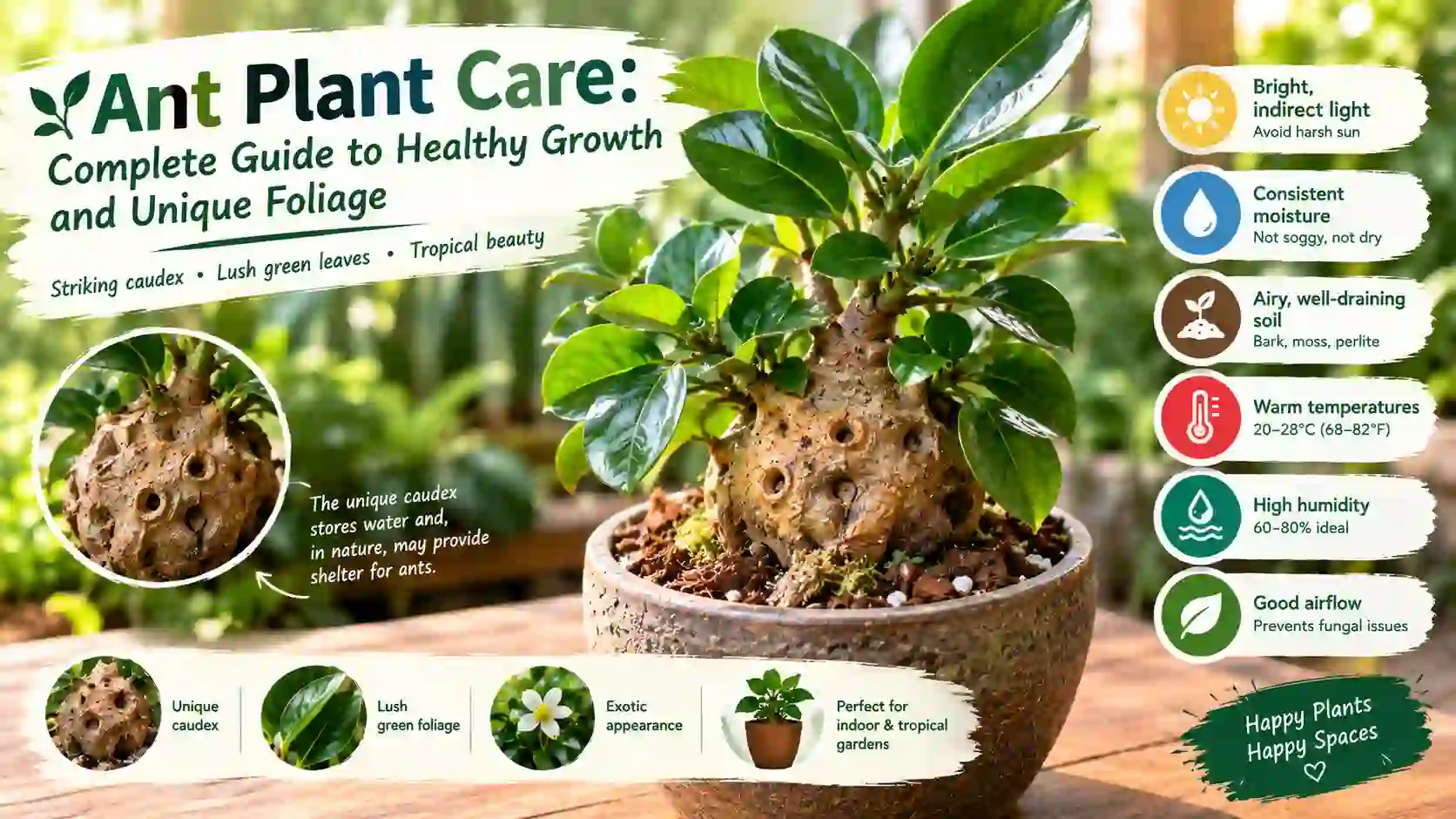
Ant plants are among the most unusual tropical plants you can grow indoors. Unlike common houseplants, many ant plants develop a swollen, bulbous base with tunnels and chambers inside. In nature, these structures often provide shelter for ants, creating a fascinating relationship between the plant and its environment.
The most important part of ant plant care is understanding that these plants are tropical epiphytes. Many grow on trees or other surfaces rather than in dense, waterlogged ground soil. Their roots need moisture, but they also need plenty of air.
This makes ant plants rewarding but sometimes challenging for beginners. Too much water can cause the base to rot, while dry air, poor lighting, or an unsuitable growing medium can slow growth.
Whether you’re growing an ant plant in a terrarium, greenhouse, or indoor plant collection, this guide explains how to provide the right light, humidity, watering, soil, and seasonal care.
Quick Answer:
Ant plants (Hydnophytum and Myrmecodia species) grow best in bright, indirect light, warm temperatures, high humidity, and an airy, well-draining growing medium. Water when the medium begins to dry slightly, but never leave the roots sitting in water. Use a ventilated pot, avoid burying the swollen stem base, and provide gentle airflow. These tropical epiphytes need careful moisture management because their roots require both hydration and oxygen.
1. Understand What Makes an Ant Plant Unique

Ant plants belong to several tropical plant groups, particularly Hydnophytum and Myrmecodia in the coffee family, Rubiaceae. They are native to tropical regions of Southeast Asia, Australia, and nearby Pacific islands.
Their most distinctive feature is the caudex, a swollen stem base containing a network of internal chambers and tunnels.
In nature, ants may inhabit these chambers. The plant offers shelter, while ants can contribute nutrients through waste and sometimes help defend the plant. This relationship is called myrmecophytism.
Hydnophytum vs. Myrmecodia: What’s the difference?

Hydnophytum
Often has a relatively smooth, rounded or irregular caudex with small entrance openings and glossy green leaves. Its exact shape varies by species.

Myrmecodia
Often develops a more textured or spiny caudex. Some species have a rugged, sculptural appearance that makes them especially striking in specialist plant collections.
Both groups generally need warm conditions, filtered light, humidity, and a highly aerated growing medium. However, the ideal moisture level and watering frequency can vary by species.
Do you need live ants to grow an ant plant? No. Many ant plants can be cultivated without an ant colony. Focus first on the plant’s root health, moisture, temperature, and light rather than introducing ants into your home.
2. Provide Bright, Indirect Light

Light supports leaf growth and helps the plant maintain healthy tissues. However, intense direct sunlight can scorch leaves, particularly when the plant is grown behind hot glass.
How much light does an ant plant need?
A bright position with filtered or indirect sunlight is a good starting point.
Suitable locations include:
- Near an east-facing window with gentle morning sunlight.
- Near a bright south- or west-facing window with a sheer curtain or some distance from the glass.
- Under a grow light designed for tropical plants.
- In a greenhouse with filtered light and good ventilation.
In a very dim room, an ant plant may produce weak growth or gradually lose leaves. If natural light is limited, a grow light can help maintain steady growth.
Signs of incorrect lighting
| Symptom | Possible cause | What to change |
|---|---|---|
| Long, weak growth | Insufficient light | Move to a brighter position gradually |
| Bleached or scorched leaves | Excessive direct sunlight | Filter the light or move the plant back |
| Slow growth with healthy-looking leaves | Low light, cool temperatures, or seasonal slowdown | Check the full growing environment |
| Leaves fading or dropping after moving | Sudden environmental change | Acclimate the plant gradually |
Practical tip: Do not move an ant plant from a shaded shop directly into intense afternoon sun. Increase light gradually over several days or weeks and monitor the leaves.
Image suggestion: A three-panel infographic comparing ideal filtered light, insufficient light, and harsh direct sunlight.
3. Choose an Airy, Well-Draining Growing Medium
The growing medium is one of the most important parts of ant plant care. These plants naturally grow as epiphytes, often attached to tree trunks or branches where their roots encounter organic debris rather than dense garden soil.
A heavy, compact potting mix can remain wet for too long and reduce oxygen around the roots.
What is the best soil for an ant plant?
Instead of ordinary garden soil, use a loose mix that retains some moisture while allowing excess water to escape.
A practical starting mix by volume is:
| Ingredient | Proportion | Purpose |
|---|---|---|
| Fine to medium orchid bark | 40% | Creates structure and airflow |
| Chopped sphagnum moss | 25% | Holds moisture around the roots |
| Perlite or pumice | 25% | Improves aeration and drainage |
| Horticultural charcoal | 10% | Adds structure and helps keep the mix open |
This is a starting recipe, not a universal formula. Adjust it to your species, humidity, pot size, and watering habits. In a humid enclosure, a mix with more coarse material may be useful. In a dry room, slightly more moisture-retentive material may help.
Use clean, horticultural-grade ingredients. Avoid garden soil, dense compost, and fine material that packs tightly around delicate roots.
How to tell whether the mix is suitable
A suitable mix should:
- Absorb water without remaining soggy.
- Allow water to drain freely.
- Maintain air spaces between particles.
- Stay lightly moist for an appropriate period.
- Avoid becoming hard and compact as it dries.
If the mix dries within hours in your environment, it may be too coarse or the plant may need a more humid location. If it stays wet for days and smells sour, inspect drainage and root health.
Image suggestion: An educational soil infographic showing orchid bark, sphagnum moss, perlite, charcoal, and the finished ant plant potting mix.
4. Water Carefully Without Causing Root Rot

Ant plants need moisture, but their roots also require oxygen. The aim is to keep the growing medium lightly moist without allowing it to remain saturated.
One of the most common mistakes is treating the plant like a desert succulent because its base looks swollen. Ant plants are tropical epiphytes, and many need more consistent moisture than typical dry-growing succulents.
How often should you water an ant plant?
There is no reliable universal schedule. Pot size, medium composition, humidity, airflow, temperature, and species all affect how quickly the roots dry.
Use this guide:
| Growing condition | Watering approach |
|---|---|
| Warm, bright conditions | Check the medium frequently and water when it begins to dry slightly |
| Cool or low-light conditions | Water less often if the medium dries slowly |
| High humidity | Monitor the roots and medium rather than watering automatically |
| Mounted on cork or bark | Check more often because exposed roots dry quickly |
| Small pot in a dry room | Inspect frequently, as the mix may dry rapidly |
The Australian National Botanic Gardens describes using a free-draining mix for Myrmecodia beccarii and notes that potted and mounted plants need different watering frequencies.
Step-by-step watering method

Step 1: Check the medium
Feel the upper layer and inspect deeper into the mix if needed. If it remains wet, wait. If it is beginning to dry, prepare to water.

Step 2: Water the root zone
Apply room-temperature water slowly and evenly. Avoid repeatedly pouring water into the openings of the swollen caudex.

Step 3: Let excess water drain
Empty the saucer after watering. Do not allow the pot to sit in standing water.

Step 4: Observe the response
Look for firm tissue and stable leaves. Yellowing, persistent wilting, or a soft, darkening base may indicate root or caudex problems.
Should you mist an ant plant?
Misting may briefly raise humidity around the leaves, but it does not reliably maintain humidity throughout the day. It can also leave water trapped in crevices if airflow is poor.
For a more consistent environment, use a room humidifier or a suitable ventilated plant enclosure. Avoid keeping the plant constantly wet simply to increase humidity.
Expert tip: When an ant plant begins losing leaves, check the moisture level inside the pot before adding more water. A plant with damaged roots may wilt even when its medium is wet.
5. Maintain Warm Temperatures and Suitable Humidity
Ant plants come from tropical environments and generally prefer warmth rather than cold windowsills or sudden temperature changes.
What temperature is best for ant plants?
A warm indoor environment is a reasonable starting point for many commonly cultivated species. Aim for roughly 20–28°C (68–82°F), while checking the requirements of your particular species.
Protect the plant from:
- Cold drafts and air-conditioning vents.
- Temperatures near freezing.
- Sudden changes between hot and cold conditions.
- Excessive heat inside a closed glass enclosure.
- Direct sunlight that overheats the leaves and caudex.
Some species have specific temperature tolerances, so the label from a specialist grower is useful.
How much humidity does an ant plant need?
Many ant plants grow best with moderate to high humidity. A starting target around 60–80% relative humidity can be useful for indoor cultivation, provided the roots and foliage also receive adequate airflow.
In a dry room, low humidity may contribute to crispy leaf edges, slower growth, or leaf loss. In a sealed enclosure with stagnant air, high humidity can encourage fungal problems.
Ways to increase humidity
- Run a clean room humidifier near the plant.
- Use a ventilated terrarium or greenhouse cabinet.
- Group tropical plants together without overcrowding them.
- Monitor humidity with a digital hygrometer.
- Maintain gentle air movement to reduce persistent dampness.
Do not assume a pebble tray will create a consistently humid microclimate around the plant. A humidifier or properly managed enclosure is generally more dependable.
Image suggestion: An ant plant humidity infographic featuring a hygrometer, humidifier, filtered light, and gentle airflow.
6. Select the Right Pot and Position the Caudex Correctly

The pot should support the plant’s roots without holding excess water. Because ant plants often have a prominent swollen base, choosing the right pot also helps prevent the caudex from becoming buried or staying constantly wet.
Which pot is best?
Choose a pot with drainage holes and enough room for the existing roots. Plastic nursery pots can retain moisture longer, while terracotta often dries faster. Either can work if you adjust watering to the material and your environment.
A shallow, ventilated orchid pot may be suitable for some specimens. Avoid choosing a very large pot simply to encourage faster growth, because excess unused medium can stay wet for too long.
Should the caudex be buried?
Keep most of the visible caudex above the growing medium unless your species or grower recommends otherwise. The roots should be supported, but burying too much of the swollen base can increase the risk of persistent moisture and rot.
The caudex may enlarge slowly as the plant matures. Do not try to speed up this process by increasing watering or fertilizer beyond what the plant needs.
When should you repot?
Repot when the medium has broken down, drainage has deteriorated, or the roots have outgrown the pot. For many plants, this may be every couple of years, but the condition of the medium is more important than a fixed calendar.
Ant plant roots can be delicate. Handle them gently, remove only clearly dead or rotting material with clean tools, and avoid damaging the caudex.
7. Fertilize Your Ant Plant Without Overfeeding
Ant plants in the wild may receive nutrients from organic debris and ant activity. In cultivation, they need modest, balanced nutrition to support leaves and roots.
However, these plants are not heavy feeders. Excess fertilizer can damage delicate roots and contribute to salt buildup.
What fertilizer should you use?
Choose a balanced, water-soluble fertilizer suitable for tropical foliage plants. During active growth, use a diluted concentration according to the product label and observe how the plant responds.
A cautious routine is better than frequent heavy feeding.
- Feed only when the plant is actively growing.
- Start with a dilute application rather than full-strength fertilizer.
- Apply fertilizer to a pre-moistened medium when appropriate.
- Reduce or stop feeding if growth slows during cooler or darker periods.
- Flush the medium with clean water occasionally if salts accumulate and drainage is good.
Do not fertilize a plant that is severely stressed, has suspected root rot, or is losing leaves rapidly. Correct the growing conditions first.
Signs of fertilizer problems
| Symptom | Possible explanation |
|---|---|
| Brown leaf tips after feeding | Fertilizer burn or salt buildup |
| Weak growth despite frequent feeding | Root damage or unsuitable growing conditions |
| White crust on the medium | Mineral or fertilizer accumulation |
| Sudden decline after fertilizing | Excess concentration or root stress |
Expert tip: Slow growth does not always mean the plant needs fertilizer. Ant plants can grow slowly by nature, and a healthy, firm caudex is more reassuring than rapid leaf production alone.
8. How to Prune and Maintain an Ant Plant
Ant plants generally require little pruning. Their unusual form is part of their appeal, and unnecessary cutting can stress a slow-growing specimen.
What should you remove?
- Completely dead leaves.
- Diseased or badly damaged foliage.
- Dead plant material trapped around the base.
- Damaged roots during necessary repotting.
Use clean, sharp scissors and avoid cutting healthy leaves simply to shape the plant.
If a leaf develops a small brown tip, first investigate humidity, water quality, root condition, and fertilizer buildup. Removing the whole leaf may be unnecessary.
Should you clean the caudex?
You can gently remove loose debris, but avoid scrubbing or scraping the caudex. Its natural openings and surface texture are important features. Excessive cleaning can damage the plant and create wounds.
9. How to Propagate an Ant Plant

Ant plants are often propagated from seed. Some may also be propagated vegetatively, but the method and results depend on the species.
Propagation from seed
- Obtain fresh seed from a reputable source.
- Prepare a clean, airy propagation medium.
- Sow the seed according to species-specific instructions.
- Maintain warmth, humidity, and gentle airflow.
- Keep the medium appropriately moist without waterlogging it.
- Allow seedlings to establish before transplanting.
Fresh seed can lose viability, so avoid storing it for long periods unless the supplier provides suitable storage guidance.
Can ant plants grow from cuttings?
Some species can produce new growth from suitable vegetative material, but a cutting may not develop the characteristic swollen caudex of a mature ant plant. Success is not guaranteed.
For most beginners, seed from a specialist supplier is a sensible starting point if the goal is to grow a plant with the characteristic caudex.
Important: Do not collect rare ant plants or seeds from the wild without checking local laws and conservation guidance. Choose legally sourced nursery plants or seed.
10. Common Ant Plant Problems and How to Fix Them

Ant plants often communicate stress through leaf changes, root condition, and the firmness of the caudex. The key is to investigate the growing conditions rather than treating every symptom with more water.
| Problem | Likely causes | What to do |
|---|---|---|
| Yellowing leaves | Overwatering, root stress, or natural aging | Check the medium, roots, and recent care changes |
| Brown, crispy leaf tips | Low humidity, fertilizer salts, or inconsistent moisture | Check humidity and review fertilizer use |
| Soft or mushy caudex | Possible rot from prolonged wetness or infection | Isolate the plant and inspect the base and roots |
| Wrinkled or shrinking caudex | Dehydration, root damage, or environmental stress | Check root health and moisture before watering |
| Sudden leaf drop | Cold, relocation stress, root problems, or unsuitable light | Review recent changes in conditions |
| Tiny pale speckles on leaves | Possible spider mites or other pest damage | Inspect the undersides of leaves closely |
| White cotton-like clusters | Possible mealybugs | Isolate the plant and treat with a suitable labeled product |
| Slow growth | Low light, cool temperatures, natural growth rate, or root stress | Assess the entire environment before fertilizing |
What should you do if the caudex becomes soft?
A soft, darkening caudex is more concerning than a slightly wrinkled surface. It can indicate tissue breakdown or rot.
Take these steps:
- Isolate the plant from other plants.
- Remove it from standing water and check the growing medium.
- Inspect the roots and base carefully.
- If rot is present, remove only clearly affected tissue with a sterilized tool, where feasible.
- Replace decomposed medium with a clean, airy mix.
- Adjust watering and improve ventilation.
Recovery is not guaranteed, especially if rot has spread deeply into the caudex. Avoid applying random household chemicals or repeatedly disturbing the plant.
Why is my ant plant losing leaves?
Leaf loss can follow a sudden move, cold exposure, root damage, poor lighting, or prolonged drought. Check whether the caudex remains firm and whether the roots are healthy before deciding how to respond.
If the base is firm and the plant has healthy roots, stabilize the conditions and allow time for recovery. Repeatedly moving, repotting, and fertilizing a stressed plant can make recovery harder.
11. Ant Plant Care in a Terrarium or Greenhouse
A terrarium or greenhouse cabinet can help maintain humidity and warmth, particularly in homes with dry indoor air. However, a closed environment needs careful monitoring.
How to create a suitable enclosure
- Use bright, filtered light.
- Keep the temperature stable.
- Monitor humidity with a hygrometer.
- Provide ventilation or gentle air circulation.
- Use an airy growing medium.
- Remove decaying leaves promptly.
- Watch for excessive condensation and fungal growth.
A terrarium that remains saturated and stagnant can be more harmful than an ordinary room. High humidity should not mean permanently wet roots.
Can you mount an ant plant on cork bark?
Some ant plants can be grown mounted on cork or similar supports, mimicking their epiphytic habitat. Mounted plants usually dry faster than potted plants and may need more frequent moisture checks.
Mounting is best suited to growers who can maintain adequate humidity and monitor the roots closely. Beginners may find a ventilated pot easier to manage.
12. Ant Plant Care in Hot Climates
In hot climates, the biggest challenges are often excessive heat, low indoor humidity, and rapid moisture loss from the growing medium.
If you live in a region with hot summers, such as parts of Pakistan, use these practical adjustments:
- Keep the plant away from intense afternoon sunlight.
- Avoid placing it against a window that becomes very hot.
- Check moisture more often during hot, dry weather.
- Use filtered light rather than harsh direct sun.
- Maintain humidity without trapping the plant in stagnant air.
- Protect the plant from cold air-conditioning drafts.
- Avoid leaving the pot in a hot, enclosed space.
A warm room is not automatically suitable if it becomes excessively dry or overheated. The goal is stable warmth, filtered light, moisture around the roots, and enough airflow to prevent rot.
Should you grow an ant plant outdoors?
Outdoor growing may be possible in a warm, humid, frost-free environment with suitable shade and protection from heavy rain. In climates with extreme heat, dry winds, or cold winters, a controlled indoor environment is often easier.
Always adapt the setup to the particular species. Ant plants from different habitats may not respond identically to the same conditions.
13. Ant Plant Care Checklist
Use this checklist to maintain a healthy ant plant without overcomplicating its routine.
My ant plant care routine
0 of 8
Provide bright, indirect light
Avoid harsh midday and afternoon sun.
Check the growing medium
Water when it begins to dry slightly, not on a rigid schedule.
Ensure excellent drainage
Use an airy epiphyte mix and a pot with drainage holes.
Maintain warm conditions
Protect the plant from cold drafts and extreme heat.
Monitor humidity and airflow
Use a humidifier or ventilated enclosure if needed.
Keep the caudex mostly exposed
Avoid burying the swollen base unnecessarily.
Feed sparingly during active growth
Use diluted fertilizer and avoid feeding a stressed plant.
Inspect leaves and roots
Watch for pests, yellowing, and soft or darkened tissue.
Reset checklist
Frequently Asked Questions About Ant Plant Care
1. Is an ant plant easy to grow indoors?
Ant plants are manageable for attentive growers, but they are less forgiving than many common houseplants. Their main requirements are warmth, bright filtered light, an airy growing medium, and careful moisture management.
2. Does an ant plant need ants to survive?
No. Many ant plants grow in cultivation without ants. The relationship is important in their natural habitat, but a home-grown plant can survive with appropriate light, water, humidity, and nutrition.
3. How often should I water an ant plant?
Water when the growing medium begins to dry slightly. The timing depends on temperature, humidity, pot size, and the type of mix. Avoid both complete, prolonged drying and constantly saturated roots.
4. Why is my ant plant caudex turning soft?
A soft caudex may indicate rot, often associated with prolonged moisture or damaged tissue. Check the roots, improve drainage, and remove severely affected material where possible. A soft base is more concerning than mild surface wrinkling.
5. Can ant plants grow in regular potting soil?
Dense regular potting soil is usually not the best choice. An airy mix containing orchid bark, perlite, and moisture-retentive material is generally more suitable for their epiphytic roots.
6. Do ant plants need a terrarium?
Not necessarily. A terrarium can help maintain humidity, but a warm room with adequate humidity and good airflow may also work. Avoid sealed, stagnant conditions that keep the growing medium excessively wet.
7. Why are my ant plant leaves turning yellow?
Possible causes include overwatering, root damage, inadequate light, temperature stress, or natural aging. Check the medium and roots before changing your watering schedule.
8. Can I grow an ant plant from seed?
Yes. Fresh seed can be used to propagate many ant plant species. Keep the propagation medium appropriately moist, provide warmth, and follow the requirements for the specific species.
9. How fast does an ant plant grow?
Growth varies by species and growing conditions. The caudex can enlarge slowly, so do not try to force faster growth with excessive water or fertilizer.
10. Is an ant plant suitable for beginners?
It can be suitable for a beginner willing to monitor humidity and moisture carefully. If you are new to tropical epiphytes, begin with a healthy nursery-grown specimen and avoid making frequent changes to its environment.
Conclusion
Successful ant plant care depends on recreating the conditions these unusual tropical epiphytes need: bright, indirect light, warm temperatures, suitable humidity, and a growing medium that holds some moisture without becoming waterlogged.
Pay special attention to the caudex and roots. Keep the swollen base mostly exposed, choose a ventilated pot, and adjust watering according to how quickly the medium dries. If leaves yellow or drop, investigate the environment before automatically adding more water or fertilizer.
With consistent care and patience, an ant plant can become a striking long-term addition to your tropical plant collection.