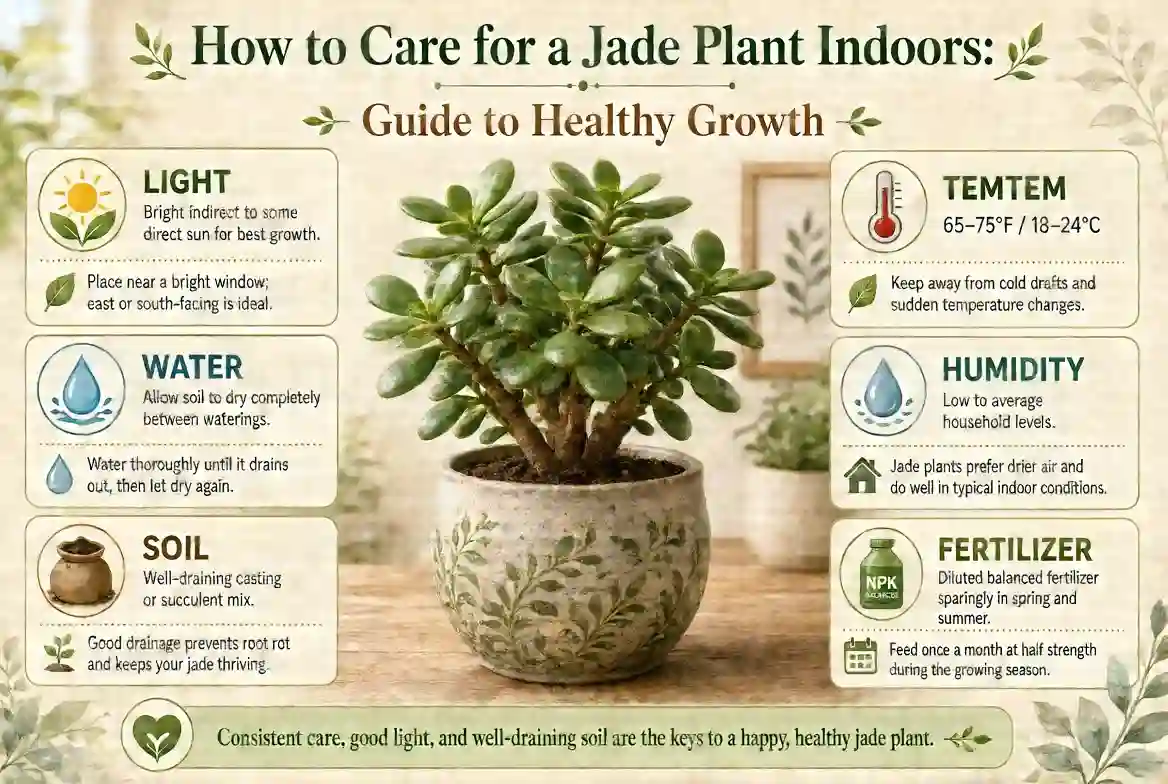
The jade plant (Crassula ovata) is a popular indoor succulent known for its thick stems, rounded leaves, and tree-like shape. It can live for many years indoors when its basic growing needs are met.
Despite its reputation as an easy-care houseplant, a jade plant can develop soft leaves, wrinkled foliage, yellowing, or weak, stretched stems when its conditions are unsuitable. One of the most common mistakes is watering too often, especially when the plant sits in a decorative pot that traps excess water.
The key to successful how to care for a jade plant indoors routines is understanding that jade plants store water in their leaves and stems. They need strong light, periods of dry soil, and excellent drainage rather than constant moisture.
This guide explains how to choose the right location, water correctly, select soil and pots, encourage sturdy growth, and solve common indoor jade plant problems.
Quick Answer:
To care for a jade plant indoors, place it near a bright window, use well-draining succulent soil, and water thoroughly only when the soil has dried out. Choose a pot with drainage holes and keep the plant in a warm room away from cold drafts. Prune leggy stems when needed, rotate the pot for balanced growth, and avoid frequent watering. Jade plants grow slowly, but the right light and watering routine help them develop thick stems and glossy, fleshy leaves.
1. Choose the Best Indoor Location for Your Jade Plant
Jade plants need more light than many beginners expect. A plant may survive in a dim room, but it usually develops weaker stems and less compact growth.


8
How much sunlight does a jade plant need?
Aim for several hours of bright light daily. A sunny south- or west-facing window can work well, provided the leaves do not become scorched. Bright indirect light is also suitable, although growth may be less compact than in stronger light.
Use these placement tips:
- South-facing window: Often an excellent choice where sunlight is available for much of the day.
- West-facing window: Provides strong afternoon light, but monitor leaf temperature during hot weather.
- East-facing window: Offers gentler morning sunlight and may work well in warmer climates.
- Dim room: Consider a full-spectrum grow light if natural light is inadequate.
Can a jade plant sit in direct sunlight?
Yes, once it has adjusted to the intensity. However, a plant moved suddenly from a dim room into intense sun may develop scorched patches.
Increase its sun exposure gradually over a week or two. In hot climates, avoid leaving the pot against glass that becomes extremely hot during the afternoon.
Expert tip: Rotate the pot about a quarter turn every week or two. This encourages more balanced growth when light comes mainly from one direction.
Image suggestion: A 16:9 infographic showing jade plant placement near east-, south-, and west-facing windows, with icons for bright light and gradual sun acclimation.
2. Water Your Jade Plant Correctly
Watering is one of the most important parts of indoor jade plant care. Its thick leaves store water, so the plant tolerates short dry periods better than continuously wet soil.
How often should you water a jade plant indoors?
There is no single schedule that works for every home. Pot size, soil, temperature, light, and season all affect how quickly the mix dries.
A practical starting point is to check the soil every week, then water only when it has dried thoroughly. During cooler months, this may take considerably longer.
The correct watering method
- Check the soil. Push a finger several centimeters into the mix or use a wooden skewer to check deeper moisture.
- Confirm that it has dried. The surface can look dry while the lower part of the pot remains wet.
- Water thoroughly. Pour water evenly over the soil until excess drains from the bottom.
- Empty the saucer. Do not allow the pot to sit in drained water.
- Wait before watering again. Let the soil dry thoroughly rather than adding small amounts every few days.
This method encourages the roots to access moisture throughout the pot while preserving air in the root zone. Poor drainage and repeated overwatering can cause root rot.
Signs your jade plant needs water
- Leaves may become slightly wrinkled or less firm.
- The potting mix feels dry deeper down.
- The plant may look less plump than usual.
Do not use one symptom alone. Wrinkled leaves can also appear when damaged roots cannot absorb water.
Signs of overwatering
- Leaves turn yellow, translucent, or unusually soft.
- Leaves drop while the soil remains wet.
- Stems near the soil become soft or dark.
- The potting mix stays wet for many days.
If these symptoms appear, inspect the roots instead of adding more water. Healthy roots should not be mushy or foul-smelling.
Image suggestion: A watering infographic comparing a healthy jade plant with plump leaves against an overwatered plant with soft yellow leaves and damaged roots.
3. Use Well-Draining Soil and the Right Pot
Jade plants need soil that releases excess water quickly. Ordinary indoor potting soil may hold too much moisture when used alone, particularly in a large container or a room with limited sunlight.
Best soil for indoor jade plants
Choose a commercial cactus and succulent mix. If it retains too much water in your conditions, improve its structure with perlite or pumice.
A practical starting mix is:
- Two parts cactus or succulent potting mix.
- One part perlite or pumice.
This is a starting point, not a fixed formula. A dense commercial mix may need more aeration, while a naturally gritty mix may need little adjustment.
The goal is a medium that wets evenly but drains freely and dries between waterings.
Which pot is best?

Terracotta pot
Unglazed terracotta allows moisture to evaporate through its sides. This can help the mix dry more quickly, especially in humid or cool rooms.
Choose a pot with at least one drainage hole. A decorative outer container is fine if you remove the inner nursery pot for watering or empty trapped water afterward.
Avoid oversized containers. Excess soil around a small root system can remain wet longer than the plant can tolerate.
Image suggestion: A labeled diagram showing a jade plant in a terracotta pot, airy succulent mix, perlite, and a clear drainage hole.
4. Maintain Suitable Temperature and Humidity
Jade plants generally adapt well to normal indoor humidity. They do not need tropical humidity levels or routine leaf misting.
| Condition | Recommended approach |
|---|---|
| Temperature | Comfortable indoor warmth, roughly 18–24°C during the day |
| Cold protection | Avoid frost and sudden cold drafts |
| Humidity | Normal household humidity is usually adequate |
| Air circulation | Provide gentle airflow without harsh drafts |
| Misting | Usually unnecessary |
The Royal Horticultural Society recommends protecting jade plants from drafts and keeping temperatures above approximately 10°C.
In a hot room, strong sunlight through glass can heat the leaves and pot. Move the plant slightly away from intense afternoon heat if you notice scorch marks.
In winter, keep the plant away from cold windows and exterior doors. Cooler conditions also mean the soil may take longer to dry.
5. Fertilize for Steady, Healthy Growth
Jade plants are not heavy feeders. They can grow well without frequent fertilizer when their light, soil, and watering conditions are suitable.
During active growth, use a balanced liquid fertilizer formulated for houseplants or succulents. Follow the label’s dilution instructions, and avoid feeding a plant whose roots may be damaged.
A simple fertilizing routine
- Feed during active growth in spring and summer.
- Use the recommended concentration or a more dilute solution if appropriate for the product.
- Reduce or stop feeding during slow winter growth.
- Avoid applying fertilizer to very dry roots.
- Do not use extra fertilizer to compensate for weak light.
Too much fertilizer can contribute to salt buildup and root stress. If the plant is already declining, identify the cause before feeding it.
Image suggestion: A clean gardening infographic showing a healthy jade plant, a small bottle of balanced succulent fertilizer, and a seasonal feeding calendar.
6. Prune Your Jade Plant to Encourage a Strong Shape
A jade plant can develop a thick trunk and branching structure over time. However, low light, uneven growth, or excessive top growth can make it lean or become leggy.
Pruning helps control its size and shape. It does not guarantee a thicker trunk overnight; sturdy growth depends on adequate light and gradual development.
How to prune a jade plant indoors
- Inspect the plant for stretched stems, damaged branches, or uneven growth.
- Use clean, sharp pruning shears.
- Cut a stem just above a healthy leaf node or branching point.
- Remove only part of the canopy at one time, especially if the plant is weak.
- Give the plant suitable light and allow the cut surfaces to dry and heal.
Spring or early summer is often a suitable time to prune a healthy plant because growth is more active.
Why is my jade plant growing sideways?
The plant may be reaching toward a window, or its top growth may be too heavy for the trunk.
Try rotating the pot gradually and improving light. If the plant is top-heavy, prune selected branches and check whether the pot is stable.
Avoid drastic pruning immediately after repotting or during a period of serious stress.
Image suggestion: A step-by-step pruning infographic showing a leggy jade plant, the correct cutting point, and a healthier branching shape after pruning.
7. How to Propagate a Jade Plant Indoors
Propagating a jade plant from stem cuttings is a simple way to create new plants. Healthy leaves can also produce new plants, but stem cuttings usually give beginners a more direct route to an established specimen.
Propagation from stem cuttings
- Choose a healthy stem without soft or diseased tissue.
- Cut a section several centimeters long using clean shears.
- Allow the cut end to dry and form a callus before planting.
- Place the cutting in a small pot containing dry, well-draining succulent mix.
- Keep it in bright, indirect light while roots begin to develop.
- Water cautiously once rooting begins, allowing the mix to dry between waterings.
Do not bury the cutting in wet soil immediately after cutting it. The moist conditions can increase the chance of rot before roots develop.
Can you grow a jade plant from one leaf?
Yes. A healthy leaf can sometimes produce roots and a new shoot when placed on a suitable propagation medium. Results vary, and not every leaf will develop into a successful plant.
Image suggestion: A propagation infographic showing a jade stem cutting, a callused cut end, a small pot of succulent mix, and new roots.
8. How to Repot an Indoor Jade Plant
Jade plants grow relatively slowly and often tolerate being slightly root-bound. Repotting every year is usually unnecessary.
Consider repotting when:
- Roots crowd the container or emerge from drainage holes.
- The plant repeatedly dries unusually quickly.
- The potting mix has broken down or drains poorly.
- The plant has become top-heavy or unstable.
Penn State Extension recommends repotting jade plants approximately every two to three years, depending on their needs.
Repotting steps
- Choose a pot with drainage holes that is only modestly larger than the root ball.
- Remove the plant gently and inspect its roots.
- Trim away roots that are clearly dead or rotting with clean tools.
- Place the plant in fresh, well-draining succulent mix.
- Keep the plant stable and avoid compressing the soil heavily.
- Allow any damaged roots or cut surfaces to recover before resuming normal watering.
If the roots are healthy and the plant fits comfortably in its current container, simply replacing some of the old mix may be sufficient.
9. Common Indoor Jade Plant Problems and Their Solutions
A single symptom can have several causes. Always check soil moisture, roots, light, and recent care changes before treating a problem.

Yellow, soft leaves
Possible cause: Overwatering, poor drainage, or root damage.
What to do: Check the soil and roots. Remove rotting tissue if present, then repot healthy portions in fresh, draining mix.

Wrinkled or shriveled leaves
Possible cause: Dry soil or roots that cannot absorb water properly.
What to do: If the mix is dry, water thoroughly and let it drain. If the soil is wet, inspect the roots before adding water.

Long, weak stems
Possible cause: Insufficient light.
What to do: Move the plant to a brighter location gradually. Prune overly stretched growth once the plant is adjusting well.

Brown or scorched patches
Possible cause: Sudden intense sunlight, heat stress, or physical damage.
What to do: Review recent changes in sun exposure and move the plant away from extreme heat. Damaged leaf tissue usually will not turn green again.

White cottony spots or sticky leaves
Possible cause: Mealybugs or other sap-feeding pests.
What to do: Isolate the plant, inspect leaf joints and stems, and use a treatment labeled for the identified pest and plant.
Jade plants can be affected by mealybugs, aphids, and other pests. Regular inspection helps catch infestations before they spread to nearby houseplants.
Why is my jade plant dropping leaves?
Leaf drop can result from excessive watering, prolonged dryness, abrupt temperature changes, or insufficient light. Check whether the fallen leaves were firm or soft and whether the soil was wet or dry.
If leaves are soft and the soil is wet, investigate root rot. If leaves are wrinkled and the mix is completely dry, the plant may need water.
Avoid changing every care condition simultaneously. Correct the most likely problem first and watch the new growth.
10. Seasonal Jade Plant Care Indoors
Your jade plant’s needs change with light levels and growth rate. Adjust care according to actual conditions rather than following a rigid calendar.
| Season | Care priorities |
|---|---|
| Spring | Increase attention to watering as growth resumes; prune and repot if needed. |
| Summer | Provide strong light, monitor heat near windows, and check soil more frequently. |
| Autumn | Reduce feeding as growth slows and watch for longer drying times. |
| Winter | Water less often when the soil dries slowly; protect the plant from cold drafts. |
A sunny room in winter may still support active growth, while a dark room in summer may not. The soil’s drying rate and the plant’s condition should guide watering.
11. Can You Make a Jade Plant Grow Faster?
Jade plants are naturally slow-growing compared with many tropical foliage plants. You can support steady, healthy growth, but you cannot safely force rapid growth through excessive watering or fertilizer.
To encourage good development:
- Provide enough bright light to prevent stretched stems.
- Use a draining mix that allows roots to breathe.
- Water thoroughly when the soil is dry.
- Feed moderately during active growth.
- Prune selectively to encourage branching.
- Keep the plant in a stable location rather than moving it repeatedly.
A jade plant may take years to develop a mature, tree-like shape. That gradual growth is part of its appeal.
How can you encourage red leaf edges?
Some jade plants develop red margins when exposed to strong light. The intensity of the color depends on the variety and growing conditions.
Do not expose a plant suddenly to harsh sunlight just to create red edges. Strong light should be introduced gradually, and leaf health matters more than color.
12. Is a Jade Plant Safe for Pets?
Jade plants are toxic to cats and dogs if ingested, according to the ASPCA. Keep the plant out of reach of pets that chew foliage, and contact a veterinarian if you suspect your pet has eaten part of it.
Avoid placing fallen leaves or pruning waste where pets can reach them. If you have curious animals, choose a secure shelf or a location that they cannot access.
Frequently Asked Questions
How often should I water a jade plant indoors?
Water when the potting mix has dried thoroughly. This may take a week or several weeks depending on light, temperature, soil, and pot size. Always empty excess water from the saucer.
Can jade plants grow in low light?
They can survive in bright indirect light, but low light often produces weak, stretched growth. A brighter window or a suitable grow light helps maintain a compact shape.
Should I mist my jade plant?
No. Jade plants store water in their leaves and do not need frequent misting. Focus on appropriate light, well-draining soil, and correct watering instead.
Why are the leaves on my jade plant falling off?
Leaf drop can indicate overwatering, underwatering, temperature stress, or poor light. Check soil moisture and root health before deciding on a treatment.
What is the best soil for a jade plant indoors?
A commercial cactus and succulent mix is a good starting point. Add perlite or pumice if needed to improve drainage, and always use a pot with drainage holes.
When should I repot a jade plant?
Repot when roots crowd the container, the mix drains poorly, or the plant becomes unstable. Many jade plants need repotting only every two to three years.
Can I keep a jade plant in my bedroom?
Yes, provided the room receives enough light. A bright windowsill is generally more suitable than a dark bedside table.
How do I make my jade plant bushier?
Provide strong light and prune selected stems above healthy branching points. You can root healthy cuttings to fill the pot, but allow the plant time to recover after pruning.
Does a jade plant flower indoors?
It can, but flowering is uncommon in many indoor settings. Mature plants need suitable light and seasonal growing conditions, and flowering is never guaranteed.
Is jade plant care suitable for beginners?
Yes. Jade plants are forgiving when given strong light, well-draining soil, and careful watering. The biggest beginner mistake is keeping the soil continuously wet.
Conclusion
Learning how to care for a jade plant indoors comes down to a few consistent habits: provide bright light, use a draining potting mix, water only after the soil has dried thoroughly, and protect the plant from cold or sudden environmental changes.
If your jade plant develops yellow leaves, soft stems, or weak growth, investigate the roots, soil moisture, and lighting before adding fertilizer or water. Small adjustments are often more effective than a complete change in routine.
With patience and proper care, a jade plant can develop a sturdy trunk, attractive branching, and glossy leaves that make it a long-lasting feature of your indoor garden.