

Learning how to care for a ficus plant can help you maintain a beautiful indoor tree with glossy leaves and strong, healthy growth. Ficus plants are popular houseplants because they add greenery, height, and a natural focal point to living rooms, offices, and bright indoor spaces.
However, ficus plants can be sensitive to changes in their environment. A plant that looked healthy in the nursery may begin dropping leaves after you bring it home. Yellow leaves, brown edges, slow growth, and sudden leaf loss can also confuse beginners.
The key is understanding what your particular ficus needs rather than following a rigid watering schedule.
This guide explains how to choose the right light, water correctly, improve soil conditions, encourage new growth, and solve common ficus problems. It also covers seasonal care and the differences between popular varieties, including the fiddle-leaf fig, weeping fig, and rubber plant.
Quick Answer:
To care for a ficus plant, place it in bright, indirect light and water it when the top 1–2 inches of soil feel dry. Use a well-draining potting mix and a container with drainage holes. Keep temperatures stable, avoid cold drafts, and maintain consistent care. Ficus plants often drop leaves after sudden changes in light, watering, or location, so give your plant time to adjust before making further changes.
1. Understand Your Ficus Plant Before You Begin
Ficus is a large plant genus that includes trees, shrubs, and climbing plants. Several species grow well indoors, but their care needs can differ.
Has small, glossy leaves and slender, arching branches. It is especially sensitive to sudden changes in light, temperature, and watering.
Rubber plant (Ficus elastica)
Features thick, shiny leaves and sturdy stems. Its foliage stores more moisture than thinner-leaved varieties, making it relatively forgiving of occasional dry conditions.
Fiddle-leaf fig (Ficus lyrata)
Has large, violin-shaped leaves. It needs strong indoor light, careful watering, and enough room for its broad foliage.
Ginseng ficus (Ficus microcarpa)
Often sold as a bonsai with thick, exposed roots. It needs good light, careful moisture management, and occasional shaping.
These varieties share several basic requirements, including good drainage and adequate light. However, creeping ficus needs more consistent moisture than many tree-like ficus plants. Identify your variety before following a specific care routine. ipm.missouri.edu+3
Image suggestion: Create a four-panel comparison showing weeping fig, rubber plant, fiddle-leaf fig, and ginseng ficus with their common names.
2. How Much Light Does a Ficus Plant Need?
Most indoor ficus plants grow best in bright, indirect light. Light provides the energy they need to produce new leaves and maintain strong growth.
A dim corner may keep a ficus alive, but it often causes weak stems, sparse foliage, and slow growth. University of Maine Cooperative Extension+1
Find the right location
- East-facing window: Often provides gentle morning sunlight and bright conditions.
- South-facing window: Can provide excellent light, but strong sunlight may require a sheer curtain.
- West-facing window: Offers bright afternoon light. Protect sensitive foliage from intense heat.
- North-facing window: May work in a bright room, but some plants will need supplemental lighting.
These are general guidelines. Window size, nearby buildings, curtains, and seasonal changes affect actual light levels.
Can ficus plants tolerate direct sunlight?
Some ficus plants tolerate gentle direct sunlight after gradual acclimation. However, intense afternoon sun through glass can scorch leaves.
If your plant has been growing in a dim room, do not suddenly place it in harsh sunlight. Increase its exposure gradually and watch for pale, dry patches.
Practical tip: If your ficus leans toward a window or develops long spaces between leaves, it may need more light. Move it to a brighter position gradually.
Image suggestion: Show a healthy ficus beside a bright window, with a sheer curtain filtering sunlight and a second panel illustrating leaf scorch from intense direct sun.
3. How to Water a Ficus Plant Correctly
Watering mistakes are among the most common causes of ficus decline. Too much water deprives roots of oxygen, while prolonged dryness can cause wilting and leaf drop.
The best method is to check the soil before watering instead of following a fixed calendar. Ask Extension+2
Step-by-step watering method
Step 1: Check the soil
For many tree-like ficus varieties, let the top 1–2 inches of potting mix dry before watering. Smaller pots and creeping ficus may need more frequent checks.
Step 2: Water thoroughly
Pour water evenly over the soil until excess water drains through the bottom. This moistens the root zone more effectively than giving small sips.
Step 3: Empty the saucer
Remove standing water after the pot finishes draining. A water-filled saucer can keep roots too wet and encourage root rot.
Step 4: Check again before watering
Let the plant use some of the available moisture before watering again. Adjust your routine as temperatures and growth rates change.
How often should you water a ficus?
There is no single correct watering schedule. A small ficus in a warm, bright room may dry faster than a large tree in a cool, dim space.
Use this table as a starting point.
| Condition | What to do |
|---|---|
| Warm weather and active growth | Check soil more frequently |
| Cool weather or slower growth | Allow more time between waterings |
| Small pot with dry soil | Check whether the root zone needs water |
| Large pot with wet soil | Wait; the center may still be moist |
| Waterlogged soil | Improve drainage and investigate root health |
Important: Do not wait for severe wilting before watering. Some ficus varieties respond to moisture stress by dropping leaves.
4. Choose the Best Soil and Pot for Ficus

Healthy roots need both moisture and oxygen. Dense soil that remains wet for too long can suffocate roots and create conditions favorable to root rot.
What type of soil is best?
Use a high-quality indoor potting mix that drains freely while retaining some moisture.
For a typical tree-like ficus, a practical mix could include:
- Two parts general-purpose indoor potting mix.
- One part perlite or pumice.
- Optional fine orchid bark if the mix needs more structure and aeration.
This is a starting formula, not a universal requirement. The ideal mix depends on your variety, pot size, and indoor conditions.
Avoid heavy garden soil in indoor containers because it can compact and drain poorly.
Select a suitable pot
Choose a container with drainage holes. A pot that is only slightly larger than the root ball is usually easier to manage than an oversized container.
Excessively large pots hold more unused wet soil around the roots. This increases the risk of overwatering.
Practical tip: If the soil stays wet for many days despite warm conditions and adequate light, check the pot size, drainage holes, and soil structure before increasing the watering interval indefinitely.
Image suggestion: Create a soil infographic comparing airy, well-draining ficus mix with dense, waterlogged soil.
5. Maintain the Right Temperature and Humidity
Most popular indoor ficus plants prefer warm, relatively stable conditions. Sudden temperature changes can trigger yellowing or leaf drop, particularly in weeping figs. Illinois+1
Ideal indoor conditions
- Temperature: A comfortable indoor range around 65–80°F (18–27°C) suits many common ficus varieties.
- Humidity: Average household humidity often works for rubber plants and other thick-leaved varieties.
- Airflow: Maintain gentle room airflow without placing the plant in a cold or hot draft.
- Placement: Keep it away from frequently opened exterior doors, heating vents, and strong air-conditioning currents.
These temperatures are practical guidelines rather than strict limits for every species.
Does a ficus need high humidity?
Some varieties, particularly thin-leaved tropical types, appreciate higher humidity. However, increasing humidity will not compensate for poor drainage or incorrect watering.
If the air is very dry, consider using a room humidifier. Grouping plants together may also help create a slightly more humid microclimate.
Misting is usually a temporary solution because its effect fades quickly.
Image suggestion: Show a ficus in a comfortable, bright room with a thermometer and humidifier, plus warning icons for cold drafts and heating vents.
6. How to Fertilize a Ficus Plant
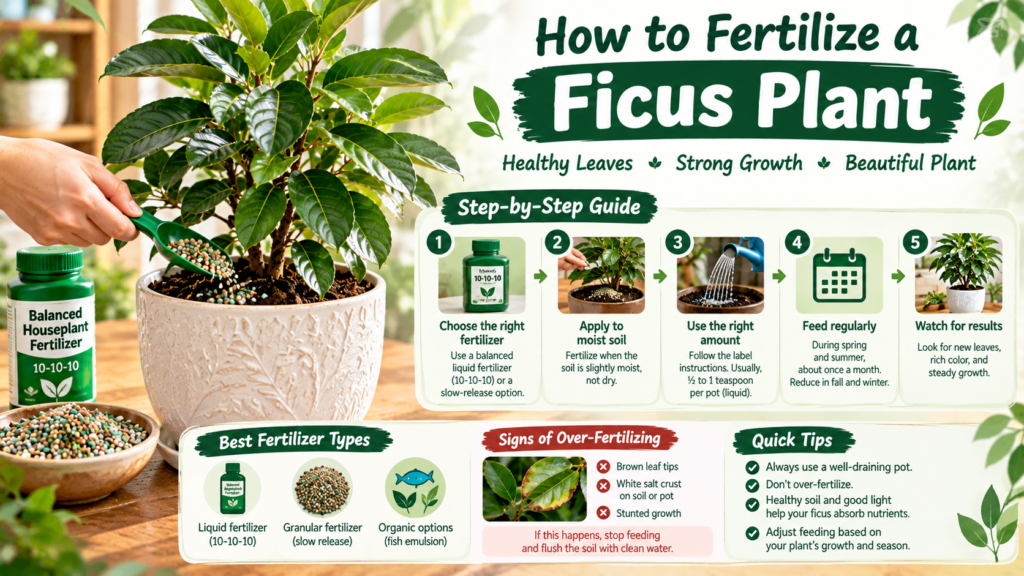
Fertilizer supplies nutrients that support leaf production, root development, and overall growth. However, adding more fertilizer does not automatically make a ficus healthier.
A plant growing in poor light or waterlogged soil may not benefit from additional nutrients.
A simple feeding routine
- Feed during active growth, usually in spring and summer.
- Use a balanced liquid houseplant fertilizer according to its label.
- Apply it to appropriately moist soil rather than a severely dry root ball.
- Reduce or stop feeding when growth slows during cooler, darker months.
- Avoid fertilizing a plant that is severely stressed until you identify the problem.
For many indoor ficus plants, monthly feeding during active growth is a reasonable starting point, but product strength and plant growth rate matter. University of Maine Cooperative Extension+1
Signs of excessive fertilizer
Excess fertilizer can cause salt buildup, damaged root tips, and brown leaf edges. A white crust on the soil surface or pot rim may also indicate mineral accumulation.
If you suspect overfertilization, stop feeding and assess drainage. For a plant with healthy roots and a pot that drains freely, flushing the soil with clean water may help remove excess soluble salts.
Image suggestion: Show a healthy ficus beside a fertilizer bottle, with a close-up panel of brown leaf tips caused by possible fertilizer or salt stress.
7. How to Prune a Ficus for Fuller Growth
Pruning helps control height, improve shape, and encourage branching. It is especially useful when a ficus grows tall but remains sparse.
How to prune safely
1. Use clean, sharp shears
Clean tools help reduce the spread of plant pathogens and make neater cuts.
2. Cut just above a healthy node
A node is where a leaf or branch grows from the stem. Cutting near a node can encourage new branching.
3. Remove only what is needed
Start with dead, damaged, crossing, or excessively long branches. Avoid removing too much foliage at once.
When is the best time to prune?
Spring and early summer are generally suitable because many indoor ficus plants grow more actively then.
Light trimming can be done as needed, but major pruning is best avoided when a plant is already struggling with leaf loss, root problems, or low light.
Safety note: Ficus sap can irritate skin. Wear gloves when pruning, avoid touching your eyes, and keep cuttings away from children and pets.
Image suggestion: Show a before-and-after ficus pruning comparison, with arrows indicating healthy cutting points above leaf nodes.
8. How to Repot a Ficus Plant
Ficus plants do not need frequent repotting. Repot when roots crowd the container, water runs through unusually quickly, or growth slows despite suitable care.
Signs your ficus needs repotting
- Roots emerge through the drainage holes.
- The root ball becomes densely packed.
- The plant dries out much faster than before.
- Growth slows even though light, watering, and nutrition are appropriate.
One sign alone does not always prove repotting is necessary. For example, roots emerging from a drainage hole can occur even when the plant still has enough space.
Repotting steps
- Select a pot with drainage holes, usually one size larger.
- Gently remove the plant and inspect its roots.
- Loosen only tightly circling roots when necessary.
- Add fresh, well-draining potting mix.
- Position the plant at its previous soil depth.
- Water thoroughly and allow excess water to drain.
- Return it to a stable location with suitable light.
Avoid combining repotting, heavy pruning, and major location changes unless there is an urgent problem. Multiple changes can increase stress.
Image suggestion: Create a three-stage infographic showing a root-bound ficus, careful repotting, and the plant established in a new container.
9. Why Is My Ficus Plant Dropping Leaves?
Leaf drop is one of the best-known ficus problems. It does not always mean the plant is dying.
Weeping figs, in particular, may shed leaves after relocation, changes in light, temperature fluctuations, or inconsistent watering. Missouri Botanical Garden+1
Common causes and solutions
| Symptom | Possible cause | What to do |
|---|---|---|
| Green leaves fall after moving | Environmental adjustment | Keep conditions stable and monitor new growth |
| Yellow leaves with wet soil | Overwatering or poor drainage | Check moisture and inspect roots if the problem continues |
| Dry, crispy edges | Underwatering, low humidity, or salt buildup | Check soil, humidity, and fertilizer history |
| Pale or sparse growth | Insufficient light | Move gradually to a brighter location |
| Brown patches on exposed leaves | Sun scorch or temperature stress | Assess sun exposure and nearby vents |
| Sticky leaves or fine webbing | Possible pests | Inspect leaf undersides and stems closely |
These symptoms can overlap, so avoid diagnosing a problem from leaf color alone.
What to do when leaves start falling
- Check the soil moisture several inches below the surface.
- Inspect drainage holes and empty any standing water.
- Assess whether the plant recently moved or experienced temperature changes.
- Check leaf undersides for scale insects, spider mites, or other pests.
- Correct the most likely problem and allow time for the plant to respond.
Do not respond to leaf drop by automatically watering more or adding fertilizer. If the roots are already wet, either action may make the problem worse.
Image suggestion: Design a ficus troubleshooting infographic showing green leaf drop, yellow leaves, brown edges, and pest damage, each paired with a likely cause and a corrective action.
10. Common Ficus Pests and How to Control Them
Indoor ficus plants can attract several sap-feeding pests. Regular inspection helps you detect an infestation before it spreads.
Pests to watch for
- Spider mites: May cause tiny pale speckles and fine webbing.
- Scale insects: Often appear as small, fixed bumps on stems or leaf surfaces.
- Mealybugs: Look like small white, cottony clusters.
- Aphids: Cluster around tender new growth and may leave sticky residue.
How to manage pests
First, isolate the affected plant from nearby houseplants. Inspect both sides of the leaves and along stems.
For a small infestation, remove visible pests manually or wash the foliage gently when appropriate. If necessary, use a product labeled for the specific pest and indoor ornamental plants.
Follow the product label and test it on a small area first. Some sprays can damage sensitive foliage, especially in hot, sunny conditions.
Image suggestion: Show a magnified leaf underside with spider mites, scale insects, and mealybugs, accompanied by a hand lens and inspection checklist.
11. Seasonal Ficus Care
A ficus needs different attention throughout the year because light, temperature, and soil-drying rates change with the seasons.
| Season | Recommended care |
|---|---|
| Spring | Resume regular feeding as growth increases; repot if necessary |
| Summer | Monitor soil moisture more often and protect leaves from excessive heat |
| Autumn | Reduce feeding as growth slows and check for pests |
| Winter | Water less frequently when soil dries more slowly; protect the plant from cold drafts |
The calendar alone should not determine your routine. A ficus in a warm, bright room may continue growing during winter, while another may become nearly dormant.
Special advice for hot climates
In hot regions, strong afternoon sunlight and high indoor temperatures can increase water loss. Check the soil more frequently during hot spells, but never water automatically just because the weather is warm.
If you use air conditioning, keep the plant away from direct cold airflow. Sudden changes in temperature and moisture can contribute to leaf drop.
Image suggestion: Use a four-panel seasonal infographic featuring ficus care in spring, summer, autumn, and winter.
12. Common Mistakes to Avoid
Even experienced plant owners can misjudge a ficus when its symptoms appear suddenly.
- Watering on a fixed schedule: Check the soil instead of assuming every plant needs water on the same day.
- Moving the plant repeatedly: Choose a suitable spot and allow it to adjust.
- Keeping it in dim light: Provide enough bright, indirect light for healthy growth.
- Using a pot without drainage: Excess water needs a way to escape.
- Fertilizing a struggling plant: Identify the cause of stress before adding nutrients.
- Pruning too aggressively: Preserve enough healthy foliage to support recovery.
- Ignoring pests: Inspect leaf undersides and stems regularly.
- Repotting too often: Repot when the roots and soil conditions justify it, not simply because a new pot looks better.
A consistent routine is usually more effective than frequent corrective changes.
13. Frequently Asked Questions About Ficus Plant Care
How often should I water my ficus plant?
Water when the upper 1–2 inches of soil have dried for many tree-like ficus varieties. The interval depends on light, temperature, pot size, and species.
Can a ficus plant grow indoors?
Yes. Many ficus varieties grow well indoors when they receive sufficient light, suitable temperatures, and proper drainage.
Why are the leaves on my ficus turning yellow?
Yellow leaves may result from overwatering, underwatering, insufficient light, temperature stress, or nutrient problems. Check soil moisture and recent environmental changes first.
Should I mist my ficus plant?
Misting is not essential for most common indoor ficus plants. A humidifier can provide more consistent humidity when the air is particularly dry.
What is the best fertilizer for ficus?
A balanced liquid houseplant fertilizer is suitable for many ficus varieties. Follow the label and feed mainly during active growth.
How do I make my ficus grow faster?
Provide bright light, suitable moisture, healthy roots, and adequate nutrients. Avoid excessive fertilizer or watering in an attempt to accelerate growth.
Can I grow a ficus plant in low light?
Some varieties tolerate moderate light, but prolonged low light often leads to slower growth and leaf loss. A brighter location is usually better.
When should I repot my ficus?
Repot when roots crowd the container, the soil structure deteriorates, or the plant dries out unusually quickly despite appropriate care. Avoid unnecessarily large pots.
Is a ficus plant toxic to pets?
Many common ficus plants contain irritating sap and can be harmful if chewed or swallowed. Keep them out of reach of cats and dogs. The fiddle-leaf fig is specifically listed as toxic to humans and pets if ingested. North Carolina Extension Gardener Plant Toolbox+1
How long does it take for a ficus to recover from leaf drop?
Recovery depends on the cause and severity of the stress. Once conditions stabilize, new growth may appear over several weeks, but severely damaged roots can take much longer to recover.
14. Related Topics for Internal Linking
If your website covers houseplant care, these related articles can help readers explore their next question.
- [How to Care for a Snake Plant] — light, watering, and common problems.
- [How to Care for a Peace Lily] — moisture, humidity, and flowering.
- [How to Care for a Rubber Plant] — glossy foliage and indoor growth.
- [How to Fix Yellow Leaves on Houseplants] — common causes and practical solutions.
- [How to Prevent Root Rot in Indoor Plants] — drainage, soil, and watering mistakes.
Use these as suggested article topics and link them to the corresponding published pages on your website.
Conclusion
Learning how to care for a ficus plant comes down to a few essential habits: provide adequate light, water according to soil moisture, maintain good drainage, and keep the environment stable.
If your plant begins dropping leaves, investigate its growing conditions before making several changes at once. Check the roots and soil, review its light exposure, and look for pests.
With consistent care, most common indoor ficus varieties can develop attractive foliage and maintain their shape for years. Start by finding the right location, then build a watering and feeding routine around how your plant actually grows.