Elephant ear plants are loved for their enormous, heart-shaped or arrow-shaped leaves that create a bold tropical look indoors and outdoors. Their dramatic foliage makes them excellent statement plants for living rooms, patios, shaded gardens, and warm-climate landscapes.
However, those impressive leaves can develop problems when growing conditions are unsuitable. Yellowing leaves, drooping stems, brown edges, and soggy roots are common concerns for new growers.
Learning how to care for elephant ear plant starts with understanding one important detail: not every elephant ear has identical needs. Plants sold under this name may belong to Alocasia, Colocasia, or Xanthosoma. Some prefer bright filtered light, while others tolerate more direct sun when adequately watered.
This guide explains how to choose the right location, water correctly, prepare suitable soil, encourage large leaves, troubleshoot common problems, and manage elephant ears through seasonal changes.
Quick Answer:
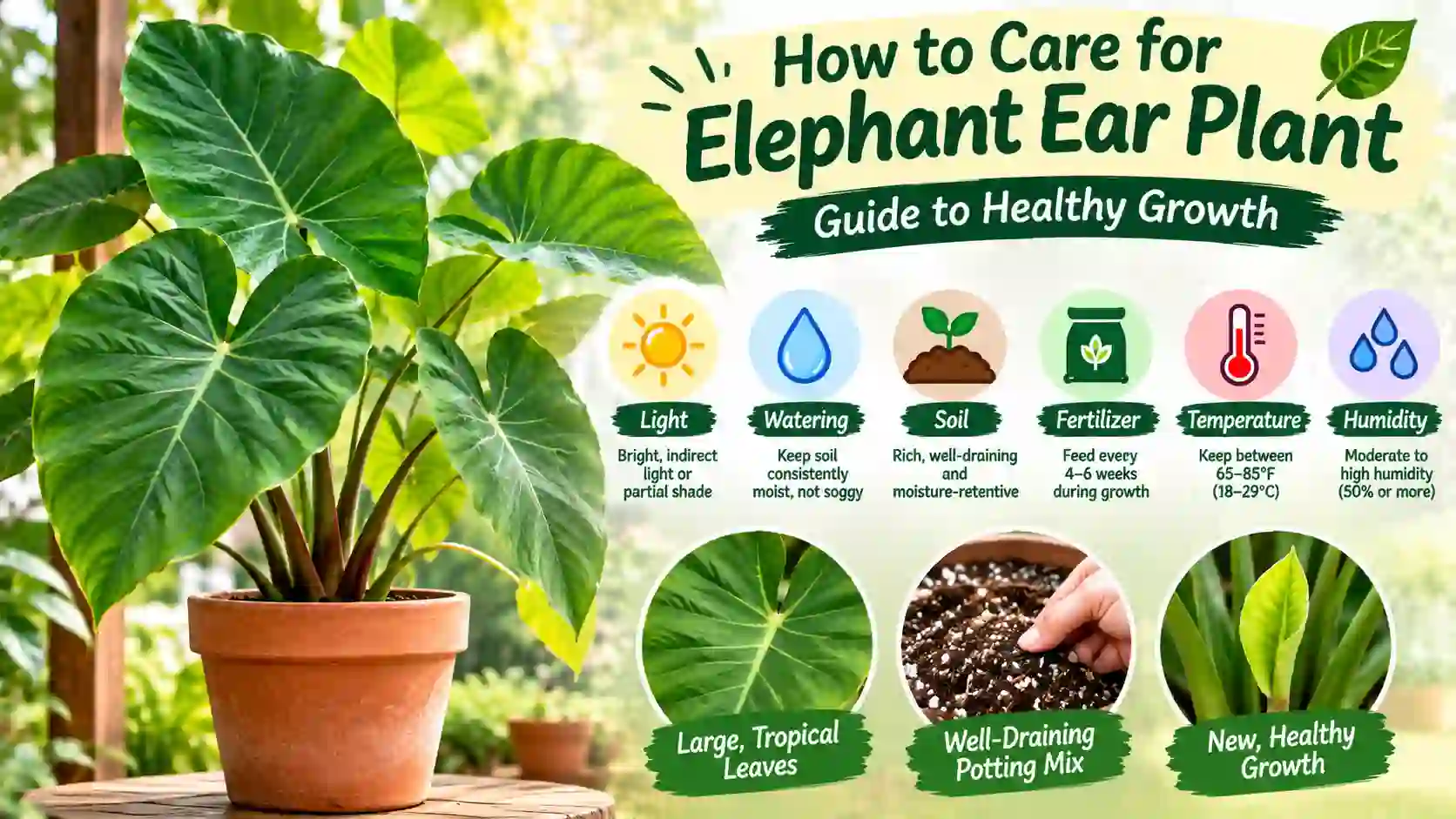
To care for an elephant ear plant, provide bright, indirect light or suitable partial sun, consistently moist but well-drained soil, warm temperatures, and regular feeding during active growth. Water when the soil surface begins to dry, but never leave the roots sitting in stagnant water. Choose a pot with drainage holes, maintain adequate humidity indoors, and protect the plant from cold. Because elephant ears include several species, adjust sunlight, watering, and winter care to suit your particular variety.
1. Understand Your Elephant Ear Plant


7
Before changing your care routine, identify which type of elephant ear you have. The name covers several tropical plants with different growth habits and preferences.
| Type | Typical appearance | General care preference |
|---|---|---|
| Alocasia | Often upright leaves with prominent veins | Bright filtered light, warmth, and carefully managed moisture |
| Colocasia | Often broad leaves that angle downward | Consistent moisture and more tolerance for sun, depending on variety |
| Xanthosoma | Large arrow-shaped leaves, often with distinctive lobes | Warm conditions, fertile soil, and regular moisture |
These are general tendencies, not strict rules. Cultivar, climate, and growing conditions can change a plant’s needs.
Practical tip: Check the nursery label before following a care schedule. If the variety is unknown, observe how its leaves respond to the light and how quickly its potting mix dries.
2. Provide the Right Amount of Sunlight

Light determines how well elephant ears produce large, healthy leaves. Too little light can lead to slow growth and smaller foliage. Too much intense sun may scorch leaves, particularly on plants grown indoors or moved outdoors suddenly.
Best light for indoor elephant ears
Place most indoor elephant ears near a bright window where the light is filtered by a sheer curtain or arrives indirectly.
- East-facing window: Often provides gentle morning light.
- South- or west-facing window: Can work when the plant is set back from harsh direct sun or protected with a sheer curtain.
- Dim room: Usually unsuitable for sustained, vigorous growth without supplemental grow lighting.
Rotate the pot occasionally so the plant grows more evenly instead of leaning toward the window.
Can elephant ear plants grow in full sun?
Some Colocasia varieties grow well in several hours of direct sun, especially outdoors when acclimated gradually and supplied with sufficient moisture. Many Alocasia varieties prefer filtered light or partial shade.
If your plant develops pale, dry, crispy patches on the side facing the sun, reduce direct exposure. If new leaves remain unusually small and stems stretch toward a window, consider increasing light gradually.
Common mistake: Moving a plant from a shaded room directly into intense outdoor sunshine. Introduce brighter conditions over several days to reduce leaf scorch.
3. Water Elephant Ear Plants Correctly

Elephant ears generally need more water than drought-tolerant houseplants because their large leaves lose moisture through transpiration. However, frequent watering does not mean the roots should remain waterlogged.
How often should you water an elephant ear plant?
There is no reliable universal schedule. Watering frequency depends on temperature, light, humidity, pot size, soil composition, and whether the plant is actively growing.
Use this simple method:
- Check the top inch or two of potting mix.
- Feel slightly deeper if the surface is dry but the pot still feels heavy.
- Water thoroughly when the mix has begun to dry at the surface and the plant’s conditions indicate it needs water.
- Allow excess water to drain through the bottom of the pot.
- Empty any saucer so the roots are not left standing in water.
In warm weather and bright light, the plant may need watering more often. In cooler conditions or during dormancy, it may need much less.
How to tell whether your plant needs water
| Observation | What it may mean | What to do |
|---|---|---|
| Soil is dry near the surface and the pot feels light | The plant may need water | Water thoroughly and drain |
| Soil is wet and leaves are yellowing | Possible overwatering or poor drainage | Check the roots and drainage |
| Leaves droop while the soil is dry | Possible underwatering | Water and observe recovery |
| Leaves droop while the soil is soggy | Possible root stress | Pause watering and assess the roots |
Drooping alone does not identify the problem. Always check soil moisture before watering again.
Expert tip: Use the weight of the pot as an additional clue. A pot that feels much lighter than it did after watering often indicates that the mix has dried considerably.
4. Choose Well-Draining, Moisture-Retentive Soil

Elephant ears need soil that holds enough moisture for their roots while allowing excess water and air to move through it. Dense, compacted soil can suffocate roots and increase the risk of rot.
A useful indoor potting mix combines:
- Quality indoor potting mix for moisture retention.
- Perlite or pumice to improve aeration and drainage.
- Fine orchid bark or another suitable coarse component to help maintain structure.
For a simple starting point, combine roughly two parts potting mix with one part perlite and one part fine bark. Adjust the blend according to your climate, container, and how quickly the mix dries.
The aim is not to make the soil dry immediately. It should remain lightly moist for a reasonable period without becoming persistently saturated.
What kind of pot works best?
Choose a container with drainage holes. Plastic pots generally retain moisture longer than terracotta pots, which lose moisture through their porous sides.
- Choose a pot only modestly larger than the root ball.
- Avoid placing a small plant in an oversized container full of wet soil.
- Repot when roots crowd the container or water runs through unusually quickly because the mix has become compacted.
Do not place a layer of gravel at the bottom as a substitute for drainage. A suitable potting mix and unobstructed drainage holes are more useful.
5. Maintain Warm Temperatures and Suitable Humidity
Elephant ear plants are tropical or subtropical plants that generally grow best in warm conditions. Cold temperatures can slow growth, damage foliage, or cause dormancy depending on the species.
For many indoor varieties, ordinary comfortable room temperatures are suitable. Avoid cold drafts, sudden temperature changes, and prolonged exposure to chilly windows.
How much humidity do elephant ears need?
Many elephant ears appreciate moderate to high humidity, especially Alocasia varieties. Dry indoor air can contribute to brown leaf edges, particularly when combined with inconsistent watering or excessive heat.
To improve humidity:
- Group compatible plants together.
- Use a room humidifier when indoor air is consistently dry.
- Keep the plant away from heating vents and strong air-conditioning drafts.
- Monitor airflow so humid conditions do not become stagnant.
Occasional misting is not a dependable way to maintain humidity. It provides only a temporary effect and should not replace appropriate room conditions.
Important: If leaf edges turn brown, do not assume humidity is the only cause. Check watering, root health, fertilizer use, and exposure to direct sun as well.
6. Fertilize for Large, Healthy Leaves

Elephant ears use nutrients to produce their impressive foliage. During active growth, appropriate fertilizing can support larger leaves, stronger stems, and steady new growth.
However, adding more fertilizer does not automatically produce a bigger plant. Excess fertilizer can damage roots and cause brown leaf tips or edges.
Best fertilizer for elephant ear plants
Use a balanced, water-soluble fertilizer formulated for foliage plants. Follow the label’s dilution instructions, and consider a reduced concentration if the product is strong or the plant is sensitive.
A practical routine is:
- Begin feeding when new growth appears in spring or early summer.
- Fertilize during active growth according to the product label.
- Apply fertilizer to appropriately moist soil rather than a completely dry root ball.
- Reduce or stop feeding when growth slows substantially.
- Avoid fertilizing a plant with severely damaged roots until it begins recovering.
Plants grown in warm conditions with strong indirect light may continue growing for much of the year. Their feeding schedule should follow active growth rather than the calendar alone.
Common mistake: Fertilizing a struggling plant because its leaves are yellow. Yellowing can result from overwatering, poor light, or root damage. Correct the underlying problem before adding nutrients.
7. Prune Damaged Leaves Without Harming New Growth

Elephant ears do not usually require heavy pruning. Removing damaged or dying leaves keeps the plant tidy and allows you to monitor its condition.
When should you remove a leaf?
Remove a leaf when it is mostly yellow, badly damaged, diseased, or completely dead. A leaf with a small brown tip can often remain if most of its surface is healthy.
Use clean, sharp pruning shears and cut the leaf stalk close to its base without damaging the crown or nearby emerging leaves.
Keep these points in mind:
- Do not remove every yellowing leaf immediately if several are developing at once. Investigate the cause first.
- Avoid cutting healthy leaves simply because they are older.
- Clean your tools between plants if disease is suspected.
- Wear gloves when pruning because elephant ear sap can irritate skin.
An older leaf occasionally yellowing as a new leaf emerges may be part of normal growth. Several leaves yellowing together, however, can indicate a care problem.
8. Encourage Bigger Leaves and Stronger Growth
Elephant ears naturally produce large foliage, but their size depends on the species, cultivar, maturity, and growing conditions. Good care helps the plant reach its natural potential.
For stronger growth, focus on the conditions that influence leaf production rather than using a single growth trick.
Give the plant enough light
Insufficient light limits the energy available for new growth. Provide the brightest suitable location for your variety without exposing shade-adapted leaves to sudden, intense sunlight.
Keep moisture consistent
Allowing the soil to become extremely dry repeatedly can interrupt growth. Keeping it constantly saturated can damage roots. Aim for steady moisture with good drainage.
Avoid excessive root disturbance
Repot when necessary, but do not repeatedly disturb the root system in an attempt to stimulate growth. After repotting, give the plant time to establish itself.
Allow enough space
Large elephant ear varieties may outgrow a small room or patio quickly. Choose a location where mature leaves can spread without being crushed against walls or furniture.
Expert insight: A healthy plant does not need every leaf to be enormous. Consistent new growth, firm stems, and healthy roots are better indicators of success than comparing your plant with photographs of mature outdoor specimens.
9. Repot an Elephant Ear Plant When Necessary

Repotting gives crowded roots more room and replaces potting mix that has broken down. Most plants do not need repotting every year; the condition of the roots and soil matters more than a fixed schedule.
Signs your elephant ear needs repotting
- Roots are growing through the drainage holes.
- The root ball is tightly packed.
- Water runs through the pot unusually quickly because the mix has deteriorated.
- Growth slows despite suitable light, temperature, and watering.
- The plant dries out much faster than it previously did.
How to repot safely
- Choose a container with drainage holes, usually one size larger than the current pot.
- Prepare a fresh, airy potting mix.
- Slide the plant out carefully, supporting the root ball.
- Inspect the roots and trim only those that are clearly dead or rotten with clean tools.
- Position the plant at approximately its previous soil depth.
- Fill around the roots without compacting the mix too firmly.
- Water as appropriate for the plant’s condition, then allow excess water to drain.
Do not bury the crown deeply. Keep the base of the plant positioned as it was before repotting unless the plant’s particular growth habit requires otherwise.
A little temporary drooping may occur after repotting. If the plant continues deteriorating, check for root damage, excessive moisture, or a major change in light.
10. Grow Elephant Ear Plants Indoors or Outdoors
Elephant ears can grow successfully in containers indoors, on sheltered patios, or in suitable garden beds. The best option depends on your climate, available space, and plant variety.
| Growing environment | Main advantage | Main challenge |
|---|---|---|
| Indoors | Better protection from cold and extreme weather | Lower light and dry air |
| Outdoor containers | Easy to move and control soil conditions | Containers can dry quickly in hot weather |
| Garden beds | Room for large foliage and mature growth | Weather, drainage, and seasonal temperature changes |
Caring for elephant ears outdoors
Choose a site with light appropriate to your variety. Amend heavy soil if needed to improve drainage, and water more frequently when heat and wind increase moisture loss.
Large leaves can tear in strong winds. A sheltered position can preserve the foliage and reduce stress.
In hot climates, check container plants regularly because a small pot may dry much faster than garden soil. However, do not water automatically just because the weather is hot; inspect the root zone first.
Can elephant ears grow indoors year-round?
Yes, many varieties can grow indoors year-round when light, warmth, moisture, and humidity are suitable. Growth may slow during darker or cooler months, even in a heated home.
If your plant receives little natural light, a suitable grow light may help maintain healthier growth.
11. Understand Dormancy and Winter Care

Winter care depends heavily on the type of elephant ear and your local climate. Some plants continue growing indoors, while others slow down or lose foliage as conditions become cooler.
If you grow elephant ears in pots
- Move outdoor containers indoors before temperatures become damaging.
- Inspect the plant for pests before bringing it inside.
- Provide suitable light and avoid cold drafts.
- Reduce watering if growth slows, but do not assume every variety must dry out completely.
- Stop or reduce fertilizer when active growth declines.
If your elephant ear grows in the ground
Some species can survive seasonal dormancy through underground storage organs in suitable climates. In colder areas, these structures may need to be lifted and stored according to the variety’s requirements.
Do not assume every elephant ear can overwinter outdoors. Cold tolerance differs among species and cultivars, and wet, cold soil can increase the risk of rot.
Important: If the plant loses its leaves during cold weather, check whether the variety naturally enters dormancy before discarding it. If the underground structure remains firm and healthy, regrowth may be possible when suitable conditions return.
12. Troubleshoot Common Elephant Ear Plant Problems
Elephant ear leaves provide useful clues, but a single symptom can have several causes. Check the soil, roots, light, and recent changes before treating the plant.

| Problem | Possible causes | What to do |
|---|---|---|
| Yellow leaves | Overwatering, insufficient light, nutrient issues, or normal aging | Check soil moisture and drainage; assess light and feeding |
| Brown, crispy edges | Dry air, irregular watering, fertilizer buildup, or sun damage | Review humidity, watering consistency, fertilizer use, and light |
| Drooping leaves | Underwatering, root damage, heat stress, or cold exposure | Check the soil and roots before watering |
| Soft stems or a mushy base | Possible rot caused by persistently wet conditions | Inspect the roots and underground structure promptly |
| Small new leaves | Insufficient light, immature growth, root restriction, or inadequate nutrition | Improve growing conditions and check the root system |
| No new growth | Seasonal slowdown, dormancy, low light, cold, or root problems | Check the variety, season, temperature, and roots |
| Holes or damaged leaf surfaces | Chewing pests, physical damage, or wind | Inspect both sides of leaves and examine the growing area |
Why are my elephant ear leaves turning yellow?
First, check how wet the soil is. Yellowing combined with persistently wet soil suggests that overwatering or poor drainage may be involved.
If the soil is dry, the plant may need water. If only one older leaf yellows while the rest of the plant grows normally, natural leaf aging may be responsible.
Do not remove all yellow leaves without checking whether the problem is spreading.
Why is my elephant ear plant drooping?
A thirsty plant may droop because its leaves are losing water faster than the roots can replace it. Watering may help if the root ball is dry.
But drooping in wet soil is a different warning. Saturated soil can deprive roots of oxygen, preventing them from absorbing water effectively. Adding more water in that situation can worsen the problem.
Why are the leaves developing brown edges?
Brown edges can result from low humidity, irregular watering, excess fertilizer, or sun exposure. Review recent changes rather than assuming that misting or additional watering will solve everything.
If fertilizer buildup is suspected and the roots are healthy, flushing the potting mix with clean water may help remove excess soluble salts. Let the pot drain completely afterward.
13. Identify and Manage Common Pests

Indoor elephant ears can attract spider mites, thrips, mealybugs, and aphids. Pest activity may cause speckled leaves, distorted new growth, sticky residue, or fine webbing.
Check the undersides of leaves and the areas where leaf stalks meet the main stem. Small infestations are easier to control when caught early.
What to do if you find pests
- Isolate the affected plant from other houseplants.
- Inspect the entire plant, including leaf undersides and new growth.
- Remove visible pests where practical with a gentle stream of water or a damp cloth.
- Use an appropriate insecticidal soap or other labeled treatment if needed.
- Repeat inspections and treatment according to the product instructions.
Test sprays on a small area first, especially on delicate foliage, and avoid applying treatments in harsh direct sunlight unless the label permits it.
Do not treat every brown spot as a pest problem. Water stress, sun damage, and root issues can produce similar symptoms.
14. Common Elephant Ear Care Mistakes to Avoid
Even a vigorous plant can struggle when several small mistakes happen together.
Watering on a fixed schedule: Soil dries at different rates depending on the season, pot, and environment. Check moisture rather than watering simply because a certain number of days has passed.
Using a pot without drainage: Excess water needs a way to escape. Decorative pots without drainage should hold a nursery pot that can be removed for watering and draining.
Assuming every elephant ear likes full sun: Light preferences differ among species and cultivars. Identify the plant and acclimate it gradually when changing locations.
Fertilizing a sick plant: Fertilizer cannot repair rotten roots or correct poor drainage. Diagnose the problem first.
Ignoring cold exposure: Tropical foliage can deteriorate rapidly after exposure to unsuitable temperatures. Move vulnerable plants before cold weather arrives.
Mistaking dormancy for death: Some elephant ears lose foliage seasonally. Check the plant’s variety and underground structures before discarding it.
Using an oversized pot: Excess soil around a small root system may stay wet for too long. Increase pot size gradually as the plant grows.
15. Is the Elephant Ear Plant Toxic?
Yes. Many plants commonly called elephant ears contain insoluble calcium oxalate crystals that can irritate the mouth and digestive tract when chewed or swallowed. Sap may also irritate sensitive skin.
For safer handling:
- Keep the plant out of reach of children and pets.
- Wear gloves when pruning or dividing it.
- Wash your hands after handling plant material.
- Clean tools after cutting leaves or roots.
- Avoid allowing pets to chew the foliage.
If a child or pet chews the plant, seek advice from an appropriate poison-information service, medical professional, or veterinarian. Breathing difficulty, significant swelling, or severe symptoms require urgent medical attention.
Frequently Asked Questions
How often should I water an elephant ear plant?
Water when the top inch or two of soil begins to dry, adjusting for the plant’s variety, pot, temperature, and light. Water thoroughly and allow excess water to drain. Do not keep the roots continuously waterlogged.
Do elephant ear plants need direct sunlight?
Not all of them. Many Alocasia varieties prefer bright, filtered light or partial shade. Some Colocasia varieties tolerate several hours of direct sun when acclimated and adequately watered.
Why is my elephant ear plant dying?
Common causes include overwatering, poor drainage, underwatering, unsuitable light, cold damage, and pests. Check the soil and root condition first, then correct the most likely problem rather than changing every care condition at once.
Can elephant ear plants grow indoors?
Yes. Many varieties grow well indoors with bright light, warm temperatures, suitable humidity, and consistently moist but well-drained soil. Large varieties need enough room for their mature leaves.
Should I cut off yellow elephant ear leaves?
Remove leaves that are mostly yellow or dead, using clean shears. If several leaves yellow at once, investigate watering, drainage, light, and root health before pruning extensively.
Do elephant ear plants come back every year?
Some varieties regrow from underground storage organs in suitable climates, while others may need protection or indoor overwintering. Cold tolerance varies, so check the requirements of your particular species.
What is the best fertilizer for elephant ear plants?
A balanced, water-soluble fertilizer suitable for foliage plants is a practical choice during active growth. Follow its label and reduce feeding when growth slows. Too much fertilizer can damage roots and leaf edges.
Why are my elephant ear leaves curling?
Curling can be associated with underwatering, heat stress, low humidity, pests, or root problems. Check soil moisture, leaf undersides, and recent temperature or light changes to narrow down the cause.
How do I make my elephant ear plant grow bigger?
Provide suitable light, warm conditions, consistent moisture, well-drained soil, and appropriate fertilizer during active growth. Choose a variety suited to your available space because mature leaf size depends partly on genetics.
Can elephant ear plants survive winter outdoors?
Some varieties tolerate mild winters, but many are vulnerable to cold. Their survival depends on the species, local temperatures, soil drainage, and whether the underground structures are protected. Move or protect plants before damaging cold arrives.
Helpful Related Articles for Internal Linking
If you are building a plant-care blog, these related topics can help readers continue learning. Link to the relevant articles on your website where available.
- Alocasia Plant Care: Learn about light, humidity, watering, and common Alocasia problems.
- Philodendron Plant Care: Explore tropical foliage care for indoor growing.
- Pothos Plant Care: Understand watering, pruning, propagation, and indoor light.
- Snake Plant Care: Compare the needs of a drought-tolerant houseplant with moisture-loving tropical foliage.
- How to Fix Yellow Leaves on Houseplants: Learn how to investigate yellowing without guessing at the cause.
- How to Choose Well-Draining Potting Soil: Understand soil aeration, moisture retention, and drainage.
Conclusion
Successful elephant ear plant care comes down to balancing moisture, light, warmth, and drainage. Give your variety the right light, water according to soil conditions, use an airy potting mix, and fertilize during active growth.
When problems appear, look at the whole plant rather than treating a single symptom. Yellow leaves in soggy soil require a different response from drooping leaves in dry soil. Understanding that difference can prevent unnecessary watering, pruning, and fertilizer use.
With suitable conditions and regular observation, your elephant ear can produce healthy foliage and make a striking addition to your home or garden.