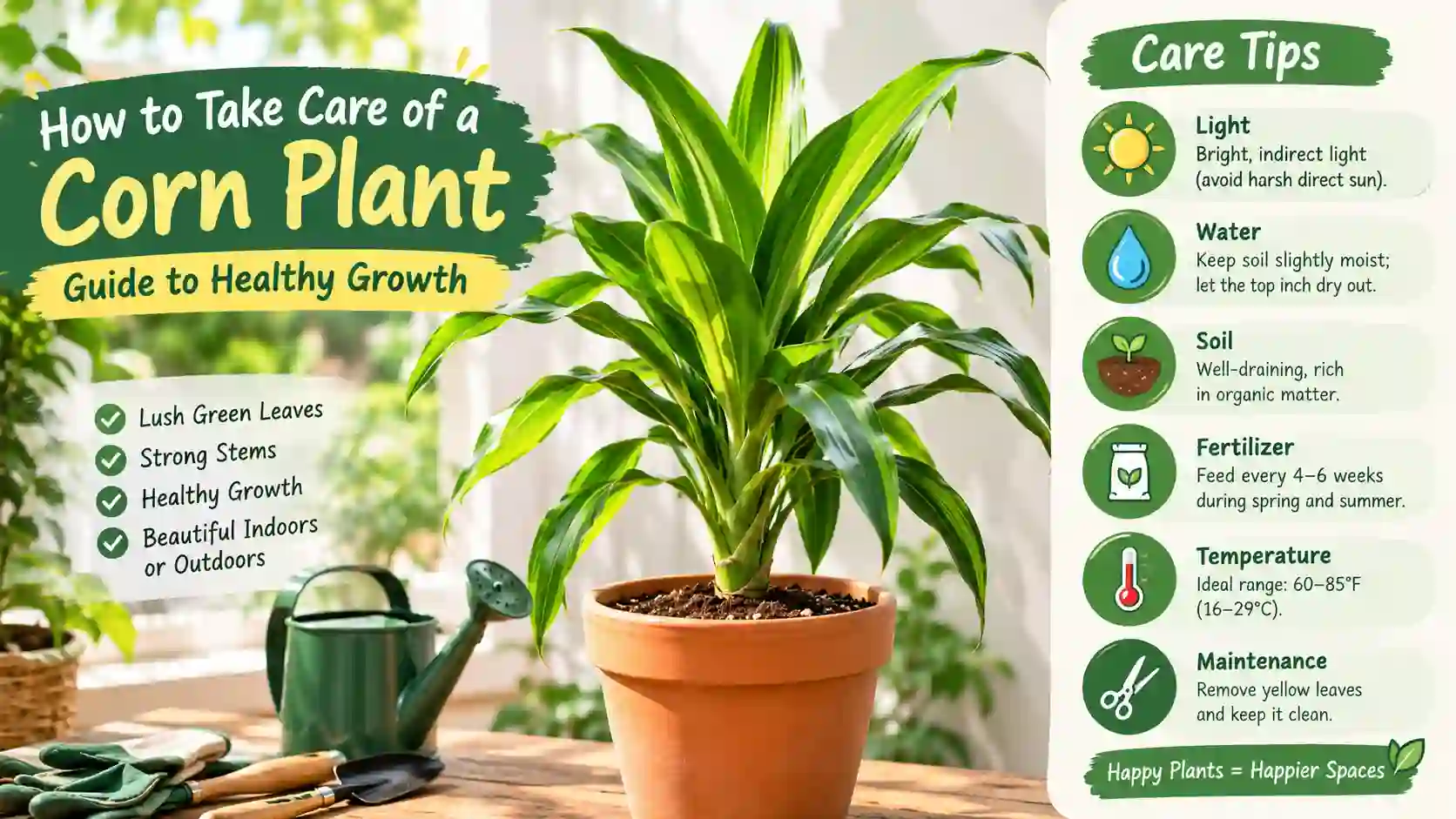
The corn plant is a popular tropical houseplant known for its upright cane-like stems, graceful green leaves, and attractive yellow or lime-green stripes on many varieties. Despite its tree-like appearance, it is relatively easy to maintain when its basic growing needs are met.
However, even a hardy corn plant can develop brown leaf tips, yellow leaves, drooping foliage, or slow growth when its environment is unsuitable.
Learning how to take care of a corn plant means understanding more than watering and sunlight. You also need to recognize how quickly the soil dries, how much light your particular variety receives, and whether the roots have enough room to grow.
This guide explains how to grow a healthy corn plant indoors, solve common care problems, encourage attractive foliage, and avoid mistakes that can damage this long-lived houseplant.
Quick Answer
To take care of a corn plant (Dracaena fragrans), place it in bright, indirect light, use well-draining potting soil, and water when the top 1–2 inches of soil feel dry. Keep it in a warm room with moderate humidity, and feed it lightly during active growth. Avoid overwatering, direct afternoon sunlight, and excessive fertilizer. Trim brown leaf tips when needed, clean the foliage regularly, and repot only when the roots outgrow the container.
1. Understand Your Corn Plant Before Choosing Its Care Routine
The corn plant, scientifically known as Dracaena fragrans, is a tropical evergreen native to Africa. It belongs to the Dracaena group and grows on sturdy, woody stems called canes.
Its long, arching leaves create a lush appearance without requiring frequent pruning. Some varieties have solid green foliage, while others feature striking yellow or lime-green stripes.


Popular corn plant varieties
| Variety | Appearance | Care consideration |
|---|---|---|
| Massangeana | Green leaves with a broad yellow central stripe | Needs sufficient light to maintain attractive variegation |
| Lemon Lime | Bright green and yellow-green striped foliage | Benefits from bright, indirect light |
| Janet Craig | Broad, dark green leaves | A useful choice for rooms with moderate indoor light |
| Victoria | Decorative striped foliage | Provide suitable indirect light to maintain leaf color |
Cultivar names and availability vary between nurseries. Confirm the plant’s label when purchasing because different Dracaena varieties can have slightly different growth habits.
Why identifying the plant matters
Corn plants are sometimes confused with actual corn seedlings because their leaves resemble corn foliage. However, Dracaena fragrans is an ornamental tropical houseplant, not an edible crop.
Its long-term success depends on indoor conditions rather than vegetable-garden care. It usually grows slowly, tolerates some lower-light conditions, and prefers its roots to receive oxygen between waterings.
2. Give Your Corn Plant the Right Amount of Light
Lighting is one of the most important factors in corn plant care. The plant can survive in moderate light, but better lighting usually supports healthier growth and stronger foliage color.

How much sunlight does a corn plant need?
A corn plant generally performs best in bright, indirect light. Place it near a bright window where daylight reaches the foliage without strong, prolonged direct sun.
Good locations include:
- Near an east-facing window with gentle morning light.
- A few feet from a bright south- or west-facing window, depending on its intensity.
- A well-lit room with filtered daylight.
- Under a suitable grow light if natural light is limited.
Corn plants can tolerate lower light, but growth may become slower and new leaves may lose some of their vibrant coloration.
Can a corn plant tolerate direct sunlight?
Mild morning sun may be tolerated, especially after gradual acclimation. However, harsh afternoon sunlight through glass can scorch the leaves.
Signs of excessive direct light include:
- Bleached or faded patches.
- Dry, crispy areas on exposed leaves.
- Brown patches concentrated on the window-facing side.
Move the plant slightly away from the window or filter the sunlight if these symptoms develop.
What if your corn plant is in a dark room?
If the plant sits far from a window, move it closer to natural light or provide a grow light. A room that looks bright to your eyes may still provide limited light for plants.
Practical tip: If new leaves become unusually small, growth slows significantly, or the plant leans toward a window, reassess its lighting before adding fertilizer.
Image suggestion: A corn plant in bright indirect light compared with a plant showing pale foliage from insufficient light.
3. Water Your Corn Plant Without Causing Root Rot
Watering mistakes are a common reason corn plants decline indoors. Their roots need moisture, but they also need air. Soil that remains wet for long periods can cause roots to deteriorate.
How often should you water a corn plant?
Water when the top 1–2 inches of soil feel dry. Check deeper if the pot is large or the soil remains moist below the surface.
The exact interval depends on light, room temperature, pot size, soil composition, and season.
| Growing condition | Watering approach |
|---|---|
| Bright room during active growth | Check soil regularly and water when the surface layer dries |
| Low-light room | Water less frequently because the soil dries more slowly |
| Hot weather | Check more often, especially in small pots |
| Cool winter conditions | Reduce watering frequency if growth and evaporation slow |
| Large pot with dense soil | Check deeper to avoid watering while the root zone remains wet |
A weekly check can be useful, but a rigid weekly watering schedule is not reliable for every plant. University extension guidance specifically warns that corn plants are sensitive to overwatering.
The correct way to water a corn plant

Step 1: Check the soil
Push your finger into the top 1–2 inches. If the soil still feels damp, wait and check again later.

Step 2: Water evenly
Pour water slowly over the soil surface until excess water flows from the drainage holes.

Step 3: Let excess water drain
Empty the saucer or decorative outer pot. Do not leave the roots sitting in standing water.
Should you use tap water or filtered water?
Some corn plants develop brown leaf tips when exposed to accumulated minerals, salts, or fluoride in irrigation water. Their sensitivity varies with the water supply and growing conditions.
If brown tips persist despite appropriate watering:
- Try rainwater or low-mineral filtered water when practical.
- Avoid excessive fertilizer, which can increase salt buildup.
- Flush the potting mix periodically with suitable water if drainage is good.
- Make sure excess water can escape freely.
Letting tap water stand may help chlorine dissipate, but it does not reliably remove dissolved minerals or fluoride. If those are the problem, use a more suitable water source.
Expert tip: Always diagnose the soil before watering a drooping plant. Drooping leaves can indicate underwatering, but root damage from soggy soil can produce a similar appearance.
4. Choose the Best Soil and Pot for Healthy Roots
A corn plant needs a potting mix that retains some moisture without remaining saturated. Dense, compacted soil can make watering difficult and increase the risk of root problems.
What soil is best for a corn plant?
Use a quality indoor potting mix that drains well. A mix formulated for tropical foliage plants is a good starting point.
Look for a medium that:
- Holds enough moisture for the roots.
- Allows air to circulate around the root system.
- Drains excess water efficiently.
- Does not compact quickly after repeated watering.
If your existing potting mix stays wet for many days, consider improving its structure with an appropriate aeration material, such as perlite, or repotting into a better-draining mix.
Avoid planting directly into heavy garden soil in an indoor container.
How to choose the right pot

Choose a container with drainage holes. When repotting, select a pot only slightly larger than the existing root ball rather than moving a small plant into an oversized container.
A pot that is much too large can hold excess moisture around the roots for longer than the plant can use it.
Decorative outer pots are fine if you can remove the nursery pot to drain it completely after watering.
When should you repot a corn plant?
Repot when:
- Roots emerge from the drainage holes.
- The root ball becomes densely packed.
- Water passes through unusually quickly because little soil remains.
- Growth and watering patterns suggest the plant has outgrown its container.
- The potting mix has broken down and stays wet too long.
Repotting is often best in spring or early summer when the plant can resume active growth. A corn plant does not need a larger pot every year if its roots still have adequate room.
Image suggestion: A step-by-step diagram showing root inspection, fresh potting mix, a correctly sized pot, and drainage holes.
5. Maintain the Right Temperature and Humidity
Corn plants come from tropical environments, so they prefer stable indoor temperatures and protection from sudden changes.
Ideal temperature for a corn plant
Normal comfortable indoor temperatures are generally suitable. Aim for approximately 65–80°F (18–27°C) and protect the plant from cold drafts and sudden temperature drops.
Avoid placing it directly beside:
- Air-conditioning vents.
- Frequently opened exterior doors.
- Cold windows during chilly weather.
- Heaters or radiators that produce intense, dry heat.
Temperature stress can contribute to leaf damage and slower growth.
Does a corn plant need high humidity?
Corn plants tolerate typical indoor humidity, although moderate humidity can help maintain attractive foliage.
If your room is particularly dry, consider using a humidifier or grouping plants together while maintaining airflow. Misting leaves is not a dependable way to increase room humidity for long periods.
In warm climates, indoor air-conditioning can dry the surrounding air even when outdoor humidity is high. Observe the leaves and adjust conditions if they repeatedly develop dry edges.
6. Fertilize Your Corn Plant for Steady Growth
Corn plants are not heavy feeders. They generally grow well with modest fertilizer applications during their active growing season.
Excess fertilizer can cause salt accumulation around the roots, which may contribute to brown tips, damaged roots, and poor growth.
When should you fertilize?
- Spring: Begin feeding when new growth appears.
- Summer: Continue light feeding if the plant is actively growing.
- Autumn: Reduce feeding as growth slows.
- Winter: Usually pause or reduce fertilizer when growth is minimal.
A balanced liquid fertilizer formulated for foliage houseplants is suitable when used according to its label. Some extension recommendations suggest monthly feeding during spring and summer, but the appropriate frequency depends on fertilizer strength and growing conditions.
How to fertilize safely
- Check whether the potting mix already contains fertilizer.
- Follow the product’s recommended dilution and frequency.
- Apply fertilizer to appropriately moist soil rather than a severely dry root ball.
- Reduce feeding if the plant is not actively growing.
- Stop fertilizing temporarily if you suspect salt buildup or fertilizer injury.
Do not fertilize a plant simply because its leaves are yellow. Yellowing can result from overwatering, poor drainage, low light, or natural aging.
Practical tip: If your corn plant grows slowly but looks healthy, it may not need more fertilizer. Slow growth is normal for many indoor Dracaena plants.
7. Prune and Shape Your Corn Plant
Pruning helps manage height, remove damaged foliage, and encourage new shoots from a cut cane. It is not necessary to prune a healthy corn plant frequently.


How to trim brown leaf tips
Brown tips do not always mean the entire leaf is unhealthy. If the remaining leaf tissue is green, you can trim away the brown portion.
- Use clean, sharp scissors.
- Follow the natural shape of the leaf.
- Leave a thin brown margin if needed to avoid cutting into healthy green tissue.
- Remove the entire leaf only when it is mostly yellow, dead, or badly damaged.
Trimming improves appearance, but it will not correct the underlying cause. Check water quality, watering habits, fertilizer use, and root health if the problem continues.
How to control a corn plant that grows too tall
If the cane becomes taller than your space allows, you can cut it back during active growth.
- Decide the height you want.
- Use clean, sharp pruning shears.
- Make a clean cut through the cane.
- Keep the plant in suitable light and water carefully while it recovers.
- Watch for new shoots developing below the cut.
The cut section may be suitable for propagation. New growth is not guaranteed at a precise location, so avoid cutting unless you are comfortable changing the plant’s shape.
Should you remove lower leaves?
Older leaves naturally yellow and die as the plant grows. Remove them once they are mostly yellow or dry, but avoid stripping away healthy foliage unnecessarily.
8. Propagate a Corn Plant to Grow New Plants
Propagation is a useful way to rejuvenate a tall plant or turn a single plant into several. Corn plants can be propagated from stem cuttings, cane sections, or suitable rooted shoots.
Method 1: Stem-tip cuttings

Step 1: Take a cutting
Cut a healthy leafy stem section using clean pruning shears. Include enough stem below the leaves for rooting.

Step 2: Encourage rooting
Place the lower stem in water or use a suitable, lightly moist propagation medium. Keep leaves above the water or medium.

Step 3: Establish the new plant
Keep the cutting warm in bright, indirect light. If rooting in water, transfer it to a well-draining potting mix once roots have developed sufficiently.
Method 2: Cane cuttings
Leafless cane sections can also develop roots and shoots under suitable warm, moist conditions. Each section must have viable tissue and be positioned correctly for its growth orientation.
This method takes patience, and results can vary with the cane’s condition and propagation environment.
Important: Keep propagation medium moist but not waterlogged. Rotting stem tissue is a common reason cuttings fail.
9. Diagnose Common Corn Plant Problems
When a corn plant begins to decline, examine the whole plant rather than treating individual symptoms in isolation. Several different problems can produce similar-looking leaves.

Brown leaf tips
Possible causes: Mineral or fluoride sensitivity, excess fertilizer, inconsistent watering, or dry conditions.
What to do: Check water quality, reduce unnecessary fertilizer, inspect soil moisture, and trim damaged tips. If the problem persists, inspect the roots and potting mix.

Yellow leaves
Possible causes: Natural aging of lower leaves, overwatering, insufficient light, or temperature stress.
What to do: If only an occasional older leaf yellows, monitor the plant. If several leaves turn yellow rapidly, check soil moisture, drainage, and light.

Drooping leaves
Possible causes: Dry soil, saturated soil, root damage, or environmental stress.
What to do: Check soil moisture before watering. Water if the root zone is dry; if it is wet and the plant continues drooping, inspect drainage and roots.

Slow growth or pale new leaves
Possible causes: Low light, seasonal slowdown, depleted potting mix, or root problems.
What to do: Improve indirect light first. Check whether the plant is actively growing before adjusting fertilizer.

Soft cane or root rot
Possible causes: Prolonged waterlogging and deteriorating roots.
What to do: Remove the plant from standing water and examine the roots. Trim clearly rotten tissue with clean tools and repot any salvageable healthy sections in fresh, well-draining mix.
A useful way to diagnose leaf damage
Use the location and texture of the damage as clues.
- Crispy, dry edges: Consider water quality, dry soil, or fertilizer salts.
- Soft, yellow leaves with wet soil: Investigate overwatering and root health.
- Yellowing limited to the oldest leaves: Natural aging may be responsible.
- Pale growth and long gaps between leaves: Assess light levels.
- Sudden damage after moving the plant: Consider temperature changes or excessive direct sunlight.
These are clues rather than definitive diagnoses. Check more than one factor before making major changes.
10. Identify and Control Corn Plant Pests
Corn plants are generally resilient, but indoor conditions can allow certain pests to multiply. Inspect the undersides of leaves, leaf joints, and cane surfaces when you water or clean the plant.


Common pests and how to manage them
| Pest | Signs | Recommended action |
|---|---|---|
| Mealybugs | White, cottony clusters around leaf joints | Remove small infestations with a damp cloth or cotton swab |
| Scale insects | Small, firm brown or tan bumps on stems and leaves | Remove accessible insects and monitor for new ones |
| Spider mites | Fine webbing, pale stippling, or bronzed leaves | Rinse foliage where practical and inspect surrounding plants |
| Thrips | Silvery or streaked leaf damage and tiny insects | Isolate the plant and use a treatment labeled for indoor ornamentals if needed |
For persistent infestations, use an appropriate insecticidal soap or other labeled product according to its instructions. Test treatments on a small area first, and keep treated plants away from pets and children as directed.
Avoid applying oils or soaps in direct sunlight or under conditions that may damage foliage.
How to prevent pests
- Inspect new plants before bringing them home.
- Isolate plants with suspected infestations.
- Clean dust from leaves regularly.
- Avoid excessive fertilizer that encourages weak, lush growth.
- Check nearby houseplants because pests can spread between them.
11. Adjust Corn Plant Care for Different Seasons
Corn plants grow indoors throughout the year, but their needs change as light, temperature, and growth rates change.
Spring
New growth often resumes as daylight increases. Check whether the plant needs repotting, resume suitable feeding, and remove damaged leaves.

Summer
Monitor soil moisture more frequently during warm weather. Protect foliage from harsh direct sun and avoid letting containers overheat.

Autumn
Reduce fertilizer as growth slows. Check whether changing sunlight patterns leave the plant in a darker location.

Winter
Water less often when the soil dries slowly, maintain suitable indoor temperatures, and protect the plant from cold drafts.
The key is to adjust care based on the plant’s actual conditions rather than following the calendar alone. A warm, bright room may support more growth than a cool, dim room during the same season.
12. Keep Your Corn Plant Safe Around Pets
An important part of responsible corn plant care is choosing a safe location in your home.
The corn plant is considered toxic to cats and dogs if eaten. It contains saponins that can cause vomiting, drooling, reduced appetite, and other symptoms. Cats may also develop dilated pupils.
To reduce the risk:
- Place the plant somewhere pets cannot chew its leaves.
- Collect fallen leaves and pruning debris promptly.
- Keep cuttings away from curious animals.
- Contact a veterinarian if your pet eats part of the plant and develops symptoms or if you are concerned about ingestion.
The plant is grown for decoration, not for food. Keep it away from children who might chew the foliage.
13. A Simple Corn Plant Care Schedule
Use this practical checklist to keep your plant healthy without overcomplicating its routine.
Your care checklist
0 of 7 checked
Check the topsoil before watering
As needed
Empty the saucer after watering
After each watering
Inspect leaves for pests or new damage
Weekly
Wipe dusty leaves with a damp cloth
Every few weeks or when dusty
Review light exposure and temperature
Monthly and after moving
Apply suitable houseplant fertilizer during active growth
According to product directions
Check roots and pot size
Periodically, especially when growth slows
Reset checklist
The most important routine is simple: check the soil, assess the light, and inspect the leaves before changing anything. This helps you catch problems early and avoid unnecessary watering or fertilizing.
Frequently Asked Questions About Corn Plant Care
1. How often should I water a corn plant indoors?
Water when the top 1–2 inches of soil feel dry, then allow excess water to drain. The interval depends on light, temperature, pot size, and soil drainage. Avoid watering automatically every few days.
2. Why are the tips of my corn plant turning brown?
Brown tips can result from fluoride or mineral buildup, excess fertilizer, inconsistent watering, or dry conditions. Check your water source and root-zone moisture before changing your routine.
3. Can a corn plant survive in low light?
Yes, corn plants can tolerate lower indoor light, but growth will usually be slower. Bright, indirect light is preferable for healthy foliage and attractive leaf coloration.
4. Should I mist my corn plant?
Misting is not necessary. It raises humidity only briefly and does not replace proper watering. If indoor air is very dry, a humidifier provides more consistent humidity.
5. How fast does a corn plant grow?
Corn plants are generally slow to moderate growers indoors. Growth depends on the variety, light, temperature, root health, and available nutrients. Do not assume slow growth means the plant needs more fertilizer.
6. Why are the lower leaves on my corn plant turning yellow?
Occasional yellowing of older lower leaves is normal as the plant grows. Rapid or widespread yellowing may indicate overwatering, poor drainage, insufficient light, or another environmental problem.
7. Can I cut the top off my corn plant?
Yes. You can prune the cane to control height, and new shoots may develop below the cut. Use clean tools and avoid removing more growth than necessary.
8. When should I repot my corn plant?
Repot when the roots become crowded, emerge from drainage holes, or the potting mix deteriorates. Choose a container slightly larger than the root ball with adequate drainage.
9. Is the corn plant toxic to cats and dogs?
Yes. Dracaena fragrans contains saponins and can cause illness if eaten by cats or dogs. Keep the plant and its cuttings out of reach.
10. Why is my corn plant drooping even though the soil is wet?
Wet soil and drooping foliage can indicate poor drainage or root damage. Check the drainage holes and inspect the roots if the plant continues to decline. Adding more water may worsen the problem.
11. Can I grow a corn plant outdoors?
It can grow outdoors in suitable warm, sheltered conditions, but it is sensitive to cold and freezing temperatures. In most regions, it is grown as an indoor ornamental plant.
12. How can I make my corn plant grow new leaves?
Provide suitable indirect light, maintain healthy roots, and water according to soil moisture. New leaves emerge from the growing tips, while pruning a cane may encourage additional shoots under suitable conditions.
Conclusion: Help Your Corn Plant Thrive With Consistent Care
Knowing how to take care of a corn plant comes down to providing the right environment and avoiding a few common mistakes. Give it bright, indirect light, use well-draining soil, and water only when the upper layer begins to dry.
Feed lightly during active growth, keep temperatures stable, and remove damaged leaves when needed. If brown tips, yellow leaves, or drooping foliage appear, investigate the cause instead of immediately adding water or fertilizer.
With regular observation and a simple care routine, your Dracaena fragrans can remain a beautiful feature in your home for years. Start by checking its light and soil moisture today, then adjust its care to match the conditions it actually experiences.